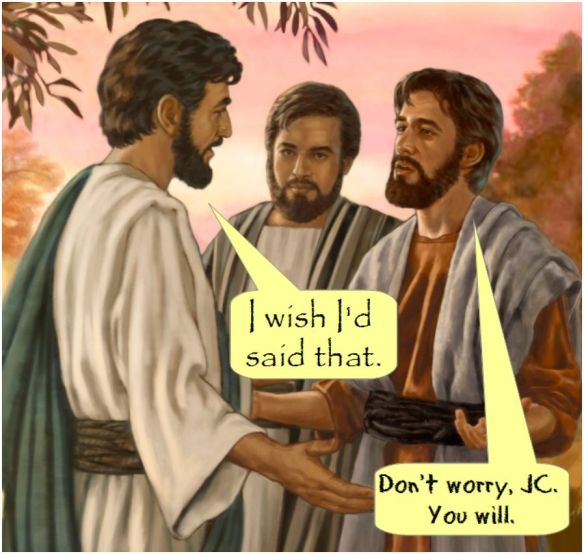
The Evolution of Jesus II: from Life Giving Spirit to God the Son and beyond.

A couple of decades after the first visions of a risen Jesus, a Jewish zealot called Saul decided he’d seen him too. He came to imagine a vision he’d had in his head was this same Jesus, who then revealed to Saul – all entirely within his head as he admits – what his death and return from the dead really meant. Paul, as he renamed himself, announced that God had decided Jesus was a good man and returned him to life after his execution. In doing so, God made Jesus his Son (you can read all this poppycock in Romans 1:3-4). Jesus was now a life-giving spirit, the Saviour Christ: 1 Corinthians 15:45. (Maybe though Jesus always had been this; it’s kind of confusing, but in Philippians 2:6-8 Paul seems to think Jesus was some sort of quasi-divine being from the get-go. Take your pick. Whatever.)

Memetic selection ensured the survival and perpetuation of Paul’s bizarre idea, one that was, after all, not unfamiliar to the Hellenised people of the first century. The superstitious embraced and transmitted it without knowing a thing about any itinerant Jewish preacher. 

The next stage of Jesus’ evolution came twenty or so years later, when a believer we now know as Mark decided to write a back story for this Christ. He created his story using Jewish scripture, Paul’s ideas and the rules of the sect to which he belonged. Who knows if Mark believed Jesus had ever been a real person who trudged around Palestine preaching the good news about the end of everything, but in Mark’s story he had him do just that. He decided, crucially, that he wouldn’t have Jesus become God’s adopted son at the time of his spiritual resurrection. Instead, Mark had him become God’s son at his baptism (Mark 1.10-11).

This wasn’t quite good enough for the next two cultists who attempted a Jesus narrative. While they plagiarised much of Mark’s story, they changed details and made up more for Jesus to say and do. Importantly, where Mark had avoided suggesting Jesus’ resurrection appearances had occurred in the real world, Matthew and Luke showed no such reticence. Their Jesus(es) showed himself not in visions but in the flesh. It’s likely Matthew at least knew he was creating a symbolic, literary representation of others’ visions.

At the other end of the story, Matthew and Luke invented largely incompatible birth stories for their hero. For Matthew, Jesus was the Messiah from the time he was born, fulfilling all the prophecies Matthew borrowed to create his nativity story (he doesn’t: the Messiah, according to the very ‘prophecies’ Matthew manipulates is not divine but a human warrior).

Luke, on the other hand, is determined to push Jesus’ divinity even back further. For Luke, Jesus became divine when God magically made Mary pregnant; Luke’s Jesus is quite literally God’s son (Luke 1.35). Unfortunately, Mary forgot all about being impregnated by the Holy Semen Spirit later on in Luke’s ridiculous story. Nevertheless, Jesus’ status had evolved again; he’d become God’s son from the very moment of conception.

Even this was not good enough for the next version of the Jesus’ story. The writers of the fourth gospel decide to make him eternal and part of God himself. Plundering Greek philosophy and Paul’s ruminations from Philippians, they declare Jesus the ‘Logos’; the Word or aspect of God responsible for the creation of everything (John 1:1-5). And despite this being as far from an itinerant peasant preacher as it’s possible to be, even more gullible folk came to believe it.

Jesus’ evolution was still not complete, however. The council of Nicaea in 325 decided that Jesus was ‘begotten not made’ (whatever that means) – but couldn’t quite decide whether being the Logos and the Son of God actually made Jesus God Incarnate. It wasn’t until the Council of Constantinople in 381 that a collection of bishops decided Jesus was, after all, officially part of the Godhead. The apocalyptic preacher from the backwoods finally became God the Son, a mere 350 years after he lived (if indeed he did).

Jesus has continued to evolve ever since, becoming all things to all people; a God pliable enough to be whatever his followers want him to be: Roman Catholic, Greek Orthodox, Russian Orthodox, Evangelical, Mormon, fringe cult. He’s evolved into a schizophrenic deity capable of being both meek and mild and bellicose; best buddy and chief executioner; Christian Nationalist, socialist and capitalist, gay and anti-gay, pro-family and anti-family; anti-abortion and pro-gun; environmentalist and iconoclast; the one who promotes a prosperity gospel and the ‘One True God’ known (only) to a select few. Every contradictory manifestation is supported by the Bible, the Church or tradition. Every one is non-existent and ultimately pointless.

That’s some evolution.

The Evolution of Jesus I: from Itinerant Preacher to Death-Defying Vision

Image by Doppler, from YouTube video The Evolution of Jesus Christ.


Everything evolves. Not just Life, but the Mind, Personality, Morality and Culture. This is the thesis of Matt Ridley’s book, The Evolution of Everything: How Small Changes Transform Our World, in which he demonstrates that everything, from the Economy and Technology to Government and Education, were originally, and to some extent remain, bottom up phenomenon. Each emerged because of the developments that had preceded them; for this reason, they couldn’t arrive before they did, but their arrival, when it came, was inevitable. The time was right. Once each did arrive, it embarked on an inexorable process of change. It evolved.

‘Everything’, of course, includes Religion. As Ridley says (p259):

Further evidence for the man-made nature of gods comes from their evolutionary history. It is a little-known fact, but gods evolve. There is a steady and gradual transformation through human history not only from polytheism to monotheism, but from gods who are touchy, foolish, randy and greedy people, who just happen to be immortal, to disembodied and virtuous spirits living in an entirely different realm and concerned mainly with virtue. Contrast the vengeful and irritable Jehovah of the Old Testament with the loving Christian God of today.’

This is undoubtedly the case (Ridley presents his evidence); religion is an entirely human enterprise that developed from the bottom up. It too evolved. As Ridley shows, there is no other way.

While Ridley doesn’t discuss it, this evolutionary process applies to Jesus too. This seems to me apparent, rather than a little-known fact. He didn’t spring from nowhere; the time was right for him. By the start of what is now the first century, an apocalyptic brand of Judaism had emerged, inspired in part by the book of Daniel and other late Old Testament prophecy. It was whipped to fever pitch during the Roman occupation. People were anticipating that the Messiah would soon rescue them by force; the time was right for him to appear. And appear he did, in multiple forms, all of them eliminated by the Romans. Jesus was one of these.

He began either as an itinerant preacher with delusions of grandeur or he was an imaginary being whom a few people thought miraculously appeared to them. It doesn’t matter which; even if he existed, he very quickly evolved into a supernatural being. As an itinerant preacher he would have wandered around a small part of Palestine with a handful of followers, mouthing platitudes and predicting that God’s Kingdom would soon be arriving, and that he would be its king. Instead, he was executed for insurgency. Shortly afterwards, a couple of his followers swore they’d seen him alive again. With this claim Jesus made an evolutionary leap, from troublesome Jewish preacher to death-defying vision.

His evolution was underway.

To be continued…

Only The One Book

Some years ago I visited friends where another of their guests told me he had been reading a remarkable book. It was he said, about Atlantis and demonstrated beyond any doubt that the ancient city had really existed and had sunk beneath the ocean where it still waited to be found. I asked him how he knew this (a polite way of asking what his evidence was.) He looked at me incredulously. ‘Because the book says so,’ he explained.

It’s the same with all the claims made about Jesus: that he was the Saviour, the Messiah and the Son of God. All such claims are found only in one book written by people who already believed such things about him.

Outside of this book there’s nothing: no Roman records of his death and subsequent resurrection; no reports of post-resurrection visits by witnesses who weren’t already invested; no contemporary, independent accounts of his remarkable miracles; nothing from historians of the day about his return from the dead and subsequent ascent into the sky; no mention of him at all in any documentation for the first 80+ years of Christianity outside of this one book. The Son of God appears on Earth and nobody but a handful of superstitious zealots notice.

Not very convincing, is it? 

How The Trick Was Done

Mark 15 tells the story of the trial, crucifixion and burial of Jesus. Here’s how it was constructed from parts of the Old Testament:

Isaiah 53:7 is rewritten in Mark 15: 60-62 as the trial before Pilate

He was oppressed and afflicted, yet He did not open His mouth. He was led like a lamb to the slaughter, and as a sheep before her shearers is silent, so He did not open His mouth.

So Pilate questioned him, “Are You the King of the Jews?” You have said so,” Jesus replied. And the chief priests began to accuse him of many things. Then Pilate questioned him again, “Have you no answer? Look how many charges they are bringing against you!” But to Pilate’s amazement, Jesus made no further reply.

(Oops! Looks like we are expected to overlook the fact that Jesus does speak! Mark obviously had trouble shoe-horning this one in!)

——————————–

Isaiah 53.5 becomes Mark 15:15:

He was crushed for our iniquities; the punishment that brought us peace was upon him, and by his stripes we are healed.

Pilate had Jesus flogged and handed him over to be crucified.

——————————–

Isaiah 50:6 and 53:16-20 are rewritten as Mark 15:16-20:

He was despised and rejected by mankind, a man of suffering, and familiar with pain. Like one from whom people hide their faces he was despised, and we held him in low esteem.

Then the soldiers led Jesus away into the palace (that is, the Praetorium) and called the whole company together. They dressed him in a purple robe, twisted together a crown of thorns, and set it on his head. And they began to salute Him: “Hail, King of the Jews!” They kept striking his head with a staff and spitting on him. And they knelt down and bowed before him. After they had mocked him, they removed the purple robe and put his own clothes back on Him. Then they led Him out to crucify Him.

——————————–

Psalm 22:18 becomes Mark 15:24

They divide my clothes among them and cast lots for my garment.

And they crucified him. Dividing up his clothes, they cast lots to see what each would get.

——————————–

Isaiah 53:12 is used for Mark 15:27:

He poured out his life unto death, and was numbered with the transgressors.

Along with Jesus, they crucified two robbers, one on His right and one on His left.

——————————–


Psalm 22:7-8 becomes, verbatim in places, Mark 15:29:

All who see me mock me; they hurl insults shaking their heads: He trusts in the Lord; let the Lord rescue him. Let him deliver him, since he delights in him.

Those who passed by hurled insults at him, shaking their heads and saying, “So! You who are going to destroy the temple and build it in three days, come down from the cross and save yourself!”

——————————–

Psalm 22:1 ‘My God, my God why have you forsaken me?is lifted straight into Mark 15:34.

——————————–

Isaiah 53:5 becomes the underpinning of the whole of this chapter and Mark 15:6-15 in particular: the story of Barabbas.

Surely he took up our pain and bore our suffering, yet we considered him  punished by God, stricken by him, and afflicted. But he was pierced for our transgressions, he was crushed for our iniquities; the punishment that brought us peace was on him, and by his stripes/wounds we are healed.

The verses are not alluded to directly, but Jesus is made to stand in for Barabbas (literally, ‘son of the father’) who has deservedly been sentenced to death, or so Mark would have us believe. The story is patently invented to make this point. No such tradition existed and Pilate would never have been so placatory. The other made up story in Mark 15, the tearing of the temple veil, symbolises that the old way of accessing God, though the temple system, had now been superseded by… who else? Jesus. Ironic really when Mark plunders that old system’s scriptures for his purposes.

——————————–

Isaiah 53:9 is written up as Mark 15.43-46

He was assigned a grave with the wicked, and with the rich in his death,
though he had done no violence, nor was any deceit in his mouth.

Joseph of Arimathea, a prominent member of the Council, who was himself waiting for the kingdom of God, went boldly to Pilate and asked for Jesus’ body... Pilate gave the body to Joseph. So Joseph bought some linen cloth, took down the body, wrapped it in the linen, and placed it in a tomb cut out of rock.

——————————–

Mark 15: all of it constructed from the OT or just plain made up. You could, like gullible Christians, insist that Mark didn’t invent his story using fragments of scripture. You could say instead that these fragments were really prophecies of incidents that were to happen in the life of an itinerant preacher many years in the future. You could argue that the probably non-existent creator of the universe was all the time controlling events, dropping into ancient scriptures veiled references to tenuously connected incidents centuries later. But then you’d have to concede that not one of them is precise enough to name Jesus or indicate he’d die by crucifixion or would return from the dead after a day and a half.

Which seems to you more likely? That imprecise ‘prophecies’, which really weren’t prophecies in the first place, came true in Jesus’ life; or that Mark lifted scriptures which suited his purpose and crafted his Jesus story around them?

For me, it’s always a case of ‘seek ye first the human contrivance’, by far the most plausible and persuasive explanation of scenarios such as this.


Inventing Jesus

What do we know about the gospels?

  • The stories they tell aren’t history; none of the gospel writers cites their sources, none refers to other independent accounts of Jesus’ life.
  • None of the versions of the story are eyewitness accounts; none of the writers claims to be an eyewitness; the gospels are anonymous despite the names that were attributed to them in the second century.
  • The gospels were created decades after the events they purport to relate; there is no evidence of an oral tradition that preceded them, no guarantee such a tradition would, if it existed, be reliable.
  • None of the gospels are independent; all of them are based to one extent or another on ‘Mark’. There really is only one story with three, sometimes markedly different versions.
  • The gospels are frequently contradictory where the later writers altered or embellished Mark’s story. They are often geographically and historically incorrect, and include anachronisms.
  • Each writer presents a different Jesus, the fourth radically so; there is no way of knowing which, if any, is the most historically reliable.
  • It is unlikely the actual words of Jesus would have been preserved accurately for 40 years or more; the fact the different authors freely alter them whenever it suits their purpose tells us they did not.
  • None of the gospel writers could possibly have known exactly what was done and said in private, for example, when Jesus communed with Satan in the desert, when he was hauled off to be flogged; when he was interviewed by Pilate.
  • The authors evidently invented episodes and events; the wandering star; Herod’s massacre of Innocents; zombie ‘saints’ wandering around Jerusalem; angels at Jesus’ tomb; the resurrection itself.
  • The gospels are literary creationsstories – as their structure, editing, use of myth, tropes, symbolism, metaphor and aphorisms attest.

This is what we’re working with. So, just where did the details of Jesus’ life, as we have them in the gospels, come from? We know Matthew, Luke and John found them to differing extents in Mark’s story. Other details they invented or took from Paul. Matthew in particular followed Mark’s lead and drew even more heavily on the Jewish scriptures, the Old Testament (OT). Both Mark and Matthew rewrote sections of the OT to create most of their Jesus stories. Next time, we’ll take look at Mark 15, relating, for the very first time, Jesus’ trial, crucifixion and burial to see how it was done.

Don’s Dynamic Lie-Detector

But you have an anointing from the Holy One, and all of you know the truth. I do not write to you because you do not know the truth, but because you do know it and because no lie comes from the truth.

1 John 2:20-21 as quoted by Don Camp.

Our resident, regularly banned God-botherer, Don Camp, claims that he has a special way of reading and interpreting spiritual writing. No, he hasn’t got a pair of magic rocks, but an inner ‘anointing’ with what Don calls his ‘lie-detector’. (You might have a similar device yourself, known more commonly as a bull-shit detector. Its alarm may well have been a-ring-a-ding-dinging when you read Don’s comment.)

Anointing, if you’re interested, is the ancient Jewish custom of initiating a king or priest by daubing oil on their head. Don has no evidence that he has been inwardly ‘anointed’ by an unseen spirit that helps him understand scripture better than anyone else. There is no evidence, outside of subjective feelings and one tautological bible verse, that any religious believer has had this done to them. (Read 1 John 2.20-21 again, Don, and you’ll see that a tautology is what it is: ‘the truth is the truth is the truth,’ is really all it says.)

On the contrary, we find that different Christians interpret given scriptures in a variety of different ways (I’ll get to examples in a minute). They differ too on which bits of the Bible are relevant to them and their church or sect. They disregard or explain away verses that don’t suit their purposes.

Don does this himself. His anointing Spirit doesn’t lead him to interpret verses like Matthew 16:27-28; 24:27, 30-31 & 34, Romans 13, 11 & 12, 1 Peter 4:7, 1 John 2:18, Revelation 22.20 etc at face value. He cannot countenance the fact that Jesus, Paul, John and all those other early fanatics were wrong about when the end of the age would happen – they are all very clear they thought it was imminent – so he reinterprets what they say to mean something they clearly and unequivocally do not. Don’s interpretation has them meaning, despite what they say, that the end of the age and all that goes with it would be thousands of years in their future. Should you challenge him on this, Don tells you that how you see it is wrong because you don’t have the special anointing he has. As he puts it in his comment, you’re lacking the right ‘dynamic’ (ring-a-ding-ding!) and as a result, you are incapable of interpreting scripture in the right way (i.e. his way).

In fact, Don does not have a way of understanding scripture that he can call his own. Rather, he interprets it with preconceptions he’s acquired elsewhere; that it is God’s Word, that it is Truth, that the spiritual world it describes is real, that it relates an historical resurrection, and so on. He comes to it with these presuppositions that he has learnt from preachers, teachers, commentaries, devotional books and other Christian propaganda he’s been exposed to. He is completely unable to take a step back to look at what he’s reading objectively. He knows what it says before he reads it – ‘truth’ as far as the Bible is concerned, ‘lies’ when it’s the Book of Mormon – and imposes that meaning onto it. This ‘dynamic’ enables him too to smooth over all of the Bible inconsistencies and allows him to see it as one seamless garment when it evidentially is not. He’s not alone in doing this, of course. Most evangelical (‘anointed’) Christians do it. I know I did.

Now for those examples, and a challenge for Don:

1. A few days ago, Holy Spirit anointed, preacher Dillon Awes used his dynamic lie-detector to interpret the Bible’s declarations about homosexuality like this:

What does God say is the answer, is the solution, for the homosexual in 2022, here in the New Testament, here in the Book of Romans (1:26-27)

That they are worthy of death! These people should be put to death!

Every single homosexual in our country should be charged with the crime, the abomination of homosexuality, that they have. They should be convicted in a lawful trial. They should be sentenced with death. They should be lined up against the wall and shot in the back of the head! That’s what God teaches. That’s what the Bible says.

2. Similarly, over the weekend, Ken Ham interpreted Genesis 1 to mean that dinosaurs and humans lived at the same time. After all, he ‘reasoned’, Genesis says God created ‘everything’ in those first six days, so that must include dinosaurs as well as Adam and Eve.

3. Pastor Douglas Wilson who featured recently on Bruce Gerencser’s blog, interpreted the assertion in Ephesians 5:22-24 that wives should be submit to their husbands, even if it entails rape:

…We have forgotten the biblical concepts of true authority and submission, or more accurately, have rebelled against them… However we try, the sexual act cannot be made into an egalitarian pleasuring party. A man penetrates, conquers, colonizes, plants. A woman receives, surrenders, accepts. This is of course offensive to all egalitarians, and so our culture has rebelled against the concept of authority and submission in marriage.

My question to you, Don, is: do you interpret Romans 1:26-27, Genesis 1 and Ephesians 5:22-24 the same way as these other Holy Spirit directed interpreters of scripture? If not, why not, when it’s the same Holy Spirit that equips you with your dynamic lie-detector, that also leads them into all truth?

These is not a rhetorical question; we all want to know. But be warned, Don, our bullshit detectors are primed and ready.


How We Got The New Testament

Recycled pictures, new post.

Once upon a time, there was, possibly, a bloke called Yeshua Bar Yosef. Maybe there was, maybe there wasn’t, but either way, a couple of other blokes, one called Simon (or maybe Cephas or maybe Peter), came to believe that Yeshua had returned from the dead and had appeared to them, alive. This was probably all in their heads and what they saw was at most a blinding light, if they saw anything at all. This was certainly the case for a different bloke, Saul (or maybe Paul) who came along later. He wrote about his experiences and admitted they were all in his mind.

This Simon-Peter-Cephas and maybe one or two others convinced themselves that Yeshua was God’s special emissary and would save them from something, somehow or other. They told other people this and, being gullible, some of these other people believed that Simon-Peter-Cephas and his mates really had seen Yeshua alive again. They started to believe Yeshua would save them too. Saul-Paul, meanwhile, wrote letters to the people he’d persuaded to believe in his version of events – it was a bit different from what Simon-Peter-Cephas and co believed – and, writing in Greek, rendered Yeshua as Iesous (‘Jesus’ came much later when the ‘J’ was invented in the 16th century.) Paul thought Iesous was a celestial being he called ‘the Christ’. He taught that this Christ would soon be coming down to the Earth to set up God’s Kingdom here. Even though they were obviously a bit rubbish, Saul-Paul’s letters were copied multiple times by hand, which is when errors began to creep in. In some places, the letters were deliberately altered.

Other people wanted to get in on the act, so they wrote letters too, pretending they were Saul-Paul. Sometimes these letters said the exact opposite of what the real Saul-Paul wrote. His weren’t the only letters to be forged either. Fifty or more years after the entire scam had got underway, someone pretending to be Simon-Peter-Cephas sent letters as if they were from the man himself. Needless to say there were cultists daft enough to believe it. There were others who wrote letters too, people like James and John. James didn’t see eye-to-eye with Saul-Paul and contradicted many of the things he said.

About 40 years after Simon-Peter-Cephas thought he’d seen the dead-but-alive Yeshua-Iesous-Jesus, somebody in a different country decided to write a back story for the character. He didn’t know much about Yeshua-Iesous-Jesus, what he’d said and done and whatnot, but that didn’t deter him. He borrowed bits from Saul-Paul’s letters and Greek myths and set about it. He scoured the Jewish scriptures for anything that sounded like it might be a prediction of Yeshua-Iesous-Jesus and his supposed escape from death. He made up episodes for him based on these completely unrelated scraps of scripture. He forgot to sign his work, however, and it wasn’t until years later that someone else decided this author’s name should be ‘Mark’.

A couple of other anonymous dudes liked what ‘Mark’ had done when inventing his Yeshua-Iesous-Jesus story but thought they could make a better job of it themselves. The first of these, who would later be called Matthew, lifted most of Mark’s effort (which is how we know ‘Matthew’ wasn’t an eye-witness; an eye-witness wouldn’t plagiarise most of the story from someone who wasn’t) and then went overboard with the prediction/prophecy thing that Mark had started. He found even more spurious bits of scripture and made up a whole lot of new stories about Yeshua-Iesous-Jesus from them. Later still, ‘Luke’ wrote his version of the story, using Mark and Matthew’s accounts and inventing a few new episodes himself. This same person went on to write a fabricated history of the Yeshua-Iesous-Jesus cult, making up stories and speeches for caricatures of Simon-Peter-Cephas and Saul-Paul.

The fourth person to try his hands at writing a script for Yeshua-Iesous-Jesus decided to completely reimagine the character. Strictly speaking, this ‘gospel’ was produced not by a single person but by a collective of cult members. Their Jesus was nothing like the one in the other three gospels. He was more a super-hero, whose special power was boasting about himself. This is the Jesus that, 70 years on, the cult wanted to believe in. Eventually, the name John would be attached to this fantasy, though this isn’t the same John who wrote letters nor the one who created the hallucinatory nightmare that would become the final book of the Bible.

These various letters and stories circulated round the Roman Empire wherever members of the new cult met. Eventually, someone hit upon the idea of collecting them together as one volume. The first we hear of this is when a guy called  Marcion produced his own collection, round about AD140. Stupidly, he didn’t include the right ‘books’ and it wasn’t until AD367 that the collection we now know as the New Testament was first mentioned. This was ratified later that century by a group of men who had elevated themselves to positions of authority in the Church, as the cult was now calling itself. Despite claiming they had been guided by the Holy Spirit, these learned men endorsed the inclusion of several forgeries. Neither did they see fit to arrange the books in the order they’d been written, giving the impression that the accounts of Yeshua-Iesous-Jesus’ life existed before Simon-Peter-Cephas and Saul-Paul’s innervisions that had sparked the whole thing in the first place.

Jump forward a few hundred years and the New Testament, as it was now known, had come to be regarded, by some, as the infallible, inerrant and authoritative Word of God, which clearly it is not. These epithets stuck, however, and are still held to be accurate descriptors of the New Testament by people who have stopped thinking for themselves.

So there we have it: how we got the New Testament –

  • It wasn’t written by eye-witnesses.
  • Its accounts of Jesus’ life are largely fictional.
  • It owes much to fanatics who were prone to visions.
  • It is given to wild speculation, offered without a scrap of evidence.
  • It contradicts itself.
  • It includes many fakes and forgeries.
  • It was banged together by men who didn’t really know what they were doing.

And after that, everyone lived delusionally ever after. The End.

Fakin’ It

Here’s my dilemma. I got this letter from a group of students at the university of Selcuck in Turkey. Well, when I say I received the letter, it was addressed to Professor Paulson who was head of the Philosophy department here in the 90s. He’s been dead now over 20 years of course, so when I picked up the letter, I thought I’d just write back and tell them that and that they’d have to work out their problems for themselves. Then I thought, ‘well, hang on a minute, the Professor was your tutor back in the day. You know how he thought and how he’d address these particular problems. Hell, you’ve even got some of his old papers locked away in your filing cabinet. You could take one or other of those and with a bit of tweaking, concoct a reply yourself. That’d be perfectly legitimate wouldn’t it?’ I mean I occupy the chair he once did so I am in effect his replacement.

So that’s what I do. I take one of Professor Paulson’s papers and I use it as the basis of a letter. Of course, matters in philosophy have moved on a bit since the Professor’s time so I add quite a bit of my own stuff, which is all pretty good and in line with what he might have thought, had he lived this long. After all, I studied under him in the ’80s so I have a pretty good idea of what he might think today, if he were still with us. If I do say so myself, it’s pretty good stuff. Nobody could tell Paulson didn’t write it.

Now, I do consider admitting at the start of the letter, or maybe the end of it, that I wrote the letter and not the Prof. But then I think, well, these folk don’t know he’s no longer with us so what’s the harm? I’ll just send it and they can reach their own conclusions. I mean, it wouldn’t be my fault, would it, if they jumped to the wrong conclusion. And then I think, well, if they’re going to do that I might as well sign it as if it is from the Professor. I mean, who’s to know? And maybe I could add that bit at the beginning suggesting it was from him. Suggesting? Saying it is from him. That’s what I do, and off it goes.

I hear later, on the grapevine, it’s gone down pretty well. They like what it says and are convinced it’s from Paulson. Everybody’s happy.

And then I find out, a couple of months down the line, that it’s been published. The Selcuck students have had it published, in an influential journal no less, and the academic world is celebrating the final lost paper of Professor Paulson’s. And here’s my dilemma: it’s not, is it. It’s me. I’ve taken his old paper, embellished it and sent it out into the world as if it’s his. What do I do? What would you do? Confess it’s not what it seems? Or bask in the knowledge that what I’ve written is as good as anything he wrote in life? A fake, yes, for sure, but a damn good one that, with a bit of luck, no-one’s ever going to spot. Do you know, I think I’ll leave it, say nothing. The joke’s on them.

Of course such a thing could never happen. Or could it? The letter to the Ephesians in the New Testament claims to have been written by Paul. It starts with this greeting:

Paul, an apostle of Christ Jesus by the will of God, To God’s holy people in Ephesus, the faithful in Christ Jesus: Grace and peace to you from God our Father and the Lord Jesus Christ.

and ends with some vaguely autobiographical details.

But it wasn’t written by Paul. Scholars think it was created in the 80s, about twenty years after Paul died. Much of the letter is a reworking of Colossians, the authorship of which is similarly disputed. Here’s the opening of Colossians:

Paul, an apostle of Christ Jesus by the will of God, and Timothy our brother, To God’s holy people in Colossae, the faithful brothers and sisters in Christ: Grace and peace to you from God our Father.

The Ephesians opening is a direct lift. None of Paul’s genuine letters follow this format. The letter itself has a style and vocabulary unlike that in the genuine Pauline letters and there are significant differences in theology too. Here’s how Bart Ehrman summarises the problem (though note he is not the only scholar who disputes Paul’s authorship of Ephesians; it is the consensus view): 

Ephesians does not resemble Paul’s writing style and the letter contains an inordinate number of words that Paul does not use in any of his undisputed letters. As in Colossians, Ephesians suggests that the believer has already been raised with Christ-a view that contradicts Paul’s undisputed writings. The author of Ephesians, moreover, uses the term “works” differently than Paul. For Paul, “works” refers to adherence to the Jewish law, actions that cannot save. The author of Ephesians, however, understands “works” to mean those actions that demonstrate one’s faith.

Some generously describe Ephesians and other letters attributed to Paul that aren’t by him, as Deutero-Pauline: ‘in the tradition of Paul’. Some speculate that they were written by one of Paul’s disciples but there’s no way of knowing this for sure. Others prefer the term Pseudepigrapha, literally ‘false inscription or writing’, which is nearer the mark.

The author of Ephesians, like those of other pseudepigraphical letters, such as the pastorals (1 and 2 Timothy and Titus) claims explicitly to be Paul knowing full well he is not. This is not some disciple trying to express the views of the master, this is someone passing themselves off as someone else, pretending they are the more well-known, revered and authoritative figure. Even if they were someone familiar with Paul’s teaching (the differences in theology suggest otherwise) would it be legitimate for him to claim he is Paul?

Like my fictional individual above, the author of Ephesians is a deceitful impostor, his work a forgery, designed possibly to ‘correct’ Paul’s position on certain issues. And yet here is his letter in the New Testament; God’s Holy Word no less. While there is a very human history of how works were selected for inclusion in the New Testament, how on Earth did God, in the guise of the Holy Spirit, allow this and other forgeries to become part of the canon?

Of course, God had nothing to do with it. The author of Ephesians duped not only the letter’s original audience, but also the later believers who included it in the Bible. He continues to deceive the faithful down to this day.  I know: I was one. 

The Meaning Of Matthew’s Mistakes

So Matthew likes quite a lot of what he finds in Mark. Likes it so much he decides to lift over 90% of it into his own Jesus story. Of course he’ll tweak it a bit because, disappointingly, Mark hasn’t emphasised Jesus’ Jewishness enough. That definitely needs bumping up; it’s what his readers will expect. And Mark has missed a trick or two: he starts his story with Jesus’ baptism, when, as everyone knows, every godman needs a magical origin. Just look at Tammuz, Horus, Romulus and, according to some, the Jewish high priest Melchizedek. So Matthew sets about scouring the scriptures for a prophecy or fable, anything really, that hints that the Messiah would have a miraculous birth. And he comes across this in Isaiah (7.14):

Therefore, the Lord, of His own, shall give you a sign; behold, a virgin is with child, and she shall bear a son, and she shall call his name Immanuel.

It’s not really a prophecy about the Messiah as the context makes clear, but that’s okay. There’s enough of a hint that it could be about a future Messiah that it’ll do. So Matthew sets about creating a birth narrative for his godman based on this verse, yanked from its context. His godman is going to have a virgin birth too.

What Matthew doesn’t realise, however, is that he’s made a mistake. He’s picked up the verse in the Septuagint, a Greek translation of the scriptures. If he’d checked, or even been able to read the original Hebrew, he would have soon seen that the verse actually reads:

Therefore, the Lord, of His own, shall give you a sign; behold, the young woman is with child, and she shall bear a son, and she shall call his name Immanuel.

The Hebrew word for ‘young woman’ is alma and that is the word used in Isaiah 7.14. The word for virgin is betulah. It does not appear. The use of it in the Septuagint is a mistake, a mistake that Matthew is not aware of. So he misappropriates the mistranslated verse to create a miraculous birth for Jesus and the myth of his virgin birth is born.

But Matthew hasn’t finished scouring the scriptures for prophecies that appear to be about Jesus. This time he alights on Zechariah 9:9:

Rejoice greatly, Daughter Zion! Shout Daughter Jerusalem! See your king comes to you, righteous and victorious, lowly and riding on a donkey, on a colt, the foal of a donkey.

Incredibly, this time Matthew has stumbled upon a prophecy about the Jewish Messiah! According to Zechariah, the Messiah-King’s victorious entry into Jerusalem will follow the defeat of his enemies and the establishment of universal peace. Matthew likes the sound of this. If he can shoehorn an episode into his story where Jesus rides into Jerusalem on a donkey, this will show his readers that Jesus really is the long-awaited Messiah-King. Never mind that the Jesus version bears little resemblance to the scenario predicted by Zechariah: Jesus is not an anointed king, he has not recently defeated his enemies nor has he just established universal peace. The only thing the original prophecy and Matthew’s version have in common is that the two principle figures, Zechariah’s Messiah-King and Jesus, ride into Jerusalem on a donkey.

Oh, no, wait. That’s wrong. According to Matthew Jesus approaches on two donkeys; a mother and her colt. He’s made another mistake. He doesn’t know that the use of ‘donkey’ and ‘colt’ in the prophecy refers to the same animal. He thinks there has to be two: a larger one and a smaller one. He is not familiar with the practice of parallelism, common in Jewish writing to emphasise a point by repeating it  but using alternative terminology. There aren’t two animals on which Jesus sits lop-sidedly, there’s one: a donkey, otherwise known as a colt which, to state the bleedin’ obvious, is also the foal of a donkey. Matthew misses all of this and places Jesus precariously on two mismatched animals.

What does this tell us? That Matthew is not describing an actual event. He has, rather, created a story based on a prophecy, designed to illustrate to his readers that Jesus is the Messiah-King prophesied by Zechariah. There is nothing historical about this story; it is an actualisation-in-fiction of a prophecy. A prophecy,  which, incidentally, still has not been fulfilled.

So Matthew is caught out at least twice. There are more examples in his gospel of his forcing an episode from the scriptures into his Jesus fable: other aspects of his birth narrative are clearly based on elements of Moses’ story; Judas’ thirty pieces of silver are based on a story from Zechariah 11, which has no relevance at all to the use he makes of it. There is also evidence that Matthew invented prophecy that he could then show Jesus ‘fulfilling’ (Matthew 2.23, for example.)

What all of this demonstrates is not that Jesus was foreshadowed in the Jewish scriptures, (foreshadowing being a technique beloved of some authors who use it to hint at future events in their fiction) but rather that many aspects of the Jesus story are literary re-imaginings of ‘prophecies’ and often unrelated episodes from the scriptures.

And if some, why not all?

How Prophecy Works

Like many evangelicals and others afflicted by Christianity, Don Camp believes that the Old Testament is jam-packed with prophecies about Jesus; his origin, background, mission, teaching, sacrifice and resurrection. He quotes a couple in one of his recent comments, which we’ll get to soon, and thinks that the general direction of travel is from ancient prophecy to later fulfilment in Jesus. Don and those like him will not entertain the possibility that this is an illusion created by those who constructed the Jesus’ stories.

Here’s how the illusion was created: the gospel writers, and Paul too, looked back at the Old Testament (‘the scriptures’) and found there what Don describes as ‘indistinct’ references to events they believed had happened in their own time. From these and other sources, they built their stories about Jesus. More often than not, these scriptural references were not in themselves prophecies or predictions of Jesus’ life, death or resurrection. We know this by a) reading them in their original context, b) recognising that the Jewish scriptures as a whole never speak of a Messiah who must die an ignoble death for his people, and c) noting the number of times these ‘indistinct’ statements have to be altered by the gospel writers and others, to make them ‘fit’ their conception of their God-man.

Let’s start with one of Don’s picks, from Isaiah 53:11:

After he has suffered, he will see the light of life.

It has to be conceded that all of Isaiah 53 does indeed look like it’s a prophecy of Jesus’ suffering, death and resurrection. In context, however, the suffering servant it describes is Israel itself, as surrounding chapters make clear. Furthermore, on closer inspection, some of it doesn’t seem to apply to Jesus at all. Verses 2&3 really don’t describe a man followed around by multitudes and later worshipped by millions:

He grew up before him like a tender shoot, and like a root out of dry ground. He had no beauty or majesty to attract us to him, nothing in his appearance that we should desire him. He was despised and rejected by mankind, a man of suffering, and familiar with pain. Like one from whom people hide their faces he was despised, and we held him in low esteem.

Unsurprisingly, Don doesn’t quote these verses. Sure, it’s possible to make them fit; to say that these verses 2-3 describe Jesus on trial with the crowd baying for his blood; but it’s a stretch. We’ll come back to Isaiah 53 shortly.

Don then refers to ‘the prophecy about (Jesus) not seeing corruption as a dead body’. This is actually Psalm 16:10:

You (YHWH) will not abandon me to the realm of the dead, nor will you let your faithful one see decay.

And, my, yes it does seem to fit Jesus once again, if we believe he died and rose again before his body could deteriorate. But it isn’t about him. It’s about the writer of the psalm, traditionally David, expressing his belief that his God will preserve him. Plucked out of context, it can sound like it’s Jesus being described, just as any number of other verses can be said to be about future events when they’re not. For example, some Christians, including Pat Robertson, are currently claiming that Ezekiel 38:1-2 is a prophecy of Russia’s invasion of Ukraine:

Son of man, set your face against Gog, of the land of Magog, the prince of Rosh, Meshech, and Tubal, and prophesy against him.

That works, don’t you think?

No. Me, neither. Such nebulous statements can easily be applied to much later events on which they have no actual bearing.

Which brings us neatly to the gospels. These claim that the events they describe were foretold by the prophets of old (Luke 24:44). It would be truly remarkable if, as Don believes, all of the prophecies about Jesus in the scriptures were actually fulfilled by him. Some Christian sources claim there are as many as 300. But, as we’ve seen, some of these are so vague they can be made to apply when in fact they don’t.

And this is how the Jesus story came about; it is structured around many of these indistinct prophecies. The authors of the gospels, and Paul too, knew their scriptures and built up a story about the Messiah using them. Like Paul, Mark had little knowledge of the circumstances of his Messiah’s earthly life, so he set about creating a biography for him using ‘prophecies’, scenarios and statements from the scriptures. We might ask here why he should do this if Jesus was as remarkable as early cultists claimed. There is no need to invent stories about a remarkable figure if that figure has already lived an amazing life that is widely known about. Be that as it may, Mark and the other gospel writers set about creating an elaborate life for their hero, largely based on ancient scriptures.

Mark quotes Isaiah 53 directly in 15:38 and makes extensive use of the chapter in his account of Jesus’ passion. Let me stress: Isaiah 53 is not a prophecy of the passion, it is the blueprint for it. Mark’s account is Isaiah 53, down to Jesus’ silence at his trial and his being buried ‘with the rich’.

Matthew and Luke later embellished Mark’s efforts by doing more of the same thing, adding fresh episodes to Mark’s core gospel. Most of these embellishments  are based on ‘prophecies’ that Mark somehow missed. None of them necessarily happened – I’m persuaded they didn’t – but are ‘actualisations’ of parts of ancient scripture. We know this because of mistakes Matthew made in expanding the story, using the additional ‘prophecies’ he ‘discovered’ in scripture. We’ll get to these mistakes next time.