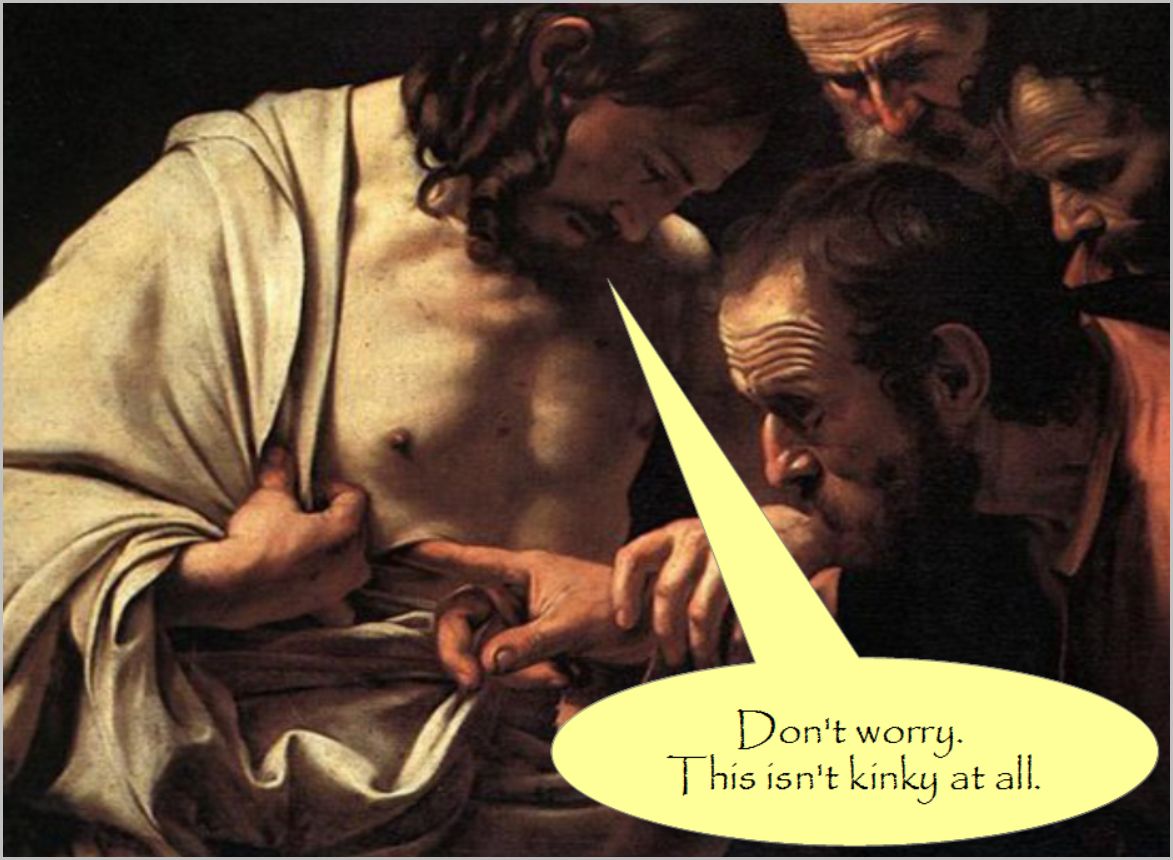
No True Christian

WeekendA favourite response of Christians to any criticism is, ‘it doesn’t apply to me. I’m not that sort of Christian. The people who do or believe or think those things are not true Christians.’ This the ‘no true-Scotsman‘ fallacy.

  • You get it when you point out how God’s People™ agitate in Africa and Europe to deprive LGBT people of rights, protection and safety (unless of course you’re talking to a Christian who thinks this is a loving thing to do.)
  • You get it when you challenge Christians about Westboro baptist church’s activities, (the latest of which is claiming that Ebola is God’s punishment for Obama, which must be why he’s smiting poverty-stricken Africans.)
  • You get it when you mention those Christians who believe mumbo-jumbo that’s slightly different from theirs.
  • You get it when you ask them about any of the other deplorable things Christians do in Jesus’ name.

‘These other people are not true Christians,’ they say. ‘Their theology isn’t the same as mine; they’re misinterpreting the Bible; I wouldn’t do those kind of things; you’re picking out extremists.’

And do you know, Christians, those very people you say are not true Christians would say the same about you.

So what defines a Christian? Isn’t it that you accept Jesus Christ as your Lord and Saviour, profess him as such, and avail yourself of the salvation you think he offers?

Indeed it is. And it’s precisely this that you have in common with the Westboro baptist church, with those who peddle the absurd, with those who seek to damage LGBT people, with those who use their positions to abuse others and those with different ideas about what being a Christian is really all about.

You and they have bought into the same fantasy: they, like you, have accepted Jesus; they, like you, have his Holy Spirit in their hearts. That they do things you don’t approve of, or regard as embarrassing or despicable, doesn’t alter that fact. You’re all in it together; they represent Jesus just as much as you do; are as much a part of the ‘bride of Christ’ as you are. The zealots, extremists and wackos are your brothers and sisters in Christ, and if you’re right about Jesus being your Saviour – which of course you’re not; I’m being generous here – you’re going to be spending all of eternity with them.

So time to knock the ‘no true Christian’ excuse on the head – it’s going to be so embarrassing for you when you get to heaven.
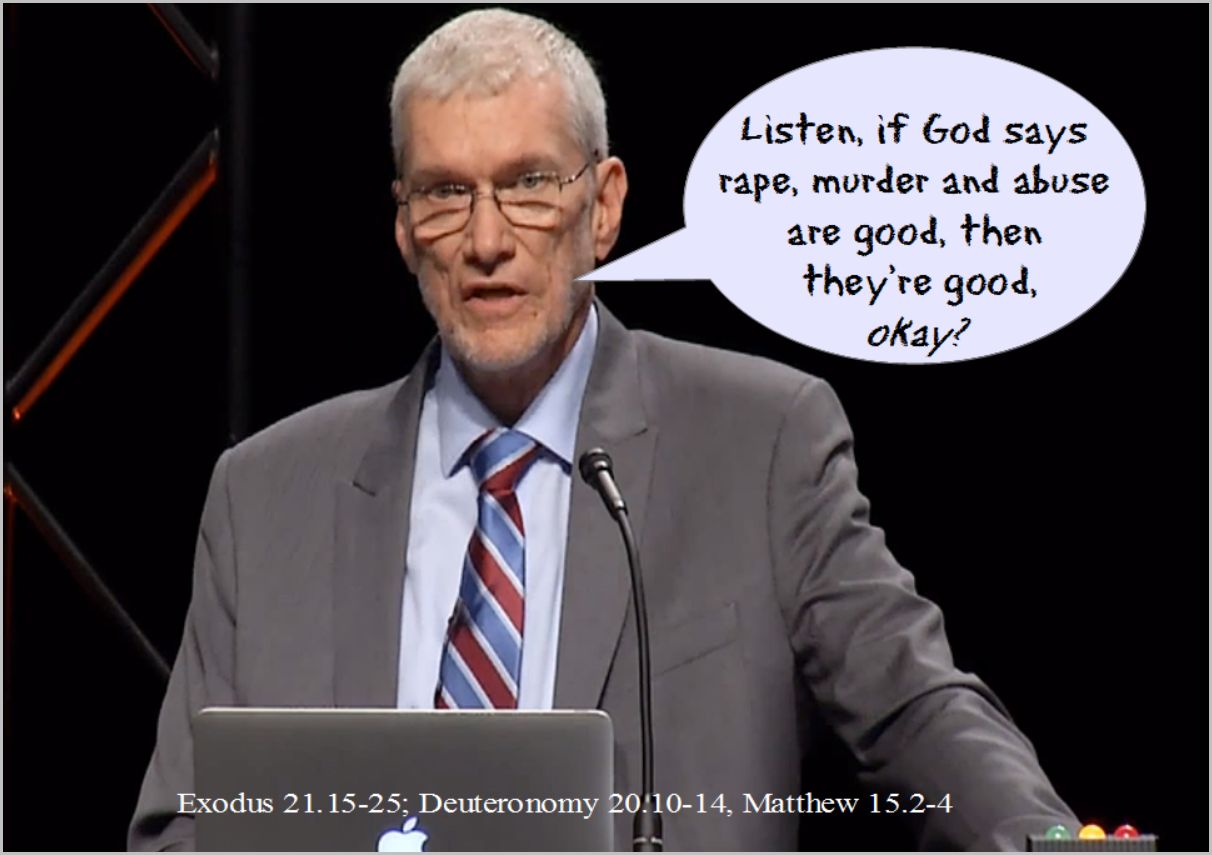
Good For Nothing

HamWhere does morality come from? Ken Ham of Answers In Genesis says it can only come from (his) God. Atheists have no grounds for morality, he claims, because, without a God to tell them, they’ve no way of knowing the difference between right and wrong .

As usual, Ham is being creative with the truth. Clearly atheists are as capable of being moral as anyone else. Equally and also evidently, Christians and other brands of believers are capable of deplorable immorality. Hardly a week goes by without more reports of Christians abusing, cheating, lying and killing in Jesus’ name.

Why do Christians act so despicably when, supposedly, they have God’s Spirit inside them – that’s the God from whom all morality flows, according to Ken Ham. Why doesn’t his indwelling Spirit guide Christians so that they always behave morally, or even just considerately?

I don’t have the answer. Perhaps Ken Ham or some other knowledgeable Christian can tell us.

No, morality doesn’t derive from any god. It has evolved, inevitably and like much of our behaviour, from our being social animals. Living in close proximity with other humans has meant we have developed ways of behaving that take these others into account, as well as the repercussions of our behaviour on ourselves.* The principle of treating others as we ourselves would like to be treated is very old – much older than Christianity.

Morality, though, is not absolute and is far from infallible. Non-believers, like the religious, make mistakes and don’t always treat others as they should. But the fact they behave well most of the time is evidence that behaving morally has nothing to do with a god, especially not the capricious, murderous psychopath of the Abrahamic religions.

Ken Ham’s position, and that of other religionists who tell us we have no grounds for morality without such a god, is as offensive as it is absurd.


* There are innumerable books that consider our moral evolution; you might like to try Frans De Waal’s Primates and Philosophers; How Morality Evolved or Christopher Boehms’s Moral Origins.


Is This It?

AlphaI was disappointed that my local church, when advertising the Alpha Course this year, didn’t use its usual poster. You know the one – and if you don’t it’s like the one above – that asks ‘Is this it?’, meaning both, ‘Is this all there is to life?’ and ‘Is this life all there is?’ Every year, I so much want to answer the question by scrawling ‘Yes’ on the bottom of the poster. I don’t, of course, because I’m too law-abiding to deface someone else’s property. But ‘yes’ really is the answer to the question ‘Is this it?’ and to the other two questions it suggests. This life is all there is. What you make of it is also ‘all there is’ (so better make the most of it).

Of course, the Alpha Course and Christians in general want to persuade you that this life isn’t all there is, that a better life awaits you after death. They want to tell you too that there’s a life that’s better than the one you’re currently living, however interesting, challenging, fulfilling or unhappy that might be. All you have to do to have this better life – and have it last forever – is to give yourself to Jesus. Oh, yes, and sign up for the Alpha Course too, of course.

Will your life really get better if you decide to believe in a mythical figure who magically sacrificed himself to himself to save you from yourself? It might, but not because you’ll have bought into this particular delusion. If it happens at all, life will be better because you’ll have become a member of a community (a church) and will enjoy the support of others who share the delusion. It might seem better too because your church will tell you what to think about particular issues – morality, abortion, homosexuality, evolution, for example – and you will be freed, should you want to be, from the burden of thinking for yourself.

But your life will not assume any cosmic significance, because nothing human beings do, say or believe ever has cosmic significance. Humans, whatever your church or the Alpha Course tells you, simply do not have cosmic significance. So, your decision to follow Christ won’t mean you’ll live forever (because, however much they might wish it, human beings don’t live forever.) It will not transform you into a ‘spiritual creature’; won’t make you beloved of the Creator of the universe; won’t transform you into the likeness of the mythical Christ. You will not have a hot-line to either the Creator nor to this Christ and so you won’t find them answering your prayers. You will not be part of any cosmic battle between God and the devil. You will not have God’s Son or the Son’s Spirit (which is it, Christians?) coming to make their home in you. You will no more be living in the End Times than you were before your conversion and the world will, though you will fail to recognise it, make even less sense than it does now.

What Christianity offers is pure fantasy, the same sort of fantasy that Mormons, Muslims, Moonies and all manner of other religious believers claim as their Truth. The only difference between your fantasy and theirs will be in the detail. Of course, as a Christian you’ll be told that your set of superstitions is the real and only Truth and that all of the others are false (or the lies of the devil, or whatever.) But in reality, yours will be just as absurd, just as impossible, just as disconnected from reality as theirs. And, what’s more, you’ll go on facing the same problems, the same joys, the same pain, the same short lifespan and the same opportunities that your culture offers you, that you’ve always had.

So give the Alpha Course a miss. Give Christianity a miss. Give all religion a miss. Give anything that tells you this life isn’t all there is a miss too, because this IS all there is. And thank God for that.

What did you do today, God?

Duck

What have you achieved today? I finished some illustrations for a children’s book a friend has written. It’s a minor accomplishment, of course, but one I like to think hasn’t added to the sum total of suffering and misery in the world (though you might want to disagree.) There’s every chance that whatever you’ve done today has been productive and positive too. That is, unless you also happen to be a deity.

What are God’s accomplishments today? What has the Omnipotent, Omniscient and All-loving God achieved in the last twenty-four hours?

Has he, for example, eliminated Ebola, Aids or cancer, or even helped those sinful human beings who strive to develop cures for these terrible diseases (which we would be right in thinking God himself created in the first place)? Erm, no. He hasn’t. Ebola, Aids and cancer are still with us today, their cure and prevention a little closer only because of human endeavour.

Has he prevented any further brutal murders by those who claim to operate in his (alternate) name? Has he rushed to the assistance of Christians being persecuted in Syria and Iraq? Erm… that’s another no. You’d think he might, wouldn’t you, given that his own people are among the persecuted, but no. And given that ‘gentle and compassionate’ relief worker, Alan Henning, has today been beheaded by Islamic extremists, you’d be right to wonder just where God is. What does he spend his days doing?

Did he, then, decide that today was the day he’d let us know which of his many manifestations is the real him – Yahweh? Allah? Shiva? Ra? One of the myriad others? None of the above? No, he didn’t do that either. He left us in our ignorance about which of the many religions, groups and sects has got it right about him. He couldn’t find the time today to tell us who it is that worships the real him, and who it is who’s deceived. Just as he couldn’t for all of the days that have so far made up recorded time.

Maybe, however, he hasn’t had time to do this because he’s been too busy sustaining the universe; you know, winding up gravity and giving the Earth those little pushes it needs to make it spin. But of course, the universe doesn’t work like this. It needs no external power source to keep it going. Even if it was God who set the ‘laws of physics’ in motion at the beginning of everything (it wasn’t), they have been self-sustaining ever since. So, no, he hasn’t the excuse that he spends his days making sure everything is ticking over nicely.

Does he spend them instead empowering believers to move mountains, heal the sick, raise the dead and perform miracles even better than those of his ‘son’, just like he had Jesus promise? Not so’s you’d notice. In fact, not at all.

Oh dear. We really are running out of possible things for God to do. Despite the sometimes desperate state of the world, perhaps all of his time is taken up finding parking spaces for Christians and sorting out their career prospects. Perhaps he’s too busy directing the thoughts and words of his ‘chosen instruments’ (see my previous post) so they can express their hatred for non-Christians and gay people. Or maybe all of his energies go into inspiring those Holy Spirit led church services that ‘bless’ Christians but are no more than human emotion run riot. Alternatively, maybe he just spends his time being offended by everything and everybody. If these are his accomplishments over the last twenty-four hours, then, given all the things he could have been doing, doesn’t it all seem rather pathetic? This is all he can manage?

Of course not. All of the triviality, and all of the brutality, attributed to him is entirely human in origin and manifestation; the beheadings, the euphoria, the offence, the vitriol. All part of the self-delusion that is ‘faith’. There is no God doing all these things, no God who manifests himself in the operation of the universe, in human suffering or the pleasures and happy coincidences of life.

It’s possible, I suppose, that there is a god somewhere, one without any interest in human beings and life here on Earth, but then he’d be even more irrelevant than the impotent gods we’ve invented for ourselves.

As Ariane Sherin famously said, ‘There’s probably no God’, with the ‘probably’ looking ever more redundant.

God’s Blunt Instruments

CultI get so tired of how Christians think they should show ‘love’ to others. They’ve got clear instructions in their holy book about how to do this but as with so many of their beliefs, they by-pass the commands of their saviour, to come up with their own, less costly ways of ‘loving’ their neighbour.

The righteous will (say), ‘Lord, when did we see you hungry and feed you, or thirsty and give you something to drink? When did we see you a stranger and invite you in, or needing clothes and clothe you? When did we see you sick or in prison and go to visit you?’

“The King will reply, ‘Truly I tell you, whatever you did for one of the least of these brothers and sisters of mine, you did for me.’ (Matthew 25.38-40)

Christians, however, have decided that the best way to show love is not to do what Jesus says but instead to call out others’ ‘sin’, to rant about how lost they are and how they’d be so much better if they adopted the same beliefs as Christians themselves.

I’ve experience of this in my own life. ‘While you’re a sinner of the worst kind,’ I’ve been told, ‘I love you enough to tell you about Jesus’ –

As if I’ve never heard about Jesus before;

As if there’s any credence to the entirely religious concept of ‘sin’;

As if this kind of emotional blackmail equates in any way with love.

In case you’ve been lucky enough to avoid it yourself, there’s plenty of this kind of stuff online too: try here or here or here or here for starters. As Matt Barber, who modestly describes himself as ‘an instrument of God’s truth’, puts it, ‘all we, all you, as faithful Christians can do is to speak truth in love and pray that those truths plant a seed that bears fruit in the hardened hearts of lost souls.’

Oh yes, it’s all done in the name of ‘love’ – and the cherry-picked bits of ‘God’s truth’ that appeal to the self-righteous.

Of course, gay people get more than their fair share of this brand of Christian love™. There’s no sign of the unconditional love of which Jesus speaks for the ‘sodomites’ regularly trashed by Christian Voice (Stephen Green’s choice of phrase, not mine) and those ‘mired’ in ‘the homosexual lifestyle’ (no, I don’t know what it is either) invented by the likes of Matt Barber and others who mistake their prejudices for truth and their bigotry for love.

Christians just don’t seem to get it that their ‘witness’ doesn’t consist of judging and condemning the rest of us for our ‘sin’, accosting us with ‘God’s truth’ and telling us how they love us really, even though they don’t show it.

It is – or should be – about action; doing and showing love unconditionally and sacrificially. How do we know this? Because their saviour says so. And until we see this, Christians, you’ll forgive us, won’t you, for not taking very seriously your claims to be instruments of God’s truth nor your empty rhetoric about ‘love’.


The words in the speech bubble above are Bill Muehlenberg’s, another of God’s self-appointed tools. Even Jesus, who was not averse to unpleasantness, didn’t spout the vitriol that some of today’s Men of God™ delight in. In any case, doesn’t Muehlenberg’s claim describe Christianity so much more accurately than it does ‘homosexualism’, whatever that is? Just try replacing the term with ‘Christianity’ and you’ll see. Bill doesn’t know a cult when he’s in one. (Well, he wouldn’t, would he.) And don’t you just love his mismatched pronouns?

Idiotic Stuff Jesus Said 7: You Must Be Born Again

Born Again

Jesus answered him, ‘Very truly, I tell you, no one can see the kingdom of God without being born again (or ‘from above’).’ Nicodemus said to him, ‘How can anyone be born after having grown old? Can one enter a second time into the mother’s womb and be born?’ Jesus answered, ‘Very truly, I tell you, no one can enter the kingdom of God without being born of water and Spirit (John 3.3-5).

While John’s gospel isn’t the only source of Christian nuttiness, it’s certainly a mine of golden nuggets. This is mainly because it was made up so long after Jesus lived, by people who had, in all probability, never met him but who belonged to a sect led by someone who claimed he had.

Imagine, in a world without technology, photography and literacy, writing an account from memory (or from other people’s memories) of events that had occurred sixty years earlier. It would be like attempting to create today the history of a charismatic, back-water nobody who lived in the early 1950s – but without any reliable written records, pictures or sound recordings. How much faith would you have in such an account? How far would you trust, at such a distance, the account’s supposedly verbatim dialogue, especially when it conflicts on nearly all crucial points with the few other stories that circulate from the period? Of course you wouldn’t. And yet this is precisely what we have in ‘John’s gospel’, where we find the famous exhortation to be ‘born again’.

Let’s be clear at the outset; Jesus did not say ‘you must be born again.’ The point of the story is that he meant something else (equally ludicrous, but different nonetheless). Despite this, today’s Christians still insist he did say it and that to be truly saved you must indeed be ‘born again’.

But, as Bart Ehrman explains in Jesus, Interrupted (p 155), the misunderstanding central to this exchange, between ‘born again’ and ‘born from above’ occurs only in Greek. As Aramaic speakers, Jesus and Nicodemus would not, if they knew any, have resorted to Greek for this one conversation, just so this very confusion could be created.

The word in question is the Greek word anothen, which can mean both ‘again’ and ‘from above’, and it is this double meaning that prompts Nicodemus to ask if he is expected to crawl back into his mother’s womb so he can be born ‘again’. The contrivance allows Jesus to make a show of correcting him and to make his real point; ‘No, Nic, you dumbkoff. Not ‘born again’, but ‘born from above’. What do they teach you at synagogue school these days?’

So in a conversation he never had, depending as it does on a misunderstanding of the Greek he didn’t speak, ‘born again’ is not what Jesus means: his point, as the writers of John’s gospel make clear (in the Greek Jesus didn’t speak, but they did) is that one has to be ‘born from above’.

And why do people have to be ‘born from above’? Because that’s where the story’s creators believed heaven to be – above them, in the sky. Jesus himself would have believed this too, even though he didn’t utter a single one of the words attributed to him in this fabricated conversation.

Why_Christians_Don't_Cover_for_KindleThis post is adapted from my (five-star rated!) book Why Christians Don’t Do What Jesus Tells Them To …And What They Believe Instead, available from Amazon.co.uk and Amazon.com


Idiotic Stuff Jesus Said 5: Give to everyone who asks

Beggar

Give to everyone who asks you, and if anyone takes what belongs to you, do not demand it back. Do to others as you would have them do to you… Love your enemies, do good to them, and lend to them without expecting to get anything back. (Luke 6:30-35)

I’d really like to see this. I’d like to see Christians giving to anyone and everyone who asks them.

Asks them for what? Jesus implies in this ridiculous command that it’s ‘what belongs to you’. He’s talking about physical possessions – give your possessions to whoever asks, he says, and don’t try to get back any item that someone takes from you. There can be no making a metaphor out of this, or symbolising it away. Christians try to of course; see here and here for their lame attempts at explaining why Jesus doesn’t really mean they should give their stuff away. But he does mean it, and just in case Luke might’ve got it wrong, the writers of Mark’s and Matthew’s gospel record him saying much the same thing.

So how about it Christians? How about giving away all you’ve got? Even a little bit of it to everyone who asks of you? Should you own cars, property and businesses when there are charities asking you to give generously to the needy (‘give to all who ask’) and when there are people out there with nothing? Your Lord and saviour proposes you sell all you have and give the proceeds to the poor (Mark 10.21), so how about it? How about conceding (civil) same-sex marriage to gay couples, without making the shameful song and dance about it that you do? How about shouting less about the ‘rights’ you claim are being taken from you when your Lord specifically says not to? Why not try doing instead just what he commands?

Because you don’t really believe him. You prefer the super-hero Jesus, the ‘Christ’ that St Paul invented, who ‘saves’ you, guides you and doesn’t make demands like Jesus did when he was alive. That Jesus you don’t believe in. And who can blame you? He was a fanatic who believed the world was going to end very soon (Matthew 16.28). His idiotic demands, like this one, were for this soon-to-end system of things. You could give everything away when God was about to intervene and set up his own Kingdom in which you would be rewarded for your generosity. It’s this radical Jesus you reject; you don’t do what he says because he’s just too damned demanding.

Give to all who ask? Let others take things from you? Sell all you have?

Don’t be ridiculous.


Idiotic Stuff Jesus Said 4: Rivers Of Living Water

Or more precisely: Whoever believes in me, as Scripture has said, rivers of living water will flow from within them (John 7.38).

WoundMe: What does this even mean, this ‘rivers of living water’ stuff?

Christian: It’s a metaphor. Jesus means it symbolically.

Me: Symbolically, how? A metaphor for what exactly?

Christian: The wonderful life-giving message that is the gospel.

Me: Which gospel? Jesus’s or Paul’s?

Christian: Oh, you’re splitting hairs. They’re one and the same.

Me: They most certainly aren’t, but we’ll let that pass for now. So by ‘living waters’ you mean that death-obsessed, rag-bag of negativity that fails to deliver in any way? (See all previous posts).

Christian: Well, I wouldn’t put it quite like that, but when one is reborn of the Spirit, then this wonderful feeling takes hold of you. That’s what we mean by ‘living waters’.

Me: I see. So all it comes down to is how good it makes you feel inside. ‘Living waters’ is just a metaphor for feeling good.

Christian: Oh, no, it’s more than that. It’s the Love that compels us to share the good news with others – that’s really what Jesus means by rivers of living waters.

Me: So banging on about hell and how the world is doomed (because, you know, gay people) and how only you know the Truth, is letting your love flow, is it? Is that what we see on sites like this, and this and this? Living waters of love? Or running sores of bile?

Christian: Well, those sites and those people aren’t representative of true Christians.

Me: That’s funny. They say the same about you.

Christian: Now you’re being unfair.

Me: And what’s more, there’s no reference to ‘rivers of living water’ flowing inside people anywhere else in ‘Scripture’. That’s another bit of made-up nonsense.

Christian: Oh, no, you’re mistaken about that. You must be. Jesus wouldn’t get a thing like that wrong.

Me: You know, maybe none of you have rivers of living water sloshing around inside you. Maybe this is just another of those idiotic things Jesus said, or was made to say about a hundred years after he lived, that means absolutely nothing at all.

Christian: Ma! He’s persecuting me.

Let’s Suppose…

This article originally appeared as a guest post on Bruce Gerenscer’s U.S. blog, ‘The Way Forward’ a couple of months back. Bruce has since had to close his blog and as a result the article became inaccessible. I’ve rescued it, my little lost sheep among a hundred, and present it here for your delight and delectation. Or something.

While on ‘The Way Forward, the post generated quite a few comments from Bruce’s readers. Feel free to respond to it here in like manner – and indeed to any other posts. All comments, spam excluded, are published whether agreeing or disagreeing with what I have to say.

BlessedLet’s, for the sake of argument, suppose that Christians could prove that the universe was created by a supernatural agent.

Let’s further suppose that they could demonstrate conclusively that this supernatural agent is none other than their very own God, as opposed to, say, Allah or Atum or Marduk.

And then let’s say they are able to show us, with sundry proofs, that an itinerant Jewish preacher, generally known by the Greek name, Jesus – though he was never called that by those who knew him – was somehow a manifestation of this God on Earth.

Then let’s say we grant them, although it doesn’t seem it from reading Jesus’ story in the synoptic gospels (Mark, Matthew and Luke, all written between forty and sixty years after this man lived) that his death somehow or other bridged the gap between humanity and this very touchy deity.

And then let us suppose that, although he never met Jesus but only had some sort of hallucination about him, the man Paul was right to say that through magically invoking Jesus’ name, people could be reunited with God and completely remade.

Let’s further grant them that, although their book about Jesus and Paul doesn’t actually say so in so many words, they really are going to go and live in Heaven when they die.

Assuming all of this is true – even though Christians are unable to demonstrate even the first of these propositions (the one about the universe being made by a supernatural being) – why is it they disregard and otherwise ignore most of what their god-man, Jesus, tells them about how they should live their lives?

Why are they, for example, so cavalier about forgiving others when he says in order to be forgiven they must first forgive those who have offended them? (Matthew 6.14-15)

Why are they so harsh in their judgements of others when he tells them that how they judge others will be how they themselves will be judged? (Matthew 7.1-2 & Matthew 25.34-46)

Why are they so lacking in compassion, when he says the amount of compassion they’ll receive is directly related to the amount they show others? (Matthew 5.7 & Luke 6.38)

Why are they so vociferous in their condemnation of others when they should be dealing with their own ‘sins’ first? (Luke 6:42)

Why do so many of them fail to serve others sacrificially, without expectation of reward and with no ulterior motive? (Mark 9.35 & 10.43-44)

Why are they not known for selling their possessions, giving to all who ask and going the extra mile? (Luke 12.32, Matthew 19.21, Luke 6.38 & Matthew 5.41)

Why do they not turn the other cheek, bless and pray for those who abuse them, and treat others like they want to be treated themselves? (Luke 6.28-29 & Matthew 7.12)

Why do they not love their neighbour as themselves, and their enemies too? (Matthew 22.39 & Matthew 5.44)

Shouldn’t they be doing these things, and more, as if their eternal lives depended on it? Especially when Jesus says their eternal lives do depend on it (Matthew 25.37-40). Shouldn’t they be just so much more radical than they actually are, changing the world by serving others? (Matthew 25.34-40)

Yes, they should, but they’re not, and they never have. Deep down, they know that Jesus is too extreme, too demanding. They make excuses for themselves; he doesn’t really mean the things he says; he speaks in metaphor and uses hyperbole (specially when he’s saying something they don’t like the sound of) and they invoke the bumper-sticker theology of ‘we’re not perfect, just forgiven’, even when ‘perfect’ is the very thing Jesus tells them they must be (Matthew 5.48).

The only reasonable conclusion we can draw from all of this is that Christians don’t really believe the man they call God and Saviour. Their actions, or lack of them, speak far louder than their words. It’s so much easier to claim Paul’s magical incantation, looking heavenward and damning the rest of us, than it is to do what Jesus demands. Who cares what Jesus said anyway. What did he know?

John Sentamu To End All War

SentamuNever one to shy away from self-promotion, the Archbishop of York, ‘the most reverend and right honourable’ John Sentamu, has begun a week-long fast and prayer vigil for world peace. The Archbishop reckons this will show ‘solidarity with the suffering people of our world, particularly in the Middle East.’

How, I hear you ask, will it do this? How will John’s fasting and praying – ‘on the hour, every hour’ – be any more effective than, say, his cutting up his dog collar in 2007 in protest at Mugabe’s presidency of Zimbabwe (seven years later and Mugabe is still there.) What will all the prayers and the fasting accomplish, other than thrusting the Archbishop briefly into the limelight once again?

Does God need Sentamu’s prayers to alert him to what is going on in the world? Doesn’t God know already? Will his pleading prick God’s conscience so that he intervenes and brings to an end the bloodshed in Syria, Iraq, Afghanistan and Palestine? Why doesn’t God do something anyway?

And isn’t all of this rather arrogant, this assumption that God will only act if problems are pointed out to him by fallible human beings? (Even Jesus thinks this is how it works in Luke 11.5-8.) What sort of God is this, who is unaware of how things are here on Earth and is unable or unwilling to do anything about them until important show-offs men like the Honourable Rev. let him know?

Maybe though, the Archbishop is less ambitious. Perhaps he just wants to demonstrate to those caught up in the world’s conflicts that he stands with them – though only metaphorically. But if that’s it, what exactly is he saying in all those prayers, on the hour, every hour?

Whatever it is, there will be no divine intervention. There is no God to take action, as evidence throughout history has shown us time and time again. Religion is part of the problem not its solution.