Hasa Diga Eebowai*

Blog378

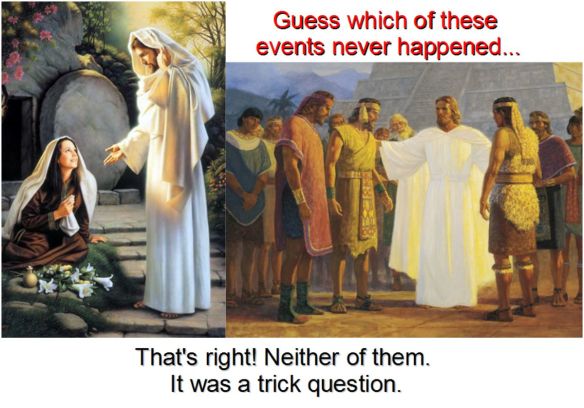
I went to see The Book of Mormon at the weekend. It’s offensive, blasphemous (if there is such a thing) and very funny. I recommend it. I’d say that, by and large, it represents the Mormon faith pretty accurately, mocking the Latter Day Saints’ belief that Jesus visited America about a year after his resurrection. Beaming into the proto-U.S.A, he converted the Nephite civilisation and turned them white, while the Lamanites, who were ‘so wicked’, God eventually curses ‘with (a) dark and benighted and loathsome condition’ (he made them black.) Sadly, all the archaeological evidence for these two civilisations has since been lost.

Three centuries later one of their number, a fictional character guy called Mormon, wrote down their adventures with Jesus on some gold plates that happened to be lying round. After Mormon died, his son Moroni buried these plates for safe keeping, as you would. 1500 years later still, Jesus prompted a chancer called Joseph Smith to dig them up again and, with the help of the returning Moroni and some magic stones, Smith translated them from the original Gibberish into stilted English. The plates and stones were never seen again, but every true Mormon knows that he/she will be resurrected after they die, provided, of course, they are wearing their special underwear. According to some, they’ll then be given their very own planet to rule.

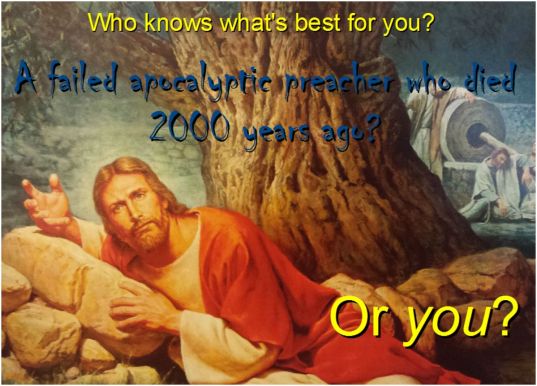
Ludicrous, right? How could anyone invent such twaddle, let alone believe it and allow it to determine their lives? Yet, they do. But is it any more far-fetched than the fantasy on which it’s based? A guy called Yeshua goes round spouting platitudes and proclaims himself king of the New Age that’s coming soon. He gets killed and after 36 hours comes back to life, walks through walls and takes off into the sky. Not long after, a crank who never met him, decides this Yeshua must really have had super powers, and that all anyone has to in order to live forever is believe in a magic spell he, Paul, just made up! More than this, he’s convinced Yeshua will visit the Earth soon, when he’ll condemn most of its inhabitants to an eternity of hellish torture. Unbelievable! Literally unbelievable, and yet millions do believe it.

Joseph Smith’s hokum deserves all the mockery The Book of Mormon and others heap on it, but the original story is every bit as preposterous. Why can’t mainstream Christians see it?


*The phrase ‘Hasa Diga Eebowai’ appears in The Book of Mormon. It definitely doesn’t mean ‘no worries’.

Between Jesus and Paul

Blog371a

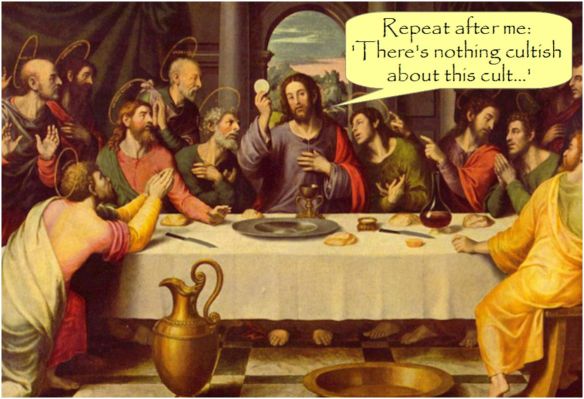
When I joined the group – which I’m not going to call a cult; other people call it a cult, but it’s not. There’s nothing cultish about it – when I joined the group, the leaders told me I had to ignore whatever my family said about it. They instructed us all that the best way to really commit ourselves was to turn our backs on our families. Of course they were right – hadn’t the Teacher himself said so? – families belonged to our old lives. They didn’t understand the Teacher’s message or how important his mission was and how much he loved us. So I turned my back on mine. They weren’t worth a thing next to Him.

Then they said I should give everything away. Sell it all and hand it over to the poorest in the group because possessions only hold us back. Get rid of them, they told us the Teacher had said, and don’t even hang onto the money you got for your stuff. Give that away too. Because, you see, nothing material matters. We’re in the last days. God is going to use the Teacher to do amazing things, to change the world so that those of us at the bottom of the pile rise up to the top, and those on top now – the rich, the powerful and the cruel – well, they’re going to get their comeuppance. Nothing else matters. How could it, really? God’s New Kingdom is going to arrive any day now.

So I spend all my time going out into the streets, proclaiming this great news to the lost. Most of them don’t want to know, of course. They say there have been a thousand would-be messiahs who’ve declared that the world is about to end soon and it never does, and things go on just the same.

This time, though, it’s different. The Teacher is different. He said, the leaders who knew him say, that we should act as if the Kingdom has already arrived. So we try not to judge the foolish ignoramuses who ignore his words of warning, and we make ourselves servants, always doing more than people demand of us, turning away meekly when they spit at us or strike us in the face. We give to anyone who asks – not that I have much to give these days (only what the group graciously provides for me) – and we visit the sick and those in prison. We feed the hungry and give our clothes to the poor, specially our impoverished brothers and sisters in the Lord. Truth to tell, I’m one of those myself now – one of the poor – but I have untold riches stored up in Heaven.

So I have no regrets. I’m doing what the Teacher commanded. I follow his blessed instructions, which his followers passed on to our revered leaders. And it won’t be forever, will it. Just a short while now and we will have our reward. The Teacher will return and he will usher in God’s magnificent Kingdom on Earth and there’ll be no more crying and no more serving; the Lord will lift us up to great heights and we will inherit the Earth.

Didn’t the Teacher say so?

Wouldn’t this be what it was like for some of those early followers of Yeshua Bar Yosef? Those who came immediately after the disciples, but who heard ‘the good news’ only second or third hand? Followers of the Way, known in some circles as ‘The Poor’, whom Paul persecuted? Believers who were around in those few years prior to Paul getting his hands (and unhinged mind) on the message and altering it beyond all recognition? Those ‘Christians’ (the name wouldn’t have existed back then) must’ve believed something and it couldn’t have been Paul’s mystical salvation plan, which didn’t yet exist. From the evidence that survives in the synoptic gospels and from Paul’s disputes with the disciples, I surmise that, for someone who took Jesus’ message seriously in those very early days, it must have been something like the experiences of the hypothetical follower above. As misguided and futile as all of this was, it is, nevertheless, a far cry from the bloated, self-serving travesty that is Christianity today.

Why Christians Don’t Do What Jesus Tells Them To …And What They Believe Instead*

Blog370

A few days ago, notorious God-botherer and TV evangelist, Pat Robertson, said on his TV Show that churches should revise Jesus’ stern teaching about divorce to better fit modern sensibilities. As today’s Christians divorce at about the same rate as non-believers, old Pat thinks it a mite inconvenient that they should feel guilty about it. He reminded his viewers that Jesus gave the church authority over all things and that it should therefore amend Jesus’ teaching. That’s amend as in ‘ignore completely’.

Which is fine, I guess, if you take the same approach to everything else Jesus said. That way, Christians would be safe to ‘amend’ his commands about feeding the hungry, visiting the imprisoned, healing the sick, turning the other cheek, welcoming the stranger, going the extra mile, forsaking possessions, relinquishing wealth, giving to everyone who asks, not judging, putting themselves last and others first, loving their neighbour and enemies alike… and so on.

But wait – they do that already, don’t they? Most Christians don’t practise these things. They don’t see these commands as applicable to them. They work hard, and unconvincingly, at interpreting his words as metaphorical – ‘he didn’t really mean give everything away because where would that leave us?’ – or claim they’re being taken out of context, or insisting they have a spiritual meaning…

Which is to say, nothing Jesus said is to be taken literally, even though the most straight forward reading of his pronouncements is that this is how he meant them. It’s how his early followers, the people who preserved or created his words in the gospels, understood them. Why record them otherwise?

But Jesus’ moralising is inconvenient, impractical, exacting, extreme; ridiculous, in fact, and Christians know this. Still his commands must be dealt with somehow. So the Righteous™ work round them – like Robertson and the teaching about divorce – or they ignore them completely and replace his priorities with ones of their own: worshipping him; defending his reputation; striving for power; complaining about secular society; promoting aggression; acquiring wealth; trying to control others’ behaviour; interfering in others’ sex lives; suppressing LGBT people; arguing that religious rights trump those of minorities; opposing abortion.

None of these figured on Jesus’ agenda. Some are in direct opposition to what he’s made to say in the gospels.

When we see Christians doing the things Jesus tells them they should be doing, maybe then we’ll listen to what they have to say. When they demonstrate credibility rather than hypocrisy, maybe they’ll have earned the right to be heard. But as there’s not much chance of that happening any time soon, it’s way past time we ignored them, and their superstition, in much the same way they ignore their Lord and Saviour™.


*See my book of the same name: https://www.amazon.com/gp/product/147016373X/ref=dbs_a_def_rwt_hsch_vapi_taft_p1_i0 (US) & https://www.amazon.co.uk/gp/product/147016373X/ref=dbs_a_def_rwt_hsch_vapi_taft_p1_i0 (UK)


All in the Mind

Blog 368 (2)

Christians dispute that those who saw the Risen Jesus after his death were merely experiencing hallucinations or ‘visions’ in their own heads. Despite the fact that the only first-hand eye-witness report we have of a resurrection sighting is of precisely this nature – Paul’s, in Galatians 1.16 where he says that the Risen Christ was revealed ‘in’ him – Evangelicals in particular insist that Jesus rose physically from the dead and was seen by numerous ‘witnesses’.

And yet, in the two thousand years since he supposedly ascended into Heaven, no-one has seen Jesus in his resurrected, physical body. This doesn’t stop believers today claiming that they experience him in ‘real’ ways. As the old song goes, they walk with him and talk with along life’s narrow way. Or they think they do.

Back when I was a Christian I used to hear Jesus speaking to me. He’d create a thought in my head, telling me to act in a certain way, to speak to some lost soul about him, for example. At the time I was convinced these promptings were really ‘the Lord’. How could they not be? I had his Spirit living inside me, a sure-fire way of experiencing the living Jesus. His presence felt very real, as it does still for millions of Christians. What greater proof of the resurrection could there be?

In fact, Jesus’ ‘voice’ was no more than the vague recollections of Bible verses I half remembered. The sense of his presence I felt was a trick of my own mind, conditioned by hours of sermons, Bible reading and the mutual reinforcement provided by fellow-believers.

I never actually visualised Jesus, though many claim to. They see him in burnt toast or cloud formations; they dream about him or think he has visited them in the night, standing at the foot of the bed. Some have near-death experiences when (they imagine) they travel to Heaven and are welcomed by his outstretched arms. Others ‘know’ he has rescued them from calamity, or purposely sent them a sign (by leaving a Bible unscathed after a storm destroyed a house, as happened this week in Indiana.) Still others, a mite more credibly perhaps, have a sense of Jesus being present in a wishy-washy mystical way. He seems especially real when they’re caught up in the ecstasy of worship or a mighty and wondrous healing is being staged taking place. What a blessing! After all, didn’t Jesus promise in Matthew 18.20 that ‘when two or three are gathered in my name there I am in the midst of them’? (Probably not, but Christians believe he did and that’s what matters.)

My point is this: if this is how Jesus ‘manifests’ himself today – in whispered messages, inner-visions, emotions, dreams, blessings and ‘signs’ – and if these are enough to keep today’s believers convinced he lives again, then isn’t it likely that this was exactly how his earliest followers experienced him after his death? Not as a real, physical body but in these same ‘spiritual’ ways, conjured up by minds deep in the thrall of religion? If illusions of their own imaginations are enough to persuade the susceptible of the Risen Lord’s presence today, then surely they were more than enough to convince a handful of superstitious zealots in the first century.

I mean, just look at Paul.

Christian charity?

Blog367

Over at the distastefully named Cripplegate, Jordan Standridge has been considering what Christians should do when a homeless person asks for money. Jordan wants some means of weeding out the fakes (fair enough, though he doesn’t really have any clear strategy for doing this) and also attaches conditions to his giving – the recipient of his largesse has to listen to him ‘sharing the gospel’. Jordan reports that none of those he treats to a free meal object to him doing this – probably because they fear going hungry if they don’t listen to him droning on about Jesus.

Most of the comments following Jordan’s post betray the Christian eagerness not to have to follow the command of Jesus’ to give unstintingly. I felt moved to add one of my own:

It’s good that you’re considering ways you can help the poor and homeless, but Jesus says to ‘give to everyone who asks’ (Luke 6.30). ‘Everyone’ is a pretty inclusive! There’s no mention of ‘weeding out the fakes’; just give to all. Seems to me you’re hedging around this command.

This met with variety of responses, shown below in italics, followed by my replies:

Mike: By that logic, if a homeless person asks you for your home, are you then to sign it over to them? If they simply ask for your car, are you then going to hand them your keys? Of course not. That’s not what Luke 6 has in mind. Otherwise YOU would be left on the street naked and homeless simply because someone ASKED you for everything you owned…

You’re right, Mike – it’s completely absurd and unreasonable. But it’s Jesus’ absurdity and unreasonableness, not mine. If you want to say he’s wrong – as you do when you say ‘that’s not what Luke 6 has in mind’ (you know what it ‘has in mind’, I take it?) – then your dispute is with him, not me.

Jane: I believe your atheism qualifies you as the one having the dispute with Him.

Well, Jane, you’re the one who claims to obey him as Lord and Savior and yet here you are trying to figure out ways not to. It brings to mind another of his sayings from Luke 6: ‘Why do you call me “Lord, lord,” and not do what I tell you?’ Why indeed.

Craig: The passage in Luke 6 is not instructions for the body of Christ. In the gospels Jesus has come to Israel as their Messiah to bring in the kingdom that was promised to them. Jesus is telling them how it will be if they accept Him as Messiah.

It’s not, Craig? How’d you know?

What you’re really saying is ‘we Christians don’t much care for this commandment, so we’ve decided it doesn’t apply to us.’

However, if we were to go along with your argument, that Jesus is not addressing the ‘body of Christ’ here, then it follows neither can he be addressing it anywhere else in the gospels. You can’t simply delete the bits you don’t like.

4CommenceFiring4: “Give to everyone who asks” doesn’t specify what to give, or how much. The other commands–like going the second mile or giving them your cloak when they ask for your shirt–has to do with attitude, not mathematical formulas.

The Jews asked Jesus for a “sign” that He was the Christ. Did violate His own standards by not providing a sign? If you think He did, then it would be fruitless to get into the subject any further.

Really? It’s to do with attitude not action? Who says so? I thought the Bible was the literal word of God, meaning Jesus’ commands here should be taken at face value. Thanks for enlightening me; I’m relieved to learn there’s enough wriggle room not to have to do what Jesus says.

Oh, and according to John’s gospel, Jesus provided numerous ‘signs’ for ‘the Jews’ (which he was himself, of course.)

4CommenceFiring4: “The Bible is the literal Word of God” is the claim of someone–believer or otherwise–who hasn’t thought much about what that even means. There are theological debates by serious people about that, so don’t think for one minute that because “literal” means different things to different people means it doesn’t mean anything and we can go merrily on our way thinking we have nothing to which we owe our attention.

A devotion to strict literalism would lead to ridiculous conclusions, as you well know, so if you intend to use that as a defense for why the Bible isn’t to be taken seriously, try again. Smarter people than either of us have devoted their lives to debunking it, and it’s still standing long after they faded away. So don’t waste your time with that empty pursuit.

The bottom line is, are you ready for what comes next? And are you sure? It’s a bet you can’t afford to get wrong. Examine that, and everything else is secondary.

Great stuff. The ingenuity and effort that goes into avoiding doing what Jesus clearly commands is truly impressive.

Am I ready for what comes next? Sure. Oblivion never hurt anyone.

*****

Meanwhile, the homeless go on being homeless and Christians continue to demonstrate that the people who get the most out of their ‘discipleship’ is primarily they themselves.

The Gods of Christianity

Blog366

Christians who argue that only their God is real and that life is futile without him, are like the person who jumps up and down on thin ice insisting the ground beneath him is solid.

The various forms of Yahweh belief have rarely been monotheistic. While Isaiah declares there is only one God, the Jewish scriptures also refer to ‘him’ as ‘Elohim’ and ‘Adonai’, plurals meaning ‘deities’ and ‘my lords’ respectively. Other gods abound, with Psalm 82.1 relating how Yahweh presides over an assembly of other deities. From the beginning – certainly the beginning of the bible – a belief in other supernatural agents has been a requirement; Satan and angels are both present in Genesis and throughout the Old Testament. There are also the cherubim and seraphim of Genesis 3.24 and Isaiah 6:1-8 who do Yahweh’s dirty work for him. All of these beings are supernatural entities of immense power; gods in everything but name.

And this is before we get to the New Testament where several new superhuman characters are introduced. Most notable, of course, is the Christ, the invention of cultist Paul. This eternal being is capable of rescuing human beings from the wrath of God and has the power to resurrect them after death. He is, in Paul’s eyes, on an equal footing with Yahweh himself, a god in his own right (Philippians 2.6-11). While the Christ himself has resided in heaven for the past two thousand years (or for eternity, give or take thirty years), his spirit haunts the Earth to this day, possessing members of the Christ cult. The three of them together – the Christ, the Spirit and Yahweh (re-imagined as ‘The Father’) – are the chief gods of Christianity. The church has spent almost two millennia trying to explain how there is only one god who is simultaneously three distinct deities. The Vatican declares the Trinity to be the greatest mystery of all, though of course it is only a mystery in the same way something that makes no sense whatever can be considered a mystery.

According to the gospels, Jesus himself believed in yet another collection of supernatural agents; demons who caused all manner of illness and mischief, opposing Jesus wherever he went. According to the writer of Ephesians (6.12), these ‘wicked spirits’ and ‘principalities’ rival God in terms of power, and are, together with their overlord, Satan, the real rulers of this world

For Catholics, this pantheon of three-in-one gods, angels, devils and demons is supplemented by another layer of super-beings. These are humans who have attained the status of divine immortality, and who are prayed to and worshipped by acolytes on Earth. Mary, the supposed ‘mother of God’ is the most significant, followed by ‘saints’ who have been translated to Heaven and now have free access to the chief gods, ‘interceding’ with them on behalf of ordinary mortals. While no doubt Catholics would dispute that these figures are themselves gods, it’s difficult to see how they are not: they’re immortal, eternal, possessed of great power and in direct communication with the Big Three. They are the equivalent of the Titans’ offspring in Greek mythology.

There is nothing monotheistic about Christianity (nor Judaism) despite the protestations of those who claim to follow the one true God. Christianity has, like most of its predecessors, a pantheon of gods. This not surprising when history repeatedly demonstrates the extent to which humans are inclined towards ensemble theistic imaginings.

So, beware those who tells us they know what the one true God wants, what he approves of and what he condemns: that ice is exceedingly thin and already cracked. It has been from the very beginning.

Proof of God

Blog364

Amateur apologist and C. S. Lewis wannabee, Don Camp, makes the argument that as human beings have always believed in gods (have they?), it must mean that gods exist. They – or at least one of them – must have planted an instinct for worship within us from the outset. Don, of course, feels it is ‘self-evident’ that the god he believes in (the Christianised version of the Jewish tribal god, YHWH) is the One True God and consequently the deity who imbued us with the god instinct. Eventually, after millennia, during which humans misdirected their god-instinct to create thousands of false gods and imaginary supernatural beings, this One True God revealed himself and made known his expectation that he be acknowledged as the only God.

Where to begin?

It is not ‘self-evident’ that the tribal god of ancient Jews is the One True God. It is not ‘self-evident’ that this god exists while all the other gods humans have created (current estimate: 28,000,000) do not. The people who created these other deities were equally convinced they existed. Some had texts setting out the expectations the gods had of their human acolytes; most had rituals and forms of worship that had to be adhered to; they had experts – priesthoods – who knew exactly what the gods required; many encouraged adherents to serve the gods in their daily lives.

These other deities were every bit as ‘real’ as YHWH. There is nothing that singles ‘him’ out from them; nothing that makes him any more real than they were. He is indistinguishable from them in every way. It cannot be argued that they don’t exist, while, ‘self-evidently’, the Christian god – a very late arrival on the scene – is real.

What of the god instinct then? Where does it come from if not from the gods themselves? As others have argued (Dawkins and Harris, for example) it appears to be a misfiring of our need to know. The ancient peoples who devised gods to explain their world were doing their best with what little knowledge they had. Attributing agency to the activities of nature is an understandable mistake to make. Early people had first-hand experience of human agency and it was not an unreasonable assumption that agency must therefore lie behind other phenomena. We know that very early religions did precisely this in respect of animals, weather and the stars (animism; while astrology, in which celestial bodies control human behaviour, survives to this day.)

We now know, however, that such attribution was wrong. Inanimate phenomena do not possess agency. They do not possess it because they are not cognitive beings; any cognition we think we detect is our own, reflected back at us. The entities earlier humans created to explain what they took to be the purposeful activities of nature had no independent existence.

Our imaginary creations have no counterparts in reality; none of the 28,000,000 gods that humans have conjured up have actually existed. Is it reasonable to assume, then, that one of these otherwise imaginary beings really does? That YHWH is the exception; the one god, who, just because we’re more familiar with him than any of the other 27,9999,999 deities, is one hundred percent real?

What do you think?

Evangelical Extremist Parades Ignorance Shock!

Blog365

Fundamentalist street preacher, tract distributor and general nuisance, Bob Hutton, shared his thoughts this week on the assassination of Irish journalist, Lyra McKee. According to Bob, Lyra’s death was tragic on two counts. First, because she was made in the image of God and God regards all life as precious. (You’ll be hard pushed to find this in the Bible, never mind in reality.)

Second, Lyra was gay and this, for Bob, is a tragedy on the same level as her murder:

her death was tragic because of the life she led. It is an undoubted fact that her lifestyle was in accord with what the Bible refers to as unnatural perversions (see Romans 1 v 24-28). Moreover, we read in 1st Cor. 6 v 9-10 that people who engage in this kind of activity “will not inherit the kingdom of God”. If we don’t inherit the kingdom of God when we die then there is only one other place we can go, and that fate is too horrible to bear thinking about. I don’t know if Lyra McKee repented of her lifestyle before she died; I truly hope she did – God is merciful to all who truly repent of their sins and accept Jesus Christ as their personal Saviour.

In 1st Cor. 6 v 11 we are told of people who formerly engaged in all manner of perversions being transformed by God’s power. It is my sincere wish that McKee came to experience the joy and forgiveness from God that comes from knowing Christ.

Finally, let us remember, that although God is merciful to those who repent and accept Christ, the day of Grace does not last forever. Anyone who is involved in a sinful lifestyle is gambling with their souls, and could be called to the judgement seat of Christ at a moment’s notice.

You’ll note, I’m sure –

  • the condescension and judgement implicit in buzzwords like ‘lifestyle’, ‘sinful’, ‘unnatural’, ‘perversion’; 
  • empty evangelical cliches such as ‘repentance’, ‘knowing Christ’, ‘merciful’, ‘joy and forgiveness’;
  • how ‘the Kingdom of God’, which Jesus and Paul predicted was coming to the Earth in the first century, is conflated with the much later but equally muddle-headed concept of Heaven;
  • how all of this sneakily condemns not only Lyra McKee but all gay people, as well as those who have had the good sense to avoid or ditch the Jesus scam.

This callous, superficial and ever so ‘umble twaddle is what passes for the ‘gospel’ in the Christian bubble these days. Yes, Lyra’s death was terrible and wasteful, but not because a non-existent deity regarded her life as precious,  and certainly not because she was gay.

What I find really tragic is that there are still millions of people like Bob, who think magic salvation spells and empty promises about ‘eternal life’ are what make life meaningful.

Try praying

TryPraying

I was in Edinburgh recently and spotted posters, like the one above, on the backs of buses, advising people to ‘try praying’. There is, naturally, an entire web-site devoted to the campaign, created by Christians with more money than sense.

Here’s a thought: try praying that the bus on which one of these ads appears waits for you as you run for it and it pulls away from the stop. You think that would work? (No more than chance would allow.) Or try praying that if you do catch it, the driver will let you on, even though you’ve left your purse at home and can’t buy a ticket. Try praying that the pain you’ve experienced all day be taken from you as you set off walking home. Try praying for or about anything and see what God’s response is. Prayer, ‘tried’ or not, is no more effectual than wishful thinking or chatting with the fairies at the bottom of your garden.

Blog362a

(fixed it)

While in Edinburgh, I visited St Giles’ cathedral in the centre of the city. A friend I was with wanted to see a commemorative plaque there and I saw a chance to rest my aching legs. At the entrance was a sign that said the cathedral welcomed a donation of £5 ($6.55) per visitor to help with daily running costs. Evidently the ecclesiastical administrators haven’t realised they could ‘try praying’ and ask God to fund a building, the sole purpose of which is to honour him. Or perhaps they had ‘tried’ prayer and had discovered God wasn’t willing to provide the hundreds of pounds needed every day to keep it going.

Whichever, the only way churches like St Giles can survive is to have those humans who think they serve some meaningful purpose, fund them themselves. God couldn’t care less whether they flourish or not. If he did he’d keep them going from his abundant supply. That he doesn’t demonstrates not only his non-existence but also tells us that the church is an entirely human enterprise. Without human effort, and liberal amounts of filthy mammon, they invariably fail.

Desiderata

Blog361a

There’s really no secret to what life is about. It’s simple – simplistic even. All the same, it took me most of my life to discover it.

The best way to live your life is to be yourself.

That’s not as easy as it sounds, because you have to have pretty good sense of self to begin with and, for a multitude of reasons, such awareness can elude you.

It’s possible that this is because none of us truly has a self. Current thinking among psychologists and neuroscientists is that the self doesn’t exist. It’s an illusion, created by competing and often conflicting processes in the brain. I picture it like those optical illusions in which carefully arranged shapes make it appear, as in the figure below, that there’s a different shape in their midst, when in fact all that’s there is clear space. Maybe the neuroscientists are right about this, but even so, the self is a damn convincing illusion.

Kanizsa-triangle

Because the brain’s processes are ever active the illusory shape at the centre is subject to constant change – which we perceive as mood swings, changes to our personality, acting ‘out of character’ or being out of sorts with ourselves. Perhaps what I really mean by being yourself, then, is finding a point of equilibrium for the shape at the centre, where it isn’t constantly buffeted by the turbulence of the brain’s activities. However, this is merely to exchange one metaphor for another, so for now I’ll talk about the sense of ‘me-ness’ that we all experience subjectively and intuitively, and know as ‘the self’.

Perhaps you’ve never been in tune with who you are, living, as Plato called it, an unexamined life (he believed such a life wasn’t worth living). Perhaps like me, you drifted through the earlier part of life, allowing unplanned, random experiences to pull you along in their wake until you were left in a place you felt you don’t quite fit. Maybe though, you’ve heard a small inner voice calling you, telling you that this isn’t you. Perhaps, as I experienced for many years, the incongruity between who you are and where you’ve ended up is taking its toll on your mental health.

It’s also possible that you have heard your inner calling but have been told – by society, family or church that who you are is inconvenient, undesirable or unrealistic. ‘Just settle yourself down and conform to what we think is right for you,’ they’ve told you – and you have. They’ve convinced you that you won’t be accepted if you’re truly yourself, so you’ve suppressed or obscured who you know yourself to be.

Alternatively, you’ve assumed a role you know isn’t you. You’re doing a job that allows for no self-expression (because, after all, we all need to make a living), you’re in a relationship that suffocates the real you or you’ve been a church member, striving to conform to everyone’s unrealistic expectations of you. The result is you’re stressed, unhappy and uptight. You’re acting, as the term ‘role’ implies, without any authenticity. We all act from time to time, of course; there are occasions when it is unavoidable. But to live an entire life this way is to invite strife and depressive illness. To be healthy, happy and whole, you need to be authentic – true to yourself.

To adopt a religion is to assume a role. It is to deny your real self (Jesus demands you do: Matthew 16.24) and pretend you’re something you’re not. You can no doubt convince yourself God is doing a great work in you, sanctifying you and making you increasingly Christ-like, but the more you act out the part, the less like your genuine self you become. How can this be right for you, for your happiness and well-being? Adopting any ideology is to add a fake and unnecessary veneer to life that serves only to mask your true identity. Replacing who you are with a predetermined set of religious or political beliefs is mere play acting. Denial is not a solution; embracing your self is.

I hope that like me, you have reached a place where you know and embrace your real self. If not, and at the risk of sounding like a poor man’s Wayne Dyer, I’d ask you to take time to listen to your inner voice. Recognise it for what it is; it will not lead you astray. You know deep within who you are and who you should be, whether that’s an artist, teacher or baker; parent, celibate or gay; writer, performer or mystic; builder, musician or doctor, or a combination of these and other possibilities. You have to be what makes you happy. You owe it to your self.