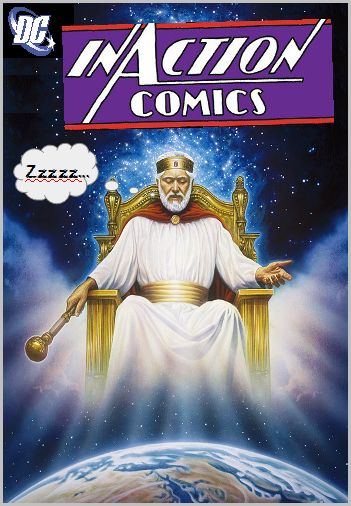
God or Superman?

Blog397

An early problem faced by the creators of Superman, only a few years after his first appearance in Action Comics #1 in 1938, was his impotence in the real world. Here was a character with incredible super-human powers – not quite as phenomenal as they would later become – who could defeat gangsters, wife-beaters, bullies and evil dictators with a flick of his little finger, but who, when a real life bully emerged on the world stage, couldn’t do anything. Stories could have been written about how he single-handedly defeated the Nazis and restored world peace but none of this would have been reflected in the real world. It’s true that today with its alternate realities and constant rebooting that Superman could be made to defeat modern-day fascism; but that would be on some other fictional Earth, not the real one. In the real world, Superman would remain impotent, having little effect beyond raising awareness and morale, which is what he did – or, more accurately, what his creators had him do – during World War II. There wasn’t anything else he or they could do.

By now, coronavirus should really have disappeared from the face of the Earth. Last Sunday was National Day of Prayer in the US. Independent of Donald Trump’s ‘initiative’ in calling for a day of grovelling in front of the Almighty, many other Christians have also been begging God to protect their church community from covid-19 (the godless can fend for themselves). Still others have commanded the virus, in the name of Jesus, to leave them and the USA alone (the rest of the world be damned.)

The effect of all this pleading and commanding has been that the coronavirus has continued to spread, heedless of borders and indifferent to the religious beliefs of its victims. Either God doesn’t give, as we say in this neck of the woods, a rat’s arse about who contracts covid-19, nor who dies from it, not even his born-again Chosen Ones. Everybody’s gotta die sometime, right? The important thing is that they’re right with the Lord before they do.

Or – God’s just like Superman. We can imagine him doing all sorts of incredible things, like healing disease, curing illness and saving the world, but in reality, none of them ever happen. He’s not going to protect people from coronavirus in precisely the same way he failed to protect them from 9/11, AIDs, the Holocaust, Spanish Flu, The Great Plague, Black Death and Leprosy. It’s not that he doesn’t care, it’s that he’s not there. He’s no more real than Superman and is every bit as impotent as the Man of Steel.

I’m a big fan of Superman – I’ve been reading the comics he appears in for 57 years now – and I’m fully aware he’s not real; he was created by Jerry Siegel and Joe Shuster 82 years ago and has been embellished by every writer and artist who’s worked on him ever since – much like God. If only those who plead with the Almighty, and worse, tell the rest of us what he thinks of us, would recognise that he is fictional too. He exists only in a fantasy realm, outside of which he has no super-powers, no influence, no ability to save us from coronavirus or anything else.

Remember the sequence in the Simpsons episode where Homer is, as usual, in lots of trouble; he looks to the sky and pleads, ‘I’m not normally a praying man, but if you’re up there, please save me… Superman.’ That’s exactly what Christians are doing right now, and the result will be the same as it was for Homer and for everyone else who’s ever called on Superman God to save them.

Coronavirus defeated

Blog395

Thank God the Coronavirus pandemic is over. It was scary there for a minute or two. Over 3,000 people died from it. Fortunately, they were mainly Chinese and South Koreans. Vice-president Mike Pence and other anti-abortionists Christian leaders have now taken care of it. On Friday they prayed that it would go away and God has done as they asked. The picture above, courtesy of The Friendly Atheist, shows them doing it. Here’s some other nitwits righteous ones doing the same thing and here an article about the prophet whom God chose to announce to the world that the threat was over. You have to wonder, though, why he made the virus in the first place and why he allowed it to spread so indiscriminately. I mean, even Christians were infected.

Truly, the way to resolve a world wide health crisis is to enlist the help of an imaginary sky fairy who, as usual, does f**k all to help.

Next week: the coronavirus continues to spread. These same men of God then realise that the virus is actually God’s punishment for abortion… er, homosexuality… um, opposition to Trump… er, people shaking their fists in his face (he really doesn’t like that.) Then it all becomes clear why God made the virus in the first place. Difficult to explain why he started it off in China though, but the Lord will surely let his prophets know that too (I mean, those Chinese are commies.)

Life must be easy when all you have to do is make stuff up. It’s more than a little bit worrying that those who do it are listened to by multitudes who’ve switched off their critical faculties. More worrying still when some of these fantasists are in charge of entire countries. The only way coronavirus will be defeated is through science; the development of a vaccine, which is still many months away. Imaginary deities – and they’re all imaginary – prayers, pleading and blaming are all worse than useless.

Can you be a Christian and … a Realist?

Blog391c

If you’ve been reading this series of posts, you’ll pretty much know how this one’s going to go. You can’t really be Christian if you have, as the old song goes, half a brain. Still, it won’t hurt to see how compatible faith is with reality as we know it. You never know, we might be surprised.

Speaking of songs, I always liked Billy Joel’s ‘An Innocent Man’ from the album of the same name. Of course, by Christian reckoning there’s no such thing as an innocent man, nor woman or child – no, not one – because all have fallen short and are worthy only of death (Romans 3:23 & 6:23). All the same, we’ll give Billy the benefit of the doubt. In a song of insightful lyrics, the lines I particularly like are

Some people hope for a miracle cure
Some people just accept the world as it is
But I’m not willing to lay down and die
Because I am an innocent man

Christians seem to have such difficulty accepting the world as it is. They’re constantly upset that the world, which I’m taking to be synonymous with reality, does not and will not conform to what they expect of it. And when it doesn’t, it’s the world that’s at fault, that has it all wrong.

When the evidence is presented for climate change and our contribution to it, some believers announce, with no hint of irony, that God will never let it happen. He’ll step in, just like he always does, to prevent it. So take that Australia with your bush fires, Java with your floods and all you polar bears with your melting icebergs: God’s got it all in hand.

When a Hollywood movie depicts a same sex couple in the background of a scene for a nano-second, the born-again are apoplectic about the world’s immorality. When two female performers wiggle their bits, Franklin Graham – arch-supporter of the Pussy-Grabber-in-Chief – has the hypocrisy to claim, ‘I don’t expect the world to act like the church, but our country has had a sense of moral decency on prime time television in order to protect children.’ Clearly he does expect the world to act like the church (which as we know is both spotless and sinless.) All these modern-day Jeremiah’s do.

Reality doesn’t, and won’t, conform to what Christians want it to be. So what to do? Either join with Graham and those other evangelicals railing pointlessly against reality, like Don Quixote and his damn windmills, or (and this a much more comfortable position to adopt) be like those climate change deniers and tell yourself that whatever sort of state the world is in, God will be step in any time soon to sort it all out. After all, this is what Jesus believed. He didn’t rant and rave about the state of things, brutal Romans and all, he just had a simple, smug faith that his Father was going to set everything right real soon and put him in charge.

Christianity demands that Jesus’ disciples deny the world; reject it, despise it. The faith has denial at its core, even of oneself. It demands reality be replaced with a fantasy version of the world.

As I’ve written before:

Christians, even moderate ones

Those older links could easily be replaced with up-to-date, reality-denying ones. This is what it’s like in the Christian bubble; with all this denial taking up space, there’s no room for accepting the world as it is, and trying to change what needs changing and improve what needs improving.

Again as I’ve said before, truth, reality and other people are the casualties of religion’s life-denying efforts at self-preservation. Fantasy and reality are just not compatible.

Can you be a Christian and… accept Evolution?

Hoax

People of faith have a problem with evolution. Some of them can’t seem to see it, but the Theory of Evolution is a significant encumbrance to faith, as it has been since Darwin first proposed it in 1859.

There are essentially four ways Christians (and those from other religions) deal with evolution.

1) There are those who recognise that evolution and faith are incompatible and consequently compartmentalise them both to avoid thinking about the problem: ‘Yes, evolution probably happened but my faith is important to me so I’m going to pretend it didn’t.’

It’s impossible to argue with this head-in-the-sand position, so let’s not bother.

2) Others insist that evolution is ‘just a theory’ and as such is in conflict with what the Bible teaches about the creation of life. But this is a double misunderstanding: of what ‘theory’ means in science, and of what the Theory of Evolution proposes. It has nothing to tell us about how life began, but how it developed. Nonetheless, it contradicts the order of creation found in the two creation accounts in Genesis.

Some believers are content to dismiss evolution on these grounds: a theory, in the popular sense, that is trumped at every turn by the Bible’s accounts of creation. Ken Ham and the laughable Answers in Genesis hold to this position:

The real issue is one of authority—is God’s Word the authority, or is man’s word the authority? So, couldn’t God have used evolution to create? The answer is No. A belief in millions of years of evolution not only contradicts the clear teaching of Genesis and the rest of Scripture but also impugns the character of God. He told us in the book of Genesis that He created the whole universe and everything in it in six days by His word: “Then God said … .” His Word is the evidence of how and when God created, and His Word is incredibly clear.

Hammy and his acolytes do accept what they call micro-evolution, the small incremental stages made within a species over time. Macro-evolution, as they like to call it, when one species gives rise to another over significant amounts of time apparently never happens. Why? Because the Bible says so (but good luck finding where.)

3) Still others extend this dismissal on the basis of ignorance: they are positively hostile to the idea of evolution. Street preachers who set up shop in my home town from time to time are always accompanied by a sign that says ‘Evolution is a Hoax’ (see above.) These kind of believers are not content simply to dismiss evolution as ‘theory’, nor do they accept that it occurs within species. They rail against evolution and disparage the vast amounts of evidence that exist for it. Evolution they declare over their megaphones, is not only a hoax, it is of the devil, who uses it to deceive people and lead them away from God. This is ignorance of a more wilful sort.

Christians in both these last two camps would themselves say that one can’t be a Christian and accept evolution. Actually, they’d say one can’t ‘believe’ in evolution, a word I’ve avoided. Evolution can no more be ‘believed in’ than gravity (itself a theory in the scientific sense.)

4) The fourth way Christians have of dealing with evolution is to attempt to marry the theory with their faith. They acknowledge that evolution has occurred, that life on earth has developed much as Darwin proposed and that the evidence from paleontology, geology, genetics and developmental biology fully substantiates this explanation.

Where then to fit God when he is superfluous to the explanation of life’s development, in much the same way the tooth fairy is superfluous to dentistry? This doesn’t stop these believers finding a place for him. They regard the apparent randomness (their term) of evolution impossible to accept and see a place for God in countering it. As Greg Allison puts it on Desiring God, without a hint of irony, the ‘entire process (of evolution) was undirected and purposeless, without God.’

Consequently, Christians who accept evolution have come up with a couple of ways of injecting God into the process, regardless of the fact he is not needed and there is no place for him. So-called Theistic Evolution, in both its forms, is the belief – and it’s nothing more than a belief – that God set evolution in motion and then let it take its course. One school proposes he occasionally gave it a nudge so that it went in the right direction, the other that he just sat back to see what would happen, though presumably he knew this from the start, being omniscient and all that.

This a hopeless compromise; the prevalence of suffering, death and extinction as drivers of evolution discount any involvement of a benign creator. Such a being’s disinterest in the constant struggle for survival of his created pets, every one of which perishes once past reproductive age (if they reach it in the first place) does not point to a loving God. Paul, who of course had no understanding whatsoever of evolution, believed that death entered creation only when Adam first ‘sinned’. Yet death and suffering existed eons before human beings first appeared. The ‘Evolutionary Creationists’ at BioLogos have a hard time trying to explain this one away. (Spoiler alert: they can’t.)

And let’s not even mention sex; sexual reproduction is a massive problem for the creationist.

As Greg Allison concedes, one cannot be a Christian and subscribe to a theistic model of evolution. Having considered the possibilities, Greg concludes that neither form of theistic evolution is compatible with faith. In this he is right. He comes back to the scriptural accounts of creation as the best explanation of life’s development. In this he is wrong.

No doubt there are commenters out there who think that some form of compromised Christianity and a diluted evolutionary theory are somehow compatible. They have no doubt discovered a way to put God at the heart of evolution or have a misunderstanding of the theory that somehow leaves room for him. Such arguments are unconvincing. Evolution and God are incompatible. One is true (as in observable, supported by evidence and predictive), the other imaginary. There’s no need to pollute the former with the latter.

The Chosen One

Blog377

Donald Trump is chosen by God. His powerful friends in The Family have decided. Other influential Christians, like the odious Franklin Graham, have endorsed it. Trump himself made reference to it in a speech recently. He claims this was a joke, but we know what’s said about words spoken in jest; the Donald believes what his Christian chums have told him.

Evidently Trump cannot have been chosen by God when there is no God to do the choosing. Nor does Trump’s behaviour indicate that he’s God’s man. He is ignorant, self-obsessed, spiteful, vindictive, boorish, narcissistic and cruel. Not only is he ignorant generally, he is ignorant about the bible, has no idea about what being a Christian entails and is unable to answer any questions about his supposed faith.

Why then do Christians of all stripes claim he is specifically chosen by God to be president? How do they know? Allowing for a moment that there is a God, the notion that he chooses his agents here on Earth is fraught with insurmountable problems. That he predetermines who will serve him or even who is saved is an insoluble paradox that I’ve written about before, here and here.

No, Christians who say Trump is God’s Chosen are convinced of this only because he supports and implements their agenda; he is anti-abortion, anti-gay and anti-immigrant. He favours guns, white people, Israel, the wealthy and evangelicals. This is why Christians like him, why The Family says he is chosen by God, because these are their priorities and therefore, they conclude, they must be God’s priorities too.

Blog377a

For any Christians reading, particularly in the U.S., the process goes something like this:

1. You decide what is important to you.

2. You find support for your priorities in the bible (because support for just about anything can be found somewhere in the bible. Alternatively, you can just say what you believe is in the bible. Nobody’s checking.);

3. You disregard any apparent contradiction in the words attributed to Jesus;

4. You tell yourself that because God supports your agenda somewhere in the bible, this must therefore be his agenda also;

5. You exercise cognitive dissonance, a.k.a. dishonesty, to enable you to conclude that any influential agent who is prepared to support your priorities must therefore be chosen by God.

Naturally your agent need not demonstrate any other traits that might reasonably be expected of a God-follower (humility, love, hospitality, treating others like they themselves like to be treated and so on.) These things are unimportant so long as the agent is carrying out your agenda.

6. You tell others only of point 5, thus furnishing the entire process with a high-sheen spiritual gloss;

7. You accuse anyone who doesn’t support your agenda and your Chosen One of betraying God.

A good deal of self-deception and deceiving of others is required to pull this off, but Christians are more than up to the job. That’s why Trump is in the White House and why his Christian fixers are never far from his side.

All in the Mind

Blog 368 (2)

Christians dispute that those who saw the Risen Jesus after his death were merely experiencing hallucinations or ‘visions’ in their own heads. Despite the fact that the only first-hand eye-witness report we have of a resurrection sighting is of precisely this nature – Paul’s, in Galatians 1.16 where he says that the Risen Christ was revealed ‘in’ him – Evangelicals in particular insist that Jesus rose physically from the dead and was seen by numerous ‘witnesses’.

And yet, in the two thousand years since he supposedly ascended into Heaven, no-one has seen Jesus in his resurrected, physical body. This doesn’t stop believers today claiming that they experience him in ‘real’ ways. As the old song goes, they walk with him and talk with along life’s narrow way. Or they think they do.

Back when I was a Christian I used to hear Jesus speaking to me. He’d create a thought in my head, telling me to act in a certain way, to speak to some lost soul about him, for example. At the time I was convinced these promptings were really ‘the Lord’. How could they not be? I had his Spirit living inside me, a sure-fire way of experiencing the living Jesus. His presence felt very real, as it does still for millions of Christians. What greater proof of the resurrection could there be?

In fact, Jesus’ ‘voice’ was no more than the vague recollections of Bible verses I half remembered. The sense of his presence I felt was a trick of my own mind, conditioned by hours of sermons, Bible reading and the mutual reinforcement provided by fellow-believers.

I never actually visualised Jesus, though many claim to. They see him in burnt toast or cloud formations; they dream about him or think he has visited them in the night, standing at the foot of the bed. Some have near-death experiences when (they imagine) they travel to Heaven and are welcomed by his outstretched arms. Others ‘know’ he has rescued them from calamity, or purposely sent them a sign (by leaving a Bible unscathed after a storm destroyed a house, as happened this week in Indiana.) Still others, a mite more credibly perhaps, have a sense of Jesus being present in a wishy-washy mystical way. He seems especially real when they’re caught up in the ecstasy of worship or a mighty and wondrous healing is being staged taking place. What a blessing! After all, didn’t Jesus promise in Matthew 18.20 that ‘when two or three are gathered in my name there I am in the midst of them’? (Probably not, but Christians believe he did and that’s what matters.)

My point is this: if this is how Jesus ‘manifests’ himself today – in whispered messages, inner-visions, emotions, dreams, blessings and ‘signs’ – and if these are enough to keep today’s believers convinced he lives again, then isn’t it likely that this was exactly how his earliest followers experienced him after his death? Not as a real, physical body but in these same ‘spiritual’ ways, conjured up by minds deep in the thrall of religion? If illusions of their own imaginations are enough to persuade the susceptible of the Risen Lord’s presence today, then surely they were more than enough to convince a handful of superstitious zealots in the first century.

I mean, just look at Paul.

The Gods of Christianity

Blog366

Christians who argue that only their God is real and that life is futile without him, are like the person who jumps up and down on thin ice insisting the ground beneath him is solid.

The various forms of Yahweh belief have rarely been monotheistic. While Isaiah declares there is only one God, the Jewish scriptures also refer to ‘him’ as ‘Elohim’ and ‘Adonai’, plurals meaning ‘deities’ and ‘my lords’ respectively. Other gods abound, with Psalm 82.1 relating how Yahweh presides over an assembly of other deities. From the beginning – certainly the beginning of the bible – a belief in other supernatural agents has been a requirement; Satan and angels are both present in Genesis and throughout the Old Testament. There are also the cherubim and seraphim of Genesis 3.24 and Isaiah 6:1-8 who do Yahweh’s dirty work for him. All of these beings are supernatural entities of immense power; gods in everything but name.

And this is before we get to the New Testament where several new superhuman characters are introduced. Most notable, of course, is the Christ, the invention of cultist Paul. This eternal being is capable of rescuing human beings from the wrath of God and has the power to resurrect them after death. He is, in Paul’s eyes, on an equal footing with Yahweh himself, a god in his own right (Philippians 2.6-11). While the Christ himself has resided in heaven for the past two thousand years (or for eternity, give or take thirty years), his spirit haunts the Earth to this day, possessing members of the Christ cult. The three of them together – the Christ, the Spirit and Yahweh (re-imagined as ‘The Father’) – are the chief gods of Christianity. The church has spent almost two millennia trying to explain how there is only one god who is simultaneously three distinct deities. The Vatican declares the Trinity to be the greatest mystery of all, though of course it is only a mystery in the same way something that makes no sense whatever can be considered a mystery.

According to the gospels, Jesus himself believed in yet another collection of supernatural agents; demons who caused all manner of illness and mischief, opposing Jesus wherever he went. According to the writer of Ephesians (6.12), these ‘wicked spirits’ and ‘principalities’ rival God in terms of power, and are, together with their overlord, Satan, the real rulers of this world

For Catholics, this pantheon of three-in-one gods, angels, devils and demons is supplemented by another layer of super-beings. These are humans who have attained the status of divine immortality, and who are prayed to and worshipped by acolytes on Earth. Mary, the supposed ‘mother of God’ is the most significant, followed by ‘saints’ who have been translated to Heaven and now have free access to the chief gods, ‘interceding’ with them on behalf of ordinary mortals. While no doubt Catholics would dispute that these figures are themselves gods, it’s difficult to see how they are not: they’re immortal, eternal, possessed of great power and in direct communication with the Big Three. They are the equivalent of the Titans’ offspring in Greek mythology.

There is nothing monotheistic about Christianity (nor Judaism) despite the protestations of those who claim to follow the one true God. Christianity has, like most of its predecessors, a pantheon of gods. This not surprising when history repeatedly demonstrates the extent to which humans are inclined towards ensemble theistic imaginings.

So, beware those who tells us they know what the one true God wants, what he approves of and what he condemns: that ice is exceedingly thin and already cracked. It has been from the very beginning.

Proof of God

Blog364

Amateur apologist and C. S. Lewis wannabee, Don Camp, makes the argument that as human beings have always believed in gods (have they?), it must mean that gods exist. They – or at least one of them – must have planted an instinct for worship within us from the outset. Don, of course, feels it is ‘self-evident’ that the god he believes in (the Christianised version of the Jewish tribal god, YHWH) is the One True God and consequently the deity who imbued us with the god instinct. Eventually, after millennia, during which humans misdirected their god-instinct to create thousands of false gods and imaginary supernatural beings, this One True God revealed himself and made known his expectation that he be acknowledged as the only God.

Where to begin?

It is not ‘self-evident’ that the tribal god of ancient Jews is the One True God. It is not ‘self-evident’ that this god exists while all the other gods humans have created (current estimate: 28,000,000) do not. The people who created these other deities were equally convinced they existed. Some had texts setting out the expectations the gods had of their human acolytes; most had rituals and forms of worship that had to be adhered to; they had experts – priesthoods – who knew exactly what the gods required; many encouraged adherents to serve the gods in their daily lives.

These other deities were every bit as ‘real’ as YHWH. There is nothing that singles ‘him’ out from them; nothing that makes him any more real than they were. He is indistinguishable from them in every way. It cannot be argued that they don’t exist, while, ‘self-evidently’, the Christian god – a very late arrival on the scene – is real.

What of the god instinct then? Where does it come from if not from the gods themselves? As others have argued (Dawkins and Harris, for example) it appears to be a misfiring of our need to know. The ancient peoples who devised gods to explain their world were doing their best with what little knowledge they had. Attributing agency to the activities of nature is an understandable mistake to make. Early people had first-hand experience of human agency and it was not an unreasonable assumption that agency must therefore lie behind other phenomena. We know that very early religions did precisely this in respect of animals, weather and the stars (animism; while astrology, in which celestial bodies control human behaviour, survives to this day.)

We now know, however, that such attribution was wrong. Inanimate phenomena do not possess agency. They do not possess it because they are not cognitive beings; any cognition we think we detect is our own, reflected back at us. The entities earlier humans created to explain what they took to be the purposeful activities of nature had no independent existence.

Our imaginary creations have no counterparts in reality; none of the 28,000,000 gods that humans have conjured up have actually existed. Is it reasonable to assume, then, that one of these otherwise imaginary beings really does? That YHWH is the exception; the one god, who, just because we’re more familiar with him than any of the other 27,9999,999 deities, is one hundred percent real?

What do you think?

Try praying

TryPraying

I was in Edinburgh recently and spotted posters, like the one above, on the backs of buses, advising people to ‘try praying’. There is, naturally, an entire web-site devoted to the campaign, created by Christians with more money than sense.

Here’s a thought: try praying that the bus on which one of these ads appears waits for you as you run for it and it pulls away from the stop. You think that would work? (No more than chance would allow.) Or try praying that if you do catch it, the driver will let you on, even though you’ve left your purse at home and can’t buy a ticket. Try praying that the pain you’ve experienced all day be taken from you as you set off walking home. Try praying for or about anything and see what God’s response is. Prayer, ‘tried’ or not, is no more effectual than wishful thinking or chatting with the fairies at the bottom of your garden.

Blog362a

(fixed it)

While in Edinburgh, I visited St Giles’ cathedral in the centre of the city. A friend I was with wanted to see a commemorative plaque there and I saw a chance to rest my aching legs. At the entrance was a sign that said the cathedral welcomed a donation of £5 ($6.55) per visitor to help with daily running costs. Evidently the ecclesiastical administrators haven’t realised they could ‘try praying’ and ask God to fund a building, the sole purpose of which is to honour him. Or perhaps they had ‘tried’ prayer and had discovered God wasn’t willing to provide the hundreds of pounds needed every day to keep it going.

Whichever, the only way churches like St Giles can survive is to have those humans who think they serve some meaningful purpose, fund them themselves. God couldn’t care less whether they flourish or not. If he did he’d keep them going from his abundant supply. That he doesn’t demonstrates not only his non-existence but also tells us that the church is an entirely human enterprise. Without human effort, and liberal amounts of filthy mammon, they invariably fail.

Interlude: A word from God

Blog359

While nothing like Cyclone Idai that hit southern Africa recently, we had some terrible storms here in the north of England last weekend. The thunder woke me just after 2 a.m., each peal shaking the house, and with the flashes of lightning, it felt frighteningly apocalyptic.

And then it hit me: the Lord was sending a sign! He was angry about something we’d done! Maybe same-sex marriage, though as we’ve had that for a while now in the UK, I’d have thought he’d be used to that particular idea by now. So, maybe he was upset about abortion again. That could be it, though again, a bit late in the day. Still, with God a day is as a thousand years (and vice versa), so you never know. Maybe it’s Brexit. Perhaps the Lord’s angry we’re coming out of Europe. Or, perhaps he’s angry we aren’t coming out fast enough. Back in the 1970s, when Britain first joined the European Economic Community (as it was called then), he told his representatives here on Earth it was a Very Bad Thing, because it was like a recreation of the old Roman Empire and a sure sign of the End Times. He disapproved, but told only a few of his Chosen Ones how he felt and completely forgot to mention it to anyone else.

Christ! Don’t you just get fed up with religiously fixated nutjobs coming up with this sort of crap every time there’s a storm or a tsunami or an eclipse? Every natural disaster, every human catastrophe, every phenomenon in the night sky has to be interpreted as a message or warning from a deity who is otherwise as dumb as a rock. Only when weather does what weather is prone to do does he start communicating with us – incoherently and in code. Only a special few, those who’ve appointed themselves as his prophets and mouthpieces, are capable of telling us what he’s really saying. It’s a miracle if two or three of them ever agree about what that is.

If you need evidence there’s no God, then this is it. If he were real, we would have independent knowledge of him; knowledge that isn’t filtered through human messengers or delivered, garbled, by the weather or by a seriously flawed and obviously human book. He would be apparent; he wouldn’t need to be interpreted, explained and represented by people who give every impression of making stuff up as they go along.

What we have instead is a God who is very evidently human. It’s humans who interpret weather conditions, claim to know what God’s saying and declaim his messages and warnings. It is impossible to know anything, either about or from him, other than what humans – very often ones with very little brain and a penchant for self-promotion – tell us.

If there really were a God, I’d ask him to stop communicating with us through extreme weather, disasters and massacres, and instead to miraculously lift the curse of religion from the 7.7 billion of us here on Planet Earth. But there isn’t, so we’re stuck with it – with religion and those who have a vested interest in perpetuating its nonsense.