Idiotic Stuff Jesus Said 12: My words will never pass away

AndersonThe premise of my first ‘Jesus’ book* is that while Christians profess to believe in Jesus, they choose to ignore most of what he taught while he was alive. While they claim a vapid super-hero Christ as personal saviour, they replace what the human Jesus had to say with words of their own choosing. In reality, they have about as much time for Jesus’ ‘eternal words’ as the average non-believer or atheist. You don’t have to look very far to see how much his words have already ‘passed away’:

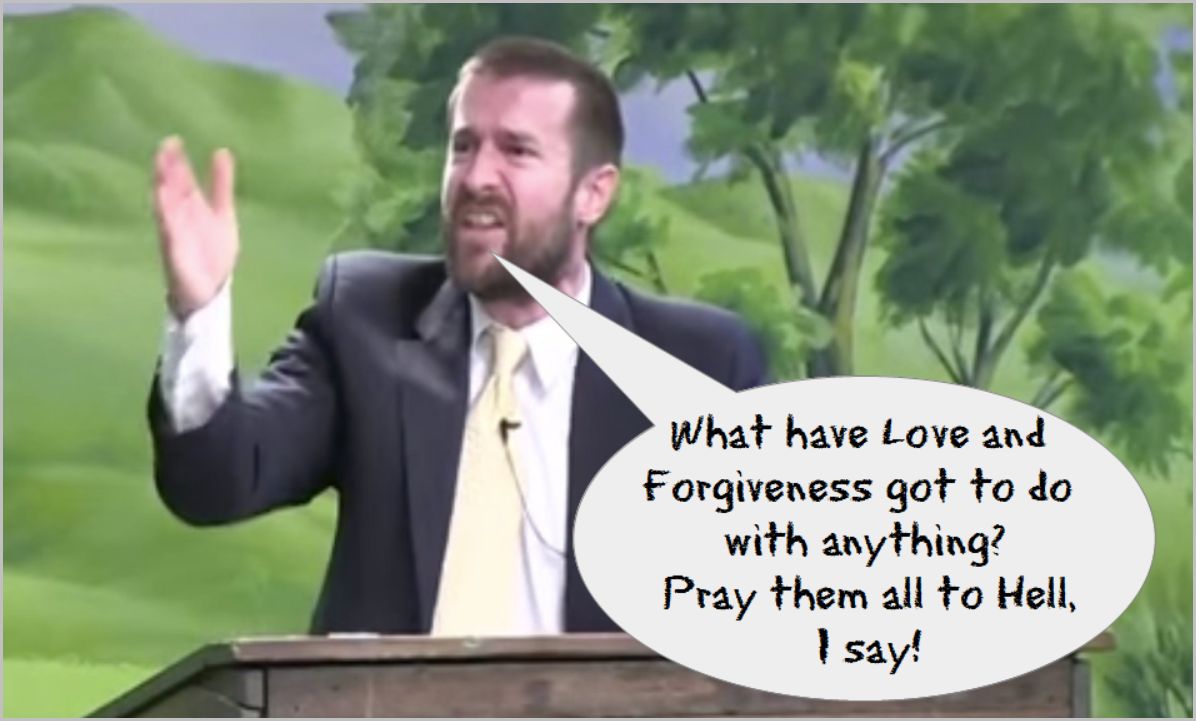
Jesus said, ‘Don’t judge so that you won’t be judged’ (Matthew 7.1). Our representative Christian says, ‘LGBT people are filthy and wrong.’

Jesus said ‘Love your enemies, pray for those who persecute you’ (Matthew 5.44). Our representative Christian says, ‘I’m gonna pray a transgender person dies and goes to Hell.’

Jesus said, ‘Love your neighbour as yourself’ (Mark 12.31). The Christian says, ‘The way to show love is to tell other people they’re going to Hell.’

Jesus said, ‘sell all you have and give to the poor’ (Mark 10.21). The Christian is concerned about where to buy jewellery: ‘…somewhere other than Tiffany’s, because Tiffany’s is gay friendly.’

Jesus said, ‘Forgive those who sin against you so you can be forgiven yourself’ (Matthew 6.14). Our believer rants, ‘LGBT people should be executed.’

Jesus said, ‘Don’t commit adultery and don’t get divorced’ (Matthew 5.27-28 and 19.9). Significant numbers of Christians , including our own Stephen Green, say, ‘that doesn’t apply to me.’

See what I mean? Christians regard the words of their saviour, not as having everlasting value, but as if they’re nothing more than worthless bits of fluff. Even if God were real, every word of the Bible true, every aspect of the Great Salvation Plan genuine, it wouldn’t change the fact that believers treat as optional almost everything Jesus commanded and live as if he never had.


* Why Christians Don’t Do What Jesus Tells Them To …And What They Believe Instead is available from Amazon worldwide (UK here, US here) but not, alas, from Tiffany’s.

The picture shows the deplorable Pastor Steven Anderson (linked above). He knows better than Jesus ever did.


Idiotic Stuff Jesus Said 11: Build Your Lives on the Things I Say

WhoDoJesus demanded you base your life on his teaching. It’s the only way, he said, that you’re going to find meaning, as well as the principles you’ll need when the going gets tough:

Everyone then who hears these words of mine and acts on them will be like a wise man who built his house on rock. The rain fell, the floods came, and the winds blew and beat on that house, but it did not fall, because it had been founded on rock (Matthew 7.24-25).

And what exactly were those words of his? Here’s what he taught:

  • The Son of Man was coming to the Earth to establish God’s Kingdom within the lifetime of his original followers (Matthew 16:27-28; Matthew 24:27, 30-31, 34; Luke 21:27-28, 33-34);
  • His own people needed to be more ‘righteous’ in order to be part of this Kingdom (Matthew 5.20; Matthew 6.33; Matthew 13.49 etc);
  • Being righteous entailed some extreme behaviour; loving your enemies, giving away all you had, turning the other cheek, forgiving repeatedly, being perfect (Matthew 5.44; Matthew 5.42; Luke 6.29; Luke 6.37; Matthew 5.48; Matthew 19.21);
  • It was crucial to obey Jewish law, even if some of it could be reinterpreted (Matthew 5.17-18; Matthew 12.1-7);
  • Once the Kingdom arrived Jesus himself would be King of the world, aided and abetted by his pals (Matthew 19.28; Luke 22.30);
  • His followers would do even greater miracles than he did himself. Given he controlled the weather, healed the sick and raised the dead, that’s going some (John 14:12).

Anybody know anyone who believes all of this or lives this way? Anyone who operates on these exacting principles? I don’t know of anyone and never have. I didn’t even when I was Christian myself. Jesus demands are impossible. No-one can live according to them. ‘Of course not,’ say Christians. ‘You need supernatural help to live like this.’ So why don’t they, when they have God’s spirit living within them (John 14.16-17)? Why don’t we see Christians who perform spectacular miracles, who constantly go the extra mile, who give away everything they have, who are, as Jesus tells them they should be, perfect?

We don’t because no-one can live as Jesus insisted they should. Nor do we see Christians who believe his prophecies either, particularly the one about the Son of Man bringing God’s Kingdom to Earth two thousand years ago. Christians pretend he didn’t really say it, or if he did, that he meant something else entirely. They’ve changed his very words – the ones they should be building their lives on – to claim Jesus himself will be returning any time now (the synoptic gospels are confused about whether Jesus is this Son of Man, or someone else). When he does, they say, true believers will be going with him to Heaven. Never mind that Jesus teaches nothing of the kind and there’s absolutely no foundation for these beliefs in his words. As such, they’re the faith built on sand he tells them is worthless:

And everyone who hears these words of mine and does not act on them will be like a foolish man who built his house on sand. The rain fell, and the floods came, and the winds blew and beat against that house, and it fell—and great was its fall! (Matthew 7.26-27).

So, if Christians don’t do what Jesus tells them and don’t believe his promises or prophecies, then in what way can it be said they take his words as the foundation of their lives? Don’t they, rather, base them on Paul’s teaching, about a supernatural Christ who bears little resemblance to the zealous Jewish preacher they pretend is their ‘Lord’? Teaching that has nothing to do with that of the man who demands his pronouncements be the very basis of life? Paul doesn’t quote any of Jesus’ teaching.  The foundation Jesus speaks of is of no interest to him; so, naturally, this is whom Christians follow – not Jesus, but Paul and his mythical Christ.

Christians have no time for Jesus’ words – and who can blame them? All he offers is impossible morality, false promises and failed prophecies. Far better to go with what Paul offers, because that’s about what’s in it for them. But even Paul didn’t believe anyone was going to Heaven, so they ignore that bit in his teaching too.

The View from Higher Ground

PopesLast week, the good people of Ireland voted to legalise same-sex marriage. Predictably, the Holy Men of the Roman Catholic Church have emerged from wherever it is they secrete themselves when they’re not in their frocks to condemn the outcome. Sour grapes the Holy Spirit prompts Cardinal Raymond Burke to whinge:

I was deeply saddened by the result… I think that you cannot just talk of a defeat for Christian principles, but of a defeat for humanity… I mean, this is a defiance of God. It’s just incredible. Pagans may have tolerated homosexual behaviours, they never dared to say this was marriage.

Of course, same-sex marriage is not ‘a defiance of God’, because there is no God, and marriage is a wholly human institution that we can arrange and change exactly as we like – but perhaps I’m splitting hairs here.

Also lost on the Cardinal is the irony that he speaks for a church (one of several as it turns out) that systematically abused children for many years, attempted to cover up its crimes, lied to victims and, when finally caught out, denied it had done anything wrong. A church, in other words, that has voided itself of all moral authority and has forfeited the right, if it ever had it, to judge anyone else’s ‘principles’ or ‘behaviours’. Those who voted for equality in the Irish vote were right to ignore and defy an organisation as dissolute and hypocritical as the Roman Catholic Church. That this church now believes itself to be in a position to condemn same-sex marriage demonstrates just how shameless and arrogant it is.

To add insult to injury, this Burke goes on to declare that the church should respond to the growth of equality, not with humility and gracious acceptance, but by intensifying its efforts to convert others to a corrupted, lifeless religion:

The church must take account of this reality, but in the sense that it must strengthen its commitment to evangelisation.

Because believing in Jesus, Mary and a whole load of other dead people will make the gay go away. Or something.

Talk about a defeat for humanity.

BurkeCardinal Burke can be seen modelling a fetching chiffon two-piece in – what else – Cardinal red, with a dainty lace number to complement. Here he demonstrates the fabulous fullness of both items, which, regrettably, are no longer available in sack-cloth or ash grey.

Money, Money, Money

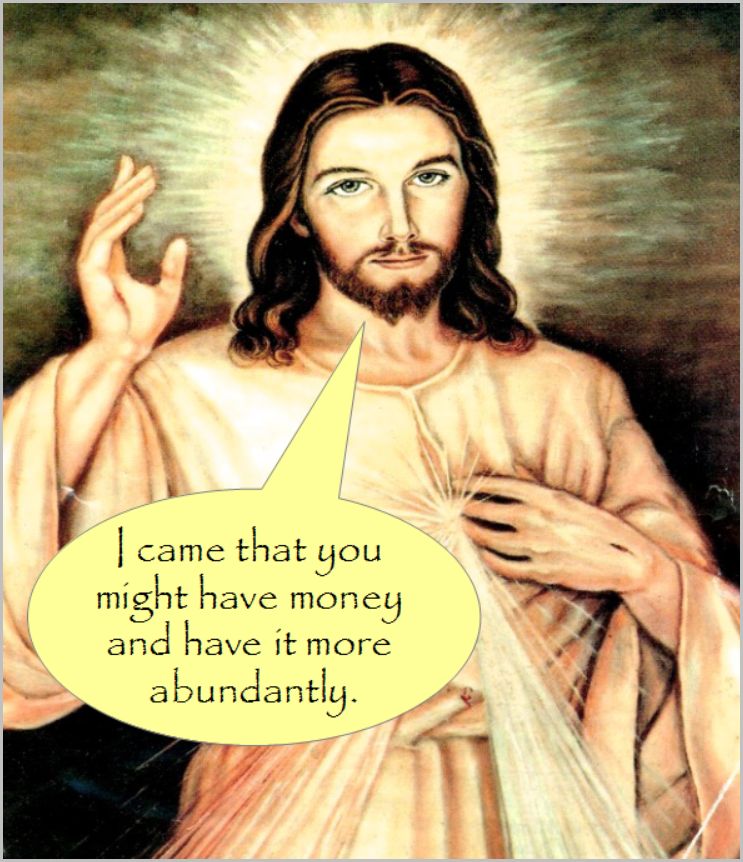
MoneyAfter the Kingdom-that-never-comes, what does Jesus talk about more than anything else? Love? Forgiveness? Marriage? Sin? No. While he does mention all of these, more of his teaching is to do with money and wealth. When he isn’t speaking about money specifically he’s using it as the background to a parable. Eleven of his thirty-nine parables involve it.

He had a thing about money. He resented the wealthy to such an extent he said it was unlikely they’d find a place in his new world order – the famous ‘camel through the eye of a needle’ saying of Matthew 19.24.

Come the revolution, he implied, the rich would have their wealth stripped from them (Luke 6.24-25).

He consigned the wealthy to Hell, not because they weren’t ‘saved’, but because they were rich and ignored the poor (Luke 6.19-25).

He seemed to think being poor was a virtue and that those who were, were especially favoured by God (Luke 6.20).

He preached against what he saw as the dangers of wealth and on more than one occasion (Matt 19.21 & Luke 12.33) and advised those with money and possessions that if they wanted God’s approval they’d have to give them away to the poor.

“No one can serve two masters,” he’s recorded as saying in Matthew 6.24. “Either he will hate the one and love the other, or he will be devoted to the one and despise the other. You cannot serve both God and Money.”

Jesus was no capitalist.

So what do Christians make of Jesus’ evident contempt for money? They certainly don’t give it all away as he said they should. Nor do they see it as an impediment to their salvation, even though Jesus was clear it is (Matt 13.22). As far as today’s Christian are concerned you can serve God and mammon, which is good news – just not Jesus’.

Most Christians in the modern west are incredibly wealthy in comparison with the rich of the first century whom Jesus castigated. Take a look too at the incomes of well known pastors and evangelists – Billy Graham is estimated to be worth $25 million, for example; Creflo Dollar $27 million (but he can still beg his flock for $60 million more to buy a new jet) and Benny Hinn $40 million (who did the same a few years ago). You can see why it’s imperative rich Christians get round Jesus’ injunctions about the evils of wealth somehow.

What is a Christian to do? What they always do when they don’t like what Jesus has to say: ignore him, or try to explain away what he actually said. So, enter the usual excuses: he was only speaking metaphorically/shouldn’t be taken literally/’really meant’ something else. And what did Jesus ‘really mean’ when he denigrated money? That it’s the love of money that’s the problem – doesn’t 1 Timothy say so? Indeed it does, but 1 Timothy was written a hundred years after Jesus. Already his message about wealth was being diluted; Jesus doesn’t make any nice distinction between possessing wealth and loving it. According to Jesus, having money is to love it (Matthew 6.21).

In that case, say those who really can’t countenance surrendering their wealth, money and/or the love of it is really only a problem when it comes between the believer and God. But to believe this necessitates overlooking Jesus’ repeated point that it always comes between the individual and God. Money, according to the radical, demanding Jesus of the synoptic gospels cannot be trifled with; it will always turn those who have it away from God, as well as from those who don’t have any (Matthew 6.21).

And that’s the problem, isn’t it. Jesus is – or was – just too radical and too demanding for those who profess belief in him. He can’t possibly mean that they should surrender their wealth and possessions for the sake of their spiritual well-being. And so they do exactly what he said they’d do: they put their money before God.

Never mind. They can always campaign against others’ so-called sin or whinge about the supposed loss of religious liberty, about which Jesus says nothing. Just so long as they don’t have to do what he says with their wealth because in an area where they have all the religious freedom in the world, they definitely don’t want to exercise it.


Christian Homeopathy

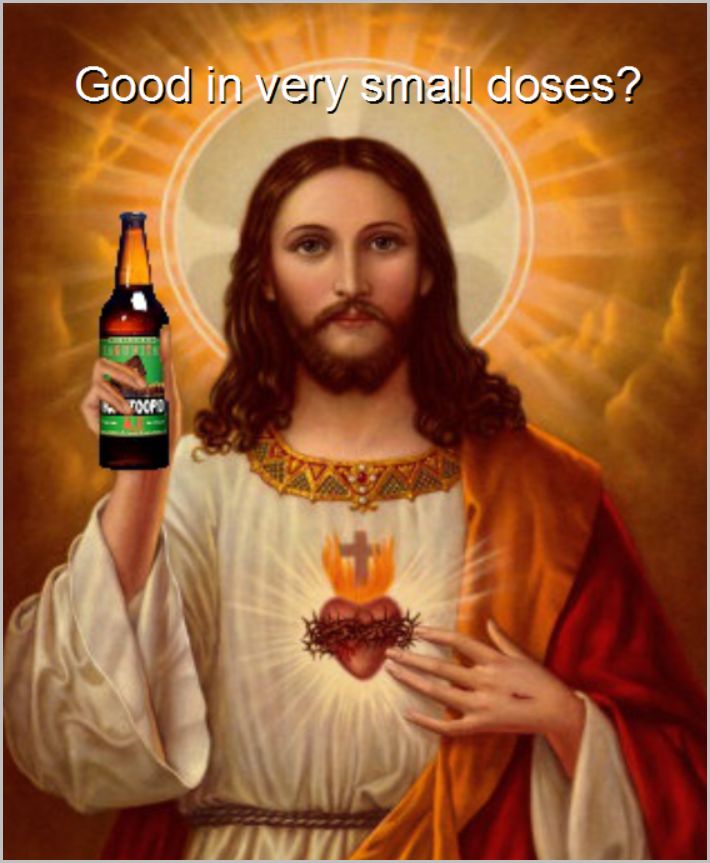
Drink2Homeopathy works on the ‘principle’ that in order to cure yourself of an illness or complaint you take natural remedies in a radically diluted form. Like, say, a couple of molecules of arsenic per reservoir of water. And it really works. It says so on the Internet so it must be true.

Biblical morality is a form of homeopathy. At least that’s how most Christians practise it: in miniscule amounts and only to their own taste.

Others remain strongly opposed to homeopathic marriage.

It only encourages them

HealDear Believer,

Let us be direct. We have to tell you, out of love, that we can never serve you in our restaurants, never teach you in our colleges, never supply you with goods we make, never sell you items from our shops. Why? Because of your fake faith.

Your belief in a mythical figure and in eternal life is a sin against the intellect. More than this, it causes you to act in mean-spirited, unloving ways. We cannot endorse such abhorrent, evil practices.

So if you come into our restaurants, classrooms, shops or offices wearing a cross or talking about your faith or praying, you will be turned away. We do this only because it breaks our hearts to see you lost in your delusion and to witness the damage you do to other people as a result of your beliefs.

It is our fervent wish, dear “Christian” friend, that by doing this we can lead you to abandon the illusory path you have chosen so that you may reclaim both your intelligence and humanity.

We hope you understand that all we say and all we intend to do, we do out of love and in the spirit of truth.

faithlessly,

The Freethinkers

What do you think? Too judgemental? Too much of a generalisation? Tars all Christians with the same brush? Unforgiving? Moralistic?

You’re right…

The original version of this letter is a long-winded, sanctimonious diatribe by right-wing Christian, Matt Barber. You can find the full thing at this link, but here are the highlights:

Dear homosexual,

…Let us be direct. According to the unequivocal moral precepts of biblical Christianity, explicit throughout both the Old and New Testaments, your homosexual behavior is sin. Sin is evil. Homosexual behavior is the central, defining characteristic of your counterfeit “gay marriage.” Therefore, “gay marriage” is evil. Christians are obligated to avoid sin – to “do no evil”…

It really is that simple. This is why, as faithful Christians (apostate “Christians” notwithstanding), we will never have anything whatsoever to do with your pagan, sin-based “same-sex wedding” rituals.

We will not bake your fake wedding cake.
We will not arrange your fake wedding flowers.
We will not take your fake wedding pictures.
We will not host your fake wedding reception.

We will not do these things because to do these things is to disobey God. It is to aid you in your sin, to cause you to stumble, which, in and of itself, is to layer sin upon sin…

We’re telling you no because we love you with the love of Christ. But understand this: As we are so commanded, we must, and do, hate the evil conduct by which you define your identity… what you do is wrong. Period. Full stop….

Dear “gay” friend, you will one day realize, hopefully before it becomes too late, that you are not only on the wrong side of history, you are on the wrong side of eternity.

It breaks our hearts to see you there.

And so we refuse to help send you.

Sincerely,

The Christians

Yes, definitely unforgiving and judgemental. Presumptuous too: Matt Barber speaks for all Christians? He writes and signs his letter in your name. Who appointed him to do that?

Arrogant in deciding we’re all sinners, gay people more than any. The whole sin thing is a specifically Christian mindset which – surprise, surprise – not all of us subscribe to, not least because it has little purchase in the real world.

Hypocritical that he condemns everyone, gay people more than any, but conveniently ignores the parts of his saviour’s teaching that says ‘don’t judge unless you want to be judged’ (Matthew 7.1). What does it feel like, Christians, when the tables are turned? Those of you, like Barber, who sit in judgement of others merit judgement in return. This is a sound Biblical principle, every bit as much as, or even more than, the ‘principles’ you use to condemn your ‘gay friends’ as ‘evil’. JC himself said so.

Ignorant too, of the scriptures that say ‘give to all who ask’ (JC again, in Luke 6.30-36). They don’t say, anywhere, ‘refuse to do anything for a group of people you don’t approve of.’ As Christians you’re not given that option, no matter how much you twist unrelated verses to endorse the position you’ve already chosen to take.

No, Christians like Barber who stand on ‘principles’ like these, who think they know the mind of Jesus while ignoring the very words he said are unchristian, unforgiving, unbiblical, arrogant and, whatever they may claim to the contrary, unloving. How attractive they make their faith seem.

Gentle Jesus – meek and mild?

StonedWhen it comes to derogatory and hateful remarks about minorities, Jesus is frequently given a pass. His ‘meek and mild’ persona – not one he actually had, but one he’s acquired over time – is brought into play to absolve him of all unpleasantness.

For example, and as liberal bloggers are fond of saying, here’s what he had to say about gay marriage:

                                                                                                                                            ”


Yup, that’s right; he said absolutely nothing about it – not directly anyway. But what Jesus did say, if ‘Matthew’ is to believed, was that he upheld the Jewish Law in its minutest detail:

Do not think that I have come to abolish the law or the prophets; I have come not to abolish but to fulfil. For truly I tell you, until heaven and earth pass away, not one letter, not one stroke of a letter, will pass from the law until all is accomplished. Therefore, whoever breaks one of the least of these commandments, and teaches others to do the same, will be called least in the kingdom of heaven; but whoever does them and teaches them will be called great in the kingdom of heaven. (Matthew 5.17-19)

That’s the Law that prescribes death for even the smallest infraction that he’s endorsing there. Here’s a brief sample of that Law and the penalty for breaking its petty rules:

Stone to death anyone who works on the Sabbath. (Exodus 35.2 and Numbers 15.32-36)

Kill publicly children who dishonour their father or mother. (Leviticus 20.9)

Stone to death anyone who blasphemes the name of the Lord. (Leviticus 24.16)

Execute a married couple who have sexual intercourse during the woman’s period. (Leviticus 18.19)

Put to death those involved in adultery. (Leviticus 20.10)

Execute any man who lies with another man, as with a woman. (Leviticus 20.13)

Stone to death at her father’s door any woman who is not a virgin on her wedding night. (Deuteronomy 22.13-14 and 20-21).

Sound familiar? With its oppressive brutality and liberal use of the death penalty, this sort of behaviour is like IS practices today. They’re both desert ‘moralities’, after all. And this is the law that Jesus advocates and insists remains in place until ‘heaven and earth pass away’. As that hasn’t happened yet, the Law, according to Jesus anyway, remains in effect. Never mind that Paul says it doesn’t – God himself, in the shape of Jesus Christ says it does. How’s that for meek and mild?

(Cue Christians referencing the story of the woman caught in adultery. That, however, is a late addition to the Bible and, in any case, Jesus only saves the woman because his beloved Law hasn’t been properly complied with.)

Thankfully, civilised human beings – and civilised Christians too – ignore Jesus and don’t seek to apply such old barbaric laws (though there are some believers who want to when it comes to LGBT people; see my previous post.) But if you want to know Jesus’ position on moral issues that he doesn’t pontificate on explicitly, just remember he fully supports the death penalty for adultery, homosexuality, working on the Sabbath, not being a virgin on your wedding night, having sex at the wrong time of month, dancing, listening to the radio, tweeting and texting… oh wait… now I have got him confused with Islamic extremists. It’s so easy to do.
Next time: Jesus says that the only way to gain eternal life is to follow this vicious Law with all its unreasonable demands.

No True Christian

WeekendA favourite response of Christians to any criticism is, ‘it doesn’t apply to me. I’m not that sort of Christian. The people who do or believe or think those things are not true Christians.’ This the ‘no true-Scotsman‘ fallacy.

  • You get it when you point out how God’s People™ agitate in Africa and Europe to deprive LGBT people of rights, protection and safety (unless of course you’re talking to a Christian who thinks this is a loving thing to do.)
  • You get it when you challenge Christians about Westboro baptist church’s activities, (the latest of which is claiming that Ebola is God’s punishment for Obama, which must be why he’s smiting poverty-stricken Africans.)
  • You get it when you mention those Christians who believe mumbo-jumbo that’s slightly different from theirs.
  • You get it when you ask them about any of the other deplorable things Christians do in Jesus’ name.

‘These other people are not true Christians,’ they say. ‘Their theology isn’t the same as mine; they’re misinterpreting the Bible; I wouldn’t do those kind of things; you’re picking out extremists.’

And do you know, Christians, those very people you say are not true Christians would say the same about you.

So what defines a Christian? Isn’t it that you accept Jesus Christ as your Lord and Saviour, profess him as such, and avail yourself of the salvation you think he offers?

Indeed it is. And it’s precisely this that you have in common with the Westboro baptist church, with those who peddle the absurd, with those who seek to damage LGBT people, with those who use their positions to abuse others and those with different ideas about what being a Christian is really all about.

You and they have bought into the same fantasy: they, like you, have accepted Jesus; they, like you, have his Holy Spirit in their hearts. That they do things you don’t approve of, or regard as embarrassing or despicable, doesn’t alter that fact. You’re all in it together; they represent Jesus just as much as you do; are as much a part of the ‘bride of Christ’ as you are. The zealots, extremists and wackos are your brothers and sisters in Christ, and if you’re right about Jesus being your Saviour – which of course you’re not; I’m being generous here – you’re going to be spending all of eternity with them.

So time to knock the ‘no true Christian’ excuse on the head – it’s going to be so embarrassing for you when you get to heaven.

Good For Nothing

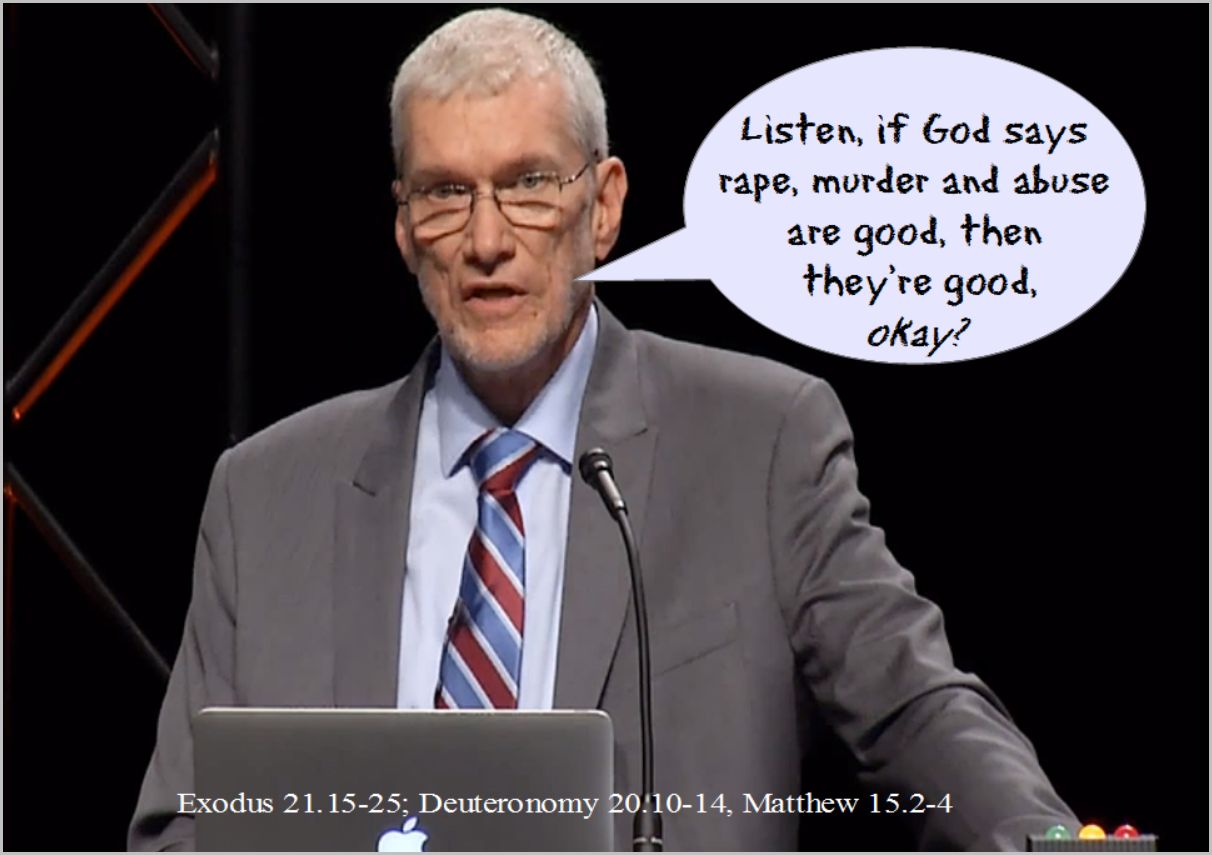
HamWhere does morality come from? Ken Ham of Answers In Genesis says it can only come from (his) God. Atheists have no grounds for morality, he claims, because, without a God to tell them, they’ve no way of knowing the difference between right and wrong .

As usual, Ham is being creative with the truth. Clearly atheists are as capable of being moral as anyone else. Equally and also evidently, Christians and other brands of believers are capable of deplorable immorality. Hardly a week goes by without more reports of Christians abusing, cheating, lying and killing in Jesus’ name.

Why do Christians act so despicably when, supposedly, they have God’s Spirit inside them – that’s the God from whom all morality flows, according to Ken Ham. Why doesn’t his indwelling Spirit guide Christians so that they always behave morally, or even just considerately?

I don’t have the answer. Perhaps Ken Ham or some other knowledgeable Christian can tell us.

No, morality doesn’t derive from any god. It has evolved, inevitably and like much of our behaviour, from our being social animals. Living in close proximity with other humans has meant we have developed ways of behaving that take these others into account, as well as the repercussions of our behaviour on ourselves.* The principle of treating others as we ourselves would like to be treated is very old – much older than Christianity.

Morality, though, is not absolute and is far from infallible. Non-believers, like the religious, make mistakes and don’t always treat others as they should. But the fact they behave well most of the time is evidence that behaving morally has nothing to do with a god, especially not the capricious, murderous psychopath of the Abrahamic religions.

Ken Ham’s position, and that of other religionists who tell us we have no grounds for morality without such a god, is as offensive as it is absurd.


* There are innumerable books that consider our moral evolution; you might like to try Frans De Waal’s Primates and Philosophers; How Morality Evolved or Christopher Boehms’s Moral Origins.


New series! Idiotic stuff Jesus said!

This one’s gonna run and run!

EyesYou hear the one about the blind Christian bloke with only one hand and no balls? And he did it all to himself! Cut off his hand, gouged out his eyes and castrated himself. When asked why he’d done it the man explained, ‘I’m a follower of Jesus and when he tells me to do something, I do it. My self-mutilation is my witness to what a great guy he is. He wouldn’t steer me wrong.’

Sure enough, the normal people who heard him were incredulous, until one of them looked in the Bible and found the very instructions to which the eyeless, testicle-free, one-handed believer referred.

In Matthew’s gospel chapter 5, Jesus is talking about lusting after a woman, which in his eyes (he still had both of his) is as bad as having sex with her. Course it isn’t, not by a long way, but he tells his followers, ‘If your right eye causes you to sin, tear it out and throw it away; it is better for you to lose one of your members than for your whole body to be thrown into hell’ (Matthew 5.29).

A bit drastic perhaps, but there it is; the Son of God is clear about how to avoid the sin of checking out a member of the opposite sex. That’s why you see so many one-eyed Christians around the place because they all take his admonition very seriously.

Except… you don’t. Either Christians ignore him entirely on this one or they never look at the opposite sex with an eye to sexual congress. We all know they’re like the rest of us in this respect – some, as Jimmy Carter once famously did, are honest enough to admit it – and some even act on it; the divorce rate among Christians is not the same as it is for everyone else just because they get tired of being married.

Perhaps though Jesus is being metaphorical when he proposes that gouging out one’s eyes is the best way to deal with lust. Not surprisingly, Christians prefer this possibility. In The Method and Message of Jesus’ Teachings, Robert Stein argues that:

what Jesus was seeking to convey to his listeners by this use of overstatement was the need to remove from their lives anything that might cause them to sin… Jesus is saying in effect, “Tear out anything in your life that is causing you to sin and keeping you from God”.

If that was his intention, Jesus might have actually used these words. If he wants to say ‘in effect’ that the believer should jettison anything from his life that causes him to sin then why doesn’t he?

But eyes are not enough. You gotta get rid of that wanking* hand too (the context of Jesus’ comments is specifically sexual and entirely male orientated throughout these verses): ‘And if your right hand causes you to sin, cut it off and throw it away; it is better for you to lose one of your members than for your whole body to go into hell’ (Matthew 5.30). This must be why we see so many one-handed Christians…

The difficulty with interpreting these and other verses metaphorically is that Christians want to claim that the Bible is the literal ‘word of God’ and then want select parts of it to be metaphorical – and guess who they think should do the selecting. But they can’t have it both ways. Even if they could, how would they know which parts to interpret literally and which symbolically? Perhaps the Holy Spirit tells them, or maybe, and more likely, it’s just their personal preferences. After all, who wants to lose eyes and hands just for being human?

If that’s not enough, Jesus encourages other mutilations for the sake of his Kingdom when he reveals in Matthew 19.12 that ‘there are eunuchs who have made themselves eunuchs for the sake of the Kingdom of heaven. Let anyone accept this who can’. No Christians today seem able to ‘accept’ this recommendation, either; what a truly feeble bunch they are, putting their testicles before the Kingdom!

It seems likely that, given he believed the end of the age was fast approaching, Jesus actually meant what he said, counting on the probability (as he saw it) that anyone who followed his ridiculous suggestions would not be eyeless or handless for long. They would, at the resurrection, be fully restored to live in the Kingdom where, according to Matthew 22.30, they would not be troubled by either impure thoughts or marriage itself (and so wouldn’t need those testicles anyway).

Whichever way you cut it (off) – literally or metaphorically – Jesus words in these verses are remarkably idiotic. Throughout history there have been some individuals, like the dude we started with, who have indeed made themselves eunuchs for the cause. But the vast majority of male Christians have always dismissed this advice or have decided JC was only speaking metaphorically (as he always is when they don’t like what he’s telling them to do).**

So next time True Believers start thundering on about the evils of same-sex marriage and gay sex, tell them to get their own house in order first. A little amputation is all that the Lord requires.


* ‘Jerking off’, for any Americans reading.

**Read more in my (five star reviewed!) book Why Christians Don’t Do What Jesus Tells Them To …And What They Believe Instead, available from Amazon.