Recent Encounters of the Religious Kind

2. Maria and the Evil One

devil

Maria comes to the door again. She’s very personable but wasting away her life as a Jehovah’s Witness. She wonders if I’ve read the leaflet she left last time. I have, and have filled in the answers to its questions, including, ‘does the Bible have the answers to life’s big questions?’ Maria doesn’t seem very happy about my answer.

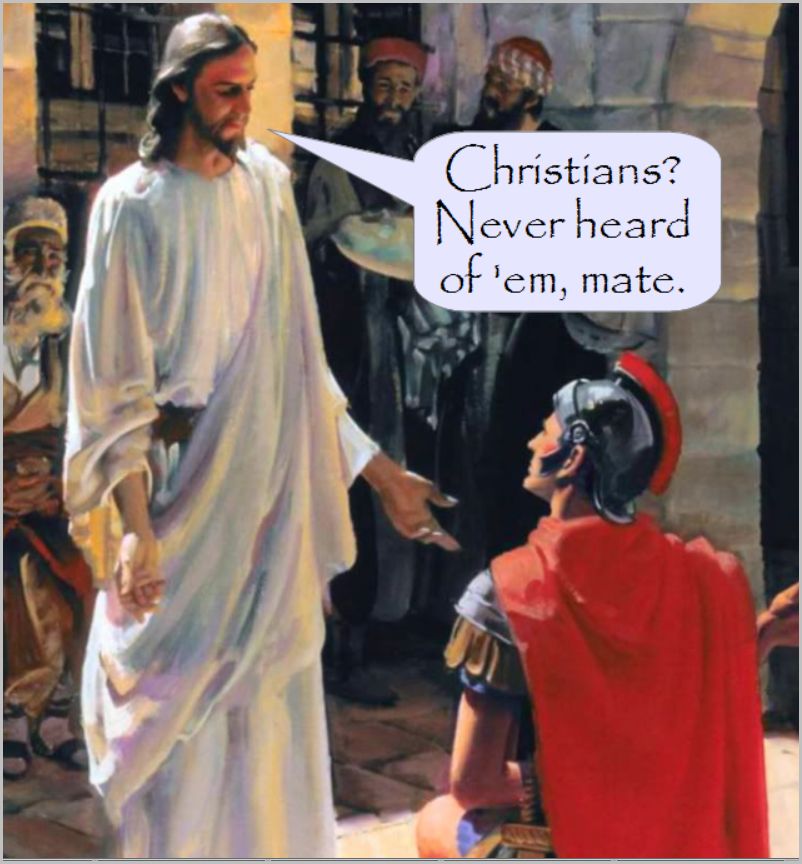
She insists on showing me a video on her iPad. It is slick and includes some clever CGI. She tells me afterwards that the ‘Evil One’ is in control of this world which is why it is in such a mess. I tell her that any mess is our own doing, we humans. She asks if I know the Bible; I say I do. She tells me that Jehovah’s Witnesses are the only ones who interpret it correctly. It doesn’t, she says, tell us that believers will go to heaven when they die (she’s right about this; it doesn’t). It promises rather that Jesus will be coming back to set up God’s Kingdom on Earth (right again). Except, I remind her, it has him promise that he will return within the lifetime of those listening to him, the Kingdom scheduled to appear within his own generation (Matthew 16:27-28; Matthew 24:27, 30-31, 34; Luke 21:27-28, 33-34). Maria concedes the point and then tries to say a generation is longer than we think. Maybe so, I say, but not 2,000 years.

Maria says she learnt something about this problem in a class recently. She appeals to her confederate for help, but he can’t remember what the elders said either. She decides now retreat is the better part of proselytising but promises to return once she has the answer.

But there is no answer; at least not one that sees Jesus’ megalomanic fantasies realised two millennia in his future.

I feel certain that, unlike Jesus, Maria will be back soon.


Did Jesus Exist? (part two)

WaterIf Matthew, Mark and Luke were creating a Messiah from scratch, or, more probably, recording the invention of believers who went before them, then it is unlikely they would have arrived at the loser preserved in their accounts. The Jesus we find there is nothing like the Messiah anticipated in Jewish scripture nor by Jews at the time.

He is a false prophet, his good news about the imminent arrival of the Son of Man and the Kingdom of God being patently unfulfilled. His ministry is a failure, ending as it does in ignoble execution. This is not the Messiah anyone would create if they were inventing one to satisfy the longings of a thwarted people. In particular, God’s emissary would not lose control of the situation in the way the Jesus of the synoptic gospels does. He would not allow himself to be executed by the occupying forces in the manner the gospels record. (All the surviving sources attest to his death by crucifixion; we can be fairly certain he died in this way.)

A created Messiah, on the other hand, would surely have announced the arrival of the Son of Man/Kingdom of God before leaving the stage of his own volition – ascending to heaven perhaps as some of the gospel writers eventually have him do – to await the unfolding of the events he had proclaimed. Of course, the death of a godman is a recurrent theme in the mythologies of the ancient world, so it is possible that an unpleasant death would be invented for an imaginary Jesus so that he complied with the trope. But, as I’ve already suggested, the central figure of the synoptic gospels is noticeably ungodmanlike. We only see him as such through the distorting prism of Paul’s theology; without this, we can see that the gospels of Mark, Matthew and Luke really don’t portray him like this at all.

It seems much more likely, therefore, that what the synoptic writers are conveying are distorted memories of an individual who actually lived. A man who promised much but whose mission went drastically wrong but which would, his earliest followers believed, be completed by God himself in the near future. This latter part is, as we now know, pure invention, the gospels conveying only an imaginative interpretation of this man. It would seem, nonetheless, to be an interpretation of someone – a charismatic Jewish preacher and failed heir-presumptive – who had actually lived some years before.

As I said at the beginning of this two-part post, I don’t really care whether Jesus existed or not. The end result is the same; millions of people seduced by a significance he did not have, either as a real person or as an imaginary construct. On balance, for the reasons I’ve touched on in these posts, it seems to me Jesus – Yeshua bar Yosef – did once exist. Like we all must, he died and others set about interpreting his life in their various, incompatible ways. These interpetations are all ultimately meaningless; we can be absolutely certain that, whatever the Bible and Christians today tell us, Jesus, whether he lived two thousand years ago or not, does not exist now in any shape or ethereal form.

Dear Christian

Christians

Dear Christian,

Jesus said treat others as you like to be treated (Matthew 7:12) so why do you treat them with abuse and unpleasantness?

Blog191(2)

Jesus said turn the other cheek (Luke 6:29) so why do you respond with insults?

Blog191(1)Jesus said don’t judge unless you want to be judged (Matthew 7:1) so why do you constantly judge and condemn?

Blog191(5)

Jesus said love your enemies (Luke 6:27) so why doesn’t it happen?

Blog191(11)

Jesus said don’t call anyone a fool (Matthew 5.22) so why do you call them far worse than that?

Blog191(4)

Jesus said don’t pray in public (Matthew 6.5) so why do you pray in public?

Blog191(7)

Jesus said sell all you have and give the money to the poor (Luke 18.22) so why don’t you?

Jesus said you cannot serve God and money (Luke 16.13) so why are some of you so obscenely rich?

CrouchHinn'sJet

Jesus said deny yourself (Matthew 16.24) so why do you indulge and promote yourself above all things?

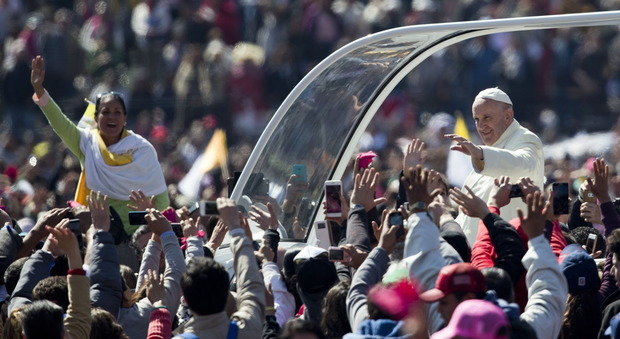
Blog191(8)OsteenPope Francis waves to the crowd, aboard the popemobile in Mexico City's main square, the Zocalo, Saturday, Feb. 13, 2016. Pope Francis kicks off his first trip to Mexico on Saturday with speeches to the country's political and ecclesial elites. The pontiff's five-day visit will include a very personal prayer at the Virgin of Guadalupe shrine. (AP Photo/Moises Castillo)

Jesus said ‘be perfect’ (Matthew 5.48) so why don’t we see you trying?

Sick

Jesus asked why you call him ‘Lord, Lord’ and yet don’t do what he tells you (Luke 6.46). Evidently he didn’t understand, as you do, just how many of his commands are optional. Thank goodness you know better than he did.

Get your free Porsche here*

*Or maybe notRaising

A True Story**

“So,” he says, “you might have an old banger now but when it finally packs in for good, we’ll upgrade it for you, free of charge.”

“You’ll upgrade it?”

“Sure. No problem. You see your old car is… well, I’ll be honest with you, it’s a really rubbish make. It’s a pile of crap to tell you the truth.”

“A pile of crap?” I splutter. “I can’t believe what I’m hearing. If it’s such a pile of crap why’d you sell me it in the first place? Why d’you sell them at all?”

“No need to get upset, mate,” he says. “As I said, when it’s completely clapped out we’ll replace it with a brand new one, free of charge.”

“Free of charge?”

“Yeah, that’s the deal. You wear out a lemon we give you a brand new Porsche.”

“A new Porsche? C’mon man, you’re winding me up. Why would you give me a new Porsche for nothing?”

“Because as I said, that’s the deal. Have a little faith man. It all works out.”

“Okay, I say. Well how about I get the Porsche now. Before this old rust bucket let’s me down completely.”

“Doesn’t work like that mate,” he says. “You get the banger first, the Porsche at the end.”

I tell him this makes no sense at all. “Look… Paul,” I say, reading his name off the dirty old name tag he’s wearing, “if you want people to have a completely free brand-new, top-of-the-range luxury car then you should just give it to them the first time they come in here. Forget the clapped out old banger bit. Just give them the Porsche.”

“Nah, mate. I’ve told you, that’s not the offer.”

“Okay,” I say, making one last effort. “Show me one person who’s benefited from this mad scheme of yours. Show me one person who’s driven away in a Porsche after their old vehicle’s reached the end of the road.”

“Listen, mate,” he says, “it’s like I said. You need to have a little faith.”

One person,” I say.

“Okay,” he mumbles, ”there are stories that the boss’s son did once…”

“The boss’s son? ‘Stories’? Christ, what sort of con are you operating here?”

“You’ve upset me now, you fool” he says, “and I’m not sure you qualify for the deal any more.”

I can only shake my head. “I’m not sure I ever did… mate,” I say.

*   *   *   *   *   *   *   *   *   *   *   *

**Yes, this really is a true story. You can find it in Paul’s first letter to the Corinthians (15.35-50). Here’s how it goes there:

But some one will ask, “How are the dead raised? With what kind of body do they come?” You foolish man! What you sow does not come to life unless it dies.  And what you sow is not the body which is to be, but a bare kernel, perhaps of wheat or of some other grain…

So will it be with the resurrection of the dead. The body that is sown (buried) is perishable, it is raised imperishable; it is sown in dishonour, it is raised in glory; it is sown in weakness, it is raised in power; it is sown a natural body, it is raised a spiritual body…

Flesh and blood cannot inherit the kingdom of God, nor does the perishable inherit the imperishable.

Right…


There’s good news and there’s good news…

Bat-Jesus

Mark, Matthew and Luke all tells us that Jesus preached the gospel when he was alive (Mark 1.14-15; Matthew 4.23, 9.35 & 10.5-7; Luke 20.1). So what was this gospel? What was Jesus’ ‘good news’? He had yet to die so it couldn’t possibly have been ‘you can be saved through my death and resurrection’ because this magic formula had yet to be arrived at by those who came later. Nor could it have been ‘accept my substitutionary atonement whereby I take the punishment you deserve in order to restore your relationship with God,’ for much the same reason. Nor could it have been, ‘you must accept me as your personal your saviour if you want to gain everlasting life in Heaven,’ because he didn’t regard himself in this way and he didn’t, according to the synoptic gospels, offer an eternity in Heaven. No, Jesus’ good news could not have been any of these because they are all later developments, mumbo-jumbo invented about him by others, not things he said himself .

Actually we needn’t speculate on what the good news was that Jesus preached because the gospels tell us: God was going to intervene in history very soon, rescuing his people from Gentile rule and setting up his Kingdom, in which he, Jesus, would be judge and king (Matt 24.27-34 & 25.31; Luke 1.33; 21.25-28). People, he said, referring only to Jewish people, should prepare themselves for this coming Kingdom by mending their ways (Matthew 10.5-6).

How soon would all this happen? In the lifetime of his hearers according to Mark 9.1, Matthew 16.28 and Luke 9.27, maybe even within a few weeks or months. When sending out the disciples to spread his good news he promised them, ‘you will not have gone through all the towns of Israel, before the Son of man comes (to usher in the new Kingdom)’ (Matthew 10.23). We can only assume that the disciples are back by now – in fact they return a few verses later – yet the Son of man still hasn’t materialised among the clouds in full view of ‘the tribes’ of the Earth (Matthew 24.30).

As the Bible records, Jesus was wrong in every respect; God did not set up his new Kingdom within the lifetime of those Jesus spoke to; the Son of man did not appear; the Romans were not overthrown; Jesus was not appointed judge and king of the world. The sarcastic inscription on his cross, ‘King of the Jews’, was the closest he came to having his self-aggrandising prophecy realised.

Is this the Jesus that Christians worshipped subsequently and still worship today? It ought to be as he’s the one revealed in the first three gospels. But the Jesus believers carry around in their heads is not this man. The ‘Jesus’ worshipped by Christians is primarily a construct of Paul’s – his ‘Christ’ – and their own collective imaginations. The mythical ‘Christ’ that Paul ‘did not receive from any man’, has replaced and almost obliterated Yeshua and his mistaken beliefs about the coming Kingdom (though Paul held on to the idea that it was indeed imminent; see 1 Thessalonians 4.15-17).

Admittedly ‘the Christ’ has had a far better shelf-life than Yeshua could ever have had on his own; the continual resurrection of the idea in the minds of believers – and only there – has ensured the perpetuation of the myth. When all is said and done, however, the Christ is nothing more than an imaginative recreation of a failed zealot with an altogether different gospel.* Yeshua’s good news of the Kingdom died shortly after he did and like him has stayed dead, its echoes preserved by Mark, Matthew and Luke and ignored by Christians everywhere.

* I’m aware there is a body of thought that gives primacy to the mythical god-man, ‘the Christ’, with the Jesus stories being seen as a later ‘in-fill’ designed to provide him with a plausible back-story. I’m not convined of this for several reasons, which I’ll explore at a later date.

Christianity: always winter but never Christmas

Spot the difference:Shore

Christians are hot on evidence.

There isn’t enough for evolution, they say, even though there’s an abundance.     

None, they claim, that the Earth is billions of years old, but only 6 thousand.

Not enough that climate change is man-made, when there’s considerable evidence it is.

None that there’s a genetic component to homosexuality when science reveals that there is.

But, as far as the resurrection of the body, judgement and eternal life in either Heaven or Hell are concerned, these they believe in, no evidence required.

I recently challenged Christians on Charisma magazine’s blog-site to provide or point me to evidence that any one of the 107 billion people who has ever lived who after they had died had gone on to enjoy either eternal life in Heaven or eternal punishment in Hell. Unfulfilled promises from magic books weren’t admissible, because a promise of something happening is not the same as it actually doing so. Jesus didn’t count either, as there are no eye-witness accounts of his bodily resurrection, only stories written decades after the supposed event. In any case he was half Vulcan or something, not an ordinary mortal.

Alas, my challenge went unanswered. You won’t find it on the Charisma site now because it has been removed by the moderator there. Expecting evidence from Christians for what they believe is patently unreasonable. After all, who needs evidence when you can exercise your licence to believe whatever you’re told?

Of course, there is no evidence of any resurrection nor of anyone who has gone on, post-mortem, to enjoy everlasting life. Have you noticed how everything about Christianity is either invisible – God, the Holy Spirit, Heaven, angels, demons – or lies permanently in the future; the Second Coming, the resurrection of the body, the Kingdom of God, judgement and eternal life? All of them always just that little bit further on. This year, next year, sometime, never. Just not now.

Yet Jesus, Paul, Revelation’s John and most other New Testament luminaries believed God’s Kingdom, the resurrection and judgement were coming within their own lifetimes.* Not one of them entertained the thought that 2000 years down the line none of these miraculous events would have materialised.

Small wonder then, that at the start of the second century, believers began to lose hope in the Second Coming, the Kingdom’s arrival and an earthly resurrection of the dead. Maybe, some of them began to think, eternal life would be not be here on Earth, as Jesus and Paul had promised, but in Heaven with God, which they most definitely hadn’t. This way, everything that hadn’t happened here on Earth would happen instead after death (we can see this transition taking place in the very late gospel of John). All of which was fortunate, because it dispensed with the need for confirmation and evidence; no-one could prove – apart from the fact nobody has ever survived their own extinction – that believers didn’t go to Heaven when they died. Equally, no-one could provide evidence they did.** How neat and convenient.

So if any Christians reading this would like to like to show us some evidence for the resurrection of the dead, post-mortem judgement, Heaven, Hell, God’s Kingdom on Earth – any of it – I’m sure we would all like to see it. Until then, I will go on regarding all of these assurances as empty promises – pie in the sky – that believers cling to desperately, while calling their desperation ‘faith’.

* See Matthew 16.27-28 & 24.27, 30-31, 34; Luke 21.27-28, 33-34; 1 Corinthians 15.51-52; 1 Thessalonians 4.15-17; 1 John 2:17-181; Peter 4.7; Revelation 1.1 & 21.2-4

** Psychics claim to commune with the dead of course, or at least with their spirits; more hokum from the minds of the deluded. Even if it weren’t, this isn’t the kind of resurrection Christians envisage for themselves. They dismiss psychics’ ‘evidence’ of life-after-death as so much demonic deception.

Faith: An Exercise In Futility

MountainsWhat is faith?

The anonymous author of the book of Hebrews says it’s ‘the substance of things hoped for, the evidence of things not seen.’ (11.1)

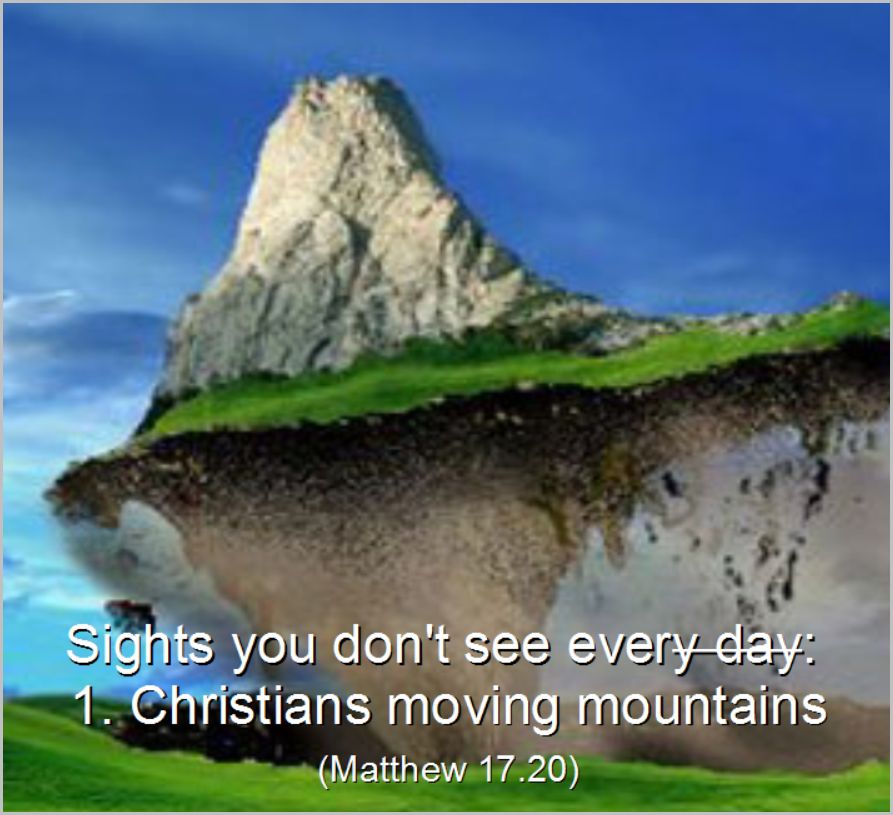
Hoping for ‘things’ like perfection, resurrection, eternal life, heaven (not to mention the ability to move mountains), the likes of which no-one has ever achieved, is nothing but wishful thinking. Despite what the Hebrews author says, wishful thinking isn’t evidence of anything – except a capacity for wishful thinking.

By it’s very nature, then, faith is not evidence, but the very opposite. It is the effort to believe in things for which there is no evidence and the delusional insistence that the imagined is more real than that which is.

Our Father

FatherJosh, our social worker, would always tell us that our father didn’t mean it. He didn’t mean to threaten and intimidate us. He didn’t want to have us cringing in fear of him whenever he came near. Josh said our father loved us really, in his own way. I think we knew that ‘in his own way’ really meant ‘not in the way anyone else would recognise as love’. But, Josh said, whatever it might look like, father really did love us. It was just, Josh said, that he was naturally short-tempered and really couldn’t tolerate what he judged to be our terrible behaviour, even though none of us was really what you’d call badly behaved. No more than most children, anyway. Just by being there, it seemed we irritated father to such an extent that he’d punish us severely, the punishments out of all proportion with our supposed misdemeanours. Dolores once spent the night in the coal shed because she forgot to ask father’s permission for something trivial. No-one could remember what the next morning when she was allowed back in, crying, shivering and covered in black dust. But father said she deserved it for being such a wicked child. He said we all did.

We’d appeal to Josh, of course, but he’d just say we should ask father’s forgiveness for our wickedness, but as we explained to Josh, it seemed to us that father was the wicked one. We couldn’t see what we’d done that we needed to ask forgiveness for. Josh said that this sort of attitude wasn’t going to get us anywhere except into more trouble. Didn’t we know father loved us very much? All the same, he said, he’d have a word with father on our behalf. ‘He’ll listen to me,’ he said, but it didn’t seem like he did. Father’s demands would become all the more exacting as he told us he expected more of us only for our own good. Then he’d punish us when we couldn’t do what he asked — when we weren’t what he asked, which seemed terribly unfair when we couldn’t be anything more than he’d made us in the first place. Maybe if he’d been around more and had shown us more love than he did, we might not have turned out to be such a disappointment to him.

As you might expect, we eventually lost all faith in Josh. He really wasn’t much use. He promised to fix things with father, but it always seemed like he was on father’s side rather than ours, and his threats still hung over us. We would never be good enough for him, even with Josh’s ineffectual interventions. So when we grew up we all left home. I don’t think any of us has any contact with father now. I’m fairly sure he’s dead, in fact. He has no more control over us anyway; we don’t live in fear of his threats and punishments. We’re finally free of him, thank God.

The Embarrassment that is the Old Testament

bible2

When does the Old Testament count and when doesn’t it? When does what it says matter and when doesn’t it?

The answer to both questions is when Christians say so. It counts when something from it can be used to underline how wicked the rest of us are and when they think it’s pointing to the coming of Jesus, many years in its future. It doesn’t, of course, foretell of Jesus as such, despite its predictions of a coming Messiah and/or Son of Man. Jesus doesn’t fit its descriptions of either of these figures. Rather, Jesus’ story is read back into the older texts, their characters and events forced to serve typological and prophetic purposes for which they were never designed. The entire endeavour, which began very early in the development of Christianity, is entirely back to front, with the gospel writers, Paul and other New Testament authors pillaging older Jewish texts and forcing them to fit Jesus retrospectively (and often laughably.)

Regarding ancient Jewish texts as an Old Testament – that is, as representing a previous agreement/covenant between God and his people that has since been superseded – is a political, interpretive manoeuvre of the later religion. (While it’s true Jesus is made to speak of a new covenant, it is debatable how authentic his words are; rewriting the past is not only confined to the New Testament’s treatment of the Old.) This kind of slippery manoeuvring was also endorsed by those who later compiled the Bible as we now know it,* when they relegated the writings that Jesus and all the New Testament writers would have regarded as sacred Scripture to nothing more than a forerunner of the real thing.

Believers want to hang on, naturally, to Genesis, because that’s where it tells them God created everything using nothing but magic and breath from his holy lungs. It relates too how everything went pear-shaped after some mythical people ate some fruit. Noah’s ark is there too, which is a jolly good fantasy, apart from that weird bit at the end where Ken Ham gets an eyeful of his old man’s old man (Genesis 9.20-27). Christians are less keen on those Old Testament stories where God instructs the Israelites to massacre other tribes (1 Samuel 15.2-3; Deuteronomy 2.34 etc) and rape their women (Isaiah 13.15; Zechariah 14.1-2 etc) but nonetheless they’ll defend these unpleasant, barbaric stories just because they’re in the Bible. The Psalms are nicer, what with their words of comfort and paranoia, but best of all are the Old Testament pronouncements that can be used for clobbering sinners. Leviticus 20.13 – ‘If a man lies with a male as with a woman both of them have committed an abomination; they shall be put to death; their blood is upon them’ – is a particular favourite, as is the story of Sodom and Gomorrah for much the same reason. But when it comes to other diktats, Christians are less interested; rules about not eating shellfish or wearing clothes of mixed fabrics, they are quick to point, are entirely negated by the new covenant; they don’t count any more, even though they’re in the same list of largely petty rules as the homophobic one (Leviticus 11.10 & 20.9.)

So how do Christians decide which Old Testament laws are applicable and which are now inessential? There is no shortage of know-alls Christian scholars who make it up as they go along and can tell them. It’s easy you see; the old ‘ceremonial’ rules of the old covenant are now redundant while the moral precepts still stand. Needless to say, the Bible itself suggests no such thing, with Jesus saying precisely the opposite in Matthew 5.17-18 and Luke 16.17; evidently another of his strange ideas that can safely be ignored.

So how do we know which of the Old Testament’s prescriptions are ceremonial and which moral? The same self-appointed experts can tell us this too, though it’s actually easy to work it out for oneself. As a general rule of thumb, verses that condemn other people are still applicable while those that Christians themselves don’t care for are not. So the shellfish and mixed fabrics directives can be disregarded, because obviously they’re ceremonial, while the anti-gay stuff isn’t – obviously. And there’ll be no public stoning of wayward teenagers (Deuteronomy 21.18-21) because that’s obviously ceremonial too – and don’t even think of having sex with the slaves, not even ceremonially. These days, thank God, it’s considered so uncivilised (even if, in Numbers 31.17-18, Yahweh says it’s okay. )

The Old Testament then; an embarrassment Christians are compelled to defend as part of their magic book but which they nevertheless feel free to use selectively, according to taste. Not unlike the New Testament really.

*There are, we should note, several variations of the Bible within Christendom; God can’t seem to decide which books are or are not part of his Holy Word.

2015: How was it for you?

2ndComingI promised this time last year to revisit my predictions for the year that lay ahead. So how did I do in my prophecies for 2015?:

The first was that there would be no Second Coming in 2015. Well, how wrong could I be! As we all know Jesus returned on September 13th, just as John Hagee hinted he would be. It’s been so great, hasn’t it, living in Hell / God’s Kingdom on Earth (delete as appropriate) since that time. Fantastic. I’m so pleased to have been wrong about this one.

On the other hand, maybe what I said last year still stands: Jesus won’t be back this year. Just like he wasn’t back in 2014, 2013, 2012… 1985… 1914… 1868… 1497… 1000… 446… 35. Just think of all those years – count ’em, nearly two thousand – when he’s failed to return so far. Actually, he promised he’d be back while his followers and those listening to him were still alive, around AD30 or thereabouts. Safe to say he’s not coming back at all, just like dead people don’t. Not in 2015, not ever.

Of course it still stands. As ever Christianity fails to deliver. That hasn’t stopped True Believers™ from telling us that he’ll be back very, very soon. Which was prediction number 2: Christians will go on believing that Jesus is going to return any day now. I gave up collecting examples well before the end of the year – there were just too many – but here’s a few of them: here, here, here, here, here, here and here. Will the gullible Born Again ever come to their senses and stop listening to idiots like these? (Nope).

Prediction 3. There’ll be no natural disasters or human calamities as a result of gay marriage. There have been lots of disasters and calamities during the year, but here’s the thing – natural disasters have natural causes, not supernatural ones, and similarly, human calamities have human causes. Not one of the events this year (or any other) was the direct result of gay marriage. This hasn’t stopped the religious from claiming – as I predicted they would in prophecy number 4 – that disasters and calamities are God’s punishment for gay marriage; here, here , here, here, here, here and here, for example.

Prediction 5: More than one prominent Christian will call for the execution of gay people. Yup. Here are those loving men of God doing just that (and here, here and here too). Jesus would be so proud.

Prediction 6: Christians in the west will claim they’re being persecuted when they’re being expected to treat others fairly and equally, and not to discriminate against them. Yes, I know Christians are persecuted in some parts of the world, but the moaners I’m talking about are only focused on their own self-serving, self-inflicted ‘marytrdom’. Again, there are just too many of these to link to them all, but here are a few (and here, here and here).

Prediction 7. Christians will respond to criticism with clichés like ‘they wouldn’t dare say that about Muslims’… ‘Christians are the last group who are fair game’… ‘It’s time for Christians to speak out’… ‘Stand up for God’s standards…’ etc. Yes, predictable in more ways than one

Prediction 8: Christians will continue to dismiss and disparage anyone who doesn’t share their views, especially atheists. Look out for ‘atheists have no morality’,’the fool hath said in his heart there’s no God’ and ‘atheists want to oppress Christians’ occurring with tedious regularity. And they didn’t disappoint: here, here, here and here.

Prediction 9: There will be more revelations about the abuse of children by church ministers. Of course there were. Christians may be new creatures in Christ but that doesn’t stop some of them behaving in the same old despicable ways, God love ’em.

Ditto number 10: Church hierarchies will attempt to cover up the abuse of children by their ministers. And here they are at it. The body of Christ certainly seems to have an unhealthy interest in the bodies of others. Still, they always ever so modestly cover up afterwards.

Prediction 11. There will be the usual manufactured ‘war on Christmas’. Ho-hum. And you can guess who did the manufacturing.

And finally I offered number 12: these predictions have far more chance of coming to pass than any of the so-called prophecies of Bible. And do you know, they did. That’s because none of the Bible’s predictions have ever come to pass – not those purportedly about Jesus himself, nor of the second coming, nor the judgement of sheep and goats, nor God’s Kingdom on Earth – and (here’s another prediction) they never will.

So, another year of empty promises, failed prophecies and superstitious fantasy in the wonderful, wacky world of religion. May you all be safe from the effects of faith and fundies in the one that lies ahead.