Less religion, not more

Welby

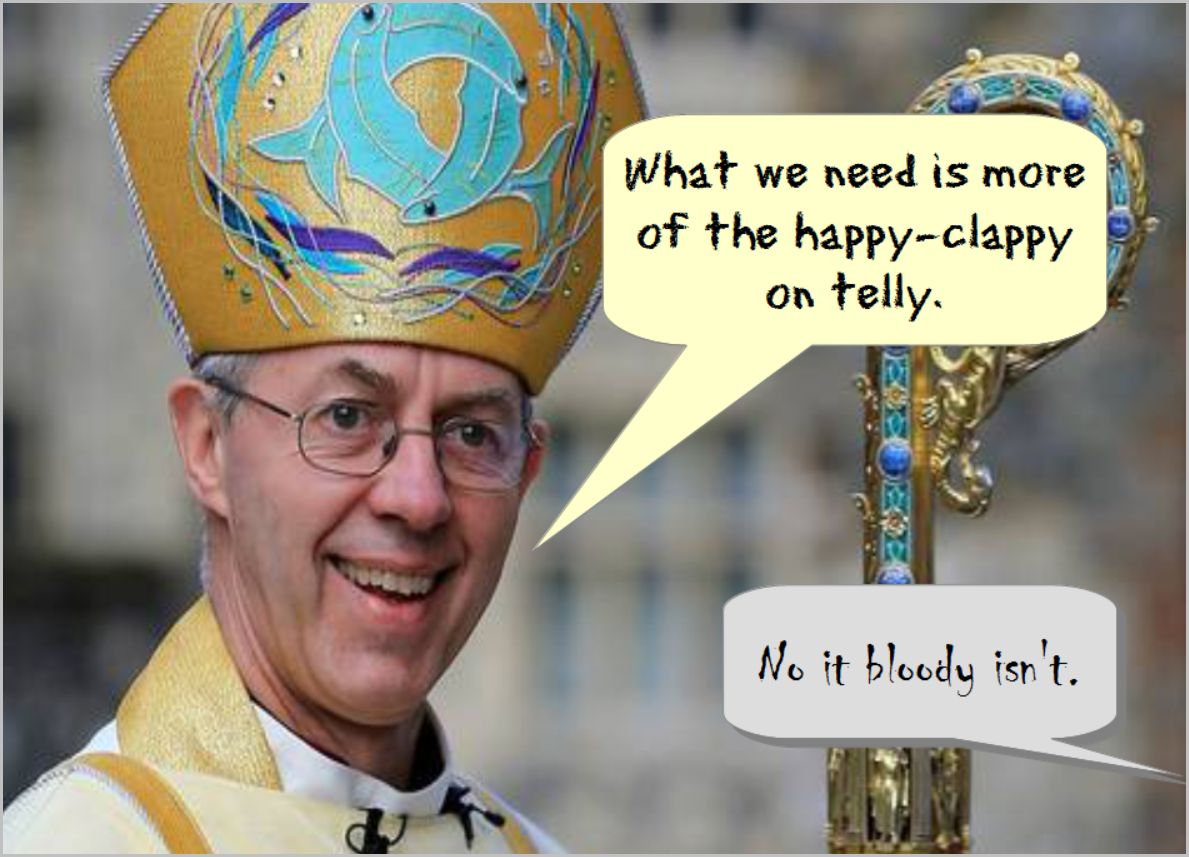
A bloke in a pointy hat and posh frock thinks there should be more religion on television and radio. Justin Welby, Archbishop of Canterbury, says that religion merits as much air time as politics, sport and drama.

The Archbish makes it sound like there’s nothing at all on TV and radio already about religion. In fact, in the last few months in the UK we’ve had a full schedule of Easter programmes; Simon Reeves’ The Ganges on BBC2 (looking at India’s religious heritage); Channel 4’s Unreported World and Dispatches, which regularly consider religious issues; Clare Balding’s trite Good Morning Sunday on Radio 2; the weekly broadcast of church services and daily Thought For the Day on Radio 4; the weekly dollop of worship on Songs of Praise on BBC1 and the 24-hour Christian ‘ministry’ of Trinity Broadcast Network and other God channels for those who just can’t get enough mumbo-jumbo.

Maybe that’s not as much as sport, but then there’s hardly anything on TV that has as much coverage as sport. (Bad news too for those of us with little interest in watching others running, jumping and hitting things; there’s even more to come in the shape of Wimbledon, Euro 2106 and the Olympics.)

Do we really want religion to have the same level of coverage? Are people really as interested in belief systems as they are in sport? Or music? Or art? Or comic book franchises? Even if there are, why is it up to television – the Archbish singles out the BBC as the broadcaster he thinks should indulge his fantasies – to provide it? Isn’t it, rather, up to churches, mosques, temples and other centres of superstition to promote their own particular brand of nonsense?

Make no mistake about it, this is what Justers is proposing; the promotion of religion – ‘religious literacy’ he calls it. He is not, we can be fairly sure, looking for programmes that are critical of religion (unless it’s other people’s). He wants, he says, to see more programmes that give us a better understanding of religious belief. What he means by this are proselytising programmes that create greater empathy for those who subscribe to delusion.

He isn’t advocating, for example, documentaries that explore the irrationality of faith, or ones that show the slap-dash, deceptive ways in which holy books came to be compiled or ones that demonstrate how most adherents to faith fail to live out its exacting demands. Nor is he suggesting programmes that focus on the appalling misery religion brings to some, or shows that give a sympathetic hearing to cults, sects and extremists. I would have no objection to programmes like these (except those that are sympathetic to extremists) because the ugly underbelly of religion deserves to be exposed, like Channel 4’s The Untold History of Islam of a few years ago, taken off air after its presenter was threatened with violence by those who didn’t like its critical perspective.

But these are not the kind of programmes the Archbishop is proposing. The religious literacy he wants us to have is of the cuddly side of faith, the supposed deep spirituality of the obsessive and what he regards as the positive contribution religion makes to the world; a one-sided picture already more than adequately covered by the nation’s broadcasters.

Thankfully, despite the recent political interference in the BBC, the Corporation is still required to present balanced and impartial views of its subject matter. If the Archbishop, who sits in the House of Lords and so is not without influence, is successful in forcing the BBC and other broadcasters to increase their coverage of his obsession, then we should also be able to look forward to programmes that are critical of religion too.

No broadcaster is obliged to promote religion nor to proselytise on its adherents’ behalf. Shame on the Archbishop, with his smiles and pointy hats, for suggesting they are.

Dear Christian

Christians

Dear Christian,

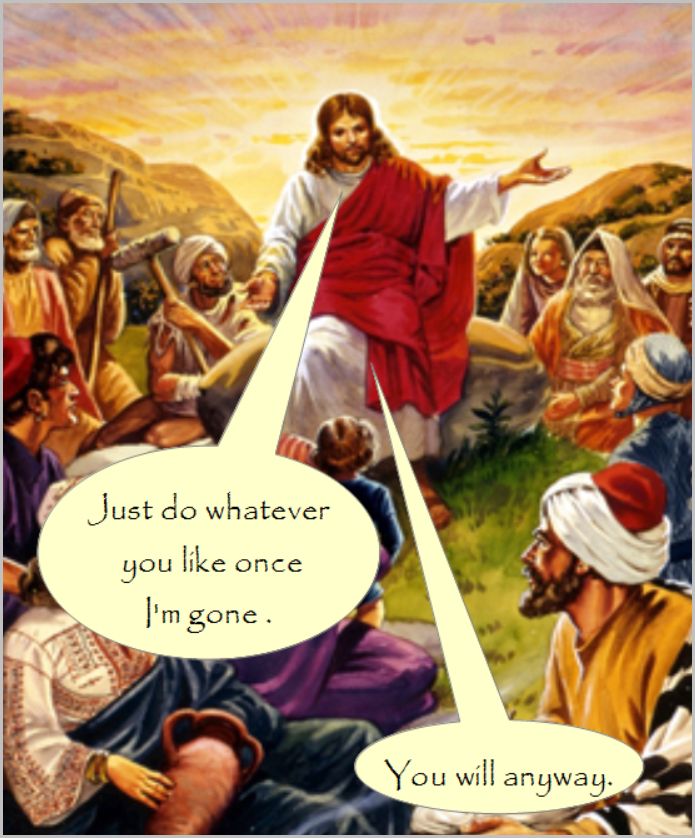
Jesus said treat others as you like to be treated (Matthew 7:12) so why do you treat them with abuse and unpleasantness?

Blog191(2)

Jesus said turn the other cheek (Luke 6:29) so why do you respond with insults?

Blog191(1)Jesus said don’t judge unless you want to be judged (Matthew 7:1) so why do you constantly judge and condemn?

Blog191(5)

Jesus said love your enemies (Luke 6:27) so why doesn’t it happen?

Blog191(11)

Jesus said don’t call anyone a fool (Matthew 5.22) so why do you call them far worse than that?

Blog191(4)

Jesus said don’t pray in public (Matthew 6.5) so why do you pray in public?

Blog191(7)

Jesus said sell all you have and give the money to the poor (Luke 18.22) so why don’t you?

Jesus said you cannot serve God and money (Luke 16.13) so why are some of you so obscenely rich?

CrouchHinn'sJet

Jesus said deny yourself (Matthew 16.24) so why do you indulge and promote yourself above all things?

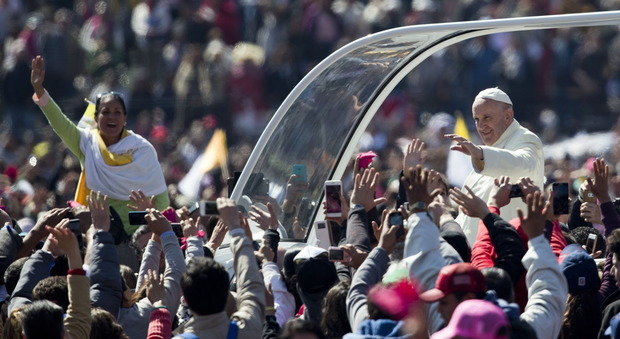
Blog191(8)OsteenPope Francis waves to the crowd, aboard the popemobile in Mexico City's main square, the Zocalo, Saturday, Feb. 13, 2016. Pope Francis kicks off his first trip to Mexico on Saturday with speeches to the country's political and ecclesial elites. The pontiff's five-day visit will include a very personal prayer at the Virgin of Guadalupe shrine. (AP Photo/Moises Castillo)

Jesus said ‘be perfect’ (Matthew 5.48) so why don’t we see you trying?

Sick

Jesus asked why you call him ‘Lord, Lord’ and yet don’t do what he tells you (Luke 6.46). Evidently he didn’t understand, as you do, just how many of his commands are optional. Thank goodness you know better than he did.

Get your free Porsche here*

*Or maybe notRaising

A True Story**

“So,” he says, “you might have an old banger now but when it finally packs in for good, we’ll upgrade it for you, free of charge.”

“You’ll upgrade it?”

“Sure. No problem. You see your old car is… well, I’ll be honest with you, it’s a really rubbish make. It’s a pile of crap to tell you the truth.”

“A pile of crap?” I splutter. “I can’t believe what I’m hearing. If it’s such a pile of crap why’d you sell me it in the first place? Why d’you sell them at all?”

“No need to get upset, mate,” he says. “As I said, when it’s completely clapped out we’ll replace it with a brand new one, free of charge.”

“Free of charge?”

“Yeah, that’s the deal. You wear out a lemon we give you a brand new Porsche.”

“A new Porsche? C’mon man, you’re winding me up. Why would you give me a new Porsche for nothing?”

“Because as I said, that’s the deal. Have a little faith man. It all works out.”

“Okay, I say. Well how about I get the Porsche now. Before this old rust bucket let’s me down completely.”

“Doesn’t work like that mate,” he says. “You get the banger first, the Porsche at the end.”

I tell him this makes no sense at all. “Look… Paul,” I say, reading his name off the dirty old name tag he’s wearing, “if you want people to have a completely free brand-new, top-of-the-range luxury car then you should just give it to them the first time they come in here. Forget the clapped out old banger bit. Just give them the Porsche.”

“Nah, mate. I’ve told you, that’s not the offer.”

“Okay,” I say, making one last effort. “Show me one person who’s benefited from this mad scheme of yours. Show me one person who’s driven away in a Porsche after their old vehicle’s reached the end of the road.”

“Listen, mate,” he says, “it’s like I said. You need to have a little faith.”

One person,” I say.

“Okay,” he mumbles, ”there are stories that the boss’s son did once…”

“The boss’s son? ‘Stories’? Christ, what sort of con are you operating here?”

“You’ve upset me now, you fool” he says, “and I’m not sure you qualify for the deal any more.”

I can only shake my head. “I’m not sure I ever did… mate,” I say.

*   *   *   *   *   *   *   *   *   *   *   *

**Yes, this really is a true story. You can find it in Paul’s first letter to the Corinthians (15.35-50). Here’s how it goes there:

But some one will ask, “How are the dead raised? With what kind of body do they come?” You foolish man! What you sow does not come to life unless it dies.  And what you sow is not the body which is to be, but a bare kernel, perhaps of wheat or of some other grain…

So will it be with the resurrection of the dead. The body that is sown (buried) is perishable, it is raised imperishable; it is sown in dishonour, it is raised in glory; it is sown in weakness, it is raised in power; it is sown a natural body, it is raised a spiritual body…

Flesh and blood cannot inherit the kingdom of God, nor does the perishable inherit the imperishable.

Right…


Are You Doing What Jesus Christ Says?

Billboard

Dale McAlpine, sometime commenter here and fanatical street-preacher in these parts, has posted a tasteful little video on his web-site – that’s the smugly named Repent.com if you’re interested – called Are You Doing What Jesus Christ Says? Take a look at it over on Repent.com or on YouTube; it’s ludicrously melodramatic and wonderfully over the top. You’re sure to enjoy its typos and spelling mistakes too.

What’s remarkable about it apart from these things is that, despite its title, it makes little reference to what Jesus is supposed to have said. Instead, it’s all about how you’ll go to hell if you don’t repent and accept him as your saviour; but Jesus never said this. It says you’re a ‘vile, wretched, hell-deserving son or daughter of Adam’ – Jesus didn’t say this either. It also insists you should let his cross ‘disrupt the very centre and citadel of your life of self’ (whatever that means) and guess what? This wasn’t part of Jesus’ teaching either. In fact, none of these claims were part of his ‘good news’.

Of the things Jesus did say – go the extra mile, sell all you have to give to the poor, turn the other cheek, avoid judging so you won’t be judged, give to all who ask, give away your shirt as well as your coat, feed the hungry, visit the sick, clothe the naked and love your enemies – the video makes no mention. Funny that. Maybe that’s why we don’t see Christians doing them very often.

So, Christians – and Dale too – are you doing what Jesus said or are you, like the video, only interested in pointing out others’ supposed sins and shouting about how they need to join you in your delusional mumbo-jumbo?

Yes. Thought so.

The Stuff Christians Say… (part three)

DoorToDoorAtheists are aggressive/militant/unreasonable: The Christians might’ve got us on this one. After all, it is incredibly irritating when we atheists start preaching in the town centre or invade others’ events to tell them what to believe or dish out loony pamphlets or turn up at people’s doors when they’re just about to have their tea. And what about all those meeting places we have, on just about every corner of the city, with smart-arse posters about Adam and Steve on the board outside? And let’s not forget our readiness to blow up ourselves and others in the name of our great cause. Now that’s ‘militant’! Yes, we atheists really do have too much freedom to push our views on others. No wonder we’re so insufferable. (Note to self: check you’ve got this right.)

It takes more faith to be an atheist than a Christian: It takes no faith to recognise there are no supernatural beings. It takes no more faith not to believe in God – or to acknowledge that there is no God to believe in – than it does not to believe in Santa Claus, Poseidon or Ra. Christians themselves require no great abundance of faith to dismiss these characters. Is it so difficult to understand that atheists disregard the Christian pantheon of fantasy figures in exactly the same way? Or are believers practising their dishonesty-for-Jesus again? There is no faith involved in being an atheist. On the other hand, believing in an omnipotent but suspiciously inactive God, a super-hero Saviour, a magic Spirit, angels, cherubim, seraphim, demons, Satan, resurrected saints, Heaven, Hell and all manner of powers and principalities – this requires faith in delusional quantities. No atheist could possibly compete. Nor would they want to.

Do No Harm

sermon2

If religions took ‘do no harm’ to heart (as the Hippocratic Oath does) and their adherents were made to comply with it, what a better place this world would be. There’d be –

No more religiously-motivated suicide bombers and terrorist atrocities;

No more murder in the name of the Lord (whichever);

No more children molested by priests and pastors;

No churches attempting to cover up their crimes;

No more child deaths as a result of ‘faith-healing’;

No religiously-sanctioned denigration and abuse of women;

No more ritualistic mutilation of children’s and young women’s genitals;

No more religious scams and shams;

No more religiously-inspired vitriol directed at gay and transgender people;

No more barbaric executions of ‘minorities’, like gay men, women and those of other faiths.

Of course, even without these, the world would still not be perfect. Awful things would still happen. But the principle of doing no harm would eliminate much of the trauma inflicted on people by the proponents of irrational superstition.

On paper at least, the Abrahamic religions have expectations that are more demanding than simply doing no harm:

Love your neighbour as yourself (Leviticus 19:18; Judaism);

Love your enemies; treat others as you would like to be treated’ (Matthew 7.12 and 5.44; Christianity);

…compete with each other in doing good (Surat al-Ma’ida, 48; Islam).

However, these are just too damned hard for so many religionists. They disregard them and opt instead for the spiteful paranoia of the same holy books. Perhaps the simpler injunction of ‘do no harm’ would be easier for them. But until the preachers of judgement and hatred find it in themselves to promote such a principle, we will all continue to suffer the destructive effects of the ‘great’ faiths.

So, how long until the next terrorist attack? The next church child-abuse cover-up? The next rape scandal? The next persecution of gay people?

      Not long at all.

           Praise the Lord (whichever)!


The stuff Christians say… (part one)

Jesus-Facepalm

On the day Christians remember the time Jesus allegedly spent being dead and buried (that’s one day, if you’re counting; what happened to the three he promised?) by going shopping or watching sport, let’s take a look at some of the nonsense they spout about atheists:

Atheism/humanism is of Satan: Given there’s no evidence for any supernatural beings, there can be no devil, Satan, Lucifer – or whatever other name Christians come up with for this fantasy figure. (Bizarrely, it’s Jesus who’s called Lucifer in Revelation 5.5) The devil is a creation of the human mind, intended to explain the nasty stuff in life and to let a supposedly good God off the hook. It follows that an imaginary being can’t make human beings be anything. The devil therefore does not make people atheists nor direct them in their ways.

Humanists/atheists set themselves up as God: Every manifestation of the god(s), including those that happen to be popular at present, is of human origin. Like all the others, the Christian God is a product of the human imagination that is made manifest only through human behaviour. So who is it who sets themselves up as God? Those who recognise that this creation of the human mind has no external reality, or those who claim an intimacy with the ‘Supreme Being’, believe his Holy Spirit lives within them and delude themselves into thinking they speak for him? No prizes.

Humanists/atheists worship man as God: Atheists don’t do this either. We are well aware of humans’ fallibility, inconsistency and capacity to bugger things up. However, we’re all we’ve got. There’s no God going to come and save us or solve our problems. We have to do it ourselves (or, as the case may be, not). Nor do atheists regard other people as wicked sinners who have no good in them – a particularly unhealthy viewpoint favoured by the religious – but this hardly constitutes ‘worship’.

Atheists hate God: Only to the same extent we ‘hate’ Santa Claus, Poseidon and Ra. You can’t hate (or rebel) against something that doesn’t exist. We do get very tired though of Christians foisting their views on us, insisting we should believe what they believe. And we get angry when they disparage others and attempt to curtail their freedom because they alone know what Jesus would want. But being angry about Christians’ unreasonableness is not the same as hating something that doesn’t exist.

To be continued

Is It Wise To Be An Atheist?

Tract

Christians say the funniest things… like ‘atheists can’t possibly know that there’s no God.’

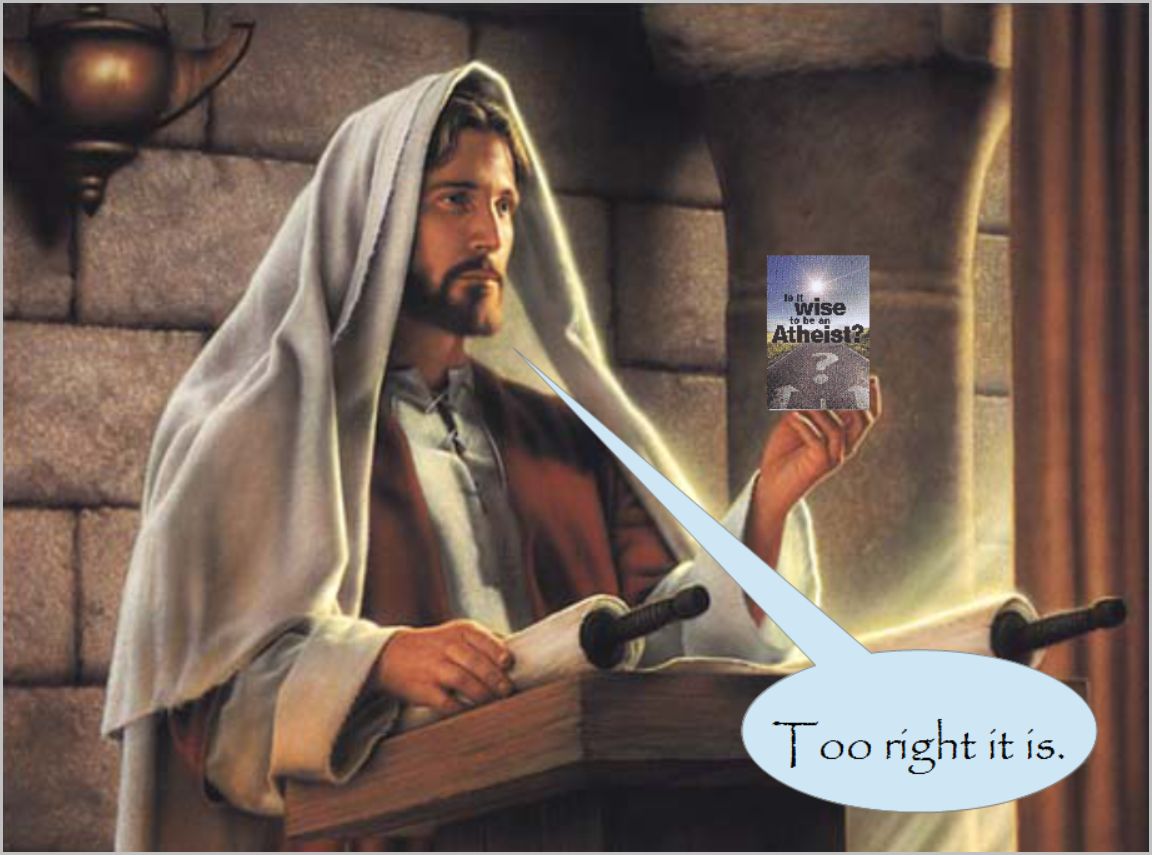
This is the argument expressed in a tract,  Is It Wise To Be An Atheist?, that I was given on the street the other day:

A person cannot really be sure there is no God (unless) they have existed for all time and have identified that God isn’t there; they have been everywhere and have seen that God isn’t anywhere and they know everything and therefore know for certain that God is non-existent.

Safe to say, these are not the same impossible criteria Christians apply when determining whether deities other than their own exist. Even Christians know that Allah, Zeus, unicorns and the tooth fairy don’t really exist. But without being immortal, omnipresent and omniscient, they cannot know for sure. By their own criteria, all mythical/supernatural beings have as much chance of existing as their God. Yet Christians do claim, with reasonable certainty, that other Gods and imaginary entities are not real. This is because determining the authenticity of entities is not about absolute certainty but probability and, yes, reasonable certainty.

For reasons I explore on this blog – here, here and here, for example – the likelihood that a god of some sort exists is low. That that god should then turn out to be the one worshipped by Christians today reduces the possibility still further, on the basis that the more conditions one adds to a proposition, the more improbable it becomes.

To put it another way, the probability that there is no god is already high; that there is no God as conceived by Christians is higher still. Therefore it is reasonable to conclude he does not. This is reasonable certainty; the same reasonable certainty Christians apply when dismissing all other gods.

Better luck next time, Christians.

Arguing for God

God3It’s a funny thing, but there aren’t hundreds of sites on the internet arguing for Barrack Obama’s existence. Nor the Eiffel Tower’s. Nor Australia’s. Nor the moon’s, nor the universe’s.

Why not? Because we have an abundance of empirical evidence that all of these things are real. People have experienced them first hand, can observe them and interact directly with them. There is no need to ‘prove’ or argue for their existence.

There are, however, hundreds of sites – plus books and broadcasts – that argue for the existence of God. This is telling. It is, whether those offering such arguments realise it or not, a blatant admission that there is no empirical evidence for him. If there were, there would be no need for argument and ‘proofs’; no need for apologists to resort to persuasion that is ultimately self-refuting to ‘demonstrate’ his existence. No need for apologists. Their problem is, of course, no-one has ever met God nor observed or interacted directly with him. Not in the same way people have met President Obama, seen him on the television, heard him speak or interacted with him in person. No-one has done anything of the kind with God, not even those who claim they have and feel compelled to tell us all about it. Every encounter with the Almighty has taken place in the mind of the individual experiencing it, just as St Paul admitted. God himself has never made an appearance.

So, yes, it’s very telling, this having to argue for God. If there was clear evidence of him there wouldn’t be any need to devise arguments for his existence; he’s not, or shouldn’t be, a philosophical proposition. An omnipotent, omniscient, omnipresent, creative being would, by dint of his immanence (presence in this world), be somewhat obvious and there would be incontrovertible evidence of his existence. Christians and other god-botherers say there is such proof, citing Nature, Goldilocks universes, Holy Books and personal experience. But these are far from incontrovertible, being much better explained by other means, none of which involve God. His very superfluousness demands that, through the application of Occam’s razor, he be discarded; not, as apologists would have it, rebranded as ‘transcendent’, a sleight of hand allowing them to proffer unreality as the ultimate reality.

The desperation to convince others there’s a God with an existence outside the human imagination is, then, more than adequate demonstration that there isn’t. Christians and others who want us to believe their God is real, protest much too much and in so doing, demonstrate precisely the opposite.

Our Father

FatherJosh, our social worker, would always tell us that our father didn’t mean it. He didn’t mean to threaten and intimidate us. He didn’t want to have us cringing in fear of him whenever he came near. Josh said our father loved us really, in his own way. I think we knew that ‘in his own way’ really meant ‘not in the way anyone else would recognise as love’. But, Josh said, whatever it might look like, father really did love us. It was just, Josh said, that he was naturally short-tempered and really couldn’t tolerate what he judged to be our terrible behaviour, even though none of us was really what you’d call badly behaved. No more than most children, anyway. Just by being there, it seemed we irritated father to such an extent that he’d punish us severely, the punishments out of all proportion with our supposed misdemeanours. Dolores once spent the night in the coal shed because she forgot to ask father’s permission for something trivial. No-one could remember what the next morning when she was allowed back in, crying, shivering and covered in black dust. But father said she deserved it for being such a wicked child. He said we all did.

We’d appeal to Josh, of course, but he’d just say we should ask father’s forgiveness for our wickedness, but as we explained to Josh, it seemed to us that father was the wicked one. We couldn’t see what we’d done that we needed to ask forgiveness for. Josh said that this sort of attitude wasn’t going to get us anywhere except into more trouble. Didn’t we know father loved us very much? All the same, he said, he’d have a word with father on our behalf. ‘He’ll listen to me,’ he said, but it didn’t seem like he did. Father’s demands would become all the more exacting as he told us he expected more of us only for our own good. Then he’d punish us when we couldn’t do what he asked — when we weren’t what he asked, which seemed terribly unfair when we couldn’t be anything more than he’d made us in the first place. Maybe if he’d been around more and had shown us more love than he did, we might not have turned out to be such a disappointment to him.

As you might expect, we eventually lost all faith in Josh. He really wasn’t much use. He promised to fix things with father, but it always seemed like he was on father’s side rather than ours, and his threats still hung over us. We would never be good enough for him, even with Josh’s ineffectual interventions. So when we grew up we all left home. I don’t think any of us has any contact with father now. I’m fairly sure he’s dead, in fact. He has no more control over us anyway; we don’t live in fear of his threats and punishments. We’re finally free of him, thank God.