How it is

God5

It all depends on the premise from which you begin. I’m tired of the arguments of Christians of all stripes that

   The bible is the inspired word of God

      Jesus died for me

          He really did rise from the dead

                Jesus was, in some sense, the son of God

                     God, or Jesus, loves us and wants to have relationship with us

                          God, or Jesus, will forgive our sins if only we ask him

                            He has supernaturally changed the lives of millions

               We are all, whether we realise it or not, involved in a spiritual battle

       Jesus is coming back soon to judge the world

Most people will go to Hell, a select few to Heaven

We can argue with Christians about these claims – and others you can probably think of yourself – pointing out how the Bible really can’t self-authenticate itself, that just because it appears to say it’s the Word of God doesn’t mean it is; arguing about who wrote the gospels and whether they can be trusted; disputing the resurrection when the bible’s own accounts are so inconsistent; challenging the theology behind Paul’s redemption formula… and so on.

But really, why bother? Take a step back.

All of these ideas are dependent on one thing: that there is a God.

Yet there is no evidence there is. Christians will tell us that that the absence of evidence doesn’t necessarily equate with evidence of absence, but in this case it does. The absence of evidence that I keep a pink unicorn in my garage is fairly conclusive evidence that I don’t – and so it is with God. The evidence for him is circumstantial and so remarkably thin that the probability he exists is virtually zero (I’ve discussed this previously; here, for example). What humans have imagined him to be is not evidence of his external reality; a book written by superstitious sheep-herders and first century fanatics certainly isn’t. And beyond that? Nothing.

It follows that if God doesn’t exist then

       the Bible can’t be his inspired word;

                    Jesus cannot be his son;

                       God cannot have sent Jesus to redeem us;

                            he cannot have raised Jesus from the dead;

                                  he cannot be offended by ‘sin’;

                                        it cannot be God who changes lives;

                                  heaven and hell are not real;

the whole panoply of supernatural beings that populate the bible don’t exist either.

Take away God (and he was never there in the first place) and Christianity with its claims of the supernatural, salvation and eternal life, crumbles to nothing. It is nothing.

So it all depends on your premise. If you’re prepared to believe, against the evidence, that God exists you’ll find substance in the claims of religion. If you recognise that he doesn’t, however, you will also recognise that religion’s claims are illusory, fallacious, deceptive. No need to get involved in fruitless arguments with believers about it; that’s how it is.

“Christian” Scare Quotes: A Response

JesusLaughs

Christian bloggers like their quotation marks – ‘scare quotes’ as they’re often known. The Righteous wear away the computer keys with them on when ranting writing about same-sex “marriage” in particular. This kind of marriage always receives them, even though marriage is marriage whether same-sex or not. Those who like to use and over-use them, however, intend to show that same-sex marriage isn’t marriage at all but a devilish, unbiblical substitute for the real thing.

The Christian Research Network (a misnomer if ever there was one: the site only ever features two contributors, involves no research and is distinctly unChristian) regularly adds speech marks to other terms and titles. The Pope, for example, becomes “Pope Francis”, and the fact Francis is not his real name is constantly highlighted. This is intended to show, presumably, that he lacks authenticity. The irony is that the figure whom Christians themselves worship and adore isn’t known by his real name either, a fact lost on “God’s chosen”. Yeshua Bar Yosef wouldn’t recognise “Jesus” and certainly not “Jesus Christ”.  Then there’s “Paul”, real name Saul. Christianity’s use of false names is nothing new.

My proposal, therefore, is that from now on, whenever we write “Christians”, we add quotation marks to the term to reflect the hypocrisy of so many of them, as well as the vacuity of the belief system itself. This can be done even when speaking of “Christians”, by wiggling the fingers as the word is said. It can, and should, be extended to all of the other fallacious ideas within Christianity: “God”, “Jesus”, “God’s Word”, “The Kingdom of God”, “Holy Spirit”, “Heaven” and “faith”.

We needn’t worry about running out of quotation marks with which to do this; we can always use those that “Christians” have previously attached to same-sex marriage.

Jesus demonstrates that God doesn’t exist

300th

I often feel I’ve run out of thing to say about Christianity, or rather, I think I’ve said all I want to say about it. It’s not much of a challenge to show how insubstantial, inconsistent and spurious religious faith is. None of it actually works, even though Christians, in the face of all the evidence, continue to insist it does.

On his Theological Rationalism blog,  James Bishop smugly tells his readers how he can ‘defeat atheism’ with three questions, chief of which is asking, ‘What would you count as “actual, credible, real world evidence for God?”’ Although I’ve already responded directly on his blog, for me it would be if any of the promises Jesus made (or was made to make) actually came true in the ‘real world’. 

Jesus said that Kingdom of God would descend on the Earth within the lifetime of his original followers, in Luke 21:27-28, 33-34; Matthew 24:27, 30-31, 34 and here in Matthew 16:27-28:

For the Son of Man is going to come in his Father’s glory with his angels… I tell you the truth, some who are standing here will not taste death before they see the Son of Man coming in his Kingdom.

Did this come true when he said it would?

He claimed that the judgement of the nations and their peoples would immediately follow, with the righteous going on to populate the new Earth while the wicked were sent to eternal punishment: 

But when the Son of Man comes in his glory, and all the holy angels with him, then he will sit on the throne of his glory. Before him all the nations will be gathered, and he will separate them one from another, as a shepherd separates the sheep from the goats (Matthew 25.31-46).

Did this?

He promised that whatever his followers pray for in his name, God would grant. No ifs and buts, he would do it. Matthew 17.21, Matthew 21.21-22, John 14.12-14 and here in Mark 11:24:

…if you do not doubt in your heart, but believe that what you say will come to pass, it will be done for you. So I tell you, whatever you ask for in prayer, believe that you have received it, and it will be yours.’

Does this ever happen?

He said that with enough faith, believers would literally be able to move mountains. (Matthew 17.20).

They literally don’t.

He guaranteed that his followers would be able to drink poison and handle serpents with impunity (Mark 16:18).

Those who are stupid enough to take him at his word find they can’t.

He said ‘very truly’ that believers would be able to do even greater miracles than he himself did:

Very truly I tell you, whoever believes in me will do the works I have been doing, and they will do even greater things than these, because I am going to the Father (John 14.12).

Where’s the evidence of this?

The fulfilment of any of these promises would be enough to convince atheists – well, me anyway – that Jesus’ God exists. If those about the Kingdom and judgement had come to pass when Jesus said they would, we wouldn’t even be having this discussion. I could still be convinced, however, if his guarantees of miracles and answered prayers regularly came about in the spectacular ways he said they would. The fact is, they never have done and they don’t; the world would be a very different place if they did.

All that the ridiculous claims Jesus makes for his God convince me of is that Jesus himself was, at best, deluded, and at worst, an utter fraud – a travelling salesman who promised the Earth and delivered absolutely nothing. His unfulfilled, empty promises are evidence enough that his God, like all the others, does not exist.


Judgement Day

Franklin2

And the Lord said to them, ‘Let’s have a look how you got on. You fed the hungry, right?’

And they answered, ‘Well, we gave some money to charity a couple of times and we’re pretty sure the charity fed the hungry for us.’

‘Okay,’ he said, ‘I suppose I can give you some credit for that, though I have to say I was looking for something a little more… hands on. How about when people were naked – you know, needing their material needs met. How’d you get on then?’

‘The charities did that too, we think. Maybe.’

‘And the sick and imprisoned? You bother with them?’

‘Not so much,’ they answered. ‘Look, Lord, if people can’t take care of their own health needs or choose to live lawless lives, then that’s up to them. It’s really not up to us to help them out, now is it.’

‘I see. So how about the stranger, the homeless, the immigrant? You take any of them in? You cared for them?’

‘Well, no. I mean, if you’d said that’s what you wanted doing we would’ve done it, wouldn’t we. But you didn’t make it clear.’

‘I thought I had,’ he said. ‘Maybe it got lost somewhere in translation. Selling all you have to give to the poor, then? Surely some of you did that.’

‘One or two extremists maybe, but look where it got them. Obviously that daft instruction was meant only for the guy you were talking to – you know, the rich young ruler or whatever he was.’

‘Well, not exactly. I said it so many times in so many ways you’d have thought you’d have got the message.’

‘We’re not socialists, you know, even if you are,’ they said.

‘So how about turning the other cheek, then? Or going the extra mile? Giving to all who ask? Surely you managed those?’

‘Well, no. We felt you were speaking metaphorically when you said all that. You didn’t seriously expect us to do such ridiculous things, did you? I mean, we’re not doormats.’

‘So what is it you did in my name?’

‘Well, we accepted you as Lord and Savior. That’s all that’s required, isn’t it?’

‘Not really,’ he said. ‘Not if you didn’t do as I asked.’

‘Lord, Lord,’ they said, becoming exasperated. ‘We’re washed in the blood of the lamb. Sanctified and redeemed.’

‘You’re what?’ he said.

‘Sanctified and redeemed. Made spotless. You know, like Saint Paul explained.’

‘Saint who?’ the Lord said.

‘We worshipped you and praised your holy name,’ they went on. ‘Filled with your Holy Spirit we witnessed unto you and defended your Holy Word.’

‘But you didn’t actually do as I commanded?’ he said. ‘And you think that’s good enough?’

‘We stood up for you and for family life. We spoke out against unbelievers and sodomites and all those who were unholy, lest they bring down the Father’s wrath on all of us.’

‘You didn’t consider that to be judging, then?’ he asked. ‘Something else I told you not to do?’

‘Oh no, Lord, not really. We decided what you really meant was it was okay to judge so long as it was done righteously. We always judged righteously, so that was fine.’

‘Well,’ he said, ‘what can I say? You came up with a much better agenda than the one I left you with. Come in and dwell in the house of the Lord forever. You’re my kind of people.’

And, lo, the self-righteous stepped forward, ready to surge into heaven.

But he stopped them in their tracks. ‘Now you just hold on,’ he said, ‘I was being metaphorical there,’ and he stood up to his full height and cleared his throat. ‘Here’s the deal,’ he said, ‘Not everyone who keeps saying to me, ‘Lord, Lord,’ will get into the kingdom from heaven, but only the person who keeps doing the will of my Father in heaven… So, get away from me, you who practise evil. I never knew you.’

‘What?’ they said. ‘We didn’t think you really meant that. We’re washed in the blood of the lamb, you know.’


Bible Blunders #568

Zechariah

Over Christmas I heard again the account in Luke, chapter 1, of Mary and Elizabeth’s miraculous pregnancies. The story includes one of the most laughable blunders in the bible.

In what is clearly a re-write of the story in Genesis 17 about Abraham and Sarah, John the Baptist’s father-to-be, Zechariah, is told by an angel that his elderly wife will soon become pregnant. Zechariah, like Abraham, has his doubts and is immediately struck dumb because of his lack of his faith. When the child is born, Elizabeth announces he will be called ‘John’ as per the angel’s instructions. However, according to Luke 1.61-63 ‘the people’ (which people?) thought this a bad idea and said to Elizabeth:

“No one in your family has ever been named John.” So they motioned (‘made signs’ in the NIV) to Zechariah to find out what he wanted to name his son. Zechariah asked for a writing tablet.

Wait – they motioned to Zechariah? Why? He’s been struck dumb – he’s not deaf; he’s perfectly capable of hearing them. Then he asks for a writing tablet. He asks? He doesn’t ‘motion’ for it like the others have just done? It seems he can speak again suddenly – but in that case, why does he need the writing tablet?

Looks like Luke got a might confused here, forgot ol’ Zech had been rendered speechless and thought, for these two verses only, that he’d made him deaf.

And this, brethren, is the Inspired Word of God™.


What has God ever done for us?

Noah

Back in my Christian days, I used to sing a hymn with a line that went ‘give and give and give again what God has given thee’. It was a fine if largely ignored sentiment – like those of similar nature demanded by Jesus – but I was reminded of it recently on hearing for the umpteenth time of just how much God has given us.

Join me in taking a look around to see.

Everything around me here in the room is… well, not to put too fine a point on it, man-made, that is devised, created, crafted and manufactured by human beings. No supernatural intervention appears to be have been required in the creation of the technology you and I are currently using, nor in the creature comforts that surround me: the chair I’m sitting on, the cushions, the clothes that are keeping me warm this cold winter’s day, the glasses I’m wearing that enable me to see properly (and have done since I was a young child), the carpet that keeps my feet from bare boards, the boards themselves, the house that they’re part of. No god was involved in the making of these things and the many more conveniences that make life in the Western world as comfortable as it is. You name it, humans made it.

It’s true that many of these items utilise natural resources – wood, cotton and so on – but the cultivation of these is again the result of human effort. There’s a clue too in the name of such materials – ‘natural’. Nature produces them, which as Darwin made plain 150 years ago, does not require any god pulling any strings behind the scenes.

The same applies to our bodies; they are the product of natural processes. I was created by my parents who in turn were created by theirs and so back to a time before any of us were human; no god was steering the direction of evolution, nor, despite what Ken Ham thinks were we created as we are today in six days. And when our bodies let us down, as they inevitably do? Even the most ardent among us do not depend on god’s willingness to heal us – he is, as in so many other respects, notoriously unreliable – we go instead to the physician and the surgeon, to medicine and technologies; in short we turn to other human beings and the creations of human beings; we turn to science. The vast majority of Christians do this too, which says much about their faith in an Almighty who can work wonders (but doesn’t). When the chips are down they don’t, as Ham puts it, reject the ‘foolish ways of man’, but turn to the skills and provision of their fellow men and women. They help far more than – infinitely more than – any imaginary god.

So it is with ideologies, philosophies and religions; they too are human inventions, everyone of them. In the West we enjoy the benefits of living in capitalist democracies with their attendant conveniences and freedoms. No god-on-high handed down such systems. Jesus was rabidly opposed to riches and wealth and there was nothing democratic about his intention to be king of the world.

Everything we have, from our ideologies and morality to science and technologies we  created ourselves; no god was involved. The messes we’ve made too; these are our responsibility, from the damage we’ve inflicted on the environment and the climate to the wars we seem endlessly to engage in and the often often appallling way we treat each other. We are culpable. No god is going to come down from heaven to right these wrongs. No god ever has; we have to sort things out ourselves. That has always been the case and always will be.

If it’s not, then those who of you who promote a god need to show him to the rest of us. Show us your god – not through the actions of human beings because those are just that, the actions of human beings. Show us something your god made that is not better explained as a product of nature or of human beings themselves. Provide evidence of your Christ, his angels and his heaven that is more than the delusion shard by you and your co-religionists; show us that they are beings with an existence independent of the human mind.

You can’t, you say, because that’s not the way of spirituality, not the way of a transcendent god.

How very convenient.


“When (a worldview) doesn’t include God, there is no basis for morality.” Roy Moore, 2008

Ravi3

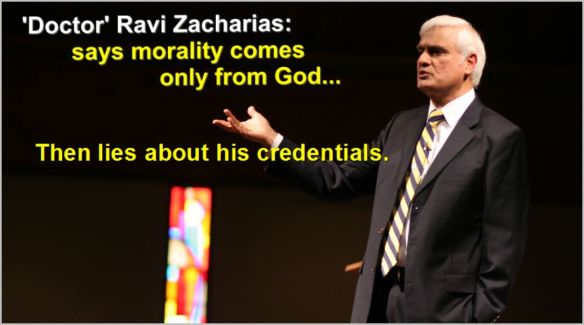
I planned to dissect Ravi Zacharias’ morality argument even before recent revelations that he lied about his credentials. I’m sure that, despite his fraudulent claims, he’s still a good Christian™, perfectly entitled to tell the rest of us what terrible sinners we are. If you’ve ever seen his grandiose sermonising, you’ll know he likes to pretend that Faith is something deeply intellectual, despite Paul’s contention in 1 Corinthians 1. 26-27 that it isn’t. Zacharias’ pseudo-intellectual Christianity is, like many of his qualifications, fake.

In common with other Christians desperate to prove their God, he relies too on circular reasoning. He tells us that our morality derives from God (you listening TC Howitt?) and then uses this to argue that, because of we have morality, God must exist. His unproven conclusion is his premise, with nothing in between to justify either.

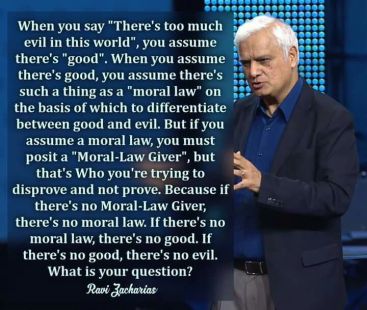
Here’s his ‘argument’ in full:

Ravi3

Let’s take a closer look:

‘When you say “There’s too much evil in the world”, you assume there’s “good”. Who says this? How much evil is ‘too much’? Do people other than Christians see the world in terms of good and evil? Does acknowledging evil mean one also assumes there is good? How is this ‘good’ defined? So many unanswered questions in this first muddled statement.

‘When you assume there’s good, you assume there’s such a thing as a “moral law” on the basis of which to differentiate between good and evil.’ The only one making assumptions here is Ravi himself. The considerate treatment of others, which is how we might reasonably define morality, is easily recognisable when it occurs. This presumably, given he fails to define any of his terms, is what Ravi means by ‘good’ (and conversely, inconsiderate or malicious treatment of others is his ‘evil’). There’s no reason to suppose, however, that the demonstration of good is a component of an objective ‘moral law’ that exists somehow independent of human interaction. Morality and any resulting goodness (or ‘evil’), is human interaction.

‘But if you assume a moral law you must posit a “Moral-Law Giver.” Well, of course we’re not assuming a moral law, not in the magical way Ravi is assuming we’re assuming. And how about that imperative: ‘You must posit a “Moral-Law Giver”‘! Must we? Morality is socially determined by human beings themselves; we see this is in the different moralities that have emerged in cultures with shared heritage; we see it in the changing attitudes over the last fifty years to the treatment of women and gay people. Morality is fluid; it evolves. The ‘Moral-Law Giver’ then, if we must have such a term, is we ourselves.

‘But that’s Who you’re trying to disprove and not prove.’ Erm no. Ravi’s being disingenuous here. ‘We’ were not trying to disprove a Moral-Law Giver at all; he was trying to prove it (him? – note the capital sneakily added to ‘Who’). Let’s though, for the sake of argument say Ravi is right; let’s say there is a Moral-Law Giver out there somewhere. Why has he, over the expanse of human existence, issued such varying and often conflicting moral codes? Compare, for example, today’s moral standards with the harsh, brutal morality of the ancient Israelites, which demanded the death penalty for almost any infringement of the law. Compare that with the morality Christians today claim they derive from New Testament. Then compare Jesus’ impossible demands with how Christians actually behave. By and large, they’re happy to ignore him and, with the exception of one or two areas they get hot under the collar about (abortion, same-sex relationships), they go along with the consensus of the culture in which they live.

‘Because if there’s no Moral-Law Giver, there is no moral law.’ There is a ‘moral-law giver’: it is us. That is why moral laws vary according to culture and through time. Zacharias wants us to conclude that this capitalised ‘Moral-Law Giver’ is his God, yet he has neither demonstrated that a deity (any deity) decrees moral codes from on high, nor has he ‘proved’ (his word) that this cosmic law giver is his god, the barbaric and inconsistent YHWH. Rather, he ‘assumes’ this to be the case and hopes that his audience, failing to notice his assumptions, presuppositions and sleight of hand, will too. Given that most of them are Christian sheep  (Jesus’ term, not mine) they will no doubt do just that.

‘If there’s no moral law, then there’s no good. If there’s no good, there’s no evil.’ This is where the argument, such as it is, turns back on itself. Zacharias thinks he’s being very clever (he always thinks he’s being clever) but all he’s doing is declaring his premise over again.

Of course there are moral standards; humans have devised them throughout their existence. The ‘Golden Rule’ promoted by Jesus, for example, is first recorded thousands of years before him. We determine for ourselves what is good and therefore what is ‘evil’; these defintions are not delivered to us ready made from a “Moral-Law Giver” in the sky.

(While Zacharias doesn’t use the argument, there are those who like to say, on the basis of Romans 2.15, that God has written his (ever-changing) rules in our hearts, a fallacy I’ll address in the next post.)

‘What is your question?’ clever Ravi finally asks. We didn’t have a question. Here’s one for him anyway: how has he got away with such fraudulent drivel for so long?


Can you be good without God?

Good

You can’t be good without God, you can only be good with him – or so Christians like to tell us.

What is the evidence for this? What ‘goodness’ do we see in and from Christians (and other believers in God) that demonstrates they are directed in their morality by a supernatural being who, they say, dwells within them? ‘By their fruits ye shall know them,’ declares their leader in Matthew 7.16 – so what ‘fruits’ do we see?

How about Christians abusing the vulnerable? Sexual abuse of minors has long been widespread in the Catholic church and more and more cases are coming to light in Protestant ones too. Bruce Gerencser keeps a log of those accused and convicted of such crimes, adding names and cases from the States on almost a daily basis. Is this the ‘goodness’ Christians like to say comes from knowing God?

Or how about those believers whose ‘goodness’ manifests itself in cruelty, dishonesty or extreme right-wing views? (Never mind goodness, from these examples it would seem God doesn’t even provide his followers with common sense.)

Then there’s the likes of former judge Roy Moore, anti-LGBT politician who, when he’s not trying to erect monuments to the ten commandments, is excusing his history of grooming and abusing 14 year old girls? What part of this behaviour is ‘good’?

How about preachers like Franklin Graham, Stephen Green here in the UK and the self-righteous know-alls of Teens4Truth, all of whom persistently bear false witness? Perhaps demonising others with the intention of stirring up hatred and paranoia is somehow ‘good’ inside the Christian bubble.

‘Ah, but wait!’ say those Christians who insist we can only be good with God. ‘These people are not true Christians; if they were they wouldn’t be doing these things. Their behaviour tells us they’re not really Christians at all.’ And yet, they all profess faith in Jesus and are convinced his spirit lives in them; however they behave, and whether or not other believers accept it, they are Christians by virtue of this profession alone (Romans 10.9). Christian apologists can’t get out of the double-bind they’ve got themselves into by saying those who do wrong can’t be considered Christians and only those who are seen to be ‘good’ are true believers. They can’t reasonably demonstrate the goodness of God’s Chosen by discounting those who don’t manifest the characteristic they’re attempting to demonstrate, while pointing only to those who remain.

‘Well,’ Christians say, ‘non-believers and atheists are capable of behaving immorally too!’ which is true. But wasn’t their original argument that Christians are so much better (more good) than non-believers because of the indwelling Holy Spirit and their resulting spiritual discernment (or whatever)? Pointing out that some non-believers are capable of behaving as deplorably as some Christians is hardly a demonstration of the supernatural goodness that allegedly infuses Christ’s followers.

It has always seemed to me that religion is like alcohol. A little too much of either accentuates an individual’s true nature. If he or she is already a decent, kind person, drink and god-bothering tend to highlight these characteristics. If, on the other hand, a person is self-centred, greedy and unreasonable then that’s what we get more of. God has nothing to do with it; if it’s your nature, you can be good with or without him. As Bertrand Russell put it:

Cruel men believe in a cruel god and use their belief to excuse their cruelty. Only kindly men believe in a kindly god and they would be kindly in any case.

It is a pernicious lie that subscribing to a superstition imbues a person with ‘goodness’. It should be disputed at every turn.


On being free

chains

Commenter Rebecca responded at length recently to my post ‘Why God Could Not Possibly Have Created The Universe (pts 4 & 5)’. There was so much in her response, that I thought it best to reply to her in a full length post rather than with a brief comment:

Hi Rebecca,

I won’t be able to respond to all of your points as there are so many, but will attempt a few.

I’m glad you find your faith beneficial. You’ve obviously thought about the whole incarnation/sacrifice/reconciliation issue, but I wonder whether you’ve ever asked yourself what it is you need saving from and reconciled with? What is it that means you personally need to avail yourself of the sacrifice Jesus supposedly made (however you interpret that)? I guess evangelicals, of which you seem to say you are not one, would claim it’s because of sin; the alienation from God that our very existence seems to cause.

Is that really the case though? Isn’t it rather that ancient superstitious peoples needed some explanation for why life was so difficult, short and brutish? They reasoned that surely it couldn’t be the fault of the creator God, so his tendency to treat them badly must be entirely their fault. Consequently, they had to do something to appease this god, to make him smile upon them again as they felt he must once have done. They thought the way to do this was, variously, through sacrifice and/or righteous living, by murdering those they felt offended him the most, and through praise and supplication.

There is no getting away from the fact, however, that the primary way they sought to reconcile themselves with their deity was through blood sacrifice. The New Testament’s interpretation of the death of Jesus is expressed in just such terms:

In Him we have redemption through His blood, the forgiveness of our sins, according to the riches of His grace (Ephesians 1.7).

This is not just an evangelical perspective; it is the major theme of much of the New Testament.

I’d like to ask you, Rebecca: are you really so steeped in sin that you need to avail yourself of a bloody human sacrifice in order to be reconciled with God? I have to say it seems extremely unlikely.

I didn’t leave faith behind because of how repugnant this idea is, however. I experienced an epiphany while walking one day, after many years of thinking about such things, and realised with conviction that there was no god: no god to appease, be reconciled with or commune with. He simply didn’t and doesn’t exist (see here for why I think this is the case). Of course, there being no god means there’s no son of god either.

I then started living my life on the basis of the fact there is no god, and I have to tell you it became a whole lot better. I didn’t have the constant feeling I had to come up to some impossible standard; I didn’t feel guilt for the most trivial of ‘sins’; I no longer worried that not getting my beliefs quite right would result in the loss of my eternal life; I stopped worrying about eternal life because it was obvious there was no such thing; I stopped thinking hell and heaven were real; I started living in the here and now; I stopped thinking I had to respond to others’ needs by telling them about Jesus (and started relating to them as people); I no longer had to subjugate whatever intellect I have to force myself to believe things that were clearly nonsense; the self-loathing I felt about my sexuality began to slip away. I could be me, and what a massive relief that was. I think I became a better person as a result. I certainly became a happier one.

You say the bible contains many deep truths – perhaps – but it also includes much that is cruel, spiteful, damaging and just plain wrong. I lost interest in sifting the wheat from the chaff because there was just too much chaff (a free biblical analogy for you there.)

The secrets of life, whatever they may be, Rebecca, are not in the bible, nor in any convoluted explanation of what Jesus stood for (he was just another failed apocalyptic preacher). They do not lie in Christianity or in any religion. Life is more than any of these ultimately dead things.

Thank you for writing. It can only be a good thing that you’re thinking about these issues. You will I’m sure find your way out into the light. I hope what I post here can help you with that.

The evidence for Christ

Christ

The evidence for Christ is not historical — it’s spiritual — and that evidence is indeed abundant for those who believe.

So says T. C Howitt, commenter on the Rational Doubt blog. And what is the ‘abundant evidence’, of which he speaks, for the existence of this spiritual being? It is, he says, ‘spiritual’. That’s quite a tautology: ‘the evidence for my fantasy is my fantasy’.

T.C. goes on to say that only those who truly believe can know that their experiences of the spiritual are real; the rest of us, he decrees, are blind. In other words, evidence that his fantasy is real is that other people have experienced versions of the same fantasy – some of them thousands of years ago. The ‘evidence’ for Christ (as opposed to Jesus) is therefore one’s own feelings plus the strange psychotic experiences Paul relates that he feels sure must be this supernatural being.

Science removes human subjectivity, as far as is possible, from its demonstration of how things are. All that Christians (and other believers in the supernatural) need do is similarly demonstrate that the spiritual realm, with its attendant beings, has an existence independent of human emotions, feelings and imagination. They could show us that, like gravity, electricity and quantum mechanics, Christ and angels, seventh heavens, demons and all manner of spiritual beings, have an existence separate from the internal, subjective experiences of human beings.

They’ve had two thousand years to do just this and still they haven’t. Why not? Because it can’t be done: Christ and his angels, God and his heaven are mythologies and, like all others, are constructs of the human mind.