Imagine… no religion

Jimenez2People say, like, you know, “Aren’t you sad that 50 superstitious nut-jobs died?” Here’s the problem with that. It’s like the equivalent of asking me, you know, what if you asked me, “Hey, are you sad that 50 Christians were killed today?” Um, no, I think that’s great! I think that helps society! You know, I think the world is a little safer tonight!…

The tragedy is that more of them didn’t die… because these people are predators! They are abusers! They take advantage of people! And look, as Rationalists, we need to take the stand that it is not our job to sit there and say, “Oh, this is a tragedy” or “Oh, this is something we mourn.” Look, everything tells us these are deluded, wicked people. These are evil people.

… People sometimes will say, “You guys are advocating violence!” We’re not advocating violence! We’re not saying we should go do this! But we’re just saying this: If we lived in a rational nation with a rational government, then the government should be taking them… I wish the government would round them all up, put them up against a firing wall, put a firing squad in front of them, and blow their brains out. If we lived under a truly secular government that loved rationality and loved children, and wanted to protect them, that’s what we’d do.

Hate speech? Certainly. But not mine. The original, which you can find here, is about the Orlando shootings a few weeks ago, and is directed at gay people. I’ve simply replaced gentle ‘Pastor’ Jimenez’s use of ‘sodomite’ and ‘paedophile’, which he disingenuously uses interchangeably, with ‘Christians’ and ‘religious nut-jobs’, and his use of ‘God’ and ‘righteous’ with ‘superstition’ and ‘rational’. Jimenez, emissary of a religion of love (Matthew 5.44 etc), would like to see his government exterminate LGBT people.

But, you know, maybe there’s also a case to be made for eliminating the superstitious and irrational from among us. Those of us who have adopted a rational basis for our lives would be happy to see the end of religion and superstition, the removal from the Earth of the religious and the superstitious (I use the terms interchangeably). After all, what do believers in mumbo-jumbo add to the world that is any way positive? What can those who are unable to engage with reality without the crutch of make-believe possibly have to give? On top of their general uselessness, they’re also dangerous and predatory.

Maybe there is a case to be made. But I’m not making it. Any philosophy, ideology or religion that preaches the extermination of other people is wrong, debased, corrupt (you’d think, wouldn’t you, that we’d have learnt that by now.) If you subscribe to such a view – be it from a Christian, Islamic or Jewish perspective – you are wrong. No-one, whatever magic books may say about them, merits death simply because those magic books say so (ratified, of course, by the dim-witted prejudices of those who subscribe to them). Rationality and a secular perspective, on the other hand, eschew hatred and are philosophically opposed to harming those who might not agree with them. Yes, even the religious.

In this way it is vastly superior to religion – your religion, whatever that happens to be.

Effective Preachin’ (Part Two)

Sheep

Reverend M. T. Vessal of the Church of The Raised Up here again, with the second part of my guide to Effective Preachin’. In case you missed it, repent! (The first part’s here.)

Now we’re really gonna get going, praise the Lord! The tools you’re gonna need for your talk proper are:

Lots of anecdotes (make up ’em up if you don’t know any true ones), specially ones about life- and-death situations. Stories about encounters with people on planes always go down well, as there’s always the chance the plane will too, and accounts of foolish follk who hear the gospel and ignore it, only to die in a terrible accident soon after.

Cod-psychology. That’s the stuff about God-shaped holes, how only Christ can forgive sin and meet all our needs, even though he doesn’t and never said he would. You can add something in here slagging off atheists and anyone else you disagree with.

Conviction. This is crucial. Sound as if you mean whatever it is you’re spouting. Sound as if you really know what the Bible says. Make it sound like it’s relevant and meaningful, even though it isn’t.

Modulation, otherwise known as shouting and dropping your voice. Shout when the argument is weak (and they’re all weak – you’re making this stuff up, remember)) and drop your voice almost to a whisper so that people know you’re being really, really sincere.

Drama. Pace up and down, like ‘Bishop’ T. D. Jakes, and mop your brow a lot. Wave your arms about, like Joseph Prince and show you really mean it. Maybe you could use props, like Beth Moore does, though you run the risk then of diverting the attention away from yourself. Better is to demonstrate what a cool guy you are, even if you’re not a guy, by sitting on the edge of the altar steps or, if you’re in a really cool church like Steve Furtrick’s, the Stage. This shows the congregation/audience just how cool you are.

Whipped up emotion. This is optional but if you lay it on thick about what Jesus has done for the spiritually inferior, how their sin caused those nails to be driven in, then you’re on to a winner. Aim for some arm waving from ’em, babbling in jibberish speaking in tongues and maybe even some crying. Don’t forget to tell ’em that whatever they’re feeling is the Outpouring of the Holy Spirit. Definitely nothing to do with your manipulating their already fragile emotions. No sir. This here frenzy is divinely inspired.

Finally, get to the challenge bit of your sermon/talk/self-promotion. This can involve an appeal for money. Correction: this will involve an appeal for money. The God who supplies everything doesn’t supply money so you’ll need to lay a guilt trip on your fans/congregation to provide you with the cash to maintain your lavish lifestyle continue the Lord’s work. But it’s not only about money; remember to pressurise/inspire the congregation/audience/fans to go out and harrass their neighbours so maybe they and their wallets will come to church next week. As the Lord Jesus himself said, ‘the harvest is plentiful but the labourers are few’!

Above all, though, let everyone leave feeling that they’ve had a good time. Like kettles, they should have had a real great Outpouring and feel well and truly Blessed. Leave ’em feeling ready for more, same time, same place next Sunday.


Effective Preachin’ (Part One)

church3Reverend M. T. Vessal of the Church of The Raised Up here, with the first of my special guest posts for all you wannabe preachers out there. I’m gonna be telling you on how to preach the Good News of Salvation and win souls for Christ.

Right. First off, remember to use the words ‘Blessings’, ‘Sanctify’ and ‘Outpouring’ in your preamble or opening prayer. ‘Course no-one will know what these mean as you haven’t provided any context and they’re pretty meaningless anyway – apart from ‘Outpourings’ which is something kettles do. But it’ll get the folks worked up to expect something real good. Folks in church go for things like Blessings, Sanctifying and Outpourings, believe me.

Next, repeat the title of your sermon – or, if you’re part of a cool modern church like Steve Furtick’s, your talk, or, if you’re really honest (and let’s face it you wouldn’t be doing this if you were really honest) your spot of self-promotion – three times. This is a useful tip for any point of your sermon/talk/self-promotion; if you can’t remember what you were going to say next, say the last thing you can remember saying three times over, putting the emphasis on a different word each time. So, for example, ‘Twelve ways to receiving the Lord’s blessings’ would be: ‘Twelve ways to receive the Lord’s blessings’, then ‘Twelve ways to receive the Lord’s blessings’, and finally, ‘Twelve ways to receiving the Lord’s blessings‘, though feel free to alter this as suits. Saying it three times like this makes it sound like you’ve just come out with something real deep and profound, when you’ve done nothing of the sort. Plus, people sit up and listen to things said in threes. It’s kinda hypnotic.

I said, ‘it’s kinda hypnotic.’

‘It’s kinda hypnotic.’

See? It works.

Next make a joke. Say something like, ‘if you’ll switch on your Bibles’, just to show how with-it and up-to-date you are, knowing most folks bring their iPads to church these days. That way they can shop on Amazon or send an offensive tweet when your sermon gets really boring (and it will get really boring).

Now quote the verse you’re gonna preach about and let the folks follow along; you won’t need to quote it accurately because they’ll all be using different translations, so accuracy’s not important. Unless, of course, you’re one of those churches that only accepts the Authorised Version, the one with all the errors in it that right-royal homosexual James I… well, authorised. (One of the advantages of the KJV is you can  drop in words like ‘lieth’ and ‘unto’ which sound like you really know what you’re talking about.) So, yes, it’s okay to paraphrase the verse your talk is gonna be tenuously connected to because, let’s face it, it’s not going to have much to do with the verse in any case. It’s going to be more about you than whatever’s in the Bible. The exception is if you’re planning on having a rant about homosexuals, in which case you’ll want to stick pretty closely to Leviticus 20.13 and Romans 1.26.

A word on choosing your Bible verse: make it one of Paul’s or something from John. The other stuff, about loving your neighbour and your enemy and going the extra mile isn’t the kind of thing you want to have to talk about. You’re gonna concentrate on Blessings, Sanctification and Outpourings, remember, things that are exclusively for Christians. If you’re feeling really adventurous though you can try a story from the Old Testament. Maybe one of those blood-baths it has a lot of. You can show how all that bronze-age inter-tribal slaughter was really about how much Jesus loves Christians in the twenty-first century.

Right. You’re all set. Next time, I’ll tell you how to preach so that you can make a name for yourself truly reflect the glory of Jesus.

What does God think about the Orlando massacre?

Orlando

Let’s see what he’s saying through his spokesmen here on Earth:

According to a minister from the cathedral in my home town, who conveyed this message from the Lord at a vigil on Monday night,

God is just as confused as we are. All the same, he’s full of compassion for those who died and for their loved ones.

Makes you wonder though, if he’s so compassionate, why he didn’t do anything to prevent the murders in the first place. Still, he is sympathetic, which is something.

Oh wait! That isn’t how God feels at all, not according to Pastor Steven Anderson, who knows exactly what the Lord thinks:

…in Leviticus 20:13, God’s perfect law, he put the death penalty on murder, and he also put the death penalty on homosexuality. That’s what the Bible says, plain and simple. So, you know, the good news is that at least 50 of these pedophiles are not gonna be harming children anymore. The bad news is that a lot of the homos in the bar are still alive, so they’re gonna continue to molest children and recruit people into their filthy homosexual lifestyle.

Right. So now we know.

Hang on, though. Christian Today tells us something different again. According to this guy, what God really wants his followers to know is that,

true believers should pray for everyone involved in the terrible events of the weekend and ‘not miss a huge opportunity to build bridges and demonstrate our saviour’s love.’

Phew, glad that’s finally sorted.

Or maybe not, because God has changed his mind again: Pastor Roger Jimenez has this straight from the Lord himself:

The tragedy is that more of them didn’t die… the Bible paints the picture that these are wicked people. These are evil people. God gave them up to their vile affections… they’re not natural… they received a reward for their error… God almighty says, ‘there’s nothing I can do for (homosexuals).’

All these mixed messages, and all supposedly from the same Person! Compassion, punishment, love, abandonment; that truly is one confused, mixed-up deity you worship, Christians. You’d be confused too, I guess, if one nutjob after another put words into your mouth. Just who’s the ventriloquist here and who the dummy?

When, Christians, are you going to stop deluding yourselves that arses like Anderson and Jimenez know anything about what God thinks? When are you going to stop pretending that anyone knows what he thinks? When are you going to recognise that a God who ‘speaks’ so inconsistently through simple-minded ‘intermediaries’ is not God at all?  When are you going to stop deluding yourselves that there even is a God?

Religion poisons the well. Again.

dye

The shooting in Orlando of people in a gay night club (50 dead, 53 wounded) is yet another example of religion as the antithesis of human flourishing. Not Christianity this time, of course, but that other ‘great’ religion, Islam, the religion of peace. But Christians cannot distance themselves from atrocities like this, carried out in the name of God, when the influence of even moderate religion is a pervasive, unhealthy presence in our society.

It’s true that Christians don’t, as rule, rampage in the streets or fly planes into buildings but they do contribute to the medium in which more extreme forms of religion grow:

Westboro Baptist Church, for example, with its own peculiar brand of Bible-based homophobia – ‘God hates fags’ and all the rest – is, like it or not, an expression of Christianity;

Right-wing evangelicals who interfere in the churches and governments of Africa and South America, actively encouraging them to take a homophobic stance and to pass anti-LGBT laws, are equally culpable; Scott Lively, Pat Robertson, Sharon Slater, you too are people filled with hate;

Likewise, those Catholic bishops who use their influence to denounce gay and transgendered folk as ‘mentally disordered’;

Christian bloggers who trot out the old, ‘Woe to those who call evil good and good evil’ (Isaiah 5.20) and misapply it to homosexuality, together with those who quote Leviticus 18.22 (‘abominations!’) and Romans 1.26-27 (‘unnatural and indecent!’)…

All of these contribute to the animus directed towards fellow human beings whose ‘sin’ is merely to be different. Religions, or more specifically their adherents, contribute significantly to the levels of misery in the world today, though Christians will cry ‘foul’ here (or ‘persecution’ even, because how they love claiming they’re being persecuted when asked to demonstrate some empathy and a little love.) After all, it wasn’t a Christian who gunned down the people in the Pulse nightclub this weekend. No it wasn’t. But every time religious bigots –

tell others what despicable sinners they are,

misrepresent and denigrate minorities,

promote ‘gay cures’,

attack same-sex marriage,

add quotation marks around the words gay and gay marriage, as if they’re somehow not real,

assert homosexuality and transgenderism are synonymous with ‘moral decay’,

claim natural disasters are God’s response to gay people’s very existence,

boycott businesses that support equality,

‘take a stand’ against transgendered people using the appropriate restroom and

refuse to serve gay couples –

every time, in short, they say LGBT people are evil, sick or worthless, the self-righteous prepare the ground for individuals like Omar Mateen to do what he did in Florida on Sunday. Religious leaders condemning such atrocities after the event is too little, too late, when they’ve failed to take charge of their acolytes and  do nothing to stem the tide of hatred flowing from their churches, mosques and temples. 

To those of us on the outside, religions are all of a kind; harmful superstitions. If a ‘faith’ entails belief in supernatural beings and puts allegiance to such imaginary figures above fellow human beings, it is without merit. It is the evil among us.

Less religion, not more

Welby

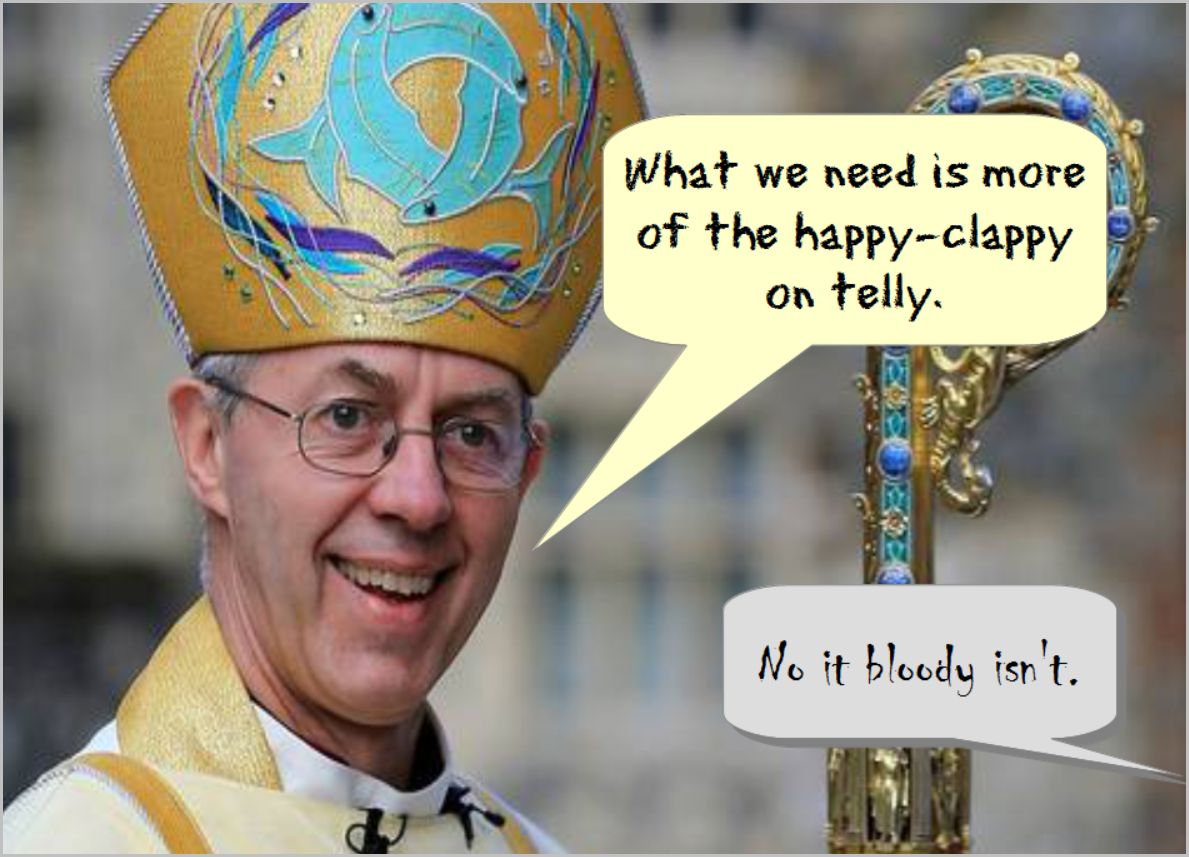
A bloke in a pointy hat and posh frock thinks there should be more religion on television and radio. Justin Welby, Archbishop of Canterbury, says that religion merits as much air time as politics, sport and drama.

The Archbish makes it sound like there’s nothing at all on TV and radio already about religion. In fact, in the last few months in the UK we’ve had a full schedule of Easter programmes; Simon Reeves’ The Ganges on BBC2 (looking at India’s religious heritage); Channel 4’s Unreported World and Dispatches, which regularly consider religious issues; Clare Balding’s trite Good Morning Sunday on Radio 2; the weekly broadcast of church services and daily Thought For the Day on Radio 4; the weekly dollop of worship on Songs of Praise on BBC1 and the 24-hour Christian ‘ministry’ of Trinity Broadcast Network and other God channels for those who just can’t get enough mumbo-jumbo.

Maybe that’s not as much as sport, but then there’s hardly anything on TV that has as much coverage as sport. (Bad news too for those of us with little interest in watching others running, jumping and hitting things; there’s even more to come in the shape of Wimbledon, Euro 2106 and the Olympics.)

Do we really want religion to have the same level of coverage? Are people really as interested in belief systems as they are in sport? Or music? Or art? Or comic book franchises? Even if there are, why is it up to television – the Archbish singles out the BBC as the broadcaster he thinks should indulge his fantasies – to provide it? Isn’t it, rather, up to churches, mosques, temples and other centres of superstition to promote their own particular brand of nonsense?

Make no mistake about it, this is what Justers is proposing; the promotion of religion – ‘religious literacy’ he calls it. He is not, we can be fairly sure, looking for programmes that are critical of religion (unless it’s other people’s). He wants, he says, to see more programmes that give us a better understanding of religious belief. What he means by this are proselytising programmes that create greater empathy for those who subscribe to delusion.

He isn’t advocating, for example, documentaries that explore the irrationality of faith, or ones that show the slap-dash, deceptive ways in which holy books came to be compiled or ones that demonstrate how most adherents to faith fail to live out its exacting demands. Nor is he suggesting programmes that focus on the appalling misery religion brings to some, or shows that give a sympathetic hearing to cults, sects and extremists. I would have no objection to programmes like these (except those that are sympathetic to extremists) because the ugly underbelly of religion deserves to be exposed, like Channel 4’s The Untold History of Islam of a few years ago, taken off air after its presenter was threatened with violence by those who didn’t like its critical perspective.

But these are not the kind of programmes the Archbishop is proposing. The religious literacy he wants us to have is of the cuddly side of faith, the supposed deep spirituality of the obsessive and what he regards as the positive contribution religion makes to the world; a one-sided picture already more than adequately covered by the nation’s broadcasters.

Thankfully, despite the recent political interference in the BBC, the Corporation is still required to present balanced and impartial views of its subject matter. If the Archbishop, who sits in the House of Lords and so is not without influence, is successful in forcing the BBC and other broadcasters to increase their coverage of his obsession, then we should also be able to look forward to programmes that are critical of religion too.

No broadcaster is obliged to promote religion nor to proselytise on its adherents’ behalf. Shame on the Archbishop, with his smiles and pointy hats, for suggesting they are.

There’s good news and there’s good news…

Bat-Jesus

Mark, Matthew and Luke all tells us that Jesus preached the gospel when he was alive (Mark 1.14-15; Matthew 4.23, 9.35 & 10.5-7; Luke 20.1). So what was this gospel? What was Jesus’ ‘good news’? He had yet to die so it couldn’t possibly have been ‘you can be saved through my death and resurrection’ because this magic formula had yet to be arrived at by those who came later. Nor could it have been ‘accept my substitutionary atonement whereby I take the punishment you deserve in order to restore your relationship with God,’ for much the same reason. Nor could it have been, ‘you must accept me as your personal your saviour if you want to gain everlasting life in Heaven,’ because he didn’t regard himself in this way and he didn’t, according to the synoptic gospels, offer an eternity in Heaven. No, Jesus’ good news could not have been any of these because they are all later developments, mumbo-jumbo invented about him by others, not things he said himself .

Actually we needn’t speculate on what the good news was that Jesus preached because the gospels tell us: God was going to intervene in history very soon, rescuing his people from Gentile rule and setting up his Kingdom, in which he, Jesus, would be judge and king (Matt 24.27-34 & 25.31; Luke 1.33; 21.25-28). People, he said, referring only to Jewish people, should prepare themselves for this coming Kingdom by mending their ways (Matthew 10.5-6).

How soon would all this happen? In the lifetime of his hearers according to Mark 9.1, Matthew 16.28 and Luke 9.27, maybe even within a few weeks or months. When sending out the disciples to spread his good news he promised them, ‘you will not have gone through all the towns of Israel, before the Son of man comes (to usher in the new Kingdom)’ (Matthew 10.23). We can only assume that the disciples are back by now – in fact they return a few verses later – yet the Son of man still hasn’t materialised among the clouds in full view of ‘the tribes’ of the Earth (Matthew 24.30).

As the Bible records, Jesus was wrong in every respect; God did not set up his new Kingdom within the lifetime of those Jesus spoke to; the Son of man did not appear; the Romans were not overthrown; Jesus was not appointed judge and king of the world. The sarcastic inscription on his cross, ‘King of the Jews’, was the closest he came to having his self-aggrandising prophecy realised.

Is this the Jesus that Christians worshipped subsequently and still worship today? It ought to be as he’s the one revealed in the first three gospels. But the Jesus believers carry around in their heads is not this man. The ‘Jesus’ worshipped by Christians is primarily a construct of Paul’s – his ‘Christ’ – and their own collective imaginations. The mythical ‘Christ’ that Paul ‘did not receive from any man’, has replaced and almost obliterated Yeshua and his mistaken beliefs about the coming Kingdom (though Paul held on to the idea that it was indeed imminent; see 1 Thessalonians 4.15-17).

Admittedly ‘the Christ’ has had a far better shelf-life than Yeshua could ever have had on his own; the continual resurrection of the idea in the minds of believers – and only there – has ensured the perpetuation of the myth. When all is said and done, however, the Christ is nothing more than an imaginative recreation of a failed zealot with an altogether different gospel.* Yeshua’s good news of the Kingdom died shortly after he did and like him has stayed dead, its echoes preserved by Mark, Matthew and Luke and ignored by Christians everywhere.

* I’m aware there is a body of thought that gives primacy to the mythical god-man, ‘the Christ’, with the Jesus stories being seen as a later ‘in-fill’ designed to provide him with a plausible back-story. I’m not convined of this for several reasons, which I’ll explore at a later date.

See what you want to see

dog's bottom2

Paul was a religious fanatic, a zealot is how he describes himself, whose raison d’etre had become the elimination of those who believed that Yeshua was the Messiah. The Jesus movement, which at this time was still very much a part of Judaism (it is Paul who will later uncouple it from its Jewish mooring) is in Paul’s eyes an aberration and he is prepared to brutalise and imprison those who subscribe to it. He is an extremist; religion is his life, his world, his being; he spends all of his time with his band of Pharisaic thugs and members of the new cult (trying to destroy them, admittedly). That’s all he does. He doesn’t have any other interests. No wonder then, that he starts to hallucinate, as fanatics are prone to do, perhaps while suffering an epileptic seizure.

According to Luke in Acts 9.5, Paul can’t make sense of what he thinks he’s ‘seeing’ in his head. He doesn’t immediately connect the light there with Jesus and is forced to interpret it, perhaps some considerable time afterwards (both he and Luke recount the experience only many years later) as being the cult leader whose followers he is persecuting. Once he has decided that this is what his experience was all about, he switches from one kind of fanaticism to another, from one kind of extremist Judaism to another equally fanatical kind.

He does not, I want to emphasise, go from being a Jew to a Christian; he has three years yet to spend brooding on his hallucinatory experience and to work up a convoluted interpretation of it. Only after that does he offer his own bizarre take on the Yeshua phenomenon that conflicts with the original cult and will eventually succeed it.

So, the risen Jesus, like ghosts today, was ‘seen’ only by those already infatuated with him, and even then not always in a form that was recognisably human.

There were no appearances to anyone in the outside world who might have provided objective verification of his return from the dead.

No appearance to any authority, none to the emperor.

There was no appearance in front of Pilate so that the resurrection might be become part of Roman records.

None to Herod to show him he had overcome death.

None to the masses who had earlier called for his death to prove to them he really was their King. 

None to usher in, at last, the Kingdom of God he’d been promising for so long.

None to Caiaphas to demonstrate that he, Jesus, truly was the prophesied Messiah.

None to Judas, to prevent his suicide and forgive him for his betrayal (or ask his forgiveness for using him as a pawn in the Great Divine Plan).

None, in fact, to anyone outside his own coterie, people who were already susceptible to ‘visions’ and psychologically primed to see him again – or to convince themselves they had, like the gullible people today who swear they’ve seen him in the clouds, in various food items or in the hallowed form of a dog’s bottom.

Keen amateur photographer Terry Buckman spotted the 'Face of God' in a cloud formation as he was taking pictures of boats sailing on the English Channel near Sandbanks in Poole, Dorset. Terry said that he was the clouds part and then suddenly the shape of the face appeared. *** Local Caption *** Disclaimer: While Cavendish Press (Manchester) Ltd uses its' best endeavours to establish the copyright and authenticity of all pictures supplied, it accepts no liability for any damage, loss or legal action caused by the use of images supplied. The publication of images is solely at your discretion.kit-katdog's bottom


Believing is Seeing

Fish

Have you noticed how the risen Jesus seems only to have appeared to those who were already primed to see him? Of course, the accounts of the resurrection are inconsistent, unreliable and constructed long after the supposed event, but just for now, let’s take them at face value. Jesus appears first, according to Matthew, Luke and John, to his female followers – maybe one on her own (in John), maybe two (Matthew), maybe several (Luke) – but to women who would be mourning him and would be longing to see him again. And lo and behold, they do! He’s not quite substantial and not quite recognisable – every bit the hallucination, in fact – but he appears.

Next he is said to have shown himself to the disciples – maybe one (Luke), maybe two (Luke again), maybe several (Matthew) – men who have been thrown into complete disarray by Jesus’ death but who believed in him and his mission to inaugurate the Kingdom of God, and were looking forward to ruling it with him. So naturally they see him in their midst. Never mind he walks through walls and disappears at will, just like an apparition – he appears! As Acts 1.3 puts it, ‘he presented himself alive to them after his suffering by many proofs’.

Wait – ‘by many proofs’? What does that mean? That he had to prove he’d come back to life? Could they not see that for themselves? Couldn’t they recognise the man with whom they’d spent the last three years? Or if they could, weren’t they convinced he’d returned from the dead so that he felt he had to prove it? How? How did he prove it? With a death certificate? By letting them poke his holes? And this took forty days? Isn’t it more likely they were subject to group hysteria and some sort of hallucination (they’d had hallucinations before – see Matthew 17:1-9) and they then had to convince each other that what they’d experienced was really Jesus? No wonder it took forty days to concoct a ‘plausible’ story, to arrive at ‘the many proofs’ that Acts speaks of. Whichever it was, Jesus’ gullible old pals convinced themselves they’d seen him.

During these same forty days – though in his gospel Luke implies it’s a much shorter time (24.40-53) – Jesus fits in a guest appearance at a rock concert in front of 500 believers – believers, note. Not people who were converted as a result of this miraculous appearance, but people who were already part of the Jesus cult when they experienced this vision. Or so Paul tells us in 1 Corinthians 15.3-8. He wasn’t actually there, but he heard about it from a friend of a friend of a friend so it must be true.

And finally he appeared also to Paul himself (1 Corinthians 15.5). Not as a physical body but as a beam of light in Paul’s head. I’m not getting into how this was, as Paul himself admits, no more than an inner vision (he too is prone to hallucinations – see also Acts 16:9-10 and 2 Corinthians 12.1-7) because you can read about that here. Rather, I’m going to argue that Paul, arch-enemy to this point of all things to do with the Jesus cult, is just as primed for a sighting of the Lord as all those other people who think they saw him… next time.

to be continued.

Are You Doing What Jesus Christ Says?

Billboard

Dale McAlpine, sometime commenter here and fanatical street-preacher in these parts, has posted a tasteful little video on his web-site – that’s the smugly named Repent.com if you’re interested – called Are You Doing What Jesus Christ Says? Take a look at it over on Repent.com or on YouTube; it’s ludicrously melodramatic and wonderfully over the top. You’re sure to enjoy its typos and spelling mistakes too.

What’s remarkable about it apart from these things is that, despite its title, it makes little reference to what Jesus is supposed to have said. Instead, it’s all about how you’ll go to hell if you don’t repent and accept him as your saviour; but Jesus never said this. It says you’re a ‘vile, wretched, hell-deserving son or daughter of Adam’ – Jesus didn’t say this either. It also insists you should let his cross ‘disrupt the very centre and citadel of your life of self’ (whatever that means) and guess what? This wasn’t part of Jesus’ teaching either. In fact, none of these claims were part of his ‘good news’.

Of the things Jesus did say – go the extra mile, sell all you have to give to the poor, turn the other cheek, avoid judging so you won’t be judged, give to all who ask, give away your shirt as well as your coat, feed the hungry, visit the sick, clothe the naked and love your enemies – the video makes no mention. Funny that. Maybe that’s why we don’t see Christians doing them very often.

So, Christians – and Dale too – are you doing what Jesus said or are you, like the video, only interested in pointing out others’ supposed sins and shouting about how they need to join you in your delusional mumbo-jumbo?

Yes. Thought so.