Surviving 2026

It’s that time of year when, according to the media, we need to consider what our strategies might be for surviving the 12 months ahead. I thought I’d share with you some of my thoughts along these lines:

1. Have the lowest expectations of politicians that you can muster. That way you’ll only be mildly disappointed when they fail to live up to them.

2. Have a sense of proportion. The universe has existed for 13.8 billion years, the earth for 4.54 billion, life for 3.8 – 3.5 billion, humans for a mere 300,000 years and you for a miniscule fraction of even this final statistic. None of these events has been directed by a sentient power. They are all the result of natural forces. With this perspective you’ll recognise how nonsensical it is to attribute anything to a tribal deity.

3. Reserve your respect for people who merit respect. You do not have to respect those who espouse nonsense and/or don’t respect you. You certainly don’t have to genuflect in front of ideologies, whether religious, philosophical or political. Ideologies are not people.

4. Party like it’s 1999. That way you can pretend the world isn’t being run by septuagenarian megalomaniacs.

5. Resist the Newspeak that is daily foisted upon us. Call a spade a shovel, an Islamist a Muslim, and send the Thought Police packing when they turn up at your door because someone somewhere is offended by something you’ve said, on someone else’s behalf.

6. Spend lots of time with friends. Studies repeatedly show that socialising contributes significantly to living a longer, happier, healthier life. Even talking to strangers helps. I know that other people can sometimes be  challenging (see below) but being with them is, on balance, pleasurable and rewarding. They do you good (and you them).

7. Stop anyone who starts a sentence with ‘Me and partner’. Point out that this is grammatically incorrect and reflects badly on both their education and personal integrity.

8. Read comic books.

9. Take pride in your country. It belongs to you, not just to politicians and billionaires. Other countries quite rightly take pride in their country’s achievements, culture and values. We need to as well. .

10. Write to your MP/Congressperson to tell them what you think of the job they’re doing. Tell them what they should be doing instead, like keeping their promises. Do this while trying not to use swear words.

11. Do something you might not normally do. Keep it legal. Or at least don’t get found out.

12. Question everything, including everything that’s written here.

I hope 2026 turns out to be a great year for you.

Back by unpopular demand – it’s the New Year Pop Quiz!

All set? Here we go!

1. Which one of these fantasy figures actually exists?

2. For which one of these ideas is there refutable/verifiable, corroborative scientific evidence?

3. Which one of these events is demonstrably historical?

4. Which one of these phenomena is verified and corroborated by psychology?

5. Applying logic and reasoning, which of the following scenarios is most likely to be true:

6. Which of these statements is verifiably true?

Answers:

Question 1. The answer is none of them, though C, Donald Trump, comes closest. 10 points if you put C, none if you plumped for any of the others: despite the volumes written about them there isn’t an iota of  evidence that they exist.

Question 2. Award yourself 10 points for B, though if you’re a True Believer this is the only one you think isn’t true. There is an abundance of refutable/verifiable, corroborative scientific evidence that it is. You can only wish there were for the other three.

Question 3. A is correct – 10 points. There is a considerable amount of evidence that the moon landing occurred on 20th July 1969. There is absolutely none at all that the other three are historical. For the sake of argument, let’s say they’re mythical. Nul points if you think otherwise.

Question 4. The answer is all of them. Oh no, wait… that’s my cognitive dissonance speaking. D is the only one of those listed recognised by psychologists. My bad and 10 points to you.

Question 5. The answer is of course E. Award yourself another 10 points if you thought outside the box on this one. (You can also have 10 points if you said they’re all equally likely, as in ‘not at all’.)

Question 6. 10 points for D

Scores: 

If you scored 50 or more, congratulations! If you scored nothing at all, you are confirmation that question 6’s answer – D. Human beings are capable of believing just about anything – is true. Well done.

A happy new year to you all.


No God and the Domino Effect

This a response to Don Camp’s comment on my post The Evil of Christianity, in which he tries to isolate ‘the crux’ of our disagreement about the Faith.

You start, Don, from the assumption that there is a God. I, on the other hand, have considered the evidence and concluded that in all probability there isn’t one. Certainly not the Christian God. There may be a god out there somewhere that has no interest in human beings and their affairs, though I doubt it. As far as we humans are concerned such a deity is as good as non-existent, being entirely hypothetical. If it is out there, it certainly won’t be offended at my saying so.

Once I realised some years ago that a personal God did not exist a number of other things followed (or rather, collapsed):

No God means no Son of God or God Incarnate, no Saviour or Christ.

No God means no resurrection (which Paul makes clear was a work of God).

No God means no Holy Spirit.

No Holy Spirit means no regeneration of individuals to become new creations in God (you only have to look at Christians today to see this is the case.)

No God means no grand Salvation plan.

No God means no Heaven, no Final Judgement, no Kingdom of Heaven of Earth, no Eternal Life.

No God means the universe can’t have been created by him.

No God means no manipulation of evolution, no intervention in human history and no prophecy of things to come.

No God means that the world would be just as we find it: messy, beautiful, dangerous, turbulent, indifferent.

No God means prophecy is man-made and comes to pass at no greater rate than chance allows (i.e. practically zero.)

No God means conversations with ‘him’, revelations from him and visions of him are all imagined, generated by and within the human brain, which works in mysterious ways.

No God means no God-given morality. Morality is, as you say, culturally determined and so may and does change over time. (You can see this in the Bible itself where morality supposedly handed down by God for all time evolves throughout the Old Testament and into the new.)

No God means there is neither Sin nor Righteousness. These are religious concepts. The whole spectrum of human behaviour, from destructive to altruistic, is demonstrated by believers and non-believers alike.

No God means assertions like ‘the issue turns on what I perceive as good for me versus what God declares is good for me’ are illusory. What is good for you is what you have worked out, even if you think God had a hand in it. A supernatural being who doesn’t exist cannot be responsible for your well-being, though your church and the bible undoubtedly contributed to your conditioning.

No God means individuals must work out their own meaning and purpose. Some do, some don’t, as you observe, Don. This is as true of believers as it is for non-believers. Many atheists have managed it, or not, without having it imposed by religion. And despite what you say, Christianity is a religion. It is the epitome of religion.

No God means none of the Abrahamic religions are true and therefore Christianity and its ‘holy’ book, being based on an invalid premise, must be false. Most of the posts on this here blog are about demonstrating this fact.

No God means all gods are man-made, not all gods except one.

The crux of the matter is you believe in God while I see how unlikely it is that there is one. I’d agree with you if I could, Don, but then we’d both be wrong.

The Bible Is Fantasy

The Bible contains:

113 appearances of angels, usually interacting with human beings;

50+ visions, on which all of Christianity hangs: those of Daniel; Cephas and others who ‘saw’ the risen Christ; Paul and John the Elder in Revelation. 

21 supernatural dreams, including those experienced by Jacob, Technicolor Joseph, NT Joseph, the Magi, Pilate’s wife and Paul

Numerous apparitions and ghostly appearances, including that of the resurrected Jesus as well as Moses and Elijah and, in the Old Testament, the spirit of Samuel, conjured up from the grave by the witch of Endor.

Innumerable resurrections: not only that of Jesus but several Old Testament characters, and, in the New, Lazarus, Jairus’ daughter, the young man of Nain and the hordes who rose from their graves at the time of the crucifixion.

Multiple impossible astronomical events, ranging from the sun stopping in its orbit(!); a star wandering and hovering over a small house; a solar eclipse lasting several hours; stars that one day will fall from the sky; a God who lives just above the clouds and a ‘firmament’ between the Earth and the heavens that holds back water;

Several events in which nature is magically controlled: the parting of the Red Sea; Moses’ magician’s staff becoming a snake; the Nile turning to blood; Jonah being swallowed but not digested by a ‘great fish’ and Jesus calming a storm.

An abundance of fantastic beasts and fairy tale creatures: Giants (Genesis 6:1-4, Numbers 13:33); Leviathan the sea monster (Isaiah 27:1 etc); the Behemoth (Job 40:15-24); the Cherubim monsters (Ezekiel 1:4-21); the dragon and other beasts from Revelation

Many characters who are clearly legendary, from Adam & Eve, Noah, Lot and Abraham to Moses, Job, Daniel and gospel Jesus. Some of the Bible’s fictional characters lived to a literally incredible age: Adam 930 years, Seth 912, Methuselah 969, Noah 950, Abraham 175, Moses a pitiful 120. Jesus holds the record being now either 2,000 years old or eternal, depending on how you count it.

5 mythical places: Eden at the beginning of the book; New Jerusalem at the end; Heaven, the abode of God; Sheol the Old Testament place of the dead; Hades (Sheol mark II?) which Jesus visited while supposedly dead in his tomb (Acts 2:27, 31; Matt 16:18).

2 sentient ‘pillars’: one of cloud, one of fire (Exodus 13).

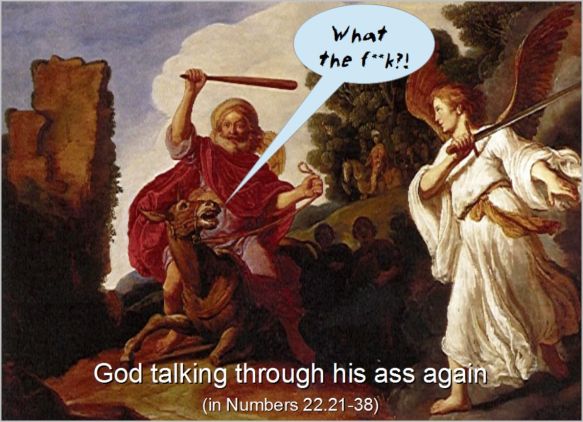
2 talking animals: the serpent in Eden and Balaam’s ass.

1 talking plant (Exodus 3:3).

0 science. No understanding whatsoever of what we now call astronomy, meteorology, germ theory, genetics, evolution, psychology… you name it.

So how do we read all of this? As the ancients themselves would, with an understanding of the world that regarded the supernatural, magic, miracles and monsters as real? We’re told often enough that this is how we should interpret scripture, not from a modern perspective. Perhaps we might credit the creators of the many books of the bible with greater skill, however, and interpret the inclusion of magic and miracle as allegorical or metaphorical; literary pieces, if you will. But then we have to decide which far-fetched stories are myth and which are historical accounts,. There really is no way to do this. A New Testament story awash with impossible events, implausible characters and symbolic tropes is every bit as allegorical or metaphorical as the same kind of story in the Old Testament (or, indeed, in Egyptian, Greek and Roman myth.) The reader who wants to see stories in the Old Testament as carefully crafted allegories has to concede that the Jesus narratives are of the same order.

It looks like we have to read the Bible as 21st century readers, because that is what we are. After all the Bible is supposedly a book for all time. We can, however, recognise the way in which its many creators saw the world – populated with fantasy creatures and subject to impossible events – and accept that they were wrong. Reality is not as they perceived it. What we cannot do is claim that the Jesus story is an oasis of truth in the midst of all this fantasy . 

Mr J: The Defence

Unfortunately, Mr J is unable to speak for himself so I have taken it upon myself to defend him. I’m going to prove to you he exists and that he loves us all.

The first thing I want to mention is how he created the Earth and everything in it in six days, about six thousand years ago. Or possibly not. It’s might’ve been billion years ago and it might have taken a very long time. Mr J would like to keep his options open.

In any case, he eventually created human beings, either on the sixth day or billions of years later. He quite probably controlled evolution to get to them, killing off billions of other creatures along the way just so humans could emerge. Some might say this was pretty heartless but it’s the only way natural selection could produce Mr J’s favoured creation. All a bit hit and miss, but Mr J knew what he was doing. I read it in a Richard Dawkins book some time.

Anyway, once humans appeared they managed to upset Mr J in some silly, insignificant way, so that he had to come up with a whole series of complicated plans to bring them into line.

The first plan was, admittedly, not all that great. It was necessary though. He drowned the lot of them, every man, woman and child, except for one old drunkard and his family. Needless to say the humans that came along after them weren’t any better than the ones who’d come before. No surprise there! Mr J rightly blamed the humans themselves for the shortcomings he’d built into them. That and the demons with their boss, Satan, whom he’d thoughtfully made right back at the start of the six days. Or maybe it was during the billions of years when he was creating everything by process.

Er… moving swiftly on, his second plan was that he’d just concentrate on one special group. He picked, for reasons best known to himself, a small, nomadic desert tribe. He demanded of those who had them that they should slice the tops off their penises. Weird, I know, but other tribes were doing it and Mr J thought if it was good enough for them and their fertility deities then it was good enough for his besties too. They also had to obey all 613 of the rules he would make up as he went along. This was to set a moral example to his Chosen People so naturally included instructions on how to beat their slaves, how to stone people to death and how to massacre their neighbours. Needless to say, despite how reasonable Mr J’s terms were, the useless humans couldn’t manage to comply with them. He was more than pissed. He let other tribes brutalise them, had them turn on each other and sent them into exile. But still they didn’t learn. You might think he’d have done better offering some encouragement, a little bit of positive enforcement, but you’d be wrong. Mr J always knows best.

The time rolled round for another half-arsed plan. This time Mr J sent a Figment Of His Imagination down to the Earth so the friends for whom he’d set such a good example while punishing them endlessly, could engineer his death. Or maybe it was the Romans who did it. Whatever, the story got around that after his execution this Figment had come back to life, which meant all sort of marvellous things would happen, including a complete reboot of the Earth. The old deal with its dick-docking and interminable lists of rules was over. There was a new deal now: believe it and you’d live forever: don’t and you’d boil forever in a fiery pit while demons tortured you for eternity.

Soon after this (because a thousand years is like a day to him), Mr J became something of a recluse. He removed himself from time and space – no more walking in gardens and masquerading as a burning bush – he would become… transcendent! He also announced, in a revelation to some churchy types, that he wanted, henceforth, to identify as a threesome. He insisted he be called ‘Daddy’, ‘Sonny’ and ‘Friendly Ghost’ all at the same time. It was a mystery why he…

Hang on. I just can’t go on with this. I mean, I know I’m supposed to be defending Mr J but when you see it written down like this, none of it makes sense. None at all. It’s rubbish and if this is what Mr J is all about, he can’t be defended. Not by anyone with half a brain anyway, and I like to think I have at least that. Mr J will just have to defend himself or, failing that, get someone without any critical faculties at all to do it for him.

The Inflationary Vacuum

Not a simulation, not created by a God: so how did the universe come to be? Can something arise naturally from nothing, after all? Many scientists think so, but not because a god overturned the idea that something cannot come from nothing. They also answer the related question of why there is something rather than nothing.

I’m not going to reiterate their explanation here, as you can read a summary for yourself (I’ve linked to a simple one for the sceptical among us and of course the diagram above makes it all clear.) Suffice to say, the theory demonstrates that ‘something’ came about when quantum particles popped into existence from nothing. We know they are capable of doing this, making them the Uncaused Cause. These particles led to ‘a chunk of inflationary vacuum’, from which, everything else arose..  

And no, Don, unless he’s ‘a chunk of inflationary vacuum’, this is not your God. Nor did he conjure up the chunk .Before it appeared at the quantum level there was, according to this scientific theory, nothing: no God, nothing.

The God

So the universe isn’t a simulation created by a Mind in its mom’s basement. Shame. I thought Don was onto something there.

Let’s consider then another option. The universe, reality and we ourselves were made by a super-being, a God no less. How would that work?

The God looked round. There was nothing, only himself. He did not know for sure that he was a he because he had no Y chromosome or a penis. He hadn’t invented either yet and as an eternal being he had no need of such things. Heavens above, he didn’t even drink or eat so didn’t need dual purpose genitals, not even for urination. He did plan however to create, eventually, when billions of years had past, a sentient being who would have a Y chromosome and a penis. He intended calling this being A Man. This Man would be inherently male so it seemed only right that he, God, should identify as male too.

Damn, he’d digressed again. Where was he? He realised for the billion billionth time (though it was hard to count when time didn’t yet exist and even if it did he’d be outside it) he was nowhere amidst nothing and hadn’t created anything yet. It was time, bearing in mind no time existed, to create the universe, a reality outside of himself.

He looked round again. He was, he had to admit, a bit stuck. There was nothing around with which to create anything; no quarks, no gravity, elements or even Lego; none of the fundamental forces of the universe. There were no fundamental forces because there was no universe. He was going to have to create these things before he could even think about creating a universe. But how? He looked around for something with which to make the quantum realm and gravity and elements and all the other stuff from; but there was nothing. Even as God he was constrained by the principle that something cannot come from nothing. This was a truth universally acknowledged even if there wasn’t yet a universe.

What to do? Could he make a universe from himself, from his own essence as it were? But if he did, would that not diminish him in some way, make him less of a God? A God with a universe-shaped hole in his middle? He didn’t much like the idea of that. It really wouldn’t work.

Could he, he wondered, zap things into existence with just a word? But wouldn’t that be the same as making something from nothing? As such it couldn’t be done. In the far, far future those who believed in him would insist that something could not come from nothing in their arguments with those who doubted his existence. He couldn’t flout the rule and make his acolytes look foolish.

He decided he would have to abandon the whole project. He’d had such plans too, of making his Man and then destroying his descendants in a flood and every other way imaginable until he could send his other Big Idea down to rescue them with special magic. ‘Shit,’ God thought, though that didn’t exist either: ‘I’ll just have to get used to being here all alone with my Big Ideas, surrounded by all this nothing instead of something.’

God’s conundrum demonstrates that it is logically impossible that a God created the universe. Apparently, something cannot be made from nothing, even by a god.

The Mind

Let’s run with the idea* that this reality might be nothing more than a simulation, created by a Mind vastly superior to our own.

*From an idea by Don Camp.

The Mind set up its simulation to run without any external interference. The Mind is outside the simulation and has no interest in engaging with it. Doing so would negate the purpose of the simulation, which is to see how it evolves naturally and unaided.

It is not clear at this point how long the simulation has been running; part of its programming exists to create the impression of a considerable passage of time. Time, memory and even distance are all simulated.

Unfortunately for the simulated individuals within it, the simulation also incorporates penalties – bugs, viruses, perils, conflict and ultimate deletion – to stimulate their collective evolution. These are in fact the drivers of the simulation.

Through them, the simulation has produced the semblance of sentient life. These apparent sentients are largely unaware, like the characters in their simulated dreams, that they are not real. Some of them however are vaguely aware – a glitch in the program, no doubt – that they are the product of a simulation. They create their own simulated constructs of what they think the initiator of the simulation must, in their simulated imaginations, be like. They give these constructs names: Ra, Osiris, Zeus, YHWH, Allah. Jesus and many others. They mistake these simulations for the Mind itself with some concluding they will, once the simulation ends for them, join the Mind in actual reality.

The Mind notes this development with disinterest. It is mildly amusing, nothing more. It turns to more important matters – feeding the cat, taking out the trash – and leaves the ssimulation to run in the corner of the basement.

Now, don’t you think Don, that this is a much more likely scenario than that of super-beings outside of time and space? I’m so glad you suggested it.

Next, what if the universe really was created by a super-being? How would that work? From another brilliant idea of Don’s!

It’s life, Don, but not as we know it

Don wrote:

Here’s the deal. Present evidence, not validations, for the natural fine-tuning of the fundamental forces and for the natural origin of those forces and I’ll use that as a model for my evidence for the existence of God.

I assume a non-answer is because there is no answer.

While I’m under no obligation to respond to Don’s challenge ( a fact he seems unable to comprehend) he continues to badger me to do so.  So here is my response.

Like many of your comments, Don, I really don’t know what point you’re making here. Your challenging me, I think, to provide evidence that the fine-tuning of the universe arose by natural means. I declined to engage with this evasive irrelevancy but as it is preventing you from answering our questions about the evidence for God, I’ll reiterate points I’ve previously made here and here. God forbid you should search for these for yourself, or indeed that you should remember the one from last year, which you commented on.

You  presuppose the universe is fine-tuned for life. The evidence demonstrates quite conclusively that it is not.  With 99.9999% of it inanimate, it is evident that what the universe is ‘fine-tuned’ for is inanimacy.

Statistically, however, given there are billions of planets, the likelihood that at least one will have conditions capable of giving rise to life is good. Indeed, the sheer enormity of numbers makes it highly probable. This is not ‘fine-tuning’, which implies conditions were created in order for life to arise.  They weren’t. Conditions happened to be conducive for life’s emergence, though only after 3.7 billion years of inanimacy. That is all.

You come at this from the assumption that life is the most incredible thing the universe could possibly produce. We don’t know this. If the universe were conscious it might think stars or worm-holes much more impressive. Life is but one of the phenomena the universe has produced. We think it’s the most amazing achievement because we are it. This doesn’t mean it is. Indeed that same conscious universe might regard life as a bothersome infestation of one of its more insignificant planets.

No God is required to explain the phenomenon of life and therefore, applying Occam’s razor, we can safely conclude that no God had a hand in its creation or development here on Earth. Certainly not your small, man-made tribal deity, YHWH.

So, as you promised, let’s see you apply these same principles to demonstrate your God’s existence and/or that of a supernatural plane. You can make use of empirical evidence, probability theory and logic but you mustn’t appeal to myth, the Bible or ‘spiritual experiences’ that originate inside people’s heads. Have at it.

Christians’ Favourite Delusions 36: The Universe Is Fine-Tuned For Life.

  1. The return of an old favourite(?)! Christians’ Favourite Delusions. The other 35 posts in this series start here

The vast universe, almost infinite in size, was created, according to Christians, with the sole purpose of bringing us humans and the other creatures who share this planet with us into existence. This fine-tuning argument is used to ‘prove’ that the God of the Bible really exists.

According to Ken Ham, we’re the only life forms in the universe, while other Christians speculate that there may be other intelligent creatures out there somewhere. If there are, then, so says the late Larry Norman, ‘(Jesus) has been there once already and has died to save their souls.’*

The fine-tuning argument proposes that the universe exists so that this minute, insignificant blue dot we live on, and possibly a few other tiny specks, could produce life of some sort. But what of the rest of the universe: the other 99.9999% that doesn’t have life, because it is entirely hostile to it; the vast bulk of the universe that is made up of nebulae, gas clouds, lethal radiation, black holes, anti-matter and lifeless planets?

Taken as a whole, the universe is cold and dead; not finely-tuned for anything, let alone life. But don’t take my word for it. Here’s Richard Carrier debunking the whole fine-tuning argument:

‘[T]he only way we could exist without a God is by an extremely improbable chemical accident, and the only way an extremely improbable chemical accident is likely to occur is in a universe that’s vastly old and vastly large; so atheism predicts a vastly old and large universe; theism does not …

Likewise, if chance produced this universe, we should expect it to be only barely conducive to life, indeed almost entirely lethal to it (as in fact it is), since there are vastly more ways to get those universes by chance selection, than to get a universe perfectly suited to life throughout. … Design predicts exactly the opposite.’

And here, several more scientists, philosophers and other interested parties do the same thing:

https://www.skeptic.com/reading_room/non-fine-tuned-universe/

https://www.google.com/amp/s/www.technologyreview.com/2011/01/18/260556/evidence-emerges-that-laws-of-physics-are-not-fine-tuned-for-life/amp/

https://whyevolutionistrue.com/2015/12/31/sean-carroll-debunks-the-fine-tuning-argument-for-god/

https://m.youtube.com/watch?v=Z9O5wXsgqrc

https://www.goodreads.com/quotes/tag/fine-tuning-argument-debunked

https://www.answers-in-reason.com/religion/christianity/fine-tuning-debunked-holy-koolaid/

Life is remarkable, it is true (but then we would think that, wouldn’t we, when we are it) but it is no more remarkable than any other of the phenomena the universe has produced in its 13.7 billion years of its current existence. No God has been required for any of it. No fine-tuning = no fine-tuner

*In his 1972 song ‘UFO’.