Conversion

I’d be interested to know, of those of you who are no longer Christians, what led you to become one in the first place.

It seems to me there are thousands of websites, books that argue philosophically for the validity of Christianity, present their evidence for the resurrection and generally take an intellectual approach to promoting the faith.

I’d be very surprised if this ‘evidence’, which is poor at best, and Christians’ philosophical arguments lead anyone to Jesus/God/faith.

My own experience is that conversion is an emotional experience. As a teen I listened to speaker after speaker at the YMCA I attended tell me how their sins had been forgiven and how getting to knew Jesus had given them a great sense of peace and purpose. I originally went along to the YM, as we called it, to meet friends, play table–tennis and drink coffee while listening to the juke-box. I had no idea I was a sinner nor that I needed forgiven but I liked the enthusiasm – they said it was ‘joy’ – that the speakers conveyed. I thought too I could maybe do with a sense of purpose though I was, as a fifteen year old, quite happy drifting along relatively aimlessly.

The persistent drip feed of what Jesus could do for me (and others) was persuasive. It sowed the seed, as the Christian cliché has it. It took a lively young American evangelist from Arthur Blessitt ministries to convict me. Jesus had turned his life around and he was on his way to heaven. Denying Jesus, he said, was to crucify him all over again. So I prayed the sinner’s prayer and gave my life to Jesus too.

Nowhere in any of this was there anything philosophical, no ’proof’ of the resurrection, no explanation of how the Bible was the Word of God. All the talks were appeals to emotion – how I could feel forgiven, how I could know love, joy and peace, how I could live forever after I died, up there with God in heaven.

All the rationalisation came later, like it always does. Psychologists tell us that the intuitive part of the brain makes decisions ahead of the rational part, which seeks to catch up afterwards, supply the reasons why the decision we’ve made is a good one. We’ve all done it when we’ve bought that item we don’t really need and have justified it all the way home. Religious conversion follows this pattern.

The thinking mind only becomes involved afterwards, hence ‘post hoc rationalisation’. We then become complicit in our own indoctrination: Bible study (both group and individual), listening to sermons, learning from more mature Christians, worship (all those song and hymn lyrics reinforcing the mumbo jumbo), reading Christian books, immersing ourselves in the complexities of the religion. This is how it’s always been. As Paul puts in 1 Corinthians 3:2, we move from milk to meat as we delve further into ‘the mysteries of Christ’. Or, more accurately, we become more deeply indoctrinated.

But all of this comes later. The emotional experience is first, as it was for Paul, C S. Lewis (who described it as being ‘surprised by joy’), George W. Bush and millions of other converts. In my Christian days, I personally ‘led people to the Lord’, by ‘sharing my testimony’ (I’ve still got the jargon!) and can assure you, those involved felt the Holy Spirit with a profound intensely. Only kidding. They became pretty emotional.

I know of no-one who became a Christian by assessing the evidence for the resurrection, reading Paul’s theobabble or analysing the central claims of Christianity. I suppose there might be some who, like Lee Strobel, insist they ‘came to faith’ this way. But faith and rational analysis are incompatible. When the writer of Hebrews (11:1) says: ‘faith is the substance of things hoped for, the evidence of things not seen,’ he is oblivious to the fact that there isn’t any ‘evidence’ of unseen spiritual ‘things’. There are only our own feelings and emotional confirmation bias.

So that’s how it was it for me. How was it for you?

Next time I’ll take a look at the deconversion process.

The Great Resurrection Scam

Brothers and sisters, we do not want you to be uninformed about those who sleep in death, so that you do not grieve like the rest of mankind, who have no hope.  For we believe that Jesus died and rose again, and so we believe that God will bring with Jesus those who have fallen asleep in him. According to the Lord’s word, we tell you that we who are still alive, who are left until the coming of the Lord, will certainly not precede those who have fallen asleep. For the Lord himself will come down from heaven, with a loud command, with the voice of the archangel and with the trumpet call of God, and the dead in Christ will rise first. After that, we who are still alive and are left will be caught up together with them in the clouds to meet the Lord in the air. And so we will be with the Lord forever.

1 Thessalonians 4:13-17 (circa AD 49-51)

Paul said that because Jesus died and rose from the dead others would too. How does this follow?

He also claimed that all a person had to do to be sure of a spiritual resurrection was to believe that Jesus had already risen (1 Corinthians 15:20, AD 53-54), How did he know this? Almost certainly it came to him in one of his visions and his subsequent ‘revelations’ (‘the Lord’s word’ as he puts it in the letter to the Thessalonian sect).

Possibly, though less likely, he learnt it from the Christians he persecuted prior to his conversion. If so, where did they get the idea from? That the cult members in Thessalonica had to ask Paul what would happen to those who had passed away suggests this wasn’t a significant concern prior to this point. Paul and other early believers thought the Messiah/Son of Man was going to appear within their lifetimes (‘we who are still alive’ etc). It was only when cultists started dying off in noticeable numbers, and the Lord remained a no-show, that it started to become an issue. Paul had to make something up. And make it up he did.

How the Bible tells us the Resurrection was nothing more than Visions

I’ve written about this before, but want to pull together some strands that demonstrate the risen Jesus was a vision or hallucination. He appeared only in the mind of others: the New Testament tells us as much.

Exhibit 1. Paul writes of the appearance of the risen Jesus, whom he sees as a ‘life-giving Spirit’, being ‘in’ him (Galatians 1.16). Paul has more than one such vision, including his trip to heaven recounted in 2 Corinthians 12.2, which he refers to as his ‘revelations’.

Exhibit 2. Paul implies in Corinthians 15.5-8 that others who have experienced the post-mortem Jesus ‘saw’ him in exactly the same way he did. For Paul, there was no difference between his inner-visions and those experienced by the so-called apostles.

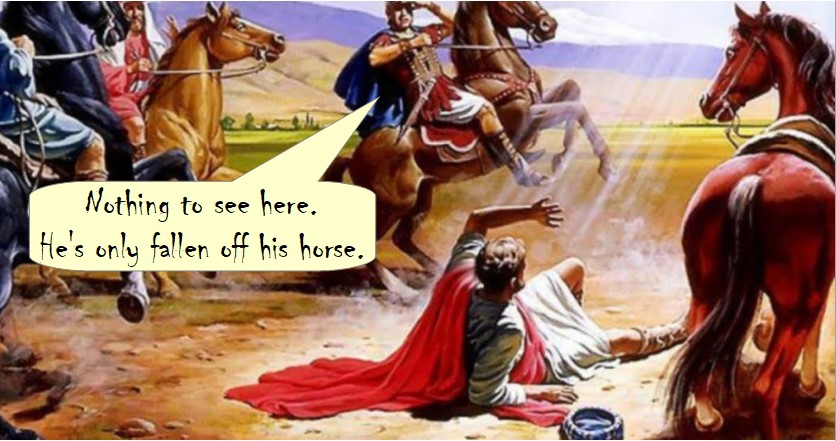
Exhibit 3. The author of Acts creates a story out of Paul’s first vision, the famous account of his conversion on the road to Damascus. It’s a fabrication of course, told differently each time it’s referred to Even so, Luke retains the visionary nature of the experience: Jesus is a bright light and a disembodied voice.

Exhibit 4. The other sightings of the risen Jesus in Acts are visions. When, for example, Stephen is about to be stoned (Acts 7:54-56) he sees in his mind’s eye the heavens open and Jesus sitting at the right hand of god. Other New Testament encounters of the resurrected Jesus, such as John’s Revelation, are explicitly said to be visions.

Exhibit 5. Many of the sightings of the risen Jesus in Matthew and Luke are not of a real, physical human being. Those who experience him see him materialising in locked rooms, vanishing at will and floating up into the clouds. None of these events actually happened; they are the gospel writers’ literary realisations of visions experienced decades earlier, and they retain the hallucinatory qualities of those experiences.

Exhibit 6. Remaining with the gospels’ accounts of the risen Jesus, there is the strange phenomenon of those experiencing him failing to recognise him. Mary in the garden thinks he’s the gardener; the disciples on the road to Emmaus don’t know its him until he breaks bread; the disciples mistake him for someone else on the shore until he tells them how to fish properly. Most damning of all, some of the inner circle of disciples doubt it’s Jesus they’re seeing in their collective visions (Matt 28:17-18). Again, these stories preserve the tradition that the earlier visions weren’t always recognised as Jesus. And why wasn’t he? Because he was an hallucination

Exhibit 7. The risen Jesus has to prove who he is. According to Acts 1:1-3, he ‘presents himself’ his followers, some of whom have wandered around aimlessly with him for three years, and has to convince them he is who he appears to be. And, the text suggests, it takes him forty days to do it. This makes no sense. A far better explanation of this story (and it is a story) is that having experienced their visions of something-they-took-to-be-the-resurrected-Jesus (bright lights? Disembodied voices?), his followers set about convincing themselves that what they experienced really was their former Master. This they did by scouring the scriptures to find ‘proof’ that the Messiah would die and rise again. We know this is how their thinking worked. The same process was used to create the gospels and is evident throughout the New Testament.

Exhibit 8. Dead people stay dead. They do not resurrect.. This is not an a priori assumption. No corpse has ever revived after 36 hours or indeed any other period of time. We know this experientially, statistically and scientifically. Only in stories and religious myth do the dead return. This is what we are dealing with here: stories and myth that flesh out the visions and hallucinations of a few religious zealots.

Mark and the Oral Tradition

Paul never refers to ‘the disciples’, the term used for Jesus’ inner circle in the later gospels. Instead, he refers to the founders of the cult as ‘apostles’ (literally ‘messengers’). Cephas is described as an apostle, as is Barnabas (Acts 14:14) and Paul himself. Paul defines the term more specifically as someone who has been commissioned directly by Jesus (1 Corinthians 9:1; Galatians 1:1-2). Evidently he himself was not: he encountered the risen Christ only in his head. He felt this was more than good enough. For Paul it was the only qualification anyone needed to be an apostle. He cites others who had encountered Jesus in the same way:

For what I received I passed on to you as of first importance: that Christ died for our sins according to the Scriptures, that he was buried, that he was raised on the third day according to the Scriptures, and that he appeared to Peter, and then to the Twelve. After that, he appeared to more than five hundred of the brothers at the same time, most of whom are still living, though some have fallen asleep. Then he appeared to James, then to all the apostles, and last of all he appeared to me also, as to one abnormally born. For I am the least of the apostles and do not even deserve to be called an apostle, because I persecuted the church of God. (1 Corinthians 15: 3-8)

What he goes on to say is crucial in understanding the nature of ‘the gospel’ that was in circulation in the years before Mark’s gospel:

But by the grace of God I am what I am, and his grace to me was not without effect. No, I worked harder than all of them – yet not I, but the grace of God that was with me. Whether, then, it was I or they, this is what we preach, and this is what you believed (1 Corinthians 15: 8-11; my emphasis.)

What they preached was their visions of a celestial Saviour. The witness of these visionaries of the risen Christ was the only gospel they knew and, Paul suggests here and elsewhere, the only one that was being transmitted orally when he was active. As we saw last time, he knew no other details of Jesus’ life, had none passed on to him and passed none on to others, except for these visions and the teaching he worked out from them – his ‘revelations’. Let me say that again: the visions of the risen Jesus were all he, Cephas and others knew. Paul says so categorically. There was no other ‘oral tradition’.

Paul builds his subsequent teaching on Jewish scripture, showing how his ‘revelations’ must be from the Christ because they comply with this scripture (even though he has to manipulate it to make it do so: in Romans 9, for example). Nowhere does he say he is referring to any history he has learnt, nor to anything passed on to him orally about Jesus’ teaching, ministry, life or miracles. Just the opposite in fact:

I want you to know… that the gospel I preached is not of human origin. I did not receive it from any man nor was I taught it; rather I received it (directly) by revelation from Jesus Christ’ (Galatians 1: 11-12).

About seven years after Paul’s death, a literate member of the one of the cult communities – known to us as Mark – decided to set down Paul’s teaching about the Christ in allegorical form. He tells us this is what he is doing several times in his gospel, including Mark 4:11-12:

To you has been given the secret of the kingdom of God, but for those outside everything is in parables, so that “‘they may indeed see but not perceive, and may indeed hear but not understand, lest they should turn and be forgiven’” (referencing and misquoting Isaiah 6:9)

Mark did not depend on any oral tradition for his information about Jesus’ life because apart from the ‘announcement’ built on Cephas’, Paul’s and others’ visions there was no oral tradition. Mark took Paul’s teaching and like him, used Jewish scripture as the basis for the story he developed from it. Thus, Paul’s ‘revelation’ of a bread and wine ritual (1 Corinthians 11:23-27) becomes the Last Supper (Mark 4:22-24); Paul’s teaching about forgiveness becomes Jesus’ teaching about forgiveness; Paul’s dispute with Cephas leads to a gospel Peter who is bungling and disloyal; Paul’s mention of The Twelve in 1 Corinthians becomes, with a miscalculation, the disciples; Paul’s instruction to obey the authorities (Roman’s 13:1) becomes Jesus’ (Mark 12:17); Paul’s, and Jewish scriptures’, promise of the spiritually blind (2 Corinthians 4:3-6) being helped to see becomes Jesus’ miracles of healing; Paul’s predictions about the end of the age (1 Thessalonians 4:15-17) become Jesus’ (Mark 13); Paul’s talk of the coming of the Christ in person (1 Thessalonians 4:13-5:11) becomes Jesus’ prophecies about the Son of Man appearing (Mark 14:61); Paul’s vision of the risen Christ becomes the resurrection. And on and on. There is nothing in Mark’s gospel that doesn’t derive from Paul’s teaching, and Jewish scripture in turn. it is, in short, made up.

All of this accounts for the absence of any resurrection appearances in Mark. His gospel ends with the discovery of the allegorical empty tomb and leaves off there because it is where his audience came in, as it were. They had been converted by hearing of the ‘appearances’ of the celestial Christ to Cephas and those Paul lists in 1 Corinthians. They already knew how the story ended or, more accurately, how it had begun: with those visions.

Later, Matthew, Luke and John would take Mark’s allegory and use it as the basis for their gospels, adding new, invented material of their own. The myth, in both the technical and popular sense, was born.

Redeemed: From Slavery to… erm, Slavery

Thanks be to God, who delivers me through Jesus Christ our Lord! So then, I myself in my mind am a slave to God’s law, but in my sinful nature a slave to the law of sin. (Romans 7:25)

Do you not know that if you present yourselves to anyone as obedient slaves, you are slaves of the one whom you obey, either of sin, which leads to death, or of obedience, which leads to righteousness? (Romans 6:16)

(We are) justified freely by his grace through the redemption that is in Christ. (Romans 3:24)

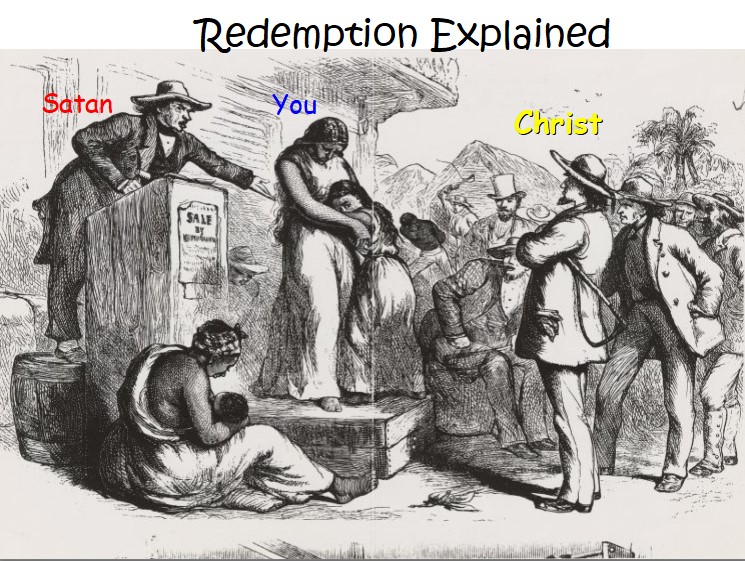
When a slave had served sufficient time and had accumulated sufficient wealth or found a benefactor, he or she could buy their freedom. This seems particularly egregious when their servitude was already, in the case of debt, the means of paying back what was owed. In effect the enslaved individual was paying twice for their freedom. Be that as it may, the act of buying oneself out of slavery was known as redeeming oneself; redemption. Likewise, a third party buying your release was also known as redeeming. We still use the term in this sense today: a pawned item can be redeemed, bought back, for a greater amount of cash than the pawnbroker originally paid for it. The related term ‘ransom’, in Mark 10.45 has the same sense; paying money to secure the release of a captive.

The principle of buying oneself out of captivity and slavery underscores the Christian idea of redemption. It is the analogy Paul and other New Testament writers use, to explain Christ’s paying the price, through his sacrificial death, for the slave’s release. He redeems (or will do at some future point depending on which fantasist you’re reading) in exactly the same way a slave was redeemed, from a life of captive slavery to sin/the Law/Satan and his minions. 

There’s a catch. If a slave was redeemed by a third party, he was likely to find himself not free at all but the property of whoever had redeemed him. His debt having been paid off to his first owner, he might very well find himself in hock to a new one. So it is with Christian redemption. Christ may have paid off your perceived debt to your original owner (sin, Satan or whoever) but now you’re indebted to him. You’re his slave, as we saw in the previous post.

To downplay slavery as it was practised in the centuries before the cult adopted it as an analogy, is to undercut redemption as Paul and early cultists perceived it. Arguing that slavery was a relatively benign practice removes the basis of Christian redemption; if being a slave wasn’t really too bad then neither can being a slave of sin/the Law/Satan be too serious either. There’s really no great need to be redeemed and what Paul says in Romans and elsewhere counts for nothing.

But we knew that anyway.


Saved by Faith Alone

For it is by grace you have been saved, through faith – and this is not from yourselves, it is the gift of God – not by works, so that no one can boast (Ephesians 2:8-9).

Hi!

I heard this fabulous new speaker last night and have given my life to Jesus. All the things I’ve said and written critical of God, Jesus and the Bible, I take back and repent of. Jesus now lives in my heart. Through God’s grace I am saved, and his grace alone. I have done nothing to save myself. The speaker explained I am saved by faith alone through the atoning blood of Christ. Hallelujah! Saved from sin, from the wrath I merit and from death and hell. I am going to live forever in heaven with God.

There’s nothing I need to do. God has done it all.

There was a wonderful Christian lady, Donna, whom I spoke to afterwards. She knew everything about God and Jesus, she really did. She’s been saved for most of her life. Amazing! Anyway, Donna told me it was really important I should start to work out my salvation. I wasn’t sure what she meant when the speaker had said faith was all I needed, but I will try. Donna also said that now I’m a Christian, the devil will increase his attacks on me. I never really thought about the devil before but now I know he’s real, I’ll be on the lookout for him. Satan and his demon hordes rule the world, but only because God lets them. Of course there’s the angels too, taking care of us, which makes up for Satan’s wickedness.

Donna said I should talk with Jesus as much as I can. He’s always listening and will guide me in my walk with him. She said I will hear him speaking to me. He wants to give me anything I ask for, which is just amazing. Or maybe it’s God who does that. I’ll have to check. She also said that I need to join a church and gave me the addresses of some locally. It’s important, she told me, to worship Jesus on a regular basis and to thank him for saving me. I must make sure I take part in the Lord’s supper too, sharing his body and blood, till he comes back to Earth to take us all to heaven. ‘Us’ just means those who believe in Jesus, obviously.

Donna said it was vital I read my bible as well because it’s the Word of God and is full of his Truth. I’m should get to know more about what the Lord requires of me in my daily walk with him. She recommended I join a bible study group, so I’m going to do that. I asked her about the stuff in the Bible that says to give money to anyone who asks and to forgive people loads of times, but she said that that was all metaphorical and I needn’t bother with it.

She told me I have to tell everyone I can that I now belong to Jesus. I’m never going to be ashamed of proclaiming his holy name and telling others how they can be saved, through his precious blood alone.

She told me my life should reflect the fact that I now belong to Jesus, so no more swearing, smoking or drinking for me! Not that I did those much anyway.

Which brings me to why I’m sending you this message, apart from telling you how wonderful it is to be saved by faith alone, of course. Donna was, I have to say, a little taken aback when I mentioned I was gay. She explained very patiently that it’s a sin God really, really doesn’t approve of. She said Jesus would help me defeat it and as a start I really, really couldn’t live with someone of the same sex any longer, not if I wanted to claim my inheritance from the Lord. I have to turn away from sin, especially that one. Donna says it seriously offends God and he’d never let me into the Kingdom of Heaven as, well… you know, as an abomination. So I’m giving up my previous life.

I know you’ll be a little upset by this, but it’s really why I’m writing. By the time you see this, I’ll have moved out. I still love you, course I do, but it’s for the best. I have to make all the sacrifices I need to preserve my salvation. And think of it this way, it’ll help you give up your life of sin too, so you can be redeemed.

Well, that’s it. Remember, you too can be saved by faith alone and the blood of Jesus and all those other things I’ve mentioned. Simple really. I hope and pray you’ll give your heart to Jesus soon.

Love in Christ who saves us,

Sam

A Funny Thing Happened On The Way To The Forum

So I’m saved now.

Saved? From what?

My sins.

Your sins. Right. How’d this happen then?

My friend Marcus told me about a new Saviour.

And how did Marcus know about a new Saviour?

Gaius told him.

And Gaius?

His neighbour Livia told him.

And where’d she hear it?

She said she was told it by a travelling preacher.

Well, travelling preachers are always reliable, so sure.

Paûlos I think she said he was called. Anyway, Livia heard him talking about the new Saviour in the forum and she told Gaius, Gaius told Marcus and he told me.

Right. So what did this Paûlos say?

That he’d had a vision or something and had seen this new Saviour in his vision. I think he said he was called Iesous. Something like that.

So a Jewish Saviour then. I take it this Paûlos was Jewish?

I don’t think Livia said.

So what’s a Jewish Saviour to you? Or Livia and Gaius and Marcus for that matter?

Well, that’s the great thing. Marcus said that Gaius said that Livia said that Paûlos said that this particular Jewish Saviour is for everyone, not just Jews.

And Paûlos worked this out from his vision, did he?

Yes. Iesous told him all about it.

In his vision.

Yeah. He told Paûlos that anyone who wanted to could ask him to save them from their sins. So Livia did, and then when she told Gaius, he did too, and then Marcus.

So, Paûlos. He ever meet this Iesous? In the flesh, I mean.

Oh, I don’t think so. Paûlos didn’t need to, you see. Iesous talked to him from Heaven. He didn’t need to meet him.

He say whether he’d met anyone who had actually met him?

No. He knew of some fellas who’d seen Iesous same as him, in marvellous visions, but he said he didn’t need to meet them either. Like I said, Iesous the Saviour spoke to Paûlos direct. You don’t need any more than that. I’m hoping he’ll speak direct to me before long.

So, how’d you know this Iesous existed if nobody knows anyone who’s seen him in the flesh?

I told you, Paûlos saw him right there in his head and Iesous told him all he needed to know. The Saviour said that when he comes down from the sky, which he will real soon, those of us he’s saved will live with him forever, right here on Earth.

Live forever, you say?

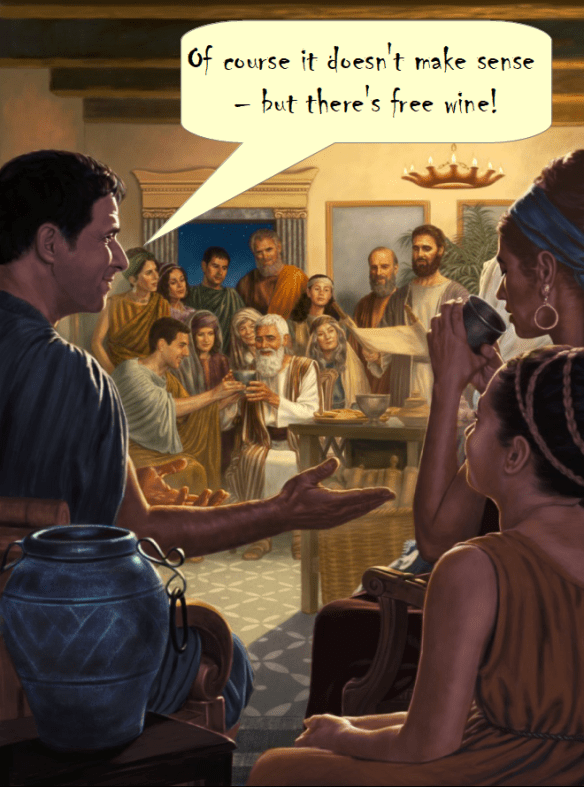
Sure. And there’s free wine while we wait.

Free wine? Why didn’t you say? Where do I sign up?


This time it’s personal

Desperately searching for another reason to dismiss recent critiques of Christianity, Don has suggested that my views and those of commenters here are somehow invalid because they’re ‘personal’. (I declined to publish Don’s latest comment in which he elaborated on this theme; not only was he already on enforced rest but he also decided to have a rant about ‘sexual depravity’. This would appear to have been directed  at my own happy same-sex relationship, as well as all other forms of consensual sex that God Don disapproves of.)

So what’s wrong with ‘personal’? My faith, when I had it was personal. I’d prayed the sinner’s prayer in which I confessed I was a sinner and I received Jesus into my heart (or so I thought) and began to live my life in accordance with what he required of me. This personal relationship with Jesus, as it was usually described in evangelical circles, was reinforced by the preaching I heard in church, by prayer meetings and Bible studies, by the devotional books I read, C. S. Lewis’s writing and the notes I used alongside my personal Bible reading.

I’ve written before how I abandoned all of this when, in a time of crisis, God wasn’t there, and I eventually came to realise, in what I can only describe as a moment of personal revelation, that this was because he didn’t exist.

I then set about discovering what it was I had believed for the previous 30 years; what were these beliefs that had shaped my life, determining what I did, who I married, my morality, my sense of guilt and failure… essentially all that I was. That quest, which began with my broadening my reading well beyond the bounds of devotional Christian books (how treacherous I felt when I first picked them up!) was personal. It was fuelled by the reaction of some Christian friends who attacked me personally when, still later, I came out not only as an atheist but as gay too. My dealings with one particular zealous and homophobic friend led to my first book and ultimately, over 12 years ago, to this blog.

RejectingJesus is a personal working out of my love-hate relationship with Christianity. It is, I hope, informed by my reading but it is first and foremost personal. The posts are my analysis of Christianity as it is practised and my own dissection of the Bible. I’m not a historian nor a theologian (thank god); my Masters is in English Literary Research and it is these skills, together with my knowledge of the Bible from my Christian days, that I apply in my sometimes irreverent analyses. Nothing is sacred, though I’m aware of the importance of providing evidence for my claims and, where relevant, in citing appropriate sources, which is why I provide links and reference relevant verses from the Bible. Perversely, Don also accuses me of being in thrall to the scholars I cite; the opposite of his complaint that posts are ‘personal’.

Do I then, as Don implies, try to discredit the Bible because I’m gay? Am I, as Don suggests, motivated by the ‘constraints’ the Bible places on my sexuality? I don’t believe so. Once I recognised that God didn’t exist, it followed that he could not have any opinion about homosexuality or indeed anything else. Like any other fictional character, his views were created by those who presumed to speak for him: ‘I am so mysterious and my ways unknowable. Oh, but by the way, I really don’t like those depraved gays. Feel at liberty to stone them.’ God’s self-appointed homophobes have to be challenged because of the damage they do.

Am I as an atheist predisposed to being critical of both faith and the Bible, as Christian readers sometimes say? Undoubtedly, but I’m no more predisposed than as a Christian I was predisposed to see God everywhere. As Nan put it in a recent comment:

Any individual who allows him/herself to put aside the centuries-long teachings of Christianity … and read the scriptures without bias and/or preconception … cannot fail to see the multitude of inconsistencies.

Nor can they fail to see the Bible’s flights of fancy, its reliance on dreams and visions, its make-believe and pretend fulfilment of prophecy, its forgeries and false promises, its disconnect from reality and magical thinking, its supernaturalism and sheer cultishness. Critically evaluating scriptures at face value, without making excuses for them or trying to guessing what the original writers might have ‘intended’ or deciding that unpalatable parts are ‘really’ symbolic/metaphorical is, however ‘personal’, by far the more honest approach.

To insinuate with a personal slur that having ‘personal’ reasons for criticising Christianity is a weak ad hominem. It does not address the arguments in question nor the issues at hand. Anyone who wants to demonstrate that what I say about the Bible, Christian belief and practice is wrong needs to provide evidence of their own. Insult, screeds of Bible quotation and ‘a legion of “work arounds”’ (Nan again) is not how to go about it.


Battle Of The Magic Books

Don Camp replies (in blue) to my previous post. My responses are in black.

There are multiple reason for rejecting Mormonism. The primary reason is similar to discerning between a fake $20 bill and the real thing. The fake just doesn’t feel like the real thing. Of course, that test requires that one knows what a $20 bill feels like. Anyone who does not know is easily fooled.

In fact, if you don’t know what the real thing is like, it is impossible to identify a fake. You might notice an ink smudge and a difference in paper, but who is to say one is fake and the other is not?

This presupposes that your version of Christianity is ‘the real thing’. For a Jew, Judaism is the real thing and Christianity the Johnny-come-lately fake. All you’re saying here is that you ‘feel’ your version of Christianity is the real thing and you ‘feel’ Mormonism isn’t. This isn’t persuasive. I know, for reasons other than intuition, that Christianity isn’t the real thing. To use your analogy, it is the twenty dollar bill received in change when in the UK a twenty pound note is the ‘real thing’.

But since you have a knowledge of literature, Neil, why not apply those standards? Nice concession there, Don. The Bible is indeed literature and as such deserves to have the same standards applied to it as any other work of fiction.

Is the Bible and the narrative in the Bible coherent?? No. Its central character is ridiculously inconsistent. Described as an unchanging God, he changes from book to book and most noticeably between the Old and New Testaments. As someone commented on Debunking Christianity recently, it’s as if he ate a Snickers bar between the two. (He does get hungry again towards the end of the NT, when he reverts to being an omnipotent Putin.)

As the protagonist undergoes his major rewrite, the plot also suddenly deviates, becoming a completely different story. It starts by being about this poorly conceived character’s ‘everlasting covenant’ with his chosen people, but then two thirds of the way through, this everlasting covenant is scrapped and replaced with a new, largely incoherent deal involving a human sacrifice that the unchanging God has previously said he finds abhorrent.

Does it stick together and develop a single theme across the whole? No, it doesn’t ‘stick together’, not unless you ignore the gaping inconsistencies in character and plotting, and its overall implausibility.

Do you know what the theme of the Bible is, Neil? Yes, thank you, Don. Condescending of you to ask. Any apparent consistency is because the writers of the second part of the story had access to the first part. They plundered it for their own purposes, drastically altering it so that it suited their new theme. That is why much of the Jesus story appears to be foreshadowed in the Old Testament. The Jesus story – and it is a story – is built on events and episodes they found there.

Remember that the Mormons tell us that the Book of Mormon is an extension of the Bible and that the people of the Americas were related to the Jews and held to the basic truths of the Jews. (Remember also the Mormons believe that Jesus appeared to these people in the New World shortly after his resurrection.) So if you put the Torah and the Book of Mormon together, is the narrative coherent? Does it develop a single theme? The Old testament and the New Testament are a coherent whole, but I do not think the Old Testament and the Book of Mormon are. As you can tell, I dispute that the Old and New Testament are a coherent whole. The Old Testament and the Book of Mormon aren’t either. That lack of coherency becomes even more obvious when we compare God in the Old Testament with God in the Book of Mormon. The person of Jesus is also inconsistent in the Book of Mormon with the Bible.

But they’re inconsistent within the Bible too, Don. Compare John’s Jesus with Mark’s. Compare Paul’s beatific Christ with Revelation’s grotesquely super-powered warlord.

Of course, the standard explanation by Latter Day Saints is that the Bible has not been adequately translated, though I know of no place where they can demonstrate that claim. There are significant translation problems with the Bible, which mainstream scholars consider at length. Mormon desperation to resolve these conflicts is the same as that demonstrated by Christian theologians.

Finally, there is a matter of provenance. We know in very good detail where the Bible came from.

We do? We know who Matthew, Mark, Luke and John actually were? No, we don’t nor do we know where they wrote or what their sources were. We don’t have the autographs (originals) of any of the New Testament documents but we do know some of them are forgeries and others have been tampered with.

There are many copies, especially for the New Testament, and there are many commentaries of both the OT and NT from very early in the their history. Proving what? Only that they were copied, frequently inaccurately. The copies are all much later than the probable time of composition. The commentaries are similarly far removed from them; there are commentaries on the Book of Mormon much closer to its composition.

What is the provenance of the Book of Mormon? It apparently appeared magically out of nowhere pretty recently. No mention in any other literature of its existence. It did appear magically! Oh ye of little faith! God sent an angel, like he does numerous times in the Bible, and told Joseph Smith to translate the golden tablets. The NT books were similarly created, with God breathing his word into cult followers as they wrote. God, angels, Holy Spirit, magic – all of a muchness, don’t you think?

No copy is available to examine. Nor of the original copies of anything in the Bible.

That is not to speak of the total lack of any archaeological evidence for the Mormon claims of Jews in the Americas. Mormons dispute this, of course. There are similar problems with some locations mentioned in the Bible. More fatally, most of what the Bible promises has proven false. For example: Jesus’ imminent return, his guarantee of miracles, believers becoming new creations. (Paul spends much of his time ticking off these ‘new creations’ who remain resolutely unreformed.)

So, I would say the Book of Mormon fails on all levels.

I would too. As does the Bible for the reasons I’ve outlined, and despite your special pleading. You don’t apply the same rigour in your consideration of the Bible that you do to Latter Day Saint fiction. Why is this, Don?

The Resurrection: Real or Imagined?

Did Paul see a physically resurrected man or did he hallucinate some sort of spirit? What does the bible say?

Paul describes his encounter with the risen Jesus in his letter to cultists in Galatia:

For I did not receive it (the gospel) from man, nor was I taught it, but it came through a revelation of Jesus Christ… God was pleased to reveal his Son in me… (Galatians 1.12 & 15)

‘Revelation, revealed, in me’: there’s no physically resurrected body here.

In his letter to the little community in Corinth, Paul tells us explicitly that Jesus was raised as a ‘life giving spirit’ (1 Corinthians 15.45). Whatever this means, this is how Paul experienced the risen Christ. Nowhere in his letters does he claim to have seen a man who has physically risen from the dead. Even in the legend created around Paul’s mystical revelations decades later, there’s no physical Jesus: a bright light and disembodied voice is what Luke comes up with.

Why does this matter? Well, for a start, Paul’s is the only first hand account of an encounter with the risen Jesus we have. And it was of an entirely ‘spiritual’ nature. Second, Paul assumes that those who ‘saw’ the risen Jesus had exactly the same sort of experience he did. He says in 1 Corinthians 15.5-8,

…(the Risen Jesus) appeared to Cephas, and then to the Twelve. After that, he appeared to more than five hundred of the brothers and sisters at the same time, most of whom are still living, though some have fallen asleep. Then he appeared to James, then to all the apostles, and last of all he appeared to me also, as to one abnormally born.

Paul makes no distinction between the way he experienced the risen Jesus, as a life giving Spirit, and the way these others did. His persistent use of ‘appeared to’ also underlines the mystical nature of these encounters; he doesn’t say Jesus ‘visited’ James or ‘spent time with’ Cephas or ‘chatted with’ the apostles over a fish supper (those legends would come later). There’s absolutely no human interaction here between these people and a real human being. No: instead, Paul says Jesus ‘appeared to’ them, as in ‘he was an apparition’.

The translation of the same passage in the King James version makes this obvious:

…he was seen of Cephas, then of the twelve: After that, he was seen of above five hundred brethren at once; of whom the greater part remain unto this present, but some are fallen asleep. After that, he was seen of James; then of all the apostles.  And last of all he was seen of me also, as of one born out of due time.

As for Paul, then, so for all these other sightings (we only have Paul’s word they actually took place.) They were apparitions, hallucinations, innervisions, emotional, spiritual experiences – call them what you will – ‘seen of’ others. They were not of a real man physically raised from the dead.

Why do some Christians find this so hard to accept? After all, this is much their own experience today. They may not hallucinate that Jesus is standing in front of them (assuming that’s what the ‘life giving spirit’ looked like to Paul and others) but they have an emotional experience at conversion that they credit to the presence, the spirit, of this long dead individual. If that’s how it is for converts today, why not for the original Christians? Why does there have to be physical resurrection at all?

Spoiler: there doesn’t and there wasn’t.