Bible Study

Again he entered the synagogue, and a man was there with a withered hand. And they watched Jesus, to see whether he would heal him on the Sabbath, so that they might accuse him. And he said to the man with the withered hand, Come here.” And he said to them, Is it lawful on the Sabbath to do good or to do harm, to save life or to kill?” But they were silent. And he looked around at them with anger, grieved at their hardness of heart, and said to the man, Stretch out your hand.” He stretched it out, and his hand was restored. The Pharisees went out and immediately held counsel with the Herodians against him, how to destroy him. (Mark 3:1-6)

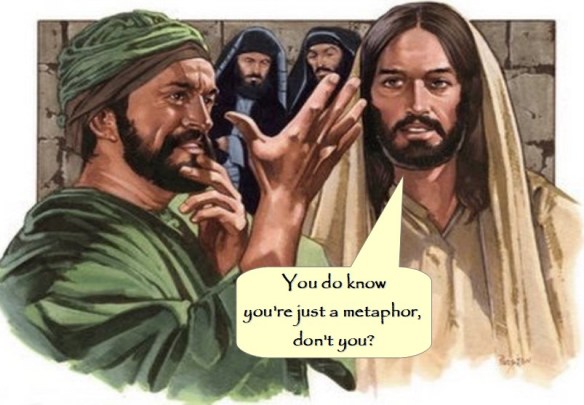
Greetings, my beloved Brethren. Today we are going to look at God’s Holy Word as revealed to our dear brother in the Lord, the one who will one day be called ‘Mark’. We’re looking specifically at the passage above, because some of you have expressed difficulty in discerning the full import of the text. I have to say I’m surprised at this. You only have to bear in mind Mark’s rule of thumb that everything in his gospel is a metaphor, which, when looked at with discernment, reveals a previously hidden mystery: 

To you has been given the secret of the kingdom of God, but for those outside everything is in parables, so that “‘they may indeed see but not perceive, and may indeed hear but not understand, lest they should turn and be forgiven’” (Mark 4:11-12, referencing Isaiah 6:9)

Our passage today begins with the Lord healing a man with a withered hand, which should straight away alert us to the fact we are dealing with metaphor. All of the healings in the gospels are. They stand for something more significant than any actual healing.

Some of you might already have made the connection between the use of ‘withered’ here, with its use in another story (Mark 11-12-14), where Jesus withers an unfruitful fig tree. Of course, no actual fig trees were harmed during this miracle. The fig tree and its withering are metaphors.

The tree, you see, is a metaphor for the Jewish system of worship, the old Covenant of the Law. This had reached the end of its life. It was fruitless and God was done with it. He was in the process of replacing it with salvation through Grace. All of this is represented metaphorically by Jesus cursing the fig tree and causing it to wither.

So it is in our passage today, except this time, God offers healing to the Jewish nation. He is nothing if not gracious, reaching out and offering acceptance into the new Covenant, expressed here as the healing of a withered hand. You won’t have missed the fact – again symbolic – that the healing occurs in the synagogue, the Jews’ place of worship. We might also remember Deuteronomy (6:8) where the Lord God instructs the Jews to wear his Law on their foreheads and, more significantly, to tie them to the backs of their hands. But now their hands have, metaphorically speaking, withered away, just as the fig tree will.

God knows of course that few will accept his proffered healing, insisting instead of labouring blindly under the old Covenant. The rest of the story reflects this stubbornness and the incalcitrant attitude as the Pharisees – metaphors for the Jews as a whole – round on Jesus and castigate him for breaking the Sabbath laws in healing the man – in spiritual reality the Jews themselves. That Jesus heals on the Jews’ sacred day is metaphorical too, demonstrating as it does that all the old laws are now surpassed. Jesus, and more importantly his followers – you, my dear brethren – are no longer under the yoke of that law but have new freedom serving Jesus under his new yoke, which is easy to bear. At the end of the story, the Pharisees – the Jewish leaders of our own time, lest we forget – leave to plot against the Lord; in reality against us. With his help we will of course bear this persecution stoically.

So you see my brothers, this story was written for you, to remind you that you are saved. You are the New Covenant. The Old has passed away. You can follow Jesus’ example and do good, yea, even on the Sabbath. You need not fear the Jews or others who might persecute you because the Lord is with us. The Jews, on the other hand, will soon be cast into outer darkness when he comes in person. Even so, Lord Jesus, come quickly.

I hope this has made clear to you the mystery hidden in this part of Mark. I know there will be some of you who are not sufficiently advanced in their understanding of the mysteries, being still babes in Christ, and may yet object to this exposition of the deeper secrets of the Lord. So be it. But don’t say you haven’t been made aware of the Truth.

Next time, if there are those who need to know more of the mysteries hidden in God’s new revelation, we can look at the next part of Mark, though I trust that you are, by now, developing sufficient spiritual insight to discern for yourselves the hidden mysteries embodied by the gospel’s metaphors.

How To Read The Bible

A step by step guide to reading God’s Word, courtesy of Don Camp.

Always read passages in context. This is the only way you can understand what they mean.

Synthesise different passages from a range of contexts so that collectively they say something else.

Read the Bible with all the discernment of a fifth grader.

Always take what is being expressed at face value.

Work out what the original author intended. (Note: ignore the Intentional Fallacy for this purpose.)

Scrutinise what the author intended until he says what you think he should say.

Because the Bible is made up of stories, poems and other literary forms, make sure you recognise the genre you’re dealing with and process it accordingly. (Note: different genres may be synthesised if it suits your purposes.)

Always assume that the improbable, implausible or ludicrous parts of the bible are metaphor, allegory or hyperbole.

Interpret metaphor and allegory in a way that eliminates their obvious ludicrousness.

Do not apply the metaphor/allegory principle to the gospels. The gospels are 100% historical documents, untainted by metaphor and allegory.

Ignore any of Jesus’ commands that are expressed as metaphors.

Dismiss any of Jesus’ more extreme commands – give away all you have, love your enemies, turn the other cheek etc – with the assurance that they’re hyperbole and/or metaphor.

Read the Bible like a first-century believer, even though the Bible didn’t exist in the first century.

On no account concede that Carrier, Ehrman or any other scholar with a book to sell has reached a far more valid conclusion than you have yourself.

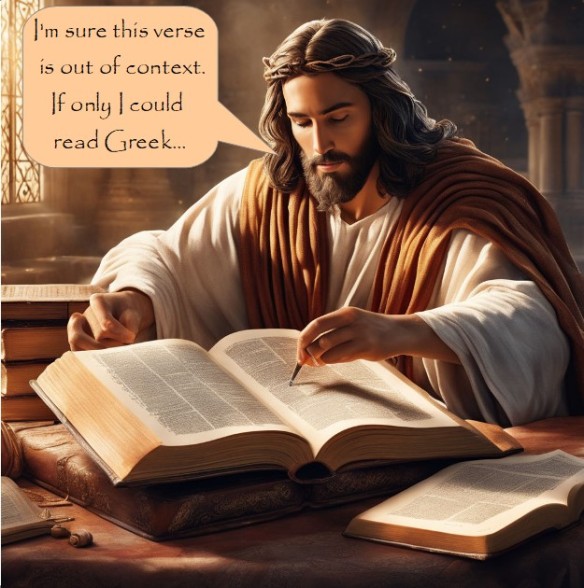
To appreciate fully the nuances of New Testament theology, learn Ancient Greek.

Above all, remember that cognitive dissonance is one of the most powerful tools at your disposal.

(Continues in similar vein for 86 pages.)

Thank you, Don. I appreciate how you’ve collected together the many and varied points you’ve made in your recent voluminous comments, synthesised them and presented them here to equip us to read the Bible the Don Camp way. I can’t help but think that, as a result, we’re all that much closer to a personal encounter with Jesus.

The Bible Is Fantasy

The Bible contains:

113 appearances of angels, usually interacting with human beings;

50+ visions, on which all of Christianity hangs: those of Daniel; Cephas and others who ‘saw’ the risen Christ; Paul and John the Elder in Revelation. 

21 supernatural dreams, including those experienced by Jacob, Technicolor Joseph, NT Joseph, the Magi, Pilate’s wife and Paul

Numerous apparitions and ghostly appearances, including that of the resurrected Jesus as well as Moses and Elijah and, in the Old Testament, the spirit of Samuel, conjured up from the grave by the witch of Endor.

Innumerable resurrections: not only that of Jesus but several Old Testament characters, and, in the New, Lazarus, Jairus’ daughter, the young man of Nain and the hordes who rose from their graves at the time of the crucifixion.

Multiple impossible astronomical events, ranging from the sun stopping in its orbit(!); a star wandering and hovering over a small house; a solar eclipse lasting several hours; stars that one day will fall from the sky; a God who lives just above the clouds and a ‘firmament’ between the Earth and the heavens that holds back water;

Several events in which nature is magically controlled: the parting of the Red Sea; Moses’ magician’s staff becoming a snake; the Nile turning to blood; Jonah being swallowed but not digested by a ‘great fish’ and Jesus calming a storm.

An abundance of fantastic beasts and fairy tale creatures: Giants (Genesis 6:1-4, Numbers 13:33); Leviathan the sea monster (Isaiah 27:1 etc); the Behemoth (Job 40:15-24); the Cherubim monsters (Ezekiel 1:4-21); the dragon and other beasts from Revelation

Many characters who are clearly legendary, from Adam & Eve, Noah, Lot and Abraham to Moses, Job, Daniel and gospel Jesus. Some of the Bible’s fictional characters lived to a literally incredible age: Adam 930 years, Seth 912, Methuselah 969, Noah 950, Abraham 175, Moses a pitiful 120. Jesus holds the record being now either 2,000 years old or eternal, depending on how you count it.

5 mythical places: Eden at the beginning of the book; New Jerusalem at the end; Heaven, the abode of God; Sheol the Old Testament place of the dead; Hades (Sheol mark II?) which Jesus visited while supposedly dead in his tomb (Acts 2:27, 31; Matt 16:18).

2 sentient ‘pillars’: one of cloud, one of fire (Exodus 13).

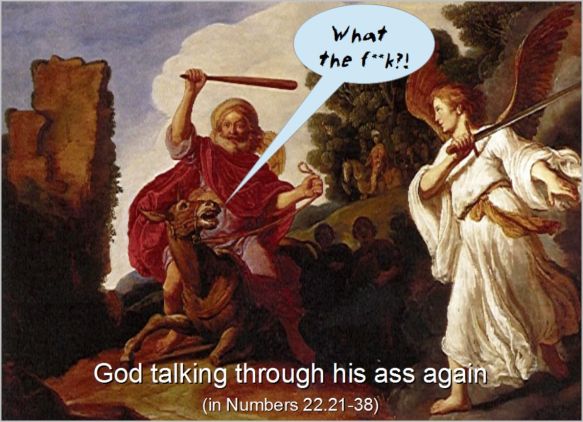
2 talking animals: the serpent in Eden and Balaam’s ass.

1 talking plant (Exodus 3:3).

0 science. No understanding whatsoever of what we now call astronomy, meteorology, germ theory, genetics, evolution, psychology… you name it.

So how do we read all of this? As the ancients themselves would, with an understanding of the world that regarded the supernatural, magic, miracles and monsters as real? We’re told often enough that this is how we should interpret scripture, not from a modern perspective. Perhaps we might credit the creators of the many books of the bible with greater skill, however, and interpret the inclusion of magic and miracle as allegorical or metaphorical; literary pieces, if you will. But then we have to decide which far-fetched stories are myth and which are historical accounts,. There really is no way to do this. A New Testament story awash with impossible events, implausible characters and symbolic tropes is every bit as allegorical or metaphorical as the same kind of story in the Old Testament (or, indeed, in Egyptian, Greek and Roman myth.) The reader who wants to see stories in the Old Testament as carefully crafted allegories has to concede that the Jesus narratives are of the same order.

It looks like we have to read the Bible as 21st century readers, because that is what we are. After all the Bible is supposedly a book for all time. We can, however, recognise the way in which its many creators saw the world – populated with fantasy creatures and subject to impossible events – and accept that they were wrong. Reality is not as they perceived it. What we cannot do is claim that the Jesus story is an oasis of truth in the midst of all this fantasy . 

Jettisoned

It’s all very well discussing how the gospels came to be, but are they true and do Christians adhere to what Jesus purportedly tells them there? Let’s take a look at one of his instructions from Matthew 23.8-10:

But you are not to be called ‘Rabbi,’ for you have one Teacher, and you are all brothers. And do not call anyone on earth ‘father,’ for you have one Father, and he is in heaven. Nor are you to be called instructors, for you have one Instructor, the Messiah. 

Context: Matthew’s cult community is moving away from synagogue worship and so supplies Jesus with words condemning Pharisaic practices. Instead, because the new cult at this point is egalitarian, they have him endorse its practice. One teacher: the heavenly Christ. One church: the brotherhood. One Father: God in heaven. One Instructor: the heavenly Christ again.

How quickly the church jettisoned this advice! By the time of Ephesians (written in the late 1st or early 2nd and certainly not by Paul who was long dead) the church is awash with ‘the apostles, the prophets, the evangelists, the pastors and teachers, (given by Christ) to equip his people for works of service, so that the body of Christ may be built up (Ephesians 4.11-12)

A little later still, 1 Timothy – again, not written by Paul – speaks of hierarchical structures of overseers (‘bishops’), leaders, teachers and instructors (the two words have the same meaning), while later in the first century, and in direct contravention of Jesus’ admonition, the Roman church started calling its priests ‘father’. The Pope, – the term means Father or Papa – soon became the Father of all fathers.

Did the early church not really believe that Matthew 23.8-10 recorded the words of Jesus? (They’d be correct if so.) Or did they think that they didn’t matter; were, in fact, optional? (Parenthetically, what is it with gospel-Jesus habitually referring to saviour-figures in the third person? He does it here – ‘one instructor: the Messiah’ – and when he refers to ‘the Son of Man’. Why should we suppose he means himself when he does this? He’s not afraid to talk at length in the first person about himself in John’s gospel, but in the synoptics he’s apparently too timid to do so and feels compelled to use the third person and hide behind alter-egos. Unless of course fictional gospel-Jesus, or his script writers, regards ‘the Messiah’ and ‘the Son of Man’ as beings other than himself.) 

Then there’s the modern church, with its pastors (‘shepherds’), bishops (‘overseers’), teachers, instructors and priests (‘elders’). Does it too consider that gospel truths about brotherhood, no father but God and no teacher except the Christ, to be optional – insignificant even? Apparently so.

Which other words of Jesus do believers feel free to jettison? We’ll take an occasional look in the weeks ahead.


Myths and Endless Genealogies

I’ve been reading Richard Carrier’s recent post about Docetism. Docetism, as you’ll know, is the idea that the Christ’s human body was illusory. Carrier questions whether this idea existed as a belief system in ancient times; the term, he says, was invented by modern theologians to describe a few vague notions that appeared only towards the end of the 2nd century.

He finds no evidence for Docetism as a movement at any time and certainly not when the books of the New Testament were being composed. Along the way, however, he discusses 1 Timothy 1:3-4, written either in the late first or early second century (and therefore not by Paul who died in AD 64):

…Command certain people not to teach false doctrines any longer or to devote themselves to myths and endless genealogies. Such things promote controversial speculations rather than advancing God’s work – which is by faith. (My emphasis)

‘Myths and endless genealogies’: interesting. What could these myths and genealogies be? Where were they to be found? In what way did they promote controversial speculations? How did they deplete faith?

The ‘myths’ are mentioned again in 2 Timothy, also not written by Paul but by someone using his name, again in the late first or early second century:

For the time will come when people will not put up with sound doctrine. Instead, to suit their own desires, they will gather around them a great number of teachers to say what their itching ears want to hear. They will turn their ears away from the truth and turn aside to myths. (2 Timothy 4:3-4)

Not, you’ll note, ‘(they will) turn aside to false doctrines or heretical teaching’, which is how this verse is usually interpreted and applied by nit-picking evangelicals today, but ‘they will turn aside to myths‘. Some in the early second century church were being distracted by such myths – spurious stories about Jesus – and the writer(s?) of 1 and 2 Timothy feel compelled to warn against them.

The author of 2 Peter, who certainly wasn’t Peter/Cephas, issues a similar warning in his letter of 80-90:

For we did not follow cleverly devised stories when we told you about the coming of our Lord Jesus Christ in power, but we were eyewitnesses of his majesty. (2 Peter 1:16)

What can these myths have been? What ‘cleverly devised stories’ about Jesus were circulating in the late 1st century and early 2nd? There were no ‘Docetic’ texts at this time, no ‘Gnostic’ ones, none of the more far-fetched, downright weird gospels, which all appeared later.

The use of ‘genealogies’ in 1 Timothy is a clue. Which documents with ridiculously contrived genealogies were circulating in the churches of the late first and early 2nd centuries? We know of none – apart from Matthew and Luke’s gospels. Could the forgers of 1 & 2 Timothy and 2 Peter be referring to these? Did they object to the fictional backstory Matthew, Luke and Mark had created for their heavenly saviour? Were these the myths to which believers were turning to instead of gazing heavenward at the ‘majesty’ of the celestial saviour who was soon to come in power to the Earth, as 2 Peter 1:16 suggests?

It certainly could.

God’s Design for Sexual Relationships: the Gospel According to Don

A digression:

A little while back, a Christian commenter (we’ll call him ‘Don’) made the point that homosexuality and other non-conformist sexualities are ‘not the order of creation God intended‘. Yes, Don knows the intentions of a God whose purposes are unknowable (Romans 11:33-34)! 

And what are those intentions?’ I hear you ask. It is that everyone be, or pretends to be, heterosexual and involves the marriage of one man to one woman for life, for the procreation of children. I know this because it says so in the Book of Common Prayer, originally composed in 1622:

The union of husband and wife in heart, body, and mind is intended by God for their mutual joy; for the help and comfort given one another in prosperity and adversity; and, when it is God’s will, for the procreation of children and their nurture in the knowledge and love of the Lord. Therefore marriage is not to be entered into unadvisedly or lightly, but reverently, deliberately, and in accordance with the purposes for which it was instituted by God.

But how did the writers of this book know this was God’s plan? How do evangelicals today, who subscribe to the same ideas, know that this is what God intended? How does Don?

The Bible. Surely the writers of the prayer book consulted the Bible and created their summary of God’s plan from that. Surely the evangelicals who promote one-man one-woman marriage draw their inspiration from God’s Word. Surely this is how Don knows too.

Let’s see. Here’s what Paul has to say about marriage 1 Corinthians 7:28-29:

…if you marry, you do not sin, and if a virgin marries, she does not sin. Yet those who marry will experience distress in this life, and I would spare you that. I mean, brothers and sisters, the appointed time has grown short; from now on, let even those who have wives be as though they had none.

Hardly a ringing endorsement of marriage!

Paul goes on to say,

I would like you to be free from concern. An unmarried man is concerned about the Lord’s affairs—how he can please the Lord. But a married man is concerned about the affairs of this world—how he can please his wife— and his interests are divided. An unmarried woman or virgin is concerned about the Lord’s affairs: Her aim is to be devoted to the Lord in both body and spirit. But a married woman is concerned about the affairs of this world—how she can please her husband.I am saying this for your own good, not to restrict you, but that you may live in a right way in undivided devotion to the Lord…So then, he who marries the virgin does right, but he who does not marry her does better. A woman is bound to her husband as long as he lives. But if her husband dies, she is free to marry anyone she wishes, but he must belong to the Lord. In my judgment, she is happier if she stays as she is—and I think that I too have the Spirit of God (1 Corinthians 7:32-40).

In other words, avoid marriage if you can, the better to devote yourself entirely to the Lord. How many Christians actually do this? How many preachers and evangelists promote it? None that I know of.

I can already hear Don arguing that Paul’s views are his own and were not handed down from on high. Let’s then turn to what Jesus says about marriage. If anyone knows God’s views on the matter, it must surely be his very own Son. I don’t for a second, believe he was of course, especially as Jesus’ script was written years after Paul and owes a great deal to him. Nonetheless, here’s what Jesus is made to say about God’s plan for marriage:

Jesus said to them, ‘Those who belong to this age marry and are given in marriage; but those who are considered worthy of a place in that age [i.e. that of the Kingdom] and in the resurrection from the dead neither marry nor are given in marriage (Luke 20:34-36).

Surely he can’t be saying that those who want to rise from the dead and make it into the Kingdom of God shouldn’t marry? That they’re not worthy of that Kingdom if they do? Yup, that’s exactly what he’s saying.

Similarly, in Matthew 19:10-12, after discussing divorce with the Pharisees, Jesus responds to the disciples’ remark that ‘it is better not to marry’, with –

…not everyone can accept this teaching, but only those to whom it is given. For there are eunuchs who have been so from birth, and there are eunuchs who have been made eunuchs by others, and there are eunuchs who have made themselves eunuchs for the sake of the Kingdom of heaven. Let anyone accept this who can.

Even interpreted figuratively – though it’s not evident from the text that Jesus is speaking figuratively – this means Jesus thinks it’s preferable to be sexless: chaste, celibate, single. How well that’s worked out for the Catholic church!

Finally, there’s Luke 14:26 where Jesus makes it clear what following him entails:

If anyone comes to me and does not hatewife and children, brothers and sisters—yes, even their own life—such a person cannot be my disciple.

Not much ‘mutual joy’ there.

Unlike Jesus and Paul, I’m not knocking hetero-marriage or the procreation of children. I’ve been involved with both. If these are what floats your boat, that’s great. But they’re not what the Bible promotes. Just the opposite. After the tales of incest, polygamy and adultery in the Old Testament, the New teaches that marriage has had its day. It is to be avoided, the better to follow Jesus, prepare for the coming kingdom and be worthy of eternal life. Only marry, Paul advises, if you can’t control your sexual urges. But, according to Jesus, you are risking your place in the coming kingdom if you do. You can improve your chances by shunning sex altogether.

This is the Bible’s teaching about marriage and God’s intentions for the sexual beings he created. Strictly speaking, it’s the New Testament’s teaching; that of the Old is even more bizarre.

Aah but,’ I hear someone say, ‘it’s all about context.’ Certainly it is; and the context is that Paul and those who created Jesus’ script believed the current age was about to end. Marriage, such as it was (very different from the modern concept, particularly for women who could be bought and sold aged only 12 or 13), would also then be coming to an end. With the arrival of the Kingdom of God on Earth, marriage would be redundant. Better, Paul and the gospel writers argue, to have done with it now to conform ahead of time with the new system, with God’s plan: ‘those who are considered worthy of a place in that age and in the resurrection from the dead neither marry nor are given in marriage.’

But God’s plan – the arrival of his kingdom on Earth in the first century didn’t come to fruition. His plan for marriage to end likewise fell by the wayside. Instead, and without the assistance of any deity, the very human institution of marriage persisted and evolved, eventually being hijacked by the Catholic church in the ninth century. It emerged more or less in its current form – though not for everyone – in the 17th century. Whatever this signifies, it was not what ‘God intended for his creation’ nor his ‘design for sexual relationships’ (Don again, doubling down on his position.)

If the Bible is anything to go by, God has never been very impressed by marriage. His long-term plan for it, if that disreputable book is to be believed, was to scrap it altogether. Yet we still have Christians who use its continued existence to disparage and denigrate those of us who express our sexuality with other adults of the same sex, with whom we share a mutual attraction.

Shame on them.

According to Scripture

A simple comparison of Mark’s and Matthew’s gospels is enough to demonstrate that the gospel writers invented their stories of Jesus. I’m going to take only a few examples over the next few posts, but the same analysis could be made of any of the episodes in the two gospels and yield the same results.

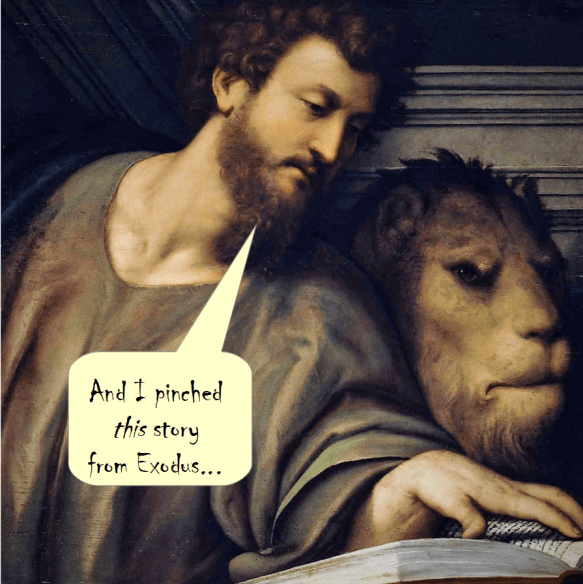
Mark starts his story with Jesus’ baptism and subsequent 40 days in the wilderness. The dominant motifs of both episodes are intended to alert the reader to the fact that Mark sees Jesus as the new Moses, preparing to lead his people out of bondage and into the Kingdom that God is preparing for them. The parting seas of Exodus 14 become the parting clouds through which God proclaims Jesus his Son, the 40 year trek through the wilderness (Exodus 16 etc) is replaced with Jesus’ 40 days in the wilderness. 

Mark gives the wilderness episode a mere two sentences (Mark 1.12-13) which isn’t enough for Matthew. He embellishes it in his gospel, making it a full-blown fantasy, complete with a lengthy conversation between Jesus and Satan. Matthew invented this story. We know he did because:

it cannot possibly have come from an eye-witness (because there wasn’t one);

It is patently fantasy material, with Satan, ministering angels and teleportation;

it cannot have derived from any oral tradition (as it is an embellishment of Mark’s tale, invented only a decade earlier, designed to echo the Moses story);

It is designed specifically to extend the analogy with the Moses. In Matthew, Jesus encounters the same temptations as the ancient Israelites in their wilderness trip, but, unlike his forebears, Jesus triumphantly resists them. He then recruits 12 disciples to go on ahead of him (Mark 3:13-15) just as Moses’ appointed 12 spies for the same purpose (Numbers 13). 

Matthew has even more up his sleeve. He is fully aware of the parallels Mark has made between Jesus and Moses and adds a third to the beginning of his Jesus narrative. In his contrived nativity story, he rewrites the story from Exodus 1 and 2, itself a complete fabrication, in which Pharaoh orders the elimination of all Israelite baby boys. He lifts it directly into the so-called Massacre of the Innocents episode in his gospel.

Again, we know Matthew made this up:

Herod did not order any such massacre. It is not an historical event.

Matthew was determined to find incidents in Jewish scripture he could claim were really about Jesus. Here he is at it.

He is determinedly extending Mark’s metaphor; this is not material from any other source or tradition.

He constructs the narrative using additional ‘prophecies’ he finds in the scriptures. For example, the trip to Bethlehem and the flight to Egypt, neither of which happened (no other gospel writers knows of them.) The Egypt episode is an imaginative (and dishonest) expansion of Hosea 11:1: ‘Out of Egypt I called my son’. In context, the verse refers to the Jewish nation not a future Messiah. And who led the Israelites out of Egypt? Moses.

The nativity story and the Moses/Israelite parallels in the Egypt/baptism/wilderness episodes in Matthew are not drawn from tales of Jesus that were doing the rounds. They are clever, contrived literary creations. They tell us too that Matthew did not regard Mark’s more basic stories as history or biography. He evidently did not view them as immutable. He changes and adds to them to make his own points, ‘correct’ Mark, extend his analogies and emphasise that which he thinks Mark hasn’t emphasised enough. Throughout his gospel he’s prepared to create new incidents, even when they conflict with points Mark makes. He knows that Mark’s work, like his own, constitutes carefully devised stories and he feels free – compelled – to improve them. You can’t treat history this way but you can rewrite fiction.

The Oral Tradition

Where did stories about Jesus originate?

Memory and the Oral Tradition, part 2

The passing on of stories from memory is the ‘oral tradition’ that some argue preserved the words of Jesus more or less accurately for forty years. We’re expected to believe that eye-witnesses recalled in precise detail what Jesus said and did; that they all largely agreed on what this was; that none of them embellished or altered their recollections in any way in the telling and that they were passed on to convert after convert after convert in precise and unaltered form. And then, that no-one in forty years amended or refined the stories in any substantial way, because if they did the originators of the tales would be quick to point out any inaccuracies.

We know this isn’t what happened. The stories evolved and were refined and embellished as they were passed along for forty years between numerous converts. The defence that ancient largely illiterate cultures were better at faithfully preserving stories orally than we are today is a myth. (See EhrmanHow Jesus Became God: The Exaltation Of A Jewish Preacher from Galilee)

Even when some of the oral stories about Jesus were eventually written down, as in the gospels, they continued to evolve; Matthew and Luke both altered stories they took from Mark while John’s Jesus, in the latest of the canonical gospels, is a different creation altogether; either the source stories John knew had evolved quite differently from those Mark, Matthew and Luke had access to, or John created his Jesus out of whole cloth himself.

These stories once written down were changed again, both deliberately and accidentally, whenever the gospels were copied. We know this from the myriad of differences in the extant manuscripts. As Bart Ehrman puts it in Misquoting Jesus, there are more variations among our manuscripts than there are words in the New Testament’. The evolution continued. This is why the Jesus seminar concluded, controversially, that only 20% of the words attributed to Jesus in the gospels can be regarded as originating with him. I consider this to be over-generous. 

Even if the writers of Jesus stories took some of their material from the so-called oral tradition (aka, ‘stories that were being passed around’), we have no way of knowing which of it, if any, is an accurate representation of the things Jesus did and said. It’s unlikely much of it is, given how stories are misremembered, reshaped and altered over time. Their evolution makes them less reliable, not more.

By the way, you’ve not read the post I wrote on Cape Cod. Most of it was completed in Boston and I’ve edited and posted it from my home in the UK. In other words, it evolved in various locations. Kind of like the gospels.


Memory


Where did stories about Jesus originate?

3. Memory and the Oral Tradition, part 1

I’m writing this on Cape Cod in Massachusetts. I lived and worked here for a year almost 40 years ago and have returned to visit a few old haunts and stay with a friend, Carol, from back in those days. So much is how I remember it, some has changed and some I can’t remember at all.

Carol and I have met only once in the intervening years, 20 years ago, but we have kept in touch through letters and emails. We’ve been reminiscing a lot this week, telling stories from the time we worked together in the ‘80s, stories we’ve each told many times before. It’s been interesting to discover how much our memories of the same events differ.

We don’t always remember who else was present on a given occasion (were there 4 there or 6? Was K with us or was it V?); who said what; what they actually said and what order events occurred in (was that before this, or vice versa?)

This is before we add in the refinements we’ve each made to the stories over the years; the gaps in our memories we’ve filled in to allow the story to flow; the (different) parts we’ve omitted because they interrupt that flow or now seem irrelevant; the tidying up and restructuring of the tale to make it pithier; the refining of half-remembered dialogue to make it punchier and funnier; the changes in vocabulary (cheeky for fresh, pushchair for stroller)… and so on.

And all of this from eye-witnesses, Carol and me, who were both present and involved when the events in question took place almost 40 years later (which coincidentally is the time between the supposed events of Jesus life and Mark’s gospel.)

On occasion, I’ve heard someone else repeat one of my stories, and infuriatingly they never get it right. They change it to tell it their way; I want to say, and sometimes do, ‘that’s not how it happened. That’s not what she said.’ But that’s the trouble when stories are passed on. They’re out of the control of those who originated them. They take on a life of their own. They become unverifiable, even by their originators. They are changed further when still others take them over. And others and still others, like a giant, out-of-control game of Chinese whispers. In this way, stories evolve and are far beyond anyone’s control – beyond my control in terms of my Massachusetts memories. I couldn’t fact-check them even if I wanted to.

I’ll get to the point – though you can see it coming, can’t you – next time.

In Which Don Gets It All Back To Front

Let’s take a look at one of Don Camp’s latest contributions regarding the authenticity of the Jesus story and how it was all prophesied beforehand and explained after the fact:

Don: You mean all the Old Testament prophecies that spoke of the eternal continuance of the Messiah king were mistaken?

What prophecies, Don? You mean all those tenuously connected Old Testament stories that the gospel writers, especially Matthew, pressed into service to construct their Jesus stories? That this is how it happened is the scholarly consensus and once we exclude the possibility of magic, the only way ‘prophecy’ can later be ‘fulfilled’.

Don: “After he has suffered he will see the light of life and be satisfied; (Isaiah 53:11).

Which proves my point. You think this is a prophecy? It could mean anything about anyone!

Don: The prophecy about him not seeing corruption as a dead body was mistaken?

And again. Not mistaken: lifted from the OT around which to build the resurrection story.

Don: The words of Jesus as he repeatedly told his disciples of his resurrection were mistaken?

He didn’t. The stories were written long after Jesus supposedly lived. Those who created his story gave him this ‘foreknowledge’ long after the event.

Don: Paul made nothing up; his simply explained what it all meant.

Oh come on, Don. Why would God leave it to someone who’d never met Jesus, and appears to know nothing about him, to explain ‘simply’ what he was all about? Of course Paul made it all up, after he had some sort of vision, in his head, from which he developed a fanciful theology, one that was very much at odds with that put in Jesus’ mouth years later. Hence Paul’s disputes with the ‘pillars of the church’ whom he held in such disdain.

I know you’ll have some convoluted explanation about how everyone else has got it wrong, Don, but it’s you who’s got it all back to front!