Who wrote the Bible?

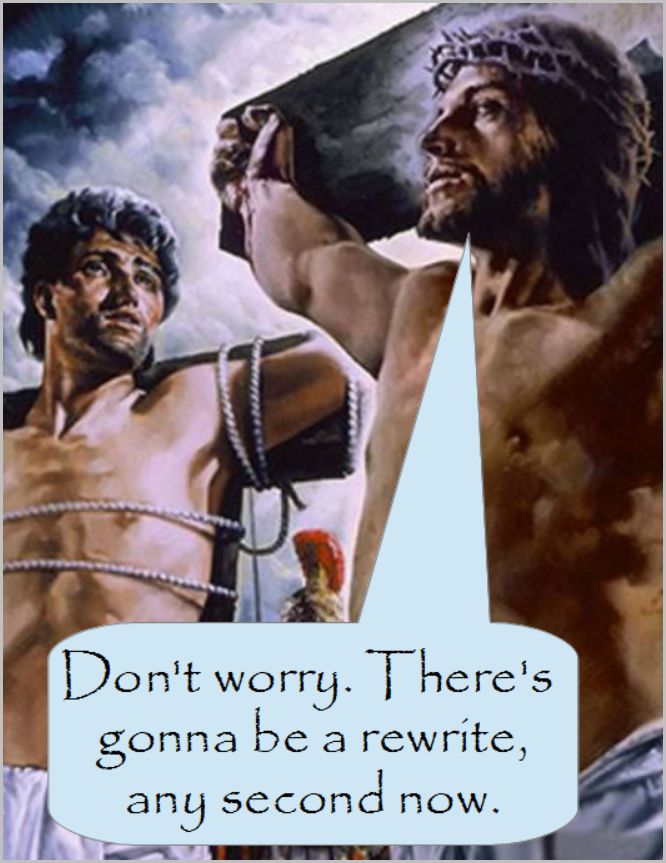
According to Christians, Moses wrote the first five books of the Bible; Genesis to Deuteronomy are widely known as ‘the books of Moses’. There is little evidence Moses had anything to do with them and plenty that he didn’t. The narrative, for example, is never once in the first person; it’s all ‘Moses ordered this slaughter, Moses ordered that slaughter’, never ‘I was the bastard who ordered all the genocide.’ Maybe he was embarrassed about it or – much more likely – it was written by someone else..

In fact, the books were compiled from a range of sources, including stories from other cultures. They reached the form in which we know them around 600-400BC, a mere eight hundred to a thousand years after Moses was supposed to have lived. The events and folk-heroes they describe are demonstrably mythical.

Moses2

Christians like to say that King David wrote many of the Psalms. While David’s name is attached to 73 of the 150, there is no reason to conclude he wrote them. It is more likely ‘of David’ serves as a dedication to a revered (and long dead) figure and may, indeed, have been added much later. The Psalms were actually created over an extended period of time – as much as five hundred years – by a wide range of unknown composers.DavidBelievers attribute much of the book of Proverbs to King Solomon, the fruit of David’s loins. Again, this is highly unlikely. The sayings are largely traditional and the attribution ‘is likely more concerned with labeling the material than ascribing authorship.’

Palin

Christians believe four blokes called Matthew, Mark, Luke and John wrote the New Testament’s gospels. They didn’t. The gospels were written anonymously and did not have the traditional names attached until a century or so after their composition. None is by an eye-witness. There is no evidence that the writer of Mark was a disciple of Peter’s, nor that ‘Luke’ was a companion of Paul’s (and even if he was, this wouldn’t make him an expert on the historical Jesus), nor that ‘John’ was a bona fide disciple. The fourth gospel was written between 90 and 110CE when the disciple would have had to be between 80 and 100 years old, or, much more likely given life-expectancy in the first century, dead. There are several hands at work in ‘John’, as the gospel itself concedes (John 21.24).

 Beatles

Christians insist that all of the letters attributed to Paul in the New Testament were written by him. However, despite the fact they say they’re by Paul, Colossians, Ephesians, 2 Thessalonians, 1 & 2 Timothy and Titus are not; they are forgeries. They were composed long after Paul’s death, which occurred some time around 64CE. The earliest of the forgeries, Colossians, is thought to be circa 75CE, while the ‘pastoral’ letters to Timothy and Titus may be as late as 150CE. All of the forgeries contradict the ideas expressed in Paul’s genuine letters.
PaulPeter wrote the letters that carry his name, or so god-botherers claim, but according to the Bible itself, Peter was an illiterate Galilean fisherman (Acts 4.13). The Greek of the letters supposedly by him is accomplished and the theology well developed. Did Peter have time to learn Greek and polish its written form to perfection while busy preaching the gospel to all nations? Even if he did, how did he manage to write a letter (2 Peter) concerned with conditions in the church more than a century after his time with Jesus?

Anderson3

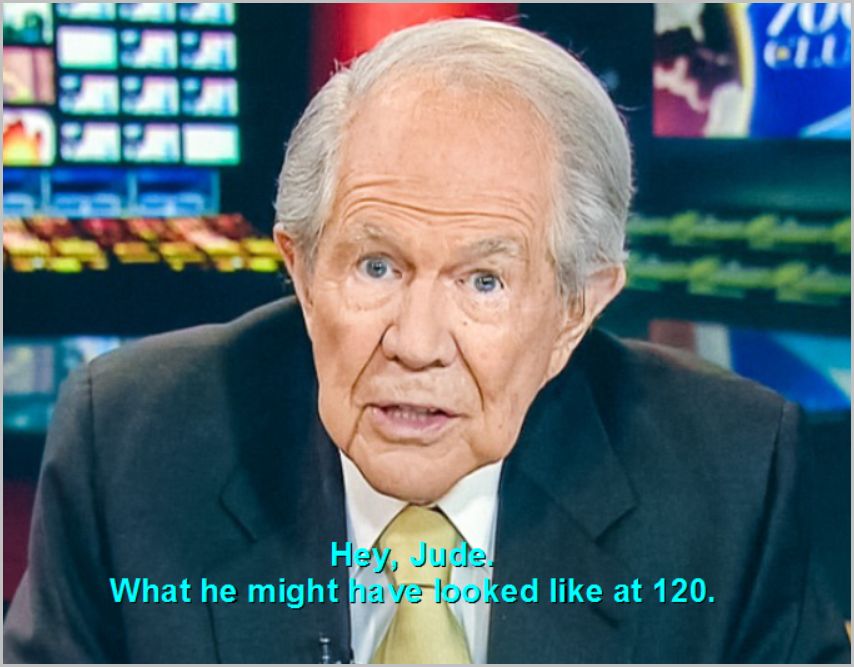
Jesus’ brothers James and Jude, we’re told, wrote the letters carrying their names. Again, they didn’t. The letter of James may have originated in the early Jerusalem church presided over by James the Just, but there’s no evidence this was Jesus’ brother. Jude is plagiarised from 2 Peter – word-for-word in places – which is itself a forgery. Would someone who knew Jesus as intimately as a brother need to steal what he had to say from an illegitimate source? Jude would have had to be well over a hundred years old to pull this one off.
Robertson2When all else fails – and it does – Christians fall back on that most implausible of last resorts, ‘the Holy Spirit’. The very breath of God, they insist, presided over the creation of the Bible from start to finish. If it did, it made a staggeringly bad job of it; misattribution, mistakes and forgeries are the hallmarks of ‘God’s precious Word’.doveAnd on this unstable foundation, this tissue of lies, rests the entire edifice that is Christianity.

(It is difficult to find online sources on the authorship of the Bible. Christians have taken over the Internet with innumerable sites insisting the Bible was written by whoever they say it was. I’ve had to fall back on Wikipedia here (the articles are pretty comprehensive) but if you don’t think it reliable enough, I recommend Bart D. Ehrman’s Forged: Writing in the Name of God – Why The Bible’s Authors Are Not Who We Think They Are.)
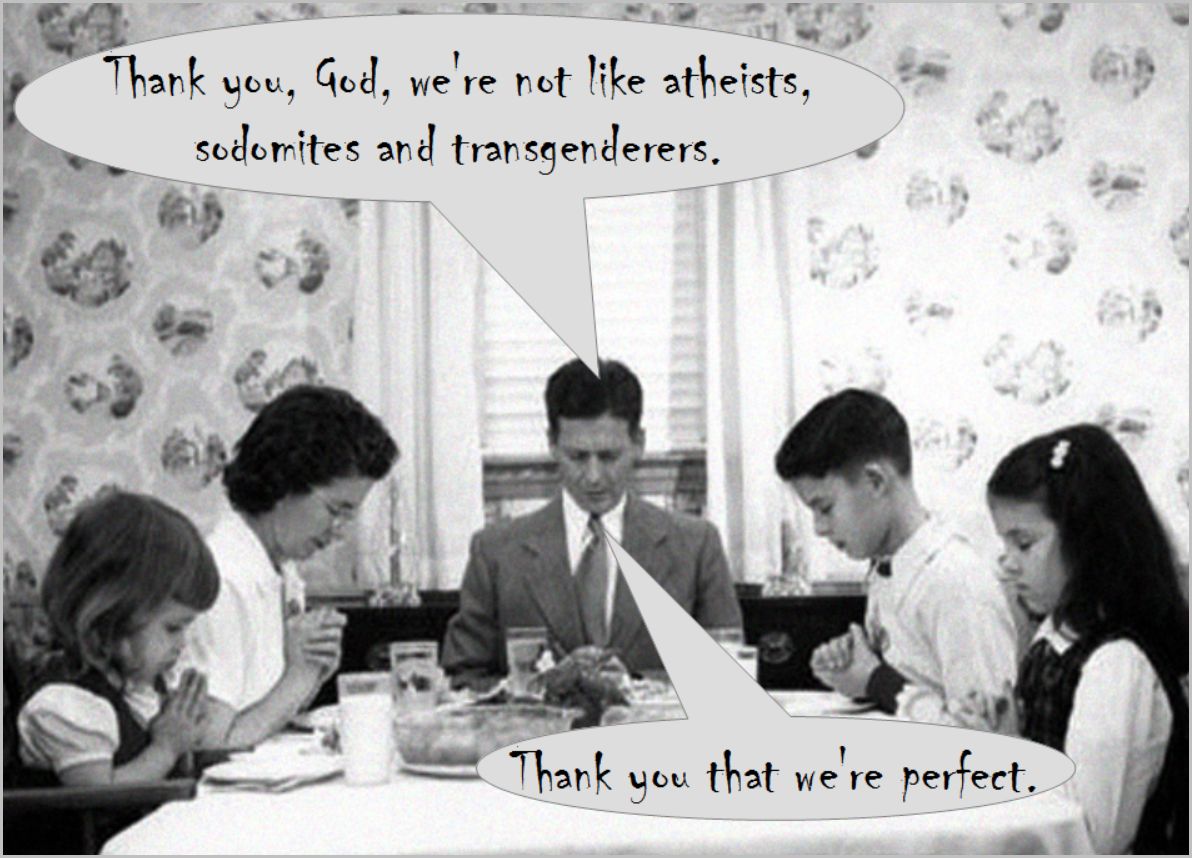
 

Sweet and sour, nasty and nice

or, whatever happened to Luke 18.11-14?

prayer2Why is it when people are emotionally blackmailed into becoming followers of Jesus, does their conversion make them sweet and sour, nasty and nice at the same time? The sweet and nice parts are what their new experience does for them. They get a new start of sorts, are introduced to like-minded friends in the church and become compelled to share their new joy with everyone else, whether they want to hear it or not, about how much they’ve changed because of Jesus. It’s nice for them. Deluded too, but if it makes them happy then why not?

This is why not. What they don’t tell you, not at first anyway, is how sour and nasty they have also become; how they must now defend God’s standards, because, as everyone knows, the omnipotent God of all creation is incapable of defending them himself. Being born again and morphing into ‘a new creation’ involves, without exception, becoming judgemental of others, condemnatory, inflammatory, bigoted and spiteful.

You think not? Then you haven’t heard what these same Christians think about abortion and women who have them. Homosexuality and those who are gay. Transgenderism and those born in the wrong body. Science and those who value evidence. Atheism and those of us who see through believers’ sad delusion.

Christians don’t, as some of them profess, hate the sin but love the sinner. They despise those who have philosophies different from them, those who live differently from them, those who are different from them.

A recent BBC poll asked if the world wouldn’t be more peaceful without religion. Here’s the results as of 14th July 2016:

Poll

I don’t know how many people this represents nor where they’re from – the site doesn’t say – but it would seem that most of us would think we would be better off without religion. It’s long past time we were able to be; religion has nothing to offer. It’s time we stopped giving it special treatment because some of it is sweet and nice. Its sour, nasty aspects are just as much a part of it, inseparable from whatever positives its adherents say it has. I’ll be looking soon at how we might push back against religion’s pervasive and poisonous influence in society.

Effective Preachin’ (Part One)

church3Reverend M. T. Vessal of the Church of The Raised Up here, with the first of my special guest posts for all you wannabe preachers out there. I’m gonna be telling you on how to preach the Good News of Salvation and win souls for Christ.

Right. First off, remember to use the words ‘Blessings’, ‘Sanctify’ and ‘Outpouring’ in your preamble or opening prayer. ‘Course no-one will know what these mean as you haven’t provided any context and they’re pretty meaningless anyway – apart from ‘Outpourings’ which is something kettles do. But it’ll get the folks worked up to expect something real good. Folks in church go for things like Blessings, Sanctifying and Outpourings, believe me.

Next, repeat the title of your sermon – or, if you’re part of a cool modern church like Steve Furtick’s, your talk, or, if you’re really honest (and let’s face it you wouldn’t be doing this if you were really honest) your spot of self-promotion – three times. This is a useful tip for any point of your sermon/talk/self-promotion; if you can’t remember what you were going to say next, say the last thing you can remember saying three times over, putting the emphasis on a different word each time. So, for example, ‘Twelve ways to receiving the Lord’s blessings’ would be: ‘Twelve ways to receive the Lord’s blessings’, then ‘Twelve ways to receive the Lord’s blessings’, and finally, ‘Twelve ways to receiving the Lord’s blessings‘, though feel free to alter this as suits. Saying it three times like this makes it sound like you’ve just come out with something real deep and profound, when you’ve done nothing of the sort. Plus, people sit up and listen to things said in threes. It’s kinda hypnotic.

I said, ‘it’s kinda hypnotic.’

‘It’s kinda hypnotic.’

See? It works.

Next make a joke. Say something like, ‘if you’ll switch on your Bibles’, just to show how with-it and up-to-date you are, knowing most folks bring their iPads to church these days. That way they can shop on Amazon or send an offensive tweet when your sermon gets really boring (and it will get really boring).

Now quote the verse you’re gonna preach about and let the folks follow along; you won’t need to quote it accurately because they’ll all be using different translations, so accuracy’s not important. Unless, of course, you’re one of those churches that only accepts the Authorised Version, the one with all the errors in it that right-royal homosexual James I… well, authorised. (One of the advantages of the KJV is you can  drop in words like ‘lieth’ and ‘unto’ which sound like you really know what you’re talking about.) So, yes, it’s okay to paraphrase the verse your talk is gonna be tenuously connected to because, let’s face it, it’s not going to have much to do with the verse in any case. It’s going to be more about you than whatever’s in the Bible. The exception is if you’re planning on having a rant about homosexuals, in which case you’ll want to stick pretty closely to Leviticus 20.13 and Romans 1.26.

A word on choosing your Bible verse: make it one of Paul’s or something from John. The other stuff, about loving your neighbour and your enemy and going the extra mile isn’t the kind of thing you want to have to talk about. You’re gonna concentrate on Blessings, Sanctification and Outpourings, remember, things that are exclusively for Christians. If you’re feeling really adventurous though you can try a story from the Old Testament. Maybe one of those blood-baths it has a lot of. You can show how all that bronze-age inter-tribal slaughter was really about how much Jesus loves Christians in the twenty-first century.

Right. You’re all set. Next time, I’ll tell you how to preach so that you can make a name for yourself truly reflect the glory of Jesus.

Did Jesus Exist? (part two)

WaterIf Matthew, Mark and Luke were creating a Messiah from scratch, or, more probably, recording the invention of believers who went before them, then it is unlikely they would have arrived at the loser preserved in their accounts. The Jesus we find there is nothing like the Messiah anticipated in Jewish scripture nor by Jews at the time.

He is a false prophet, his good news about the imminent arrival of the Son of Man and the Kingdom of God being patently unfulfilled. His ministry is a failure, ending as it does in ignoble execution. This is not the Messiah anyone would create if they were inventing one to satisfy the longings of a thwarted people. In particular, God’s emissary would not lose control of the situation in the way the Jesus of the synoptic gospels does. He would not allow himself to be executed by the occupying forces in the manner the gospels record. (All the surviving sources attest to his death by crucifixion; we can be fairly certain he died in this way.)

A created Messiah, on the other hand, would surely have announced the arrival of the Son of Man/Kingdom of God before leaving the stage of his own volition – ascending to heaven perhaps as some of the gospel writers eventually have him do – to await the unfolding of the events he had proclaimed. Of course, the death of a godman is a recurrent theme in the mythologies of the ancient world, so it is possible that an unpleasant death would be invented for an imaginary Jesus so that he complied with the trope. But, as I’ve already suggested, the central figure of the synoptic gospels is noticeably ungodmanlike. We only see him as such through the distorting prism of Paul’s theology; without this, we can see that the gospels of Mark, Matthew and Luke really don’t portray him like this at all.

It seems much more likely, therefore, that what the synoptic writers are conveying are distorted memories of an individual who actually lived. A man who promised much but whose mission went drastically wrong but which would, his earliest followers believed, be completed by God himself in the near future. This latter part is, as we now know, pure invention, the gospels conveying only an imaginative interpretation of this man. It would seem, nonetheless, to be an interpretation of someone – a charismatic Jewish preacher and failed heir-presumptive – who had actually lived some years before.

As I said at the beginning of this two-part post, I don’t really care whether Jesus existed or not. The end result is the same; millions of people seduced by a significance he did not have, either as a real person or as an imaginary construct. On balance, for the reasons I’ve touched on in these posts, it seems to me Jesus – Yeshua bar Yosef – did once exist. Like we all must, he died and others set about interpreting his life in their various, incompatible ways. These interpetations are all ultimately meaningless; we can be absolutely certain that, whatever the Bible and Christians today tell us, Jesus, whether he lived two thousand years ago or not, does not exist now in any shape or ethereal form.

Did Jesus Exist? (part one)

Cross3

I want to say at the outset that I don’t think it matters whether Jesus existed or not. Even if he lived, it is highly unlikely he said much that is attributed to him or that he performed the miracles ascribed to him. Neither would it be the case that he rose from the dead or became a supernatural godman afterwards. All of these supposed attributes would be, for an individual who actually existed, later accretions. The man underneath them, the so-called historical Jesus, is difficult to detect. It hardly matters to Christians; they’re really only interested in the accretions, the later add-ons, the myth the man became.

Those who think Jesus never existed raise a number of interesting points, chief of which is that what I’ve referred to as accretions, being central to subsequent Christian belief, actually came first. The accounts of Jesus’ life – the gospels – they see as later attempts to provide the myth with a ‘realistic’ back story based in history. Certainly the gospels came after Paul had had his vision and had set about interpreting it to arrive at his convoluted theology about ‘the Christ’. Jesus-belief certainly existed decades before the first gospel account, Mark’s, and was as a result entirely independent from it. In this scenario, therefore, the myth came first and the stories of Jesus were crafted afterwards as supplementary fiction.

For me, however, as problematic as the gospels are, the synoptic accounts – Matthew, Mark and Luke – are largely at odds with Paul’s theology. If they were written to bolster the myth of a supernatural godman, they don’t do it very well. John’s gospel, on the other hand, is much more successful in portraying a mythical being, which is why its implausible ‘Word became flesh’ is not very much like the Jesus of the synoptic gospels.

The synoptics of course have their own agendas and do not represent accurate biographies of Jesus either – there are too many contradictions and anomalies to claim they do – but, to varying degrees, they do not present a Jesus who is the embodiment of Pauline theology. The synoptic Jesus doesn’t, for example, promote a salvation plan involving his own death or say that faith is the means by which one enters the Kingdom of God. These are ideas of Paul’s, as are notions of grace, election, sanctification, redemption, substitutionary atonement, imputation, gifts and fruits of the Spirit and even more mumbo-jumbo besides.

The good news of the synoptics’ Jesus, however, is that God’s Kingdom is coming to Earth soon and to be part of it one must become ‘righteous’ both by serving others and relating to them in a ‘measure for measure’ way: forgiving in order to be forgiven, being compassionate to be shown compassion, giving in order to receive, not judging so as to avoid being judged. This Jesus and his gospel are, moreover, predominantly Jewish; Matthew’s version in particular is virulently anti-Gentile. All of this is totally at odds with the magic formula of salvation-available-to-all of Paul’s make-believe. If this came first, it is difficult to see why the synoptic gospels would not present, as John does, a Jesus who is more compatible with it.

Either the synoptic gospel writers got much wrong in providing the Christ’s supposed back story or they were representing other traditions, ones that were different from and possibly even older than Paul’s interpretation. Belief in Jesus as teacher, prophet and, possibly, Messiah predates Paul (he refers to it himself while Matthew and Luke make use of an earlier sayings gospel known as ‘Q’) and it seems likely that Mark and Matthew in particular reflect these traditions, untainted by Paul’s fantasies. Of course these traditions too could have been invented, just as Paul’s theology is, but if that is the case, then, once again, the gospel writers – Mark and Matthew especially – make a decidedly bad job of it.

Next: what this ‘bad job’ tells us about the existence of Jesus.

What does God think about the Orlando massacre?

Orlando

Let’s see what he’s saying through his spokesmen here on Earth:

According to a minister from the cathedral in my home town, who conveyed this message from the Lord at a vigil on Monday night,

God is just as confused as we are. All the same, he’s full of compassion for those who died and for their loved ones.

Makes you wonder though, if he’s so compassionate, why he didn’t do anything to prevent the murders in the first place. Still, he is sympathetic, which is something.

Oh wait! That isn’t how God feels at all, not according to Pastor Steven Anderson, who knows exactly what the Lord thinks:

…in Leviticus 20:13, God’s perfect law, he put the death penalty on murder, and he also put the death penalty on homosexuality. That’s what the Bible says, plain and simple. So, you know, the good news is that at least 50 of these pedophiles are not gonna be harming children anymore. The bad news is that a lot of the homos in the bar are still alive, so they’re gonna continue to molest children and recruit people into their filthy homosexual lifestyle.

Right. So now we know.

Hang on, though. Christian Today tells us something different again. According to this guy, what God really wants his followers to know is that,

true believers should pray for everyone involved in the terrible events of the weekend and ‘not miss a huge opportunity to build bridges and demonstrate our saviour’s love.’

Phew, glad that’s finally sorted.

Or maybe not, because God has changed his mind again: Pastor Roger Jimenez has this straight from the Lord himself:

The tragedy is that more of them didn’t die… the Bible paints the picture that these are wicked people. These are evil people. God gave them up to their vile affections… they’re not natural… they received a reward for their error… God almighty says, ‘there’s nothing I can do for (homosexuals).’

All these mixed messages, and all supposedly from the same Person! Compassion, punishment, love, abandonment; that truly is one confused, mixed-up deity you worship, Christians. You’d be confused too, I guess, if one nutjob after another put words into your mouth. Just who’s the ventriloquist here and who the dummy?

When, Christians, are you going to stop deluding yourselves that arses like Anderson and Jimenez know anything about what God thinks? When are you going to stop pretending that anyone knows what he thinks? When are you going to recognise that a God who ‘speaks’ so inconsistently through simple-minded ‘intermediaries’ is not God at all?  When are you going to stop deluding yourselves that there even is a God?

Religion poisons the well. Again.

dye

The shooting in Orlando of people in a gay night club (50 dead, 53 wounded) is yet another example of religion as the antithesis of human flourishing. Not Christianity this time, of course, but that other ‘great’ religion, Islam, the religion of peace. But Christians cannot distance themselves from atrocities like this, carried out in the name of God, when the influence of even moderate religion is a pervasive, unhealthy presence in our society.

It’s true that Christians don’t, as rule, rampage in the streets or fly planes into buildings but they do contribute to the medium in which more extreme forms of religion grow:

Westboro Baptist Church, for example, with its own peculiar brand of Bible-based homophobia – ‘God hates fags’ and all the rest – is, like it or not, an expression of Christianity;

Right-wing evangelicals who interfere in the churches and governments of Africa and South America, actively encouraging them to take a homophobic stance and to pass anti-LGBT laws, are equally culpable; Scott Lively, Pat Robertson, Sharon Slater, you too are people filled with hate;

Likewise, those Catholic bishops who use their influence to denounce gay and transgendered folk as ‘mentally disordered’;

Christian bloggers who trot out the old, ‘Woe to those who call evil good and good evil’ (Isaiah 5.20) and misapply it to homosexuality, together with those who quote Leviticus 18.22 (‘abominations!’) and Romans 1.26-27 (‘unnatural and indecent!’)…

All of these contribute to the animus directed towards fellow human beings whose ‘sin’ is merely to be different. Religions, or more specifically their adherents, contribute significantly to the levels of misery in the world today, though Christians will cry ‘foul’ here (or ‘persecution’ even, because how they love claiming they’re being persecuted when asked to demonstrate some empathy and a little love.) After all, it wasn’t a Christian who gunned down the people in the Pulse nightclub this weekend. No it wasn’t. But every time religious bigots –

tell others what despicable sinners they are,

misrepresent and denigrate minorities,

promote ‘gay cures’,

attack same-sex marriage,

add quotation marks around the words gay and gay marriage, as if they’re somehow not real,

assert homosexuality and transgenderism are synonymous with ‘moral decay’,

claim natural disasters are God’s response to gay people’s very existence,

boycott businesses that support equality,

‘take a stand’ against transgendered people using the appropriate restroom and

refuse to serve gay couples –

every time, in short, they say LGBT people are evil, sick or worthless, the self-righteous prepare the ground for individuals like Omar Mateen to do what he did in Florida on Sunday. Religious leaders condemning such atrocities after the event is too little, too late, when they’ve failed to take charge of their acolytes and  do nothing to stem the tide of hatred flowing from their churches, mosques and temples. 

To those of us on the outside, religions are all of a kind; harmful superstitions. If a ‘faith’ entails belief in supernatural beings and puts allegiance to such imaginary figures above fellow human beings, it is without merit. It is the evil among us.

Less religion, not more

Welby

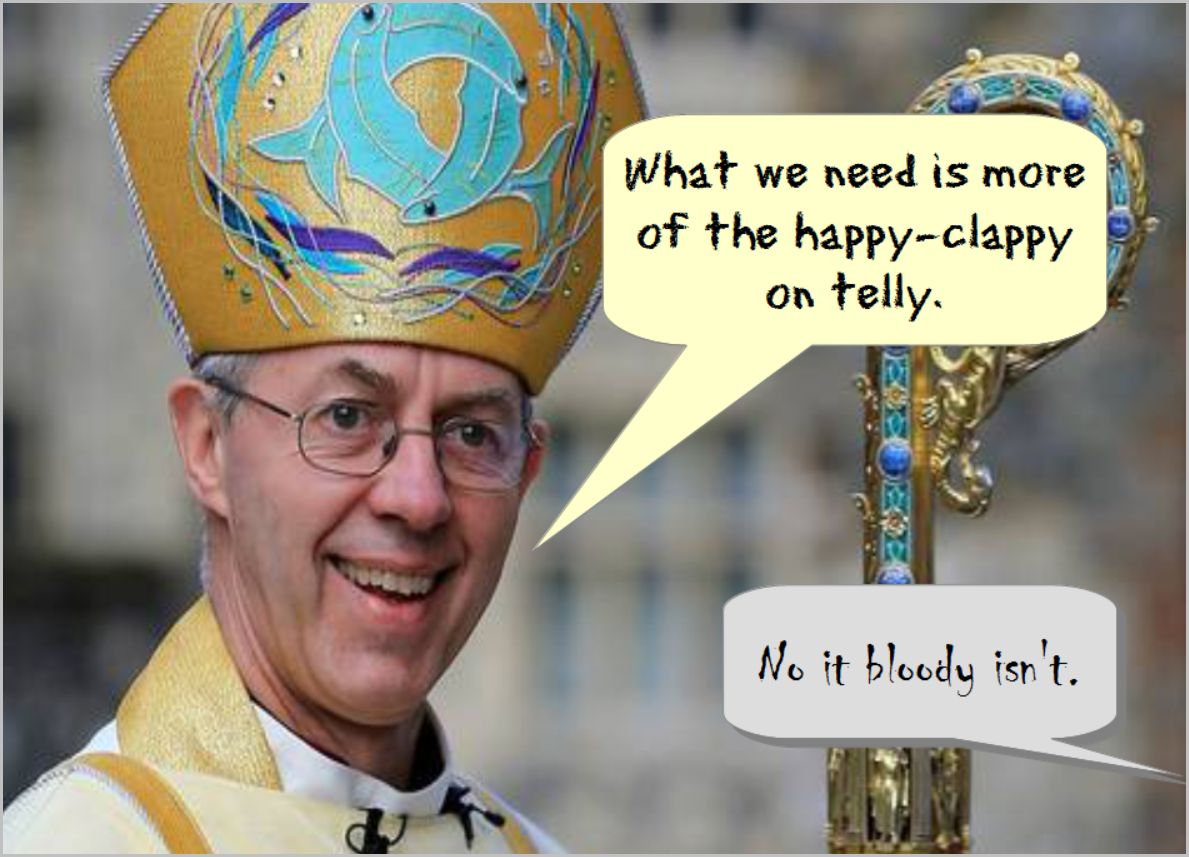
A bloke in a pointy hat and posh frock thinks there should be more religion on television and radio. Justin Welby, Archbishop of Canterbury, says that religion merits as much air time as politics, sport and drama.

The Archbish makes it sound like there’s nothing at all on TV and radio already about religion. In fact, in the last few months in the UK we’ve had a full schedule of Easter programmes; Simon Reeves’ The Ganges on BBC2 (looking at India’s religious heritage); Channel 4’s Unreported World and Dispatches, which regularly consider religious issues; Clare Balding’s trite Good Morning Sunday on Radio 2; the weekly broadcast of church services and daily Thought For the Day on Radio 4; the weekly dollop of worship on Songs of Praise on BBC1 and the 24-hour Christian ‘ministry’ of Trinity Broadcast Network and other God channels for those who just can’t get enough mumbo-jumbo.

Maybe that’s not as much as sport, but then there’s hardly anything on TV that has as much coverage as sport. (Bad news too for those of us with little interest in watching others running, jumping and hitting things; there’s even more to come in the shape of Wimbledon, Euro 2106 and the Olympics.)

Do we really want religion to have the same level of coverage? Are people really as interested in belief systems as they are in sport? Or music? Or art? Or comic book franchises? Even if there are, why is it up to television – the Archbish singles out the BBC as the broadcaster he thinks should indulge his fantasies – to provide it? Isn’t it, rather, up to churches, mosques, temples and other centres of superstition to promote their own particular brand of nonsense?

Make no mistake about it, this is what Justers is proposing; the promotion of religion – ‘religious literacy’ he calls it. He is not, we can be fairly sure, looking for programmes that are critical of religion (unless it’s other people’s). He wants, he says, to see more programmes that give us a better understanding of religious belief. What he means by this are proselytising programmes that create greater empathy for those who subscribe to delusion.

He isn’t advocating, for example, documentaries that explore the irrationality of faith, or ones that show the slap-dash, deceptive ways in which holy books came to be compiled or ones that demonstrate how most adherents to faith fail to live out its exacting demands. Nor is he suggesting programmes that focus on the appalling misery religion brings to some, or shows that give a sympathetic hearing to cults, sects and extremists. I would have no objection to programmes like these (except those that are sympathetic to extremists) because the ugly underbelly of religion deserves to be exposed, like Channel 4’s The Untold History of Islam of a few years ago, taken off air after its presenter was threatened with violence by those who didn’t like its critical perspective.

But these are not the kind of programmes the Archbishop is proposing. The religious literacy he wants us to have is of the cuddly side of faith, the supposed deep spirituality of the obsessive and what he regards as the positive contribution religion makes to the world; a one-sided picture already more than adequately covered by the nation’s broadcasters.

Thankfully, despite the recent political interference in the BBC, the Corporation is still required to present balanced and impartial views of its subject matter. If the Archbishop, who sits in the House of Lords and so is not without influence, is successful in forcing the BBC and other broadcasters to increase their coverage of his obsession, then we should also be able to look forward to programmes that are critical of religion too.

No broadcaster is obliged to promote religion nor to proselytise on its adherents’ behalf. Shame on the Archbishop, with his smiles and pointy hats, for suggesting they are.

Get your free Porsche here*

*Or maybe notRaising

A True Story**

“So,” he says, “you might have an old banger now but when it finally packs in for good, we’ll upgrade it for you, free of charge.”

“You’ll upgrade it?”

“Sure. No problem. You see your old car is… well, I’ll be honest with you, it’s a really rubbish make. It’s a pile of crap to tell you the truth.”

“A pile of crap?” I splutter. “I can’t believe what I’m hearing. If it’s such a pile of crap why’d you sell me it in the first place? Why d’you sell them at all?”

“No need to get upset, mate,” he says. “As I said, when it’s completely clapped out we’ll replace it with a brand new one, free of charge.”

“Free of charge?”

“Yeah, that’s the deal. You wear out a lemon we give you a brand new Porsche.”

“A new Porsche? C’mon man, you’re winding me up. Why would you give me a new Porsche for nothing?”

“Because as I said, that’s the deal. Have a little faith man. It all works out.”

“Okay, I say. Well how about I get the Porsche now. Before this old rust bucket let’s me down completely.”

“Doesn’t work like that mate,” he says. “You get the banger first, the Porsche at the end.”

I tell him this makes no sense at all. “Look… Paul,” I say, reading his name off the dirty old name tag he’s wearing, “if you want people to have a completely free brand-new, top-of-the-range luxury car then you should just give it to them the first time they come in here. Forget the clapped out old banger bit. Just give them the Porsche.”

“Nah, mate. I’ve told you, that’s not the offer.”

“Okay,” I say, making one last effort. “Show me one person who’s benefited from this mad scheme of yours. Show me one person who’s driven away in a Porsche after their old vehicle’s reached the end of the road.”

“Listen, mate,” he says, “it’s like I said. You need to have a little faith.”

One person,” I say.

“Okay,” he mumbles, ”there are stories that the boss’s son did once…”

“The boss’s son? ‘Stories’? Christ, what sort of con are you operating here?”

“You’ve upset me now, you fool” he says, “and I’m not sure you qualify for the deal any more.”

I can only shake my head. “I’m not sure I ever did… mate,” I say.

*   *   *   *   *   *   *   *   *   *   *   *

**Yes, this really is a true story. You can find it in Paul’s first letter to the Corinthians (15.35-50). Here’s how it goes there:

But some one will ask, “How are the dead raised? With what kind of body do they come?” You foolish man! What you sow does not come to life unless it dies.  And what you sow is not the body which is to be, but a bare kernel, perhaps of wheat or of some other grain…

So will it be with the resurrection of the dead. The body that is sown (buried) is perishable, it is raised imperishable; it is sown in dishonour, it is raised in glory; it is sown in weakness, it is raised in power; it is sown a natural body, it is raised a spiritual body…

Flesh and blood cannot inherit the kingdom of God, nor does the perishable inherit the imperishable.

Right…


Christianity: always winter but never Christmas

Spot the difference:Shore

Christians are hot on evidence.

There isn’t enough for evolution, they say, even though there’s an abundance.     

None, they claim, that the Earth is billions of years old, but only 6 thousand.

Not enough that climate change is man-made, when there’s considerable evidence it is.

None that there’s a genetic component to homosexuality when science reveals that there is.

But, as far as the resurrection of the body, judgement and eternal life in either Heaven or Hell are concerned, these they believe in, no evidence required.

I recently challenged Christians on Charisma magazine’s blog-site to provide or point me to evidence that any one of the 107 billion people who has ever lived who after they had died had gone on to enjoy either eternal life in Heaven or eternal punishment in Hell. Unfulfilled promises from magic books weren’t admissible, because a promise of something happening is not the same as it actually doing so. Jesus didn’t count either, as there are no eye-witness accounts of his bodily resurrection, only stories written decades after the supposed event. In any case he was half Vulcan or something, not an ordinary mortal.

Alas, my challenge went unanswered. You won’t find it on the Charisma site now because it has been removed by the moderator there. Expecting evidence from Christians for what they believe is patently unreasonable. After all, who needs evidence when you can exercise your licence to believe whatever you’re told?

Of course, there is no evidence of any resurrection nor of anyone who has gone on, post-mortem, to enjoy everlasting life. Have you noticed how everything about Christianity is either invisible – God, the Holy Spirit, Heaven, angels, demons – or lies permanently in the future; the Second Coming, the resurrection of the body, the Kingdom of God, judgement and eternal life? All of them always just that little bit further on. This year, next year, sometime, never. Just not now.

Yet Jesus, Paul, Revelation’s John and most other New Testament luminaries believed God’s Kingdom, the resurrection and judgement were coming within their own lifetimes.* Not one of them entertained the thought that 2000 years down the line none of these miraculous events would have materialised.

Small wonder then, that at the start of the second century, believers began to lose hope in the Second Coming, the Kingdom’s arrival and an earthly resurrection of the dead. Maybe, some of them began to think, eternal life would be not be here on Earth, as Jesus and Paul had promised, but in Heaven with God, which they most definitely hadn’t. This way, everything that hadn’t happened here on Earth would happen instead after death (we can see this transition taking place in the very late gospel of John). All of which was fortunate, because it dispensed with the need for confirmation and evidence; no-one could prove – apart from the fact nobody has ever survived their own extinction – that believers didn’t go to Heaven when they died. Equally, no-one could provide evidence they did.** How neat and convenient.

So if any Christians reading this would like to like to show us some evidence for the resurrection of the dead, post-mortem judgement, Heaven, Hell, God’s Kingdom on Earth – any of it – I’m sure we would all like to see it. Until then, I will go on regarding all of these assurances as empty promises – pie in the sky – that believers cling to desperately, while calling their desperation ‘faith’.

* See Matthew 16.27-28 & 24.27, 30-31, 34; Luke 21.27-28, 33-34; 1 Corinthians 15.51-52; 1 Thessalonians 4.15-17; 1 John 2:17-181; Peter 4.7; Revelation 1.1 & 21.2-4

** Psychics claim to commune with the dead of course, or at least with their spirits; more hokum from the minds of the deluded. Even if it weren’t, this isn’t the kind of resurrection Christians envisage for themselves. They dismiss psychics’ ‘evidence’ of life-after-death as so much demonic deception.