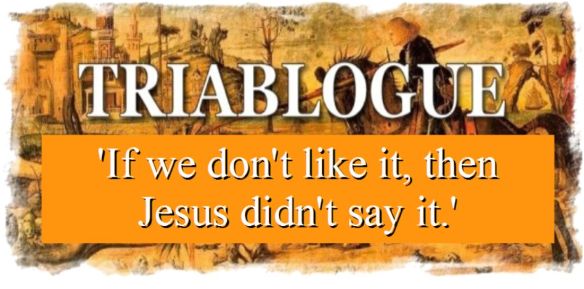
The Christian blog that knows better than Jesus

Triablogue-Header-240x1080 (1)

The superior intellects at Triablogue responded to my comment (see previous post below) by telling me they’d already dealt with the claim that Jesus believed the arrival of the Son of Man/the End of the Age/the Final Judgement and God’s Kingdom on Earth were imminent.

They directed me to one of their articles, Misdating the Second Coming, which argues that neither Jesus nor Paul really believed the end was nigh and that the texts which suggest they were need to be interpreted carefully (i.e. to get round what they clearly say to make them say something else.)

I can’t find any other instance of Triablogue contributors proposing that Jesus didn’t really say what the gospels have him say. They don’t dispute, for example, the so-called great commission in Matthew 28.19 (‘Therefore go and make disciples of all nations, baptizing them in the name of the Father and of the Son and of the Holy Spirit‘) even though, with its Trinitarian formulation, Jesus almost certainly didn’t say it. Instead, the know-alls at Triablogue  reserve their hedging for the prophecies that patently failed to materialise, on the basis that Jesus couldn’t possibly have been wrong so he must have meant something else.

I’ve written several posts under the banner Making Excuses for Jesus, on the varied and feeble attempts Christians make to get round the fact the synoptic gospels consistently have Jesus say the Kingdom of God, and all that accompanies it, are just around the corner. His early followers all believed this and his eschatological pronouncements are recorded in all of the earliest texts. Mark’s gospel includes his prophecies about the Son of Man while Matthew and Luke include material not found in Mark from their ‘M’ and ‘L’ (oral?) sources that warn it is the ‘eleventh hour’. The entire thrust of the synoptic gospels is that the Kingdom is about to arrive and therefore people need to be prepared for it: ‘The time is fulfilled, the kingdom of God is at hand; repent and believe the good news’ (Mark 1.15).

The sayings gospel ‘Q’, which predates Mark and was probably in circulation only a few years after Jesus died, preserves several Son of Man sayings; he would be appearing soon to kick-start the Kingdom. Paul, writing decades before the gospels, tells his readers to expect the Second Coming – the Son of Man having become Jesus himself – while he and they are still alive (Thessalonians 4.14-15). Likewise, the anonymous writer of Hebrews believed he lived in the ‘last days’ (1.1-2) while the nutjob who concocted Revelation claimed he was quoting the Risen Jesus promising he would ‘surely come quickly’ (22.20). The imminence of God’s Kingdom on Earth is the consistent message of the New Testament.

And what do the cerebral Christians at Triablogue do when confronted with a summary of these facts? They don’t approve my comment, that’s what. I guess that’s all you can do when you really don’t have an answer for why your Savior™ got everything so drastically wrong; dishonestly pretend he didn’t and silence those who show that he did

Why I can’t believe in ‘the Lord Jesus Christ’ (one of many reasons)

Jesus10

Over on the very smug Christian web-site, Triablogue, which I discovered via Gary’s Escaping Christian Fundamentalism blog, a commenter poses the question, ‘What evidence would it take to believe in the Lord Jesus Christ?’ This is the answer I left:

If the Son of Man came back through the clouds with a heavenly host of angels in full view of the tribes of the Earth to judge the nations and separate the righteous from the unrighteous; if this Son of Man then established God’s Kingdom on the Earth for the meek and righteous while consigning the unrighteous to eternal punishment; if he and those he appointed to rule alongside him then reigned over this Kingdom for ever and ever, and if all of this happened within the lifetime of Jesus’ original followers, as he promised and predicted it would, then, and only then, would I be able to believe in him.

After all, this was Jesus’ good news (Luke 4.43). When none of his predictions/prophesies/promises came to pass then, as always happens with failed cults and failed cult leaders, those who followed came up with alternative explanations. They hoped, and no doubt believed, that these would do instead of the original ‘good news’. In many ways they weren’t wrong, given the later success of these interpretations, but these were not the cult’s original message and were no more true than Jesus’ Son of Man/Kingdom of God fantasy.

* * * * * *

Just in case you don’t think Jesus promised all these things here’s a mere sampling of where he does:

The Son of Man coming through the clouds: Mark 13.26

with a heavenly host of angels: Matthew 16.27

in full view of the tribes of the Earth: Matthew 24:30

to judge the nations: Matthew 16.27

and separate the righteous from the unrighteous: Matthew 25.32

The Son of Man establishing God’s Kingdom on the Earth: Matthew 19.28, 25.34

for the meek and righteous: Matthew 5.3

while consigning the unrighteous to eternal punishment: Matthew 25.46

Those he appointed ruling alongside him: Matthew 19.28, Luke 22.30

and reigning over this Kingdom for ever and ever: Matthew 6.13, Revelation 11.15

all of this to happen within the lifetime of Jesus’ original followers, as he promised and predicted it would: Mark 1.15, 9.1, Matthew 10.23, 16.28; 24.34, Luke 9.27 etc

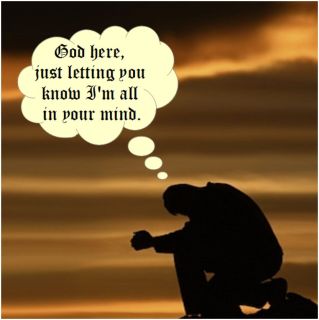
I apologise for the strong language in the picture above, but c’mon, how can Christians reasonably explain the out-and-out failure of all of Jesus’ promises and predictions, while still maintaining he was somehow a manifestation of the God of the Universe?

Pride & Prejudice

Dale2

Ken Ham took a swipe at Gay Prides recently on his crackpot Answers in Genesis. He didn’t, for once, harp on at length on about how sinful same-sex everything is (if it’s same sex, it’s sinful) but takes the perspective that because Prides involve the word ‘pride’ they are prideful – and that, my friends, is a sin too! This remarkable insight allows the Hamster to gay bash from a completely different angle, though predictably the result is the same. LGBTQ people are lost in sin, and it’s a double whammy; they don’t just wallow in their sexual sin but in pride too, and, my, how God hates both of those!

In the context of Gay Pride, ‘pride’ doesn’t quite mean what ol’ Kenny thinks it does. He takes his definition from some esoteric evangelical dictionary that defines pride as “both a disposition/attitude and a type of conduct,” which according to Ham boils down to that old chestnut, Rebellion Against God, which, he says epitomises gay people.

As usual, he’s wrong. What Gay Pride represents, in both its public and personal forms, is gay people’s rejection of any shame imposed by others about who they are and their refusal to remain hidden; not so much pride but joy, liberation and self-assertion. I’ve been to one or two Prides myself and these have been their predominant characteristics. They reflect the exhilaration gay people feel about being themselves and escaping from the constrictions of the closet. For many, this can be a long and difficult journey, as it was for me. Gay people have every reason to be pleased with who they are and what they’ve achieved and Gay Prides are a way of declaring this self-acceptance, self-esteem and, yes, love – to their communities, city and the world.

‘Pride’ of this sort is no sin (neither is any other, because there’s no such thing as ‘sin’) but other kinds of pride – say, Donald Trump’s arrogance and bluster – are particularly distasteful. Thank goodness Christians don’t suffer from that sort of pride!

They don’t for example, think they’re superior to the unsaved and especially to LGBTQ people. if they did, they’d spend their time judging everyone else and finding them lacking. They’d lambast gay folks and suggest they should cured or silenced or even executed. They’d disparage atheists, sceptics and unbelievers at every turn. Thank God Christians don’t demonstrate this sort of pride!

Praise the Lord they don’t think they somehow merit living forever! What a relief they don’t think a magic trick of God’s is going to make that possible because, really, they don’t deserve to die; there’s something about them that is worth preserving forever. Thank goodness they can see that this life is all there is and the little bundle of hopes, fears, neuroses and prejudices that make up most of us, don’t really merit unlimited continuation. To think that really would be prideful!

Hallelujah that Christians don’t think the particular brand of mumbo-jumbo they subscribe to is the only one true religion. If they did, they’d spend their time disputing with one another about who’s right and who’s apostate, misguided and deceived by the devil. Praise Lucifer we don’t see pride like this emanating from Christians everywhere!

So, one last message for Kenny and those who put down others, or call them out on their ‘pride’:

Judge not, that you be not judged. For with the judgment you pronounce you will be judged, and with the measure you use it will be measured to you. Why do you see the speck that is in your brother’s eye, but do not notice the log that is in your own eye? Or how can you say to your brother, ‘Let me take the speck out of your eye,’ when there is the log in your own eye? You hypocrite, first take the log out of your own eye, and then you will see clearly to take the speck out of your brother’s eye (Matthew 7.1-5).

And if you think you have removed that log from your own eye – isn’t that just another manifestation of, well… pride?

Abandon Reason all ye who enter the Faith

Descartes

The question of whether religious believers are less intelligent than non-believers surfaces every now and again. The atheist blogs I read are usually courteous enough to say that of course believers are not less intelligent, and there are no studies that I can find that have considered the matter.

Evidently there have been intelligent Christians; C. S. Lewis comes to mind, Francis Collins of the Human Genome project and William Lane Craig are evidently intelligent men. (I can’t think of any obviously intelligent women who subscribe to religion; I suspect intelligent women are intelligent enough to avoid superstition altogether.) It seems to me though that what those who profess religious belief are prepared to do, is sublimate whatever intelligence they have and sacrifice intellect in the service of faith. They suppress their critical faculties, usually through a form of cognitive dissonance, and press rationality into the servitude of beliefs that have been arrived at irrationally. I might be wrong of course, but this what the evidence suggests to me.

A recent commenter on this blog by name of tides99, does seem to support to this hypothesis. tides99 originally wrote to say how his chosen superstition, Catholicism, is the one true way (aren’t they all) and that while I’m right to criticise Protestantism, I really should investigate Catholicism for myself. When I declined his very generous offer, tides99 responded – you’ll find his comments in ‘the author’ section above – with a number of points about the limits of human reason. It is these I take apart respond to here.

tides99: I have a PhD in philosophy, so I certainly would not believe in anything that goes against reason or requires one to repress or contradict one’s critical faculties.
For one who professes a PhD in philosophy, tides99, there is some very sloppy reasoning here and throughout your argument. Already in this first sentence we see the contradiction between belief and reason; they are not the same and can’t ever be; belief doesn’t require reason. That is why it is often called ‘faith’.

Criticsl (sic) reason is only one way of encountering and assessing reality… You’re right, tides99, but not for the reason you think. Critical reasoning is one way of assessing reality, but is insufficient on its own. It needs the support of evidence. Evidence is supplied by science and the methods used in scientific enquiry that seek to eliminate, as far as possible, human bias and presupposed conclusions.

and there are aspects of reality that reason cannot adjudicate because it cannot access them. If there are aspects of reality that reason cannot ‘adjudicate’ (whatever that means) and that science cannot access, then how do you know these supernatural aspects exist? You feel them? Your church says they do? You’d like them to? Maybe so, but none of these mean that these mysterious ‘aspects’ really do exist. You’re sneaking supernaturalism in through the back door here, tides.

Rationalism is itself based Upon faith, of faith… Oh dear, this old chestnut.

in the ultimate intelligibility of the universe, and its perfect transparency to human reason. Is rationality really based on these things? Scientists concede there may be aspects of the universe which, while we might observe them or extrapolate mathematically, we might never properly understand or be able to explain. This doesn’t, to my knowledge, prevent the exercise of rationality.

This of course cannot be proven, yet you believe it anyway. Scientists and free-thinkers rarely go in for ‘proof’. Your use of the word makes me suspicious of your claims about your credentials. Things can be proven mathematically, it’s true, as can matters in a court of law (beyond reasonable doubt) but by and large science is more interested in theories, working models and demonstration. So, no-one is looking to ‘prove’ that the universe is ultimately intelligible and no-one ‘believes’ it is perfectly transparent to human reason. This is a strawman argument, tides.

It’s quite superstitious to have such faith, but yet have nothing really to ground it on. Whatever reason and rationality are based on, it is not faith in the universe’s intelligibility or transparency. The use of reason and the application of the scientific method are nothing like ‘faith’. Both are tools, and they are the best we have.

The truth is that the reason why reason exists is because the universe is ordered… Beware any statement that starts ‘the truth is’! Reasoning is a manifestation of the human brain. It is not something that has discreet, independent existence. It has not been floating around for aeons, out there somewhere, waiting for advanced apes finally to discover it and make it their own. The only reason reason exists is because the human brain evolved to the extent it became capable of reasoning. All the same, the brain did not leave behind its capacity for irrationality, unreasonableness and disorderly impulse. Might we not then claim, this being an equally viable proposition, that because these are human traits of even longer standing than our capacity for reason, that the universe must therefore also be irrational, unreasonable and disordered? Of course not, because the universe’s characteristics are not a reflection of the human brain’s abilities, and vice versa. The inclination to project human behaviour onto an impersonal, indifferent environment – to anthropomorphise the universe – exemplifies our irrationality, not rationality.

But, just a minute, we have another contradiction here, tides99. You have already speculated that there are aspects of reality beyond our grasp – and yet here you are telling us that, along with the rest of the universe, these supernatural aspects are ordered. How do you know this? How do you know anything about parts of reality which reason cannot ‘adjudicate’ and science cannot access?

and the reason why it’s ordered is, of course, because there is an orderer, namely God. And there we have it. It’s God. Of course it is. Far from demonstrating that the universe is ordered, you now conjecture that the order you claim for it has an orderer behind it. Yes, it’s another leap of faith, reason be damned. Anthropomorphising the universe leads inevitably to deities and, ultimately, the Christian god, who is merely ourselves writ large.

Speaking for myself, anyway, I can say this much. When I was an undergrad I came across the saying that learning a little philosophy leads you away from God, but learning a lot of philosophy leads you back. As a young man who had learned a little philosophy, I scoffed. But in later years and at least in my own case, I would come to see that it’s true.

It’s no good blaming a surfeit of philosophy, tides99. If what you say were true, all philosophers with PhDs would have reached conclusions similar to your own. The majority haven’t.

To summarise your argument, you claim – without evidence – that there are supernatural aspects to the universe/reality which reason and science can’t detect. You assert that nevertheless the universe as a whole is ordered and it follows therefore that there must be an orderer. This orderer, you then go on to assume, is the very God you’ve chosen, for entirely irrational reasons, to worship.

Science and reason tell us that every one of these assertions is wrong. You are projecting your beliefs onto the universe as you perceive it, tides99. Project away, by all means, but remember, these beliefs and your version of reality are only in your head. The real universe as science, and, I’d venture to say, reason demonstrate, is busy doing something else entirely.

It all comes down to feelings and subjective experience

Faith4

Argue with Christians (Hi there, Jim! Hi there, Don!) about the veracity of their faith and they will tell you it’s true for two reasons: the Bible and their own personal experience. ‘Christianity is true and Jesus is real because the Bible says so – and, whatsmore, I feel it.’

Or, as William Craig Lane likes to put it, the inner witness of the Holy Spirit testifies to the truth of Christianity. It’s a beautifully circular argument: ‘Christianity and its holy book are true; I know this because the Holy Spirit who lives in me tells me so; I know the Holy Spirit lives in me because the Bible says he does; therefore, I know Christianity and the Bible are true because the Holy Spirit tells me so’.

But equally, Mormons claim that they ‘know’ a completely different set of improbable beliefs are true because they experience a ‘burning in the bosom’ that tells them so. Roman Catholics say their faith is true because they experience Christ through the Eucharist, while Muslims know theirs is true because they have a real sense of Allah’s presence.

All of these spiritual convictions are not, as a liberal theologian like Karen Armstrong might claim, evidence that there is Something-Out-There that loves and communicates with us, but more obviously that human beings’ brains are adept at creating whatever ‘inner witness’ is required to support the beliefs and convictions they have arrived at. William Lane Craig concedes this when he acknowledges that

Anyone (or, at least any sort of theist) can claim to have a self-authenticating witness of God to the truth of his religion. But the reason you argue with them is because they really don’t: either they’ve just had some emotional experience or else they’ve misinterpreted their religious experience.

In other words, any experience of ‘self-authenticating witness’ enjoyed by believers in faiths outside Craig’s own brand of Christianity is at best mistaken, at worst fake. But then, how can anyone know, Craig included, that his own conviction isn’t just as much an emotional flush or mere subjective experience? Why is his conviction any more real than that of other kinds of believers? Ultimately, Craig can only say, “because it is”:

a person (possessed by the Holy Spirit) does not need supplementary arguments or evidence in order to know and to know with confidence that he is in fact experiencing the Spirit of God.

In other words, the true believer knows his experience of the Holy Spirit is real because his experience of the Holy Spirit tells him it is. And round the argument goes, though no amount of assertion makes a subjective experience an event in objective reality.

It is impossible for Craig, or any other Christian, to demonstrate that an entity he imagines inhabits his brain, no matter how convincing its presence may seem, has any existence anywhere other than in his brain. What the person who says ‘I believe’ is really saying is that they have no evidence at all for what they are claiming. If they had, they wouldn’t need to believe it; they would know it. They would, whatsmore, be able to point to independent, external evidence for it.

The Bible makes a virtue out of not knowing, of believing when there is no evidence.  It calls the resulting cognitive dissonance, ‘faith’.

Adapted from my book, Why Chrisitans Don’t Do What Jesus Tells Them To …And What They Believe Instead.

Jesus Exposed

Here it is at last – the book you’ve all been waiting for! Jesus Exposed: The Failure of Christianity.

JECover3

The only way to read ‘Rejecting Jesus’ posts once the anti-Christ gets here and shuts down the Internet! Foil the Enemy – own them forever!

Available now from Amazon,  here in the UK, here in the US and worldwide.


God’s forgiveness doesn’t last forever

JesusWelcome

Apologies that there hasn’t been a post for a little while. I’m compiling articles from the last three years into a new book – probably to be called Jesus Exposed – which is taking up a lot of my time. I realise that , in spite of my reading and re-reading these posts over and over again before I publish them, there are far too many typos. I apologise for those too!

Recently I came across a couple of verses in Hebrews (10.26-27) which I thought were interesting in terms of Christians who repeatedly ‘miss the mark’ and behave immorally (‘sin’ to use their esoteric terminology) and think that all they have to do is repeatedly ask God to forgive them. Well, the author of Hebrews seems to think differently:

For if we go on sinning deliberately after receiving the knowledge of the truth, there no longer remains a sacrifice for sins, but a fearful expectation of judgment, and a fury of fire that will consume the adversaries.

The writer of one of the weirdest books in the bible (there’s some stiff competition) says that those who go on deliberately sinning effectively negate the effect of Christ’s salvation (‘here no longer remains a sacrifice for sins’). Those who do are already up God’s shit creek without a paddle or prayer (or, if you prefer, with ‘fearful expectation of judgment, and a fury of fire that will consume [them]’) – with no hope of forgiveness.

As I said a few posts back, repeat offenders – Christian child-abusers, fraudsters and bullies – who run to God every time they ‘sin’, aren’t going to get anywhere with him. They wouldn’t even if their chosen fantasy were true.


Edited for clarity 26th April


Were the gospels ‘fact checked’ by those in the know?

Ashes

In a discussion I’ve been having with Don Camp on his blog-site, Biblical Musings, Don has been arguing that the Gospels are completely accurate because a) he wants to believe this and b) the Gospels ‘could have been fact checked by people living who had known Jesus and who had heard the Apostles teach this very story for many years. New and embellished versions would not have been acceptable to these people’ (my emphasis).

Clearly this is not so; John’s gospel presents a very different, highly embellished Jesus from that of the synoptic gospels (a divine being who is preoccupied with himself as opposed to a prophet concerned with ushering in God’s Kingdom), yet nowhere do we have any record of anyone saying, ‘hang on, one of these isn’t right – this isn’t how I remember things.’ Similarly, Paul’s itinerary (not to mention his theology) in Acts differs from that he talks about in his letters. Yet there’s no surviving evidence that anyone pulled Luke up about his inaccuracies.

If it didn’t happen, as far as we are aware, for these discrepancies, then why should we suppose it would have happened for others? It isn’t legitimate to hail the absence of ‘fact checking’ as evidence that everyone thought the gospel writers’ versions of Jesus’ life, despite multiple contradictions and evident embellishments, were reasonably accurate. This absence is not evidence that there was nothing to be disputed; it can be explained in numerous other, more likely ways (no-one was particularly interested in the discrepancies and embellishments because the gospels are literary creations, not historical accounts; the objections weren’t recorded or simply didn’t survive; they were quashed by orthodoxy and so on.)

Still Don insists ‘nobody in the know’ objected to anything in the gospels at the time they were written. This of course is mere conjecture on his part. We simply don’t know whether anyone objected, who did and who didn’t. Perhaps the disciples did object but were overruled (just as they were by Paul over other matters); maybe they objected to being portrayed as idiots, when their interpretation of what Jesus was about was being diminished, and nobody actually cared; maybe they didn’t mind the mythologising of their leader; maybe they never even saw the gospels, written as they were well away from Palestine and long after the events they portray; maybe most of the disciples were dead by the time the gospels were in circulation – life expectancy was short. Yes, I’m hypothesising here, just as Don does, my conjecture being every bit as valid as his.

Finally, Don refuses to see the errors, discrepancies and contradictions in the Gospels, as well as the mythologising of their central figure. Even with their inconsistencies, inaccuracies and flights of fancy (that may or may not have been objected to), Don maintains the Gospels are still ‘true’ and ‘inspired’. He really knows how to stretch a definition to the point of meaninglessness.

As if that’s not bad enough, he now he wants to pray for me.

How To Be Saved (Possibly)

NewCreature

Personal righteousness, that’s how. Who says so? Not Paul, that’s for sure; he thinks you get right with God by accepting the salvation made possible by Jesus death (Romans 1.16-17). Jesus on the other hand thinks it’s by being righteous. More than this, he says God will treat you in exactly the same way you treat others. He makes this point repeatedly; what the believer will receive from God will be in direct proportion to what the believer does.

So, according to Jesus, if you want God’s forgiveness, you must first forgive those who have wronged you:

For if you forgive men their trespasses your heavenly Father also will forgive you; but if you do not forgive neither will your Father forgive your trespasses. (Matthew 6.14)

He applies this principle to other areas too. You want to experience God’s riches and blessings? Then first be generous yourself:

Give and it will be given to you; good measure, pressed down, shaken together, running over, put into your lap. For the measure you give will be the measure you get back. (Luke 6.38)

You want to avoid God’s judgement? Then don’t judge others:

Judge not that you be not judged. For with the judgement you pronounce you will be judged, and the measure you give will be the measure you get. (Matthew 7.1-2)

You want God to show you mercy? Then you must first show mercy yourself:

Blessed are the merciful, for they shall obtain mercy. (Matthew 5.7)

You want God to show you compassion? Then be compassionate yourself:

The King will say to those at his right hand… I was hungry and you gave me food, I was thirsty and you gave me drink, I was a stranger and you welcomed me… Then the righteous will answer him, ‘Lord when did we see the hungry and feed thee or thirsty and give thee drink? And when did we see thee a stranger and welcome thee?… And the King will answer them, Truly I say to you, as you did it to one of the least of these my brethren, you did it to me’. (Matthew 25.34-46)

Do Christians believe that the degree to which they demonstrate mercy and forgiveness to others is the degree to which God will demonstrate it towards them, both in this life and the next?

It’s not that Christians don’t help the needy. Clearly many do, as do some atheists, Jews, Muslims and all manner of others. No, the point is that Christians have lost sight of the fact that for Jesus such behaviour directly equates with righteousness, which in turn determines one’s ultimate fate. There really is no getting away from the correlation that Jesus is at pains to underscore, particularly in Matthew and Luke’s gospels. The only recourse seems to be to disregard it, which most Christians are content to do. They are much happier with the self-centred faith that Paul offers in Romans 5.17, ‘the free gift of righteousness’. This makes far fewer demands, carrying only the minimal expectation that one’s treatment of others has any bearing on one’s own well-being.

Except this isn’t how it works, not according to Jesus; God’s forgiveness, blessing, compassion and removal of judgement are entirely conditional. To Jesus, a ‘measure for measure’ arrangement is how one attains righteousness, which is not God-given, but is worked at in the practicalities of daily life, in relation to others.

I dared to suggest this recently on a Christian blog and was berated for making a ‘Satanic’ suggestion. Not me, but the one Christians say is the Son of God, God himself even. Evidently this doesn’t extend to knowing what he actually says, taking notice of it and doing something about it.

Christianity: a failure from the very beginning

Celia5

Christianity just doesn’t deliver. Jesus doesn’t deliver. None of his promises that I outlined last time have ever produced the goods. Not surprising really when he’s been dead for the past two millennia. He’s no more likely to deliver than anyone else who’s been regarded as a god by misguided devotees (and there’s plenty of them).

Yet for those 2000 years Christians have insisted that he does, even when there isn’t a scrap of evidence he’s listened to a single word they’ve said, answered even one of their prayers, enabled them to heal the sick or helped them move mountains – any of the stuff he promised he’d do. So why do they insist he really does? Partly because many of them haven’t a clue that he even said these things. Discussing their faith with Christians online, they often tell me that Jesus never said, for example, that God would give them whatever they ask for or would make their lives better or give them the ability to do miracles greater than Jesus did himself (which of course he does, in Mark 11.24, Matthew 11.28 and John 14.12-14 respectively). In short, they are ignorant of what the bible actually says and all the preposterous magical promises it makes.

Those who do know of its promises have a range of excuses for why they never happen; they were only meant for the early church; today’s believers don’t have enough faith; they were only ever intended metaphorically; God is currently withholding his good will (usually because Christians are too tolerant of everyone else’s ‘sin’). The fact is the promises of Christianity have never delivered.

I’ve been reading Bart D. Ehrman’s The Triumph Of Christianity, where, for entirely different reasons, he lists the problems that beset the church in Corinth (p291) that Paul addresses in his first letter to them. Here’s a summary:

Serious divisions within the church, with different members following different leaders (1 Corinthians 1.12)

Various forms of sexual immorality (1 Corinthians 5)

Men in the church visiting prostitutes and bragging about it (1 Corinthians 6)

Other men under the impression they shouldn’t have sex at all, not even with their wives (1 Corinthians 7)

Fractious arguments about whether Christians should eat meat from animals sacrificed to pagan gods (1 Corinthians 8 & 10)

Some women attending meetings without their heads covered (1 Corinthians 11)

The wealthy greedily eating the shared meals and leaving none for the less well-off (1 Corinthians 11)

Worship that was chaotic because those speaking in tongues were trying to show spiritual one-upmanship (1 Corinthians 12-14)

Members not using their spiritual gifts for the benefit of the community (1 Corinthians 12 & 13)

Some claiming they had already experienced ‘resurrection’ and so were more ‘saved’ than others (1 Corinthians 15)

Apart from one or two specifics, this could be the church of the 21st century! Paul, though, wrote his letter to the relatively small group of believers in Corinth around 54-55CE, a mere twenty or so years after Jesus’ death. Already by then, Christian communities were overcome with problems. There’s no indication they were experiencing the miracles Jesus promised, nor were they behaving like the ‘new creatures’ Paul’s says the Holy Spirit makes of believers:

If anyone is in Christ, the new creation has come: the old has gone, the new is here! (2 Corinthians 5.17)

The behaviour of the Christians at Corinth was, by any standard, appalling; they seem to have no more understanding of morality, no more sense of charity, no more demonstration of brotherly love than the ‘heathens’ around them. And yet they were new creatures ‘in Christ’, believers in Jesus, vessels of the Holy Spirit. With all this supernatural support they really should have been doing better – much better – than they were.

I’ve often wondered why Paul didn’t just give up at this point, especially when other churches he wrote to had similar problems. Any rational person would have looked at how these new converts were behaving and would have concluded that the new religion simply wasn’t working. The promises Jesus made (if Paul was even aware of them) and the changes he himself said accompanied conversion simply weren’t happening. None of them had materialised, even at this early stage.

But instead, Paul soldiered doggedly on. He travelled far and wide drawing others into the cult and then had to write to them too, to tell them how to behave and what faith in his Christ actually entailed (see his letter to the Galatians, for example, and that to the church at Philippi). Didn’t Paul ask himself where the Holy Spirit was in all this? Where was the guidance and supernatural assistance promised by Jesus? Despite the airbrushed version of the early church presented in Acts, Paul’s letters tell us what it was really like: a complete disaster.

And so it continued. As Ehrman shows, people converted to Christianity in part because of its promises that believers would avoid hell and live forever in heaven instead. Many convert for the same reason today. With the zero success rate of all of its other promises, it’s not difficult to predict how Christianity’s assurances of eternal life are going to pan out.