The Bible as Metaphor (again)

A few days ago, Dennis and I visited Penrith, a small market town a short distance from the city where we live. What a delight it was to discover that the street preacher who plagues our city – the humourless Dale McAlpine – also inflicts himself on this smaller place. We so enjoyed hearing him bellow out, as we manoeuvered past his confederates handing out poorly written tracts, that we were all sinners – ye, everyone of us – bound for hell.

As we stopped at an ATM we heard Dale announce how Jesus healed lepers and cured leprosy, which patently he did not. He said Jesus’ healing of lepers was a metaphor for what he could do for us all, by removing our sin and making us whole again. His metaphor schtick – an sophisticated one for a simple street preacher – put me in mind of our very own Camp commenter. As Sunday school teacher Don frequently reminds us, the Bible is a) literature and b) largely metaphorical.

In case he’s forgotten and is arguing this week that we should view the bible’s stories as historical accounts (his other favourite tack), here’s what he actually said:

Much of scripture is the kind of literature in which metaphor and other kinds of figurative language is common… you are out of touch with the literary character of ancient literature.

I hope you all feel thoroughly chastised by this. I know I do. Don was taking exception to my post in which I itemised the Bible’s mythical creatures, talking animals and impossible events. So, I’m going to take him, and Dale at their word and take a fresh look at the Bible’s use of ‘metaphor and other kinds of figurative language’

First though, let’s understand that metaphor and figurative language are distinctly literary techniques. In literature and sometimes in speech, metaphors make subtle comparisons and bring to mind a host of associations that the author does not then have to explain. Outside of fiction, they don’t have much of a function. We don’t, for example, attribute metaphorical meaning to human events and interactions in the real world. The present war in the middle east is not a metaphor for something else, like, for example, the warfare that Christians believe rages in the Spirit world. Sleepy Joe Biden’s activity, or lack of it, is not a metaphor for the present condition of the USA (let’s hope not anyway). Our personal relationships are not metaphors for something grander. There is no metaphor embedded in actual events or real world interactions.

No. Metaphor exists almost entirely in literature. While the occasional non-fiction author might add a metaphor for flourish, strictly speaking, metaphor exists in and for fiction and poetry. More than this, when, in fiction, ideas are expressed metaphorically, it signals that the surface meaning is of lesser significance. It is the underlying or hidden meaning that matters. The fiction is the vehicle by which the metaphorical truth is conveyed. Don admits as much in his comment.

Let’s try some illustrations. The underlying metaphor of The Great Gatsby, its truth, is the dark underside of the American dream. Its surface story isn’t real; it is fiction. The metaphor conveyed through Moby Dick – the fictional whale as well as the novel as a whole – is the destructive nature of obsession. Again, as powerful as this is, none of the story that conveys it actually happened. Frankenstein’s central metaphor is the danger that uncontrolled science represents to humankind. The story that carries this message is, however, pure invention. In All The Light We Cannot See, Light is the metaphor, as it frequently is. The characters’ insights into truth are what the author seeks to convey. The fiction is the vehicle of that truth. Choose your own example: fiction embodies metaphor, the ‘truth’ of the story. But the story itself is rarely an actual event. Even when it’s based on one, as the movies say, the narrative is extensively fictionalised.

So, let’s go back to Dale’s leprosy metaphor. In several gospel stories, the authors have Jesus cure lepers precisely to illustrate how he can heal people of their inner leprosy: their sinful nature. Jesus almost certainly did not heal any lepers; this is the fiction. The creators of the gospels designed the story to carry metaphorical meaning, which, in this case, is that Jesus can heal us from sin.

Likewise the stories in which he heals the blind; the blindness is metaphorical. The saviour opens people’s eyes to spiritual truth. He didn’t really cure blind people; that is the fictional vehicle for the metaphor.

He didn’t turn water into wine; the writers of the fourth gospel wanted to convey the spiritual ‘truth’ that the new cult’s beliefs were superseding old Jewish ones; a metaphor was a memorable way to do it.

Lazarus was not raised from the dead; the story is a metaphor to illustrate how God will raise believers at the last day.

The Romans did not execute Jesus; it was the spiritual rulers of the age who, according to Paul in 1 Corinthians 2:8, put the saviour to death. The Romans are the metaphor for the wickedness of these supernatural beings.

Jesus did not rise from the dead. This too is a metaphorical fiction.

How did I do, Don? I’ve interpreted isolated periscopes from the gospels metaphorically. I’ve borne in mind that metaphor and other figurative devices are purely literary, techniques in fiction. I’ve channelled the literary character of ancient literature as defined by you (except of course you never actually do define it.)

You are invited to respond. I offer to post your comment, if it is as lengthy as I expect it to be. You must, however, keep to the point and resist making personal jibes. Choose any of the miracles, healings or pericopes from the gospels and demonstrate that they are real historical events.

It matters to you and to other Christians that the events of Jesus’ life did happen. That they’re not just the invention of clever writers who, taking inspiration from Jewish scriptures, created metaphorical events to convey higher ‘truths’. So persuade us that at least one miracle, healing or episode is more than a literary device, a metaphor for some fanciful theological ‘truth’. Provide the evidence that it really happened. Claiming the disciples witnessed the miracles or healing won’t cut it, when the disciples are themselves characters in the stories, and metaphorical at that.

A Reply to a Slave

I’ve discovered this new gizmo that lets me look stuff up on the Interweb. Goober or somesuch. I used it to find the meaning of ‘doulos’ that the absence of dictionary prevented you from doing. All of the results Goober brought up described doulos thusly:

Doulos (Ancient Greek: δοῦλος, Greek: δούλος, Linear B: do-e-ro) is a Greek masculine noun meaning “slave”. Wikipedia

Doulos (a masculine noun of uncertain derivation) – properly, someone who belongs to another; a bond-slave, without any ownership rights of their own. Biblehub (Christian site)

…anyone could become a slave, in a sense. However, once someone was sold into slavery, they remained a slave for life, and all of their offspring automatically became slaves as well. The only standard way of obtaining freedom was to earn enough money to pay your owner back as much as he had paid for you in the first place. This was a nearly impossible task to accomplish because slave owners did not often facilitate their slaves ability to earn money on the side. As such, most slaves, and their offspring remained slaves for the totality of their lives. Slavesandsons (Christian site)

Doulos is a Greek word in the Bible that has only one true historical option for accurate translation into English, which is slave. It literally means to be owned by someone for a lifetime. This word is found at least 127 times in 119 verses in the New Testament scriptures. It is used in the context of human slavery, which, sadly, was very common throughout the ancient Roman Empire for hundreds of years. Recorder.com (Christian site)

You’ll see none of them say what you say, Don. None think slavery was a nice amicable arrangement. Christian sites especially emphasise how slavery was a downright awful thing so’s they can sermonise about how Jesus saves us from slavery to sin.

If you’re going to reduce real world, God-approved slavery to something akin to a nice comfortable arrangement, you diminish the metaphor of Christ’s redemptive work to… not much at all. (Which of course it isn’t.) I noticed you didn’t comment on this point when I mentioned it in an earlier post and here you are digging yourself in deeper with your ‘slavery wasn’t really all that bad’. Good work, Don!

You’re certainly enslaved to all this Christian mumbo-jumbo. To Christ though, not really. There’s no such being and you certainly don’t give the impression of being a slave in any real world sense. Perhaps that’s because you have no understanding of what slavery was and is.

God’s Agents?

Christians are agents of God or so we’re informed. I’ve tried to locate where in the Bible it says that the Lord appoints fallible humans to be his 007s, but alas, I can’t find it anywhere. The best I can do are the claims in the fourth gospel that Jesus was God’s agent on Earth, but that’s not the same thing.

What about the idea then, also touted by Christians, that they are somehow God’s ‘partner’? No, that’s not there either. God regards himself as so far above us, his creators, that it would be like you or I partnering one of the ants crawling around in our gardens.

So how does the Bible describe the Christian’s relationship with God? It refers to it as master and servant. The word usually translated as ‘servant’ however, is doulos, which actually means ‘slave’. God doesn’t want you as an agent, partner or servant. He expects you to be his slave. Christian blogger, Sam Storms, explains what this means:

I, in the totality of who I am, have been purchased by Jesus Christ. He literally owns me. I belong to him, body, soul, spirit, mind, affections, abilities, talents, heart, will, and emotions. There is nothing in me or about me that belongs to me.

As a slave of God you are stripped of the very agency other Christians claim they gain from aligning themselves with the divine despot. And when you’ve done all he requires of you he’ll barely acknowledge you. As Jesus puts it in Luke 17:5-10:

Suppose one of you has a slave (doulos) ploughing or looking after the sheep. Will he say to the slave when he comes in from the field, ‘Come along now and sit down to eat’? Won’t he rather say, ‘Prepare my supper, get yourself ready and wait on me while I eat and drink; after that you may eat and drink’? Will he thank the slave because he did what he was told to do? So you also, when you have done everything you were told to do, should say, ‘We are unworthy slaves; we have only done our duty.’”

Whatever you do as God’s or Jesus’ slave won’t be enough, they’ll still regard you as a worthless slave.

I didn’t know about you, but this isn’t for me. I have more self-respect than to submit to a life as a slave. So have you. So in fact has everyone.

Most Christians agree. Almost all of them disregard the expectation that they become slaves. We know this because –

  • The majority don’t act as if they’re slaves, serving their fellow human beings till they’re fit to drop (Matthew 25 etc).

  • Most seem unaware even that Jesus insists they must be slaves when successive translators have deliberately altered the unsavoury ‘slave’ to the more palatable ‘servant’.

  • Those who are aware of his expectation seem to regard it as a metaphor; always a good get-out. And doesn’t Paul remark in his letters that believers are sons of God? That’s much more acceptable.

  • They omit the slavery element from their evangelising because no-one is going to be attracted by the offer of life-long servitude; far better to present Jesus as a would-be friend, big brother and all round good guy with whom people can be in ‘partnership’ or a fellow special ‘agent’.

  • They talk about free will when a slave, either of sin (John 8:34) or of Christ’s, has no freedom and no free will to exercise.

  • They convince themselves that sitting at a computer arguing with atheists online is the kind of slavery Jesus had in mind.

  • They turn a blind eye to the fact that the Bible teaches slavery is what they can expect not just now but for all eternity (Revelation 22:3-4).

It’s almost as if they don’t really believe such self-abasing, masochistic nonsense themselves.


Applying Christian Logic

Apparently, because I’m no longer a Christian, it means I was never really a Christian. (According to Don I just enjoyed the ‘perks’.)

Convinced by the logic of this great insight, I now realise –

I am no longer young and therefore I was never young. (I just enjoyed thinking I was);

I am not now a teacher and therefore I never really was one. (I just enjoyed the holidays);

I am not now a husband and therefore I never really was. (I just imagined it);

I am no longer raising my children and therefore I never really did. (I just spent 25 years thinking I did);

I am not now a university lecturer and therefore I never really was. (I just experienced an illusion);

I’ll be dead one day and therefore I am not really alive now (I’m just – you guessed it – enjoying the perks).

I feel so much better knowing all this. Thanks, Don.


A Funny Thing Happened On The Way To The Forum

So I’m saved now.

Saved? From what?

My sins.

Your sins. Right. How’d this happen then?

My friend Marcus told me about a new Saviour.

And how did Marcus know about a new Saviour?

Gaius told him.

And Gaius?

His neighbour Livia told him.

And where’d she hear it?

She said she was told it by a travelling preacher.

Well, travelling preachers are always reliable, so sure.

Paûlos I think she said he was called. Anyway, Livia heard him talking about the new Saviour in the forum and she told Gaius, Gaius told Marcus and he told me.

Right. So what did this Paûlos say?

That he’d had a vision or something and had seen this new Saviour in his vision. I think he said he was called Iesous. Something like that.

So a Jewish Saviour then. I take it this Paûlos was Jewish?

I don’t think Livia said.

So what’s a Jewish Saviour to you? Or Livia and Gaius and Marcus for that matter?

Well, that’s the great thing. Marcus said that Gaius said that Livia said that Paûlos said that this particular Jewish Saviour is for everyone, not just Jews.

And Paûlos worked this out from his vision, did he?

Yes. Iesous told him all about it.

In his vision.

Yeah. He told Paûlos that anyone who wanted to could ask him to save them from their sins. So Livia did, and then when she told Gaius, he did too, and then Marcus.

So, Paûlos. He ever meet this Iesous? In the flesh, I mean.

Oh, I don’t think so. Paûlos didn’t need to, you see. Iesous talked to him from Heaven. He didn’t need to meet him.

He say whether he’d met anyone who had actually met him?

No. He knew of some fellas who’d seen Iesous same as him, in marvellous visions, but he said he didn’t need to meet them either. Like I said, Iesous the Saviour spoke to Paûlos direct. You don’t need any more than that. I’m hoping he’ll speak direct to me before long.

So, how’d you know this Iesous existed if nobody knows anyone who’s seen him in the flesh?

I told you, Paûlos saw him right there in his head and Iesous told him all he needed to know. The Saviour said that when he comes down from the sky, which he will real soon, those of us he’s saved will live with him forever, right here on Earth.

Live forever, you say?

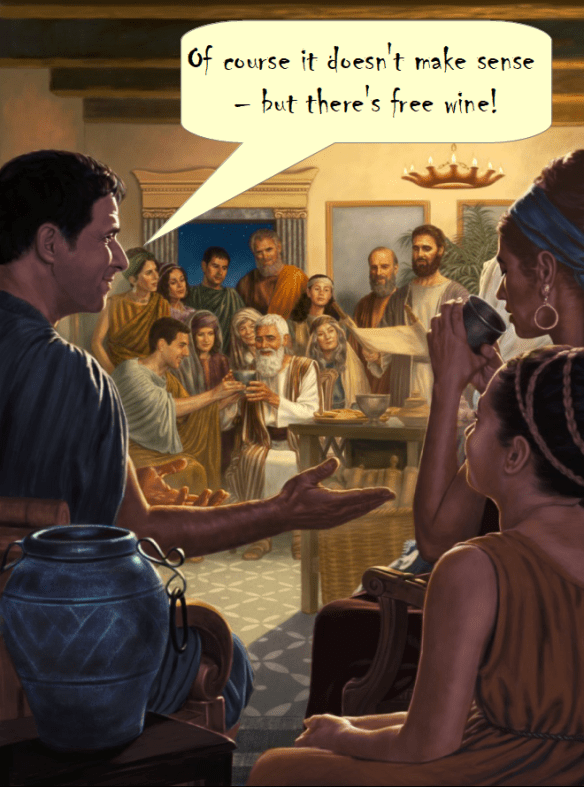
Sure. And there’s free wine while we wait.

Free wine? Why didn’t you say? Where do I sign up?


Just Like Jesus

Some parts of this post have appeared before.

Early in the first letter of John, we read,

By this we know that we have come to know Him, if we keep His commandments. The one who says, “I have come to know Him,” and does not keep His commandments, is a liar, and the truth is not in him; but whoever keeps His word, in him the love of God has truly been perfected. By this we know that we are in Him: the one who says he abides in Him ought himself to walk in the same manner as He walked. (1 John 2: 3-6)

Isn’t that interesting? John, whoever he was, says that Christians can know they’re saved because they keep Jesus’ commands and ‘walk’ as he walked. Likewise, others should be able to see these traits too because, as Jesus is (later) made to say, cult members can be recognised by their ‘fruits’ (Matthew 7:16).

Just what are Jesus’ commands that converts can’t help but demonstrate? Here’s a few:

  • Cutting themselves off from family – hating their parents, in fact – just to follow him (Luke 14.26);
  • Deny everything about themselves (Matthew 16.24-27);
  • Forsaking home, job, wealth, status, credibility and comfort to help bring about God’s Kingdom on Earth (Mark 10.29-31 etc);
  • Slaving tirelessly in the service of others (Mark 10.43-44; Matthew 23.11 etc);
  • Selling their possessions so that they can give the proceeds to the poor (Matthew 19.21; Luke 14.33);
  • Turning the other cheek, repeatedly going the extra mile and giving away the shirt and coat from off their backs– if they’ve still got them after giving everything away – (Matthew 5.38-40);
  • Welcoming the stranger, feeding the hungry, clothing the naked and visiting those in prison (Matthew 25.35-40);
  • Forgiving again and again and again (Matthew 18.21-22);
  • Avoiding judging others so that they won’t  be judged in turn (Matthew 7.1-3);
  • Loving their enemies (Matthew 5.44);
  • Regarding persecution and injustices as blessings (Matthew 5.11);
  • Doing miracles even more impressive than Jesus’ own (Mark 16.17-18; John 14.12);
  • Healing the sick, raising the dead and casting out demons (Matthew 10.7-8);
  • Asking for anything in prayer, which will be given to them (Mark 11.24; Matthew 21.22);
  • Telling others that the world is about to end (in the first century) and that only Jesus can save them from God’s wrath (Matthew 28.29-34; Matthew 28.16-20).

How many of these things do we see Christians doing? How many of these commandments are Christians compelled to ‘keep’, as letter writer John puts it? Some, it’s true, make attempts with the last (if only they wouldn’t) and a very limited few have a go at a couple of the others. But as far as most Christians are concerned, these commandments may as well not exist. They don’t see Jesus’ instructions as applying to them. I know from experience that they have ready made excuses for not obeying them, let alone feeling an inner compulsion to realise them in their own lives.

Their excuses necessitate them reinterpreting Jesus’ words. They’re metaphorical, they say. ‘He didn’t really mean give everything away because where would that leave us?’ – or they insist his commands have been taken out of context, or have only a spiritual meaning

Which is to say, nothing Jesus said is to be taken literally, even though the most straight forward reading of his pronouncements is that this is how he meant them. It’s how his early followers, the people who preserved or created his words in the gospels, understood them. Why record them otherwise?

But Jesus’ moralising is inconvenient, impractical, exacting, extreme; ridiculous, in fact, and Christians know this. Still his commands must be dealt with somehow. So the Righteous™ work round them or ignore them completely, replacing his priorities with ones of their own: worshipping him; defending his reputation; striving for power; complaining about secular society; whining about the media;  promoting aggression; acquiring wealth (there should be no such thing as a millionaire Christian); claiming persecution; equating faith with guns; trying to control others’ behaviour; interfering in their sex lives; suppressing LGBT people; arguing that religious rights trump those of minorities; opposing abortion.

None of these figured in Jesus’ agenda. Some are even in direct opposition to what he’s made to say in the gospels.

When we see Christians doing the things Jesus tells them they should be doing – what God’s love perfected in them compels them to do – maybe then we’ll listen to what they have to say. When they demonstrate credibility rather than hypocrisy, maybe they’ll have earned the right to be heard. But as there’s not much chance of that happening any time soon, it’s way past time we ignored them, and their superstition, in much the same way they ignore their Lord and Savior™.

Where’s The Harm?

So what does it matter if people believe in make-believe? It does no harm and might even do some good, right? I mean, if they want to believe in ghosts or horoscopes and that helps them make sense of life, then why not?

But with Christianity and other theistic religions it’s a different story. While they might provide their adherents with some coherence to their lives, they also equip them with a distorted and unhealthy view of other people. This is what compels local street preacher, Dale McAlpine, to pick up his megaphone and stand yelling at passers-bye in my local town centre. I took the picture above of him yesterday, when he invited me, like an evangelical Hannibal Lecter, to come closer. I declined.

Dale’s theme this time was, predictably, that evolution is a Satanic hoax, everyone is a wicked sinner and God requires a blood sacrifice for them to be saved. He no doubt had a swipe at LGBT folk too; he usually does. Dennis and I didn’t stop to listen to him but, along with everyone else, were lambasted with his ignorant BS as we passed. Such nasty stuff needs to be opposed and in the absence of my own megaphone, this is my way of doing it.

Those who believe planets millions of miles away control their lives don’t, as a rule, set themselves up on a soap box in the centre of town and threaten people with hell. Ultimately, though, there is no substantial difference between the baseless wishful thinking of astrology and Christianity. Today’s version of the faith owes its existence to Paul’s ‘revelation’ of an imaginary celestial being that sacrificed itself to restore our standing with an imaginary God. This makes as much sense as believing that the planets ‘in conjunction’ shape our destinies.

Would I, if it were in my power, ban the likes of Dale from spouting his ignorant, ugly version of Christianity? Probably not, as I’m a liberal at heart and cancel culture concerns me. I would, however, be pleased if he came to senses and of his own volition stopped spouting publicly his brand of theo-babble. I’d rather he spent his time tending to the sick, homeless, naked and imprisoned as his Saviour tells him to. I fear though that that kind of Christianity is too hard for the likes of Dale.

The Trouble With Atheists: A Christian Sets Us Straight

My friend Bruce Gerencser was good enough to repost my previous post on his blog. It prompted a comment from someone calling himself James Thompson, who Bruce says used a fake email address and quite possibly a false name. (These Christians; so fearless and honest in all their doings!) Here’s what ‘James’ had to say:

It’s because that’s what you live to do argue the truth. You’re not “atheists”. Antitheists yes. Agnosticism yes. A true atheist would not give a rip about the discussion on this blasphemous blog.

And atheists don’t go out seeking to remove Mickey Mouse from everything.

Or Buddha or Mohammed.

But they do Jesus Christ because Satan knows he is the only one who can bring salvation

I did respond to James on Bruce’s blog but wanted to address his garbled points, such as they are, more fully here. They’re typical of the low level thinking Christians and others use to defend their beliefs.

It’s because that’s what you live to do argue the truth.

Amazingly James has an uncanny insight into the minds of atheists; we live only to argue the truth, by which he means, presumably, critiquing his pet deity and magical saviour. Most of the time, most atheists barely give these two mythical beings a second thought; neither do I when I’m not blogging. I live for entirely different things.

You’re not “atheists”. Antitheists yes. Agnosticism yes.

But wait! People who don’t believe in his God aren’t, according to the omniscient James, atheists; they’re anti-theists. Okay, I concede; I am opposed to the notion that there’s a loving God somewhere out there who is interested in us and has made it possible for us to know him by, according to James and other deluded souls, making his only son a blood sacrifice. I dispute this silly idea, which has no evidence to support it, and is, as Jesus is made to say in Matthew 11.25, irrational and illogical. So yes, I’m an anti-theist. I’m also anti-theist because of what believers in the one true God (in his various guises) do terrible things to each other and to non-believers. And when they’re not doing that, they’re parading their ignorance, propagating their book of myths and spells, denying evolution, dumbing down children’s education, suppressing LGBT+ people and threatening everyone who doesn’t subscribe to their superstition with eternal damnation. I mean, what’s not to like?

 A true atheist would not give a rip about the discussion on this blasphemous blog.

And then James returns to his mind reading act. How does he know what a ‘true atheist’ might think of Bruce’s blog? There are plenty of atheists who comment there; whether they are ‘true’ atheists apparently only James knows.

And atheists don’t go out seeking to remove Mickey Mouse from everything.

It is true atheists (which we’re not, according to James) don’t seek to remove Mickey Mouse from everything, whatever this means. But then Mickey Mouse doesn’t start wars, condemn everyone as wicked sinners or try to control their sex lives. Disneyworld would quickly go out of business if he did. (That Donald Duck is a different kettle of fish however.)

Or Buddha or Mohammed.

James then scrapes the bottom of the cliché barrel: ‘You wouldn’t dare criticise the revered characters of other religions’. Yes, we would. As I said in my post, which evidently James didn’t read, there is no supernatural. All gods, ghosts, spirits, angels, demons, heaven and hells, from whichever religion or superstition they emanate, are figments of the imagination.

But they do Jesus Christ because Satan knows he is the only one who can bring salvation

These two as well. The Christ and his evil doppelganger, Satan, are human inventions. As fantasy figures they are open to as much ridicule and ‘removal’ as any other imaginary being. Perhaps more, given the damage they’ve caused and continue to cause.

James has been sold salvation snake-oil and thinks that because he’s been duped, everyone else should be too. Or at the very least should respect his delusion. Ain’t gonna happen, Jimmy boy. You need to grow up a little. And maybe also learn some grammar.

So Long, Jesus – the new book is here!

My new book, marking a final farewell to Jesus and his cult, is available now from all Amazon outlets. So Long, Jesus and Other Lessons From Life collects together the religiously-themed posts that have appeared on this blog over the past three years. A great Christmas present for those of your friends who might be considering saying their own farewell to Christian mumbo jumbo. This is the book you’ve been waiting for! 

So Long, Jesus and Other Lessons From Life – get it before the rapture!

All Along The Watchtower III

Jim has shaken the dust from his sandals. As he says, and as I knew, he wasn’t really looking for a discussion. He was looking to draw me, and the others who received his letter, into his cult. When it was obvious I wasn’t going to be, he lost interest. Plus, I mentioned Jesus’s non-return. I don’t think he liked that.

Hi Neil, 

Thanks again for your response. I think we’ll have to agree to disagree. We aren’t here to debate over things but we do respect your beliefs and thank you for taking the time to talk to us. 

We find what we read in the Bible answers many of life’s big questions and there is much archaeological evidence today to back up Bible accounts which adds to the accuracy of the Bible. So we want to share the truths and hope we have found with others, but we do respect everyone’s beliefs. 

Take care, 

Jim and Sandra