A special rendering of ‘One’ Corinthians 13. You’re welcome.

Blog410a

If I obsess about religious liberty but do not have love, I am no more than a resounding gong or a clanging cymbal.

If I judge and denigrate others and do my utmost to suppress them then I have not love.

If I claim I am persecuted while persecuting others, if I try to supplant their morality with my own and have not love, then I am nothing.

If I condemn others to hell because they do not subscribe to my beliefs, but have not love, then likewise I am nothing.

If I give nothing at all to the poor and say it is their own fault anyway, then I am without love.

If I say it is not up to me to fight for social justice and make defending Christian dogma my priority above everything else but do not have love, I am nothing.

Love is patient, love is kind. It does not envy, it does not boast, it is not proud. It does not dishonour others, it is not self-seeking, it is not easily angered, it keeps no record of wrongs. Love does not delight in evil but rejoices with the truth. It always protects, always trusts, always hopes, always perseveres.

If what I have, what I espouse, what I use to beat you with is none of these things then it is not love and I am a hypocrite unworthy of your attention.


The current line-up of The Clanging Cymbals is Scott Lively on Resounding Gong, Tony Perkins on Empty Vessel, Franklin Graham on Smug Tone, Pat Robertson on the Befuddlement, Robert Jeffress blowing his own trumpet and Steven Anderson contributing Heavy Flatulence.

Other members of the band are available for Self promotion, Church socials and Bar Mitzvahs. Pride events are excluded.


Demons, demons everywhere…

Blog407

I wonder if any Christians out there can help me understand something. I know that not all of you believe in demons; some of you are far too rational to believe in non-existent supernatural beings! I know too that when the bible mentions demons, as it does often, you know it’s as a metaphor, for sin perhaps, or as the personification of evil. Presumably, you reach this conclusion with the help of the Holy Spirit (you do believe in him, don’t you?)

And yet other, lesser brethren are led by that same Spirit to see demons as 100% real.

Take this guy, Jeremiah Johnson, a preacher/prophet/author from Florida who recently had a real live conversation with a demon:

On the night of May 30th, while praying and pacing over the United States in my home around 2 am, a demonic entity appeared right before me in an open vision. This type of encounter has only ever happened one other time while I was ministering in a foreign country in 2015. I have always engaged in this type of spiritual warfare while asleep and dreaming prophetically, but rarely if ever to this degree while awake.

This demonic entity had a visible and deep scar underneath its right eye, but it also had the ability to mutate or rather change forms. I watched this “being” morph several times right in front of me, yet the gash below its right eye remained.

As I see it, there are three options here. Either –

a) This really happened, or

b) Jeremiah made it up, or

c) It happened but entirely within Jeremiah’s disturbed mind

Can you advise me which it is? I’m leaning towards b) or c). I say ‘leaning’ when what I mean is I rule out a) entirely, though I’d be interested to know which conclusion the Holy Spirit is leading you to. (Actually, reading the comments following Jeremiah’s posting of his ‘Urgent Prophetic Alert and Warning’ on Facebook, I already know what 4 thousand of you think: you fall for this crapola hook, line and sinker.)

Of course, not all supernatural encounters are with demons. Sometimes your fellow believers have encounters with angels, or dead people from the bible. Here’s an example of that:

I kneeled down, and prayed, saying, ‘O Lord, what Church shall I join?’ Directly I saw a light, and then a glorious Personage in the light, and then another personage, and the first personage said [of] the second, ‘Behold this is my beloved Son, hear him’” 

Wow, that sounds amazing, doesn’t it? Joseph Smith recounting his first ‘vision’.

Again, you’ve got three options:

Either:

a) This really happened, or

b) Joseph made it up, or

c) It happened but entirely within Joseph’s disturbed mind.

If you’re a Mormon, the Holy Ghost will have led you to embrace option a). I lean myself towards b), possibly c). If you’re an evangelical Christian, however, you probably think Smith’s vision was demonically inspired. Can I ask you why you think this? Is it because that’s what your version of the Holy Ghost tells you? Ain’t it amazing how ‘he’ always confirms what you already believe?

With that in mind, let’s look at one final example:

When Jesus stepped out of the boat, a man out of the tombs with an unclean spirit met him. He lived among the tombs; and no one could restrain him any more, even with a chain; for he had often been restrained with shackles and chains, but the chains he wrenched apart, and the shackles he broke in pieces; and no one had the strength to subdue him. Night and day among the tombs and on the mountains he was always howling and bruising himself with stones. 

When he saw Jesus from a distance, he ran and bowed down before him; and he shouted at the top of his voice, “What have you to do with me, Jesus, Son of the Most High God? I adjure you by God, do not torment me.” For he had said to him, “Come out of the man, you unclean spirit!”  Then Jesus asked him, “What is your name?” He replied, “My name is Legion; for we are many.”  He begged him earnestly not to send them out of the country. Now there on the hillside a great herd of swine was feeding; and the unclean spirits begged him, “Send us into the swine; let us enter them.” So he gave them permission. And the unclean spirits came out and entered the swine; and the herd, numbering about two thousand, rushed down the steep bank into the sea, and were drowned in the sea. (Mark 5.1-20)

Either:

a) This really happened, or

b) Mark made it up, or

c) Mark made it up but it’s a metaphor for something or other.

I’m guessing most of you, including those who regard yourselves as rational Christians, opted for a): you think this really happened in some form. Why? Because this time it’s your hero, Jesus, who’s involved.

However, and this is my point, Jesus’ encounter with a demon – and it’s not the only one in the gospels – is no different in kind from Jeremiah Johnson’s or Joseph Smith’s. If you believe one really happened – the Jesus one – you really haven’t any reason not to believe the other two. And yet, my Christian friends, you reject at least one of the other two, don’t you. You dismiss Smith’s encounter with God and Jesus as, at best, a delusion and at worst, a fiction intended to dupe others. You may, as I’ve suggested, see it as demonically inspired (even though no actual demons appear, unlike in the Jesus and Johnson accounts.)

You may also, if you’ve half a brain, dismiss Johnson’s ridiculous story too. I hope so. So why persist in believing that Jesus met with demons? It’s not the Holy Spirit who convinces you that this story is the only plausible one of the three. The Holy Spirit is only as real as Johnson’s morphing demon. No, the only reason you give Jesus a free pass, but not Smith or Johnson (possibly), is that the Jesus story is in the bible.

So, what’s the answer to the question at the top of this post: which of those men, Jeremiah Johnson, Joseph Smith and Mark’s Jesus, is deluded? The answer is… all of them. And at least two of them are frauds.

Myself, I’m leaning towards all three.

 

The many and varied, Spirit-inspired interpretations of the Kingdom of God

Blog406Heaven

For the Son of Man is going to come with his angels in the glory of his Father, and then he will repay each person according to what he has done. Truly, I say to you, there are some standing here who will not taste death until they see the Son of Man coming in his kingdom” (Matthew 16.27–28).

Truly I say to you, this generation will not pass away until all these things take place. (Matthew 24.34)

See also Matthew 24.27, 30-31; Luke 21:27-28, 33-34; 1 Corinthians 15.51-52; 1 Thessalonians 4.15-17; 1 John 2:17-181; Peter 4.7

The Kingdom of God. What does it look like? When will it happen? Has it happened? You’d think that with the Kingdom of God being a central part of Jesus’ teaching, the central part, in fact – his ‘good news’ is about nothing else – that these would be questions Christians would find easy to answer.

They don’t. The Holy Spirit inspires a variety of incompatible responses from the faithful to the what, when and where questions. The most popular is, of course, that the Kingdom of God equates with Heaven: the saved are all going to heaven when they die. Post-mortem bliss, most Christians would tell you, is what Jesus meant by the Kingdom of God. After all, doesn’t Matthew refer to the Kingdom as the Kingdom of Heaven? Yes… but no: an after-life in Heaven is not what Jesus and his scriptwriters meant by the Kingdom. If it was, they would have said so, rather than promising, as they do, that God’s Kingdom was coming to the Earth real soon.*

So, when Jesus says the kingdom is just around the corner, which he does repeatedly in the synoptic gospels, he can’t have meant Heaven. Let’s try another favourite: Jesus meant that God’s Kingdom on Earth would manifest itself thousands of years in the future – in our time, no less. It’s all to do, you see, with Jesus’ return and the final judgement. As these have yet to happen then the final part of God’s plan – his reclaiming of his creation – will be in the (far) future too. A neat solution to be sure, but one that runs counter to everything in the gospels and in Paul. Admittedly it’s an idea that was taking shape in 2 Peter (3.8), a forgery written about 150CE, long after it had become apparent the Kingdom was running way behind schedule. However, you won’t find it in the synoptic gospels or the Pauline epistles because it isn’t what Jesus, Paul, the gospel writers or the earliest Chrsitians believed.

Where does this leave Jesus’ devotees today? With a Jesus who didn’t really mean the Kingdom would be manifesting itself in the physical world. This Jesus proclaims the Kingdom as something that exists inside his followers as an internal state of being. It’s true some of his pronouncements appear to fit this interpretation; the Kingdom is within you and all that, but what these statements are about in context is the Kingdom’s immanence at the time; what Jesus was saying was, ‘the Kingdom is arriving now; look at the signs – it’s all around you.’ A gnostic flavoured restructuring of what he actually claimed is yet another Spirit-led interpretation we can dispense with.

Consequently, some Christians accept that, yes, Jesus preached a Kingdom that would dramatically materialise in the real world close to the time he was speaking. That it didn’t in any observable way creates a dilemma: as God Incarnate, perfect and infallible, Jesus can’t have been wrong. This must mean the Kingdom did arrive when he said it would and we are living in it now. The Kingdom, these Covenantists say, is another term for the Christian era; the reign of the church, the Age of the Holy Spirit. We’re living in the Kingdom and have been for two thousand years!

How’s that working out?

Blog406Riot

Blog406Pollution

Blog406Bury

Blog406Starve

Yes, this looks exactly like the Kingdom of God Jesus promised: An eternity of peace with death and illness banished and the meek having inherited the earth; the social order reversed, God in charge and Jesus and his pals running the show. Or not.

So, however the faithful (re)interpret his words, however much they twist, cherry-pick or just plain ignore them, Jesus was wrong. The Kingdom of God did not arrive on the earth in the first century as he predicted. It’s definitely not here now. It won’t be coming in the future and it doesn’t await in an after-life; these were never the deal. (See my earlier series, Making Excuses for Jesus, for more detail.)

Whatever Christians do, wherever their imaginary Holy Spirit leads them, they end up with implausible and incompatible ways of explaining (away) the non-arrival of the Kingdom of God that Jesus promised. It’s a fallacy, a fantasy, another delusion sustained by the wilfully ignorant.

*John 18.36 does have Jesus say that ‘his’ Kingdom, as it’s become by the time of the fourth gospel, is not of this world. John, however, bears little relation to the other gospels and was written at least 70 years after Jesus lived. In any case, it doesn’t say or mean that common-or-garden believers are going to Heaven when they die.

The God Who Never Was

Blog404

I’m considering reasons why God is unlikely to exist. The sixth, though by no means final reason is (drumroll): Christians.

If God existed and if he did the things the Bible, and Jesus in particular, claimed for him, then Christians would be very different creatures. They wouldn’t be beligerent and self-righteous, desperately trying to draw others into their cult, callously condemning everyone outside it while claiming they themselves are the persecuted (a caricature, I concede, but not without truth).

Instead, and according to Jesus and Paul, they would be brand new creations (2 Corinthians 5.17), infused with supernatural power: the Spirit of God no less (John 14.26; Romans 8.7-9). They would, moreover, have abandoned their families (Luke 14.26) and sold all they own to give to the poor (Matthew 19.21), relying solely on God for their needs (Mark 11.24; Matthew 21.22). They’d spend all their time as his slaves (Matthew 25.21; Romans 6.22), helping the sick, the destitute and the imprisoned (Matthew 25.35-40) and in return God would have endowed them with the ability to heal all disease (Mark 16:15), raise the dead (Matthew 10.7-8) and do miracles even greater than Jesus’ own (Mark 16.17-18; John 14.12).

If Christians were like this, as Jesus and Paul promised, the world would be a much more remarkable and better place. What does it tell us that it isn’t? When Christians don’t constantly demonstrate compassion and miraculous powers but instead spend their time demeaning gay people, ranting about abortion and proselytising (the latter a redundant activity when, if they were the new creatures the Bible promises they’d be, we would all see God in and through their actions and superpowers.) That Christians are not like this tells us Jesus got it entirely wrong; that his God had no interest in him and has none in us; that faith in God, as Jesus and his early followers envisaged it, does not deliver.

Christians actually know this, which is why they ignore what the Bible says they should be like, or explain it away with convoluted exegesis. They’re focused on their own ‘spiritual growth’, ‘worship’ and on how they’ll be going to heaven when they die – an offer the Bible never makes. Whichever avoidance strategy they resort to, the Bible says what it says: that God will enable his followers to do great miracles, like healing the sick and raising the dead; ‘all things’, in fact, though Christ who strengthens them (Philippians 4.1). The evidence demonstrates conclusively, despite the disingenuous claims of some loopier evangelicals, that God does nothing of the sort. He fails, yet again, to come through. The only reasonable conclusion is that this is because he’s not real.

So those are six major reasons why it is highly unlikely God exists. There are others, some of which I’ve touched on in other posts: how, despite Jesus’ promises he will, God looks after his devotees no better than caged sparrows (Matthew 10.28-31); how there’s no evidence the supernatural exists; how the spiritual realm and the gods that go with it are products of the human imagination. Collectively – and even separately – these convince me there’s no God, and certainly not that sorry excuse for one, Yahweh.

God or Superman?

Blog397

An early problem faced by the creators of Superman, only a few years after his first appearance in Action Comics #1 in 1938, was his impotence in the real world. Here was a character with incredible super-human powers – not quite as phenomenal as they would later become – who could defeat gangsters, wife-beaters, bullies and evil dictators with a flick of his little finger, but who, when a real life bully emerged on the world stage, couldn’t do anything. Stories could have been written about how he single-handedly defeated the Nazis and restored world peace but none of this would have been reflected in the real world. It’s true that today with its alternate realities and constant rebooting that Superman could be made to defeat modern-day fascism; but that would be on some other fictional Earth, not the real one. In the real world, Superman would remain impotent, having little effect beyond raising awareness and morale, which is what he did – or, more accurately, what his creators had him do – during World War II. There wasn’t anything else he or they could do.

By now, coronavirus should really have disappeared from the face of the Earth. Last Sunday was National Day of Prayer in the US. Independent of Donald Trump’s ‘initiative’ in calling for a day of grovelling in front of the Almighty, many other Christians have also been begging God to protect their church community from covid-19 (the godless can fend for themselves). Still others have commanded the virus, in the name of Jesus, to leave them and the USA alone (the rest of the world be damned.)

The effect of all this pleading and commanding has been that the coronavirus has continued to spread, heedless of borders and indifferent to the religious beliefs of its victims. Either God doesn’t give, as we say in this neck of the woods, a rat’s arse about who contracts covid-19, nor who dies from it, not even his born-again Chosen Ones. Everybody’s gotta die sometime, right? The important thing is that they’re right with the Lord before they do.

Or – God’s just like Superman. We can imagine him doing all sorts of incredible things, like healing disease, curing illness and saving the world, but in reality, none of them ever happen. He’s not going to protect people from coronavirus in precisely the same way he failed to protect them from 9/11, AIDs, the Holocaust, Spanish Flu, The Great Plague, Black Death and Leprosy. It’s not that he doesn’t care, it’s that he’s not there. He’s no more real than Superman and is every bit as impotent as the Man of Steel.

I’m a big fan of Superman – I’ve been reading the comics he appears in for 57 years now – and I’m fully aware he’s not real; he was created by Jerry Siegel and Joe Shuster 82 years ago and has been embellished by every writer and artist who’s worked on him ever since – much like God. If only those who plead with the Almighty, and worse, tell the rest of us what he thinks of us, would recognise that he is fictional too. He exists only in a fantasy realm, outside of which he has no super-powers, no influence, no ability to save us from coronavirus or anything else.

Remember the sequence in the Simpsons episode where Homer is, as usual, in lots of trouble; he looks to the sky and pleads, ‘I’m not normally a praying man, but if you’re up there, please save me… Superman.’ That’s exactly what Christians are doing right now, and the result will be the same as it was for Homer and for everyone else who’s ever called on Superman God to save them.

The Choice Is Yours

Blog395c

I don’t get a lot of comments on this here blog, but when I do they’re rarely as cogently argued as this one, left recently on an old post,Unbelievers are Going to Hell:

NO OBLIVION. HEAVEN OR HELL. HOLINESS OR DEBAUCHERY, GOOD OR EVIL, VIRTUE OR VICE, JESUS OR SATAN, THE SPIRIT OR THE FLESH, GOD OR IDOLS, RIGHTEOUSNESS OR WICKEDNESS, KINDNESS OR SELFISHNESS, LIGHT OR DARKNESS, PIETY OR PERVERSION, PLEASURE OR PAIN, TRUTH OR ERROR, THE NARROW GATE OR THE WIDE GATE. THE CHOICE IS YOURS.

Difficult to argue with, I think you’ll agree. This is reasoning of the highest calibre. All those false dichotomies have convinced me I need to change my debauched, perverted ways and take on the mindset of a first century zealot. You win Watchman Outreach Evangelism!

Or, as I may have just put in my response:

Lower case or UPPER CASE
Logic or LUNACY
Reality or FANTASY
Sense or NONSENSE
Seems you made your choice already.

Coronavirus defeated

Blog395

Thank God the Coronavirus pandemic is over. It was scary there for a minute or two. Over 3,000 people died from it. Fortunately, they were mainly Chinese and South Koreans. Vice-president Mike Pence and other anti-abortionists Christian leaders have now taken care of it. On Friday they prayed that it would go away and God has done as they asked. The picture above, courtesy of The Friendly Atheist, shows them doing it. Here’s some other nitwits righteous ones doing the same thing and here an article about the prophet whom God chose to announce to the world that the threat was over. You have to wonder, though, why he made the virus in the first place and why he allowed it to spread so indiscriminately. I mean, even Christians were infected.

Truly, the way to resolve a world wide health crisis is to enlist the help of an imaginary sky fairy who, as usual, does f**k all to help.

Next week: the coronavirus continues to spread. These same men of God then realise that the virus is actually God’s punishment for abortion… er, homosexuality… um, opposition to Trump… er, people shaking their fists in his face (he really doesn’t like that.) Then it all becomes clear why God made the virus in the first place. Difficult to explain why he started it off in China though, but the Lord will surely let his prophets know that too (I mean, those Chinese are commies.)

Life must be easy when all you have to do is make stuff up. It’s more than a little bit worrying that those who do it are listened to by multitudes who’ve switched off their critical faculties. More worrying still when some of these fantasists are in charge of entire countries. The only way coronavirus will be defeated is through science; the development of a vaccine, which is still many months away. Imaginary deities – and they’re all imaginary – prayers, pleading and blaming are all worse than useless.

The Darkening Age

Blog393

I’ve been reading Catherine Nixey’s The Darkening Age: The Christian Destruction of the Classical World. I highly recommend it.

Its sub-title says it all. The early church’s determination to destroy any way of life, any belief system or enterprise that it didn’t agree with was deliberate, systematic and brutal. It set out to eliminate the forms of worship, culture, learning and social norms in which it found itself. It did this initially by demonising, literally as far as it was concerned, the opposition. If it wasn’t Christian then it was demonic; ancient religious beliefs especially, but also schools of philosophy, science, education, the theatre, dancing and sexual mores.

As it grew in power, the church went from holding its ‘heathen’ neighbours’ views as suspect to actively and violently opposing them, destroying temples, toppling and mutilating statues of the old gods, razing to the ground historic buildings they considered ‘demonic’. Those they regarded as ‘pagans’ were compelled to convert to the new religion. According to the Christian propaganda of the time, these pagans turned to Jesus with joy in their hearts, once shown the error of their demonic ways. What choice did people have? It was either that or lose everything they held dear.

Once Christianity became the state religion under Constantine, religious authorities legislated against other philosophies and beliefs. As the Justinian code put it, ‘we forbid the teaching of any doctrine by those who labour under the insanity of paganism.’ Free thinkers could be arrested and have their possessions, including their homes, Blog393aconfiscated. They could be imprisoned for believing and saying things that ran contrary to Christian orthodoxy. Their works were burnt, often on public pyres, and that which survived was frequently written over with pages of scripture. Soon, however, even this wasn’t enough. It became a capital offence to subscribe to alternate beliefs, to write or teach about them. Similarly, same sex activity became outlawed and punishable by death. No wonder the philosophers of the day called Christianity ‘the tyrant’.

In 392, Christian mobs destroyed the magnificent temple of Serapis in Alexandria. The Great Library in the same city had disappeared by then too, quite possibly at the hands of Christian mobs. Hypatia, one of the Library’s greatest mathematicians, was degraded in the street and then murdered. (You may have seen the 2009 film Agora where Hypatia is played by Rachel Weisz; if not you definitely should.)

By AD500, the church had successfully and completely eradicated the opposition. The culture that had preceded it had gone; its knowledge, mythologies, philosophy together with the ability to think freely and to criticise – all consigned, if not to hell, then to oblivion. Nixey reports that 90% of classical literature is lost forever (p246), including almost all Greek writing from the ancient world. As John Chrysostom boasted, the writings of the Greeks ‘have all perished and are obliterated’ (p245). From the little that survives we know that Greek philosophers had postulated that the world was made from atoms and didn’t have a beginning as such. They had also developed a form of evolutionary theory (pp35-36). It would take the world 1500 dark years to catch up with these suppressed ideas.

The elimination of Christianity’s opponents was carried out in the name of the man who supposedly said, ‘love your enemies and pray for those who persecute you’ (Nixey points out that the persecution of Christians was greatly exaggerated; many early believers aspired to martyrdom and the church undoubtedly meted out more persecution than it received.) It was done to bring the world into line with the way they thought God had decreed it should be:

That all superstition of pagans and heathens should be annihilated is what God wants, God commands, God proclaims! (‘Saint’ Augustine)

Thank Enlightenment we can’t, in the west at least, be executed these days for our beliefs and philosophies. And whatever became of Christians? Those who oppose anything in their culture they consider contrary to their tyrannical views, who would punish, perhaps execute, sexual non-conformists and who regard other belief systems, atheism especially, as demonic. The same believers who would eagerly take us back to the demon infested dark ages.

They’re still with us of course and have, in the UK where I am and certainly in the United States, a disproportionate amount of influence and power. We must be grateful they are moderate, reasonable people who wouldn’t hurt a fly.

Aren’t they?

Bathwater

Blog392

While putting together the ‘Can You Be a Christian and…’ series, I encountered on more than one occasion the line of reasoning (I use the term lightly) used by moderate Christians that, essentially, certain parts of the Bible are no longer relevant. So you can, they said, be both a free thinker and a Christian; you can be gay, so long as you disregard what the bible says about homosexuality; you can be a Christian woman if you dismiss Paul’s denigration of women; you can acknowledge evolution provided you reinterpret what the bible says about creation; you can be a realist if you ignore the bible’s supernaturalism.

But if you’re going to disregard anything the bible teaches that appears incompatible with what we know about psychology, sexuality, biology and reality, then how does the Bible’s central objective truth, as one commenter on here calls it, survive? What makes its core message (that, in some way, Jesus’ death and resurrection is capable of saving humankind) an immutable, eternal truth, while almost everything else can be compromised, deemed to be ‘culture-bound’ and metaphorical, to the point of irrelevance?

I recognise, of course, that fundamentalist Christians don’t do this. For them the bible is inspired, infallible and immutable. They’re prepared to compromise themselves, science and reality in order to honour and preserve what the book says. For them evolution, feminism, homosexuality and independent thinking will always be wrong. The alternative is to acknowledge that the bible doesn’t get everything right and to take the approach of the liberal progressive Christian who is prepared to adjust and adapt what it says; to emasculate it.

Which brings us back to asking where this process stops. If progressive Christians are prepared to dilute to the point of meaninglessness what the bible has to say about creation, women, sexuality and reality itself then why not what it teaches about Jesus and salvation?

It’s a fact that almost all varieties of the Faith, including fundamentalism, are happy to ignore completely Paul and Jesus’ teaching that the Kingdom of God was due to arrive, in all its glory, in their own time. It’s the same with Jesus’ moral extremism (giving to all who ask, loving enemies, turning the other cheek.) So why not the rest of it?

Why are Paul’s muddled theology and selected bits of the Jesus stories considered to be the baby while the rest of the bible is the disposable bathwater? On what basis do progressive Christians decide what is inessential and what is crucial, critical, indispensable? Ideas about angry deities, blood sacrifice, the sins of the people and the resurrection of god-men are every bit as culture-bound as the bible’s perspective on all those other issues.  

Because really, in the end, it’s all bathwater.


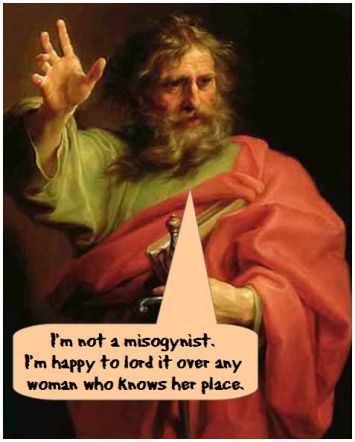
Can you be a Christian and… a Woman?

Blog391Bi

…women should adorn themselves in respectable apparel, with modesty and self-control, not with braided hair and gold or pearls or costly attire, but with what is proper for women who profess godliness—with good works… Let a woman learn quietly with all submissiveness. I do not permit a woman to teach or to exercise authority over a man; rather, she is to remain quiet… she will be saved through childbearing—if they continue in faith and love and holiness, with self-control (1 Timothy 2:9-10; 13-15).

The women should keep silent in the churches. For they are not permitted to speak, but should be in submission, as the Law also says. If there is anything they desire to learn, let them ask their husbands at home. For it is shameful for a woman to speak in church (1 Corinthians 14:34-35).

But I want you to understand that the head of every man is Christ, the head of a wife is her husband, and the head of Christ is God (1 Corinthians 11:3).

Wives, submit to your own husbands, as to the Lord. For the husband is the head of the wife even as Christ is the head of the church, his body, and is himself its Saviour. Now as the church submits to Christ, so also wives should submit in everything to their husbands (Ephesians 5:22-24).

Wives, submit to your husbands, as is fitting in the Lord (Colossians 3.18).

(Women should) be self-controlled, pure, working at home, kind, and submissive to their own husbands, that the word of God may not be reviled (Titus 2:3-5).

So according to the cult handbook, women must be –

submissive, quiet, silent, submissive, under a man’s authority, modest and… submissive. They should work at home, do nothing that might embarrass their husbands and have no authority over any men.

If a woman wants to be a Christian this is the behaviour she must assume. Above all, she must be submissive to the men God has placed above her, from her husband to… well, every other male.

What self-respecting woman is going to submit herself to this?

But wait, I can already hear liberal, enlightened Christian women approaching, all set to tell me that these New Testament admonitions are no longer relevant because they’re ‘culture bound’. They were devised, by men, in a first century milieu and therefore they don’t apply today! Which is odd, given they were applicable for almost all of the previous two thousand years, well beyond the time and context in which they were written. Not until the twentieth century, when the church’s power began to wane and women began to demand equal treatment with men, was the Bible’s misogyny questioned. Less than a hundred years have passed since women’s rights were reluctantly acknowledged by western society, even less since parts of the church caught up.

Many evangelical churches today still subscribe to the ‘commands’ of Paul and the imposters that followed in his wake. They expect their women to be silent, modest, under men’s authority and submissive. Witness the number of Christian blogs that traduce women, many written by women who regard themselves as ‘godly’ wives. Look at the frequent attacks by fellow evangelicals on female preachers like Beth Moore and Joyce Meyer, who ‘presume’ to teach men. (I can’t stand either of them personally, but not because they’re women.)

Liberal churches, however, know better. They safely consign the New Testament views of women to history; curios that provide an insight into how first century cultists thought, none of which are binding on today’s women. The world has moved on. Indeed it has; western culture has changed its views on women and their rights and roles, with little help from the church. While this is a very good thing, aren’t Christians told not to conform to ‘the world’? They are (Romans 12.2). Clearly this is yet more biblical teaching that can be ignored when it suits.

So, can you be a woman and a Christian? Evidently so, though it involves either compromising yourself as a woman to comply with the Bible’s warped ideas of what you should be and how you should behave – or compromising the Bible’s directives in order to respect and be yourself. But is compromise really what Christianity is about? Paul and his fellow fanatics didn’t seem to think so.