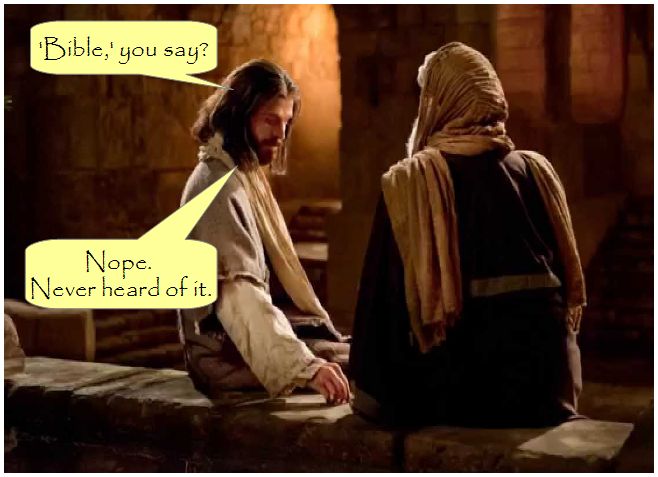
Prophets At A Loss (again)

What a joy it is to witness the prophets of the Lord who a few weeks ago assured the world that Jesus had told them Donald Trump was going to win the US presidential election. Look at them floundering now to explain away their foolishness:

Pat Robertson on 20th October: ‘Without question, Trump is going to win the election.’

After the election: ‘Here is my take on the election. In my opinion I think Trump won it. That may shock you… There are cases being filed in many courts but I don’t give them much chance of winning.’

Paula White on 5th November: I hear a sound of victory. I hear a sound of abundance of rain. I hear a sound of victory. The Lord says it is done. The Lord says it is done. The Lord says it is done.

After the election: ‘God’s decision has been made… the church must enforce some things in the realm of the Earth. We must take authority over every demonic spirit, every high thing.’

Kat Kerr on 24th October: ‘Trump will win. He will be president of the United States. He will sit in that office for four more years and God will have his way in this country.’

After the election: ‘One of the things [God] had me say was that Trump would win by a landslide… But many times, as we know in the Word or even just from experience ourselves — especially as a prophet — that doesn’t ever mean what man thinks that means.’

Jeremiah Johnson on 30th September: ‘I had a dream… God showed me… President Trump will be re-elected.’

After the election: ‘There has been a chorus of mature and tested prophets in America with a proven track record that have predicted Donald J. Trump would be re-elected President of the United States. I am one of them… Either a lying spirit has filled the mouths of numerous trusted prophetic voices in America or Donald J. Trump really has won the Presidency and we are witnessing a diabolical and evil plan unfold to steal the Election. I believe with all my heart that the latter is true.’

Denise Goulet on 19th October, speaking to Trump in person: ‘The Lord showed me today that you are going to get a second wind…another in-filling of the Holy Spirit…because the Holy Spirit makes you able to finish, to take this to the end, Mr President.’

After the election: f*** all.

It’s demons! An evil plan! I meant something else! I still think I’m right! I hope everyone forgets what I said.

Friendly Atheist Hermant Mehta has a whole lot more. These people are either frauds or self-deluded idiots. It’s stating the obvious to say that God and Jesus do not communicate directly with them. They haven’t been singled out to receive divine messages. Yet that is what they believe, or claim to anyway. They know no more about the future or God’s intentions than a typical house fly does. Yet the gullible, those caught in the same pretence that is Christianity, believe them. Yes, there are smart arse discerning Christians out there who say they never fall for these charlatans. Yet they do.

In Jesus Eclipsed, David Chumney cites Eugene Boring who, he says, ‘catalogs dozens of sayings ascribed to Jesus in the Gospels that very likely originated with later Christian prophets’ (my emphasis). Yet the writers of the gospels pass off these ‘spiritual insights’ as though they were Jesus’ own. Those who first read the gospels believed they were. Christian’s today assume the same. They’re not. They’re the words of religious zealots making things up as they went along. Some, most perhaps, no doubt believed what they were channelling the words of the Lord. Others wouldn’t have been quite so sincere.

There is no such thing as a prophet. God doesn’t make his intentions known through cranks and fraudsters. There’s no God and no Eternal Jesus to do such a thing, as today’s holy con-artists so ably demonstrated with their predictions of a Trump victory.


Will the real Jesus please stand up?: Conclusion

There will no doubt be Christians reading this blog who are keen to tell me that no-one in their right mind would believe in a made-up Jesus.

No? Yet the self-righteous are still making up Jesuses in their own image. Jesuses who bear little relation to any of those in the Bible. Jesuses that suit their own agendas: White Republican Jesus, America First Jesus, Catholic Jesus (with his heart outside his body), anti-LGBT Jesus, Evangelical Jesus, Social Justice Jesus, Prosperity Jesus, Mormon Jesus, Jehovah’s Witness Jesus, Jesus who gives glimpses of heaven, Jesus who communicates with his ‘prophets’ here on Earth… and many more.

Every single one of them is a made to order, manufactured Jesus, every single one imaginary. The Jesus worshipped by individual Christians and churches is a figment of the imagination. He may be loosely based on one of the Jesuses of the Bible (I’ll generously give them the benefit of the doubt) but he is unique to every sect and to every single person within it. Each individual sets up an altar to the idol in their head and worships him there.

Christians: your personal Saviour isn’t real. You worship a construct of your own making.

From which, two questions follow:

If no-one in their right mind would believe in an imaginary Jesus, what does this tell us about you?

Given you believe in an imaginary Jesus, why is it so difficult for you to accept that the earliest Christians did too?

Making it all up

While the Old Testament is made up of myth and legend and the New created from the visions and dreams of a few disturbed individuals, we are expected to believe that the gospel accounts nevertheless shine out as beacons of truth.

We know, however, that much of what is contained in the four canonical gospels is fiction. I’m not referring here merely to how contradictory they are (though there is that), I’m talking about the parts that are clearly made up, invented for theological and literary purposes. These include:

The nativity stories: These are myth, created so that the Godman has an origin similar to those of other Godmen: There is no historical evidence for a wand’rin’ star, a census that involved the mass movement of populations or the Massacre of the Innocents.

The virgin birth: relies on a misreading of ‘young woman’ in Isaiah 7.14

The flight to Egypt: a misapplication of Hosea 11.1.

Genealogies: invented. Matthew’s and Luke’s are completely different and don’t, in any case, include sufficient generations to reach back to ‘the first man’.

The Magnificat: Written as a Greek poem. It is not an outpouring of a young peasant woman.

The temptation in the wilderness: Jesus did not have a conversation with the devil. He was not attended to by squadrons of angels; we know such beings do not exist. In any case, which eye-witness was present to record these fanciful encounters?

Angels: 12 appearances across the gospels. Demons and other evil spirits: at least 20 mentions. Myth, pure and simple.

The miracles: all of them make a theological point. This is their purpose. They are literary.

Jesus’s teaching: designed to encourage members of the cult, a cult that could only exist after the events the gospels purport to relay. Everything he’s made to say comes from different sects, Paul’s teaching, Old Testament wisdom literature and even pagan sources.

The sermon on the mount: created and written in sophisticated Greek, not delivered by a semi-literate itinerant preacher.

John’s self-obsessed Jesus: nothing like the character in the synoptic gospels. Either he’s made up or they are. Or both.

The Transfiguration: Elijah and Moses do not return from the dead to have a chat with Jesus. This is completely made up.

The Eucharist: first appears in Paul’s teaching in I Corinthians 11.23-27. It is distinctly pagan but is accommodated in the gospels because Paul insisted he got it directly from his (imagined) Christ.

Judas’ betrayal: suggested by Zechariah 11.12-13 (which in context is not a prophecy).

The custom of freeing a prisoner (Barabbas): no such custom existed. The event is symbolic.

Resurrected corpses emerge from their graves: Matthew made this up. No-one else seems to know of it and Luke makes a point of cutting the episode out of his version of events.

The Crucifixion: based on Isaiah 53 and various Psalms.

The Resurrection: based on the visions of Cephas, Paul and others with added, invented detail, incompatible across the four accounts.

The Ascension: Jesus levitates into the stratosphere, in front of witnesses no less. Or perhaps not; Luke invented this impossibility.

There is much more in the gospels that is evidently and demonstrably made up. We can, as Christians do, believe it all really happened. We can insist that the stories are not based on other sources but that these sources are prophecies of real events that took place in history. From this perspective, Paul’s and others’ visions are then the result of these same events.

But which is more likely? –
The Old Testament is packed with prophecies about Jesus’ life and death, and that what Paul and others saw in their heads was because Jesus really existed and spoke to them once he’d returned to Heaven…

Or: The Jesus story is fictional, a patchwork of Old Testament snippets, mystical visions, invented symbolic events and pagan ideas of resurrecting Godmen.

And If the gospels are fiction – and they evidently are – then why not Jesus himself? If there was no real history to be written about him, just this mish-mash of other sources, that can only be because there was no Jesus who walked the Earth 2000 years ago.

Jesus is the same as his near contemporaries Osiris, Dionysus and Mithras. Like them, he is entirely mythological.

Will the real Jesus please stand up? (part 1)

Over the last week or so I’ve encountered a couple of Christians online (here and here) who’ve made the point that Jesus must’ve existed because

  • Early Christians wouldn’t have died for a lie. (I’ve covered this before so all I’ll say here is that yes, they would – as zealots still do today – especially if they were convinced the lie was true.)

  • They themselves know Jesus as their personal saviour, and

  • The Bible tells us about him so no-one in their right mind could possibly believe he was imaginary.

These last two are interesting and related. Susceptible people have always believed in imaginary beings. All of the pantheons that have ever existed – Egyptian, Greek, Roman, Norse, Aztec, Hindu and numerous others – have had their adherents; people who lived with the conviction that supernatural beings were real and would respond, help or judge them in some way when they themselves acted in specific ways. Yet none of these beings existed. Why not Jesus?

Christians today don’t believe in Jesus alone, however. They subscribe to an entire company of invisible beings and places: God himself, of course, spirits – holy and otherwise – angels, Satan, demons, hell, heaven as well as a celestial being called ‘the Christ’ who sits at the right hand of God and who may or may not be related to an historical Jesus. Evangelicals and other believers build their entire worldview around such mythical beings, worshipping some of them; turn on your God channels any night of the week and see trance-like Christians telling Jesus how amazing, wonderful and worthy of praise he is. Yet this is a Jesus who is wholly imaginary.

Many of the posts on this blog are about how Christians aren’t very much concerned with the Jesus of the synoptic gospels, who tells his followers to sell all they have, give to everyone who asks and to turn the other cheek. They are only interested in his supernatural alter-ego, ‘the Lord Jesus Christ’, who makes no demands on them, but who, they think, listens and blesses them from on high. For all they care, any other Jesus may just as well be imaginary.

So if the Christ contemporary Christians worship isn’t real, why are they so insistent that the Jesus of the gospels must have been? It is equally likely that, the same as them, the earliest Christians also worshipped a made-up supernatural being.  

We’ll take a look next time at just what the Bible says about Jesus, and what it doesn’t.

Body Talk

So you’re not getting a new body when you die. Sorry about that. It all comes down then to what you’re going to do with the one you’ve already got. I don’t know what condition it’s in. Your genes and the wear and tear it’s undergone in life will determine that. My own isn’t too bad for its age, I guess, though it suffers from inexplicable aches and pains these days (fibromyalgia) which is probably only going to get worse as I get older. All the same, that’s better than the alternative, so I’m not going to let it stop me from enjoying life.

And that’s what I’d recommend to you too. Enjoy life, enjoy your body. Indulge it in its appetites. The Christians who tell you you’re wrong to do so, who quote verses like Romans 8.13 at you are missing the point:

For if you live according to the flesh you will die, but if by the Spirit you put to death the deeds of the body, you will live.

Denying yourself will not take you to Heaven, won’t make you a better person and won’t make Jesus like you any more than he does already (which is not at all, on account of his non-existence.) Of course, it’s sometimes a good thing to delay gratification, if others might be adversely affected, for example, but usually it’s not. Most of the time it’s okay to do with your body what you want to do with it – it’s yours for that reason. So enjoy training it, exercising it, eating well and wisely, grooming and pampering your body, keeping it as fit and clean as you possibly can. Enjoy being creative and caring. Be sensual (as in enjoying its sensations) and have all the sex you want, however you want it – with protection, specially if you don’t intend creating more little bodies – and with whichever consenting partners you want. Your body has evolved to be like this. You have evolved to be like this. Anything else is an aberration.

Why am I saying this? Because having reached 65, I’m very aware of the physical limitations that make themselves known as one gets older. Your body, my body, everybody’s body will eventually and irrevocably let each and everyone of us down. You will have experienced some debilitation already, whatever age you are; temporary illness, ailments of one sort or another, injuries, viruses, infections and malfunctions. Your body will eventually undergo the ultimate malfunction and let you down completely. It will die. Don’t leave it until that time approaches – and which of us knows when that is? – to appreciate it. Enjoy it now, whatever stage of life you have reached and whatever shape your body is in.

Am I preaching hedonism? Not exactly. But I am recommending you take pleasure from whatever activities you use your body for, no matter how mundane they are. And let’s face it, all human activities, including the cerebral, involve the body one way or another. Be a sensualist, as in enjoying the body’s sensations, and find pleasure in all things. Give pleasure in return and in many varied ways to others.

Isn’t this more life-enhancing than all that unhealthy ‘death to the flesh’ stuff (Romans 8.13) at the heart of Christianity, which regards the body as corrupt (Romans 7.24), sinful (Romans 7.5), lowly (Philippians 3.21), weak and dishonourable (1 Corinthians 15.43) and unworthy of a place in the Kingdom of God (1 Corinthians 15.50)? It surely is. Paul says in 1 Corinthians 15.32 that if the dead are not raised in new spiritual bodies then we may as well live our lives according the maxim, ‘Let us eat and drink for tomorrow we die’. There is no resurrection, there are no bodies other than the ones we have now, so perhaps, for once, Paul was on to something.

New Bodies For Old

Paul taught that believers in the Lord Jesus would, once the Christ returned, be resurrected in a ‘spiritual body’. Those who remained alive at this time, as Paul anticipated he himself would be, were also to be ‘re-clothed’ in a new body (2 Corinthians 5.3) in preparation for life in the Kingdom.

He also seems to have believed that Jesus himself was resurrected in a ‘spiritual body’. This is presumably what Paul thinks he saw when Christ revealed himself to him in his head. Christians since have argued that when Jesus rose from the dead, it was in the same body in which he was crucified. Indeed, John’s gospel goes so far as to show his resurrected body still carried the wounds he suffered during his execution (John 20.26-29).

So what does this spiritual body, the one Paul promises all believers will receive, which is somehow physical yet not – the risen Jesus can pass ghost-like through locked doors (John 20.19) and levitate into the sky (Acts 1.8-11) – look like? What is its nature? Is it ephemeral so that it can vanish at will (Luke 24.31) and change its appearance (Luke 24.16), or is it like the bodies we have now, only better? Is it made of meat and gristle? Does it breath, eat, sweat, need to sleep, poop and pee? If not, then in what way is it a body? Will the new body retain its lungs, sweat glands, digestive system and genitals? Can it be considered a proper body if it doesn’t? If it’s to be an upgraded version of our existing bodies, minus all those pesky instincts, demands and messy bits, then how does it work? Does it only vaguely resemble the body we have now, like an Avatar in the famous film? Is it intangible, like the risen Christ’s (as implied in John 20.17)? Can it morph into unrecognisable forms (John 20.14)? Will it be able to pass through physical objects like Jesus’ ghostly form could ?

Alas, we shall never know. When Paul was making pronouncements about ‘spiritual bodies’ he hadn’t a clue what he was talking about. Writing to the cultists in Corinth, he anticipates that someone might want to know what ‘spiritual bodies’ are like. Here’s his profound answer:

But someone will ask, “How are the dead raised? With what kind of body do they come?” You foolish person! (1 Corinthians 15.35)

Yup, he had no idea what he was talking about so he resorts to ad hominem abuse instead. He then twitters on about how the physical body has to die, like a seed, before the new super-duper spiritual body can manifest itself. Except a seed doesn’t die in order to produce a plant. It may be buried but it doesn’t die. His analogy, which, you’ll note, doesn’t actually answer the question, fails miserably:

What you sow does not come to life unless it dies. And what you sow is not the body that is to be, but a bare kernel, perhaps of wheat or of some other grain…. So is it with the resurrection of the dead. What is sown is perishable; what is raised is imperishable. It is sown in dishonour; it is raised in glory. It is sown in weakness; it is raised in power. It is sown a natural body; it is raised a spiritual body. If there is a natural body, there is also a spiritual body. (1 Corinthians 15.36-37, 42-44)

His final flourish – if there is physical body then there has to be spiritual one – is, to use a technical term, absolute crap. He is making this stuff up and passing it off as a message from the Lord. Then as now, there were those who were taken in by him.

No-one has ever received a new body after their death; when this, our only body dies, we die. Our consciousness does not survive; it is a manifestation of our bodies, specifically of the brain, part of the meat and gristle that make up our bodies. It doesn’t hang around waiting for Jesus or God or some other non-existent being to transplant it in an imaginary super body.

No-one has ever received a new ‘spiritual body’, and no-one ever will. Of the 100.8 billion people who have died in the history of mankind, not one has gone on to live again in a new ‘spiritual body’. Not one has gone on to live again, period. If you think they have, you are free to present your evidence here. (Jesus, I should point out, doesn’t count: he wasn’t, according to Christian myth-making, entirely mortal. Plus his resurrection appearances are fiction.)

Paul is lying. There is no such thing as a ‘spiritual body’, no such thing as resurrection. You won’t be experiencing either. You are allowing yourself to be duped if you think you will.

The Ten Rules of Cult Club

Blog417

Which cult?        

        Any.

            All of them.

Let’s call this one The Brotherhood of the Lord.

Rule 1. Give your heart and soul to the Brotherhood.

Rule 2. Separate yourself from you family. They’ll just be a drag on you. They won’t understand you’ve found the Truth.

Rule 3. Treat other Brothers and Sisters as your family instead. Put them first.

Rule 4. Be prepared to die for your Brotherhood family. It’s not too much to ask.

Rule 5. Renounce your ego! You can’t enter fully into Truth until you let go of self.

Rule 6. Don’t criticise your brothers and sisters, specially not the leadership. The leaders know better than you; you are mere sheep and little children.

Rule 7. Sell everything you own; you won’t need it now. Give what you make to the poorest members of the group.

Rule 8. Listen to your leaders. They will tell you secrets about life that no-one outside the Brotherhood can possibly understand.

Rule 9. Don’t stop believing: if you’re obedient to the cult, your sins will be forgiven and you will live forever.

Rule 10. Be prepared: God is coming real soon to rescue you from this wicked world and elevate you to a place of glory

Or, as Jesus put it:

Rule 1. Any one of you who does not renounce all that he has cannot be my disciple (Luke 14.33). No one who puts his hand to the plough and looks back is fit for the kingdom of God. (Luke 9.62).

Rule 2. If anyone comes to me and does not hate his own father and mother and wife and children and brothers and sisters, yes, and even his own life, he cannot be my disciple (Luke 14.26).

Rule 3. Who is my mother and who are my brothers?” And stretching out his hand toward his disciples, he said, “Behold my mother and my brothers! For whoever does the will of my Father who is in heaven, he is my brother and sister and mother.” (Matthew 12.48-50).

Rule 4. Greater love hath no man than this, that a man lay down his life for his friends (John 15.13).

Rule 5. If anyone wants to come after me, let him deny himself, and take up his cross, and follow me. For whoever wants to save his life will lose it. But whoever loses his life for my sake will find it. (Luke 9.23).

Rule 6. Judge not, and you shall not be judged. Condemn not, and you shall not be condemned. Forgive, and you will be forgiven (Luke 6.37). Anyone who is angry with his brother without a cause will be subject to punishment. And whoever says to his brother ‘Raka!’ will be subject to the Council. And whoever says, ‘You fool!’ will be subject to hell fire (Matthew 5.22). Unless you change and become like children, you will never enter the kingdom of heaven (Matthew 18.3).

Rule 7. Go, sell everything you have and give to the poor, and you will have treasure in heaven. Then come, follow me (Mark 10.21).

Rule 8. This is why I speak to the crowds in parables: although they see, they don’t really see; and although they hear, they don’t really hear or understand (Matthew 13.13)

Rule 9. My sheep hear my voice, and I know them, and they follow me: and I give them eternal life; and they shall never perish (John 10.27-28)

Rule 10. Whoever exalts himself will be humbled, and whoever humbles himself will be exalted (Matthew 23.12). I am the resurrection and the life. He who believes in Me, though he may die, he shall live. And whoever lives and believes in Me shall never die. (John 11.25-26).

Two questions:

1. How many Christians today do all the things demanded by Jesus?

2. Who decided he said these things? Did Jesus say them – or was it the cult that arose in his name who put them retrospectively in his mouth?

Next time…

What Jesus didn’t know

Blog416

Creating the picture for the previous post reminded me of how little Jesus, assuming he actually existed, knew of the consequences of his ‘ministry’. Here’s a few of the things he either didn’t do or had no knowledge of while he lived.

  • Jesus never read a single word of the New Testament. The earliest of its books, I Thessalonians, was written about twenty years after he died. The New Testament did not appear in its entirety until the end of the 4th century.
  • He never read any of the accounts of his life, the first of which didn’t appear until about forty years after his death.
  • He had no control at all over what went in any of the gospels.
  • He did not endorse them in any way, nor verify their accuracy.
  • He never met Paul nor was he aware of the fantastical claims Paul would make about him.
  • He had no idea he would come to be regarded as God.
  • He did not know that soon after his death, people would worship him as God.
  • He would not have anticipated that his teaching would be adapted for a Gentile audience. It is unlikely he would have approved if he had.
  • He had no idea a new religion would be created in his name.
  • He did not know anything about, nor did he anticipate, the Church. His apparent acknowledgement of it is a fabrication.
  • He did not know the damage those who followed him would do in his name.
  • He did not know that the Kingdom of God would never arrive on Earth, nor that the Romans would continue to dominate it for a further 400 years.
  • He did not know the world would continue pretty much as it was for another 2000 years.
  • He did not know of the scientific discoveries that would be made in those years that would invalidate his beliefs and worldview.
  • He did not know that, forty years after his ‘ministry’, the Jerusalem temple would be destroyed by the Romans. His ‘prophecy’ of it is a fabrication written after the event.
  • He did not know of the world beyond the Roman Empire, if he was aware even of that. He certainly did not know of the American continent.
  • He had no knowledge of the United States, founded more than 1,700 years after he died.
  • He had no concept of most, if not all, of the concerns of today’s evangelicals: religious liberty, right-wing politics, guns, abortion, ‘the homosexual agenda’.
  • He had no idea what his legacy would be: the arrested development of millions and of western society itself; pogroms, persecutions and inquisitions; a corrupt and abusive church; the psychological damage caused to innumerable people; his name hi-jacked for political causes he had never heard of and almost certainly would not have approved of.

None of this is what he saw for himself. He thought he would be ruling the world with his besties on behalf of Yahweh. Like every other mortal, he had no idea of anything that would happen after his lifetime. What does this tell us about him?

Believe what you want to believe

Blog415

I’ve been responding to some comments of Don Camp’s over on Cross Examined.  First off, Don objected to the claim someone made that the Bible is ‘full of errors’. He went on to make a number of assertions that I felt compelled to challenge. I’ve also added here a number of other points in italics, where, it seems to me, Don is trying to bluff with guff.

Don: “Full of errors” is an overstatement. There are errors, which is obvious when one looks at the critical apparatus of the USB Greek text. (What is this ‘apparatus’ of which Don speaks? Critical scholarship? Can’t see Don bothering much with that. Magic seer stones, then?) But if you know how to read the apparatus (ah, we must have insider knowledge to know how to read the manuscripts [which ‘manuscripts?] the way Don does) you will notice that the differences between manuscripts is minor and do not impact the message (we will? How?) The doctrine of “inerrancy” speaks to the original manuscripts (autographs). (We don’t have the original manuscripts so we can’t verify their accuracy or otherwise. Even if we did have access to them, how would we know they said what God wanted them to say? How would we know if what they said was true? We wouldn’t. They’re both hypothetical and irrelevant, and this is all meaningless theobabble.)

Don: I don’t subscribe to a strong inerrancy… (The examples you cite are) nitpicking and, I suspect, avoidance. (What is ‘strong inerrancy’? I’d have thought something was either inerrant or it wasn’t. The presence of one error in a document means it isn’t inerrant. If Don doesn’t subscribe to ‘strong inerrancy’ there’s nothing else – only the presence of error.) 

And then we’re off on a tangent – call it ‘sleight of hand’ – about how marvellous the Bible is:

The Bible is a remarkable book. There is none like it in all of literary history. It is the story of man and God and explains not only why things are the way they are but how God acted to reconcile man to himself. That message throughout the Bible is the same. In that sense, the Bible is unified.

And then another unfounded assertion, to which I sent the reply that follows:

Don: The Bible is also coherent. The message is logical and consistent. The third chapter of Genesis contains the message in brief as a narrative. It is sometimes called the proto-evangel. The rest of the Bible unfolds that message and explains how God accomplished his purpose and how we can respond to his mercy and grace […]

Me: Okay, let’s disregard the numerous ‘minor’ inconsistencies and contradictions. There’s insurmountable disunity between the old and new covenants: God in the Old Testament (OT) promises Abraham his contract with him and his seed is ‘always and forever’ (Genesis 12). He negates this completely in the New Testament (NT) when he declares, or so Paul would have us believe, that the only way to find favour with him is through faith in his saviour. Yes, the Bible’s unchanging God changes his mind and presents two irreconcilable ways to be reconciled with him.

Or how about the differences between Paul’s theology – salvation through faith alone – and Matthew’s Jesus who says salvation is through personal righteousness achieved by doing good works (Matthew 25)? For God’s sake, Don, there’s only about forty years distance between these two schemes and yet they don’t agree on what God’s plan is for mankind.

You want more? How about the differences between the OT and NT perspectives of the afterlife? Jesus’ (and Paul’s) conviction about the imminence of the End of the Age and that of later NT writers? The views of Heaven in earlier and later writing?

You’re deluding yourself, Don, if you think there’s a unity to these central doctrines in the Bible. There evidentially isn’t. Please don’t take us for fools with your attempts to delude us too.

To which I’d add that Christians’ dishonest attempts to prop up that book of  suspicion and make-believe, the Bible, as something it isn’t are tiresome in the extreme. Words like ‘apparatus’ and ‘original manuscripts/autographs’, are meaningless, while ‘inerrancy’, ‘coherence’ and ‘consistent’ are used in ways that strip them of any of their meaning. There is no ‘apparatus’ that magically removes the serious discrepancies in the Bible, no pristine, error-free original manuscripts to which we can refer. As in many of its minor details, the Bible’s central messages lack unity, coherence, consistency – and anything approaching sense. The American Bible Society reported recently that through lockdown, Christians haven’t – shock! horror! – been reading their Bibles with any regularity. Given they don’t read them much anyway, this can only be a good thing.

The Mask of the Beast

Blog413

Know which fights to pick. Making an issue out of wearing a face mask isn’t one of them.

I don’t want to wear a mask. They’re an incovenience; stuffy and uncomfortable. They hide the face, making communication difficult. An internet meme I saw recently said requiring a face mask four months into a pandemic is like requiring a condom at a baby shower.

Nevertheless, I will be wearing one when they become mandatory in UK shops next week. Wearing a mask isn’t about the wearer. It’s about protecting others from your respiratory effusions that may harbour the virus. That seems a good enough reason to put one on in shops. That and the threatened £100 fine for not doing so (unenforceable in practice, I’d have thought.)

So why are so many Christians opposed to protecting the neighbours they’re supposed to love? Wonder no longer. Here is DeAnna Lorraine to explain:

Biblically, God does not want us wearing masks. Masks are a symbol of hiding yourself, of doing bad deeds, inappropriate deeds, or malicious things that you need to hide from. And it is also a symbol of stripping us of our unique identity because [when] we’re wearing a mask, we’re not unique anymore, we’re all the same. And God doesn’t see us that way.

He also sees us as being good, and anyone who is doing good deeds should not be living and hiding in the shadows behind a mask. A mask is a symbol of fear. You’re living in fear. If you have a mask on, it means you actually don’t trust God. You don’t have faith. You’re living in fear instead of faith. And of course, the Marxist globalist Satanists that are pushing all this, they are trying to invert reality and pervert God and Christians, and they want to isolate us from God, isolate us from other humans, and deprive us of that faith so that we rely on the government, the media, telling us what to do and telling us whether to be fearful or not instead of God.

It’s simple, you see: ‘Biblically’, God doesn’t want us to wear masks. It’s right there in Revelation: God just doesn’t recognise his Chosen Ones if they’ve got a mask on. Just as you or I wouldn’t recognise Hal Jordan or a ninja turtle once they donned their masks, so God is totally flummoxed when we ‘strip ourselves of our identities’ by the simple expedient of covering our mouths and noses.

Instead, according to the insecure, self-obsessed Lorraine, we should trust this enfeebled deity to keep us, and our neighbours – towards whom we evidently have no obligation – safe.

Like this has worked in churches that have flouted lockdown and social distancing rules! The God who doesn’t recognise us in a mask has proven himself incapable of protecting a single one of his followers from Covid-19; not entirely unexpectedly, admittedly, when he’s no more than a figment of their imagination. (This is the same God, incapable even of protecting them from the common cold, whom they think is going to rescue them from death.)

So no, resisting the wearing of masks and other covid precautions is not the fight Christians should be taking on. Nor is raving about the erosion of ‘religious liberty’ (read, ‘Christian privilege’) and the supposed decline in morality. I mentioned last time a number of causes with which they might consider engaging. We might add campaigning to end poverty and the deaths of 15,000 children a day through hunger. ‘Biblically’, God would want them to do that (Matthew 25.31-40).

Failing this, they might put their neighbour above themselves, wear a face mask and shut the f**k up.