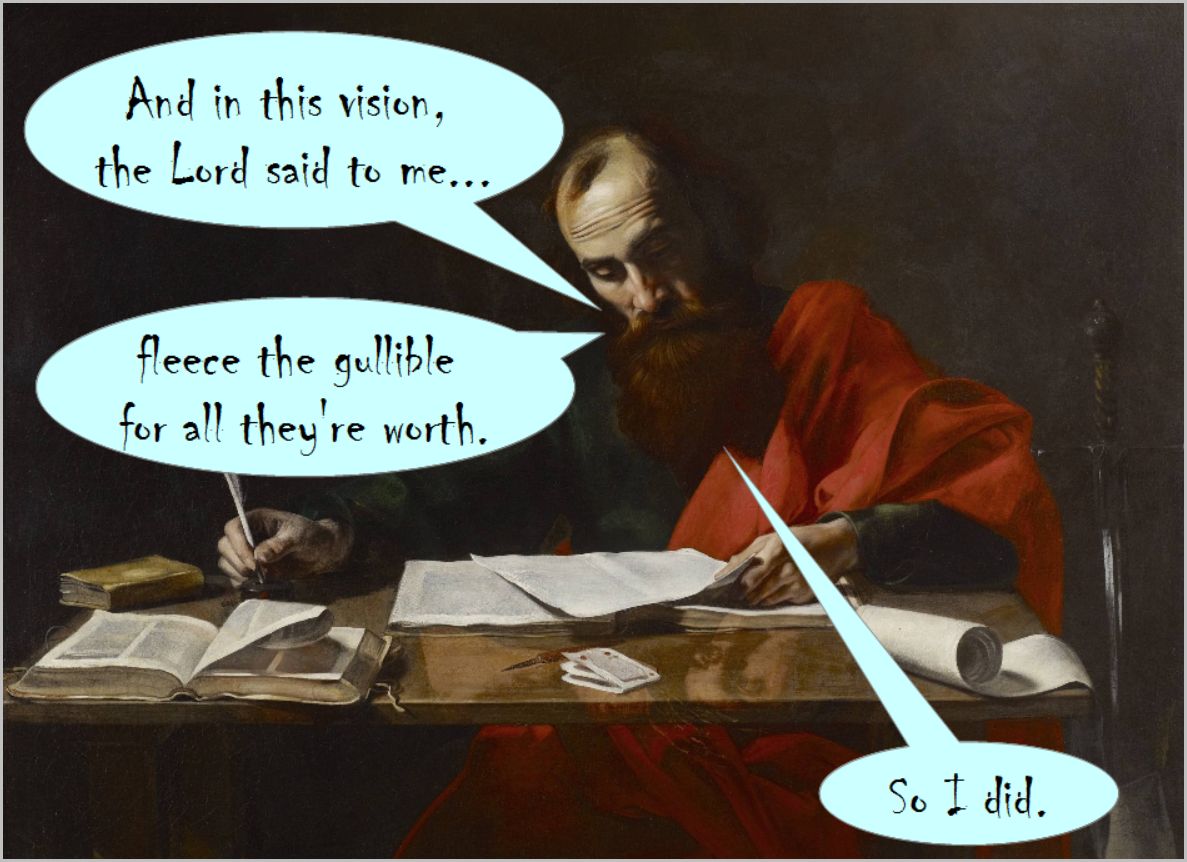
It was all just a dream…

Stone2Perry Stone, self-styled prophet, evangelist and teacher is of the view that God provides dreams and visions to his followers. He does this, apparently, when he can’t think of a better way of communicating them. Perry recommends that those on the receiving end of God’s special messages should immediately wake up and quickly write down what their dream was about. If they don’t, they’ll forget it! Who knew we can’t always recall dreams once we wake up? Who knows how to wake up as soon as a dream is over? Perry has big drawings made of his own God-delivered dreams. Here’s one. See if you can guess what it was about:

Stone1

Yes, it was a warning about 9/11. The Lord gave it to Perry, in a dream, long before the 2001 attack.

You can’t see it? You think five tornadoes and the monolith from 2001: A Space Odyssey look nothing like 9/11? Shame on you! You need to take this more seriously. You’re thinking, aren’t you, that Perry’s dream, if he had it at all, was down to the cheese he’d eaten before going to bed. That and a deranged mind.

But you’d be wrong; Perry knows for certain his dream was from God and that his interpretation is right on the mark. And who are we to doubt it? Curious, though, that even though the Lord had warned him about the attack in advance, Perry neglected to tell anyone about it. I wonder why that was? God must have wondered too – why he’d entrusted such an important message to a dimwit who did nothing with it. (Then again, if the Lord is capable of inducing dreams why didn’t he speak directly to the terrorists to prevent them from doing what they did?)

Still, good ol’ Perry’s made up for lost time since and is now more than happy to tell the rubes everyone about his dreams. And so what if it makes him a few million dollars? Frenetic Perry has a significant following on TBN and on his own web-site, which is where you can buy his dream-world DVDs for as little as $45 a set.

Nut-jobs’ dreams and visions have been at the centre of religious belief since forever. Dreams are significant, or so it’d have us believe, in the Old Testament where there are at least two dozen ‘important’ ones, together with advice about their interpretation (Job 33.15-18, for example). They’re quite a presence in the Qur’an too.

In fact, dreams and their waking equivalent, visions, are ultimately what religion is made of. They’re certainly what Christianity is made of; Joseph, the Magi, Pilate’s wife, Peter and Paul all have deeply meaningful dreams while Peter, Paul, John and others have visions which, they persuade themselves, can only be the monolith from 2001 Jesus returned from the dead, and other fantastic nonsense. The authors of the New Testament attached such importance to converts’ dreamy/visionary experiences that they had them written back into the Jesus narrative itself. That way it sounded like Jesus knew when he was alive that later fanatics would think they could sense his presence (especially when they whipped themselves up together) and could experience him in dreams and visions. Still today there are those who convince themselves they have a ‘relationship’ with him and can see him in their dreams, near-death experiences and other hallucinations. Just ask Perry Stone. It’s all real!

Well, as real as things entirely in the mind can be.

Same as it ever was…

Paul2

(Edited for clarity 2nd Aug)

Sweet and sour, nasty and nice

or, whatever happened to Luke 18.11-14?

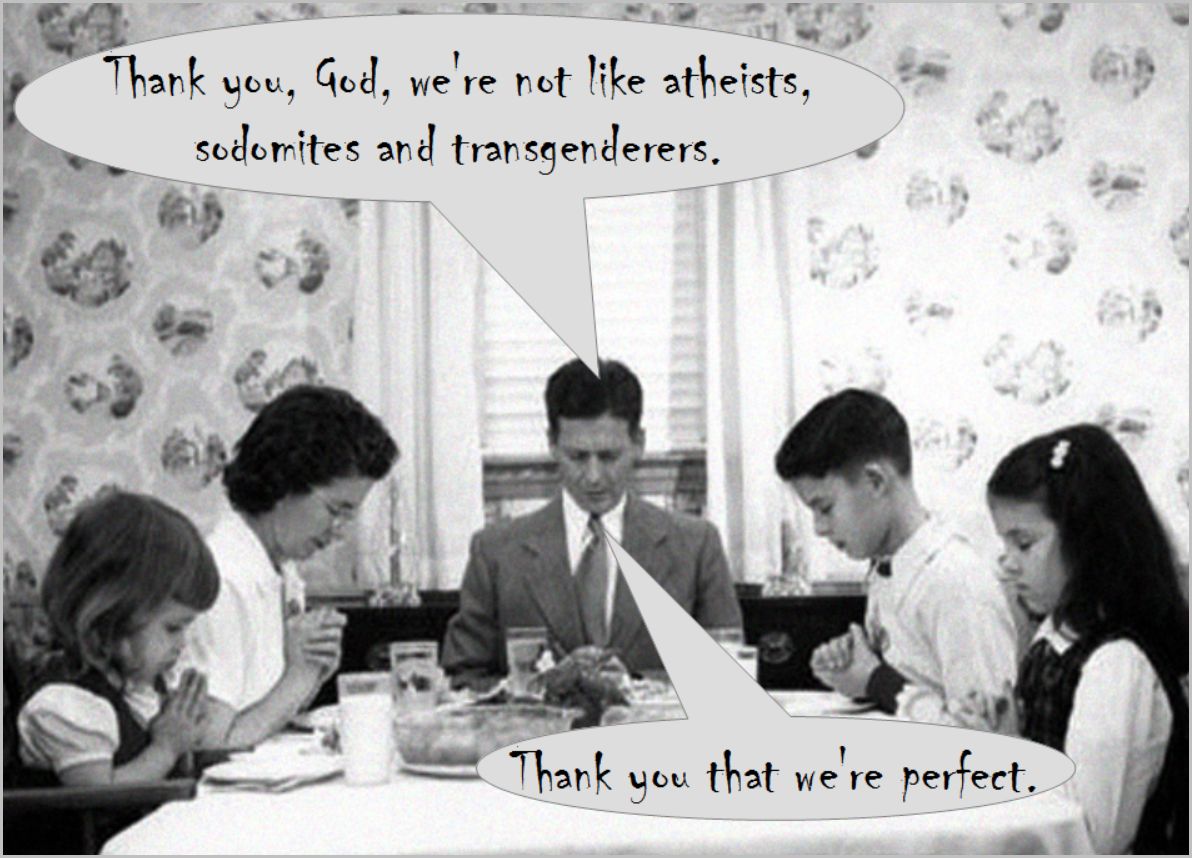
prayer2Why is it when people are emotionally blackmailed into becoming followers of Jesus, does their conversion make them sweet and sour, nasty and nice at the same time? The sweet and nice parts are what their new experience does for them. They get a new start of sorts, are introduced to like-minded friends in the church and become compelled to share their new joy with everyone else, whether they want to hear it or not, about how much they’ve changed because of Jesus. It’s nice for them. Deluded too, but if it makes them happy then why not?

This is why not. What they don’t tell you, not at first anyway, is how sour and nasty they have also become; how they must now defend God’s standards, because, as everyone knows, the omnipotent God of all creation is incapable of defending them himself. Being born again and morphing into ‘a new creation’ involves, without exception, becoming judgemental of others, condemnatory, inflammatory, bigoted and spiteful.

You think not? Then you haven’t heard what these same Christians think about abortion and women who have them. Homosexuality and those who are gay. Transgenderism and those born in the wrong body. Science and those who value evidence. Atheism and those of us who see through believers’ sad delusion.

Christians don’t, as some of them profess, hate the sin but love the sinner. They despise those who have philosophies different from them, those who live differently from them, those who are different from them.

A recent BBC poll asked if the world wouldn’t be more peaceful without religion. Here’s the results as of 14th July 2016:

Poll

I don’t know how many people this represents nor where they’re from – the site doesn’t say – but it would seem that most of us would think we would be better off without religion. It’s long past time we were able to be; religion has nothing to offer. It’s time we stopped giving it special treatment because some of it is sweet and nice. Its sour, nasty aspects are just as much a part of it, inseparable from whatever positives its adherents say it has. I’ll be looking soon at how we might push back against religion’s pervasive and poisonous influence in society.

Effective Preachin’ (Part Two)

Sheep

Reverend M. T. Vessal of the Church of The Raised Up here again, with the second part of my guide to Effective Preachin’. In case you missed it, repent! (The first part’s here.)

Now we’re really gonna get going, praise the Lord! The tools you’re gonna need for your talk proper are:

Lots of anecdotes (make up ’em up if you don’t know any true ones), specially ones about life- and-death situations. Stories about encounters with people on planes always go down well, as there’s always the chance the plane will too, and accounts of foolish follk who hear the gospel and ignore it, only to die in a terrible accident soon after.

Cod-psychology. That’s the stuff about God-shaped holes, how only Christ can forgive sin and meet all our needs, even though he doesn’t and never said he would. You can add something in here slagging off atheists and anyone else you disagree with.

Conviction. This is crucial. Sound as if you mean whatever it is you’re spouting. Sound as if you really know what the Bible says. Make it sound like it’s relevant and meaningful, even though it isn’t.

Modulation, otherwise known as shouting and dropping your voice. Shout when the argument is weak (and they’re all weak – you’re making this stuff up, remember)) and drop your voice almost to a whisper so that people know you’re being really, really sincere.

Drama. Pace up and down, like ‘Bishop’ T. D. Jakes, and mop your brow a lot. Wave your arms about, like Joseph Prince and show you really mean it. Maybe you could use props, like Beth Moore does, though you run the risk then of diverting the attention away from yourself. Better is to demonstrate what a cool guy you are, even if you’re not a guy, by sitting on the edge of the altar steps or, if you’re in a really cool church like Steve Furtrick’s, the Stage. This shows the congregation/audience just how cool you are.

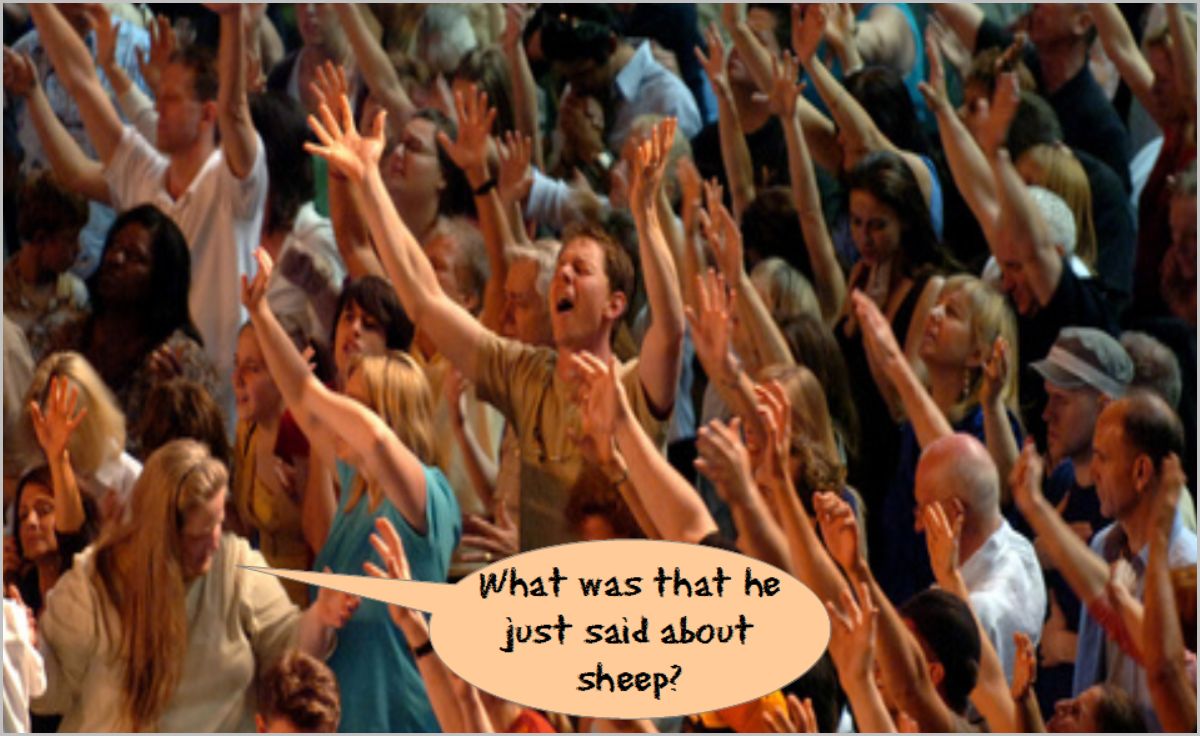
Whipped up emotion. This is optional but if you lay it on thick about what Jesus has done for the spiritually inferior, how their sin caused those nails to be driven in, then you’re on to a winner. Aim for some arm waving from ’em, babbling in jibberish speaking in tongues and maybe even some crying. Don’t forget to tell ’em that whatever they’re feeling is the Outpouring of the Holy Spirit. Definitely nothing to do with your manipulating their already fragile emotions. No sir. This here frenzy is divinely inspired.

Finally, get to the challenge bit of your sermon/talk/self-promotion. This can involve an appeal for money. Correction: this will involve an appeal for money. The God who supplies everything doesn’t supply money so you’ll need to lay a guilt trip on your fans/congregation to provide you with the cash to maintain your lavish lifestyle continue the Lord’s work. But it’s not only about money; remember to pressurise/inspire the congregation/audience/fans to go out and harrass their neighbours so maybe they and their wallets will come to church next week. As the Lord Jesus himself said, ‘the harvest is plentiful but the labourers are few’!

Above all, though, let everyone leave feeling that they’ve had a good time. Like kettles, they should have had a real great Outpouring and feel well and truly Blessed. Leave ’em feeling ready for more, same time, same place next Sunday.


Less religion, not more

Welby

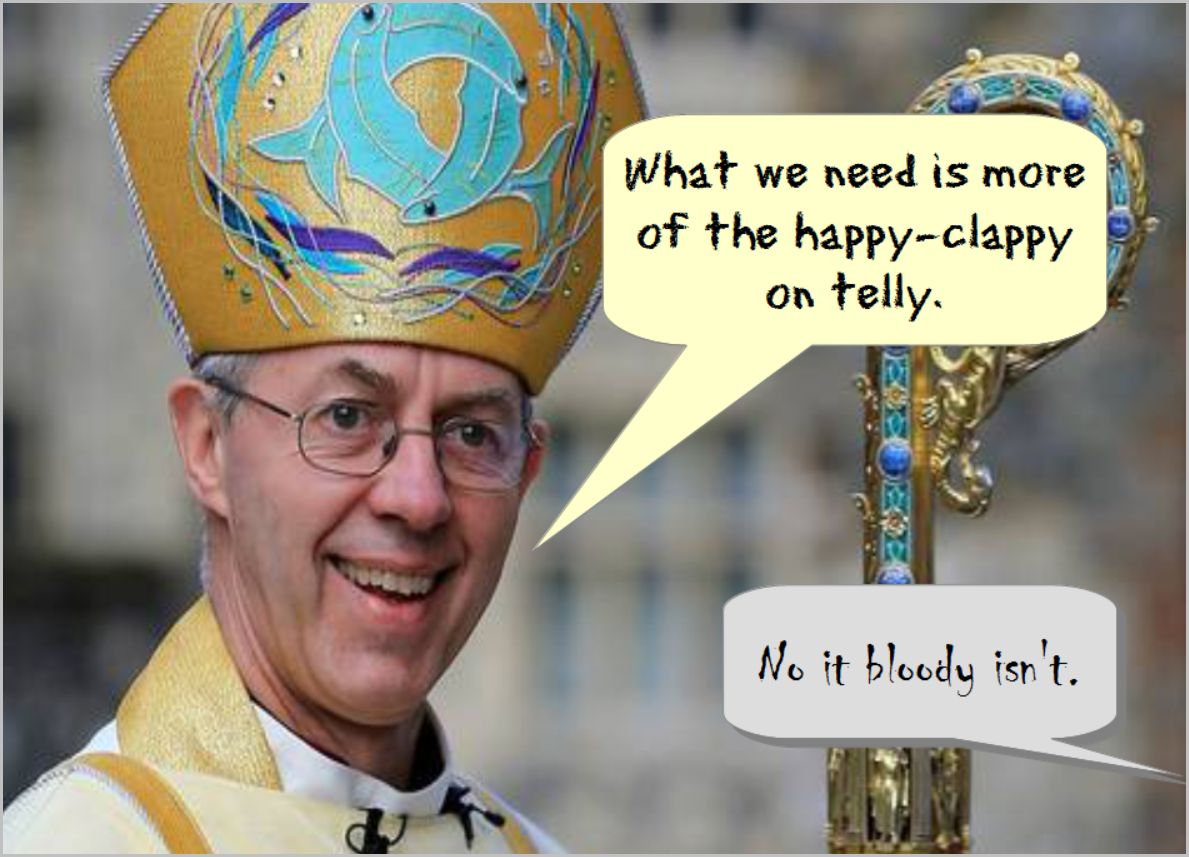
A bloke in a pointy hat and posh frock thinks there should be more religion on television and radio. Justin Welby, Archbishop of Canterbury, says that religion merits as much air time as politics, sport and drama.

The Archbish makes it sound like there’s nothing at all on TV and radio already about religion. In fact, in the last few months in the UK we’ve had a full schedule of Easter programmes; Simon Reeves’ The Ganges on BBC2 (looking at India’s religious heritage); Channel 4’s Unreported World and Dispatches, which regularly consider religious issues; Clare Balding’s trite Good Morning Sunday on Radio 2; the weekly broadcast of church services and daily Thought For the Day on Radio 4; the weekly dollop of worship on Songs of Praise on BBC1 and the 24-hour Christian ‘ministry’ of Trinity Broadcast Network and other God channels for those who just can’t get enough mumbo-jumbo.

Maybe that’s not as much as sport, but then there’s hardly anything on TV that has as much coverage as sport. (Bad news too for those of us with little interest in watching others running, jumping and hitting things; there’s even more to come in the shape of Wimbledon, Euro 2106 and the Olympics.)

Do we really want religion to have the same level of coverage? Are people really as interested in belief systems as they are in sport? Or music? Or art? Or comic book franchises? Even if there are, why is it up to television – the Archbish singles out the BBC as the broadcaster he thinks should indulge his fantasies – to provide it? Isn’t it, rather, up to churches, mosques, temples and other centres of superstition to promote their own particular brand of nonsense?

Make no mistake about it, this is what Justers is proposing; the promotion of religion – ‘religious literacy’ he calls it. He is not, we can be fairly sure, looking for programmes that are critical of religion (unless it’s other people’s). He wants, he says, to see more programmes that give us a better understanding of religious belief. What he means by this are proselytising programmes that create greater empathy for those who subscribe to delusion.

He isn’t advocating, for example, documentaries that explore the irrationality of faith, or ones that show the slap-dash, deceptive ways in which holy books came to be compiled or ones that demonstrate how most adherents to faith fail to live out its exacting demands. Nor is he suggesting programmes that focus on the appalling misery religion brings to some, or shows that give a sympathetic hearing to cults, sects and extremists. I would have no objection to programmes like these (except those that are sympathetic to extremists) because the ugly underbelly of religion deserves to be exposed, like Channel 4’s The Untold History of Islam of a few years ago, taken off air after its presenter was threatened with violence by those who didn’t like its critical perspective.

But these are not the kind of programmes the Archbishop is proposing. The religious literacy he wants us to have is of the cuddly side of faith, the supposed deep spirituality of the obsessive and what he regards as the positive contribution religion makes to the world; a one-sided picture already more than adequately covered by the nation’s broadcasters.

Thankfully, despite the recent political interference in the BBC, the Corporation is still required to present balanced and impartial views of its subject matter. If the Archbishop, who sits in the House of Lords and so is not without influence, is successful in forcing the BBC and other broadcasters to increase their coverage of his obsession, then we should also be able to look forward to programmes that are critical of religion too.

No broadcaster is obliged to promote religion nor to proselytise on its adherents’ behalf. Shame on the Archbishop, with his smiles and pointy hats, for suggesting they are.

Dear Christian

Christians

Dear Christian,

Jesus said treat others as you like to be treated (Matthew 7:12) so why do you treat them with abuse and unpleasantness?

Blog191(2)

Jesus said turn the other cheek (Luke 6:29) so why do you respond with insults?

Blog191(1)Jesus said don’t judge unless you want to be judged (Matthew 7:1) so why do you constantly judge and condemn?

Blog191(5)

Jesus said love your enemies (Luke 6:27) so why doesn’t it happen?

Blog191(11)

Jesus said don’t call anyone a fool (Matthew 5.22) so why do you call them far worse than that?

Blog191(4)

Jesus said don’t pray in public (Matthew 6.5) so why do you pray in public?

Blog191(7)

Jesus said sell all you have and give the money to the poor (Luke 18.22) so why don’t you?

Jesus said you cannot serve God and money (Luke 16.13) so why are some of you so obscenely rich?

CrouchHinn'sJet

Jesus said deny yourself (Matthew 16.24) so why do you indulge and promote yourself above all things?

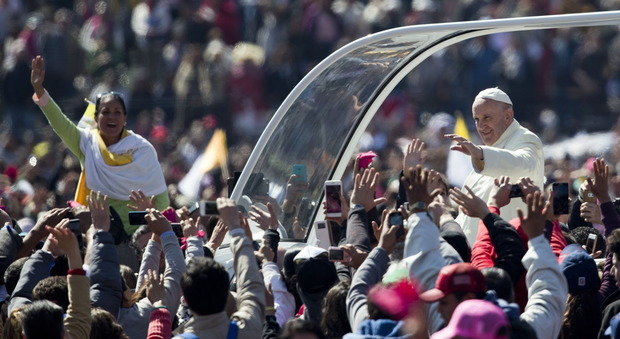
Blog191(8)OsteenPope Francis waves to the crowd, aboard the popemobile in Mexico City's main square, the Zocalo, Saturday, Feb. 13, 2016. Pope Francis kicks off his first trip to Mexico on Saturday with speeches to the country's political and ecclesial elites. The pontiff's five-day visit will include a very personal prayer at the Virgin of Guadalupe shrine. (AP Photo/Moises Castillo)

Jesus said ‘be perfect’ (Matthew 5.48) so why don’t we see you trying?

Sick

Jesus asked why you call him ‘Lord, Lord’ and yet don’t do what he tells you (Luke 6.46). Evidently he didn’t understand, as you do, just how many of his commands are optional. Thank goodness you know better than he did.

There’s good news and there’s good news…

Bat-Jesus

Mark, Matthew and Luke all tells us that Jesus preached the gospel when he was alive (Mark 1.14-15; Matthew 4.23, 9.35 & 10.5-7; Luke 20.1). So what was this gospel? What was Jesus’ ‘good news’? He had yet to die so it couldn’t possibly have been ‘you can be saved through my death and resurrection’ because this magic formula had yet to be arrived at by those who came later. Nor could it have been ‘accept my substitutionary atonement whereby I take the punishment you deserve in order to restore your relationship with God,’ for much the same reason. Nor could it have been, ‘you must accept me as your personal your saviour if you want to gain everlasting life in Heaven,’ because he didn’t regard himself in this way and he didn’t, according to the synoptic gospels, offer an eternity in Heaven. No, Jesus’ good news could not have been any of these because they are all later developments, mumbo-jumbo invented about him by others, not things he said himself .

Actually we needn’t speculate on what the good news was that Jesus preached because the gospels tell us: God was going to intervene in history very soon, rescuing his people from Gentile rule and setting up his Kingdom, in which he, Jesus, would be judge and king (Matt 24.27-34 & 25.31; Luke 1.33; 21.25-28). People, he said, referring only to Jewish people, should prepare themselves for this coming Kingdom by mending their ways (Matthew 10.5-6).

How soon would all this happen? In the lifetime of his hearers according to Mark 9.1, Matthew 16.28 and Luke 9.27, maybe even within a few weeks or months. When sending out the disciples to spread his good news he promised them, ‘you will not have gone through all the towns of Israel, before the Son of man comes (to usher in the new Kingdom)’ (Matthew 10.23). We can only assume that the disciples are back by now – in fact they return a few verses later – yet the Son of man still hasn’t materialised among the clouds in full view of ‘the tribes’ of the Earth (Matthew 24.30).

As the Bible records, Jesus was wrong in every respect; God did not set up his new Kingdom within the lifetime of those Jesus spoke to; the Son of man did not appear; the Romans were not overthrown; Jesus was not appointed judge and king of the world. The sarcastic inscription on his cross, ‘King of the Jews’, was the closest he came to having his self-aggrandising prophecy realised.

Is this the Jesus that Christians worshipped subsequently and still worship today? It ought to be as he’s the one revealed in the first three gospels. But the Jesus believers carry around in their heads is not this man. The ‘Jesus’ worshipped by Christians is primarily a construct of Paul’s – his ‘Christ’ – and their own collective imaginations. The mythical ‘Christ’ that Paul ‘did not receive from any man’, has replaced and almost obliterated Yeshua and his mistaken beliefs about the coming Kingdom (though Paul held on to the idea that it was indeed imminent; see 1 Thessalonians 4.15-17).

Admittedly ‘the Christ’ has had a far better shelf-life than Yeshua could ever have had on his own; the continual resurrection of the idea in the minds of believers – and only there – has ensured the perpetuation of the myth. When all is said and done, however, the Christ is nothing more than an imaginative recreation of a failed zealot with an altogether different gospel.* Yeshua’s good news of the Kingdom died shortly after he did and like him has stayed dead, its echoes preserved by Mark, Matthew and Luke and ignored by Christians everywhere.

* I’m aware there is a body of thought that gives primacy to the mythical god-man, ‘the Christ’, with the Jesus stories being seen as a later ‘in-fill’ designed to provide him with a plausible back-story. I’m not convined of this for several reasons, which I’ll explore at a later date.

Are You Doing What Jesus Christ Says?

Billboard

Dale McAlpine, sometime commenter here and fanatical street-preacher in these parts, has posted a tasteful little video on his web-site – that’s the smugly named Repent.com if you’re interested – called Are You Doing What Jesus Christ Says? Take a look at it over on Repent.com or on YouTube; it’s ludicrously melodramatic and wonderfully over the top. You’re sure to enjoy its typos and spelling mistakes too.

What’s remarkable about it apart from these things is that, despite its title, it makes little reference to what Jesus is supposed to have said. Instead, it’s all about how you’ll go to hell if you don’t repent and accept him as your saviour; but Jesus never said this. It says you’re a ‘vile, wretched, hell-deserving son or daughter of Adam’ – Jesus didn’t say this either. It also insists you should let his cross ‘disrupt the very centre and citadel of your life of self’ (whatever that means) and guess what? This wasn’t part of Jesus’ teaching either. In fact, none of these claims were part of his ‘good news’.

Of the things Jesus did say – go the extra mile, sell all you have to give to the poor, turn the other cheek, avoid judging so you won’t be judged, give to all who ask, give away your shirt as well as your coat, feed the hungry, visit the sick, clothe the naked and love your enemies – the video makes no mention. Funny that. Maybe that’s why we don’t see Christians doing them very often.

So, Christians – and Dale too – are you doing what Jesus said or are you, like the video, only interested in pointing out others’ supposed sins and shouting about how they need to join you in your delusional mumbo-jumbo?

Yes. Thought so.

The Stuff Christians Say… (part three)

DoorToDoorAtheists are aggressive/militant/unreasonable: The Christians might’ve got us on this one. After all, it is incredibly irritating when we atheists start preaching in the town centre or invade others’ events to tell them what to believe or dish out loony pamphlets or turn up at people’s doors when they’re just about to have their tea. And what about all those meeting places we have, on just about every corner of the city, with smart-arse posters about Adam and Steve on the board outside? And let’s not forget our readiness to blow up ourselves and others in the name of our great cause. Now that’s ‘militant’! Yes, we atheists really do have too much freedom to push our views on others. No wonder we’re so insufferable. (Note to self: check you’ve got this right.)

It takes more faith to be an atheist than a Christian: It takes no faith to recognise there are no supernatural beings. It takes no more faith not to believe in God – or to acknowledge that there is no God to believe in – than it does not to believe in Santa Claus, Poseidon or Ra. Christians themselves require no great abundance of faith to dismiss these characters. Is it so difficult to understand that atheists disregard the Christian pantheon of fantasy figures in exactly the same way? Or are believers practising their dishonesty-for-Jesus again? There is no faith involved in being an atheist. On the other hand, believing in an omnipotent but suspiciously inactive God, a super-hero Saviour, a magic Spirit, angels, cherubim, seraphim, demons, Satan, resurrected saints, Heaven, Hell and all manner of powers and principalities – this requires faith in delusional quantities. No atheist could possibly compete. Nor would they want to.

Do No Harm

sermon2

If religions took ‘do no harm’ to heart (as the Hippocratic Oath does) and their adherents were made to comply with it, what a better place this world would be. There’d be –

No more religiously-motivated suicide bombers and terrorist atrocities;

No more murder in the name of the Lord (whichever);

No more children molested by priests and pastors;

No churches attempting to cover up their crimes;

No more child deaths as a result of ‘faith-healing’;

No religiously-sanctioned denigration and abuse of women;

No more ritualistic mutilation of children’s and young women’s genitals;

No more religious scams and shams;

No more religiously-inspired vitriol directed at gay and transgender people;

No more barbaric executions of ‘minorities’, like gay men, women and those of other faiths.

Of course, even without these, the world would still not be perfect. Awful things would still happen. But the principle of doing no harm would eliminate much of the trauma inflicted on people by the proponents of irrational superstition.

On paper at least, the Abrahamic religions have expectations that are more demanding than simply doing no harm:

Love your neighbour as yourself (Leviticus 19:18; Judaism);

Love your enemies; treat others as you would like to be treated’ (Matthew 7.12 and 5.44; Christianity);

…compete with each other in doing good (Surat al-Ma’ida, 48; Islam).

However, these are just too damned hard for so many religionists. They disregard them and opt instead for the spiteful paranoia of the same holy books. Perhaps the simpler injunction of ‘do no harm’ would be easier for them. But until the preachers of judgement and hatred find it in themselves to promote such a principle, we will all continue to suffer the destructive effects of the ‘great’ faiths.

So, how long until the next terrorist attack? The next church child-abuse cover-up? The next rape scandal? The next persecution of gay people?

      Not long at all.

           Praise the Lord (whichever)!


God’s Ache

 TBNI was going through my nightly ritual of channel-hopping before going to bed the other night when I lighted on a station called ‘TBN’. ‘TBN’, for the uninitiated, stands for ‘Trinity Broadcasting Network’. It is managed and operated by a posse known only as the Father, Son and Holy Spirit. No-one else is involved. These three have decided the best way to get the word out to the masses is to do it on the TV, which, I suppose, beats the old-tech approach. I mean, who reads books these days?

The Father, Son and Holy Spirit Collective was evidently having a night off and had delegated the job of running the station to an ordinary mortal (whose name I was sure I’d remember but have already forgotten). This chap was telling everyone – I say ‘everyone’ though he was standing in an empty attic – just how much God loves us and yearns to heal us. That was his word, ‘yearns’, which means to desire strongly or to ache to do something.

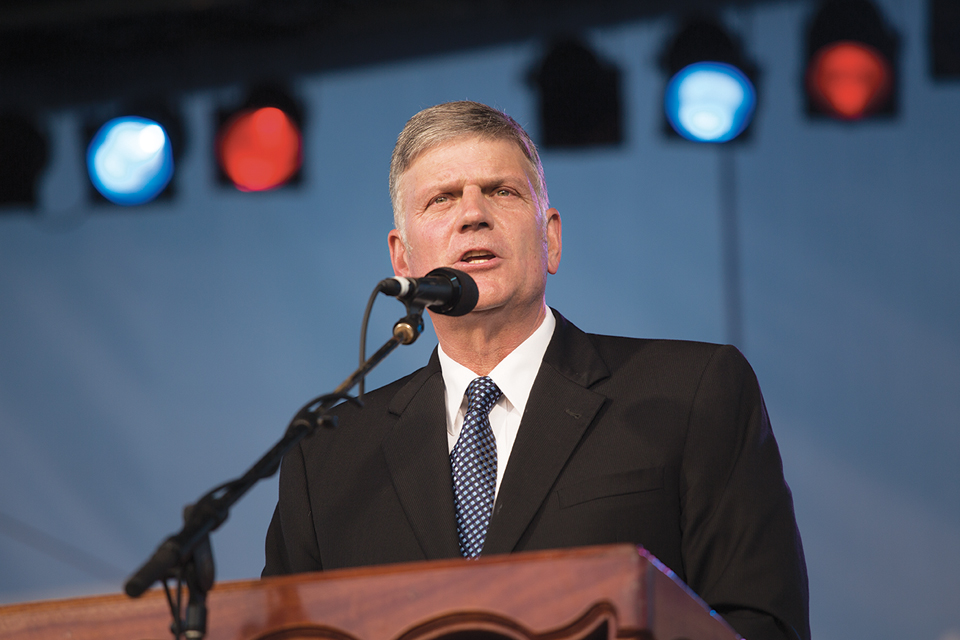
And I found myself wondering why he doesn’t – heal us, that is. I’ve already shared my thoughts on the Godhead’s abdication of any hands-on demonstration of his love, but if this bloke was right and God really does want to heal us – then why doesn’t he just get on with it? He could post a big miraculous sign in the sky saying ‘Hi. It’s me, God. I’m doing all this, the healing you’re seeing all over the world,’ so everyone would know it was him and not aliens or some super-advanced scientists who’d travelled back from the future. Or – even better idea – he could have it broadcast on his very own TV station. If he’s not available to do it himself, what with all his preparations for the miracle-to-end-all-miracles, he could get one of those Holy Joes who’ve got a direct line to him to announce it for him. Franklin Graham maybe, or Jan Crouch, who could have her hair roughed up specially:

Starting tomorrow at 12.00 the Lord God Almighty will be curing every illness, healing every psychological and physical ailment and eradicating all illness, just like he said he would way back when (in Isaiah 35.5 and Matthew 11.5 if you’re interested). Okay, he’s a little behind schedule but he’s been busy and, well, better late than never.

Something like that.

If the Lord doesn’t care for either of these splendid options then surely he can come up with a better alternative; according to his human mouthpieces, he sends storms and earthquakes when he’s unhappy, so he could easily conjure up something nice for a change. He’s a creative sort, after all. Not to mention omnipotent.

Now I know there are a couple of theological flies in the ointment that would make all of this difficult for him. The first is Kryptonite. Or human sin… one or the other. But he could obliterate this at the same time, couldn’t he; make us all perfect first then the Kryptonite couldn’t harm him while he’s busy fixing us. I know, you’re going to tell me this would be an infringement of our free-will. But there’s nothing Biblical about free-will. God’s never been keen on it, preferring instead to choose his buddies up front, and in any case, he’s going to eliminate it completely once they’re all taken up into Heaven. So it really wouldn’t hurt him to make some sort of decision about it now. With free-will gone he could just get down to the business of making us all better, not forgetting to take credit for his work in one of the mysterious ways I’ve suggested.

‘What’s in it for God?’ I hear you ask. Well, my tele-evangelist failed to say, but I can think of at least three benefits: 1. He’d get over his ache. Instead of just yearning to do something about disease he’d have actually done something and this would make him feel a whole lot better about himself. 2. He wouldn’t have to worry about Kryptonite any more. 3. He’d have lots of new friends that he wouldn’t then have to consign to Hell.

To be honest, I can’t see why God hasn’t done something like this already. His first idea, to bully a load of ancient tribesmen into submission, didn’t work so well and Plan B just ended in tears. Let’s face it, it wasn’t the greatest of ideas. This though is a far better option. So if you’re listening God, it’s yours, gratis.

                        God?

                                      God?