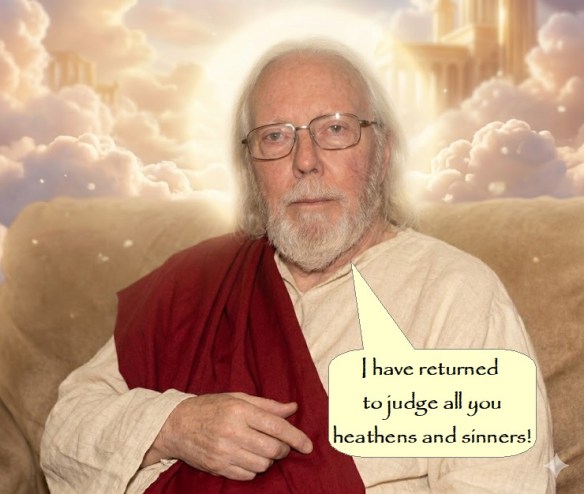
The Real Jesus

Dear Christian,

When you became a Christian, did you meet the man who wandered around Galilee 2,000 years and who, according to ancient stories, died on a Roman cross? Was it an actual human being you met at the moment you ‘saw the light’ (the clue’s in the term)? Or was it something – an emotional experience perhaps – that you interpreted as the presence of a heavenly, supernatural being? If you’re honest you’ll acknowledge you didn’t meet a real person but felt something that you took to be one.

When you pray to Jesus, exactly who are you praying to? Is it the man who drifted around Galilee 2,000 years ago? Are your thoughts magically transported back in time so he hears you, somehow or other, in his head? No? So do you pray to a supernatural, celestial Jesus who for the past 2,000 years has been sitting at the right hand of God in a mythical never, never land? I’m guessing you’ll say this is the Jesus you commune with (while disputing my calling heaven never, never land).

When you worship Jesus are your honeyed words whisked back 2,000 years to sustain a man who meandered around Galilee spouting profundities before getting himself killed? Or do you envisage your prayers reaching a supernatural figure living out there in space or maybe in another dimension? (C’mon, you know it’s the latter.)

When you say Jesus was present at the creation of the world as described at the start of Genesis, do you mean the man who, billions of years later, would roam around Galilee? Or do you mean a celestial  Jesus who was a part of the Godhead in some mysterious, inexplicable way? (I’m guessing, again, it’s this latter.)

When you say Jesus will judge the living and the dead at the End of the Age, do you refer to the man who lived 2,000 years ago, trudging around Galilee? Or do you mean some mystical manifestation of this character who’s eager to separate the sheep from the goats while hovering in the sky prior to massacring the goats? (It’s this version, isn’t it.)

In the Bible, did Paul meet the flesh-and-blood man who had slogged around Galilee a few years earlier? Or did he hallucinate a celestial being as a flash of light? (It was the latter, wasn’t it.)

When you speak of the Jesus who died on the cross to save you from your sins, do you quote the individual who supposedly drifted round Galilee 2,000 years ago? Or do you more often reference Paul, who never met him and knows nothing of his supposed earthly life? (You know which.)

Yet despite your belief in mystical, spiritual versions of Jesus, you are adamant he was not a mythical being. Not at the start of time, not at the end, nor in Paul’s writings; not in your own conversion, not in your prayers or worship and especially not in your own inner experience of him. No, he was, according to you, a very real person.

Yet there are no signs you believe in this historical Jesus, the man who allegedly roamed around Galilee two millennia ago. You ignore him and his teaching if favour of a celestial superman. How do we know you ignore him? All the examples above for a start, but there’s also the way you don’t do what he says. You don’t love your neighbour and enemies alike, you don’t sell all you have to give to the poor, you don’t give to everyone who asks, you don’t despise riches, you don’t refrain from judging others. You rarely turn the other cheek or go the extra mile and you are not prepared to forgive endlessly. You don’t accept that this man believed the End of Age was coming in his own time (or at least that his script-writers did) nor that he was disastrously wrong. It’s the cosmic super-being you go for every time.

How very strange. Cognitive dissonance is a powerful phenomenon, don’t you think?

The Day After The Rapture

Are you still there?

Either the rapture didn’t happen or there aren’t many True Christians round where I live. I watched all day for them jetting into the sky to meet Jesus but didn’t see a single one.

What went wrong? That South African preacher Joshua Mhlakela who saw Jesus surely can’t have been mistaken. Jesus told him clearly that yesterday, or maybe today, would be when he’d be back to collect his Chosen and judge the great multitude of sinners. I even turned on the TV last night to see if it had happened elsewhere. I thought the Final Judgement was underway with some dude ticking off the UN. Turned out just to be some big orange guy, not Jesus in disguise.

So what now? I think I can guess. Jesus’ message to Joshua Mhlakela will be reinterpreted: it wasn’t that the Rapture was going to happen yesterday, or today. It’s the events leading up to the rapture that he promised would kick off this week. That’ll be it. The Rapture itself is still some time off, as it always is.

Mhlakela’s vision of Jesus was no different from the ones the earliest Christian believers had: those character with fake names like Peter and Paul. Dismiss the good pastor’s vision of the Lord and what JC purportedly said and you have to dismiss the visions of those early fanatics who operated under aliases. Visions, dreams and hallucinations have no bearing on reality, as Mhlakela and the thousands who believed him have demonstrated yet again. Christianity and many other faiths are founded on such imaginings. As Luke puts it in Acts 2:17 during ‘the Last Days’ of 2,000 years ago:

And it shall come to pass in the last days, says God, that I will pour out of My Spirit on all flesh; your sons and your daughters shall prophesy, your young men shall see visions, your old men shall dream dreams (misquoting Joel 2: 28-29)

This is the basis of the Christian delusion, and every other.

I Wish We’d All Been Ready

Holy cow!

This is a special, urgent post!!! I just learnt to today, courtesy of Joe.My.God that tomorrow is the date set for the Rapture. In case you didn’t know, I need to warn you to give you time to repent and turn to Jesus. We know the rapture’s going to happen this time for sure because a pastor in South Africa was visited by Jesus a couple of nights ago who told him he was definitely returning tomorrow, 23rd September, at the time of the Jewish Feast of Trumpets (me neither). Charlie Kirk’s martyrdom has something to do with it too:

I’m sure these three signs together can’t be wrong, which means the Rapture is going to happen tomorrow as an absolute certainty.

Here’s how the UK’s always reliable Daily Mail reports it:

An ancient Biblical event in which Christians disappear from Earth and those who remain are left to face Doomsday is believed to be just days away.

Claims by social media users, as well as respected pastors and rabbis, have pushed the idea that the Rapture will begin on September 23, marking the Second Coming of Jesus and Judgment Day for non-believers.

This year, September 23 falls during the Jewish Feast of Trumpets, also known as Rosh Hashanah, but some Christians have tied the holiday to the prophecy that Jesus will return to Earth ‘with the voice of the archangel and with the trumpet call of God.’

The prophecy is mentioned in the Bible, 1 Thessalonians 4:16, which states that even the faithful who have died will rise from their graves and be taken to heaven by Jesus; however, a date for this event is not given.

In a YouTubevideo viewed nearly 500,000 times, Pastor Joshua Mhlakela, a South African preacher, claimed Jesus appeared to him in a divine vision and said he would return during the Feast of Trumpets.

‘The rapture is upon us, whether you are ready or not. I saw Jesus sitting on his throne, and I could hear him very loud and clear saying, I am coming soon,’Mhlakela said during the interview with CettwinzTV.

‘He said to me on the 23rd and 24th of September 2025, I will come back to the Earth,’ the pastor declared.

Even more clips predicting the imminent return of Jesus this month have been viewed hundreds of thousands of times in the last week alone.

If you can’t find it in yourselves to welcome Jesus into your hearts as Lord and Saviour then you’ll have to gird your loins for what happens next. Something dire I feel sure. Judgement and a millennium of despair or some such. It might not be too bad though, once the Righteous Ones are out of the picture.

Whichever, I’ll see those of you who are still around come Wednesday when we can discuss what we’re gonna do!!! This blog isn’t going to be of much use any more, that’s for sure. Those of you who’ve decided to head heaven-bound meanwhile, enjoy the trip and don’t forget to write.

More Daft Things Christians Say

Image from a video by Intimacy With God, available here. I don’t recommend it.

In this season: a new favourite of evangelicals.

Though it is biblical (2 Timothy 4:2), what the hell does it mean in the mouths of today’s Christians? Here it is used to excess in the FreshPerspective blog: 

God is shifting his faithful sons and daughters into new seasons. But before I divulge into the signs, understand that everyone is called to different seasons. Some are being released into a season of exposure (platforms, opportunities etc), some into a season of preparation (preparing for a new season), and some into a wilderness season (a time of God pruning you, deliverance from past sins and behaviors before you enter a new season). So don’t be discouraged when it seems like you’re not where everyone else is. Seek God, pray and receive his wisdom and knowledge for what season you’re in.

It’s meant to sound profound, but there’s nothing profound about it. It’s pretentious, meaningless twaddle. Bob Dylan said it far better when he sang, ‘the times they are a-changing’. Things change; they continually evolve. Likewise our personal circumstances. God isn’t blessing, releasing, pruning or preparing you. Nor has he any great plans for you or the church. (Why? Because he’s not real.)  

Thoughts and Prayers/I’ll pray for you

Thoughts and prayers are always proffered when disaster strikes. The ‘thoughts’ I understand; when a long-distance friend lost her daughter to suicide a couple of years ago, I wanted her to know I was thinking of her and was ready to listen if she wanted to talk. She told me later that it was comforting to know that friends were thinking of her and were around if she needed them. I don’t think she said this just to make us, the friends, feel better. Such painful circumstances pare away insincerity.

There’s often not much more we can do beyond thinking about others when they are suffering like this. There are circumstances of course when we can offer more practical help, but adding ‘prayers’ to any expression of concern is lazy and glib. Prayers are of no use to anyone in distress or despair because prayers are, in any context, of no use, period. There’s no God out there, up there or inside us listening to our inner pleading. Even if there were, he is, according to his personality profile in the bible, so capricious and unheeding that he would do nothing to alleviate suffering. Neither would he step in supernaturally to remedy the terrible situations humans find themselves in. If he was even remotely concerned, he wouldn’t allow these to happen in the first place. Little point then in asking him to help with any mess he’s helped created, either intentionally or through disinterest.

But as I say, there’s no God so we need not trouble ourselves trying to work out what he’s playing at. Nor do we ever need the sanctimonious promise of prayers that will probably never be said. It doesn’t matter whether they are or not, so please, True Believers, can we dispense with  the cant?

The Daft Things Christians Say (the Sequel)

The return of an old favourite (of mine if no-one else’s)!

Dennis and I were in the States a couple of weeks ago and had the dubious pleasure of watching American news channels. I noticed on more than one, the presenters signed off with ‘God Bless’. As well as undermining what little objectivity they have left, the phrase rang hollow and made those using it, for whatever reason, as vapid and insincere.

It’s a phrase that many ordinary Christians and the nominally religious use (a waitress serving us lobster also came out with it, as if the lobster would magically be granted extra flavour.) It seems to me it’s a remnant from the days of incantation and magic. ‘May God bless you’ as opposed to ‘Let the devil smite thee’ or some such. ‘Goodbye’ has survived from these times too, originally ‘God be with you’, and is equally meaningless. Meaningless because if a God existed he would presumably be with you if he felt like it, or not as the mood took him. Attempting to summon his presence with an incantation of well-wishing is hardly going to influence him. Similarly with ‘God Bless’. Doesn’t the Bible say that God blesses whom he will (Romans 9:18)? No imperative will change that. Might it make the declarer of God’s presence of blessing feel more smugly self- righteous while the intended recipient might feel better, he or she convincing themselves they are actually ‘blessed’? Maybe, but God would have nothing to do with either state of mind.

Likewise that magic phrase Christians like to add to the end of prayers: ‘we ask this in Jesus’ name’. Will God not listen to their supplications if they don’t add it? Will he grant their requests if they do? I think we all know the answer. Why should it make any difference to Almighty God whether they add magic words to their pleas? If it does, what sort of God is it who must have exact words used, like a Hogwarts spell? The addition of a ‘just’ before the word ‘ask’, meaning ‘this is really a modest little request, your worshipfulness, we don’t want to bother you,’ doesn’t make it any more meaningful. From within the faith, as without, the phrase couldn’t possibly make any difference, apart from possibly allowing the supplicant feel better, more self-satisfied, like the child who adds a pretty picture to the end of their writing. ‘We (just) ask this in Jesus’ name’ another empty and vacuous magic spell.

But Some Doubted

We know that all the accounts of the resurrection appearances are inconsistent, incompatible with each other and read like visions or hallucinations. If that’s not enough there are two aspects of the stories that are delivered almost as asides that give the game away.

Matthew 28:17 records that

…the eleven disciples went to Galilee, to the mountain where Jesus had told them to go. When they saw him, they worshipped him; but some doubted.

Meanwhile, in a completely different set of resurrection appearances, Acts 1:3 claims that

After his suffering, (Jesus) presented himself to (his chosen apostles) and gave many convincing proofs that he was alive. He appeared to them over a period of forty days and spoke about the kingdom of God.

These verses from Matthew and Acts are almost always overlooked by true believers. In the Matthew passage we have a number of the eleven remaining disciples doubting that what they were experiencing was the resurrected Jesus. That’s the same disciples whom the gospel tells us trailed round the countryside with him listening to him as he regularly predicted his death and resurrection. Yet when the resurrection happened (spoiler: it didn’t really) they doubted that what they were seeing was Jesus.

How can this be? Did he not look himself, as in the other tall-tales of his reappearance? Was he so changed he was unrecognisable? If so, how did anybody recognise him? That’s the trouble with visions and apparitions: they’re just not clear or convincing.

Luke, meanwhile, extends the time that Jesus spends with his followers from a day or so in his gospel to 40 days in Acts. This is when Jesus offers the ’many convincing proofs’ that he is the Messiah and has survived death. This really makes no sense at all. As I asked in a previous post (slightly edited here) –

By ‘many convincing proofs’: what does this mean? That he had to prove he’d come back to life? Couldn’t his old chums see that for themselves? Couldn’t they recognise the man with whom they’d spent the last three years (allegedly)? Or if they could, weren’t they convinced he’d returned from the dead so that he felt the need to prove it? And how did he prove it? With a death certificate? By letting them poke his holes? And this took forty days?

Isn’t it more likely they were subject to group hysteria and some sort of hallucination (they’d had hallucinations before – see Matthew 17:1-9) and they then had to convince each other that what they’d experienced was really Jesus?

This is what was really going on: it took those who’d hallucinated seeing the heavenly Messiah a significant amount of time (what ‘40 days’ actually means) to concoct what they thought proved their visions were real. Like Paul (perhaps copying him), they found this ‘proof’ in the ‘prophecies’ of Jewish scripture.

This is the ‘many convincing proofs’ Luke refers to. No resurrected god-man spent 40 days offering evidence from scripture that he was really back from the dead. The visionaries themselves came up with it. Unfortunately for them, relying on shaky exegesis and misapplied passages from ancient texts is no proof at all.

Try telling that to Paul and the gospel writers though. All of Christianity rests on the visions of a few and the ‘many convincing proofs’ from scripture that persuaded them that what they’d experienced was really the Messiah, manifested in all his glory.

We’re talking a faith built on sand indeed. No wonder those sensible early disciples doubted every part of it.

Spiritual Forces of Evil in the Heavenly Realms

Original AI image from Night Cafe 

For our struggle is not against flesh and blood, but against the rulers, against the authorities, against the powers of this dark world and against the spiritual forces of evil in the heavenly realms. (Ephesians 6:12)

…you followed the ways of this world and of the ruler of the kingdom of the air, the spirit who is now at work in those who are disobedient. (Ephesians 2:2)

the prince of this world now stands condemned. (John 16:11)

The first-century worldview of early Christian cultists was that somewhere above the Earth a battle raged between God and Satan. The powers of darkness – the devil and his demons – had in ages past launched an attack on the Lord and his angels. This war in the spiritual realm continued unabated up to the time when a cultist wrote Ephesians, pretending to be Paul. Paul himself had already alluded to Satan as the god of this age (2 Corinthians 4:4), while the authors of the fourth gospel would later refer to him as the archon – ruler and prince – of this world (John 12:31; 14:30).

Which just goes to show how the Almighty God they believed in was nothing of the sort. He had tussled with his arch-enemy for eons without quashing his rebellion and putting an end to his persistent attacks. The stand-off had gone on for millennia, and, according to today’s Christians, is still happening. A puny god it is who cannot get the better of one of his far less powerful creations.

And what are God and Satan fighting over? Us, apparently. The devil wants control of human beings.

Why? Who knows. In fact, according to Paul, Satan already has control over us. He enslaves us to sin, which in turn leads to death (Romans 5:12, 6:23). 

Not to worry though, Paul, fake Paul and the fourth gospel writers assure us that their enfeebled God has a cunning plan! He’ll allow a being who is precious to him – like a son, in fact – to be sacrificed so that anyone who believes in him will no longer be enslaved to Satan and sin and will be granted eternal life. How’s that for special magic!

Who shouted out from the back that that sounds like a cop-out? It’s a fantasy bordering on the insane. Like it or not, we are somehow embroiled in heavenly warfare, specially if we’re of the number who’ve bought into this malarkey.

While we’re at it, have you noticed how so many of the wars and skirmishes currently afflicting the world have religion at their heart? YHWH is scrapping with Allah, Allah is up against the Great Satan while Jesus – no stranger to war-mongering himself – presides over it all, leading the world to Armageddon and his own ultimate ‘return’.

Here’s my suggestion. All the gods and demons need to get their act together. They should agree to an ultimate slug-fest, a final battle in the spiritual realm to decide who’s really the Supreme God – the last deity standing – and leave us humans out of it entirely. Surely, being gods, they’re up for finding out who can piss furthest up the wall.

A preposterous idea? Of course it is. None of these fantasy beings exist. There’s no YHWH, Allah, Heavenly Father, Jesus, Krishna, angels, archons, Satan or ‘spiritual forces of evil’ to duke it out. There’s no ‘heavenly plane’ where they can get to it. Everyone of these despotic characters is a human creation, as are the wars, disputes and skirmishes they underpin. It follows that none of them can be the supreme god and certainly none of them are worth fighting over. It’s time we grew up and put away all of our childish imaginary tyrants.

Dear Christian…

I’m seriously considering converting but need some help figuring what I should believe. Can any Christians out there help me out?

1. As a Christian, what will happen when I die? Will I –

a) Go immediately to heaven like my pastor says;

b) Go into suspended animation until Christ’s coming and the final judgement, as it says in 1 Thessalonians 4:13-16;

c) Just cease to exist like my atheist friends tell me?

2. Can you clear up for me how long was Jesus in the grave?

a) Was it about 36 hours (Friday evening till early Sunday morning);

b) Three whole days like he predicts in Matthew 12:40;

c) Was he not really in the grave but down in hell like it says in the Apostles’ Creed?

3. Where can I find information in Paul’s letters about

a) Jesus’ miraculous birth;

b) Jesus’ parables, teaching and miracles;

c) The Empty Tomb?

4. How often did Paul refer to Jesus’ second coming?

a) In all of his letters

b) 2 or 3 times

c) Never

5. Can you tell me how often Jesus referred to his second coming? Was it –

a) Once or twice;

b) Frequently;

c) Never because it was someone called the Son of Man who was going to come?

6. Can you clear up my confusion about when Paul says the Messiah will be coming to the Earth? Is it –

a) While Paul was still alive;

b) Thousands of years later;

c) Any day now?

7. When did Jesus say this Son of Man would be coming to the Earth?

a) He didn’t

b) Thousands of years in the future

c) While those he was talking to were still alive

8. What is the Word of God? I’ve heard the term used for –

a) The Bible

b) The Church

c) Jesus

9. Help me out: which was written first?

a) Mark’s gospel

b) Acts of the Apostles

c) Paul’s letters

10. Can you clarify what it’s referring to when the Bible talks about ‘the Scriptures’?

a) Ancient Jewish writings;

b) The whole of the Bible as we now know it;

c) The New Testament.

11. How does the New Testament writers prove Jesus was the Messiah?

a) By claiming the scriptures predicted he would be;

b) By pointing to his miracles;

c) By quoting things he said

12. How would Jesus want me to spend my time?

a) By witnessing to atheists on the internet;

b) By worshipping him;

c) By feeding the hungry, healing the sick and helping the weak

(I know which I’d prefer.)

Where are those stories?

Those opposed to the idea that Jesus was only ever a mythical figure are generally dismissive of those who point to the evidence of the New Testament that this is precisely how the earliest Christians saw him. These critics lambast as ‘amateurs’, ‘pseudo-historians’ and ‘fringe’ enthusiasts those who don’t see any evidence for an historical Jesus. But such ad hominems are not arguments and they’re certainly not evidence that a human Jesus existed. When the books of the New Testament are arranged in chronological order, the very earliest writing about Jesus – Paul in the 50s and the creed of 1 Corinthians 15 – appear to view him only as a scripture-fulfilling spiritual manifestation.

So, was Jesus actually an itinerant preacher who traipsed the Earth in the 30s before rapidly evolving into Paul’s mythical Christ or was he a mythical being to begin with, only later to be cast as an historical figure?

It has to be one or the other. 

Within twenty years of his supposed death, Paul and others had experienced dreams, visions and hallucinations (Acts 2:17) that convinced them Jesus was a supernatural being in heaven. This doesn’t of course rule out that a human Jesus had actually existed, but it makes it unnecessary for him to have done so. Paul and almost all the creators of the New Testament books treat his earthly existence as irrelevant. Even when ‘proving’ their celestial Superman is the promised Messiah, they refer not to his activities on Earth, but appeal exclusively to what they believed Jewish scripture revealed about the Messiah.

According to these men, this is how they knew the Jesus of their dreams was truly the Saviour: the ancient scriptures. Not a single one of them says, ‘I refer you to Jesus’ miraculous birth in Bethlehem; I remind you that he changed water into wine, controlled the elements and miraculously multiplied food.’ Not one of them references his many healings, exorcisms and raising of people from the dead. Not one mentions the historical details surrounding his crucifixion, the empty tomb or the women who first saw him alive again. Not one relates a single resurrection appearance (beyond their own visions) nor do they mention the ascension or a looked for ‘second’ coming. Why not? Surely these would be the definitive indicators that Jesus was the Messiah, instead of, or at least alongside, the so-called prophecies of ancient scriptures.

The ‘why not?’ is because these stories – the birth, the miracles, the healings, the empty tomb, the bodily resurrection, the ascension and the rest – had, at the time Paul was writing, not yet been created. Consequently, they couldn’t be passed on to Paul when he met Cephas and James. There was no much-vaunted ‘oral tradition’ for him to call upon to fill in the gaps in his knowledge about an Earthly Jesus. There was no oral tradition because there was no Earthly Jesus to relate stories about when Paul was active in the 50s. This version of Jesus, created from Jewish scripture, Paul’s teaching and cult rules, didn’t appear until the early 70s. Even after Mark’s gospel and its copycat sequels, most of the writers of later New Testament continued to believe in and refer only to a heavenly saviour verified by ancient Jewish scripture.

But, apologists say today, no-one at the time would be taken in by talk of a Messiah who existed only in the heavenly realm. And that’s true; despite the Bible’s claims to the contrary, very few people were persuaded. But some bought into it, just as others at the time bought into Mithras. Mithraism was, for a while, more successful than the fledgling Christian cult. Yet its adherents knew Mithras himself manifested only in the heavenly plane. This didn’t stop multitudes of military men from joining the cult to worship him. It was the same for the other deities of the day. They too didn’t exist even if stories about their adventures on the Earth were widely circulated and, in all probability, believed by the gullible.

If, however, Jesus’ life on Earth had happened in the early part of the first century, how was it that 20 years after his death he had already become an angelic being without a past? Why had Paul, the writer of Hebrews, the pseudo-Pauls, James and John of Patmos never heard any of the stories about him, or didn’t care about them or felt they weren’t really evidence of Jesus’ Messiahship? Where are those stories? Outside the later gospels they don’t exist. It’s as if, when Elvis Presley died, no one cared any more about all the hit records he’d made and were instead only interested in his post-mortem sightings in laundromats and shopping malls. The process just doesn’t happen this way round.

No, it is far more likely that Jesus went from being a celestial saviour to having stories written about him, stories that are based on prophecies in Jewish scripture and Paul’s ‘revelations’. They are allegorical and metaphorical, wholly made up as the writer of Mark 4:11-12 tells us with the equivalent of a Clark Kent wink:

The secret of the kingdom of God has been given to you. But to those on the outside everything is said in parables so that ‘they may be ever seeing but never perceiving, and ever hearing but never understanding; otherwise they might turn and be forgiven!’


The New New Testament

With the New Testament books in their traditional sequence, it’s easy to conclude that there was first a remarkable individual who travelled around Galilee proclaiming the arrival of his Father God’s kingdom on Earth. He demonstrated great wisdom and compassion before being crucified by the Romans at the behest of the Jewish authorities. The first four books of the existing New Testament tell us so; that all of this happened first and all that follows occurred afterwards as a consequence of the events the gospels describe.

But, put the gospels where they belong in the chronological arrangement of the New Testament, and the events of the gospels do not happen first. Paul does:

I acknowledge that in putting the books in their correct order in my previous post, I cheated when I made the first the work of the very earliest cultists. No such book exists (no, it’s not Q and even if it were, we don’t have it). The earliest Christian beliefs are largely lost to us. All we know is that some individuals had visions of the Messiah. Paul tells us so in 1 Corinthians 15:5:

He (first) appeared to Cephas, and then to the Twelve.

These visions undoubtedly mark the beginnings of the cult. It later finds a convert in the Hellenized Jew Paul who he has his own vision(s). That these are visions and not an encounter with an actual person is clear from Paul’s declarations in Galatians 1:15-17 and 2 Corinthians 12. He stresses in Galatians that what he knows of the Messiah (‘Christ’ in Greek) comes not from any human source but from what this Christ has revealed to him in his own head: the revelations he’s fond of referring to. These, he says, showed him the importance of the Christ’s sacrifice, the crucifixion being the only Jesus event he’s interested in. Nowhere in his seven letters (1 Thessalonians to Philippians) does he mention anything a Galilean said, did or had done to him, apart from the crucifixion, which is mentioned without any historical detail. Paul’s interpretation of the crucifixion is devoid of Romans, the Sanhedrin, Gethsemane, Judas, Pilate, the scourging and cross carrying, Golgotha, the centurion, grieving disciples and empty tomb. Paul appears not to know anything specific about the event he obsesses over. Who can blame him when these details had yet to be invented?

Paul also has it revealed to him, or so he says, that this heavenly saviour will soon be coming down to the Earth to raise the dead, rescue the faithful who yet live and usher in God’s new golden age (1 Corinthians 15:52; 1 Thessalonians 4:16). It is an idea that permeates the rest of the New Testament writings.  

Paul’s faith, then, rests entirely on his visions/revelations. When proving that they really were of Jesus the Christ, he does so by repeatedly citing Jewish scriptures, never by referring to a particular saying, miracle or healing of an earthly Jesus. Paul’s Christ is a cosmic Superman who is raised from the dead as a ‘life giving spirit’ (1 Corinthians 15.46). (I’ve written about this on numerous occasions, including this post, so won’t reiterate all the details here.)

Written about a decade after Paul’s last letter, we come to the first gospel, which, lo and behold contains an abundance of sayings, miracles and healings of an earthly Jesus. Where did ‘Mark’ get these from? Not from a hitherto unknown document which won’t be posited for almost two millennia (Q); not from an ‘oral tradition’ when the only oral tradition we know of is Paul’s preaching, which doesn’t mention any details about an earthly Jesus.

  • To compound the problem, the first gospel is littered with angels, demons and other supernatural elements (voices from heaven anyone?)
  • It makes extensive use of stories from Jewish scripture, rewriting them and recasting their original protagonists with Jesus in their place.
  • It has him utter teaching that ‘astonishes’ those around him, when much of it is lifted directly from Jewish scriptures and would have been familiar to his listeners.
  • It makes him address the issues of the church as they existed around 70CE when the gospel was written and reflects the rules of the cult at that time.
  • It relies heavily on metaphor and allegory.
  • It has Jesus promise that the Son of Man will soon arrive on Earth to sort out its problems. This is Paul’s teaching about the imminent arrival of the Saviour through the clouds, dressed up in jargon from the book of Daniel. While apologists assume the Son of Man character is Jesus himself, promising his own future return, it evidently is not (it is rather, as I demonstrate here, a metaphor for the Jewish nation). What we have in Mark then, is a fictionalised Jesus predicting the appearance of the ‘real’ Christ from Heaven, just as Paul does.    

Mark’s gospel is most certainly not history nor an accurate record of the activities and teaching of a real human being. It is, as I’ve demonstrated before, fiction, from start to finish.

Following Mark in our chronological New Testament are two forged letters, purportedly by Paul (2 Thessalonians) and Peter (1 Peter) but actually by two different, anonymous authors. In them we’re back to hearing about a celestial Christ not an earthly Jesus. Earthly Jesus doesn’t get a mention despite the fact that one of the letters is supposedly by Peter, the fisherman who trailed around Galilee with Jesus for three years – allegedly – and witnessed his resurrection appearances. You think he’d have mentioned some of this in the letter. But no. Not a word.

And then two more gospels, both of which make extensive use of the first. ‘Matthew’ uses 80% of ‘Mark’ and adds some extra material of his own, including a birth narrative that is pure fantasy (including a magic dream and wandering star) and several new miracles. Where does this extra material (the so-called M source) come from? Some theologians speculate that again it’s from an oral tradition (the same hypothetical tradition used in Mark or a different one? Certainly not one known by Paul.) Even if so, we have no way of knowing whether it is reliable nor who originally reported it. It could just as easily have been invented by the anonymous creator of Matthew’s gospel. In fact, Matthew’s gospel is demonstrably a literary construct that plagiarises and embellishes Mark with more symbolic parallels – with Moses in particular – from Jewish scriptures. The stories of the resurrection are constructed in precisely this way.

Luke’s gospel is open to the same criticism. Where did his extra material (L) come from and why was it unknown to Paul and the creators of the two forgeries that preceded it? The obvious conclusion is that ‘Luke’ also made stuff up.

Here’s the problem with the synoptic gospels (those that carry the names of Mark, Matthew and Luke.) They appear in the midst of a sea of writing that knows nothing of an earthly Jesus and speaks only of a supernatural Superman. Yet we’re expected to believe that in the middle of this sea of myth and fantasy, the three gospels are an island of factual information about a real person. We’re required to accept that the synoptic gospels are reliable, factual, historical accounts of Jesus’ life on Earth. Apparently the gospel authors are the only ones who know the truth about his earthly existence while Paul and other writers evidently did not (or couldn’t care less about it) despite living and writing closer to Jesus’ supposed lifetime.

This is not the only problem. Even if the information about Jesus contained in the gospels was derived from an oral tradition, a hypothetical sayings gospel (‘Q’) or other lost sources (M & L) this would not make it any more reliable. It is just as likely to have been invented.

The next book of our chronological NT, the Acts of the Apostles was written by the same anonymous author as the third gospel. This story of the early days of the cult includes: a Jesus who beams up into the sky; visions; dreams; magic hankies and imaginary table cloths; angels; supernatural murders: miracle earthquakes and characters re-enacting events from Odyssey and the Jewish book of Jubilees. It gets Paul’s itinerary and theology wrong, smooths over his disputes with the pillars of the Jerusalem church and invents speeches for both him and various support characters. History it is not.

Immediately after Acts, we’re back to forgeries: Colossians and Ephesians, the latter being a composite of other Pauline letters and Colossians itself. We’re also back to the supernatural Jesus who makes salvation known through revelation. The two people who created these letters masquerading as Paul appear to have no knowledge of an Earthly Jesus. Had they not read any of the synoptic gospels? Did they not know any of the oral traditions or Q? Do they not care about all the supposedly factual information about Jesus that by this point was in wider circulation? Evidently not. They were interested only in promoting a celestial being, the Christ Jesus.

We’ll see more of this as we move on to the remaining books of the chronological New Testament, next time.

*It’s a trick question. Neither is any sense real.