Paul and the Oral Tradition

Much is made of the oral tradition that it is said informs the material in the synoptic gospels, and possibly John too. The tradition of conveying the events of Jesus’ life and the things he said goes back to Jesus’ original followers – the disciples and the apostles (the terms are not necessarily interchangeable) – and continues with a high degree of accuracy, at least until AD70 when the first gospel was written. 

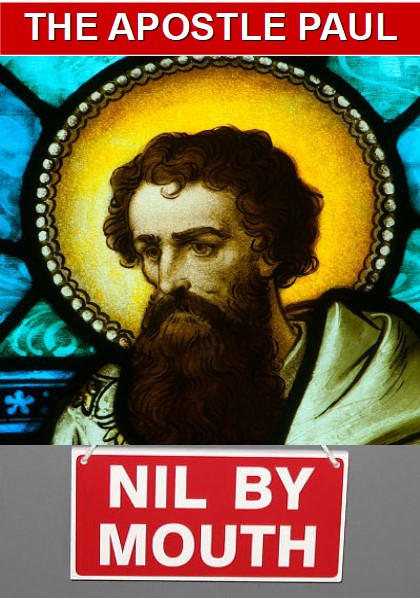
Which must be why we find so much detail about Jesus’ life in the letters of Paul, from his first letter, 1 Thessalonians, written circa AD55 to his last, Philippians (now an amalgam of several letters), written about 62. Paul was aware of the stories about Jesus – as all converts were – and affirms so many of the details of his life in his letters, passing on the vital stories and the traditions associated with him, in written form.

But not in our reality. Our Paul knows nothing of the details of Jesus’ life. Not once does he quote him or refer to the events of his life before the resurrection. There is nothing of the oral tradition. Nowhere in his letters does he draw from it; never does he say he knows for a fact that Jesus said or did a specific thing while on Earth.

Even after his meeting with Cephas and James, a full three years after his conversion, Paul relays not a single thing he learnt from them. After the encounter, he continues to promote only his own revelations and says nothing of what he learnt about Jesus from the man who supposedly spent three eventful years with him.

Fourteen years later, Paul meets again with Cephas and encounters other apostles for the first time. On this occasion, he and Cephas argue about justification and Paul comes away grumbling that ‘those leaders added nothing to me’ (Galatians 2:6) What? Not even stories about their time with the Master? Apparently these weren’t as important as disputes about soteriology.

Later still, Acts tells us that immediately after his conversion, Paul stayed with ‘disciple’ Ananias and other ‘disciples’ for several days. Did Ananias not know any of the oral tradition that he could pass on to Paul? Details about Jesus’ life, a saying or two or an account of a miracle? Apparently not. (This might be because the story is pure fabrication. Paul tells us himself, in Galatians 1: 16, that immediately after his conversion he ‘did not rush to consult with flesh and blood’).

Surely, though, he must have heard some of the Jesus story from those he persecuted prior to his dramatic conversion. If he did, he didn’t see fit to include any of it in his letters. Likewise, Paul had contact with cult communities he didn’t himself establish, such as that in Rome. Surely they conveyed some of the stories about Jesus that they had had passed on to them. He appears too to have known at least one other evangelist:  Apollos. If these other believers did pass on stories of Jesus from an ultra-reliable oral tradition, why didn’t Paul see fit to include any of them in his letters?

So what were Paul’s sources? Certainly not the oral tradition, nor Q, the hypothetical sayings gospel, which he likewise ignores. If the gospel was being spread orally from the time Jesus lived, by the apostles and other preachers, and was being passed around the fledgling cult communities, why did Paul know nothing of it? If in fact he did, why did he choose to ignore it in favour of his own inner-visions? Did he consider it of such little value?

These questions matter, as we’ll see next time when Mark decides he’ll set the Jesus story down on paper.

If not Metaphor, then what?

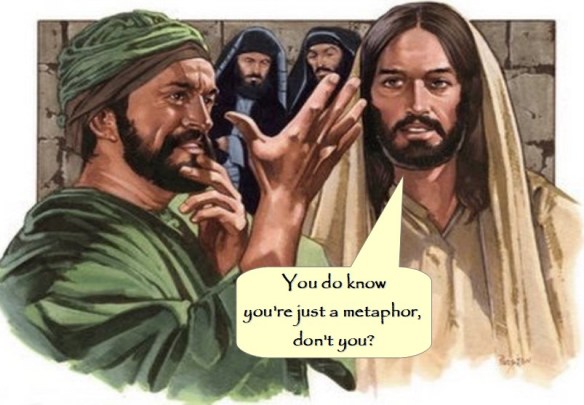
I’ve been arguing that everything in Mark’s gospel is metaphor (because he says so) but there are some pronouncements credited to Jesus in the synoptic that do seem to read as if they’re not. These look as if they are meant to be taken at face value: 

Mark 9:1 And he said to them, “Truly, I say to you, there are some standing here who will not taste death until they see the kingdom of God after it has come with power.”

Mark 10:21. Go, sell everything you have and give to the poor, and you will have treasure in heaven. Then come, follow me.

Matthew 5:39. But I tell you, do not resist an evil person. If anyone slaps you on the right cheek, turn to them the other cheek also.

Matthew 5:40. And if anyone wants to sue you and take your shirt, hand over your coat as well.

Matthew 5: 43-44. You have heard that it was said, ‘Love your neighbour and hate your enemy.’ But I tell you, love your enemies and pray for those who persecute you,

Matthew 6:24. No one can serve two masters. Either you will hate the one and love the other, or you will be devoted to the one and despise the other. You cannot serve both God and money.

Matthew 6.25. Therefore I tell you, do not worry about your life, what you will eat or drink; or about your body, what you will wear. Is not life more than food, and the body more than clothes?

Matthew 7:6. Do not judge, or you too will be judged. For in the same way you judge others, you will be judged, and with the measure you use, it will be measured to you.

Luke 6:30. Give to everyone who asks you, and if anyone takes what belongs to you, do not demand it back.

Luke 14:26 If anyone comes to me and does not hate father and mother, wife and children, brothers and sisters – yes, even their own life – such a person cannot be my disciple.

Perversely, these are the very commands that most Christians insist are intended metaphorically. This includes those who oppose the idea that, Jesus’ parables excepted, the gospels are in any way symbolic. I know from experience that they have any number of unconvincing arguments of why Jesus doesn’t really mean what he is made to say. For example: ‘these pronouncements are too severe and impractical to be taken literally’; ‘the verses are being taken out of context’, and ‘they have a deeper spiritual meaning’ (oops – that’d be metaphor, wouldn’t it?). Ask these same folk if the statements are therefore metaphorical and you can expect to be met with barrage of abuse.

If they’re not metaphorical, why do we not find Christians striving to live according to them: renouncing wealth, giving to all who ask, selling all they have, resisting no-one, judging no-one, hating family, becoming a slave and having no care for their own welfare for the sake of the kingdom that Jesus promised was imminent.

Because they don’t believe him. Easier to disregard his words about the kingdom arriving within his disciples’ lifetime and the instructions for living in the short time until then. The hard stuff is treated as metaphorical when it makes demands on Christians themselves.

Possibly they’re right. I’d suggest that the pronouncements like those above were not Jesus’s at all. They’re cult-speak; the extreme demands of cult leaders seeking to control their acolytes. In case this sounds like an about face on my part, let me assure you it isn’t; I’ve long argued that among the metaphor and the reworking of Jewish scripture, the gospels include copious amounts of early cult rules.

Whether they’re metaphor or extreme demands once imposed on cult members, no-one today takes much notice of Jesus’ commands. What does this tell us about their worth? What does it tell us about Christians from the earliest days until now? What does it say about their willingness to crucify themselves (definitely a metaphor) in order to follow him?

Bible Study

Again he entered the synagogue, and a man was there with a withered hand. And they watched Jesus, to see whether he would heal him on the Sabbath, so that they might accuse him. And he said to the man with the withered hand, Come here.” And he said to them, Is it lawful on the Sabbath to do good or to do harm, to save life or to kill?” But they were silent. And he looked around at them with anger, grieved at their hardness of heart, and said to the man, Stretch out your hand.” He stretched it out, and his hand was restored. The Pharisees went out and immediately held counsel with the Herodians against him, how to destroy him. (Mark 3:1-6)

Greetings, my beloved Brethren. Today we are going to look at God’s Holy Word as revealed to our dear brother in the Lord, the one who will one day be called ‘Mark’. We’re looking specifically at the passage above, because some of you have expressed difficulty in discerning the full import of the text. I have to say I’m surprised at this. You only have to bear in mind Mark’s rule of thumb that everything in his gospel is a metaphor, which, when looked at with discernment, reveals a previously hidden mystery: 

To you has been given the secret of the kingdom of God, but for those outside everything is in parables, so that “‘they may indeed see but not perceive, and may indeed hear but not understand, lest they should turn and be forgiven’” (Mark 4:11-12, referencing Isaiah 6:9)

Our passage today begins with the Lord healing a man with a withered hand, which should straight away alert us to the fact we are dealing with metaphor. All of the healings in the gospels are. They stand for something more significant than any actual healing.

Some of you might already have made the connection between the use of ‘withered’ here, with its use in another story (Mark 11-12-14), where Jesus withers an unfruitful fig tree. Of course, no actual fig trees were harmed during this miracle. The fig tree and its withering are metaphors.

The tree, you see, is a metaphor for the Jewish system of worship, the old Covenant of the Law. This had reached the end of its life. It was fruitless and God was done with it. He was in the process of replacing it with salvation through Grace. All of this is represented metaphorically by Jesus cursing the fig tree and causing it to wither.

So it is in our passage today, except this time, God offers healing to the Jewish nation. He is nothing if not gracious, reaching out and offering acceptance into the new Covenant, expressed here as the healing of a withered hand. You won’t have missed the fact – again symbolic – that the healing occurs in the synagogue, the Jews’ place of worship. We might also remember Deuteronomy (6:8) where the Lord God instructs the Jews to wear his Law on their foreheads and, more significantly, to tie them to the backs of their hands. But now their hands have, metaphorically speaking, withered away, just as the fig tree will.

God knows of course that few will accept his proffered healing, insisting instead of labouring blindly under the old Covenant. The rest of the story reflects this stubbornness and the incalcitrant attitude as the Pharisees – metaphors for the Jews as a whole – round on Jesus and castigate him for breaking the Sabbath laws in healing the man – in spiritual reality the Jews themselves. That Jesus heals on the Jews’ sacred day is metaphorical too, demonstrating as it does that all the old laws are now surpassed. Jesus, and more importantly his followers – you, my dear brethren – are no longer under the yoke of that law but have new freedom serving Jesus under his new yoke, which is easy to bear. At the end of the story, the Pharisees – the Jewish leaders of our own time, lest we forget – leave to plot against the Lord; in reality against us. With his help we will of course bear this persecution stoically.

So you see my brothers, this story was written for you, to remind you that you are saved. You are the New Covenant. The Old has passed away. You can follow Jesus’ example and do good, yea, even on the Sabbath. You need not fear the Jews or others who might persecute you because the Lord is with us. The Jews, on the other hand, will soon be cast into outer darkness when he comes in person. Even so, Lord Jesus, come quickly.

I hope this has made clear to you the mystery hidden in this part of Mark. I know there will be some of you who are not sufficiently advanced in their understanding of the mysteries, being still babes in Christ, and may yet object to this exposition of the deeper secrets of the Lord. So be it. But don’t say you haven’t been made aware of the Truth.

Next time, if there are those who need to know more of the mysteries hidden in God’s new revelation, we can look at the next part of Mark, though I trust that you are, by now, developing sufficient spiritual insight to discern for yourselves the hidden mysteries embodied by the gospel’s metaphors.

Announcement

The story so far…

While he used to argue vociferously that the gospels are history – remember they must be history because Pilate and Herod are in them? – our resident apologist has backed away from this position. He says now they’re not history as such but are only ‘like’ history, which means they’re ‘historical but not written as histories’, whatever this means. He derides the likes of Ehrman and Tabor for their inability to recognise this (newly invented) fact. These no-nothings make a category error when they confuse the gospels with history.

I suspect Don wants to reclassify the gospels because he recognises they make rather poor history. It’s safer to pretend they’re designed to be something else, something that doesn’t require external evidence to verify it: ‘announcement’, for example.

This, however, merely sidesteps the question of where the gospel writers got their information from. Don has previously argued that the gospels are based on eye-witness reports, Peter’s dictation to Mark and a reliable oral tradition. But conjecture like this is only necessary if the gospels are history. If they’re not, but are ‘announcement’ instead, then their sources need  be neither historically reliable nor demonstrable.

If the accounts are ‘announcement’ rather than history then where does their ahistorical, announced information come from? Fortunately, Mark gives us a clue:

To you has been given the secret of the kingdom of God, but for those outside everything is in parables, so that “‘they may indeed see but not perceive, and may indeed hear but not understand, lest they should turn and be forgiven’” (Mark 4:11-12, referencing and misquoting Isaiah 6:9)

In fact, the gospels’ ‘announcement’ is conveyed by a story constructed from supposed prophecies from Jewish scripture and the immediate concerns of the early cult communities, expressed in metaphors of the gospel writers’ making. All of the internal evidence supports this conclusion. In fact, the source of the gospels’ material is the same as Paul’s and that of other writers in the New Testament. Here’s how the great, self-appointed apostle puts it: 

My gospel and the preaching of Jesus Christ [is] according to the revelation of the mystery which was kept secret for long ages, but now is made visible through the prophetic scriptures and is made known to all nations, according to the command of the eternal God, for the obedience of faith. (Romans 16:25-26)

Christ died for our sins according to the Scriptures. (1 Cor 15:3-8)

Compare this with:

Today this scripture is fulfilled in your hearing. (Gospel Jesus in Luke 14:21)

He said to them, “How foolish you are, and how slow to believe all that the prophets have spoken! Did not the Messiah have to suffer these things and then enter his glory?” And beginning with Moses and all the Prophets, he explained to them what was said in all the Scriptures concerning himself. (Gospel Jesus in Luke 24:25-27)

He said to them, “How foolish you are, and how slow to believe all that the prophets have spoken! Did not the Messiah have to suffer these things and then enter his glory?” And beginning with Moses and all the Prophets, he explained to them what was said in all the Scriptures concerning himself. (Gospel Jesus in Luke 24: 25-27)

(Paul) reasoned with them from the Scriptures, explaining and proving that the Messiah had to suffer and rise from the dead. “This Jesus I am proclaiming to you is the Messiah,” he said. (Fictional Paul in Acts 17:2-3)

The revelation of the Messiah and the secrets and mysteries revealed to Paul and the other apostles are ‘explained and proved’ in their entirety by ancient scripture. But, these scriptures in and of themselves do not prophesy the kind of Messiah the early apostles envisaged. Rather, the scriptures are retrospectively pressed into service to match the revelations of the Messiah that Paul and the others experienced.

This is Don’s ‘announcement’: secrets and mysteries founded not on history but on revelation expressed through metaphor and the misapplication of scripture.

Christmas Quiz!

See how you do in this year’s Christmas Quiz. Most of the questions are related to subjects we’ve discussed during the year.

  1. Which of the events listed are literary realisations of so-called prophecies from Jewish scripture?

a) The virgin conception and birth

b) Bethlehem as Jesus’ birth place

c) Herod’s massacre of the Innocents

d) The ‘Holy Family’s’ flight into Egypt 

  1. Which of the events listed are metaphorical?

a) God’s insemination of Mary with Holy Semen

b) Pregnant Mary visiting Elizabeth, herself pregnant with the child she’d christen ‘John The Baptist’ (sarcasm, for those who can’t tell)

c) The visit of the shepherds with their symbolic gifts

d) The visit of the magi with their symbolic gifts

  1. Which of the events listed are sentimental and/or dramatic invention on the part of the gospel writers?

a) The archangel Gabriel visiting Mary

b) Joseph’s dream convincing him Mary hadn’t been sleeping around behind his back

c) The no room at the inn scenario

d) Jesus being laid in a manger

  1. Which of the events listed are historical fact?

a) The Roman census that entailed pregnant women trailing off to their husband’s ancestral home

b) The angelic host appearing unto shepherds

c) The Star of Bethlehem hovering over Jesus’ place of birth / home

d) Jesus’ birth occur during the reign of Herod the Great (died 4 BCE) and while Quirinius was governor of Syria (appointed 6 CE)

         5. What do the answers to questions 1-4 tell us about the rest of the      gospel stories?

a) They’re equally fanciful

b) They’re all metaphorical

c) They’re invented, largely based on ancient Jewish scripture

d) There’s nothing historical about them either

        6. What do the answers to questions 1-5 tell us about those who believe these stories to be factual and true?

a) They’re gullible

b) They’ve switched off their critical faculties

c) They believe whatever they’re told

d) They feel compelled to argue that all of the fanciful stories about Jesus are true


Answers:

  1. Which of the events listed are literary realisations of so-called prophecies from Jewish scripture?

All of them are based on what Matthew found in Jewish scripture and shoe-horned into his Jesus fantasy.

  1. Which of the events listed are metaphorical?

All of them. You don’t think such blatantly symbolic events really happened, do you?

  1. Which of the events listed are sentimental and/or dramatic invention on the part of the gospel writers?

Oh come on, what else could they be?

  1. Which of the events listed are historical fact?

None of them.

  1. What do the answers to questions 1-4 tell us about the rest of the gospel stories?

They tell us the gospel writers – Matthew and Luke as far as the Christmas stories are concerned – were more than happy to invent stuff for metaphorical purposes and to make it look like prophecy was being fulfilled when it wasn’t. If they were prepared to do this for the Nativity them why not for all of their other stories, the resurrection included?

  1. What do the answers to questions 1-5 tell us about those who believe these stories to be factual and true?

Yup, they’re all of those things. And they won’t be happy till they’ve inflicted their damn fool views on you too.

So how’d you do? Well done to everyone who got full marks. Try to do better next time the rest of you. It really wasn’t hard.

A very merry Christmas to both my readers. See you on the other side.

Beyond The Grave

A few years ago, a friend of mine was working in his front garden when he spotted what he was sure were a couple of Jehovah’s Witnesses further down the street. He aimed to back inside before they reached his house, from where he could safely ignore them. But he timed it badly and before he knew it, the JWs were upon him.

My friend was under some stress at the time so when they asked him, ‘Wouldn’t you like to live forever?‘ he responded with, ‘Good God, no. This life’s bad enough. Why would I want it to go on forever?’ This took the wind out of their sail though didn’t divert them from their sales pitch for very long.

I’ve been in the same state of mind myself, and maybe you have, when life was so difficult I spent far too much time contemplating whether being dead might not be a better option. Thankfully, I couldn’t really contemplate doing anything about it, and was aware of the effect it would have on my loved ones if I did, but nonetheless I spent too much time considering – desiring even – my own non-existence.

I was pretty sure this was what awaited after death. I hadn’t, by this stage of my life, the conviction of the Jehovah’s Witnesses and mainstream Christians that a better life, one that would last forever, lay beyond this one. Instead, I made radical changes to my life in the here and now, to lift myself out of the slough of despond in which I found myself.

I love life now. It isn’t without its difficulties, not least the physical problems that come with older age, but I enjoy it to the full (apart from supermarket shopping). Having found my pearl of great price, I hope life will last for many years yet. I can’t guarantee it will, of course, so I make the most of every moment, surrounded by people I love and who love me.

Would I like my life to go on forever? Certainly, but I know it won’t. There is simply no evidence life continues after death. Assurances that it does in religious texts is no evidence at all. Even if it were, the type of eternal life suggested by the Bible, worshipping a needy, despotic God for evermore, is not the way I’d like to spend eternity.

Ask Christians how they know they will and the best that can come up with is that the Bible tells them so or that Jesus promises they will (which amounts to the same thing.) Ask them where this everlasting life will be lived and you’ll get one of two answers: in heaven or here on a restored Earth, once Jesus ‘returns’. The earliest writings in the New Testament support the here-on-Earth scenario. The later ones – perhaps because their authors had begun to realise Jesus wasn’t coming back any time soon – start, like John 14:2, to hint at a celestial existence.

No Christian – no non-believer either – has survived death to face eternal bliss or eternal damnation. Some will tell you that rising from the dead happens in an ethereal way immediately following death. The soul (or whatever) is resurrected either to be reunited with God outside of time and space or thrown to the demons in hell. The biblically savvy, like the JWs, will tell you the resurrection will not occur until Jesus’ return at some point in the future. Significantly, both expectations occur off-stage: the first in a undemonstrable plane of existence, the second in a future that never arrives. Both are wishful thinking, scenarios dreamt up by those frightened of their own non-existence.

The offer of everlasting life is one of the New Testament’s most pernicious lies. The idea is not to be found in the Jewish scriptures that make up the Christian Old Testament. It is a later development, dreamt up by extremists who convinced themselves, on the basis of a few visions, that God would ensure their continued survival, just as he had Jesus’s.

If this isn’t how the promise of living forever came about, then what is the evidence there is an existence beyond death? Empty assurances by first and second century cultists are not it.

  • Show me someone other than Jesus – whose ‘resurrection’ is metaphorical at best – who has risen from the dead.
  • Show me evidence that ordinary human Christians have already gone on to eternal life.
  • Show me, if you don’t subscribe to this view of immortality, the souls who rest with God awaiting a future resurrection (1 Thessalonians 4:13-18; Revelation 6:9-11).
  • Show me just one human, Christian or otherwise, who has gone on beyond death.
  • Prove that the promise of eternal life is real.

Parables

Jesus’ parables are analogies: similes or metaphors. ‘The Kingdom of heaven is like’; ‘there once was a man…’ Every one of the parables tells a story that didn’t actually happen. There was no literal Good Samaritan, no Prodigal Son or Sower. Jesus, or more probably the gospel authors, made up these stories to illustrate ‘mysteries’ (μυστήριον; gnosticism anyone?) What do they say about the parables? The majority appear in Matthew’s gospel, though Mark and Luke also include them. There are none in John. Did he, a supposed eye and ear- witness, not know of them?

Mark has Jesus say to his disciples:

To you has been given the secret of the kingdom of God, but for those outside everything is in parables, so that “‘they may indeed see but not perceive, and may indeed hear but not understand, lest they should turn and be forgiven’” Mark 4:11-12

Mark lets his readers in on the ‘secret’ (μυστήριον again) because there are mysteries within the cult, secrets available only to the initiated. Remember, the parables were written – they are almost certainly literary creations – 40 years after the cult was established. Only cultists would understand the secrets/mysteries embodied in the parables. Parables, Mark tells us, are intended to disbar those who are not spiritually attuned from salvation/the kingdom of God/eternity.

The word translated as parable also means ‘riddle’, designed to puzzle or obfuscate. But Mark doesn’t just say the parables are intended to do this. He says ‘everything is in parables’. What did he mean by ‘everything’? All of the teaching he attributes to Jesus? All of the episodes he relates? Could it be that the entire Jesus story, crucifixion and resurrection included, is one long, extended parable? A metaphor, if you like.

You bet it is.

Related:

Stories about Jesus

The Jesus Story v. Reality

Cruci-fiction

Inventing Jesus

The Bible as Metaphor (again)

A few days ago, Dennis and I visited Penrith, a small market town a short distance from the city where we live. What a delight it was to discover that the street preacher who plagues our city – the humourless Dale McAlpine – also inflicts himself on this smaller place. We so enjoyed hearing him bellow out, as we manoeuvered past his confederates handing out poorly written tracts, that we were all sinners – ye, everyone of us – bound for hell.

As we stopped at an ATM we heard Dale announce how Jesus healed lepers and cured leprosy, which patently he did not. He said Jesus’ healing of lepers was a metaphor for what he could do for us all, by removing our sin and making us whole again. His metaphor schtick – an sophisticated one for a simple street preacher – put me in mind of our very own Camp commenter. As Sunday school teacher Don frequently reminds us, the Bible is a) literature and b) largely metaphorical.

In case he’s forgotten and is arguing this week that we should view the bible’s stories as historical accounts (his other favourite tack), here’s what he actually said:

Much of scripture is the kind of literature in which metaphor and other kinds of figurative language is common… you are out of touch with the literary character of ancient literature.

I hope you all feel thoroughly chastised by this. I know I do. Don was taking exception to my post in which I itemised the Bible’s mythical creatures, talking animals and impossible events. So, I’m going to take him, and Dale at their word and take a fresh look at the Bible’s use of ‘metaphor and other kinds of figurative language’

First though, let’s understand that metaphor and figurative language are distinctly literary techniques. In literature and sometimes in speech, metaphors make subtle comparisons and bring to mind a host of associations that the author does not then have to explain. Outside of fiction, they don’t have much of a function. We don’t, for example, attribute metaphorical meaning to human events and interactions in the real world. The present war in the middle east is not a metaphor for something else, like, for example, the warfare that Christians believe rages in the Spirit world. Sleepy Joe Biden’s activity, or lack of it, is not a metaphor for the present condition of the USA (let’s hope not anyway). Our personal relationships are not metaphors for something grander. There is no metaphor embedded in actual events or real world interactions.

No. Metaphor exists almost entirely in literature. While the occasional non-fiction author might add a metaphor for flourish, strictly speaking, metaphor exists in and for fiction and poetry. More than this, when, in fiction, ideas are expressed metaphorically, it signals that the surface meaning is of lesser significance. It is the underlying or hidden meaning that matters. The fiction is the vehicle by which the metaphorical truth is conveyed. Don admits as much in his comment.

Let’s try some illustrations. The underlying metaphor of The Great Gatsby, its truth, is the dark underside of the American dream. Its surface story isn’t real; it is fiction. The metaphor conveyed through Moby Dick – the fictional whale as well as the novel as a whole – is the destructive nature of obsession. Again, as powerful as this is, none of the story that conveys it actually happened. Frankenstein’s central metaphor is the danger that uncontrolled science represents to humankind. The story that carries this message is, however, pure invention. In All The Light We Cannot See, Light is the metaphor, as it frequently is. The characters’ insights into truth are what the author seeks to convey. The fiction is the vehicle of that truth. Choose your own example: fiction embodies metaphor, the ‘truth’ of the story. But the story itself is rarely an actual event. Even when it’s based on one, as the movies say, the narrative is extensively fictionalised.

So, let’s go back to Dale’s leprosy metaphor. In several gospel stories, the authors have Jesus cure lepers precisely to illustrate how he can heal people of their inner leprosy: their sinful nature. Jesus almost certainly did not heal any lepers; this is the fiction. The creators of the gospels designed the story to carry metaphorical meaning, which, in this case, is that Jesus can heal us from sin.

Likewise the stories in which he heals the blind; the blindness is metaphorical. The saviour opens people’s eyes to spiritual truth. He didn’t really cure blind people; that is the fictional vehicle for the metaphor.

He didn’t turn water into wine; the writers of the fourth gospel wanted to convey the spiritual ‘truth’ that the new cult’s beliefs were superseding old Jewish ones; a metaphor was a memorable way to do it.

Lazarus was not raised from the dead; the story is a metaphor to illustrate how God will raise believers at the last day.

The Romans did not execute Jesus; it was the spiritual rulers of the age who, according to Paul in 1 Corinthians 2:8, put the saviour to death. The Romans are the metaphor for the wickedness of these supernatural beings.

Jesus did not rise from the dead. This too is a metaphorical fiction.

How did I do, Don? I’ve interpreted isolated periscopes from the gospels metaphorically. I’ve borne in mind that metaphor and other figurative devices are purely literary, techniques in fiction. I’ve channelled the literary character of ancient literature as defined by you (except of course you never actually do define it.)

You are invited to respond. I offer to post your comment, if it is as lengthy as I expect it to be. You must, however, keep to the point and resist making personal jibes. Choose any of the miracles, healings or pericopes from the gospels and demonstrate that they are real historical events.

It matters to you and to other Christians that the events of Jesus’ life did happen. That they’re not just the invention of clever writers who, taking inspiration from Jewish scriptures, created metaphorical events to convey higher ‘truths’. So persuade us that at least one miracle, healing or episode is more than a literary device, a metaphor for some fanciful theological ‘truth’. Provide the evidence that it really happened. Claiming the disciples witnessed the miracles or healing won’t cut it, when the disciples are themselves characters in the stories, and metaphorical at that.

Jesus Shows How To Treat Slaves

Jesus’ parable of the talents

Three slaves are given money by their owner, two invest it while the third buries his share. He is castigated by his master (yes, it’s Jesus as his favourite metaphor: slave master) who says to him on his return:

I tell you that to everyone who has, more will be given, but from the one who has not, even what he has will be taken away. But as for these enemies of mine, who did not want me to reign over them, bring them here and slaughter them before me. (Luke 19:26-27)

I know, that last sentence doesn’t fit the rest of the story, but it tells us what a despicable s**t Jesus was, quite happy to see those who didn’t want a peasant with delusions of grandeur lording it over them exterminated. Thank God the Romans got to him first (if indeed he existed.) No-one likes a dictator, specially not another dictator.

How about the conclusion to the actual parable, the one about the slaves and the money? The talents are evidently a metaphor for something or other. According to Christianity.com, it’s that the third slave, ‘didn’t take joy in the promise of the master’s return but instead wasted his time, his opportunities, and the master’s money.’

In other words, it’s fanatic talk aimed at those with a lack of commitment to the cult and its beliefs, including the ‘master’s’ imminent return, when wastrels will be in big trouble. As Christianity.com puts it:

Those who are not (faithful) may face the harsh reality of being called a wicked and lazy servant. Worst of all, they may not share in the joy of their master’s presence when he returns.

And there we have it, the softening of Jesus’ dictatorial original: ‘will’, as in ‘will lose everything’ becomes the hedging-your-bets ‘may’ while ‘slave’ (doulos again) becomes the watered-down ‘servant’. After all, we wouldn’t want to draw attention to how much of a cruel bastard Jesus was originally conceived as being. (Because, yes, these stories were invented by the early Jesus cult.)

The cult took no prisoners; in terms of commitment. It was all or nothing. Waiver in that commitment and you risked expulsion when the slave-master returned. So much for being redeemed unto salvation, so much for salvation by grace alone. If you weren’t utterly committed you stood to lose it all. What the original cultists weren’t to know, of course, was that the master would never return. The whole sorry parable was as irrelevant then as it is now.

The Son of Man

I started wondering why, if his creators believed him to be the Messiah, they have gospel Jesus habitually refer to saviour-figures in the third person? He does it Matthew 23 which we looked at couple of weeks ago, when he talks about there being ‘one instructor: the Messiah’, and he does it repeatedly in all four gospels when he refers to ‘the Son of Man’. The term comes from Daniel 7:13 where it is rendered as ‘one like a son of Man’.

In my vision at night I looked, and there before me was one like a son of Man, coming with the clouds of heaven. He approached the Ancient of Days and was led into his presence.

The interpretation of which, supplied in Daniel 7:27, is that:

The sovereignty, power and greatness of all the kingdoms under heaven will be handed over to the holy people of the Most High. His kingdom will be an everlasting kingdom, and all rulers will worship and obey him (my emphasis).

The phrase used for ‘son of Man’, bar enash, means simply ‘human being’ and is used to contrast with the ‘beasts’ of nations that the ‘prophecy’ says will rule prior to this. However, as Daniel explains, the human being in question is the nation of Israel – the holy people of the Most High – who will finally triumph over the four beastly nations that will dominate the Earth first. The nation of Israel will metaphorically emerge from the clouds and join the Ancient of Days to rule from Heaven. There is no mention anywhere in the Daniel dream-prophecy of a Messiah or individual human being who will accomplish any of this.

As Neil Godfrey puts it:

The coming of this “Son of Man” is within the realm where one expects deities to travel. The coming is, moreover, to another station within the clouds, namely the throne of the Ancient of Days. The context again explains that this “coming” is effecting a change of rule on earth. A kingdom is falling, and freedom is given to “the saints of the Most High”.

Nevertheless, it is this title – the now fully capitalised ‘Son of Man’ – that Mark has Jesus assume. The other three gospel writers copy it from him. Paul, writing decades before them, seems not to know that Jesus used it. Evidently the celestial Christ he encountered in visions and revelations didn’t feel the need to mention it. (Hardly surprising when Mark is freely inventing years later.)

So what does this tell us about Jesus, or, more specifically, about how the Jewish Christians of Mark’s community viewed him?

A number of scholars (e.g. Ehrman, Carrier, Goodacre, Westar Institute) have argued (as have I in my own amateurish way) that gospel Jesus is constructed from ‘prophecies’ lifted from Hebrew scriptures. Other commentators have demonstrated how he is, in the first two gospels at least, the personification of the nation of Israel*. This isn’t just because he identifies with the son of Man figure in Daniel. He also equates himself with the Suffering Servant of Isaiah 53 and elsewhere. Strictly speaking, he is made to identify with the Suffering Servant by Mark and the other gospel authors, particularly Matthew, who all copy Mark’s original idea. As Isaiah 53 makes clear, God’s Suffering Servant is not a person: it is Israel.

Not only is Jesus identified with Daniel’s son of Man and Isaiah’s Suffering Servant – the personification of the Jewish nation – but Isaiah 53 is used as a template for his trial, mockery, crucifixion and resurrection. It is the nation that is God’s servant which, as Mark was writing, was going through trials, tribulation, suffering and apparent death: the destruction of Jerusalem and its temple, with thousands of Jewish people being crucified by the Romans.

So it will be Israel, Mark hints in his extended parable, that will emerge resurrected and who will ascend metaphorically through the clouds to sit at the right hand of God to rule the nations. He leaves out the details of this resurrection and ascension from the end of his gospel because at the time of his writing they had yet to happen. But, he tells his readers and listeners, they will. They have to because Daniel and Isaiah say so: after suffering comes God-assured victory. Mark’s Jesus story, then, is an allegory of the history of the Jewish nation and its projected future. The allusions to Abraham, Moses, the Exodus, Elijah, Isaiah’s Suffering Servant, Daniel’s son of Man and the accompanying ‘prophecies’ make this more than apparent.

Gospel Jesus is a metaphor (or indeed a simile, one who is like a son of Man/the Jewish nation), his life made to conform in every respect with the history of that same nation. He is an allegory as Mark makes clear throughout his gospel. 

The clues are there for all to discern and as Mark advises, ‘he who has ears, let him hear’.

*See Watts: Isaiah’s New Exodus and Mark and numerous Christian apologists who make the same point: Google ‘Jesus and Israel’.