My Gay Demon

I am demon possessed. I know this for a certainty because Christians all over the Internet tell me. I am gay therefore I am possessed by a demon. Maybe more than one, I don’t know.

I’ve been trying to get in touch with my inner demon but he’s been keeping schtum. I assume he’s a him given he’s a demon of gayness, but again who knows. I’ve enquired in the deepest, darkest recesses of my mind and have searched my heart (though if I’m honest I wasn’t really sure how to do this) and can’t find him anywhere.

I was going to ask him why, if he’s a demon and therefore a real nasty piece of work from the pit of hell, why he’s led me to a happy and loving relationship with Dennis, one that has taken each of us from loneliness and depression to peace and contentment. I just didn’t know demons were so… well, so positive and creative. I always thought they were destructive and devious, like C. S. Lewis’s Screwtape. I think mine must be shy and more like Casper the Holy Ghost.

Alternatively, maybe there’s no such thing as demons, invisible evil super-beings who can’t be detected in any way. In my ‘worldview’ anything that’s invisible, undetectable and is a figment of rather dim-witted people’s imaginations is a being that doesn’t exist.

But then maybe that’s just me.

  And science.

    And every other academic discipline.

       And rationality.

         And reality.

It’s possible, after all, that a book written thousands of years ago by ignorant religious zealots trumps all of that.

The Gospels and Other Fiction, part 2

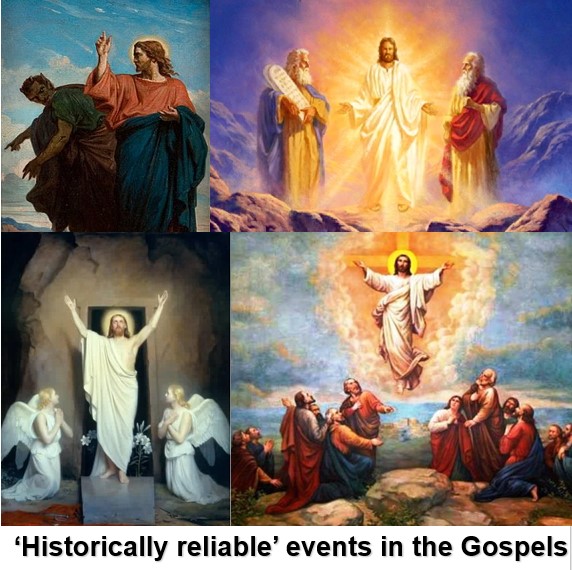
The gospels were written as history. Their writers did not make things up.’

History, as koseighty has reminded us, is not littered with angels, devils, demons, spirits, apparitions, miracles, voices from the sky and resurrected corpses. Real history was being written at the same time as the gospels, by Josephus and Suetonius for example, who do not include the supernatural but do reference their sources, something the gospels never manage.

And of course the gospel writers did make things up. They invented numerous stories for Jesus to make it appear he is fulfilling prophecy (even when that ‘prophecy’ wasn’t prophecy to begin with.) This included making up ‘history’; Herod’s Massacre of the Innocents (a rewrite of a fiction about the infant Moses), the crucifixion eclipse, the rending of the temple curtain and more. These are all symbolic events. They didn’t really happen. Jesus’ own resurrection can safely be added to the list. It’s ironic that those who defend the gospel authors against the charge they made stuff up are the same who invent stories themselves: Mark and Luke knew each other? Mark proof-read Luke’s first draft? There were people who would fact check the gospels and point out any errors? But the original Christians wouldn’t do such a thing. Except they did.

There are no Inconsistencies, contradictions and inaccuracies in and between the gospels, but if there are, these are irrelevant. It’s the bigger picture that counts.’

Jesus is different in all four gospels. Despite Matthew and Luke’s plagiarising of Mark, they alter him to reflect the Jesus they believe in. John’s Jesus is so far removed from Mark’s that he’s a different character altogether. The inconsistencies do matter: did Jesus perform signs and wonders or not? Was he crucified on Thursday or Friday? Was it Peter, John or Mary who was first to see him resurrected? Did he hang around for one day or for 40? These conflicting details tell us that the creators of the Jesus story were more than happy to alter it when it suited their purposes. This is not how history is written. It is how propaganda is created. The ‘bigger picture’ is, in any case, made up of these smaller details. They work collectively and cumulatively to create the bigger picture. If we can’t rely on their being accurate how can we be sure the bigger picture is? When the gospel writers are unreliable in the smaller details, how can we be certain they’ve got the bigger picture right, given they’re all copying it from the same source, Mark, and giving it their own spin?

There is corroborating evidence of the gospels’ accounts’.

There is? Where? Just because there is some evidence that Nazareth existed doesn’t mean Jesus performed miracles, any more than Dunsinane castle’s existence proves Macbeth murdered King Duncan (he didn’t). Just because Pilate was a real historical figure doesn’t mean he crucified Jesus, any more than the existence of King’s Cross Station means Harry Potter catches his train there. And these, surely, are merely the small details. There is no corroboration at all for the bigger picture. Mention of the followers of Chrestus in Suetonius confirms at best that there were Christians in Rome at the time of Claudius, but no-one is disputing that. At worst, for the apologist, this curious reference has nothing whatever to do with Jesus. Later references to incidents from his story, by the much vaunted Church Fathers, are derived from the gospels and are therefore dependent on them. As such, they don’t constitute independent corroboration.

Everything Jesus prophesies or predicts in the gospels will come to pass, then sceptics will see that everything in the Jesus story is true.’

This one is from a commenter on Don’s blog. (I only went there by accident, honest.) The problem with this one is that everything Jesus is made to promise should already have come true, two thousand years ago. The Son of Man should have appeared in the sky with the heavenly host to usher in God’s Kingdom on Earth, while sending most of mankind to the fiery pit or outer darkness or some other damn place. Both he and Paul claimed that this would happen within their and their followers’ lifetimes. The trouble with Christianity is it is always winter and never Christmas. Its fulfilment God’s – God’s Kingdom on Earth, life after death, the final judgement – is always going to be at some indeterminate time in the future, a time and fulfilment that never quite arrives. It never will; part of ‘the big picture’ we can be confident we will never see.

More to come (unlike Jesus). 

The Gospels and Other Fiction, part 1

Christian apologists vigorously deny the idea that the Jesus story is fiction even though all of the evidence, both internal and external, points to the fact that it is. I’m not going to rehearse that evidence in this post (I address it in several earlier posts, including here and here, and there are always primary sources that, God forbid, defenders of the faith could read for themselves.) I’m interested here in looking at Christians’ defence of scripture as truth. What arguments do they have and better still, what evidence, that the gospels are historically accurate depiction of events in 1st century Palestine? Most of these arguments have been offered by our resident apologist, Don Camp, and although I’m fairly sure Don makes things up as he goes along, I’ll not reference other sources except where I’m introducing an argument he hasn’t offered.

Church Fathers believed the gospels were accurate, therefore, because they lived closer to the time of the gospels’ composition, they’re more likely to be right.’

Church Fathers, such as the unreliable Eusebius,, Papias, Clement, Ignatius and Polycarp were predisposed to believe the gospels were accurate; they had already converted to the faith and had a vested interest in seeing it promulgated and preserved. They were also steeped in the thinking of the age, typified by Paul and other NT writers, that the Earth was at the centre of a cosmic war between God and the forces of Satan. Above all, the Jesus story was theirs, a new revelation from God that didn’t, as far as they were concerned, belong to Jewish tradition or any other. It was new and it belonged to them: they wanted and needed it to be true. Later scholars, from the 19th, 20th and 21st centuries, did not come with these particular encumbrances and while of course not entirely free of prejudices of their own, considered the texts more dispassionately as history and found them to be wanting.

‘‘Mark’ is an accurate record of the disciple Peter’s time with Jesus.’

There is no evidence at all for this claim. Analysis of Mark (and also Matthew and Luke) demonstrates how the story is constructed around supposed prophecies from Jewish scriptures. Mark also incorporates much of Paul’s gospel to the Gentiles, a feature Matthew is at pains to ‘correct’. His Jesus is distinctly Jewish.

There was an oral tradition that accurately preserved the stories about Jesus until such time as they could be written down.’

There is no evidence that this tradition, if it existed, was accurate. It is, as Bart Ehrman shows in Jesus Before The Gospels, highly unlikely that it was. We know that stories conveyed orally are altered, embellished and modified with successive retellings.

There was an earlier document that preserved sayings of Jesus’ until such times they could be incorporated into the gospels.’

Then it simply vanished so that no fragment of it survived. The Church Fathers don’t appear to know anything about it. Wouldn’t such a priceless document have been preserved somehow, somewhere by someone? Q, as it’s called, is entirely hypothetical. It’s unlikely it existed. Even if it did, it is considered to have been a sayings gospel. It did not preserve details of Jesus’ life, death or resurrection. We’ll get to the so called ‘logia’ in part 3.

The gospels were written by eye-witnesses or associates of eye-witnesses.’

We know with certainty that this is not the case. All of them were written in Koine Greek and are carefully constructed literary creations. None was written in Palestine but much further afield and all reflect the concerns of the later cult. Over a hundred years after they were written, Irenaeus ascribed the names by which they are now known without any evidence that the authors were called Matthew, Mark, Luke or John. Later compilers of the New Testament didn’t even know of ‘Mark’s’ primacy, which is why ‘Matthew’s’ gospel appears first in the New Testament. ‘Matthew’ and ‘Luke’ are heavily dependent on ‘Mark’ (as is ‘John’ for its overall structure), an incongruous and inexplicable approach for Matthew to take, and John too, if they were eye-witnesses themselves. Eye-witnesses do not need to rely on the testimony of people who weren’t.

More next time…

The Power of Figments

Since his death, no-one has seen the itinerant preacher now known as Jesus. Some dispute he existed in the first place and certainly the character depicted in the gospels is a fictional creation. Assuming, however, that there was a real individual on whom this character was based, no-one has seen him in the flesh for 2000 years.

This includes all or most of those who wrote about him in the early years of the cult and whose writing now forms the New Testament. They either learnt about Jesus by word of mouth, as most converts throughout history have done, or they had a vision within their own heads of – what exactly? Those who write of such visions are either vague about what they claim they saw (Paul in Galatians 1: 15-16), are evidently making it up (John of Patmos in Revelation) or their visions are related by third parties many years down the line (Peter and Mary in the gospels, Stephen in Acts.)

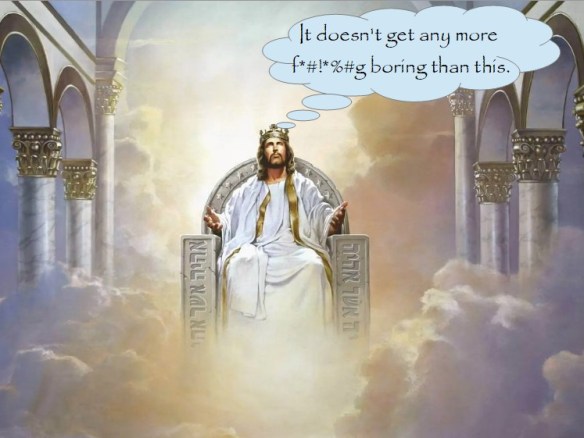
Either way, the character believers claim to have seen or have heard about is a fantasy figure, not the rabbi who may or may not have existed. It’s this fantasy who lives in heaven snuggled up to his equally fictitious father, monitoring people’s behaviour, listening into their thoughts while simultaneously observing ‘the destruction the world is bringing on itself’ and doing not a thing to help.

All this from the heaven no Christian can locate: in another unspecified, invisible, undetectable dimension is the best they can offer. Nonetheless, if only more people would turn to him, Super-Jesus would help us solve the problems we face.

Because theocracies have always been so effective. They’ve led to a more just, fairer world as wise compassionate religionists have listened to their heavenly leaders – God, Allah, Jesus, Muhammed – and have applied the principles of their holy books to the running of their societies. Only obstinate sinners have had anything to fear from the arrangement: the degenerate, like those who have sex outside marriage and want access to contraceptives; gay people (especially); women who don’t know their place; women who seek abortions; the powerless; other, ‘inferior’ races; those of other religions, non-believers and atheists. None of these would have a place in Jesus’s new perfect world either, just as they don’t in societies controlled by Muhammed’s holy ones. Jesus’ agents will be happy to exterminate them, just as he instructs.

Magic Jesus as a figment of his followers’ imaginations can be made to say whatever they want, just as he was when he was being created by Paul and the gospel writers. He is a perpetual work in process, constantly changing to conform to what those who claim to know him want him to be. It’s easy to achieve this with a non-existent being from a non-existent place.

Everything, Everywhere, All At Once

Sadly, we’ve failed to locate Jesus, the celestial super-being who is everything, everywhere, all at once yet nowhere at all. We’ve been presented with some possibilities, specifically that he exists in another dimension, which may or may not exist, from where he whispers directly into the brains of those who, over in this reality, call upon him. He even appears occasionally in visions, when the two dimensions ‘intersect’, which, as everyone knows, they’re capable of doing.

Unfortunately, all of this is undetectable by science but there’s no reason for concern because there is more to reality than that which science can observe. Equally regrettably, there’s no way of verifying this claim either; this is because science is deficient, limited as it is to investigating only ‘dirt and rocks’.

* * * *

It is far more likely that science can’t detect heaven and the eternal Jesus in precisely for the same reason it can’t detect Narnia, Valhalla and all the other fantasy worlds created over the millennia by human minds. Applying Occam’s razor, the imagination accounts for all these other ‘realities’ and the immortals that inhabit them.

No further explanation necessary.


Where’s Jesus?

Not a rhetorical question. Christians keep telling us that he’s alive, so where is he exactly? If he’s alive he has to be some place. The old hymn, ‘I Serve A Risen Saviour’, which I sang many times in my younger days, thinks it knows:

He lives, He lives, Christ Jesus lives today!
He walks with me and talks with me along life’s narrow way.
He lives, He lives, salvation to impart!
You ask me how I know He lives?
He lives within my heart.

This isn’t much use though, is it. All it’s saying is ‘I’ve convinced myself Jesus is alive because I feel him inside me.’ That’s the extent of it, and this being so, it’s really no evidence at all that Jesus is alive in any sense the word is usually understood, let alone that he has an independent on-going existence.

Perhaps the bible will be of more use. Acts 7.55-56 has Stephen see Jesus alive in heaven, standing at the right hand of God. Well, that’s great. Now we’ve got two problems. Not only do we still not know where Jesus abides, we don’t know where God lives either. They’re both together somewhere, ‘heaven’ according to Acts says, but we’re no closer to knowing where this is either.

According to the preceding verse, Acts 7.54, Stephen is ‘looking up’ when he has his vision of heaven. This is significant because for early Christians, God’s abode – heaven – was in the sky. The New Testament speaks of different levels or realms of heaven, all of them up in the sky.

In 2 Corinthians 12, Paul claims to have visited the third (and highest?) level, while the Paul-imposter who wrote Ephesians helpfully explains that the lower level, the one nearest the earth, is occupied by demons and Satan’s minions whom he refers to as ‘the powers of the air’, ‘cosmic powers’ and ‘powers and principalities’. These are the very beings whom Paul claims in 1 Corinthians 2:8 killed Jesus (betcha thought it was the Romans) and 1 Peter 5:8 says seek to devour men’s souls.

Next is the heavenly realm inhabited by angels and the original perfect copies of everything here on Earth (Hebrews 9:22-24).

Then, finally, there’s the highest heaven (alluded to in Luke 2:14)) where dwells the CEO, God himself. If Jesus stands or sits at his right hand, then presumably that’s where he is too. But where is this highest heaven, or indeed any of the levels the early cultists believed existed? There’s no evidence for any of them.

In fact, the Bible’s heavenly hierarchy (which you can read about in detail here) is absolute drivel. Above us, as John Lennon was known to say, is mere sky – the stratosphere, mesosphere, thermosphere and the like – followed by the endless vastness of largely empty space. If Jesus is alive in an imaginary highest heaven somewhere out there, then he, like it, is similarly non-existent.

But let’s not write a living Jesus off just yet. It’s possible that he, his Father and all those lesser supernatural beings – the demons and devils, powers and principalities as well as the angels and snoozing saints – are hidden away in some other invisible and undetectable alternate dimension.

Other dimensions are, according to some scientists, theoretically possible. There may, they say, be as many as 11, but unfortunately for Jesus, none of the Bible authors knew of them. Those who wrote about heaven in the early days of the Jesus cult, were convinced it was overhead and, as ‘intellectual’ Christians are fond of pointing out, we need to read and interpret scripture as the ancients themselves did, not with a modern sensibility. Certainly not with an understanding of ‘dimensions’ derived from Star Trek.

Despite this, theologians have to work mighty hard to transplant such theoretical dimensions into the Bible in order to claim that heaven, and therefore Jesus, exists in one of them. And work hard they do, at what is little more than a god-of-the-gaps argument: ‘we know Jesus is not a few (or even many) miles up above us, therefore we must find a location for him somewhere that science appears to allow.’

(Interestingly, when it comes to the fine-tuning argument, apologists are quick to dismiss the idea of other dimensions, multiverses and parallel worlds; these make the earth less special, less ‘just right’ for life, less designed by God specially for us.)

Locating the living Jesus is like finding Wally/Waldo in one of those cluttered pictures, except this time he hasn’t been included. So tell us, Christians, where is Jesus? And where is the evidence he’s where you say he is?

The Guilt Legacy

A couple of nights ago I watched a programme called Jehovah’s Witnesses and Me fronted by Rebekah Vardy. I know nothing about Rebekah apart from the fact she’s a footballer’s wife who was recently involved in a social media scandal, but her reflections on being brought up in a Jehovah’s Witness household were honest and sincere. She said one of the legacies of her mother being ‘disfellowshipped’ when she, Rebekah, was 8 was that she felt, and still feels, guilty about much in life. The teaching of the organisation was, as it is in many evangelical churches, that the individual is a hopeless sinner who cannot please Jehovah, though must nevertheless endeavour to work out their own salvation. For JWs this involved (and still does, as you may know from personal encounters with them) going door to door and standing for hours on end in public spaces with a trolley-full of Watchtower publications.

I could relate to Rebekah’s feelings of guilt. While not a Jehovah’s Witness (I was never that gullible) my years as a Christian left me with a legacy of guilt. For many years it was the dominant emotion of my life. While a Christian I constantly felt I was letting God down: not as good a Christian as those around me, not witnessing enough, listening to pop music instead of worship songs – practically anything could trigger my not-good-enough feelings. I also felt responsible for anything that went wrong, even when I couldn’t possibly be, and guilt about my secret sexual feelings and, most especially that I wasn’t been a good enough father. To this day, I feel awful if I’m unable to help with my grown-up children’s problems. I am moving away from such fruitless thinking, and recognise that possibly I am naturally inclined to blame myself for events both within and outside my control. Christianity nonetheless exacerbated the problem, with its emphasis on the sinful worthlessness of the individual who is nothing without Jesus. I have, I’m pleased to say, got a lot better since abandoning its negative anti-human philosophy.

What scars has religion left those of you who are escapees from religion with? I’d be more then pleased to hear it’s none, but most of the ex-Christians I know have not come away unscathed. Feel free to share in the comments.

Real Christianity v Catholicism

I visited a Catholic cathedral in Santa Cruz, Tenerife, while on my latest adventure. Not, I hasten to add, as a worshipper but as a tourist. One of the Canary Islands, Tenerife is a Spanish territory with a long association with Catholicism. Its name means Holy Cross, reflecting its history and the pervasiveness of the church. The cathedral’s altar can be seen in the picture above, highly ornate and completely over the top, with a statue of Mary, the Holy Mother, as its centrepiece. .Her son, you’ll note, plays only a bit part in the picture above her.

Real Christians™ of course don’t regard Catholics as true Christians. They point to their reliance on the Pope, when Jesus himself says his followers should call no-one Father apart from God; the army of dead saints that intercedes in heaven when all people really need is Jesus; the need to confess sins to a priest and the worship of Mary as the immaculately conceived ‘Mother of God’, who works miracles on their behalf.

People – Catholics – who believe these things can never be part of the club. ‘Their ideas are as ridiculous as they are unbiblical. No-one in their right mind,’ Real Christians™ say, ‘should believe such fanciful stuff. Stick resolutely to what we know to be true: the resurrection of a dead man; the Virgin birth and the promise of eternal life. These things are biblical and as such we can know and trust them. Not rubbish about saints in… erm, heaven living forever, having to ask for our sins to be forgiven and thinking Mary was conceived free from the scourge of sin.’

It seems to me that it’s only a short hop from believing one lot of far-fetched rubbish to believing still more. Maybe the Catholic stuff isn’t strictly biblical (though at a stretch it could be said to have been drawn from the make-believe found there) but then there’s nothing particularly special, plausible or reasonable about that which has found its way into God’s Word. Just because something is in there doesn’t make it true. Those who invented Jesus’ Virgin birth, his resurrection and the promise of everlasting life were making it all up, just as those who, further down the line, created the phantasmagoria that is Catholicism.

Santa Cruz is nice though.


What Happens Before We Die (according to me)


Did you ever go to a party when you were a child and your parent told you it was time to leave before you were ready? That’s how I feel about death. I’m enjoying the party too much to want to leave. Although my ‘parent’ hasn’t told me it’s time to go just yet, I know they will before I want to. I can’t see me ever being ready really, though perhaps whatever cruelty nature visits upon my body and mind in years to come will change my mind about that. But as things stand, despite my fibromyalgia (a constant painful companion) and the levels of anxiety I allow myself to feel over trivial matters, I really have too much to live for. My partner Dennis and the adventures we have together; my family with my lovely grandchildren; my friends with whom I spend many good times; the many, many simple pleasures of life; everything I still want to do and try.

So, as the days, months and years roll by at an alarming rate – there’s definitely more of life behind me than there is front of me – it’s these things that matter in my life. 

All of this might suggest I’m afraid of dying. While I doubt the process of dying will be much fun, having so much to live for – enjoying the now – dispels, perversely, the fear of death itself. I’ll face it when I get to it, raging, I hope, against the dying of light, throwing a shameful tantrum because the party will go on without me. I’ll die, though, in the knowledge I actually got to it when so many didn’t. I’ll have enjoyed it too, for the most part, with a only a few bad times, fewer regrets and many more memories.

As Christians often tell those of us who are delusion-free, I am without hope. Of course I have hope – in continued days and achievable happiness – but none that there’s existence beyond death. I am confident there isn’t. Consciousness is completely dependent on the brain; when my brain dies, so do I. That will be that. The fantasy promoted by the New Testament, that there’ll be eternal life in a new body, is nothing but hopeless wishful thinking, that in spite of overwhelming evidence we go on. There is instead serenity and purpose in accepting the reality of death. It’s part of the deal, after all.

So let’s all eat, drink and be merry, as Ecclesiastes says. Enjoy life and help others, where we can, to enjoy theirs.

____________________________________________________

Dennis and I will be on one of our adventures when next I’m due to post. While I’ll set WordPress to publish it, I can guarantee it won’t. If I can do it manually (depends on whether I have a signal) I will. Otherwise I will see you on my return.

What Happens When We Die (According to the Bible)

Street preacher Dale McAlpine was busy regaling the shoppers of my home town yesterday with the good news that they’re all sinners destined for hell. The God who created them will, Dale assured them, face an eternity of torture unless they turn to Jesus.

Dale didn’t have many (any) takers for this wonderful good news. One brave person, a young woman, asked him why, if people are resurrected, the cemeteries remain resolutely full. Good point! Dale, armed with his megaphone and hectoring ignorance, responded that it is the soul that survives death and is taken up to Heaven to live eternally with God. For those without Jesus, their souls will be consigned to hell where they will burn for eternity.

How unbiblical is that? The Bible does not teach that believers will go to live forever with God in heaven. Eternity in Heaven is not on offer. The New Testament writers anticipated the arrival of Heaven – God’s new Kingdom – on Earth. When it did, they believed, the dead would be resurrected: the saints to everlasting life in new spiritual bodies on a regenerated Earth (Revelation 21:1-4), the rest to eternal damnation.

Paul has some vague ideas about what will happen to those who die before the general resurrection – he thinks their souls will be kept safe ‘in Christ’ (whatever that mean but doesn’t suggest they will be living it up in Heaven. Rather, he describes them in 1 Thessalonians 4:14-15 and 1 Corinthians 15:20 as being ‘asleep’. Many Christian ‘thinkers’ really take exception to this idea, though Paul says this intermediate state won’t last for long; the Kingdom on Earth was imminent. He believed it would arrive while most of those he was writing to were still alive (1 Thessalonians 4:17; 1 Corinthians 15: 51-52).

It’s all tosh, of course. Paul had absolutely no idea what happens to people after death. He invented everything he said about it, from the independent existence of sleeping souls to Jesus arriving on the clouds to resurrect the dead in new spiritual bodies. These bizarre ideas come from a fevered brain convinced it had seen a dead person alive again and thought it had once taken a trip to the third heaven (whatever that is).

How do we know Paul invented it all? Because of the aspects of his teaching that should by now be history: the arrival of God’s Kingdom on Earth, the resurrection of the dead and Christians being supplied with new spiritual bodies ( while the rest of us roast in hell.) None of these things happened when he said they would, or indeed at all. We know it too because we are aware both instinctively and empirically that there is no continuation after death. When the body ceases to function so too does the ‘self’, which can be generated only by a living brain. We have no ‘soul’ that goes on alone after death and which will one day be clothed in a new sparkly body.

Here’s my challenge then to those who believe and propagate such nonsense; the Dales, the evangelicals, the fundies and the oxymoronic intellectual Christians of this world: provide evidence of one individual who has survived death in the way Paul said they would. Show us one believer who has been resurrected or whose soul is currently sleeps in Christ or who now lives in Heaven. The only proviso is that this must be a real person who is 100% human; not a mythical demi-God, not a character in a story, not someone for whom the evidence of a resurrection is extremely poor. Not, in short, Jesus. Where is the evidence anyone else has experienced a resurrection or embarked on their eternal life in heaven? Billions of believers have died since Paul created his fantasy. Surely there must be someone