Dear Christian

Christians

Dear Christian,

Jesus said treat others as you like to be treated (Matthew 7:12) so why do you treat them with abuse and unpleasantness?

Blog191(2)

Jesus said turn the other cheek (Luke 6:29) so why do you respond with insults?

Blog191(1)Jesus said don’t judge unless you want to be judged (Matthew 7:1) so why do you constantly judge and condemn?

Blog191(5)

Jesus said love your enemies (Luke 6:27) so why doesn’t it happen?

Blog191(11)

Jesus said don’t call anyone a fool (Matthew 5.22) so why do you call them far worse than that?

Blog191(4)

Jesus said don’t pray in public (Matthew 6.5) so why do you pray in public?

Blog191(7)

Jesus said sell all you have and give the money to the poor (Luke 18.22) so why don’t you?

Jesus said you cannot serve God and money (Luke 16.13) so why are some of you so obscenely rich?

CrouchHinn'sJet

Jesus said deny yourself (Matthew 16.24) so why do you indulge and promote yourself above all things?

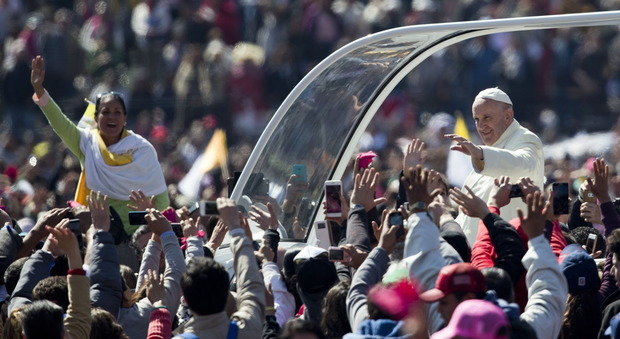
Blog191(8)OsteenPope Francis waves to the crowd, aboard the popemobile in Mexico City's main square, the Zocalo, Saturday, Feb. 13, 2016. Pope Francis kicks off his first trip to Mexico on Saturday with speeches to the country's political and ecclesial elites. The pontiff's five-day visit will include a very personal prayer at the Virgin of Guadalupe shrine. (AP Photo/Moises Castillo)

Jesus said ‘be perfect’ (Matthew 5.48) so why don’t we see you trying?

Sick

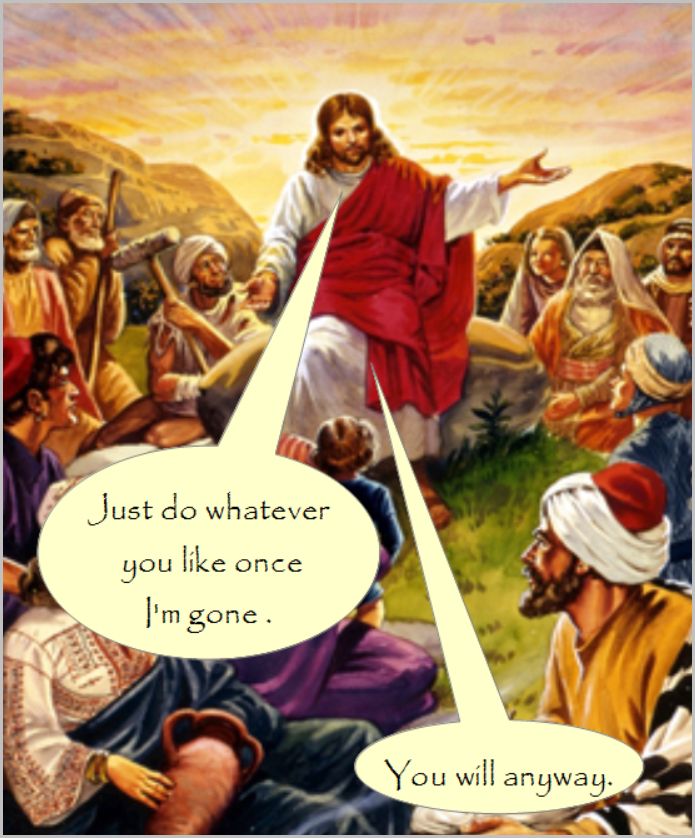
Jesus asked why you call him ‘Lord, Lord’ and yet don’t do what he tells you (Luke 6.46). Evidently he didn’t understand, as you do, just how many of his commands are optional. Thank goodness you know better than he did.

Get your free Porsche here*

*Or maybe notRaising

A True Story**

“So,” he says, “you might have an old banger now but when it finally packs in for good, we’ll upgrade it for you, free of charge.”

“You’ll upgrade it?”

“Sure. No problem. You see your old car is… well, I’ll be honest with you, it’s a really rubbish make. It’s a pile of crap to tell you the truth.”

“A pile of crap?” I splutter. “I can’t believe what I’m hearing. If it’s such a pile of crap why’d you sell me it in the first place? Why d’you sell them at all?”

“No need to get upset, mate,” he says. “As I said, when it’s completely clapped out we’ll replace it with a brand new one, free of charge.”

“Free of charge?”

“Yeah, that’s the deal. You wear out a lemon we give you a brand new Porsche.”

“A new Porsche? C’mon man, you’re winding me up. Why would you give me a new Porsche for nothing?”

“Because as I said, that’s the deal. Have a little faith man. It all works out.”

“Okay, I say. Well how about I get the Porsche now. Before this old rust bucket let’s me down completely.”

“Doesn’t work like that mate,” he says. “You get the banger first, the Porsche at the end.”

I tell him this makes no sense at all. “Look… Paul,” I say, reading his name off the dirty old name tag he’s wearing, “if you want people to have a completely free brand-new, top-of-the-range luxury car then you should just give it to them the first time they come in here. Forget the clapped out old banger bit. Just give them the Porsche.”

“Nah, mate. I’ve told you, that’s not the offer.”

“Okay,” I say, making one last effort. “Show me one person who’s benefited from this mad scheme of yours. Show me one person who’s driven away in a Porsche after their old vehicle’s reached the end of the road.”

“Listen, mate,” he says, “it’s like I said. You need to have a little faith.”

One person,” I say.

“Okay,” he mumbles, ”there are stories that the boss’s son did once…”

“The boss’s son? ‘Stories’? Christ, what sort of con are you operating here?”

“You’ve upset me now, you fool” he says, “and I’m not sure you qualify for the deal any more.”

I can only shake my head. “I’m not sure I ever did… mate,” I say.

*   *   *   *   *   *   *   *   *   *   *   *

**Yes, this really is a true story. You can find it in Paul’s first letter to the Corinthians (15.35-50). Here’s how it goes there:

But some one will ask, “How are the dead raised? With what kind of body do they come?” You foolish man! What you sow does not come to life unless it dies.  And what you sow is not the body which is to be, but a bare kernel, perhaps of wheat or of some other grain…

So will it be with the resurrection of the dead. The body that is sown (buried) is perishable, it is raised imperishable; it is sown in dishonour, it is raised in glory; it is sown in weakness, it is raised in power; it is sown a natural body, it is raised a spiritual body…

Flesh and blood cannot inherit the kingdom of God, nor does the perishable inherit the imperishable.

Right…


There’s good news and there’s good news…

Bat-Jesus

Mark, Matthew and Luke all tells us that Jesus preached the gospel when he was alive (Mark 1.14-15; Matthew 4.23, 9.35 & 10.5-7; Luke 20.1). So what was this gospel? What was Jesus’ ‘good news’? He had yet to die so it couldn’t possibly have been ‘you can be saved through my death and resurrection’ because this magic formula had yet to be arrived at by those who came later. Nor could it have been ‘accept my substitutionary atonement whereby I take the punishment you deserve in order to restore your relationship with God,’ for much the same reason. Nor could it have been, ‘you must accept me as your personal your saviour if you want to gain everlasting life in Heaven,’ because he didn’t regard himself in this way and he didn’t, according to the synoptic gospels, offer an eternity in Heaven. No, Jesus’ good news could not have been any of these because they are all later developments, mumbo-jumbo invented about him by others, not things he said himself .

Actually we needn’t speculate on what the good news was that Jesus preached because the gospels tell us: God was going to intervene in history very soon, rescuing his people from Gentile rule and setting up his Kingdom, in which he, Jesus, would be judge and king (Matt 24.27-34 & 25.31; Luke 1.33; 21.25-28). People, he said, referring only to Jewish people, should prepare themselves for this coming Kingdom by mending their ways (Matthew 10.5-6).

How soon would all this happen? In the lifetime of his hearers according to Mark 9.1, Matthew 16.28 and Luke 9.27, maybe even within a few weeks or months. When sending out the disciples to spread his good news he promised them, ‘you will not have gone through all the towns of Israel, before the Son of man comes (to usher in the new Kingdom)’ (Matthew 10.23). We can only assume that the disciples are back by now – in fact they return a few verses later – yet the Son of man still hasn’t materialised among the clouds in full view of ‘the tribes’ of the Earth (Matthew 24.30).

As the Bible records, Jesus was wrong in every respect; God did not set up his new Kingdom within the lifetime of those Jesus spoke to; the Son of man did not appear; the Romans were not overthrown; Jesus was not appointed judge and king of the world. The sarcastic inscription on his cross, ‘King of the Jews’, was the closest he came to having his self-aggrandising prophecy realised.

Is this the Jesus that Christians worshipped subsequently and still worship today? It ought to be as he’s the one revealed in the first three gospels. But the Jesus believers carry around in their heads is not this man. The ‘Jesus’ worshipped by Christians is primarily a construct of Paul’s – his ‘Christ’ – and their own collective imaginations. The mythical ‘Christ’ that Paul ‘did not receive from any man’, has replaced and almost obliterated Yeshua and his mistaken beliefs about the coming Kingdom (though Paul held on to the idea that it was indeed imminent; see 1 Thessalonians 4.15-17).

Admittedly ‘the Christ’ has had a far better shelf-life than Yeshua could ever have had on his own; the continual resurrection of the idea in the minds of believers – and only there – has ensured the perpetuation of the myth. When all is said and done, however, the Christ is nothing more than an imaginative recreation of a failed zealot with an altogether different gospel.* Yeshua’s good news of the Kingdom died shortly after he did and like him has stayed dead, its echoes preserved by Mark, Matthew and Luke and ignored by Christians everywhere.

* I’m aware there is a body of thought that gives primacy to the mythical god-man, ‘the Christ’, with the Jesus stories being seen as a later ‘in-fill’ designed to provide him with a plausible back-story. I’m not convined of this for several reasons, which I’ll explore at a later date.

Christianity: always winter but never Christmas

Spot the difference:Shore

Christians are hot on evidence.

There isn’t enough for evolution, they say, even though there’s an abundance.     

None, they claim, that the Earth is billions of years old, but only 6 thousand.

Not enough that climate change is man-made, when there’s considerable evidence it is.

None that there’s a genetic component to homosexuality when science reveals that there is.

But, as far as the resurrection of the body, judgement and eternal life in either Heaven or Hell are concerned, these they believe in, no evidence required.

I recently challenged Christians on Charisma magazine’s blog-site to provide or point me to evidence that any one of the 107 billion people who has ever lived who after they had died had gone on to enjoy either eternal life in Heaven or eternal punishment in Hell. Unfulfilled promises from magic books weren’t admissible, because a promise of something happening is not the same as it actually doing so. Jesus didn’t count either, as there are no eye-witness accounts of his bodily resurrection, only stories written decades after the supposed event. In any case he was half Vulcan or something, not an ordinary mortal.

Alas, my challenge went unanswered. You won’t find it on the Charisma site now because it has been removed by the moderator there. Expecting evidence from Christians for what they believe is patently unreasonable. After all, who needs evidence when you can exercise your licence to believe whatever you’re told?

Of course, there is no evidence of any resurrection nor of anyone who has gone on, post-mortem, to enjoy everlasting life. Have you noticed how everything about Christianity is either invisible – God, the Holy Spirit, Heaven, angels, demons – or lies permanently in the future; the Second Coming, the resurrection of the body, the Kingdom of God, judgement and eternal life? All of them always just that little bit further on. This year, next year, sometime, never. Just not now.

Yet Jesus, Paul, Revelation’s John and most other New Testament luminaries believed God’s Kingdom, the resurrection and judgement were coming within their own lifetimes.* Not one of them entertained the thought that 2000 years down the line none of these miraculous events would have materialised.

Small wonder then, that at the start of the second century, believers began to lose hope in the Second Coming, the Kingdom’s arrival and an earthly resurrection of the dead. Maybe, some of them began to think, eternal life would be not be here on Earth, as Jesus and Paul had promised, but in Heaven with God, which they most definitely hadn’t. This way, everything that hadn’t happened here on Earth would happen instead after death (we can see this transition taking place in the very late gospel of John). All of which was fortunate, because it dispensed with the need for confirmation and evidence; no-one could prove – apart from the fact nobody has ever survived their own extinction – that believers didn’t go to Heaven when they died. Equally, no-one could provide evidence they did.** How neat and convenient.

So if any Christians reading this would like to like to show us some evidence for the resurrection of the dead, post-mortem judgement, Heaven, Hell, God’s Kingdom on Earth – any of it – I’m sure we would all like to see it. Until then, I will go on regarding all of these assurances as empty promises – pie in the sky – that believers cling to desperately, while calling their desperation ‘faith’.

* See Matthew 16.27-28 & 24.27, 30-31, 34; Luke 21.27-28, 33-34; 1 Corinthians 15.51-52; 1 Thessalonians 4.15-17; 1 John 2:17-181; Peter 4.7; Revelation 1.1 & 21.2-4

** Psychics claim to commune with the dead of course, or at least with their spirits; more hokum from the minds of the deluded. Even if it weren’t, this isn’t the kind of resurrection Christians envisage for themselves. They dismiss psychics’ ‘evidence’ of life-after-death as so much demonic deception.

Now make up a story about it

Bible4

So there we have it. The accounts of Jesus’ resurrection all derive from imagined sightings of him post-mortem. Call them hallucinations, visions or revelations, none of them were encounters with a real, revived physical being.

Except that’s not quite it, because it’s worse than that, Jim.

Most of our accounts of the resurrection appearances are fifty years or more too late. Paul’s is the only first hand account we have and even that is sketchy and recounted several years after it happened. For at least three of those years, Paul meditated on his seizure and interpreted it as a revelation from the Lord. Undoubtedly, others had similar experiences; the stories of the resurrected Christ came from somewhere and the resurrection seems to have been central to Christian faith from its earliest days. Paul cites in 1 Corinthians 15:4-8 those he says have encountered the risen Christ:

He appeared to Cephas, then to the twelve. After that He appeared to more than five hundred brethren at one time, most of whom remain until now, but some have fallen asleep; then He appeared to James, then to all the apostles; and last of all, as to one untimely born, He appeared to me also.

Paul implies here that his own experience is the same as that of the others on his list; they too, then, had visions of the risen Christ within their imaginations. Significantly, Paul omits Mary Magdalene, the first to ‘see’ the post-mortem Jesus according to the later gospels, while some of the other encounters Paul claims to know about do not find their way into those accounts. Of those that do, we can be confident the details are wrong. They were most certainly not as they are described in the stories that eventually came to be written.

The earliest copies of Mark’s gospel famously have no resurrection appearances. The women discover the empty tomb, which Matthew and Luke later lift into their gospels, and, bizarrely, decide not to tell the disciples about it. By the time we get to last canonical gospel, written some thirty years down the line, its author embellishes Luke’s attempts to suggest that the risen Jesus has some physicality; he allows his old friends, especially Thomas, to poke around in his wounds and he eats fish. Nonetheless, as in the earlier gospels, the disciples all have trouble recognising him, even on a third occasion, and are afraid to ask him who he is (John 21.12). Did his followers simply experience, as John 14.15-20 and Matthew 18.20 seem to suggest, an intense sense of Jesus’ presence? This would make the reports of actual sightings evidence of later believers’ need for something more substantial than flashing lights and fuzzy feelings. Which is how, over time, surrounding detail came to be added.

In their specifics, the resurrection appearances in the gospels and Acts are stories that accrued around the visions and inner traumas experienced by Jesus’ friends and other zealots. As such they are fiction; the angels at the tomb – probably the empty tomb itself – the encounter on the road to Emmaus, the fish breakfast and the rest. Bart D. Ehrman demonstrates convincingly in Jesus Before The Gospels, that the oral tradition was not capable of transmitting the details of Jesus’ life and ministry accurately over a 40 year period (when Mark’s gospel was written). The same is true, perhaps moreso, of individuals’ idiosyncratic inner experiences. Over 50+ years, after which Matthew and Luke’s gospels were composed, reports of these visions would have been altered innumerable times by those relating them, ever onwards and outwards; details would inevitably have been changed, added, removed and invented in a protracted game of Chinese whispers. In all probability the gospel writers themselves introduced their own embellishments.

So then, from a small number of visions/hallucinations/feelings, via significantly altered accounts of these same subjective experiences, together with others that are pure invention, to the eventual recording of such stories 50 to 80 years later, this is the evolution of the fantasy that is the risen Christ.

In the Wrong Body

prayer3What to do about those people who feel they don’t belong in the body they were born with? Those who disparage the vehicle that carries them through life? Should we ban them, shun them? Prevent them from using the same bathrooms – to use that ridiculous euphemism for places never known to include baths – as those of us who accept the body we’ve got? Should they be side-lined, castigated and ridiculed?

Well, no. Let’s go easy on Christians who believe they are somehow separate from the bodies that house them; who regard their bodies are inferior to the spiritual being God intends them to be. Christians who look forward to the day when they’ll be relieved of their physical bodies, which will then be transformed into spiritual ones, and who, in preparation for this miraculous change, claim to resist the demands of the body – the lusts of the flesh as the Bible puts it (1 John 2.16). Yes, those Christians, the same ones who disparage people who find themselves in the wrong bodies and want them to conform to the sex they know themselves to be; transgender people.

The Christians are wrong on every level of course:

  • They are not designed to be spiritual beings;
  • None of us is separate from our bodies;
  • The illusion of the self is a product of the brain and wider society, and we demonstrably do not have souls or spirits;
  • Bodies, while frail and susceptible to illness, injury and ageing, are all we’ve got; they don’t survive death and are not refurbished or replaced after it.
  • The demands of the body can be managed but not entirely ignored, not even by Christians who eat, drink, have sex, sleep, defecate and generally indulge their carnality in the same way the rest of us do.

Still, none of this prevents Christians from thinking they’re prisoners of a temporary yet  strangely inhospitable body while here on Earth. You’d think that would make them empathetic to people who are also in the wrong bodies, but you’d be wrong. They ridicule them and tell them that they’re sinful aberrations; they object to their use of the ‘bathroom’ that corresponds to the gender they know themselves to be.

What was it someone once said? ‘Let he who is without sin cast the first stone’. There sure seem to be a lot of sinless Christians about these days.

The Stuff Christians Say… (part three)

DoorToDoorAtheists are aggressive/militant/unreasonable: The Christians might’ve got us on this one. After all, it is incredibly irritating when we atheists start preaching in the town centre or invade others’ events to tell them what to believe or dish out loony pamphlets or turn up at people’s doors when they’re just about to have their tea. And what about all those meeting places we have, on just about every corner of the city, with smart-arse posters about Adam and Steve on the board outside? And let’s not forget our readiness to blow up ourselves and others in the name of our great cause. Now that’s ‘militant’! Yes, we atheists really do have too much freedom to push our views on others. No wonder we’re so insufferable. (Note to self: check you’ve got this right.)

It takes more faith to be an atheist than a Christian: It takes no faith to recognise there are no supernatural beings. It takes no more faith not to believe in God – or to acknowledge that there is no God to believe in – than it does not to believe in Santa Claus, Poseidon or Ra. Christians themselves require no great abundance of faith to dismiss these characters. Is it so difficult to understand that atheists disregard the Christian pantheon of fantasy figures in exactly the same way? Or are believers practising their dishonesty-for-Jesus again? There is no faith involved in being an atheist. On the other hand, believing in an omnipotent but suspiciously inactive God, a super-hero Saviour, a magic Spirit, angels, cherubim, seraphim, demons, Satan, resurrected saints, Heaven, Hell and all manner of powers and principalities – this requires faith in delusional quantities. No atheist could possibly compete. Nor would they want to.

Faith: An Exercise In Futility

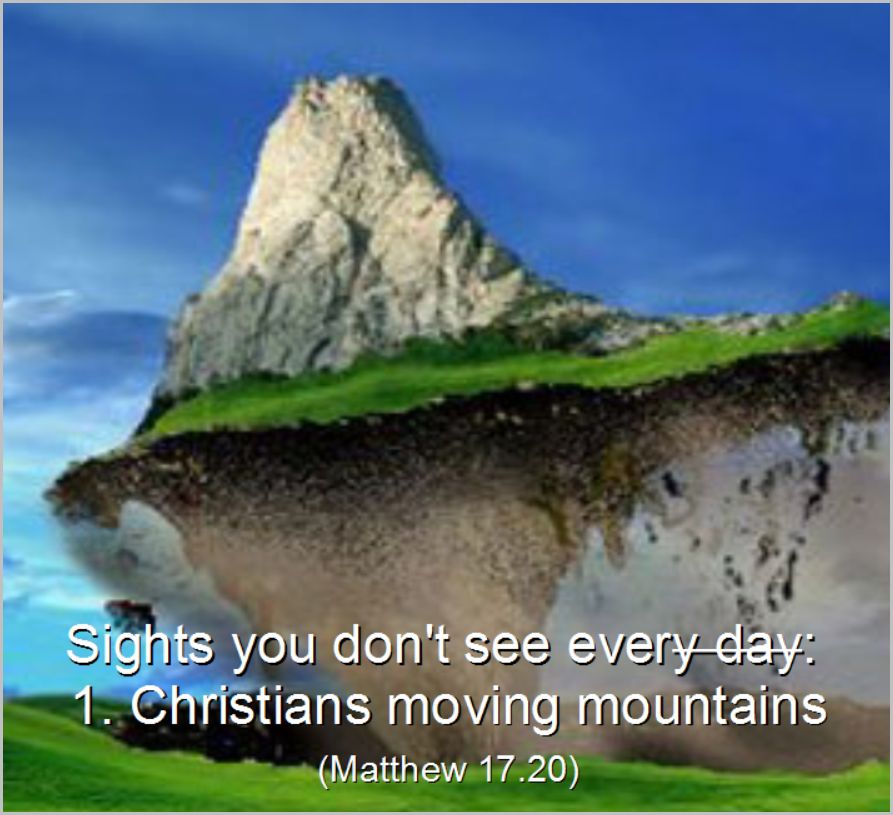
MountainsWhat is faith?

The anonymous author of the book of Hebrews says it’s ‘the substance of things hoped for, the evidence of things not seen.’ (11.1)

Hoping for ‘things’ like perfection, resurrection, eternal life, heaven (not to mention the ability to move mountains), the likes of which no-one has ever achieved, is nothing but wishful thinking. Despite what the Hebrews author says, wishful thinking isn’t evidence of anything – except a capacity for wishful thinking.

By it’s very nature, then, faith is not evidence, but the very opposite. It is the effort to believe in things for which there is no evidence and the delusional insistence that the imagined is more real than that which is.

The Stuff Christians Say… (part two)

Balaam

Atheists don’t behave as evolution says they should: This ridiculous accusation is often slung at atheists by Christians who seem to see it as some sort of stinging rebuke. Answers In Genesis is very fond of it; the Hamster’s drones and other Christians seem to believe – without ever thinking it through (plus ca change) that because those who acknowledge the veracity of evolution don’t behave according to its principles they are somehow inconsistent in their ‘beliefs’ – hypocritical even. They seriously propose that because natural selection and the survival of the fittest (not one of Darwin’s phrases) are cruel, uncaring processes, then that is how, for the sake of consistency, atheists ought to behave too. We shouldn’t care, they say, when a child develops cancer or someone dies. We shouldn’t attempt to cure illness or work to prevent suffering because these are nature’s way and part of the mechanism of evolution.

While it’s true they are, it’s been a long time since our behaviour, our existence and continued success as a species has been solely determined by what nature does. Humans regularly override its mechanisms, natural selection included; every time we use birth control, show compassion for the weak, heal the sick, develop medicines, engineer genes and preserve life. And so we should.

Christians seem unable to comprehend that evolution is not a pattern to be followed. It is not a set of instructions for living, a prescription or a set of (a)moral guidelines. It is the best explanation, supported by considerable amounts of evidence, of how life developed on the Earth. As such it makes no ethical claims nor does it demand that its principles be blindly followed (that’d be religion). Are Christians truly unable to detect this difference?

Atheists have no reason to be moral: I’ve looked at this ignorant claim before. Of course we have reason to behave morally. We’re human, we live in human society. Morals help us do so while doing the least damage to ourselves and others. They may also enable us to bring some happiness or comfort to those around us. Atheists don’t look to an imaginary God to tell us how to be good; our morals come from our culture, upbringing and education. Christians’ morals do too, whatever else they may claim. They certainly don’t get them from that most immoral of books, the Bible.


to be continued…

Do No Harm

sermon2

If religions took ‘do no harm’ to heart (as the Hippocratic Oath does) and their adherents were made to comply with it, what a better place this world would be. There’d be –

No more religiously-motivated suicide bombers and terrorist atrocities;

No more murder in the name of the Lord (whichever);

No more children molested by priests and pastors;

No churches attempting to cover up their crimes;

No more child deaths as a result of ‘faith-healing’;

No religiously-sanctioned denigration and abuse of women;

No more ritualistic mutilation of children’s and young women’s genitals;

No more religious scams and shams;

No more religiously-inspired vitriol directed at gay and transgender people;

No more barbaric executions of ‘minorities’, like gay men, women and those of other faiths.

Of course, even without these, the world would still not be perfect. Awful things would still happen. But the principle of doing no harm would eliminate much of the trauma inflicted on people by the proponents of irrational superstition.

On paper at least, the Abrahamic religions have expectations that are more demanding than simply doing no harm:

Love your neighbour as yourself (Leviticus 19:18; Judaism);

Love your enemies; treat others as you would like to be treated’ (Matthew 7.12 and 5.44; Christianity);

…compete with each other in doing good (Surat al-Ma’ida, 48; Islam).

However, these are just too damned hard for so many religionists. They disregard them and opt instead for the spiteful paranoia of the same holy books. Perhaps the simpler injunction of ‘do no harm’ would be easier for them. But until the preachers of judgement and hatred find it in themselves to promote such a principle, we will all continue to suffer the destructive effects of the ‘great’ faiths.

So, how long until the next terrorist attack? The next church child-abuse cover-up? The next rape scandal? The next persecution of gay people?

      Not long at all.

           Praise the Lord (whichever)!