Power and Influence: you either got it or you ain’t

Blog412c

We the common people, you and I, don’t have the prime minister’s or the president’s ear. We lack power and influence: we’re not the CEO of large companies, obscenely wealthy or part of any religious lobby. Those in power can rely on the fact that next year we’ll have some other cause to send us out on the streets and on to social media. It will not trouble them.

Real change takes decades to achieve. It took over a century for gay people to have the rights they have today. Stonewall was not the beginning, but a milestone on a much longer journey. Protests over the summer don’t have this effect. The Civil Rights campaigns of the ’60s were only partially successful; we wouldn’t now have the Black Lives Matter movement if they had been wholly effective. Likewise women’s rights. Even the previous president of the US, who was inclined to do so, was unable to introduce greater gun control laws; the current incumbent has no interest in doing so and is, in any case, controlled himself by the gun lobby.

The place of the common people is to be controlled, regulated and herded. We’ve seen this in sharp focus during the Covid crisis. Granted safety measures have been for our own good, even if some have taken it upon themselves to defy them. Nonetheless, the advice and regulation during the pandemic has taken on the semblance of law when much of it isn’t at all, with police making criminals of individuals who have failed to comply.

Unless, of course, they were politicians, unelected advisers to the prime minister or members of the royal family. Their flouting of restrictions have been understandable and acceptable; the exception can be made for them. That’s power and influence for you.

If you or I were friends with Jeffrey Epstein and arranged through him to pay underage girls for sex, we might expect, once the law caught up with us, to serve a prison sentence. Not so Prince Andrew. He’s a royal and so exempt: power and influence.

If you or I killed a motorcyclist while driving on the wrong side of the road in another country and then flee the country claiming diplomatic immunity, we should expect to be extradited to face justice. Not so Anne Sacoolas, the wife of a US diplomat in the UK. She does not herself have diplomatic immunity, not that that should matter. Nonetheless, the Trump administration has refused to return her to UK. Power and influence.

If you or I failed to pay our tax in full, you could be sure the Revenue service would be down on us like the proverbial ton of bricks (I know this from experience when they miscalculated my tax a couple of years back.) Yet for many years Amazon, Netflix and Starbucks have either paid nothing or a tiny fraction of tax due in the countries where they make their money. Why should they? They are giants in their fields and above such petty concerns as paying full taxes – that’s for the little people, like you and me. It pays to have power and influence.

You and I probably receive, or received, a modest salary for the work we do/did. Not so investment bankers who award themselves thousands in bonuses – and occasionally millions – on top of extravagant salaries and the interest they make from hedge funds and off-shore investments. Successive UK governments in the UK, from both the left and right, have been promising for as long as I can remember to take down these ‘fat cats’ and restore some equity to remuneration. Despite the bank collapses a dozen years ago they still haven’t. Why? Because bankers have too much power and influence. One thing we’ve learnt during the covid-19 pandemic is that they are far from being essential workers. Yet they continue to receive exorbitant rewards for what they do, while genuine key workers receive far less for their crucial service.

If you or I had lost a loved one in the 417 mass shootings in the US last year we would expect and implore the government to act. But it’s the NRA that has the ear of the president so gun laws remain unchanged. Power and influence.

The Catholic church has claimed at least $1.4 billion dollars from Covid-19 relief funds: not to feed the hungry but to line their own coffers. Who, ultimately, will pay for this handout and similar ones to equally wealthy organisations? That’s right – you and I will, through increased taxes, even though the money doled out was from our taxes to start with.

You and I aren’t able to influence the government with our personal beliefs and philosophies. Religious lobbies can. In the States, a number of prominent right-wing Christians serve as Trump advisers. The president is more than willing to aid them in scaling back the human rights of LGBT people and restricting women’s freedom of choice. In the UK, Church of England bishops have an automatic right to sit in the House of Lords where they can amend and veto the decisons of democratically elected MPs.

You and I don’t have power or influence. We are powerless. We are intentionally distracted, kept occupied by the modern equivalent of bread and circuses: television, sport, shopping, alcohol, social media.

Still, next time we’re faced with an injustice, we can always take to Twitter – or to the streets – for all the good it will do us.

In which Paul takes a trip to the third heaven

Blog408

In the New Testament, there are:

8 or more supernatural ‘visions’;

18 or so ‘appearances’ of angels;

about 6 significant dreams, through which God talks to people;

a dozen apparitions of dead people and

at least 3 significant ‘revelations’, in which individuals sense God in their heads (Paul, Jesus and John of Patmos).

The man who is largely responsible for Christianity as we know it, Paul, alludes only briefly to his magical conversion to the faith, describing it as ‘in’ his head in Galatians 1.16. It’s up to the writer of Acts to elaborate and embroider this non-event. Paul does, however, give rather more detail about another hallucination he has, in 2 Corinthians 12.1-4. To avoid boasting, he says boastfully, he refers to himself in the third person:

I must go on boasting. Although there is nothing to gain, I will go on to visions and revelations from the Lord. I know a man in Christ who fourteen years ago was caught up to the third heaven. Whether it was in the body or out of it I do not know, but God knows. And I know that this man—whether in the body or out of it I do not know, but God knows— was caught up to Paradise. The things he heard were too sacred for words, things that man is not permitted to tell.

This is evidently a psychotic episode; seeing things that are not there, experiencing events that are not happening. Paul himself admits he doesn’t know whether it was a real experience, nor does he know if he was in his body or not (definitely in it, just out of his mind.) He heard, he says, things he can’t possibly repeat, which makes you wonder why he bothers mentioning the whole bizarre episode in the first place: ‘I had this fantastic experience, unlike anything I’ve experienced before – but I can’t tell you a thing about it.’ It sounds like a dream he’s having trouble remembering or, like, man, a really freaky hallucinogenic trip.

From psychotic episodes like this – his conversion is another one – Paul spins his entire theology. Yes, the faith of Christians everywhere is founded on the hallucinations of a first century nutcase visionary.

I don’t know about you, but I’ve better things to do with my life than base it on the dreams and visions of a psychotic who lived 2000 years ago.


Demons, demons everywhere…

Blog407

I wonder if any Christians out there can help me understand something. I know that not all of you believe in demons; some of you are far too rational to believe in non-existent supernatural beings! I know too that when the bible mentions demons, as it does often, you know it’s as a metaphor, for sin perhaps, or as the personification of evil. Presumably, you reach this conclusion with the help of the Holy Spirit (you do believe in him, don’t you?)

And yet other, lesser brethren are led by that same Spirit to see demons as 100% real.

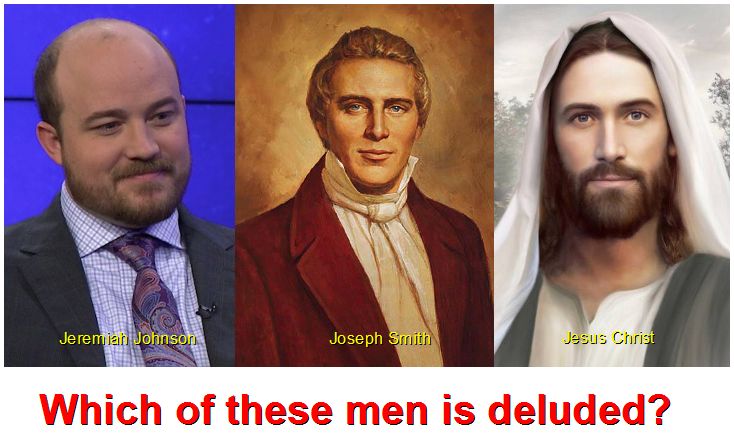
Take this guy, Jeremiah Johnson, a preacher/prophet/author from Florida who recently had a real live conversation with a demon:

On the night of May 30th, while praying and pacing over the United States in my home around 2 am, a demonic entity appeared right before me in an open vision. This type of encounter has only ever happened one other time while I was ministering in a foreign country in 2015. I have always engaged in this type of spiritual warfare while asleep and dreaming prophetically, but rarely if ever to this degree while awake.

This demonic entity had a visible and deep scar underneath its right eye, but it also had the ability to mutate or rather change forms. I watched this “being” morph several times right in front of me, yet the gash below its right eye remained.

As I see it, there are three options here. Either –

a) This really happened, or

b) Jeremiah made it up, or

c) It happened but entirely within Jeremiah’s disturbed mind

Can you advise me which it is? I’m leaning towards b) or c). I say ‘leaning’ when what I mean is I rule out a) entirely, though I’d be interested to know which conclusion the Holy Spirit is leading you to. (Actually, reading the comments following Jeremiah’s posting of his ‘Urgent Prophetic Alert and Warning’ on Facebook, I already know what 4 thousand of you think: you fall for this crapola hook, line and sinker.)

Of course, not all supernatural encounters are with demons. Sometimes your fellow believers have encounters with angels, or dead people from the bible. Here’s an example of that:

I kneeled down, and prayed, saying, ‘O Lord, what Church shall I join?’ Directly I saw a light, and then a glorious Personage in the light, and then another personage, and the first personage said [of] the second, ‘Behold this is my beloved Son, hear him’” 

Wow, that sounds amazing, doesn’t it? Joseph Smith recounting his first ‘vision’.

Again, you’ve got three options:

Either:

a) This really happened, or

b) Joseph made it up, or

c) It happened but entirely within Joseph’s disturbed mind.

If you’re a Mormon, the Holy Ghost will have led you to embrace option a). I lean myself towards b), possibly c). If you’re an evangelical Christian, however, you probably think Smith’s vision was demonically inspired. Can I ask you why you think this? Is it because that’s what your version of the Holy Ghost tells you? Ain’t it amazing how ‘he’ always confirms what you already believe?

With that in mind, let’s look at one final example:

When Jesus stepped out of the boat, a man out of the tombs with an unclean spirit met him. He lived among the tombs; and no one could restrain him any more, even with a chain; for he had often been restrained with shackles and chains, but the chains he wrenched apart, and the shackles he broke in pieces; and no one had the strength to subdue him. Night and day among the tombs and on the mountains he was always howling and bruising himself with stones. 

When he saw Jesus from a distance, he ran and bowed down before him; and he shouted at the top of his voice, “What have you to do with me, Jesus, Son of the Most High God? I adjure you by God, do not torment me.” For he had said to him, “Come out of the man, you unclean spirit!”  Then Jesus asked him, “What is your name?” He replied, “My name is Legion; for we are many.”  He begged him earnestly not to send them out of the country. Now there on the hillside a great herd of swine was feeding; and the unclean spirits begged him, “Send us into the swine; let us enter them.” So he gave them permission. And the unclean spirits came out and entered the swine; and the herd, numbering about two thousand, rushed down the steep bank into the sea, and were drowned in the sea. (Mark 5.1-20)

Either:

a) This really happened, or

b) Mark made it up, or

c) Mark made it up but it’s a metaphor for something or other.

I’m guessing most of you, including those who regard yourselves as rational Christians, opted for a): you think this really happened in some form. Why? Because this time it’s your hero, Jesus, who’s involved.

However, and this is my point, Jesus’ encounter with a demon – and it’s not the only one in the gospels – is no different in kind from Jeremiah Johnson’s or Joseph Smith’s. If you believe one really happened – the Jesus one – you really haven’t any reason not to believe the other two. And yet, my Christian friends, you reject at least one of the other two, don’t you. You dismiss Smith’s encounter with God and Jesus as, at best, a delusion and at worst, a fiction intended to dupe others. You may, as I’ve suggested, see it as demonically inspired (even though no actual demons appear, unlike in the Jesus and Johnson accounts.)

You may also, if you’ve half a brain, dismiss Johnson’s ridiculous story too. I hope so. So why persist in believing that Jesus met with demons? It’s not the Holy Spirit who convinces you that this story is the only plausible one of the three. The Holy Spirit is only as real as Johnson’s morphing demon. No, the only reason you give Jesus a free pass, but not Smith or Johnson (possibly), is that the Jesus story is in the bible.

So, what’s the answer to the question at the top of this post: which of those men, Jeremiah Johnson, Joseph Smith and Mark’s Jesus, is deluded? The answer is… all of them. And at least two of them are frauds.

Myself, I’m leaning towards all three.


The many and varied, Spirit-inspired interpretations of the Kingdom of God

Blog406Heaven

For the Son of Man is going to come with his angels in the glory of his Father, and then he will repay each person according to what he has done. Truly, I say to you, there are some standing here who will not taste death until they see the Son of Man coming in his kingdom” (Matthew 16.27–28).

Truly I say to you, this generation will not pass away until all these things take place. (Matthew 24.34)

See also Matthew 24.27, 30-31; Luke 21:27-28, 33-34; 1 Corinthians 15.51-52; 1 Thessalonians 4.15-17; 1 John 2:17-181; Peter 4.7

The Kingdom of God. What does it look like? When will it happen? Has it happened? You’d think that with the Kingdom of God being a central part of Jesus’ teaching, the central part, in fact – his ‘good news’ is about nothing else – that these would be questions Christians would find easy to answer.

They don’t. The Holy Spirit inspires a variety of incompatible responses from the faithful to the what, when and where questions. The most popular is, of course, that the Kingdom of God equates with Heaven: the saved are all going to heaven when they die. Post-mortem bliss, most Christians would tell you, is what Jesus meant by the Kingdom of God. After all, doesn’t Matthew refer to the Kingdom as the Kingdom of Heaven? Yes… but no: an after-life in Heaven is not what Jesus and his scriptwriters meant by the Kingdom. If it was, they would have said so, rather than promising, as they do, that God’s Kingdom was coming to the Earth real soon.*

So, when Jesus says the kingdom is just around the corner, which he does repeatedly in the synoptic gospels, he can’t have meant Heaven. Let’s try another favourite: Jesus meant that God’s Kingdom on Earth would manifest itself thousands of years in the future – in our time, no less. It’s all to do, you see, with Jesus’ return and the final judgement. As these have yet to happen then the final part of God’s plan – his reclaiming of his creation – will be in the (far) future too. A neat solution to be sure, but one that runs counter to everything in the gospels and in Paul. Admittedly it’s an idea that was taking shape in 2 Peter (3.8), a forgery written about 150CE, long after it had become apparent the Kingdom was running way behind schedule. However, you won’t find it in the synoptic gospels or the Pauline epistles because it isn’t what Jesus, Paul, the gospel writers or the earliest Chrsitians believed.

Where does this leave Jesus’ devotees today? With a Jesus who didn’t really mean the Kingdom would be manifesting itself in the physical world. This Jesus proclaims the Kingdom as something that exists inside his followers as an internal state of being. It’s true some of his pronouncements appear to fit this interpretation; the Kingdom is within you and all that, but what these statements are about in context is the Kingdom’s immanence at the time; what Jesus was saying was, ‘the Kingdom is arriving now; look at the signs – it’s all around you.’ A gnostic flavoured restructuring of what he actually claimed is yet another Spirit-led interpretation we can dispense with.

Consequently, some Christians accept that, yes, Jesus preached a Kingdom that would dramatically materialise in the real world close to the time he was speaking. That it didn’t in any observable way creates a dilemma: as God Incarnate, perfect and infallible, Jesus can’t have been wrong. This must mean the Kingdom did arrive when he said it would and we are living in it now. The Kingdom, these Covenantists say, is another term for the Christian era; the reign of the church, the Age of the Holy Spirit. We’re living in the Kingdom and have been for two thousand years!

How’s that working out?

Blog406Riot

Blog406Pollution

Blog406Bury

Blog406Starve

Yes, this looks exactly like the Kingdom of God Jesus promised: An eternity of peace with death and illness banished and the meek having inherited the earth; the social order reversed, God in charge and Jesus and his pals running the show. Or not.

So, however the faithful (re)interpret his words, however much they twist, cherry-pick or just plain ignore them, Jesus was wrong. The Kingdom of God did not arrive on the earth in the first century as he predicted. It’s definitely not here now. It won’t be coming in the future and it doesn’t await in an after-life; these were never the deal. (See my earlier series, Making Excuses for Jesus, for more detail.)

Whatever Christians do, wherever their imaginary Holy Spirit leads them, they end up with implausible and incompatible ways of explaining (away) the non-arrival of the Kingdom of God that Jesus promised. It’s a fallacy, a fantasy, another delusion sustained by the wilfully ignorant.

*John 18.36 does have Jesus say that ‘his’ Kingdom, as it’s become by the time of the fourth gospel, is not of this world. John, however, bears little relation to the other gospels and was written at least 70 years after Jesus lived. In any case, it doesn’t say or mean that common-or-garden believers are going to Heaven when they die.

Another name for confirmation bias

Blog405

Most Christians admit to a belief in the Holy Spirit. The majority also subscribe to the notion that this manifestation of God (or Jesus?) guides them in their spiritual journey, supernaturally from within. The Holy Spirit, the Bible says, lives inside believers (1 Corinthians 3.16); an aspect of God designed to fit the human body.

You’d think then, that with part God embedded in their psyche or wherever it (or ‘he’, according to most believers) has taken up residence, that all Christians would think alike; would have the same priorities; would subscribe to the same doctrines; moreso when that other embodiment of God, Jesus himself, supposedly prayed for such a unity (John 17. 20-23).

Evidently they don’t achieve any of this. There are, depending on which authority you consult, in the region of 34,000 Christian denominations, sects and groups, all of which see themselves as possessors of God’s sacred truths. Most regard that it is they alone who possess this truth in its purest form. There wouldn’t be separate denominations otherwise.

And from where do they derive their own peculiar revelation of the Truth? Ultimately, most would say, from the Holy Spirit. It is he who guides them in all truth, as John’s Jesus promised (John 16.13), showing them how to read the bible and interpret it aright (1 Corinthians 2.6-16) and allowing them to discern truth (1 John 4) in what they hear from God’s chosen instruments on earth: pastors, ministers, prophets, evangelists, popes.

And the Truth they arrive at is different from the Truth arrived at by that other sect or wayward denomination elsewhere.Quote4

The Holy Spirit leads different Christians to contradictory doctrines on the essentials of the faith: about how an individual is ‘saved’ for example; whether it’s legitimate to talk of being ‘saved’ at all; predestination; free will; the place of baptism in salvation (essential or not?); Heaven and Hell; the nature of faith itself; the role of ‘works’; God’s plan for individual lives; evangelism; the ‘infallibility’ of the bible; how best to worship God; the nature of God; the existence of other supernatural beings; the role of women in the church. If they can’t agree on these – and they don’t – then what the f**k is the Holy Spirit playing at?

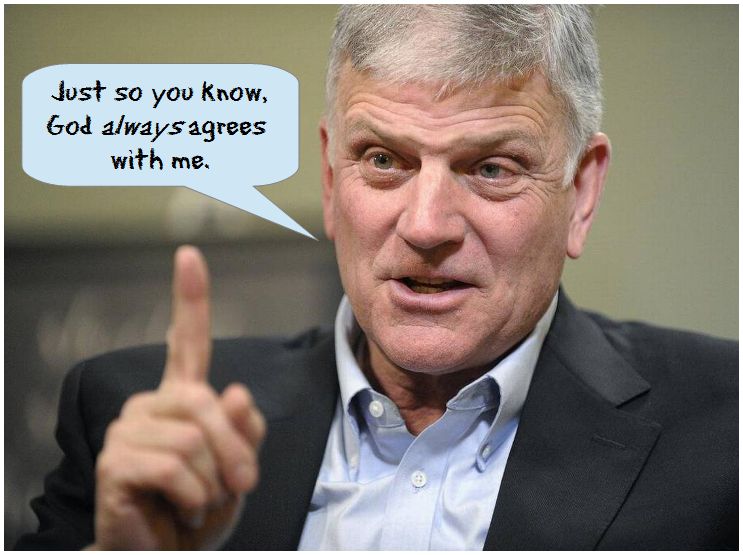
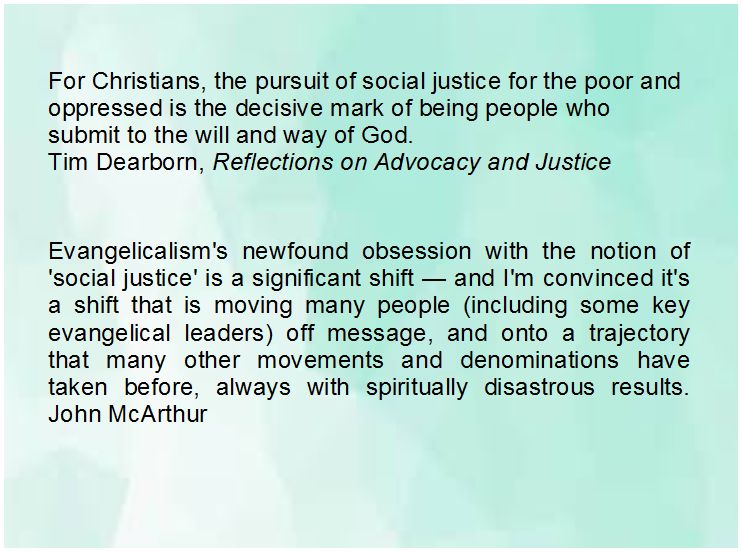
Then there are the issues they claim are of concQuotes2ern to God, though of course they don’t all agree on what these might be: social justice, morality, sex, same-sex relationships, equality, feminism, science, evolution, Hollywood, making America great again, guns, Trump, right-wing politics, liberalism, Covid-19 (many of which, we might note in passing, the bible has absolutely no interest in.) And what do we find?Quote5Quotes1First, the Holy Spirit provides diametrically opposed ‘truths’ to individual Christians, as the quotations within this post illustrate. Second, that same Spirit affirms the views, prejudices and biases of each Christian he speaks to. God’s thoughts are, miraculously, the same as those seeking them out. 

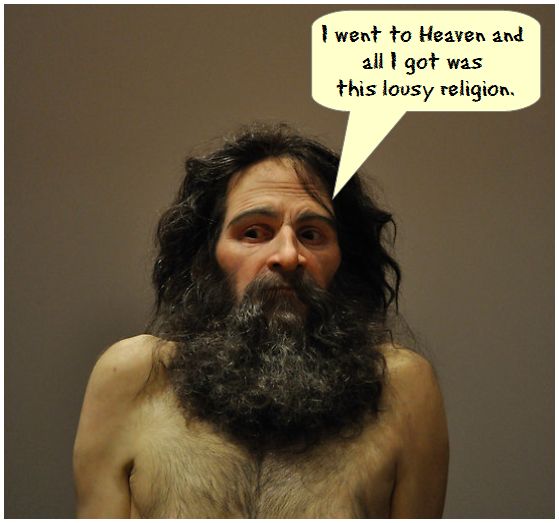
Of course, there is no Holy Spirit. There’s no Holy Spirit because there’s no God. What those who speak for him are doing is voicing the frequently ill-informed and evidence-free suppositions of their particular branch of the cult. Claiming these are endorsed by God is at best a delusion, at worst, sheer deceit.

The Holy Spirit, then: just another name for confirmation bias.


The God Who Never Was

Blog404

I’m considering reasons why God is unlikely to exist. The sixth, though by no means final reason is (drumroll): Christians.

If God existed and if he did the things the Bible, and Jesus in particular, claimed for him, then Christians would be very different creatures. They wouldn’t be beligerent and self-righteous, desperately trying to draw others into their cult, callously condemning everyone outside it while claiming they themselves are the persecuted (a caricature, I concede, but not without truth).

Instead, and according to Jesus and Paul, they would be brand new creations (2 Corinthians 5.17), infused with supernatural power: the Spirit of God no less (John 14.26; Romans 8.7-9). They would, moreover, have abandoned their families (Luke 14.26) and sold all they own to give to the poor (Matthew 19.21), relying solely on God for their needs (Mark 11.24; Matthew 21.22). They’d spend all their time as his slaves (Matthew 25.21; Romans 6.22), helping the sick, the destitute and the imprisoned (Matthew 25.35-40) and in return God would have endowed them with the ability to heal all disease (Mark 16:15), raise the dead (Matthew 10.7-8) and do miracles even greater than Jesus’ own (Mark 16.17-18; John 14.12).

If Christians were like this, as Jesus and Paul promised, the world would be a much more remarkable and better place. What does it tell us that it isn’t? When Christians don’t constantly demonstrate compassion and miraculous powers but instead spend their time demeaning gay people, ranting about abortion and proselytising (the latter a redundant activity when, if they were the new creatures the Bible promises they’d be, we would all see God in and through their actions and superpowers.) That Christians are not like this tells us Jesus got it entirely wrong; that his God had no interest in him and has none in us; that faith in God, as Jesus and his early followers envisaged it, does not deliver.

Christians actually know this, which is why they ignore what the Bible says they should be like, or explain it away with convoluted exegesis. They’re focused on their own ‘spiritual growth’, ‘worship’ and on how they’ll be going to heaven when they die – an offer the Bible never makes. Whichever avoidance strategy they resort to, the Bible says what it says: that God will enable his followers to do great miracles, like healing the sick and raising the dead; ‘all things’, in fact, though Christ who strengthens them (Philippians 4.1). The evidence demonstrates conclusively, despite the disingenuous claims of some loopier evangelicals, that God does nothing of the sort. He fails, yet again, to come through. The only reasonable conclusion is that this is because he’s not real.

So those are six major reasons why it is highly unlikely God exists. There are others, some of which I’ve touched on in other posts: how, despite Jesus’ promises he will, God looks after his devotees no better than caged sparrows (Matthew 10.28-31); how there’s no evidence the supernatural exists; how the spiritual realm and the gods that go with it are products of the human imagination. Collectively – and even separately – these convince me there’s no God, and certainly not that sorry excuse for one, Yahweh.

Jesus: best social distancer ever

Jesus is coming back. He’s coming back soon! The Covid-19 pandemic is a sign of the end times and it won’t be long now till Jesus returns to rapture all his buddies!

I know this because a whole load of cranks pastors are telling the world that, once again, the end is nigh. 56% of U.S. pastors polled believe it’ll be real soon with 97% convinced that if not now, then in the near future.

In reality, Jesus is never coming back. He might appear to predict his return in the gospels but he said it would be soon relative to those who were listening to him. True, he didn’t appear to know exactly when it would be because his Father hadn’t deigned to tell him (weren’t he and the Father one?) but he did know it was soon:

Truly I tell you, some who are standing here will not taste death before they see the Son of Man coming in his kingdom (Matthew 16:28).

Truly, I say to you, this generation will not pass away until all these things take place (Matthew 24:34).

I don’t believe Jesus said this at all. His mission while he was alive was to kick-start God’s kingdom on Earth and to right the wrongs done to his own people, the Jews. He didn’t expect to die when he did (he didn’t predict his death either) but right up the last minute thought God would intervene, rescue him and set him up as King of the world (Matthew 19.28). All of this is preserved in the synoptic gospels.

Once everything had gone disastrously wrong, his followers had to make sense of his premature death. So followed the stories of a resurrection, based on grief-induced visions and fuzzy feelings. Once these faded, his early followers became convinced this wasn’t – couldn’t be – the end of the story. Jesus had to come back to complete his mission. The newly converted Paul thought so too: Jesus’ death wasn’t the end; his resurrection wasn’t the end – it was the beginning; when Jesus came back down from Heaven he would resurrect his followers and the Kingdom of God would arrive. Paul believed this would happen in his own lifetime (1 Thess 4:15-17)

When the gospels came to be written decades later, Jesus himself was made to say much the same thing. Like a 1st century Arnold Schwarzenegger, he promised he’d be back. But Jesus wouldn’t have said this. He had no intention of going away until his mission – to bring about the Kingdom of God on Earth – had been completed. Subsequent believers, including the gospel writers, knew with the benefit of hindsight that this mission hadn’t gone to plan. Consequently, they rewrote the plan. Jesus, having risen from the dead (or so they believed) would be returning to complete his mission. They then retrospectively supplied him with foreknowledge not only of his supposed return but of his execution and resurrection too. The predictions of a second coming were put into Jesus’ mouth by later believers; the gospel writers specifically.

They were wrong. Jesus did not return when they hoped, which is hardly surprising for any number of reasons: the dead don’t come back to life; Jesus himself didn’t promise he’d return (neither the first time nor the second); beliefs, however resolutely held, do not create reality.

The Jesus story would now be over and done with if it were not for Paul re-interpreting into something it wasn’t; substitutionary atonement designed for Gentiles as well as Jews. Jesus failed to inaugurate the Kingdom of God on Earth (no surprise there); he didn’t rise from the grave; he’s not coming back. Believing won’t make it so.

Happy Easter y’all.


God or Superman?

Blog397

An early problem faced by the creators of Superman, only a few years after his first appearance in Action Comics #1 in 1938, was his impotence in the real world. Here was a character with incredible super-human powers – not quite as phenomenal as they would later become – who could defeat gangsters, wife-beaters, bullies and evil dictators with a flick of his little finger, but who, when a real life bully emerged on the world stage, couldn’t do anything. Stories could have been written about how he single-handedly defeated the Nazis and restored world peace but none of this would have been reflected in the real world. It’s true that today with its alternate realities and constant rebooting that Superman could be made to defeat modern-day fascism; but that would be on some other fictional Earth, not the real one. In the real world, Superman would remain impotent, having little effect beyond raising awareness and morale, which is what he did – or, more accurately, what his creators had him do – during World War II. There wasn’t anything else he or they could do.

By now, coronavirus should really have disappeared from the face of the Earth. Last Sunday was National Day of Prayer in the US. Independent of Donald Trump’s ‘initiative’ in calling for a day of grovelling in front of the Almighty, many other Christians have also been begging God to protect their church community from covid-19 (the godless can fend for themselves). Still others have commanded the virus, in the name of Jesus, to leave them and the USA alone (the rest of the world be damned.)

The effect of all this pleading and commanding has been that the coronavirus has continued to spread, heedless of borders and indifferent to the religious beliefs of its victims. Either God doesn’t give, as we say in this neck of the woods, a rat’s arse about who contracts covid-19, nor who dies from it, not even his born-again Chosen Ones. Everybody’s gotta die sometime, right? The important thing is that they’re right with the Lord before they do.

Or – God’s just like Superman. We can imagine him doing all sorts of incredible things, like healing disease, curing illness and saving the world, but in reality, none of them ever happen. He’s not going to protect people from coronavirus in precisely the same way he failed to protect them from 9/11, AIDs, the Holocaust, Spanish Flu, The Great Plague, Black Death and Leprosy. It’s not that he doesn’t care, it’s that he’s not there. He’s no more real than Superman and is every bit as impotent as the Man of Steel.

I’m a big fan of Superman – I’ve been reading the comics he appears in for 57 years now – and I’m fully aware he’s not real; he was created by Jerry Siegel and Joe Shuster 82 years ago and has been embellished by every writer and artist who’s worked on him ever since – much like God. If only those who plead with the Almighty, and worse, tell the rest of us what he thinks of us, would recognise that he is fictional too. He exists only in a fantasy realm, outside of which he has no super-powers, no influence, no ability to save us from coronavirus or anything else.

Remember the sequence in the Simpsons episode where Homer is, as usual, in lots of trouble; he looks to the sky and pleads, ‘I’m not normally a praying man, but if you’re up there, please save me… Superman.’ That’s exactly what Christians are doing right now, and the result will be the same as it was for Homer and for everyone else who’s ever called on Superman God to save them.

The Choice Is Yours

Blog395c

I don’t get a lot of comments on this here blog, but when I do they’re rarely as cogently argued as this one, left recently on an old post,Unbelievers are Going to Hell:

NO OBLIVION. HEAVEN OR HELL. HOLINESS OR DEBAUCHERY, GOOD OR EVIL, VIRTUE OR VICE, JESUS OR SATAN, THE SPIRIT OR THE FLESH, GOD OR IDOLS, RIGHTEOUSNESS OR WICKEDNESS, KINDNESS OR SELFISHNESS, LIGHT OR DARKNESS, PIETY OR PERVERSION, PLEASURE OR PAIN, TRUTH OR ERROR, THE NARROW GATE OR THE WIDE GATE. THE CHOICE IS YOURS.

Difficult to argue with, I think you’ll agree. This is reasoning of the highest calibre. All those false dichotomies have convinced me I need to change my debauched, perverted ways and take on the mindset of a first century zealot. You win Watchman Outreach Evangelism!

Or, as I may have just put in my response:

Lower case or UPPER CASE
Logic or LUNACY
Reality or FANTASY
Sense or NONSENSE
Seems you made your choice already.

Coronavirus defeated

Blog395

Thank God the Coronavirus pandemic is over. It was scary there for a minute or two. Over 3,000 people died from it. Fortunately, they were mainly Chinese and South Koreans. Vice-president Mike Pence and other anti-abortionists Christian leaders have now taken care of it. On Friday they prayed that it would go away and God has done as they asked. The picture above, courtesy of The Friendly Atheist, shows them doing it. Here’s some other nitwits righteous ones doing the same thing and here an article about the prophet whom God chose to announce to the world that the threat was over. You have to wonder, though, why he made the virus in the first place and why he allowed it to spread so indiscriminately. I mean, even Christians were infected.

Truly, the way to resolve a world wide health crisis is to enlist the help of an imaginary sky fairy who, as usual, does f**k all to help.

Next week: the coronavirus continues to spread. These same men of God then realise that the virus is actually God’s punishment for abortion… er, homosexuality… um, opposition to Trump… er, people shaking their fists in his face (he really doesn’t like that.) Then it all becomes clear why God made the virus in the first place. Difficult to explain why he started it off in China though, but the Lord will surely let his prophets know that too (I mean, those Chinese are commies.)

Life must be easy when all you have to do is make stuff up. It’s more than a little bit worrying that those who do it are listened to by multitudes who’ve switched off their critical faculties. More worrying still when some of these fantasists are in charge of entire countries. The only way coronavirus will be defeated is through science; the development of a vaccine, which is still many months away. Imaginary deities – and they’re all imaginary – prayers, pleading and blaming are all worse than useless.