Responding to a Christian

I responded to comments by our resident cultist, Don Camp, who replied with the following (and more: see comments). I want to pick up (in blue) on some of the points he makes:

I originally asked Don: why is it that whenever anyone asks you to provide evidence for your beliefs, or to confirm what those beliefs actually are, you invariably side-step the issue.

Don: That seems to be the procedure (your procedure, Don?) here and on most atheist blogs, I might add. I really think that I have answered that question clearly enough to be understood (you’ve responded to some questions but have provided evidence for very little of what you’ve claimed. Bible quotes are not evidence.) If not, there is my blog post. But I would ask the same and have of all of you. What do you believe to be true about life and reality? And why or what evidence do you have to support that belief?

Don, there’s ten years’ worth of blog posts on Rejectingjesus, many of which are about what I believe and the evidence I have for those beliefs. I’m not going to reiterate all of them here for your benefit. If you’re interested you could read the posts here, here, here, here and here. I suspect you’re not though; this is just another tactic to deflect the question away from yourself. Don’t you think it reasonable when you launch your sermonettes on other people’s blogs that they ask you to supply evidence for the beliefs you’re promoting? 

Don: I usually get what, I believe, Ark said when I asked about his evidence for Materialism: Everything we know has natural causes, so to presume that the whole universe has a natural cause reasonably follows. (My paraphrase) That is honest and clear. But that is the very same kind of evidence I’ve provided for my worldview. You, Neil, have not provided even that much. Usually I get something like: Atheism, is about what we don’t believe, and we don’t believe there is evidence for God. The trouble is that is negative that conveniently sidesteps the question.

So you do get answers to your questions (so what you moaning about?) I concur with Ark. However, you do not provide the same sort of evidence. You generally rely on the argument from incredulity: I can’t see how something so amazing as the universe could have come into existence on its own, therefore God must’ve done it.’ This is not evidence. You then make the further unfounded claim that this God must be your God who magically created everything via the agency of his Son. Whatever this means, it is not evidence. (Before you say you don’t do this, just check out your further comment below.)

Neil: How about answering my question: do you subscribe to Paul’s first century view that ‘the world’ is governed by wicked powers and principalities that hover around us causing all sorts of mayhem…

Don: No and Yes. No, I don’t think that people are governed by those powers, but they are influenced by them. Yes, I believe there are powers that influence people. And I believe that people can so give themselves to that influence that I would say they are governed by them. (my emphasis). So no prevarication here then! Now how about answering mine. Do you believe that reality is purely material? See above and the posts I directed you to. There is no evidence for the supernatural.

Neil:  Could only a blood sacrifice, in God’s eyes ameliorate (the effects of these demons)?

Don: No. Those powers do not cause sin. We do. (And that I believe is really Paul’s view.) Right. So you know what was really Paul’s view, which, it turns out, is not the one expressed in Ephesians 2:1-3 & 6.11-13. (Addendum: it’s widely acknowledged that Paul didn’t actually write Ephesians. It’s a later forgery based on Colossians.)

Don: No. I believe that only forgiveness can ameliorate sin. The sacrifice of the Lord Jesus is the act of forgiveness made visible. Does your believing make it so? Where does the bible actually say this?

Neil: where is your evidence that this (Paul’s worldview) is reality?

Don: I am not sure what “this” means. There are too many possible referents. If you replace that with a specific, I’ll answer.

It’s clear and specific, Don. We were discussing Paul’s worldview. I asked if you believed it and if so, what evidence you had that ‘this’, Paul’s demon-infested world, was real. You’re side stepping again. 

Me: Or how about answering Ark’s question about whether you believe Jesus was the creator of the universe and what evidence there is for such a belief?

Don: I don’t recall that question exactly (!) But the answer is I believe that God created the universe through the agency of his Son and the earth within it. (And I think that is the crux of our differences). You’re not kidding. 

Don: Evidence “succinctly” is, to use a metaphor, his fingerprints are all over it. Is a metaphor evidence? I don’t think so. It’s a literary device. In any case, every other religion that claims a creator God says the same thing. 

HOW DO YOU THINK THE UNIVERSE CAME TO BE, AND WHAT EVIDENCE IS THERE FOR SUCH A BELIEF? AND HOW DO YOU ACCOUNT FOR THE DYSFUNCTION OF HUMANITY THAT CAUSES ALL THE CHAOS AND DESTRUCTION MORALLY AND SOCIALLY? AND FINALLY, WHAT IS THE REMEDY?

My God. You’re gone all caps lock. In answer to your very important questions, see my response above. To summarise:

It is largely irrelevant what I THINK about the origin of the universe. It’s possible, however, that the universe has always existed in some form. You claim this for your God when there’s no evidence he exists; assuming those same qualities for something that does is a more realistic prospect. It is indeed what a number of scientists think. (I expect you’ll know better).

The ‘dysfunction of humanity.’ Is it dysfunctional? Many of us are kind and decent. Humanity is what it is, and it is what it is because we’re evolved primates.

The remedy for what, Don; for what we are? It’s quite likely there isn’t one. Jesus certainly isn’t it. History teaches us that Christianity has only provided some of us with an excuse to behave even more reprehensibly (Putin claims to be a Christian albeit a Catholic; he says one of the reasons he’s invaded Ukraine is to impose traditional Christian values on the country.)  If anything is going to improve us, it’s education; it has civilised us to a significant extent but still has a lot to overcome. 

That’s it. Now go and read those old posts before writing your next sermonette. 

The ‘F’ Word

Don Camp is defending Christians in the comments. They’re in the process of becoming ‘more like Jesus’, he says.

What does this even mean, Don? How can you know what Jesus was like when there are so many disparate versions of him in the Bible (as has been pointed out to you)? Does becoming more tempestuous, impatient, impossibly demanding and Jewish count? These are some of the traits his propagandists show him as having.

You then tell Jim not to measure Christians ‘by his (own) experience’. What other measure is there? Christians aggressively promote their beliefs on the internet, have infected politics and, at a lower level, are encountered as judgmental evangelicals and sanctimonious street preachers; these are the Christians of our experience and like it or not, the fragrance ain’ that sweet. As Jesus is supposed to have said, ‘by their fruits shall you know them’. We sure do.

Bottom line, Don: you Christians have had two thousand years now to make the world a better place by being ‘more like Jesus’. On balance, you’ve failed. Not surprising when Jesus himself failed even more. Where is he, Don? Following his ‘return’, the Righteous should have been living in peace and harmony for the past two millennia, tediously worshipping him and his Father in God’s Kingdom on Earth. They haven’t been, even though Jesus, Paul and several other NT writers said they would be ‘soon’, relative to their own lifetimes. 

Argue it how like, Don (and you will), Christianity merits one big ‘F‘.

Dear Evangelical: Why Aren’t You A Mormon?

Dear Don,

Why are you not a Mormon? I mean, you appeal to the evidence of consistency across the 66 books of the bible, claim that the gospel writers remained true to an oral tradition (despite John’s gospel being markedly different from the other three) and insist there is no difference between the original apostles’ gospel and Paul’s (when Paul is adamant there is.) In fact, there is even better evidence that Mormonism is true.

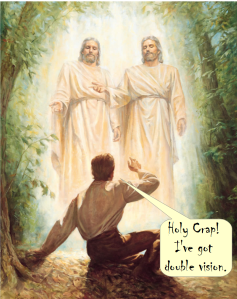
First off, Joseph Smith saw the resurrected Jesus in person! Not only Jesus but God the Father too. And they spoke to him! He relates the story himself, so unlike the gospels, this is no second hand reportage:

I saw two Personages, whose brightness and glory defy all description, standing above me in the air. One of them spake unto me, calling me by name and said, pointing to the other—This is My Beloved Son. Hear Him!

Following this, young Joseph was instructed to translate the Book of Mormon from some golden plates. We don’t have to take his word for it that these plates existed because Joseph had witnesses:

Eleven official witnesses and several unofficial witnesses testified to the existence of the golden plates and, in some cases, to dramatic supernatural confirmation of their truth. Meticulous research on these witnesses has confirmed their good character and the veracity of their accounts.

Impressive, don’t you think? We have no such affidavits for the gospel writers – we don’t even know who they were!

Also like the Bible, the Book of Mormon had multiple authors (Joseph Smith was only translating, remember):

Furthermore, in recent years, rigorous statistical analysis strongly indicates that neither Joseph Smith nor any of his known associates composed the English text of the Book of Mormon. In fact, research suggests that the book was written by numerous distinct authors.

And yet, the Book of Mormon tells a story even more consistent than the Bible’s!

Better still,

the Holy Ghost affirms the authenticity of the Book of Mormon, just as he does the Bible: the conclusion of the matter is that much modern evidence supports the more powerful witness of the Holy Ghost that the Book of Mormon is true. Joseph Smith, who translated it, had to be what he said he was, a prophet of God.

Finally, the growth of the Church of The Latter Day Saints demonstrates its truth and saving power. Its early expansion was greater than that of the first-century church.

Amazing, don’t you think, Don?

* * * * *

I expect like me, you reject all this so-called evidence and regard Mormonism as so much bunk. But on what basis? What causes you to dismiss the teaching of the Latter Day Saints while embracing the equally incredible, magic-infused stories of the Bible? As the Mormon church says (sounding not unlike yourself when talking about the Bible):

Persons who choose to dismiss the Book of Mormon must find their own ideas for explaining it and the mounting evidence for its authenticity.

When you arrive at the criteria you apply in rejecting Mormonism, you’ll have arrived at the reasons I and many others reject your beliefs.

Where’s The Harm?

So what does it matter if people believe in make-believe? It does no harm and might even do some good, right? I mean, if they want to believe in ghosts or horoscopes and that helps them make sense of life, then why not?

But with Christianity and other theistic religions it’s a different story. While they might provide their adherents with some coherence to their lives, they also equip them with a distorted and unhealthy view of other people. This is what compels local street preacher, Dale McAlpine, to pick up his megaphone and stand yelling at passers-bye in my local town centre. I took the picture above of him yesterday, when he invited me, like an evangelical Hannibal Lecter, to come closer. I declined.

Dale’s theme this time was, predictably, that evolution is a Satanic hoax, everyone is a wicked sinner and God requires a blood sacrifice for them to be saved. He no doubt had a swipe at LGBT folk too; he usually does. Dennis and I didn’t stop to listen to him but, along with everyone else, were lambasted with his ignorant BS as we passed. Such nasty stuff needs to be opposed and in the absence of my own megaphone, this is my way of doing it.

Those who believe planets millions of miles away control their lives don’t, as a rule, set themselves up on a soap box in the centre of town and threaten people with hell. Ultimately, though, there is no substantial difference between the baseless wishful thinking of astrology and Christianity. Today’s version of the faith owes its existence to Paul’s ‘revelation’ of an imaginary celestial being that sacrificed itself to restore our standing with an imaginary God. This makes as much sense as believing that the planets ‘in conjunction’ shape our destinies.

Would I, if it were in my power, ban the likes of Dale from spouting his ignorant, ugly version of Christianity? Probably not, as I’m a liberal at heart and cancel culture concerns me. I would, however, be pleased if he came to senses and of his own volition stopped spouting publicly his brand of theo-babble. I’d rather he spent his time tending to the sick, homeless, naked and imprisoned as his Saviour tells him to. I fear though that that kind of Christianity is too hard for the likes of Dale.

The Trouble With Atheists: A Christian Sets Us Straight

My friend Bruce Gerencser was good enough to repost my previous post on his blog. It prompted a comment from someone calling himself James Thompson, who Bruce says used a fake email address and quite possibly a false name. (These Christians; so fearless and honest in all their doings!) Here’s what ‘James’ had to say:

It’s because that’s what you live to do argue the truth. You’re not “atheists”. Antitheists yes. Agnosticism yes. A true atheist would not give a rip about the discussion on this blasphemous blog.

And atheists don’t go out seeking to remove Mickey Mouse from everything.

Or Buddha or Mohammed.

But they do Jesus Christ because Satan knows he is the only one who can bring salvation

I did respond to James on Bruce’s blog but wanted to address his garbled points, such as they are, more fully here. They’re typical of the low level thinking Christians and others use to defend their beliefs.

It’s because that’s what you live to do argue the truth.

Amazingly James has an uncanny insight into the minds of atheists; we live only to argue the truth, by which he means, presumably, critiquing his pet deity and magical saviour. Most of the time, most atheists barely give these two mythical beings a second thought; neither do I when I’m not blogging. I live for entirely different things.

You’re not “atheists”. Antitheists yes. Agnosticism yes.

But wait! People who don’t believe in his God aren’t, according to the omniscient James, atheists; they’re anti-theists. Okay, I concede; I am opposed to the notion that there’s a loving God somewhere out there who is interested in us and has made it possible for us to know him by, according to James and other deluded souls, making his only son a blood sacrifice. I dispute this silly idea, which has no evidence to support it, and is, as Jesus is made to say in Matthew 11.25, irrational and illogical. So yes, I’m an anti-theist. I’m also anti-theist because of what believers in the one true God (in his various guises) do terrible things to each other and to non-believers. And when they’re not doing that, they’re parading their ignorance, propagating their book of myths and spells, denying evolution, dumbing down children’s education, suppressing LGBT+ people and threatening everyone who doesn’t subscribe to their superstition with eternal damnation. I mean, what’s not to like?

 A true atheist would not give a rip about the discussion on this blasphemous blog.

And then James returns to his mind reading act. How does he know what a ‘true atheist’ might think of Bruce’s blog? There are plenty of atheists who comment there; whether they are ‘true’ atheists apparently only James knows.

And atheists don’t go out seeking to remove Mickey Mouse from everything.

It is true atheists (which we’re not, according to James) don’t seek to remove Mickey Mouse from everything, whatever this means. But then Mickey Mouse doesn’t start wars, condemn everyone as wicked sinners or try to control their sex lives. Disneyworld would quickly go out of business if he did. (That Donald Duck is a different kettle of fish however.)

Or Buddha or Mohammed.

James then scrapes the bottom of the cliché barrel: ‘You wouldn’t dare criticise the revered characters of other religions’. Yes, we would. As I said in my post, which evidently James didn’t read, there is no supernatural. All gods, ghosts, spirits, angels, demons, heaven and hells, from whichever religion or superstition they emanate, are figments of the imagination.

But they do Jesus Christ because Satan knows he is the only one who can bring salvation

These two as well. The Christ and his evil doppelganger, Satan, are human inventions. As fantasy figures they are open to as much ridicule and ‘removal’ as any other imaginary being. Perhaps more, given the damage they’ve caused and continue to cause.

James has been sold salvation snake-oil and thinks that because he’s been duped, everyone else should be too. Or at the very least should respect his delusion. Ain’t gonna happen, Jimmy boy. You need to grow up a little. And maybe also learn some grammar.

Religion Is Bad For You. Always.

There is no upside to religion. All of them, not just Christianity (though certainly including it.)

Religion makes its adherents judgmental. Those who don’t share their beliefs are ‘other’. Consider the terms that religion has spawned to describe non-believers: infidel, heathen, goy, kafir, lost, dissenter, apostate, scoffer, profaner, blasphemer, paynim, idolater, deviant. Needless to say, none of these is designed to flatter. If not being ostracised – ‘be not unequally yoked with unbelievers,’ says Paul with his usual magnanimity – then non-believers are viewed as sinners in need of redemption or enlightenment, as souls to be won, fodder for evangelism. Never as people to be respected or accepted for themselves.

Religion causes its adherents to abandon their critical faculties, accentuating their irrationality so that even those with some intellectual capacity sacrifice it to subscribe to a primitive, superstitious mind-set. They believe in miraculous resurrections, eternal life, covenants with the gods that necessitate the genital mutilation of children, prayer, ‘prophets’, demons, spirits, pantheons of supernatural beings and myths about the end of the world. There’s no evidence for any of this fantasy material, yet the believer trades in their good sense to embrace all of it to one degree or another.

Religion cultivates delusion. Otherwise intelligent believers are convinced their god talks to them in their heads while they, in turn, are capable of projecting their thoughts into the deity’s mind. They take part in rituals they believe appease him, assume  specific body positions and dress up in items of clothing they think, for some unfathomable reason, will help them gain favour in his sight. They believe they’re possessed by the spirit of the deity that enables them to do miraculous things, not least survive their own deaths.

Religion discourages thinking for oneself. Believers are told, either by a ‘holy’ book or by those who claim they know gods’ thoughts, what they should think about vaccinations, abortion, women, homosexuality, politics, guns, the significance of climate change, the state of the world and all those godawful infidels. Woe betide the believer who dissents from the views of their particular cult or sect.

Religion compels its adherents to deny reality. Believers are in a constant state of denial: about the world, evolution, education, the rights of others, the fact people can be moral without religion and death itself. They deny that the universe and nature are as they would be if there were no gods; that religion has contributed nothing to our understanding of the world, has discovered nothing, invented nothing. All of this is the equivalent of sticking one’s fingers in one’s ears and singing na-na na-na. Who needs facts when you’ve got third rate fantasy?

Religion causes hatred. There are those within every religion who seek to eliminate their enemies. They fly planes into buildings, shoot and stab innocent people in the street because they regard them as profaners or blasphemers, and call for the death penalty for those they regard as deviant.

Religion prevents people from being themselves. It convinces them they are worthless sinners in dire need of forgiveness and then imposes an inauthenticity on them. It makes them assume a role that reflects, or so they think, the nature of their saviour or prophet. It’s all an act, held in place by the collective pressure of fellow believers, in churches, synagogues, temples, mosques and kingdom halls. It is not life affirming but life denying. It is a lie.

Anyone care to defend religion? One particular version of it? What has your pet religion contributed to the world? What good does it serve?

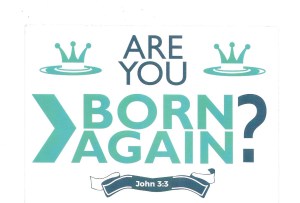
Are You Born Again?

Someone handed me the above card in town yesterday. ‘Are you born again?’ No, mate, and neither are you. As Bart Ehrman shows in Jesus Interrupted, and as I’ve written about before, the story of Jesus and Nicodemus in John 3 is a literary construct (as are the gospels in general.) The pun between ‘born a second time’ and ‘born from above’ only works in the Greek, where ἄνωθεν (anothen) can mean either ‘again’ or ‘from above’ (though it’s usually the latter.) Unfortunately, it is highly unlikely Jesus spoke Greek. Here’s Ehrman:

  In the Gospel of John, chapter 3, Jesus has a famous conversation with Nicodemus in which he says, ‘You must be born again.’ The Greek word translated ‘again’ actual has two meanings: it can mean not only ‘a second time’ but also ‘from above.’ Whenever it is used elsewhere in John, it means ‘from above’ (John 19:11, 23). That is what Jesus appears to mean in John 3 when he speaks with Nicodemus: a person must be born from above in order to have eternal life in heaven above. Nicodemus misunderstands, though, and thinks Jesus intends the other meaning of the word, that he has to be born a second time. ‘How can I crawl back into my mother’s womb?’ he asks, out of some frustration. Jesus corrects him: he is not talking about a second physical birth, but a heavenly birth, from above. (Jesus Interrupted, p155)

So Nicodemus is made to misunderstand Jesus, confusing ‘born again’ with ‘born from above’, and Jesus has to tell him what a twit he is. Translators of this chapter haven’t understood the point of the story either, making Jesus say, in John 3.3, ‘you must be born again’, when the rest of the narrative makes clear he means, ‘you must be born from above’ (i.e: be renewed by God who sits in Heaven on high.) 2000 years later, Christians, thanks to these translators, still make the same mistake.

There’s even more poppycock on the back of the card. The born again, it seems, avoid sin like the plague. Sure they do. Just ask all those kids molested by priests, preachers and Christian youth workers.

Falling Into Belief

Texas author David Heeren appeared on a UK TV channel the other day in its ‘Uncancelled’ slot, wherein a sceptical presenter interviews, usually while trying to keep a straight face, individuals who have, or have had, a world outlook at odds with any conventional narrative. This is to express it kindly in the case of David Heeren. David believes that the Second Coming is not far off; in this he has much in common with other evangelical Christians. Where he differs from most of them is that David believes the end-times sign of which Jesus speaks in Matthew 24.30 is… a comet.

In fact, David sees comets everywhere in the Bible. Amongst others, there’s the star of Bethlehem, the fire that descended to destroy the followers of Baal and the comet that parted the Red Sea. David has this to say about the last of these:

The rod Moses stretched out toward the Red Sea was a mirror image of the “arm of the Lord” in the sky above his head. A comet-generated tornado parted the sea and froze it in place long enough for three-million or more Israelites to pass through. A comet-produced earthquake cracked the frozen walls, releasing the sea waters to flow back over the Egyptians.

He finds 54 such ‘cometical’ appearances in the bible. He is obsessed both with comets and with the Second Coming. David is evidently on the fringes of an already lunatic movement (Christianity, that is) but, and here is what is astounding, David claims his books, 17 in total, five of them about the End Times, are best-sellers. If he’s to be believed, other people swallow his unadulterated guff and pay good money to do it.

 Last night, the guest in the same slot was Radhia Gleis. Radhia was part of a new age cult, Buddhafield, for 22 years before finally breaking free a few years ago. She and others came under the thrall of a charismatic individual called, variously, The Teacher, Michel and Andreas but whose real name is Jaime Gomez (pictured above). Cult members believed him to be a enlightened being who would lead them into ‘universal love and spiritual awakening’, until, that is, some recognised the level of control Gomez exerted over them and discovered he was sexually abusing young men. (The documentary, Holy Hell, about the cult, can be seen on Netflix. Buddhafield still exists, with Gomez its leader though now called Reyji (‘god-king’) and operating out of Hawaii.)

All of which, Buddhafield and Neeren’s nonsense, serves to underline how readily people will believe almost anything: stories of resurrected godmen, returning saviours, portentous comets, the honeyed words of charismatic charlatans. How crucial it is we see and evaluate evidence for ourselves. Demand to see it. Find it, read it, assess it as objectively as we can; not through a lens of preconceived ideas, be it conspiracy theory, religious worldview or prevailing narrative. We are too easily manipulated and duped not to evaluate what we are told.

Of course, we are not always capable of minimising our preconceptions nor of evaluating evidence objectively. We come with a range of psychological needs and respond emotionally to what the guru, preacher or group offer. Members of Buddhafield speak of the sense of belonging and purpose that involvement in the group offered. Many talk about how they finally felt loved. Even those young men abused by Gomez professed at the time a belief in the enlightenment offered by The Teacher, completely at odds with how he was using them for his own sexual gratification. This is how cults, political and religious movements and churches work. They offer enlightenment, forgiveness, fulfilment, purpose, eternal life, peace and joy – you name it, they’ll claim they can provide it – and our critical faculties are overruled by psychological/emotional need.

I know, I’ve been there.


All Along The Watchtower III

Jim has shaken the dust from his sandals. As he says, and as I knew, he wasn’t really looking for a discussion. He was looking to draw me, and the others who received his letter, into his cult. When it was obvious I wasn’t going to be, he lost interest. Plus, I mentioned Jesus’s non-return. I don’t think he liked that.

Hi Neil, 

Thanks again for your response. I think we’ll have to agree to disagree. We aren’t here to debate over things but we do respect your beliefs and thank you for taking the time to talk to us. 

We find what we read in the Bible answers many of life’s big questions and there is much archaeological evidence today to back up Bible accounts which adds to the accuracy of the Bible. So we want to share the truths and hope we have found with others, but we do respect everyone’s beliefs. 

Take care, 

Jim and Sandra 

All Along The Watchtower

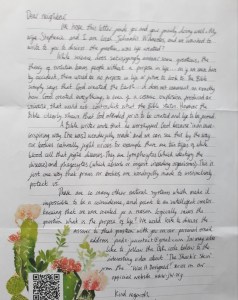
One post in and already a diversion from my planned ’12 Rules’ series. This is because I was fortunate enough to receive a letter in the post recently from my ‘neighbours’, Jim and Sandra. You can see it above. I’ve no idea who Jim and Sandra are – I’ve changed their names here to protect the guilty – but they tell me they’re Jehovah’s Witnesses. They want to convince me of their God, first by pointing out that we are, everyone of us, created by him. They then proceed to demonstrate their God’s existence with rather weak versions of the weak ‘argument from design’, with a spot of the so-called ‘argument from incredulity’ thrown in. Having ‘proved’ God, they conclude with a lovely non-sequitur, that God = purpose.

As they had gone to a lot of trouble to do this, I felt Jim and Sandra deserved a reply, specially as they were kind enough to include their email address. So here it is.  

Hi Jim and Sandra,

I was interested to get your letter recently. I notice you ask the question, ‘was life created?’ Of course it was! You’ll get no argument from me there. Nature and the processes of natural selection and evolution created life as we know it today. You of course want to draw God into these processes, but actually he’s not needed to explain them. 

Your ‘argument from design’ doesn’t work at all, because if God created all the wonderful, intricate things you talk about, he also created viruses, including covid-19, cancer and parasites. You can’t say he created everything and then discount all the nasty things as the product of natural processes or man’s sin or whatever. Either everything was made by God or everything is the result of natural processes – you don’t get to pick and choose. 

You say that only (your) God could make all the complexities of life, as complexity necessitates a creator. But that creator must, by definition, be more complex than his creation – yet you don’t think he had a creator, do you. But he must have done – because according to you, complexity has to have a creator. This principle doesn’t grind to a halt with God just because you or your church or holy book says it does. 

The intricacies and complexity of life that we see are the result of organisms, including ourselves and all other life & non-life, like viruses, adapting to their environments over billions of years. That’s it – no need to add another layer of complication, like a god, to this explanation (you may have heard of Occam’s razor, which is what I’m applying here). If something complex has existed for eons it is far more likely that it is something we know for sure exists – nature – rather than something we don’t. 

Life has in fact many purposes; one doesn’t need a God who doesn’t exist to discover them. I’d be happy to share some of these with you, though I imagine you are already quite set in your beliefs. That’s a shame.

Best wishes,

Neil