Do No Harm

sermon2

If religions took ‘do no harm’ to heart (as the Hippocratic Oath does) and their adherents were made to comply with it, what a better place this world would be. There’d be –

No more religiously-motivated suicide bombers and terrorist atrocities;

No more murder in the name of the Lord (whichever);

No more children molested by priests and pastors;

No churches attempting to cover up their crimes;

No more child deaths as a result of ‘faith-healing’;

No religiously-sanctioned denigration and abuse of women;

No more ritualistic mutilation of children’s and young women’s genitals;

No more religious scams and shams;

No more religiously-inspired vitriol directed at gay and transgender people;

No more barbaric executions of ‘minorities’, like gay men, women and those of other faiths.

Of course, even without these, the world would still not be perfect. Awful things would still happen. But the principle of doing no harm would eliminate much of the trauma inflicted on people by the proponents of irrational superstition.

On paper at least, the Abrahamic religions have expectations that are more demanding than simply doing no harm:

Love your neighbour as yourself (Leviticus 19:18; Judaism);

Love your enemies; treat others as you would like to be treated’ (Matthew 7.12 and 5.44; Christianity);

…compete with each other in doing good (Surat al-Ma’ida, 48; Islam).

However, these are just too damned hard for so many religionists. They disregard them and opt instead for the spiteful paranoia of the same holy books. Perhaps the simpler injunction of ‘do no harm’ would be easier for them. But until the preachers of judgement and hatred find it in themselves to promote such a principle, we will all continue to suffer the destructive effects of the ‘great’ faiths.

So, how long until the next terrorist attack? The next church child-abuse cover-up? The next rape scandal? The next persecution of gay people?

      Not long at all.

           Praise the Lord (whichever)!


The stuff Christians say… (part one)

Jesus-Facepalm

On the day Christians remember the time Jesus allegedly spent being dead and buried (that’s one day, if you’re counting; what happened to the three he promised?) by going shopping or watching sport, let’s take a look at some of the nonsense they spout about atheists:

Atheism/humanism is of Satan: Given there’s no evidence for any supernatural beings, there can be no devil, Satan, Lucifer – or whatever other name Christians come up with for this fantasy figure. (Bizarrely, it’s Jesus who’s called Lucifer in Revelation 5.5) The devil is a creation of the human mind, intended to explain the nasty stuff in life and to let a supposedly good God off the hook. It follows that an imaginary being can’t make human beings be anything. The devil therefore does not make people atheists nor direct them in their ways.

Humanists/atheists set themselves up as God: Every manifestation of the god(s), including those that happen to be popular at present, is of human origin. Like all the others, the Christian God is a product of the human imagination that is made manifest only through human behaviour. So who is it who sets themselves up as God? Those who recognise that this creation of the human mind has no external reality, or those who claim an intimacy with the ‘Supreme Being’, believe his Holy Spirit lives within them and delude themselves into thinking they speak for him? No prizes.

Humanists/atheists worship man as God: Atheists don’t do this either. We are well aware of humans’ fallibility, inconsistency and capacity to bugger things up. However, we’re all we’ve got. There’s no God going to come and save us or solve our problems. We have to do it ourselves (or, as the case may be, not). Nor do atheists regard other people as wicked sinners who have no good in them – a particularly unhealthy viewpoint favoured by the religious – but this hardly constitutes ‘worship’.

Atheists hate God: Only to the same extent we ‘hate’ Santa Claus, Poseidon and Ra. You can’t hate (or rebel) against something that doesn’t exist. We do get very tired though of Christians foisting their views on us, insisting we should believe what they believe. And we get angry when they disparage others and attempt to curtail their freedom because they alone know what Jesus would want. But being angry about Christians’ unreasonableness is not the same as hating something that doesn’t exist.

To be continued

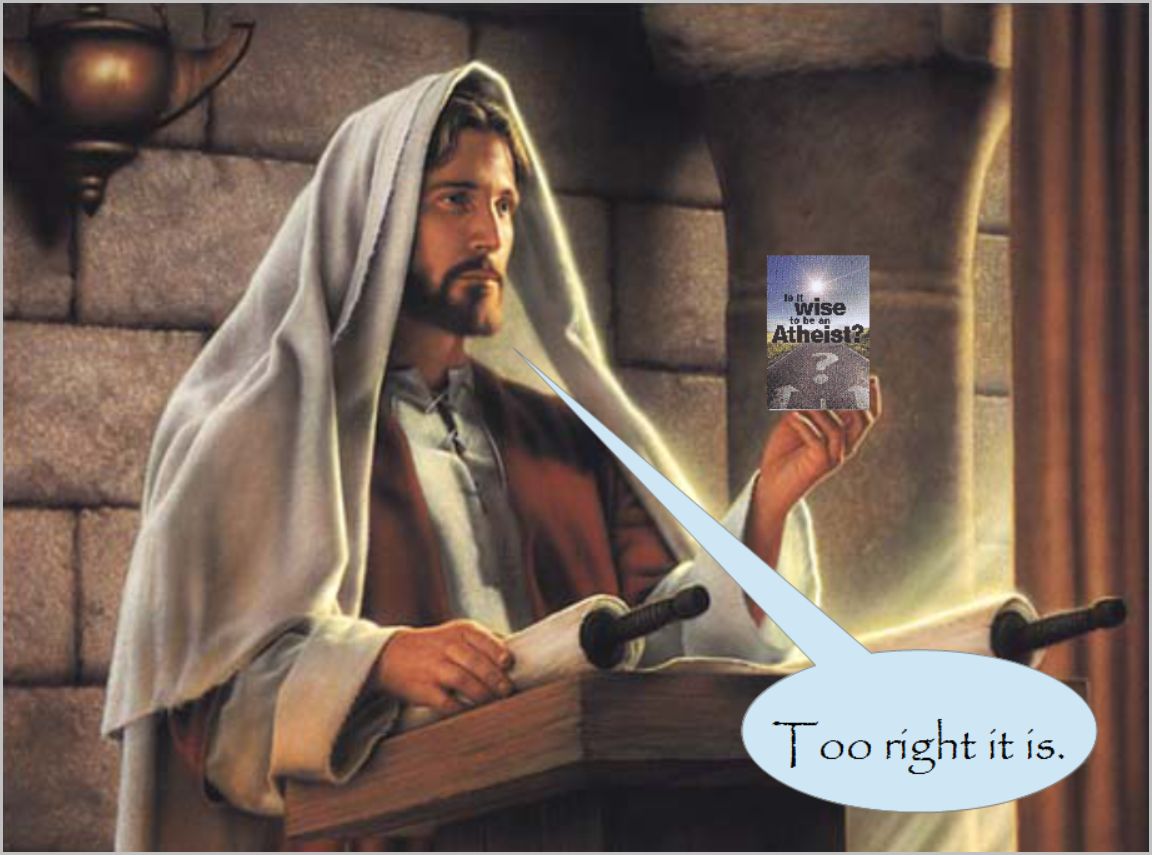
Is It Wise To Be An Atheist?

Tract

Christians say the funniest things… like ‘atheists can’t possibly know that there’s no God.’

This is the argument expressed in a tract,  Is It Wise To Be An Atheist?, that I was given on the street the other day:

A person cannot really be sure there is no God (unless) they have existed for all time and have identified that God isn’t there; they have been everywhere and have seen that God isn’t anywhere and they know everything and therefore know for certain that God is non-existent.

Safe to say, these are not the same impossible criteria Christians apply when determining whether deities other than their own exist. Even Christians know that Allah, Zeus, unicorns and the tooth fairy don’t really exist. But without being immortal, omnipresent and omniscient, they cannot know for sure. By their own criteria, all mythical/supernatural beings have as much chance of existing as their God. Yet Christians do claim, with reasonable certainty, that other Gods and imaginary entities are not real. This is because determining the authenticity of entities is not about absolute certainty but probability and, yes, reasonable certainty.

For reasons I explore on this blog – here, here and here, for example – the likelihood that a god of some sort exists is low. That that god should then turn out to be the one worshipped by Christians today reduces the possibility still further, on the basis that the more conditions one adds to a proposition, the more improbable it becomes.

To put it another way, the probability that there is no god is already high; that there is no God as conceived by Christians is higher still. Therefore it is reasonable to conclude he does not. This is reasonable certainty; the same reasonable certainty Christians apply when dismissing all other gods.

Better luck next time, Christians.

Our Father

FatherJosh, our social worker, would always tell us that our father didn’t mean it. He didn’t mean to threaten and intimidate us. He didn’t want to have us cringing in fear of him whenever he came near. Josh said our father loved us really, in his own way. I think we knew that ‘in his own way’ really meant ‘not in the way anyone else would recognise as love’. But, Josh said, whatever it might look like, father really did love us. It was just, Josh said, that he was naturally short-tempered and really couldn’t tolerate what he judged to be our terrible behaviour, even though none of us was really what you’d call badly behaved. No more than most children, anyway. Just by being there, it seemed we irritated father to such an extent that he’d punish us severely, the punishments out of all proportion with our supposed misdemeanours. Dolores once spent the night in the coal shed because she forgot to ask father’s permission for something trivial. No-one could remember what the next morning when she was allowed back in, crying, shivering and covered in black dust. But father said she deserved it for being such a wicked child. He said we all did.

We’d appeal to Josh, of course, but he’d just say we should ask father’s forgiveness for our wickedness, but as we explained to Josh, it seemed to us that father was the wicked one. We couldn’t see what we’d done that we needed to ask forgiveness for. Josh said that this sort of attitude wasn’t going to get us anywhere except into more trouble. Didn’t we know father loved us very much? All the same, he said, he’d have a word with father on our behalf. ‘He’ll listen to me,’ he said, but it didn’t seem like he did. Father’s demands would become all the more exacting as he told us he expected more of us only for our own good. Then he’d punish us when we couldn’t do what he asked — when we weren’t what he asked, which seemed terribly unfair when we couldn’t be anything more than he’d made us in the first place. Maybe if he’d been around more and had shown us more love than he did, we might not have turned out to be such a disappointment to him.

As you might expect, we eventually lost all faith in Josh. He really wasn’t much use. He promised to fix things with father, but it always seemed like he was on father’s side rather than ours, and his threats still hung over us. We would never be good enough for him, even with Josh’s ineffectual interventions. So when we grew up we all left home. I don’t think any of us has any contact with father now. I’m fairly sure he’s dead, in fact. He has no more control over us anyway; we don’t live in fear of his threats and punishments. We’re finally free of him, thank God.

All in the mind

Disaster

A new minister at the church near where I live has announced his plans to bring ‘God’s love’ to people in the parish. This sounds laudable enough, I suppose – it’s better than delivering God’s condemnation and judgement as many holy rollers are prone to do – but it begs the question why God doesn’t deliver his own love in person. Why is it he feels he can only channel his love through flawed and fallible human beings? Why doesn’t he engage intimately with his creation and let his love be known and felt directly? Why doesn’t he show his love by eradicating cancer, say, or preventing natural disasters, or exterminating the mosquitoes that cause the deaths of up to 2.7 million people every year? Why, in anything that would count as a tangible expression of God’s love for the world, as declared in John 3.16, is there a singular lack of evidence for both his love and his very presence?

‘Ah, but wait!’ say any Christians reading this. ‘God’s love is made manifest through his people, just as the new minister suggests.’ But this is my point; if I only ever expressed my affection for my loved ones through intermediaries – or even strangers, as this minister is to me – or only through a succession of Valentine’s cards, what sort of impression of my love would they have? They would, I think, be unconvinced of it, because love is not just a distant expression of feeling; it’s what we do for others. Love is action.

‘Ah, but wait again!’ say the Christians. ‘What about the second part of John 3.16 that tells us that God showed his love for the world by sending Jesus to die for us?’ You’ll pardon me, won’t you, if I find that a paltry and pathetic expression of love? If I had somehow expressed my love for others millennia ago, no-one at this distance would be impressed by a largely symbolic ‘gift’ proffered only after its original intended recipients declined it (Matthew 22. 8-10).

God didn’t really do this, of course; he didn’t send Jesus, didn’t instruct Paul to extend to all and sundry the offer of salvation that Jesus made only to Jews, didn’t transmit any sort of time-travelling compassion to reach us in the present; doesn’t express his love through other flawed human beings today. How do we know this? Because there is no God to show us love nor to judge or condemn us. Any judgement, condemnation or love is expressed by other human beings, frequently in the name of one god or another but humanly derived even when drawn from a holy book. Gods don’t write books; they’re human creations too.

Everything to do with God, from his very existence and all of his supposed attributes – his aversion to sin, his revelations about himself, his miraculous and mysterious ways, his answers to prayer, his non-answers to prayer, his supposed offer of eternal life, his holy books and his hatred and love – derive from human hopes and fears and our need for explanation. We know this because God’s love and all his other supposed characteristics are made manifest through human agency and in no other way; they have no existence outside the human imagination. So the new minister’s love can’t really be from God. At best, it will be a level of interest and concern for a limited number of people, because that is all that is humanly possible. Even so, it’s more than a God with no direct dealings with his creation can manage. Every expression of who he is, how he thinks and how he behaves is a projection of how human beings think and behave. That is why he is so maddeningly inconsistent across cultures and even within them, depending on which cult (and they’re all cults), denomination or church claims to be representing him. The Christian God is, like all the others, a human creation and all manifestations of him – including his much vaunted love and the relationship believers claim to have with him – are entirely human too.

What Does Atheism Have To Offer? (Part Three)

Celia17. Atheism offers knowledge instead of belief
‘But you must,’ Christians have said to me, ‘believe in something greater than yourself’ and ‘You can’t deny your spiritual needs.’ Well of course there are things greater than me and of all of us. The universe for a start; love, beauty, friendship, music, great art, nature, the night sky – sex even. Who hasn’t had a spiritual experience through their appreciation of these things? The fact they exist though, makes ‘belief’ in them redundant. We only need ‘believe’ in those things for which there is no evidence – which is why you can’t ‘believe’ in evolution; you can only know it as fact. Similarly, atheists know there are greater things than themselves. They don’t, as a rule, worship them, but appreciate them, often in awe and wonder, for what they are. As for such experiences being ‘spiritual’, we do not, of course, have ‘spirits’ either to nurture or express. We are emotional creatures and the value we find in those things greater than ourselves often stimulates sublime emotional responses. Nothing wrong with that, of course, but our responses reflect conditions within us, not the supernatural without.

8. Atheism offers the embrace of reality
Part of the inherent honesty of atheism is its recognition that this life is all there is. Atheism faces up to the fact that we are organic beings and like all organic beings our lives come to an end; there is nothing in us, no part of us, that survives death. Knowing heaven and eternal life are impossibilities atheism promises neither. Religions do, of course, and that is their great selling point but no-one, apart from atheists, seems to notice that they never actually deliver what they promise (because they can’t.)

Christians also tell atheists that it takes more faith not to believe in God than it does to believe in him. They need only look to their own experience to realise this cannot be so: they don’t need faith not to believe in Allah, Santa Claus or any number of other mythical beings. Equally atheists don’t exercise any faith at all not believing in Yahweh.

9. Atheism offers, unfortunately, an unsatisfactory name
One thing I wish atheism made possible but doesn’t – not yet anyway – is a better term for one who is unencumbered by gods, the supernatural and superstition. I have no wish to be defined by what I’m not, which is how ‘atheist’ works. It also implies that being a theist is somehow the default position and that any other is an aberration. I quite like ‘humanist’, but that doesn’t quite capture it either, but I’m not keen at all on Richard Dawkins’ suggestion of ‘bright’. The tide is turning though and once absence of belief becomes the norm, the right name for the true default will present itself.

10. Atheism offers a sense of well-being
Happiness, tranquility, peace perhaps don’t come from atheism per se, but they do stem from it: the opportunity for the consciousness I think of as ‘me’ to experience life in the here and now. I know many are not able to enjoy being here to the same extent that I and many in the west are able to, but this only makes it more important that we all do something to help improve the lot of others. As the nineteenth-century atheist Robert Ingersoll expressed it, ‘the time to be happy is now, the place to be happy is here, and the way to be happy is to make others so,’

As I write, Queen’s ‘Who Wants To Live Forever?’ is playing on the radio. It hardly matters who wants to; we can’t and we don’t. And – same group, different song – it’s true that ‘nothing really matters’. Really, it doesn’t, and so we are free to get on with living instead of trying to impose our beliefs on others, exterminating those we don’t like or squandering our one and only life because we think there’s a better one waiting. Atheism is far from nihilistic – it allows us to see the value of this life and helps us live it to the full.

So, what has atheism to offer? Freedom, honesty, meaning, contentment. Or, to put it another way, and to paraphrase what somebody or other once said, atheism really is the truth that can set you free.

What Does Atheism Have To Offer? (Part Two)

Think4. Atheism offers genuine morality
Having no magic book to tell them how to behave (not that Christians derive their morals from theirs) atheists work out their own morality. They don’t do this in a vacuum, however, recognising that morality is culturally derived, evolving as the means by which primates with complex social arrangements relate to one another. It’s likely they adhere to their moral codes imperfectly, as do believers of various stripes. Not having an ideology they feel compelled to impose on others, they don’t regard their fellow human beings as mere conversion fodder. The atheists’ world is big enough to embrace all, though they lament the damage wreaked on it by religion. Atheist terrorists are a much rarer breed than their religious counterparts, while secular societies are among the most peaceful and prosperous in the world today (with the more religious generally at the opposite end of the spectrum.) Nor do atheists attribute their behaviour to supernatural forces; neither god nor the devil inspires them to act. Rather they recognise and take personal responsibility for what they do.

5. Atheism offers authenticity
An atheist is free to be him or herself. There is no striving to maintain the imagined standards of an imaginary god, no need to represent the perspective of a ‘sacred’ book or to defend the indefensible. The atheist does not see themselves or other people as lost, worthless, sinners, suppressors of truth, goy, infidels or any of the other disparaging terms used of non-believers in so-called holy books. The atheist can be a free-spirit, possessed of self-respect, and true to themselves and their nature, whatever that may be. Here’s how pastor-turned-atheist Ryan Bell put it in a recent blog post:

I don’t have secrets anymore, which is a huge mental and moral relief. I also wrestle with less cognitive dissonance than ever. All of this means I’m more at peace and more comfortable in my own skin. I give far fewer fucks about what people think of me and my decisions. My ire is raised, from time to time, by unfair attacks, and I will probably always struggle with my tendency to be a people pleaser, but I am in recovery. I’m learning to tell the truth on a more regular basis and trust that people can handle the truth (whether they actually can or not). I’m learning to trust myself and what I know while remaining open to critique and able to say I was wrong.

6. Atheism offers free thought
Having no dogma to represent or promulgate, no myths to restrict them and no cult leaders, shaman or gurus dictating to them, atheists are free to think for themselves. Religion demands that its adherents begin with myth or dogma, which the facts are then forced to fit. When they don’t, which is invariably the case, the believer is compelled to dismiss the facts to preserve the fantasy (if you think not, you’ve never visited Answers In Genesis). The atheist, on the other hand, can begin with the evidence and reason from it to make up their own mind about ethics, the issues of the day and the human condition.

to be continued…

What Does Atheism Have To Offer? (Part One)

Station-12-ArtistOver the next few posts I’m going to do my best to answer the question, ‘what does atheism have to offer?’ that a commenter on Facebook has put to me – that’d be you, Dave – because, he says, I’m too sneery about Christianity. Some of my response will of necessity be personal in nature, and you can take or leave whatever I say; you won’t go to hell if you disagree (or heaven either.)

1. Atheism offers the truth
Christianity wasn’t delivering; it didn’t ring true for me any more and lacked explanatory power. As a result, a need to know the truth of why we’re here and what life is about preceded my atheism. I set about examining the facts of our existence as we know them, together with all the evidence. I became committed to this pursuit regardless of where it might lead. I didn’t, initially, confine my questioning and subsequent reading only to secular or scientific sources, but continued to explore religious and spiritual explanations of life as well. These quickly paled in comparison with empirical evidence; they were vapid and unsubstantiated, relying as they did on talk about ‘energies’ and entities that no-one had ever seen and for which there was no evidence.

Drawn increasingly to scientific explanations of life – biology, genetics, psychology, astronomy – I became increasingly aware that God wasn’t and isn’t required to explain anything about life, the natural world, the universe or indeed anything. Natural phenomena (and they’re all natural phenomena) have, on the principle of Occam’s razor, natural, not super-natural, explanations. The only reasonable conclusion to be drawn from this was that he wasn’t and isn’t involved in any of them. His very superfluity demonstrates his non-existence; a god who is not evident in any aspect of reality is a god that doesn’t exist. This pursuit of truth therefore led to atheism as something honest and inherently truthful.

2. Atheism offers a real life in the here and now
Living without recourse to the supernatural is refreshing. There is no god (no angels, devils, spirits, ghosts or demons either) watching over us, waiting for an opportunity to punish or bless us; no god whom we are answerable to either in the present or at some future judgement; no god of vengeance who must be obeyed; no god who will vindicate us at the end of time; no god to grant us eternal life; no set of frequently bizarre rules to follow and no empty promises to claim. Atheists take full responsibility for their own lives and behaviour; they construct their own meaning, knowing this life is the only one they’ll get. Atheism alone grants this responsibility and privilege.

3. Atheism offers a humanist perspective and approach to life
This is not the End Times™ as salaciously envisaged by Christians ancient and modern, just as the first century wasn’t – even though Jesus and Paul both thought it was (Matt 16:27-28; 1 Thess 4.15-17 etc.) The atheist accepts that the only help we’re going to get in solving our problems is from ourselves. There is no god waiting in the wings to put things right; no end time scenario when he will come to rescue a chosen people. (This is, incidentally, one of the most pernicious ideas ever to have been devised by humankind, causing more strife and ‘excusing’ more inhumane treatment of others than any other we’ve devised.)

Apart from natural disasters – and we seem to be contributing increasingly to those – the cause of all of our problems is us. Equally, the solutions will have to come from us too. More positively, all of our endeavours, our achievements, our scientific, technological and social progress are ours alone too. We have the potential to do great good, and often do, just as we cause great harm. Free of religious restrictions, the atheist is at liberty to help others out of fellow-feeling, not because a (non-existent) god demands it.

to be continued…

Big Bang Theory

BigBang

You’re probably familiar with William Paley’s teleological argument for the existence of God. If you haven’t used it yourself then you’ll have been subjected to it by proselytising believers. A couple of days ago I had someone treat me to an updated version of the argument.

I was on the phone with a sales-person, talking about his company’s product, when he decided it would be a good time to dust off the old idea, give it a make-over and use it to convince me of God’s existence.

He started by asking me if I would agree that a computer must have an intelligent designer; I agreed this was so (though I have my reservations.) He responded with ‘how much more then must the universe and life on Earth – being so much more complex than a computer – also have an intelligent designer.’ He said this was ‘something to think about,’ and I agreed it was, though maybe this wasn’t the best answer I could’ve given.

Having ‘demonstrated’ that everything must be intelligently designed, my new friend announced that this was therefore irrefutable proof that Allah must have made everything.

Oops. I’m sure this isn’t what the Reverend Paley had in mind when he devised his watch analogy two centuries ago. His proof, however, is every bit as much a demonstration of Allah’s existence and creativeness as it is Yahweh’s. Or Vishnu’s or Marduk’s or any other of the multitude of deities credited with intelligently creating the universe and life in this insignificant part of it. Any one of them could’ve done it according to the teleological argument. Take your pick and sign up for the set of beliefs that corresponds with your choice.

But wait – complex machines like watches and computers bear no relation to anything in nature. A watch found on a heath, as Paley conjectures, or computers in hedgerows, can only have got there because a human being put them there (fly-tipping again). They would not be there because they’d arisen, like the rocks, grass and other plants that surround them, through the processes involved when nature creates something. Moreover, we know that machines have intelligent creators, because we are they. What doesn’t follow is that because man-made objects are demonstrably the product of intelligence that natural ones, which, remember, bear no relation to computers, watches, cars and CAT scanners, are as well.

We are gaining more understanding of how the universe came to be. Significantly, it doesn’t require that there is intelligence behind it. If it did, we would then need to explain how that intelligence arose, who created it and by what process. To say, as religious believers are wont to do, that this supreme intelligence has always existed is no explanation at all. If we’re to have something that has always existed then it is far more likely to be that which we know really does exist, rather than something we don’t. Conceding the longevity of the components of the universe, which we know to exist, is a far better bet than inventing deities to account for it. A God no more explains life, the universe and everything than do fairies the intricacies of my computer (gremlins maybe, but not fairies.)

For all that, life on Earth does have a creator. The genealogy of the universe tells us that physics begat chemistry begat biology. (‘But if life emerged from physical and chemical processes, then how come there’s still physics and chemistry?’) All life on Earth, including ourselves, is the product of these processes, ‘the blind watchmaker‘ that Richard Dawkins speaks of. They are not intelligent, do not have names like Yahweh or Allah and do not, on their own, create the machines that only humans can design.

What is the point?

Stairway

There isn’t any point. At least, not ‘out there’ somewhere, waiting to be discovered. The point, purpose and meaning of life is what we make of it. We make our own purpose.

The Christians among us claim to have real purpose. Not like we sad non-believers whose purpose is to do with raising and supporting our family, being creative, doing things for others or whatever. No, Christians get their real purpose from God, or so they say. Perhaps some of them would be good enough to share it with us; is it rushing from one church meeting to another? Singing badly written hymns badly? Cosying up to one another? Telling others about the great salvation plan?

Apparently not, though they do seem to spend a lot of time doing these things. According to CARM the purpose of life ‘is to praise God, worship Him… proclaim His greatness, and… accomplish His will.’ Got Questions, on the other hand, says it’s to ‘1) glorify God and enjoy fellowship with Him, 2) have good relationships with others, 3) work, and 4) have dominion over the earth,’ while Open Bible claims it’s ‘to love and serve God in order to help bring about God’s glorious plan for creation.’

That’s it? The purpose faith supplies is this woolliness? It’s about doing stuff we already do (‘work’, ‘have good relationships with others’) and fawning over a needy, insecure deity? God help us if this is all it amounts to. Those who claim to know the secrets of eternal life and the mind of God himself should surely be able to come up with something better than the rest of us.

As I’ve written before, this isn’t what Jesus told his followers life was for. No, he said it was to work to bring about God’s kingdom on Earth (Matthew 6.33; 13.44, Luke 9.62 etc). Try as you might you’ll struggle to find a Christian site that says this is the point. That’s because Christians long ago – almost two thousand years ago – stopped believing that God’s kingdom was due to arrive here and switched their expectation to one of an after-life in heaven. But that’s not what the Bible promises, and it’s certainly not what Jesus said.

So maybe, Christians, you’re missing the point of your faith and your purpose in life; it’s to bring about the Kingdom of God on Earth (Matthew 6.10) – in the first century (Mark 9.1). No wonder you’re now so rudderless, so lacking in direction and real purpose. You missed the boat, which sank without you two millennia ago.

Now you have to construct your own meaning, just like the rest of us. Except ours is better, lacking as it does the faux Biblical language and all those fairy tale elements.