How Prophecy Works

Like many evangelicals and others afflicted by Christianity, Don Camp believes that the Old Testament is jam-packed with prophecies about Jesus; his origin, background, mission, teaching, sacrifice and resurrection. He quotes a couple in one of his recent comments, which we’ll get to soon, and thinks that the general direction of travel is from ancient prophecy to later fulfilment in Jesus. Don and those like him will not entertain the possibility that this is an illusion created by those who constructed the Jesus’ stories.

Here’s how the illusion was created: the gospel writers, and Paul too, looked back at the Old Testament (‘the scriptures’) and found there what Don describes as ‘indistinct’ references to events they believed had happened in their own time. From these and other sources, they built their stories about Jesus. More often than not, these scriptural references were not in themselves prophecies or predictions of Jesus’ life, death or resurrection. We know this by a) reading them in their original context, b) recognising that the Jewish scriptures as a whole never speak of a Messiah who must die an ignoble death for his people, and c) noting the number of times these ‘indistinct’ statements have to be altered by the gospel writers and others, to make them ‘fit’ their conception of their God-man.

Let’s start with one of Don’s picks, from Isaiah 53:11:

After he has suffered, he will see the light of life.

It has to be conceded that all of Isaiah 53 does indeed look like it’s a prophecy of Jesus’ suffering, death and resurrection. In context, however, the suffering servant it describes is Israel itself, as surrounding chapters make clear. Furthermore, on closer inspection, some of it doesn’t seem to apply to Jesus at all. Verses 2&3 really don’t describe a man followed around by multitudes and later worshipped by millions:

He grew up before him like a tender shoot, and like a root out of dry ground. He had no beauty or majesty to attract us to him, nothing in his appearance that we should desire him. He was despised and rejected by mankind, a man of suffering, and familiar with pain. Like one from whom people hide their faces he was despised, and we held him in low esteem.

Unsurprisingly, Don doesn’t quote these verses. Sure, it’s possible to make them fit; to say that these verses 2-3 describe Jesus on trial with the crowd baying for his blood; but it’s a stretch. We’ll come back to Isaiah 53 shortly.

Don then refers to ‘the prophecy about (Jesus) not seeing corruption as a dead body’. This is actually Psalm 16:10:

You (YHWH) will not abandon me to the realm of the dead, nor will you let your faithful one see decay.

And, my, yes it does seem to fit Jesus once again, if we believe he died and rose again before his body could deteriorate. But it isn’t about him. It’s about the writer of the psalm, traditionally David, expressing his belief that his God will preserve him. Plucked out of context, it can sound like it’s Jesus being described, just as any number of other verses can be said to be about future events when they’re not. For example, some Christians, including Pat Robertson, are currently claiming that Ezekiel 38:1-2 is a prophecy of Russia’s invasion of Ukraine:

Son of man, set your face against Gog, of the land of Magog, the prince of Rosh, Meshech, and Tubal, and prophesy against him.

That works, don’t you think?

No. Me, neither. Such nebulous statements can easily be applied to much later events on which they have no actual bearing.

Which brings us neatly to the gospels. These claim that the events they describe were foretold by the prophets of old (Luke 24:44). It would be truly remarkable if, as Don believes, all of the prophecies about Jesus in the scriptures were actually fulfilled by him. Some Christian sources claim there are as many as 300. But, as we’ve seen, some of these are so vague they can be made to apply when in fact they don’t.

And this is how the Jesus story came about; it is structured around many of these indistinct prophecies. The authors of the gospels, and Paul too, knew their scriptures and built up a story about the Messiah using them. Like Paul, Mark had little knowledge of the circumstances of his Messiah’s earthly life, so he set about creating a biography for him using ‘prophecies’, scenarios and statements from the scriptures. We might ask here why he should do this if Jesus was as remarkable as early cultists claimed. There is no need to invent stories about a remarkable figure if that figure has already lived an amazing life that is widely known about. Be that as it may, Mark and the other gospel writers set about creating an elaborate life for their hero, largely based on ancient scriptures.

Mark quotes Isaiah 53 directly in 15:38 and makes extensive use of the chapter in his account of Jesus’ passion. Let me stress: Isaiah 53 is not a prophecy of the passion, it is the blueprint for it. Mark’s account is Isaiah 53, down to Jesus’ silence at his trial and his being buried ‘with the rich’.

Matthew and Luke later embellished Mark’s efforts by doing more of the same thing, adding fresh episodes to Mark’s core gospel. Most of these embellishments  are based on ‘prophecies’ that Mark somehow missed. None of them necessarily happened – I’m persuaded they didn’t – but are ‘actualisations’ of parts of ancient scripture. We know this because of mistakes Matthew made in expanding the story, using the additional ‘prophecies’ he ‘discovered’ in scripture. We’ll get to these mistakes next time.

 

In Which Don Gets It All Back To Front

Let’s take a look at one of Don Camp’s latest contributions regarding the authenticity of the Jesus story and how it was all prophesied beforehand and explained after the fact:

Don: You mean all the Old Testament prophecies that spoke of the eternal continuance of the Messiah king were mistaken?

What prophecies, Don? You mean all those tenuously connected Old Testament stories that the gospel writers, especially Matthew, pressed into service to construct their Jesus stories? That this is how it happened is the scholarly consensus and once we exclude the possibility of magic, the only way ‘prophecy’ can later be ‘fulfilled’.

Don: “After he has suffered he will see the light of life and be satisfied; (Isaiah 53:11).

Which proves my point. You think this is a prophecy? It could mean anything about anyone!

Don: The prophecy about him not seeing corruption as a dead body was mistaken?

And again. Not mistaken: lifted from the OT around which to build the resurrection story.

Don: The words of Jesus as he repeatedly told his disciples of his resurrection were mistaken?

He didn’t. The stories were written long after Jesus supposedly lived. Those who created his story gave him this ‘foreknowledge’ long after the event.

Don: Paul made nothing up; his simply explained what it all meant.

Oh come on, Don. Why would God leave it to someone who’d never met Jesus, and appears to know nothing about him, to explain ‘simply’ what he was all about? Of course Paul made it all up, after he had some sort of vision, in his head, from which he developed a fanciful theology, one that was very much at odds with that put in Jesus’ mouth years later. Hence Paul’s disputes with the ‘pillars of the church’ whom he held in such disdain.

I know you’ll have some convoluted explanation about how everyone else has got it wrong, Don, but it’s you who’s got it all back to front!

The ‘F’ Word

Don Camp is defending Christians in the comments. They’re in the process of becoming ‘more like Jesus’, he says.

What does this even mean, Don? How can you know what Jesus was like when there are so many disparate versions of him in the Bible (as has been pointed out to you)? Does becoming more tempestuous, impatient, impossibly demanding and Jewish count? These are some of the traits his propagandists show him as having.

You then tell Jim not to measure Christians ‘by his (own) experience’. What other measure is there? Christians aggressively promote their beliefs on the internet, have infected politics and, at a lower level, are encountered as judgmental evangelicals and sanctimonious street preachers; these are the Christians of our experience and like it or not, the fragrance ain’ that sweet. As Jesus is supposed to have said, ‘by their fruits shall you know them’. We sure do.

Bottom line, Don: you Christians have had two thousand years now to make the world a better place by being ‘more like Jesus’. On balance, you’ve failed. Not surprising when Jesus himself failed even more. Where is he, Don? Following his ‘return’, the Righteous should have been living in peace and harmony for the past two millennia, tediously worshipping him and his Father in God’s Kingdom on Earth. They haven’t been, even though Jesus, Paul and several other NT writers said they would be ‘soon’, relative to their own lifetimes. 

Argue it how like, Don (and you will), Christianity merits one big ‘F‘.

Battle Of The Magic Books

Don Camp replies (in blue) to my previous post. My responses are in black.

There are multiple reason for rejecting Mormonism. The primary reason is similar to discerning between a fake $20 bill and the real thing. The fake just doesn’t feel like the real thing. Of course, that test requires that one knows what a $20 bill feels like. Anyone who does not know is easily fooled.

In fact, if you don’t know what the real thing is like, it is impossible to identify a fake. You might notice an ink smudge and a difference in paper, but who is to say one is fake and the other is not?

This presupposes that your version of Christianity is ‘the real thing’. For a Jew, Judaism is the real thing and Christianity the Johnny-come-lately fake. All you’re saying here is that you ‘feel’ your version of Christianity is the real thing and you ‘feel’ Mormonism isn’t. This isn’t persuasive. I know, for reasons other than intuition, that Christianity isn’t the real thing. To use your analogy, it is the twenty dollar bill received in change when in the UK a twenty pound note is the ‘real thing’.

But since you have a knowledge of literature, Neil, why not apply those standards? Nice concession there, Don. The Bible is indeed literature and as such deserves to have the same standards applied to it as any other work of fiction.

Is the Bible and the narrative in the Bible coherent?? No. Its central character is ridiculously inconsistent. Described as an unchanging God, he changes from book to book and most noticeably between the Old and New Testaments. As someone commented on Debunking Christianity recently, it’s as if he ate a Snickers bar between the two. (He does get hungry again towards the end of the NT, when he reverts to being an omnipotent Putin.)

As the protagonist undergoes his major rewrite, the plot also suddenly deviates, becoming a completely different story. It starts by being about this poorly conceived character’s ‘everlasting covenant’ with his chosen people, but then two thirds of the way through, this everlasting covenant is scrapped and replaced with a new, largely incoherent deal involving a human sacrifice that the unchanging God has previously said he finds abhorrent.

Does it stick together and develop a single theme across the whole? No, it doesn’t ‘stick together’, not unless you ignore the gaping inconsistencies in character and plotting, and its overall implausibility.

Do you know what the theme of the Bible is, Neil? Yes, thank you, Don. Condescending of you to ask. Any apparent consistency is because the writers of the second part of the story had access to the first part. They plundered it for their own purposes, drastically altering it so that it suited their new theme. That is why much of the Jesus story appears to be foreshadowed in the Old Testament. The Jesus story – and it is a story – is built on events and episodes they found there.

Remember that the Mormons tell us that the Book of Mormon is an extension of the Bible and that the people of the Americas were related to the Jews and held to the basic truths of the Jews. (Remember also the Mormons believe that Jesus appeared to these people in the New World shortly after his resurrection.) So if you put the Torah and the Book of Mormon together, is the narrative coherent? Does it develop a single theme? The Old testament and the New Testament are a coherent whole, but I do not think the Old Testament and the Book of Mormon are. As you can tell, I dispute that the Old and New Testament are a coherent whole. The Old Testament and the Book of Mormon aren’t either. That lack of coherency becomes even more obvious when we compare God in the Old Testament with God in the Book of Mormon. The person of Jesus is also inconsistent in the Book of Mormon with the Bible.

But they’re inconsistent within the Bible too, Don. Compare John’s Jesus with Mark’s. Compare Paul’s beatific Christ with Revelation’s grotesquely super-powered warlord.

Of course, the standard explanation by Latter Day Saints is that the Bible has not been adequately translated, though I know of no place where they can demonstrate that claim. There are significant translation problems with the Bible, which mainstream scholars consider at length. Mormon desperation to resolve these conflicts is the same as that demonstrated by Christian theologians.

Finally, there is a matter of provenance. We know in very good detail where the Bible came from.

We do? We know who Matthew, Mark, Luke and John actually were? No, we don’t nor do we know where they wrote or what their sources were. We don’t have the autographs (originals) of any of the New Testament documents but we do know some of them are forgeries and others have been tampered with.

There are many copies, especially for the New Testament, and there are many commentaries of both the OT and NT from very early in the their history. Proving what? Only that they were copied, frequently inaccurately. The copies are all much later than the probable time of composition. The commentaries are similarly far removed from them; there are commentaries on the Book of Mormon much closer to its composition.

What is the provenance of the Book of Mormon? It apparently appeared magically out of nowhere pretty recently. No mention in any other literature of its existence. It did appear magically! Oh ye of little faith! God sent an angel, like he does numerous times in the Bible, and told Joseph Smith to translate the golden tablets. The NT books were similarly created, with God breathing his word into cult followers as they wrote. God, angels, Holy Spirit, magic – all of a muchness, don’t you think?

No copy is available to examine. Nor of the original copies of anything in the Bible.

That is not to speak of the total lack of any archaeological evidence for the Mormon claims of Jews in the Americas. Mormons dispute this, of course. There are similar problems with some locations mentioned in the Bible. More fatally, most of what the Bible promises has proven false. For example: Jesus’ imminent return, his guarantee of miracles, believers becoming new creations. (Paul spends much of his time ticking off these ‘new creations’ who remain resolutely unreformed.)

So, I would say the Book of Mormon fails on all levels.

I would too. As does the Bible for the reasons I’ve outlined, and despite your special pleading. You don’t apply the same rigour in your consideration of the Bible that you do to Latter Day Saint fiction. Why is this, Don?

Dear Evangelical: Why Aren’t You A Mormon?

Dear Don,

Why are you not a Mormon? I mean, you appeal to the evidence of consistency across the 66 books of the bible, claim that the gospel writers remained true to an oral tradition (despite John’s gospel being markedly different from the other three) and insist there is no difference between the original apostles’ gospel and Paul’s (when Paul is adamant there is.) In fact, there is even better evidence that Mormonism is true.

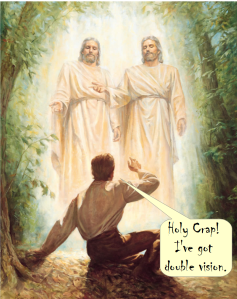
First off, Joseph Smith saw the resurrected Jesus in person! Not only Jesus but God the Father too. And they spoke to him! He relates the story himself, so unlike the gospels, this is no second hand reportage:

I saw two Personages, whose brightness and glory defy all description, standing above me in the air. One of them spake unto me, calling me by name and said, pointing to the other—This is My Beloved Son. Hear Him!

Following this, young Joseph was instructed to translate the Book of Mormon from some golden plates. We don’t have to take his word for it that these plates existed because Joseph had witnesses:

Eleven official witnesses and several unofficial witnesses testified to the existence of the golden plates and, in some cases, to dramatic supernatural confirmation of their truth. Meticulous research on these witnesses has confirmed their good character and the veracity of their accounts.

Impressive, don’t you think? We have no such affidavits for the gospel writers – we don’t even know who they were!

Also like the Bible, the Book of Mormon had multiple authors (Joseph Smith was only translating, remember):

Furthermore, in recent years, rigorous statistical analysis strongly indicates that neither Joseph Smith nor any of his known associates composed the English text of the Book of Mormon. In fact, research suggests that the book was written by numerous distinct authors.

And yet, the Book of Mormon tells a story even more consistent than the Bible’s!

Better still,

the Holy Ghost affirms the authenticity of the Book of Mormon, just as he does the Bible: the conclusion of the matter is that much modern evidence supports the more powerful witness of the Holy Ghost that the Book of Mormon is true. Joseph Smith, who translated it, had to be what he said he was, a prophet of God.

Finally, the growth of the Church of The Latter Day Saints demonstrates its truth and saving power. Its early expansion was greater than that of the first-century church.

Amazing, don’t you think, Don?

* * * * *

I expect like me, you reject all this so-called evidence and regard Mormonism as so much bunk. But on what basis? What causes you to dismiss the teaching of the Latter Day Saints while embracing the equally incredible, magic-infused stories of the Bible? As the Mormon church says (sounding not unlike yourself when talking about the Bible):

Persons who choose to dismiss the Book of Mormon must find their own ideas for explaining it and the mounting evidence for its authenticity.

When you arrive at the criteria you apply in rejecting Mormonism, you’ll have arrived at the reasons I and many others reject your beliefs.

Misinformation: Who Decides?

Back when I was in college in the 1970s, we had long, worthy discussions, as only students can, about censorship. On the whole we decided this was a bad thing. No-one’s views, we felt, should be eradicated or even doctored so that parts we didn’t subscribe to were removed from what they had to say. Of course they’re was no Internet back in those days. No texting, no Twitter, Tik Tok or Facebook. They were a long way in the future and inconceivable to those of us in the age of printed media, vinyl records first time round and three UK TV channels. Undoubtedly censorship existed; mainstream media, which is pretty much all there was apart from the occasional ‘underground’ magazine, reported on what mainstream media deemed it was necessary for us to know. Alternative or even questioning views were without a voice, which is presumably why they were considered to be alternative or questioning. There was no representation of gay or lesbian people, much less the B and T of LGBT, of radical politics, black voices, feminism or spiritual perspectives that weren’t aligned with mainstream, respectable Christianity, the state religion.

You might think this was a good thing. Surely, you might say, it made life simpler. Everyone knew what to think about and what they should think of what they thought about. There was no space for the extremist views that proliferate today, made possible by the Internet. In this latter respect you’d be right. And how much poorer we were for it. Those with dissenting, questioning and alternative voices were relatively unheard. Not so today with social media platforms. Mainstream media and politicians, the ‘system’, no longer control the agenda.

They are not giving up without a fight, however. The British government is determined to introduce laws that will make it a criminal offence to publish ‘misinformation’ or ‘harmful’ views on social media. Initially designed to prevent ‘misinformation’ about Covid-19, it has far wider application, allowing the suppression of any views that are contrary to the narrative of the day. We all know that there is misinformation out there; the Earth is not flat, Jesus is not returning soon and the world is not controlled by shape-changing lizards. It is not this sort of misinformation governments object to. As far as they’re concerned, you can believe and express this sort of rubbish as much as you like.

What these new laws are designed to control is the agenda – what I’ve already referred to as the narrative of the day. And who determines what the agenda is? Those self-same governments and their unelected advisors, who rely on a compliant media to parrot the narrative they’ve decided upon. We saw this clearly during the pandemic. Dissenting voices, not yet criminalised by draconian laws, were nonetheless suppressed, including those of respected scientists not part of the prevailing groupthink. Social media, under threat of state control and heavy fines, were pressurised to stifle views that contradicted the official line. Without a doubt, many of the views were unsupported by evidence and some were abusive*, but this does not entitle any government to suppress all contrary views. We live in a western democracy, after all, and not an authoritarian dictatorship.

If the proposed new laws had existed two years ago, would the view that lockdowns were largely ineffective be considered by the state to have been ‘misinformation’ or harmful? Almost certainly. A significant number of scientists are now of the view that they most certainly were, and far from preventing the spread of the virus created serious long-term problems in the social, societal, healthcare, economic and educational realms. What about the view that the vaccine’s effect would be relatively short-lived? Again, it is more than likely this would have been deemed to be misinformation too. (I’m strongly pro-vax; they’ve got us through the pandemic here in the UK, but we must face the fact they are not as effective as we were first told.) Repeat for the efficacy of face masks. Repeat for the exaggerated predictions of doom. 

Not far behind Covid on the system’s agenda is climate change. Who will decide what is ‘misinformation’ about climate change? You guessed it: those same official bodies; governments and their unelected advisors but also other interested parties like so-called eco-warriors who haven’t a jot of evidence to justify their pranks. And who will decide what is ‘misinformation’ about climate change? Again, those the self-same people.

Would the fact that the world is becoming greener be deemed to be ‘misinformation’ or harmful? Yet this is happening due to planting programmes, chiefly by China and India, and the increase of CO2 in the atmosphere on which plants feed. Consequently, there is 5% more vegetation now than there was twenty years ago. It is helping mitigate some of the effects of global warming. What about  that climate change is part of a natural cycle and would be happening (though perhaps not as quickly) without a human contribution? What about questioning the fact that while the UK is determined to reduce it’s 1.1% contribution to the world’s pollution (to 0% by 2050) by imposing green taxes on its populace, the majority of countries, many making significantly greater contributions to pollution, are doing nothing at all? Would this kind of comment be deemed to be ‘harmful misinformation’? It seems likely to me that it would: it doesn’t comply with the prevailing narrative/groupthink/agenda.

Laws like that proposed by the British government have no place in a democracy; Authoritarian regimes impose such draconian measures in order to silence their citizenship. I’m not sure what we in the free world can do to prevent such laws but we should not be walking blindly into them: we accept them at our peril.

_________________________________________

* It goes without saying I am not arguing for the protection of those who post abusive, hateful comments online. I’ll address this issue next time.

How Do Christians Explain Those Who Renounce Their Faith?

Aka The Death of Ananias by Raphael (Acts 5)

What was original Christianity like, long before it acquired that name? Before Paul’s ideas took hold? Clearly the cult existed prior to Paul. He tells us so himself: worship groups were around – the one he writes to in Rome, for example – before he  established his own. 

The early faith seems to have emanated from the visions of early believers such as Cephas and James. Quite what they ‘saw’ is open to debate but it led to them setting up a sect within Judaism that focused on the saving power of a risen celestial being.

And everything was absolutely hunky dory within these early communities. Members shared all their possessions (except when they didn’t, in which case they were annihilated on the spot) and lived in perfect harmony together, worshipping Jesus and experiencing miracles on a daily basis.

According to Acts, that is. According to Paul, by the time he came to be involved, it was all very different. Many of the early ‘churches’ were characterised by squabbling, greed, legal disputes, confusion about doctrine, sleeping around, visiting prostitutes and power struggles (Galatians 5.20; 2 Thessalonians 3.14-15; 1 Corinthians 1.10, 4.21; 1 Corinthians 6.1-10; 1 Corinthians 6.12-20; Galatians 1.6-9; 1 Corinthians 5.9-13 etc.) Worse still, there were defections by converts who came to their senses and left the cult.

How can this be when, according to Paul these people were inhabited by God’s holy spirit and saved once and for all by the redeeming blood of Jesus? Just as today, early believers, including Paul, had a hard time explaining how a person could be once saved and then lose their faith. They came up with various excuses how this could happen:

Excuse #1. Apostates were never really been saved: they were faking it in some way, their faith hadn’t been deep enough or Satan had snatched it away from them. One enterprising and influential cult member even came up with the sneaky idea of putting these explanations into the mouth of Jesus (because of course he would have foreseen the problem.) So arose the parable of the sower. According to Mark 4.1-20, the ‘word’ doesn’t always ‘take’. It might seem as if it has but sometimes it is uprooted by the cares of this world. Alternatively, it falls on stony ground and really doesn’t stand a chance of growing. Or Dick Dastardly Satan intervenes and destroys the faith of those who once believed. As a cultist called John later put it,

They went out from us, but they did not really belong to us. For if they had belonged to us, they would have remained with us; but their going showed that none of them belonged to us… (1 John 2.19)

Which really says nothing: ‘they left, so really they weren’t part of our gang to begin with.’ A brilliant bit of exposition.

Excuse #2. Apostates are still saved. In direct contradiction of the parable of the sower, some Christians invented a different way of accounting for those who had ‘fallen away’: the ‘once saved always saved’ argument, based on a few cherry-picked bible verses. Despite appearances, those who’ve left the faith are nonetheless still savedThe ‘reasoning’ is that because salvation is a work of God, it cannot be undone, no matter how much one refutes the faith, or provides reasons for leaving it or demonstrates the untruthfulness at the heart of it. Salvation is like a tattoo you regret getting but with which you’re stuck for the rest of your existence. (Except not really, for a whole host of reasons but principally because there’s no God to work the magic in the first place.) This line of reasoning runs entirely contrary to the acknowledgement in the parable of the sower that there are always those who will leave the faith.

Excuse #3. Apostates have been hurt by the church and as result have abandoned the faith (but Jesus is waiting for them to return!) While I don’t know anyone who has renounced Christianity for this reason alone, it does play a small part in some defections. Why? Because self-serving and vindictive Christians are evidence that Christianity simply doesn’t work. It doesn’t make ‘new creations’, infusing people with a holy spirit that makes them better people. Believers, despite their claims, are no more moral than those who are unsaved. You’ll know this if you’ve been on the receiving end of Christian judgment or condemnation. When Christians themselves undermine the claims of their religion it creates a justifiable scepticism in one-time brothers and sisters.

Excuse #4. Apostates just want to wallow in sin. Back to the parable of the sower for this one: ‘Satan has ensnared you into life of sin and debauchery and you have abandoned the one true way’. I have to say this is not true of any ex-Christians I know.  They’ve dispensed with the wholly religious idea of ‘sin’, and now live their lives as authentically as they can, looking after their loved ones and helping others where possible. Then again, so what if people want to wallow a little bit?   

The one reason that causes others to leave the fold that is never recognised by Christians is the gospel itself. No sir. That some people are able to see how irrational, contrived and downright untrue it is, is not a possibility Christians are willing to entertain. Jesus himself, however, seems to recognise that some people are just too intelligent to go along with it:

I praise you, Father, Lord of heaven and earth, because you have hidden these things from the wise and learned, and revealed them to little children (Matthew 11.25).

Even he knew – or, far more likely, the sect that put these words into his mouth – that for anyone capable of a modicum of critical thinking (‘the learned and the wise’), the cult’s claims simply don’t stand up to inspection.

Where’s The Harm?

So what does it matter if people believe in make-believe? It does no harm and might even do some good, right? I mean, if they want to believe in ghosts or horoscopes and that helps them make sense of life, then why not?

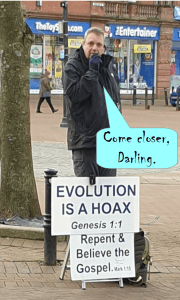
But with Christianity and other theistic religions it’s a different story. While they might provide their adherents with some coherence to their lives, they also equip them with a distorted and unhealthy view of other people. This is what compels local street preacher, Dale McAlpine, to pick up his megaphone and stand yelling at passers-bye in my local town centre. I took the picture above of him yesterday, when he invited me, like an evangelical Hannibal Lecter, to come closer. I declined.

Dale’s theme this time was, predictably, that evolution is a Satanic hoax, everyone is a wicked sinner and God requires a blood sacrifice for them to be saved. He no doubt had a swipe at LGBT folk too; he usually does. Dennis and I didn’t stop to listen to him but, along with everyone else, were lambasted with his ignorant BS as we passed. Such nasty stuff needs to be opposed and in the absence of my own megaphone, this is my way of doing it.

Those who believe planets millions of miles away control their lives don’t, as a rule, set themselves up on a soap box in the centre of town and threaten people with hell. Ultimately, though, there is no substantial difference between the baseless wishful thinking of astrology and Christianity. Today’s version of the faith owes its existence to Paul’s ‘revelation’ of an imaginary celestial being that sacrificed itself to restore our standing with an imaginary God. This makes as much sense as believing that the planets ‘in conjunction’ shape our destinies.

Would I, if it were in my power, ban the likes of Dale from spouting his ignorant, ugly version of Christianity? Probably not, as I’m a liberal at heart and cancel culture concerns me. I would, however, be pleased if he came to senses and of his own volition stopped spouting publicly his brand of theo-babble. I’d rather he spent his time tending to the sick, homeless, naked and imprisoned as his Saviour tells him to. I fear though that that kind of Christianity is too hard for the likes of Dale.

The Trouble With Atheists: A Christian Sets Us Straight

My friend Bruce Gerencser was good enough to repost my previous post on his blog. It prompted a comment from someone calling himself James Thompson, who Bruce says used a fake email address and quite possibly a false name. (These Christians; so fearless and honest in all their doings!) Here’s what ‘James’ had to say:

It’s because that’s what you live to do argue the truth. You’re not “atheists”. Antitheists yes. Agnosticism yes. A true atheist would not give a rip about the discussion on this blasphemous blog.

And atheists don’t go out seeking to remove Mickey Mouse from everything.

Or Buddha or Mohammed.

But they do Jesus Christ because Satan knows he is the only one who can bring salvation

I did respond to James on Bruce’s blog but wanted to address his garbled points, such as they are, more fully here. They’re typical of the low level thinking Christians and others use to defend their beliefs.

It’s because that’s what you live to do argue the truth.

Amazingly James has an uncanny insight into the minds of atheists; we live only to argue the truth, by which he means, presumably, critiquing his pet deity and magical saviour. Most of the time, most atheists barely give these two mythical beings a second thought; neither do I when I’m not blogging. I live for entirely different things.

You’re not “atheists”. Antitheists yes. Agnosticism yes.

But wait! People who don’t believe in his God aren’t, according to the omniscient James, atheists; they’re anti-theists. Okay, I concede; I am opposed to the notion that there’s a loving God somewhere out there who is interested in us and has made it possible for us to know him by, according to James and other deluded souls, making his only son a blood sacrifice. I dispute this silly idea, which has no evidence to support it, and is, as Jesus is made to say in Matthew 11.25, irrational and illogical. So yes, I’m an anti-theist. I’m also anti-theist because of what believers in the one true God (in his various guises) do terrible things to each other and to non-believers. And when they’re not doing that, they’re parading their ignorance, propagating their book of myths and spells, denying evolution, dumbing down children’s education, suppressing LGBT+ people and threatening everyone who doesn’t subscribe to their superstition with eternal damnation. I mean, what’s not to like?

 A true atheist would not give a rip about the discussion on this blasphemous blog.

And then James returns to his mind reading act. How does he know what a ‘true atheist’ might think of Bruce’s blog? There are plenty of atheists who comment there; whether they are ‘true’ atheists apparently only James knows.

And atheists don’t go out seeking to remove Mickey Mouse from everything.

It is true atheists (which we’re not, according to James) don’t seek to remove Mickey Mouse from everything, whatever this means. But then Mickey Mouse doesn’t start wars, condemn everyone as wicked sinners or try to control their sex lives. Disneyworld would quickly go out of business if he did. (That Donald Duck is a different kettle of fish however.)

Or Buddha or Mohammed.

James then scrapes the bottom of the cliché barrel: ‘You wouldn’t dare criticise the revered characters of other religions’. Yes, we would. As I said in my post, which evidently James didn’t read, there is no supernatural. All gods, ghosts, spirits, angels, demons, heaven and hells, from whichever religion or superstition they emanate, are figments of the imagination.

But they do Jesus Christ because Satan knows he is the only one who can bring salvation

These two as well. The Christ and his evil doppelganger, Satan, are human inventions. As fantasy figures they are open to as much ridicule and ‘removal’ as any other imaginary being. Perhaps more, given the damage they’ve caused and continue to cause.

James has been sold salvation snake-oil and thinks that because he’s been duped, everyone else should be too. Or at the very least should respect his delusion. Ain’t gonna happen, Jimmy boy. You need to grow up a little. And maybe also learn some grammar.

Slippin’ and Slidin’

Recycled picture, new post

I’ve written before about how impossible it is to argue with Christians. It’s either that they have superior knowledge because an invisible ghost possesses them and is guiding them towards truths that non-believers can’t possibly perceive. Or it’s that the supernatural just cannot be understood in an evidential, naturalistic way. Science and empiricism – what we can detect with our own eyes, with specialist equipment that serves as an extension of those eyes or that can be mathematically demonstrated – just cannot detect, perceive or understand the supernatural. Gary Matson is currently experiencing this on Escaping Christian Fundamentalism, where a Catholic Christian (an oxymoron to many other religionists) is arguing that the things he believes in – hell specifically and his God generally – are just too sophisticated for the ignorant layman to understand. We’ve met this before too, from pseudo-intellectual Christians who think their faith, which its supposed founder said was best understood by becoming like a child, requires a degree or three in theology or philosophy.

It’s all a sleight of hand, and rather like wrestling with a jelly-fish. The assertion that the believer in the supernatural makes, that his or her particular brand of woo lies outside the purview of science, is mere flannel. ‘You can’t prove this because you haven’t the tools to’, applies to any form of magical belief – in heaven and hell, in an afterlife, in ghosts, and angels, gods who speak to mortals, mystical saints, flying horses, reptilian overlords, UFO abductions… you name it – does not stand up to scrutiny. If supernatural entities and states are outside the natural universe (and they are, by definition) then they will never be detected by science, observation and empirical measurement; but not because our means of detection is inadequate, but because they don’t exist. It isn’t that they are out there somewhere, detectable only with the right frame of mind or with the help of a spirit that itself has no physical presence; they are nowhere; they are not real. It is not the inadequacy of our means of detection that is at fault; it is that the invisible, non-physical and intangible have no substance outside the human imagination. As I’ve said before, remove human imagination from the equation and the supernatural goes with it. If humans were to become extinct tomorrow, so too would all the magical beings and places that humans have ever conjured up. They have no  existence independent of the human imagination.

Arguing that this isn’t so is to assume your conclusion in your premise: ‘Of course supernatural things exist, you just can’t see them. But I can prove them with my argument/philosophy/faith’. This, however, is a demonstration of irrationality, not of the supernatural. In any case, the fact the supernatural has to be argued for at all is evidence that it doesn’t exist. Nothing real has to be argued for, it can be detected, shown, demonstrated and measured by the senses, by instruments, by mathematical proofs. That gods and ghosts can’t be, but have to be argued for, tells us they are not real – not that they are beyond the scope of our capabilities.