Jesus and the Leper

I thought we might share a couple of Bible studies these next couple of weeks. Some of you will remember these from your Christian days, when you’d gather with other eager believers so that a self-appointed expert could tell you what a particular story in the Bible really meant. I’m no expert, just someone who subjected myself to such indoctrination while all the time wondering if what I was being told was really what the passage was about. Doubts, however, were ‘of the devil’ so any such critical thinking needed to be suppressed. Since my eyes were opened to the allegorical nature of much of what is in the Bible and in the gospels in particular, I now see these same passages in a completely different light. I hope you’ll allow me to share my insights with you.

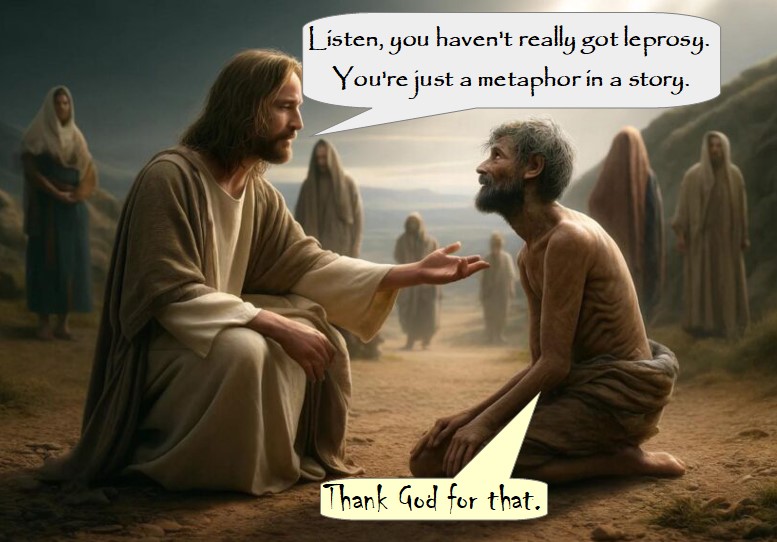
First off, it’s Mark 1:40-45, in which Jesus (seemingly) heals a leper:

 A man with leprosy came to him and begged him on his knees, “If you are willing, you can make me clean.” Jesus was indignant. He reached out his hand and touched the man. “I am willing,” he said. “Be clean!” 

Immediately the leprosy left him and he was cleansed. Jesus sent him away at once with a strong warning: “See that you don’t tell this to anyone. But go, show yourself to the priest and offer the sacrifices that Moses commanded for your cleansing, as a testimony to them.” 

Instead he went out and began to talk freely, spreading the news. As a result, Jesus could no longer enter a town openly but stayed outside in lonely places. Yet the people still came to him from everywhere.

The giveaway phrase here is ‘make me clean’. The man does not ask Jesus to heal him which, suffering from a debilitating disease as he was, would have been the most obvious, most pressing request to make. Instead, he asks to be ‘cleansed’ with all its ritual connotations, the word used here, καθαρίζω (katharizo), also meaning ‘purify’. According to Leviticus 4: 11-12, leprosy was a condition that was spiritually unclean. Only by making the prescribed offerings – the usual doves, lambs and ‘crimson stuff’ – could a leper who was already healed become ritually pure.

Who, according to the New Testament, replaces all the sacrificial offerings of the old covenant? Why, it’s Jesus himself of course (1 Corinthians 11:25, Ephesians 5:25-26 etc). Jesus cleanses and purifies the leper in the story, just as he is able to cleanse and purify sinners. This is what the early cult believed: ‘Ask Jesus, the heavenly Christ, to cleanse you of your sins and, just like he does for the leper in this parable, he’ll do it for you. As a penitent believer, you are the leper. Not only are you cleansed of your sin, you are purified.’

This also explains why Jesus is ‘indignant’ when the leper first approaches him. On the surface it makes little sense for him to be indignant with the man, which is why some translations change this verse to say Jesus ‘felt compassion for him.’ Jesus’ metaphorical annoyance is for those who have allowed the man’s spiritual condition to have deteriorated to a state comparable with leprosy. The Jewish priestly system, symbolised anachronistically in Mark as the Scribes and Pharisees, the later arch-enemies of the new cult.

Jesus commands the leper to visit the Jewish priest to demonstrate that he, Jesus, is the new cleanser of sins, replacing the priesthood itself. Instead, the leper goes against Jesus’ and the early cult’s wishes. My God, how could the cult remain secret and exclusive if newly cleansed converts behaved like this!

So there you have it. The leper is a metaphor for the sinner in need of the heavenly Jesus’ cleansing. His leprosy is a metaphor for the sin itself. The healing is a metaphor for the penitent’s spiritual purification. The man’s by-passing of the Jewish law is a metaphor for Jesus replacing the law. The cleansed leper’s shouting about it is a metaphor for the early cult’s desire to keep its rituals and teaching secret. Its parables like this one were designed to enlighten cult members while obfuscating and confusing the unbeliever (Mark 4:11-12).

As a literary creation, an allegory replete with metaphor, this event need never have happened in reality. Given its literary nature, it’s highly unlikely it did.

Presenting a well-thought through Christian Response*

If there’s one thing I love about writing this blog it’s the considered, articulate comments I get from loving Christians.

A brave anonymous commenter left one the other day on the 2015 post ‘Gentle Jesus – meek and mild?‘. Short on time and rhetorical skills, Brave Anon opted instead for a different range of tactics. Here’s what he(?) had to say:

I’m a little short on time, and i wish I wasn’t, because I could pick apart your post piece by piece for hours. I WILL say though, that I’d expect someone who has dedicated a whole site to this matter to have actually read the book he’s so dedicated to disproving. It’s pretty clear that you haven’t and only used quick Google searches to try to prove your point. The big thing that i’d really like to point out is that most of the scripture you quoted to try to prove your point is from the Old Testament. That means it was law BEFORE Jesus was born. Yes, some of them are pretty harsh. That is why Jesus whittled the 613 commandments in the OT down to 10 in the NT. The most important being, ”Love the Lord your God with all your heart, and with all your soul, and with all your mind.” The most important one, right behind that, is to, “Love your neighbor as yourself.” That is why I just prayed for you. I wish that people like you would get away from trying to disprove the Word and find something else (literally ANYTHING else) to spend your time doing. What do you have to gain by making this site? Do you have such little self worth that, as a grown adult (I assume, but maybe I’m wrong), you really need someone to pat you on the back and say, “WOW! You did a really good job! You get a gold star. That means, you get to pick out what toy you want to play with at recess first today!” Will, if that’s what you need, I ain’t the one to say it. Your arguments are weak, and you are clearly uninformed on the subject you’ve chosen to focus on. Why don’t you, at least, read the Bible (I mean cover to cover) before you speak on it. If you need a little motivation, why don’t you remember that Satan knows the Bible better than ANYONE here on Earth. I mean, even better than the POPE!!! Familiarize yourself so you can, at least, make an educated, organized, well informed, argument. You do that, and I’ll consider giving you a shred of respect. Otherwise, good luck on your day of reckoning. I hear it’s hot down there, so make sure you pack shorts!!

Let’s ‘pick apart’ the tactics in use here:

  1. Mind reading: Brave Anon knows that I have never read the Bible. Impressive. Wrong, but impressive. He uses his telepathy too to work out my motivation for writing: so I’ll be rewarded with praise. Thanks, Brave Anon; in the 12 years I’ve been blogging I’ve never realised this.

  2. Jumping to conclusions: Brave Anon decides all my information comes from Google. While it’s true I do use Google to verify sources and provide links to articles, when it comes to the Bible, I quote it directly. All those references in brackets are the clue that this is what’s going on. They look like this: (Matthew 7:1-3), (1 Corinthians 5:12). Brave Anon might want to look these two up on Google.

  3. Confused irrelevancy: Brave Anon is unhappy I ‘quoted… from the Old Testament’ in the post in question. Wait – didn’t he just say I’ve never read the Bible? Isn’t the Old Testament part of the Bible any more? The point made by the post is that Matthew’s very Jewish Jesus says that the Law – that’s the one in the Old Testament – will never pass away, not one jot or tittle of it. Wasn’t the Old Testament, under a different name of course, the only scripture Jesus knew? Maybe that’s why I quote it alongside the later stuff Matthew makes up for him to say.

  4. Intuition: Brave Anon intuits I’m a full grown adult. Brilliant. He could of course have read ‘The Author…’ above, which would have told him that, and would also have informed him of why I post what I do. Guessing is so much more effective though, don’t you think?

  5. Condescension: Brave Anon prayed for me. Nice. Nevertheless, he felt moved to send a derisory comment.

  6. Withholding his respect: Jeez, if I’d known this was going to happen I’d never have written the post. I’m positively bereft.

  7. More confused irrelevancy: Satan, the capitalised POPE… what the…?

  8. Desperation: ‘Just wait until the day of reckoning then you’ll regret criticising my buddy Jesus ‘cause you’ll be burning in hell!’ This threat is always a part of Christians’ comments. I’m thrilled Brave Anon remembered to include it.

Thanks for dropping by, Brave Anon, and for reminding me to pack my shorts.

*Not really.

Bible Study

Again he entered the synagogue, and a man was there with a withered hand. And they watched Jesus, to see whether he would heal him on the Sabbath, so that they might accuse him. And he said to the man with the withered hand, Come here.” And he said to them, Is it lawful on the Sabbath to do good or to do harm, to save life or to kill?” But they were silent. And he looked around at them with anger, grieved at their hardness of heart, and said to the man, Stretch out your hand.” He stretched it out, and his hand was restored. The Pharisees went out and immediately held counsel with the Herodians against him, how to destroy him. (Mark 3:1-6)

Greetings, my beloved Brethren. Today we are going to look at God’s Holy Word as revealed to our dear brother in the Lord, the one who will one day be called ‘Mark’. We’re looking specifically at the passage above, because some of you have expressed difficulty in discerning the full import of the text. I have to say I’m surprised at this. You only have to bear in mind Mark’s rule of thumb that everything in his gospel is a metaphor, which, when looked at with discernment, reveals a previously hidden mystery: 

To you has been given the secret of the kingdom of God, but for those outside everything is in parables, so that “‘they may indeed see but not perceive, and may indeed hear but not understand, lest they should turn and be forgiven’” (Mark 4:11-12, referencing Isaiah 6:9)

Our passage today begins with the Lord healing a man with a withered hand, which should straight away alert us to the fact we are dealing with metaphor. All of the healings in the gospels are. They stand for something more significant than any actual healing.

Some of you might already have made the connection between the use of ‘withered’ here, with its use in another story (Mark 11-12-14), where Jesus withers an unfruitful fig tree. Of course, no actual fig trees were harmed during this miracle. The fig tree and its withering are metaphors.

The tree, you see, is a metaphor for the Jewish system of worship, the old Covenant of the Law. This had reached the end of its life. It was fruitless and God was done with it. He was in the process of replacing it with salvation through Grace. All of this is represented metaphorically by Jesus cursing the fig tree and causing it to wither.

So it is in our passage today, except this time, God offers healing to the Jewish nation. He is nothing if not gracious, reaching out and offering acceptance into the new Covenant, expressed here as the healing of a withered hand. You won’t have missed the fact – again symbolic – that the healing occurs in the synagogue, the Jews’ place of worship. We might also remember Deuteronomy (6:8) where the Lord God instructs the Jews to wear his Law on their foreheads and, more significantly, to tie them to the backs of their hands. But now their hands have, metaphorically speaking, withered away, just as the fig tree will.

God knows of course that few will accept his proffered healing, insisting instead of labouring blindly under the old Covenant. The rest of the story reflects this stubbornness and the incalcitrant attitude as the Pharisees – metaphors for the Jews as a whole – round on Jesus and castigate him for breaking the Sabbath laws in healing the man – in spiritual reality the Jews themselves. That Jesus heals on the Jews’ sacred day is metaphorical too, demonstrating as it does that all the old laws are now surpassed. Jesus, and more importantly his followers – you, my dear brethren – are no longer under the yoke of that law but have new freedom serving Jesus under his new yoke, which is easy to bear. At the end of the story, the Pharisees – the Jewish leaders of our own time, lest we forget – leave to plot against the Lord; in reality against us. With his help we will of course bear this persecution stoically.

So you see my brothers, this story was written for you, to remind you that you are saved. You are the New Covenant. The Old has passed away. You can follow Jesus’ example and do good, yea, even on the Sabbath. You need not fear the Jews or others who might persecute you because the Lord is with us. The Jews, on the other hand, will soon be cast into outer darkness when he comes in person. Even so, Lord Jesus, come quickly.

I hope this has made clear to you the mystery hidden in this part of Mark. I know there will be some of you who are not sufficiently advanced in their understanding of the mysteries, being still babes in Christ, and may yet object to this exposition of the deeper secrets of the Lord. So be it. But don’t say you haven’t been made aware of the Truth.

Next time, if there are those who need to know more of the mysteries hidden in God’s new revelation, we can look at the next part of Mark, though I trust that you are, by now, developing sufficient spiritual insight to discern for yourselves the hidden mysteries embodied by the gospel’s metaphors.

Redeemed: From Slavery to… erm, Slavery

Thanks be to God, who delivers me through Jesus Christ our Lord! So then, I myself in my mind am a slave to God’s law, but in my sinful nature a slave to the law of sin. (Romans 7:25)

Do you not know that if you present yourselves to anyone as obedient slaves, you are slaves of the one whom you obey, either of sin, which leads to death, or of obedience, which leads to righteousness? (Romans 6:16)

(We are) justified freely by his grace through the redemption that is in Christ. (Romans 3:24)

When a slave had served sufficient time and had accumulated sufficient wealth or found a benefactor, he or she could buy their freedom. This seems particularly egregious when their servitude was already, in the case of debt, the means of paying back what was owed. In effect the enslaved individual was paying twice for their freedom. Be that as it may, the act of buying oneself out of slavery was known as redeeming oneself; redemption. Likewise, a third party buying your release was also known as redeeming. We still use the term in this sense today: a pawned item can be redeemed, bought back, for a greater amount of cash than the pawnbroker originally paid for it. The related term ‘ransom’, in Mark 10.45 has the same sense; paying money to secure the release of a captive.

The principle of buying oneself out of captivity and slavery underscores the Christian idea of redemption. It is the analogy Paul and other New Testament writers use, to explain Christ’s paying the price, through his sacrificial death, for the slave’s release. He redeems (or will do at some future point depending on which fantasist you’re reading) in exactly the same way a slave was redeemed, from a life of captive slavery to sin/the Law/Satan and his minions. 

There’s a catch. If a slave was redeemed by a third party, he was likely to find himself not free at all but the property of whoever had redeemed him. His debt having been paid off to his first owner, he might very well find himself in hock to a new one. So it is with Christian redemption. Christ may have paid off your perceived debt to your original owner (sin, Satan or whoever) but now you’re indebted to him. You’re his slave, as we saw in the previous post.

To downplay slavery as it was practised in the centuries before the cult adopted it as an analogy, is to undercut redemption as Paul and early cultists perceived it. Arguing that slavery was a relatively benign practice removes the basis of Christian redemption; if being a slave wasn’t really too bad then neither can being a slave of sin/the Law/Satan be too serious either. There’s really no great need to be redeemed and what Paul says in Romans and elsewhere counts for nothing.

But we knew that anyway.


Jesus: Practically Perfect In Every Way?

Was Jesus a gracious, gentle and humble as Christians like to claim or was he intolerant, self-important and frequently wrong? What do the gospels say?

He’s intolerant and self-important when:

He insists people should love him more than their own families (Matthew 10:37).

He says he’s not a peacemaker but intends creating strife (Luke 12:51).

He claims anyone who doesn’t follow him deserves to be burnt (John 15:6).

He wants the world to be destroyed by fire (Luke 12:49).

He commands people not to call others ‘fools’ (Matthew 5.22) but tells those he doesn’t care for that they’re ‘swine’, ‘dogs’, ‘snakes and vipers’, ‘whitewashed tombs’, and, yes, ‘fools’ (Matthew 7:6; 15:26; 23:33; 23:27; 23:17 & Luke 11:40).

He deliberately speaks in riddles so that people won’t understand him and won’t find forgiveness (Mark 4:12).

He tells his followers to love their enemies but says he’d have his own killed (Luke 19:27 & Matthew 13:41-42).

He endorses slavery and the cruel treatment of slaves (Luke 12:47-48).

He says people would be better off if they cut off their hands, plucked out their eyes and castrated themselves (Mark 9:43-48 & Matthew 19:12).

He endorses the Jewish law that demands the death penalty for those who disrespect their mother and father (Matthew 15:4-7).

He disrespects his mother (Matthew 12:48-49).

He tells people not to get angry but loses his own temper (Matthew 5:22 &Mark 3:5).

He callously kills a herd of pigs and, in a fit of pique, destroys a fig tree (Matthew 8:32 & Matthew 21:19).

He takes a whip to people (John 2:15).

He tells his mates he’ll soon be king of the world and promises them that they’ll rule alongside him (Matthew 19:28).

Are these the marks of a tolerant, compassionate man? Or the characteristics of an unpleasant, delusional megalomaniac?

As for frequently wrong: first, the false promises –

I will do <em>whatever</em> you ask in my name, so that the Father may be glorified in the Son (John 14:13).

Very truly, I tell you, if you ask <em>anything</em> of the Father in my name, he will give it to you (John 16:23).

These signs will accompany those who believe: …they will lay their hands on the sick, and they will recover’ (Mark 16:17).

Therefore do not worry, saying, “What will we eat?” or “What will we drink?” or “What will we wear?” But strive first for the Kingdom of God and his righteousness, and all these things will be given to you as well (Matthew 6:25-7.1).

and then there’s the failed prophecies –

For the Son of Man is going to come in his Father’s glory with his angels… I tell you the truth, some who are standing here will not taste death before they see the Son of Man coming in his Kingdom (Matthew 16:27-28). Just in case we don’t get this the first time, he tells us again in Matthew 24:27, 30-31, 34 and in Luke 21:27-28, 33-34.

Did he return with the angelic host and establish God’s kingdom on Earth before his disciples died? He did not.

Christian zealots unable to accept the evidence of the gospels themselves will no doubt have a hundred and one clichéd, implausible excuses for Jesus’ many failures: ‘he was speaking metaphorically’; ‘you lack the spiritual insight to see what he really meant’; ‘you’re quoting him out of context’, blah blah, blah.

All I ask is that they please, please don’t inflict these excuses on us here when we’ve heard them all so many times before.

Gentle Jesus – meek and mild?

StonedWhen it comes to derogatory and hateful remarks about minorities, Jesus is frequently given a pass. His ‘meek and mild’ persona – not one he actually had, but one he’s acquired over time – is brought into play to absolve him of all unpleasantness.

For example, and as liberal bloggers are fond of saying, here’s what he had to say about gay marriage:

                                                                                                                                            ”


Yup, that’s right; he said absolutely nothing about it – not directly anyway. But what Jesus did say, if ‘Matthew’ is to believed, was that he upheld the Jewish Law in its minutest detail:

Do not think that I have come to abolish the law or the prophets; I have come not to abolish but to fulfil. For truly I tell you, until heaven and earth pass away, not one letter, not one stroke of a letter, will pass from the law until all is accomplished. Therefore, whoever breaks one of the least of these commandments, and teaches others to do the same, will be called least in the kingdom of heaven; but whoever does them and teaches them will be called great in the kingdom of heaven. (Matthew 5.17-19)

That’s the Law that prescribes death for even the smallest infraction that he’s endorsing there. Here’s a brief sample of that Law and the penalty for breaking its petty rules:

Stone to death anyone who works on the Sabbath. (Exodus 35.2 and Numbers 15.32-36)

Kill publicly children who dishonour their father or mother. (Leviticus 20.9)

Stone to death anyone who blasphemes the name of the Lord. (Leviticus 24.16)

Execute a married couple who have sexual intercourse during the woman’s period. (Leviticus 18.19)

Put to death those involved in adultery. (Leviticus 20.10)

Execute any man who lies with another man, as with a woman. (Leviticus 20.13)

Stone to death at her father’s door any woman who is not a virgin on her wedding night. (Deuteronomy 22.13-14 and 20-21).

Sound familiar? With its oppressive brutality and liberal use of the death penalty, this sort of behaviour is like IS practices today. They’re both desert ‘moralities’, after all. And this is the law that Jesus advocates and insists remains in place until ‘heaven and earth pass away’. As that hasn’t happened yet, the Law, according to Jesus anyway, remains in effect. Never mind that Paul says it doesn’t – God himself, in the shape of Jesus Christ says it does. How’s that for meek and mild?

(Cue Christians referencing the story of the woman caught in adultery. That, however, is a late addition to the Bible and, in any case, Jesus only saves the woman because his beloved Law hasn’t been properly complied with.)

Thankfully, civilised human beings – and civilised Christians too – ignore Jesus and don’t seek to apply such old barbaric laws (though there are some believers who want to when it comes to LGBT people; see my previous post.) But if you want to know Jesus’ position on moral issues that he doesn’t pontificate on explicitly, just remember he fully supports the death penalty for adultery, homosexuality, working on the Sabbath, not being a virgin on your wedding night, having sex at the wrong time of month, dancing, listening to the radio, tweeting and texting… oh wait… now I have got him confused with Islamic extremists. It’s so easy to do.
Next time: Jesus says that the only way to gain eternal life is to follow this vicious Law with all its unreasonable demands.