Jesus’ Ungrateful Slaves

Jesus really liked telling stories about slaves. It’s as if he’d no objection to the inequitable arrangement of one person owning another. You’d think, if he really was the Son of God, he wouldn’t be quite so ready to assume unquestioningly, the zeitgeist of his day that decreed slavery was acceptable; necessary even. His being a man of his time, incapable of thinking beyond the assumptions and indoctrination of his culture might suggest he wasn’t a heavenly being at all. Either that or his creators, the writers of the gospels and the likes of Paul, were incapable of seeing beyond the zeitgeist and so made their god-man in its image.

In any case, they have Jesus tell a parable in Matthew 18:21-35 about forgiveness, which is populated once again with slaves and a slave owner. The story, in which a slave is forgiven by his master but fails in turn to forgive a fellow slave, ends with the following:

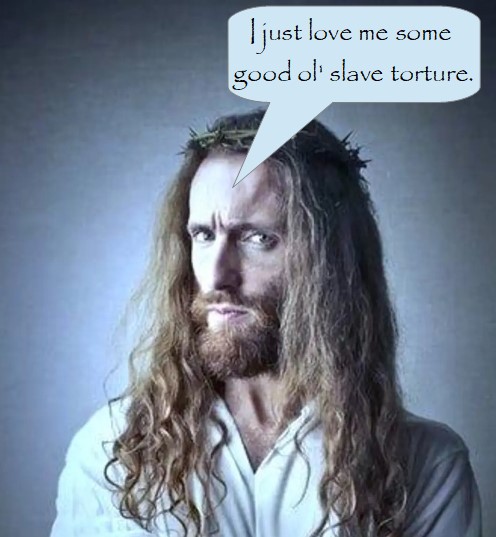
…after he had summoned him, his master said to him, ‘You wicked slave! I forgave you all that debt because you begged me. Shouldn’t you also have had mercy on your fellow slave, as I had mercy on you?’ And his master got angry and handed him over to the jailers to be tortured until he could pay everything that was owed. So My Heavenly Father will also do to you if each of you does not forgive his brother from his heart.”

Of course, the slave owner, referred at the start of the tale as ‘the king’ is – predictable metaphor alert – Jesus himself. He’s fond of casting himself in the role of kingly slave owner, with ordinary mortals his slaves. As we’ve seen already, this is the favoured analogy of New Testament writers to describe the relationship between their manufactured saviour and themselves.

Actually, the moral of the tale in this instance isn’t too bad; if you’re forgiven much it’s not unreasonable to suppose you could, in turn, forgive others their more minor offences. But this isn’t quite enough for Jesus’ script writers who have him drag jail, torture and retribution into the story. These, Jesus concludes, are the very things his wonderful Heavenly Father – based on the despotic rulers of the time – will inflict on anyone who doesn’t forgive as generously as they might.

What hypocrisy! Forgiveness is all according to Jesus but his Heavenly Father, he says with relish, will torture unforgivably anyone who doesn’t comply. What were the cultists who created this awful malicious character thinking? Jesus and everything to do with him is anti-human and soul-destroying.

As for me, I’d recommend forgiving others where you can, learning from the experience (once bitten twice shy and all that) and moving on. You won’t, whatever you do, be tortured by a fictitious, vindictive slave owner and his bullying idea of a god.


A Reply to a Slave

I’ve discovered this new gizmo that lets me look stuff up on the Interweb. Goober or somesuch. I used it to find the meaning of ‘doulos’ that the absence of dictionary prevented you from doing. All of the results Goober brought up described doulos thusly:

Doulos (Ancient Greek: δοῦλος, Greek: δούλος, Linear B: do-e-ro) is a Greek masculine noun meaning “slave”. Wikipedia

Doulos (a masculine noun of uncertain derivation) – properly, someone who belongs to another; a bond-slave, without any ownership rights of their own. Biblehub (Christian site)

…anyone could become a slave, in a sense. However, once someone was sold into slavery, they remained a slave for life, and all of their offspring automatically became slaves as well. The only standard way of obtaining freedom was to earn enough money to pay your owner back as much as he had paid for you in the first place. This was a nearly impossible task to accomplish because slave owners did not often facilitate their slaves ability to earn money on the side. As such, most slaves, and their offspring remained slaves for the totality of their lives. Slavesandsons (Christian site)

Doulos is a Greek word in the Bible that has only one true historical option for accurate translation into English, which is slave. It literally means to be owned by someone for a lifetime. This word is found at least 127 times in 119 verses in the New Testament scriptures. It is used in the context of human slavery, which, sadly, was very common throughout the ancient Roman Empire for hundreds of years. Recorder.com (Christian site)

You’ll see none of them say what you say, Don. None think slavery was a nice amicable arrangement. Christian sites especially emphasise how slavery was a downright awful thing so’s they can sermonise about how Jesus saves us from slavery to sin.

If you’re going to reduce real world, God-approved slavery to something akin to a nice comfortable arrangement, you diminish the metaphor of Christ’s redemptive work to… not much at all. (Which of course it isn’t.) I noticed you didn’t comment on this point when I mentioned it in an earlier post and here you are digging yourself in deeper with your ‘slavery wasn’t really all that bad’. Good work, Don!

You’re certainly enslaved to all this Christian mumbo-jumbo. To Christ though, not really. There’s no such being and you certainly don’t give the impression of being a slave in any real world sense. Perhaps that’s because you have no understanding of what slavery was and is.

Jesus Shows How To Treat Slaves

Jesus’ parable of the talents

Three slaves are given money by their owner, two invest it while the third buries his share. He is castigated by his master (yes, it’s Jesus as his favourite metaphor: slave master) who says to him on his return:

I tell you that to everyone who has, more will be given, but from the one who has not, even what he has will be taken away. But as for these enemies of mine, who did not want me to reign over them, bring them here and slaughter them before me. (Luke 19:26-27)

I know, that last sentence doesn’t fit the rest of the story, but it tells us what a despicable s**t Jesus was, quite happy to see those who didn’t want a peasant with delusions of grandeur lording it over them exterminated. Thank God the Romans got to him first (if indeed he existed.) No-one likes a dictator, specially not another dictator.

How about the conclusion to the actual parable, the one about the slaves and the money? The talents are evidently a metaphor for something or other. According to Christianity.com, it’s that the third slave, ‘didn’t take joy in the promise of the master’s return but instead wasted his time, his opportunities, and the master’s money.’

In other words, it’s fanatic talk aimed at those with a lack of commitment to the cult and its beliefs, including the ‘master’s’ imminent return, when wastrels will be in big trouble. As Christianity.com puts it:

Those who are not (faithful) may face the harsh reality of being called a wicked and lazy servant. Worst of all, they may not share in the joy of their master’s presence when he returns.

And there we have it, the softening of Jesus’ dictatorial original: ‘will’, as in ‘will lose everything’ becomes the hedging-your-bets ‘may’ while ‘slave’ (doulos again) becomes the watered-down ‘servant’. After all, we wouldn’t want to draw attention to how much of a cruel bastard Jesus was originally conceived as being. (Because, yes, these stories were invented by the early Jesus cult.)

The cult took no prisoners; in terms of commitment. It was all or nothing. Waiver in that commitment and you risked expulsion when the slave-master returned. So much for being redeemed unto salvation, so much for salvation by grace alone. If you weren’t utterly committed you stood to lose it all. What the original cultists weren’t to know, of course, was that the master would never return. The whole sorry parable was as irrelevant then as it is now.

Redeemed: From Slavery to… erm, Slavery

Thanks be to God, who delivers me through Jesus Christ our Lord! So then, I myself in my mind am a slave to God’s law, but in my sinful nature a slave to the law of sin. (Romans 7:25)

Do you not know that if you present yourselves to anyone as obedient slaves, you are slaves of the one whom you obey, either of sin, which leads to death, or of obedience, which leads to righteousness? (Romans 6:16)

(We are) justified freely by his grace through the redemption that is in Christ. (Romans 3:24)

When a slave had served sufficient time and had accumulated sufficient wealth or found a benefactor, he or she could buy their freedom. This seems particularly egregious when their servitude was already, in the case of debt, the means of paying back what was owed. In effect the enslaved individual was paying twice for their freedom. Be that as it may, the act of buying oneself out of slavery was known as redeeming oneself; redemption. Likewise, a third party buying your release was also known as redeeming. We still use the term in this sense today: a pawned item can be redeemed, bought back, for a greater amount of cash than the pawnbroker originally paid for it. The related term ‘ransom’, in Mark 10.45 has the same sense; paying money to secure the release of a captive.

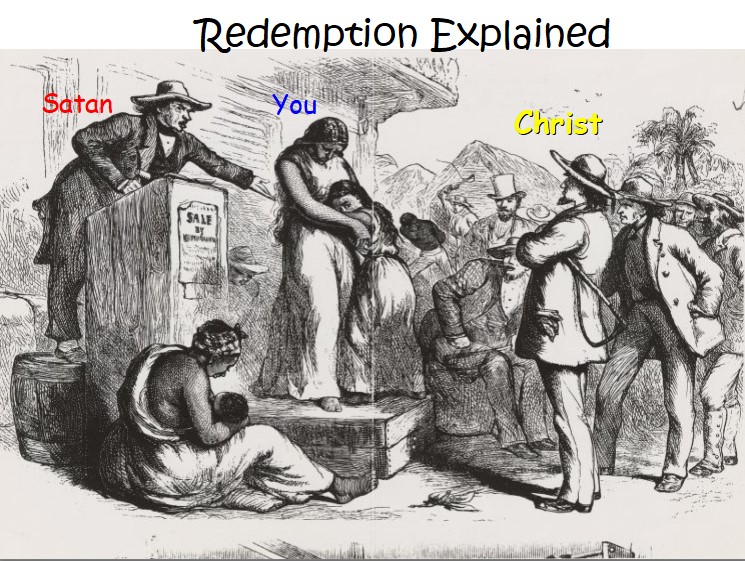
The principle of buying oneself out of captivity and slavery underscores the Christian idea of redemption. It is the analogy Paul and other New Testament writers use, to explain Christ’s paying the price, through his sacrificial death, for the slave’s release. He redeems (or will do at some future point depending on which fantasist you’re reading) in exactly the same way a slave was redeemed, from a life of captive slavery to sin/the Law/Satan and his minions. 

There’s a catch. If a slave was redeemed by a third party, he was likely to find himself not free at all but the property of whoever had redeemed him. His debt having been paid off to his first owner, he might very well find himself in hock to a new one. So it is with Christian redemption. Christ may have paid off your perceived debt to your original owner (sin, Satan or whoever) but now you’re indebted to him. You’re his slave, as we saw in the previous post.

To downplay slavery as it was practised in the centuries before the cult adopted it as an analogy, is to undercut redemption as Paul and early cultists perceived it. Arguing that slavery was a relatively benign practice removes the basis of Christian redemption; if being a slave wasn’t really too bad then neither can being a slave of sin/the Law/Satan be too serious either. There’s really no great need to be redeemed and what Paul says in Romans and elsewhere counts for nothing.

But we knew that anyway.


God’s Agents?

Christians are agents of God or so we’re informed. I’ve tried to locate where in the Bible it says that the Lord appoints fallible humans to be his 007s, but alas, I can’t find it anywhere. The best I can do are the claims in the fourth gospel that Jesus was God’s agent on Earth, but that’s not the same thing.

What about the idea then, also touted by Christians, that they are somehow God’s ‘partner’? No, that’s not there either. God regards himself as so far above us, his creators, that it would be like you or I partnering one of the ants crawling around in our gardens.

So how does the Bible describe the Christian’s relationship with God? It refers to it as master and servant. The word usually translated as ‘servant’ however, is doulos, which actually means ‘slave’. God doesn’t want you as an agent, partner or servant. He expects you to be his slave. Christian blogger, Sam Storms, explains what this means:

I, in the totality of who I am, have been purchased by Jesus Christ. He literally owns me. I belong to him, body, soul, spirit, mind, affections, abilities, talents, heart, will, and emotions. There is nothing in me or about me that belongs to me.

As a slave of God you are stripped of the very agency other Christians claim they gain from aligning themselves with the divine despot. And when you’ve done all he requires of you he’ll barely acknowledge you. As Jesus puts it in Luke 17:5-10:

Suppose one of you has a slave (doulos) ploughing or looking after the sheep. Will he say to the slave when he comes in from the field, ‘Come along now and sit down to eat’? Won’t he rather say, ‘Prepare my supper, get yourself ready and wait on me while I eat and drink; after that you may eat and drink’? Will he thank the slave because he did what he was told to do? So you also, when you have done everything you were told to do, should say, ‘We are unworthy slaves; we have only done our duty.’”

Whatever you do as God’s or Jesus’ slave won’t be enough, they’ll still regard you as a worthless slave.

I didn’t know about you, but this isn’t for me. I have more self-respect than to submit to a life as a slave. So have you. So in fact has everyone.

Most Christians agree. Almost all of them disregard the expectation that they become slaves. We know this because –

  • The majority don’t act as if they’re slaves, serving their fellow human beings till they’re fit to drop (Matthew 25 etc).

  • Most seem unaware even that Jesus insists they must be slaves when successive translators have deliberately altered the unsavoury ‘slave’ to the more palatable ‘servant’.

  • Those who are aware of his expectation seem to regard it as a metaphor; always a good get-out. And doesn’t Paul remark in his letters that believers are sons of God? That’s much more acceptable.

  • They omit the slavery element from their evangelising because no-one is going to be attracted by the offer of life-long servitude; far better to present Jesus as a would-be friend, big brother and all round good guy with whom people can be in ‘partnership’ or a fellow special ‘agent’.

  • They talk about free will when a slave, either of sin (John 8:34) or of Christ’s, has no freedom and no free will to exercise.

  • They convince themselves that sitting at a computer arguing with atheists online is the kind of slavery Jesus had in mind.

  • They turn a blind eye to the fact that the Bible teaches slavery is what they can expect not just now but for all eternity (Revelation 22:3-4).

It’s almost as if they don’t really believe such self-abasing, masochistic nonsense themselves.


Christian Values

I keep coming across the idea that the West is abandoning its ‘Christian values’ (here for example). Some say we’re doing so without having anything with which to replace them, while others bemoan the influence of ‘wokeism’, Islam and social media.

This seems to me to be lazy journalism. What Christian values are we talking about?

  • Self-sacrifice, humility, selling all to help the poor, putting others before oneself? These are Christian values according to gospel Jesus but they have never been the prevalent values of Western culture.

  • Prohibitions against lying, stealing and murdering, together with admonitions to be civil and respectful predate the Bible by some considerable time. Then, as now, they were not values adhered to by everyone but were, nonetheless, ones that ancient cultures aspired to.

  • Sexual mores, then. This is, after all, what most Christians mean when they refer to Christian values. These are forever in a state of flux in any culture; however much authorities attempt to legislate sexual practices, consenting adults will always do what they want to do. The sixth commandment and the Bible’s homophobic stance would not exist if adultery and homosexuality were not practised in the barbaric past. Meanwhile, polygamy, paedophilia and non-consensual sex (with slaves) get a free pass in the Old Testament. The West’s sexual mores, which in any case vary from culture to culture, are not based on the Bible.

  • Anti-Semitism, superstition, slavery, the subjugation of women and the denigration of those of different religions, race and sexuality, are Christian values, all derived from the Bible, that the West has upheld in the past, and occasionally returns to still. If these are the Christian values we are abandoning then good, and good riddance too. We’re all better off without them.

The West’s values are capitalism, ‘civil rights, equality before the law, procedural justice’, education, empiricism and democracy, none of which derive from Christianity. Arguably they emerged in the West as a reaction against the church and the establishment, with their oppressive values, during the Enlightenment. These are humanistic values that, it seems to me, are not under threat today (though some of them could benefit from reform).

This being said, other values, particularly the right to free speech, empiricism, privacy and the right to live peaceably according to one’s own principles do appear to be under threat. There are aspects of wokeism and its troublesome twin, cancel culture, that pose a threat to these values, which have been, until recently, highly prized in the West. wokeism gnaws troublesomely at the West’s self-esteem and self-respect, rewriting its history and insisting it apologise and make reparation for the actions of people who lived hundreds of years ago. Even so, the values wokeism threatens were not derived from Christianity; you will not find individuals’ rights, empiricism and free speech promoted in the Bible, nor by later church tradition. These values were hard won by enlightened men and women and subsequently evolved, as all values and principles do, over the last couple of centuries.

Despite the loud lament that the West is losing its Christian values, it isn’t. Apart from a few unpalatable prejudices that can be traced back to the Bible, the West does not operate on Christian values and has not done so, if it ever did, for a very long time.

Why God could not possibly have created the universe (pts 4 & 5)

Sacrifice2

The final two reasons why it is altogether unreasonable to credit the God of the bible with the creation of all that there is.

4. YHWH is inadequate

Christians want us to believe that the God of the bible is the ‘First Cause’ who purposefully created the cosmos. He is, they tell us, powerful beyond imagining, capable of bringing into existence a universe of infinite proportions, with its billions of suns, trillions of planets, nebulae, dark matter, black holes and the rest.

But this vast complexity stands is incompatible with YHWH, who demonstrates all the limitations we might expect of a god devised by primitive nomadic herdsmen. He is anthropomorphic, restricted in knowledge and defeated by technology his creators didn’t possess; like other deities of the period, he is obsessed with bizarre ritual, requiring genital mutilation and the sacrificial burning of animals. He lives, alternately, at the top of a mountain or in a box, from where he is capable of smelling roasting meat, and spends his time issuing laws about sex and slavery. He is primarily a god of war, his acts almost entirely destructive, rarely creative, which is what we might expect from a people continually in conflict with their neighbours.

Whatever else such a being might be, he is not one capable of creating the universe. He is nothing more than a small and petty tribal deity – one of many recognised by the Israelites during their history – created and sustained by men who knew no better. This is the god Jesus believed in, though he relocated him in the sky (‘the heavens’) and tried to turn him into something more amenable.

Despite this partial make-over, the New Testament version of God retains the attributes and limitations of his older self. He is, if Paul is to be believed, still pre-occupied with blood sacrifice, in dictating sexual behaviour and wreaking destruction on his supposed creation. He is no more capable of creating the cosmos than his predecessor. The God that modern Christians insist brought everything into being isn’t this limited, feeble, unsavoury figure. That God is another construct altogether, a far cry from the paltry god of the bible, and one they have devised themselves, that they make appear capable of creating the universe as we now know it to be.

5. The supernatural has no independent existence.

This is the bottom line: outside the human imagination, there is no evidence the supernatural exists. Even if we do take the human imagination into account, there is no evidence of an independent supernatural realm. No-one has ever seen a god, demon or angel, in exactly the same way they’ve never seen a fairy, goblin or unicorn. They may think they’ve experienced spiritual beings ‘within’ or felt them emotionally or hallucinated about them, but this does not mean they have independent existence. Despite millennia of religious belief no supernatural beings have ever manifested themselves, been witnessed, demonstrated or measured. Gods, like angels and spirits, do not exist. It follows, therefore, that the cosmos cannot have been created by them.

Thank you for bearing with me on my exploration of why god could not possibly have created the universe. I don’t know, of course – none of us do (yet) – how it came about, but the notion that it must have been god, the Christian god no less, simply isn’t feasible:

He would have had to create something from nothing, when the supernatural and immaterial are incapable of creating the natural and material.

The bible’s YHWH is too feeble to have been responsible and God-as-creator leads, in any case, only to an infinite regress.

The supernatural is a product of the human imagination; it has no independent existence.

However the universe came to be, we can be certain no gods, including the Christian one, were involved.


God approves of slavery

slavery

Over on his blog site, Biblical Musing, Don Camp is trying to justify why God appears to condone slavery. It’s not the first time Don has tried to defend the indefensible; he’s recently been arguing much the same thing on Debunking Christianity.

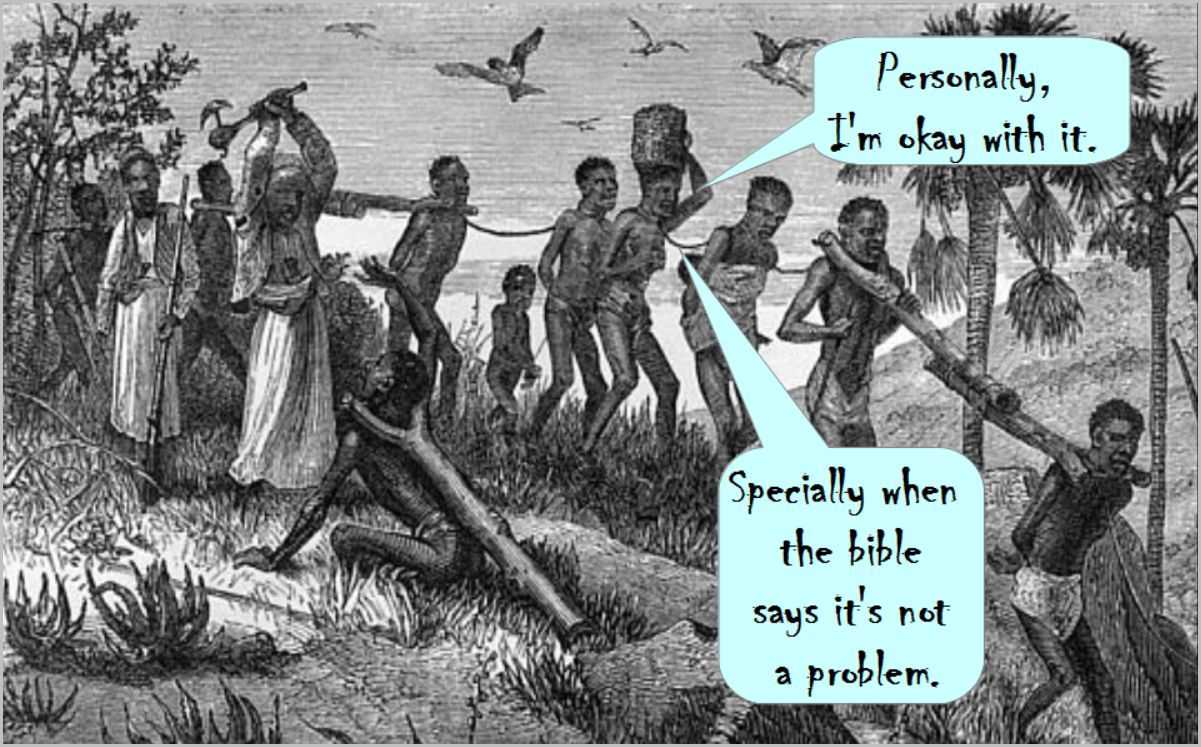
The fact the Old Testament appears to endorse the keeping of other human beings as slaves is a problem for Christians. It’s a problem compounded by the fact that Jesus in Luke 12.47-48 and the imposter-Paul, in Ephesians 6.5, both support the practice. How can it be that God approves, or at least raises no objection to it? Wouldn’t an omniscient, all-loving God have outlawed slavery, as he outlaws so much else, in one of his innumerable laws and commandments?

Instead, he provides instructions about how to keep and look after slaves; what to do, for example, when you flog one to within an inch of his life so that he later dies (Exodus 21.20-21) or when you deliberately blind your slave – she’s your property after all – or rape her (Exodus 21.26; Numbers 31.17-18).

Don’s answer is that, despite God involving himself in the minutiae of slave treatment, he knew it would be a waste of time telling his people slavery was wrong. Why? Because he took the trouble to tell them lying and stealing were wrong and yet they ignored him. So, hey, why should he bother telling them about slavery? They’d just ignore that too.

But the point is – disregarding the fact that not everyone steals and lies – ‘God’ did issue laws prohibiting stealing and lying (and eating shellfish, and wearing garments of mixed fabric). It seems it was important to him to tell his pet-tribe that these were wrong, even though he must have known many of their number, and many more subsequently, would ignore him.

What can we conclude from this? Only this: that God didn’t feel the same way about slavery as he did about lying and stealing, which is why he didn’t bother making even the same token effort to prohibit slavery.

Or, and much more likely: the tribes who wrote the laws didn’t think slavery was wrong. In fact, they thought it quite useful to have slaves. Given this utility, they were unlikely to have devised laws preventing their ownership. The enslaved themselves no doubt thought differently, but then they didn’t get to write the rules.

We don’t find a commandment prohibiting slavery in the bible because those who wrote it liked having slaves. For this reason too, we find all those inhumane instructions about keeping slaves and what should happen if you maim or kill them.

Of course God didn’t write these laws. People did. And they wrote them according to their understanding of what was moral, fair and legitimate within their own primitive milieu. Thus it was that slavery got a free pass.

How the bible gets almost everything wrong: volume 2

bible-questions

The bible’s moral inconsistencies:

As we saw here and here, the bible’s morality is confused and frequently contradictory. Jesus himself adds to the confusion with pronouncements like:

You have heard it said (in Exodus 21.24), ‘Eye for eye, and tooth for tooth.’ But I tell you, do not resist an evil person. If anyone slaps you on the right cheek, turn to them the other cheek also. (Matthew 5:38-39)

and

You have heard it said, ‘You shall not commit adultery.’ But I tell you that anyone who looks at a woman lustfully has already committed adultery with her in his heart (Matthew 5.27-28).

God’s ‘standards’ change depending on who thinks they’re channelling him:

In Joel 3.8 he advocates slavery but in Exodus 21.16 he forbids it.

In Matthew 6.1 Jesus insists good deeds should be done secretly forgetting he’s already said, in Matthew 5.1, that they should be done openly to impress others.

In Matthew 7.1-3 Jesus says judging others is to be avoided while in 1 Corinthians 6.2-4, Paul gives it the go-ahead; judging others is fine.

In Matthew 19.10-12 Jesus disparages marriage but the writer of Hebrews approves of it (13.4)

God allows divorce in Deuteronomy 21.10-14 but in Matthew 5.32 Jesus doesn’t.

And on and on. Like everyone else’s, Christians’ morality is socially determined. Unlike everyone else’s, their morality reflects the bible’s own confusion and inconsistencies. To accommodate its contradictions, Christians cherry-pick from it to bolster their pre-existing prejudices and biases. The rest of us are then measured – judged – against the resulting pick’n’mix morality and, boy, are we found lacking. ‘Biblical morality’ is nothing if not projectile.


The bible’s weak understanding of psychology:

Many of those who wrote the bible had a particularly bleak view of human beings. To these men we are totally depraved and our every thought is ‘continually evil’ (Genesis 6.5) Our ‘hearts’ are supremely deceitful and desperately sick (Jeremiah 17.9) and we’re under the control of the devil (Ephesians 2.1-3). We are incapable of doing good (Romans 3.10-13) and as Jesus himself puts it:

That which proceeds from a person, defiles that person. For from within, out of the heart, proceed the evil thoughts, fornications, thefts, murders, adulteries, deeds of coveting and wickedness, as well as deceit, sensuality, envy, slander, pride and foolishness. All these evil things proceed from within and defile a person. (Mark 7.20-23).

I don’t recognise this as a description of myself and I’m sure you don’t of yourself. Of course human beings are capable of terrible acts (I’m writing this not long after a fanatical Muslim murdered 22 young, innocent people in a terrorist bombing in Manchester, here in the UK) and, on a more mundane level, we can behave in thoughtless or vindictive ways, entirely out of self-interest.

But we’re also capable of great kindness, compassion and concern. We are a complex mixture of these traits, the good and the bad. The biblical view that we are only ever hateful, devoid of any good, is jaundiced and unnecessarily negative. If parents were to spend their time telling a child he or she is only ever bad, wicked and evil, they would rapidly deprive the child of their self-worth, self-confidence and ability to relate in positive, loving ways to others. The description would become self-fulfilling. This is what the God of the bible does to his children.

Neither are we awash with sin. Sin is a religious idea, used to describe how humans fall short of the glory of God. It need not concern us here. There is no God to fall short of; sin therefore is a concept without any traction in the real world.


The bible’s fantasy perspective of the world:

Did you know this world is controlled by the devil and his demons? That powers and principalities of the air are at war with God and the powers of holiness all around us? In fact, the devil is always looking for ways to discredit the bible and is constantly trying to weaken Christians’ faith. He smuggles false doctrine into the church in order to mislead believers, and uses the hoax that is evolution to prevent unbelievers from accepting Christ as their saviour. He gives women ideas above their station, which God says is to be submissive, and has unleashed a wave of homosexual behaviour and gender confusion to blind people to God’s goodness and to kindle his wrath.

Did you know, though, that this fallen world and the ‘heavens’ above it are soon to be destroyed and replaced by a new earth and new heavens, where Jesus will reign over the select few God decides to raise from the dead? Despite Satan thinking he’s in control, it’s actually God who is. God only allows the devil to think he’s top-dog while he, God, is secretly pulling the strings.

If you do know these things, and if you believe them, then you have a ‘biblical worldview’. Or, to put it another way, you’ve bought into third-rate hokum that bears no relation to the world – the universe, even – as it is.