The Most Important Words In The Bible

EternalLife1Some parts of the Bible are more important than others. A few verses have a prominence far greater than all the other parts of God’s Word™ and are far more authoritative. To obey these few verses alone guarantees one’s status as a true, born-again Christian.

I can announce that today I will be revealing which the verses are that matter more than all the rest.

There are only about three of them, one in the Old Testament, and two in the New. It’s possible there are a couple of others hidden away somewhere but they’re a little more obscure and don’t, as a result, give us the clarity we’ve come to expect from God’s Word™.

More ink has been spilt, or in recent times, more keyboards bashed, to pound out the implications of these verses than almost any others in the Good Book. Check out any Christian blog, any church web-site and the chances are you will find multiple postings and even entire sections dedicated to these three special verses. You could start looking here or here or here or here… There are sermons about them too and even protests and counter-protests, so important are they.

So, you might be wondering, are these the verses that tell us to love our neighbour as ourselves? Are they the ones that say we should turn the other cheek? To attend to the log in our own eye before pointing out the speck in someone else’s?

No, it’s none of these. In fact, The Most Important Words In The Bible are not ones uttered by Jesus who failed, inexplicably, to recognise their importance. Maybe they’re the words of St Paul then, about love being the most important thing or how to gain eternal life? No, it’s not those either. Only modern Christians have been able to recognise fully the significance of The Most Important Words.

And they are – fanfare from the Heavenly Host, please –

Leviticus 18.22 (duplicated in Leviticus 20.13):
You shall not lie with a male as with a woman; it is an abomination.

Romans 1.26-27
…God gave them up to degrading passions. Their women exchanged natural intercourse for unnatural, and in the same way also the men, giving up natural intercourse with women, were consumed with passion for one another. Men committed shameless acts with men and received in their own persons the due penalty for their error.

1 Corinthians 6.9-10 (plagiarised in 1 Timothy 1.9-10)
Fornicators, idolaters, adulterers, male prostitutes, sodomites, thieves, the greedy, drunkards, revilers, robbers – none of these will inherit the kingdom of God.

So now you know. The Most Important Words In The Bible are these, the verses condemning gay people. These are what Christians prioritise, write about and rant about more than any others. Not ‘forgive others if you want to be forgiven’, not ‘don’t judge’, not ‘give to all who ask’… but the ‘sin’ of homosexuality.

It’s irrelevant, apparently, that Jesus himself has nothing to say about same-sex relationships; irrelevant that, even in the verses where he touches on homosexuality, Paul lists a whole load of other ‘sins’ that Christians themselves are known to indulge in from time to time. No. The Bible is not, you see, about salvation, not about witnessing to non-believers – it’s about homosexuality and what a dreadful thing it is. Today’s Christians, having isolated these few verses, know this and so have their priorities straight.

Never mind that the Bible isn’t really God’s Word (see my previous two posts); never mind it has other things to say besides a few mentions of homosexuality; never mind that it demands a great deal of Christians themselves, which, naturally, they ignore – today’s believers know what Christianity is really about.EternalLife2
Stephen Green is Gay

Green2

Stephen always got his inspiration from the Lord…

Stephen Green of Christian Voice is unhappy. Gay Marriage, he insists, is a Very Bad Thing.

Green has had a lot to say about gay relationships and gay sex over the last few years. In fact, he’s obsessed with the subject. His latest ejaculation, called ‘Gay Marriage is a Farce’, helpfully informs us:

‘Gay’ relationships (are) built on perversion.

Homosexual desires are described as vile affections in the Bible.

‘Gay marriage’ is a massive step towards the social economy of Sodom.

We don’t say homosexuals are perverts because of what they are, but because of what they do.

Homosexual activity… is either dirty or abusive or both.

Homosexuals, frustrated by their inability to engage in true sexual intercourse, have to resort to activities which are abusive or dirty.

Homosexual acts fall a long way short of the God-ordained conjugal act.

Personally, I now use the word gay mostly in its modern sense of substandard (as in, ‘that coat’s gay’).

Never self-identify as ‘gay’. Never let someone else identify you as ‘gay’.

Green is himself ‘gay’. In the ‘modern sense’, of course. He preaches that marriage is between one man and one woman for life, yet is divorced and now with his second wife-for-life. He trashes charities that help young LGBT people and makes unwarranted personal attacks on gay celebrities, recently suggesting that Stephen Fry has a ‘porcine ancestor… not that we do evolution here’ and adding derisory inverted commas around the ‘Sir’ in Ian McKellen’s name. How big and clever is that?

Even though Jesus has more to say about poverty and homelessness than homosexuality (about which he says precisely nothing), Green never mentions them. He consistently avoids talking about his saviour’s commands to turn the other cheek, go the extra mile and avoid judging others. These, it would seem, don’t matter.

While he occasionally rants about evolution and complains Christians are persecuted, it is to homosexuality he constantly returns. Always with inverted commas around ‘gay’, to ward off the voodoo.

But Green is insecure in his beliefs and faith; he rarely publishes comments that dissent from his ‘biblical’ position and when he does, responds to those who make them with an uncharitable smugness that borders on abuse. There is no sense of any Christian charity in either his comments or on his site as a whole.

Worst of all, he washes his hands, Pontius Pilate like, of the harm his negative, destructive comments cause LGBT people. The real bullies, he says, are not Christians with poisonous views like his but rather:

homosexual activists who persuade young boys and girls that adolescent same-sex attraction indicates a permanent ‘orientation’ and who go around talking homosexuality up and giving bullies a weapon to use against shy boys and tomboyish girls. People like ‘Sir’ Ian McKellen, Elly Barnes, Jake Dyos and the rest of the low-life at ‘School’s Out’.

So now you know. Stephen Green, who calls ‘gay’ people perverts with ‘vile affections’, whose relationships and love-making are, he says, founded on dirt, disease and abuse, is in no way a bully whose views contribute to any ill-feeling towards gay people.

No, the vilification to be found on Christian Voice is actually Christian love™. The gospel according to Stephen Green: it’s so substandard.

Christians’ Favourite Delusions 18: We’re the ones being persecuted!

Persecution

You think Christians don’t say they’re persecuted? Take a look at a recent entry on Christian Voice, where the claim is made that Christianity itself is being ‘criminalised’ in the UK. Visit American Christian blogs where they insist they’re being persecuted. Listen to the former Archbishop of Canterbury, George Carey, complain ad nauseam that Jesus’ followers today are marginalised and mistreated.

And why do they feel this way? Usually because they don’t like being told they should stop persecuting gay people. It’s their religious right, they tell us, to ‘live according to conscience’ and to bash (if only verbally in this country at least) a maligned minority. And any attempt to stop them from doing so, they say, is an infringement of religious liberty. Hatred of homosexuality has become such an integral part of the Christian faith these days.

Suggest to Christians in the West that they’re not experiencing persecution at all, but only a fair and reasonable attempt to make them treat others as they themselves would be like to be treated (didn’t Jesus say that?) and they respond, as a Christian Voice supporter did the other day, by sending you a link to the site of the Christian Liberty Council. Here’s the proof that Christians are really the victims! Go to the link and what you get is, yes, a list of believers who’ve been cautioned for abusing LGBT people. It’s so unfair! And that’s it, that’s their evidence.

If Christians were prevented from gathering together for worship, imprisoned for their belief in Jesus, stopped from talking about their faith, denied the means of praying together and so on, then perhaps they could reasonably say they were being persecuted. As it is, they’re the ones doing the sniping – and whining when they’re chastised for it.

In fact, their saviour tells them in Matthew 24.9 what to expect when any real persecution or ‘criminalisation’ comes along. They should, he says, whinge about it at length, even if it’s only a very remote possibility.

Oh, no wait, that’s not it; see it as a gift, he tells them, and pray for those doing the persecuting (Mark 10.30 etc). Problem solved! As ever though, they choose to ignore him. They much prefer to hang on to their prejudices and see themselves as the real victims.

Picture shows, clockwise:

Pat Robertson, US TV evangelist, who says gay people want to destroy marriage and the church itself.

Yoweri Museveni, Ugandan president and evangelical Christian who this week approved a bill toughening penalties and punishments for gay people.

George Carey, former Archbishop of Canterbury, who complains about how dreadfully Christians are treated in Britain.

Scott Lively, American evangelist currently facing a lawsuit for ‘crimes against humanity’. Influenced the anti-gay laws recently introduced in parts of Africa and, possibly, in Russia.

Pope Francis, leader of the Roman Catholic Church, which officially condemns homosexuality, whatever conciliatory noises Frankie himself appears to make.

Stephen Green, operator of Christian Voice, which insists Christians in the UK are being criminalised for their intolerance.

Caption suggested by an article on the excellent Joe.My.God blog.

What’s this ‘Biblical morality’ we keep hearing about?

Is it feeding the hungry? Helping the poor? Visiting the sick and the imprisoned? Opposing injustice? Fighting against oppression? Giving away your possessions? Going the extra mile? Turning the other cheek? Respecting others? Loving your neighbour? Loving your enemies?

Or is just about sex? To read Christian web-sites and blogs, you’d think so. Jesus’ followers today are obsessed with it, which is why the God they make in their image is too. Sex that other people might be having, before marriage, during it; sex when it makes babies and when it doesn’t; sex with yourself; sex in the head, on the screen and in different positions; sex with too many partners, with the wrong partners and with partners of the same sex (the worst sin of all, apparently). They write about little else, because you see, what other people do in bed together is of great concern to God. It’s more important to him – or his self-appointed representatives on Earth, anyway – than hunger, oppression, slavery, injustice and genocide combined.

If only we all had sex like the Christian experts say we should (because it’s in the Bible) then we’d all be so much better off; civilisation wouldn’t be slipping into the abyss, God wouldn’t be so upset with us and we wouldn’t all be destined for hell.

End

But morality isn’t just about sex. In fact, it has little to do with who we sleep with and when. Rather, morality is about how we treat others, as Jesus said (Luke 6.31). Of course, how we treat others in a sexual context is important, but it’s no more important than how we treat them in other contexts. That’s because morality is, or should be, all embracing. It’s long past time Christians stopped banging on about it as if it was the only concern of morality. Instead they could start treating those who do sex differently from them as they themselves would like to be treated. That, if there really is such a thing, would be true Biblical morality.

Why God is always a no-show

Peter&Paul

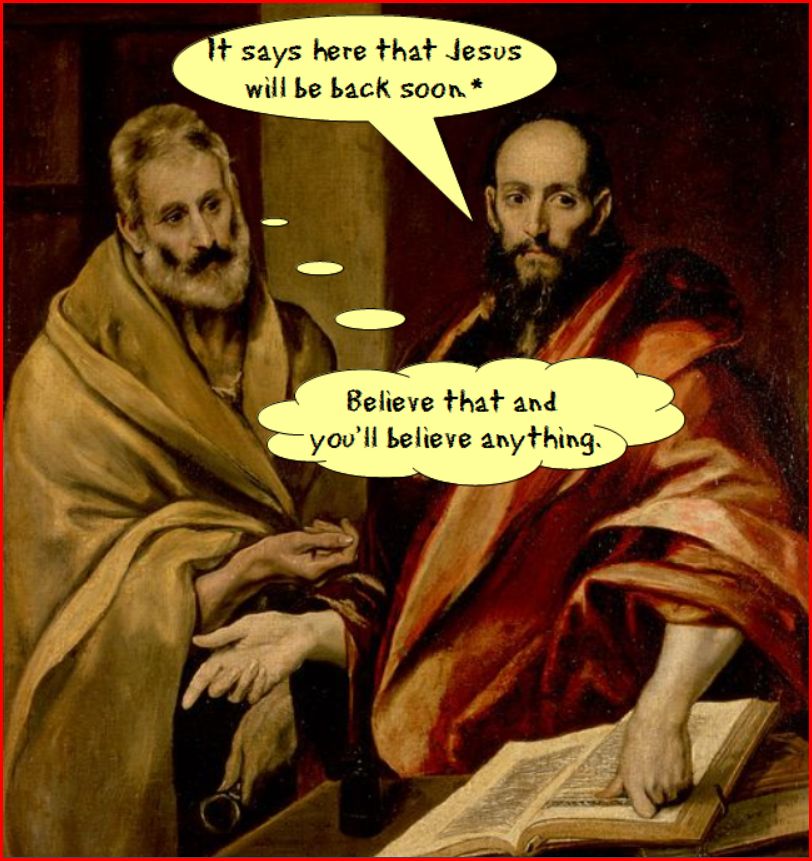
* And he should know; he wrote it in 1 Thessalonians 4:17, 5:23 and elsewhere.

When Jesus thought his world had got into such a bad way, he felt sure God would intervene and turn things around. But God didn’t and Jesus was executed instead.

When St Paul became convinced things couldn’t go on as they were, he told everyone that God was going to send Jesus back to Earth to sort it all out. But God didn’t and Paul was executed instead.

When people were accused of witchcraft in the middle ages, they waited for God to intervene and save them. But God was a no-show, again, and 100,000 were tortured or killed as a result.

When millions of Jews were taken to concentration camps in the second world war, they too prayed for God to save them. Once more, he failed to make an appearance and instead over six million men, women and children were exterminated by the Nazis.

When right-wing Christians today complain that the world has abandoned God (because, you know, gay marriage) they feel sure that God will intervene to judge us all and put things ‘right’. So far, he’s conspicuous by his absence.

God is always a no-show, despite the pleas of his followers, despite the earnest belief of his alleged son, despite the plight of his chosen people, despite those today who claim to know his will. Could this be because he has no existence outside the imaginations of human beings?

It surely could; a being that has failed to show himself throughout the history of mankind is a being that doesn’t exist.

Notes:

1) Jesus says God will intervene: Matthew 24:27, 30-31, 34, Luke 21:27-28 etc.

2) Witchcraft figures from An Atheist’s History of Belief:Understanding Our Most Extraordinary Invention by Matthew Kneale, p198

3) While I’ve linked one site that reflects modern Christian belief, there are thousands more of the same sort. Google ‘God will judge America’ for an unhealthy sample.

Christians’ Favourite Delusions 2: Prayer works.

CaptureThe Bishop of Honolulu, Larry Silva, is upset. He wants true believers to pray away the gay. He’d really like God to stop same-sex marriage from coming to Hawaii. And prayer is the answer, because, without it, God might not be inclined to bother himself.

It worked so well in the UK. Groups of Christians muttering about abomination, sin and damnation petitioned God to stop equality from happening here too. Which is why, last month, the same-sex marriage bill passed into law.

So what went wrong?

According to those who know God better than the rest of us, he’s pretty uncool about the gay (Leviticus 20:13, 1 Corinthians 6:9-11 etc) so we might wonder why he didn’t just veto same-sex marriage and have done with it. Maybe, though, he couldn’t be trusted to do the Right Thing, and needed reminding, by the most fallible of human beings, of what it was he was required to do.

Still he didn’t take the hint and even though they told him, God decided in the end – or maybe it was In The Beginning – not to bother preventing same-sex marriage in the UK and in other parts of the world.

So what does this tell us about all those unanswered prayers Christians sent heavenward? There are four possible explanations of why they failed miserably.

Either:

1. God has other plans. Namely, he wants to use same-sex marriage to bring about the End Times (yes, really).

2. The faithful didn’t pray hard enough, – though why intensity of prayer should have any bearing on whether God decides to grant petitions is never explained. Be that as it may, on this occasion Christians just didn’t pray with sufficient feeling to persuade their Heavenly Father to buy them the chocolate bar at the check-out er… prevent gay marriage. (Yes, it’s completely nonsensical, but I’m trying to give them the benefit of the doubt here).

3. God doesn’t give two hoots about human politics, institutions, social arrangements… and has no interest in who marries who.

Or,

4. God doesn’t actually exist. How else to explain his unresponsiveness, his perpetual invisibility, his total absence from any sphere of existence outside human imagination?

Whichever alternative applies in this scenario – and let’s be honest, there are no others – it is evident that prayer doesn’t work in the way Jesus said it would (Matthew 18.19, John 14.13 &16.23). Not even the most devout Christians can get it to, demonstrating emphatically that, actually, it doesn’t work at all.

So good luck, Bishop Silva. Looks like we can expect to see same-sex marriage in Hawaii some time soon.

Morality Tale

Preaches   A man who believes in the impossible – and it is a man more often than not – appears as a moral authority every morning on national BBC radio. This same man is frequently asked by television networks to give his views on moral issues of the day, be they assisted suicide, pay-day loans, same-sex marriage & adoption, abortion or capitalism. And even when he hasn’t been asked, the views he expresses on these subjects are widely reported, sometimes all around the world. The man can, in one of his roles, sit in the second most important legislative body of the land, again as a moral authority, influencing laws that are binding on everyone else whether they believe in the impossible or not. Indeed, the man has an automatic, unelected right to be part of this august body.

   Where, you might ask, does this man’s moral authority come form? Is he a psychologist with a profound understanding of human behaviour? Or a geneticist with knowledge of the biological bases of our decision making? Maybe a philosopher who has analysed the cognitive processes that lead to moral decisions? An ordinary, educated person, then, who has given much rational thought to how we might best treat one another?

   No, he’s none of these. He’s just a man who believes in the impossible and wears funny clothes to prove it. Invariably, it is true, he has become quite an expert in believing the impossible and he’s even been granted a special place in society that allows him to encourage others to believe the impossible. As a result, he has somehow made the leap into thinking that, because he believes in the impossible, he must therefore be a moral authority.

   Now, we may not object to the man believing in the impossible in the first place – it’s a free country after all – but we don’t accept, surely, that because he does, it means he knows much more than the rest of us about morality?

   Yes, I’m sorry to report that we do. We acquiesce to the man and say ‘because you believe in the impossible, and for no other reason, you must know more about morality than we do.’ And when we are looking for moral guidance, we turn to him – whether we are the BBC, the rest of the media or the government – and we say, ‘what do you say about this? What should we think about it, because, after all, you are the authority here by virtue of the fact that you believe in the impossible?’ And the man, in whatever guise he appears – pope, archbishop, bishop, reverend, imam, rabbi – says, ‘this is what it says in my magic book (even when it doesn’t) and you should follow it, even though you might not believe in either the magic book or in the impossible.

   And we say, ‘Well, you’re the expert and we respect that you should tell us how to behave, if for no other reason than you believe in the impossible.’

Same-sex marriage and Christian conscience

PrinciplesThe Queen gave royal assent to same-sex marriage yesterday and the first such marriages are likely to take place next summer. The aspect of the bill that concerns me is that ‘religious organisations will have to “opt in” to offering weddings, with the Church of England and Church in Wales being banned in law from doing so.’ Even before the passing of bill there were already instances of religious individuals declining services to same-sex couples, including a Christian registrar who refused to conduct a civil ceremony on grounds of conscience.

Remarkably, given the tenuous nature of everything they believe, Christians insist they have the right to ‘live according to conscience’. What this means in practice is that in circumstances where they feel their God-given principles might be compromised, they are compelled to withhold their services from others, denying the rights of fellow human-beings.

By the same principle, however, everyone else must also have the right to live according to their own consciences. If we arrange society so that we don’t have to help, provide a service or care for those whose lifestyles or beliefs are contrary to our own, we end up with a society that operates only on exclusion. The hotel owners who exclude homosexual couples will be matched by gay hotel owners who don’t like Christians; Muslim shopkeepers who object to non-Muslims won’t have to serve them; vegan restaurateurs will, on principle, bar meat-eaters; atheist surgeons will be able to deny treatment to the religious. Such a society could not function because we would all, at some point, be excluded, while at others we would be those doing the excluding. Conscience-based rejection of others, taken to its logical conclusion, could only lead to the breakdown of civilised living, which is reliant on interdependency and mutual cooperation.

A comment posted on the Guardian’s web-site following the case of a Relate counsellor who refused to help homosexual couples neatly summarises the issue:

Gay men and women have been giving good service to bigots for years. We’ve been nursing you through your illnesses, clipping your tickets, treating your diseases, teaching your kids, entertaining you on telly, delivering your mail, waiting on your table, shooting your enemies and cooking your dinner; all this time without ever claiming the “right” not to serve you if you don’t happen to approve of us. It’s time some straights grew up and stopped whining.

There is nothing biblical about living according to ‘principles’ that demand others be ostracised. On the contrary, Jesus demands that his followers give unconditionally to anyone and everyone who asks and treat others as they themselves would wish to be treated (Luke 6.30, 31, 35).

Christians who claim they have a right to reject and exclude others ‘according to conscience’ would do well to consider how they would react if ‘principled’ gays, Muslims and atheists refused them the services they sometimes feel ‘conscience bound’ to refuse others.  What cries of ‘persecution’ there would be then!

Oh wait! There already are…