Getting Things in the Right Order

It’s difficult to find the probable chronology of the New Testament online. The Christians have taken over, many insisting the order of the books as we have them today is correct. I’ll work from one originally devised by Bart D. Ehrman in The New Testament: A Historical Introduction (accessed here). While there are apologists who insist improbably on earlier dates and scholars who argue for later ones, there is general consensus amongst scholars for the order of the books as they’re shown here:

The first book of our reordered New Testament, if we had it, would describe the visions of Cephas, and possibly others, who believed they’d seen the heavenly Jewish Messiah. Apparently, this envisioned Messiah told them he was coming to the Earth real soon to usher in God’s kingdom. This is all we know of the beliefs of these original Christians and we know it only from Paul. They themselves left no writing of their own. And why would they? The Messiah had appeared to them (in their heads), which could only mean he’d be coming to the Earth imminently. It was all too urgent to bother writing a treatise about it. It was going to happen any day!

Paul opposed these early Jewish cultists over their very concept of the Messiah. After his own visions converted him to a belief in Jesus, he profoundly disagreed with them over their insistence that the Messiah was coming from Heaven to rescue only his own people, the Jews. They held, as Paul did not, that Jewish rites and traditions must therefore be maintained. These ‘so-called pillars of the church’ as Paul snidely calls them in Galatians 2, were probably wiped out when the Romans destroyed Jerusalem and most of its inhabitants in 70 CE.

Following this representation of pre-Pauline cultists, our reordered New Testament would next have Paul’s letters. Written between 49 and 59 CE or thereabouts, the letters derive from the visions Paul claimed he’d had of the Jewish Messiah and what he thought these meant: his so-called revelations from the Lord. He decided the Messiah had made the ultimate sacrifice in order to offer salvation to all people, not just Jews. While the letters in chronological order reveal Paul’s evolving theology they have nothing to say about a human Jesus who wandered around Galilee a couple of decades earlier. Either Paul knew nothing about this character or he didn’t care about him. Or there was no earthly Jesus for him to know about. Paul boasts several times that he devised all of he knew about ‘the Christ, Jesus’ from his visions and subsequent contemplation.

The first gospel (‘Mark’) was written circa 70 CE. Whoever created it transplanted Paul’s Heavenly Messiah into a geographical and historical context. He structured his story around Paul’s ideas, predictions about the Messiah from Jewish scripture and sayings from those same scriptures. He also incorporated cult beliefs and rules from his own time. The original ‘so- called pillars of the church’ he cast as Paul viewed them – as boneheaded disciples who failed to understand the significance of what they were experiencing. He didn’t, curiously, include any resurrection appearances.

Next comes the second letter to the cult in Thessalonica and the first of the letters supposedly by Peter. Both are considered to be forgeries for all the reasons Ehrman discusses here and here.

2 Thessalonians concentrates on the vengeance Jesus will wreak on those who have rejected him. Like in the real Paul’s letters, there’s nothing about any historical Jesus. 2 Thessalonians and 1 Peter demonstrate that possibly as early as 70 CE, cultists were happily making stuff up and passing it off as written by cult heroes (who’d also made stuff up.)

Matthew, Luke and Acts follow. Again, these books were written anonymously only acquiring their traditional attribution many years later. Matthew takes 80% of Mark, adds some material of his own derived from the Jewish scriptures, and presents his new gospel as the definitive account of the Jewish Messiah’s time on Earth. Matthew’s gospel takes the use of allegory and metaphor that he’s picked up from Mark to extremes.

Luke likewise plagiarises Mark, adds some Matthew (though he’s not keen on Matthew’s Jewish emphasis so eliminates it) and creates material of his own based on Paul and Josephus. 

Buoyed by the success of his story, Luke ploughs straight on into an account of the early church and Paul’s doings. There are multiple problems with Acts, not least that Paul’s theology in the book is nothing like that of the real Paul. It is not history but a fabrication, reworking parts of older stories, such as the Odyssey, in several places.

A couple more forgeries follow: Colossians and Ephesians, both written between 80 -100 CE, long after Paul’s death in 64/65 CE. The two books make no mention of an earthly Jesus, despite at least three accounts of his supposed life that were, by the time Colossians and Ephesians were written, in circulation among the various sects of the new cult. Instead, Jesus is depicted as a heavenly super-being. Because they’re forgeries, they really don’t belong in our new New Testament; they muddle Paul’s already muddled thinking.

Well, we’re only half way through and I figure we all need a break. We’ll pick up on the second half of Putting The New Testament In The Right Order next time.

Revealing the Truth of John’s Revelation

The revelation from Jesus Christ, which God gave him to show his servants what must soon take place. He made it known by sending his angel to his servant John, who testifies to everything he saw – that is, the word of God and the testimony of Jesus Christ.

Blessed is the one who reads aloud the words of this prophecy, and blessed are those who hear it and take to heart what is written in it, because the time is near… “Look, he is coming with the clouds,” and “every eye will see him,
even those who pierced him”; and all peoples on earth “will mourn because of him.”
So shall it be! Amen…

On the Lord’s Day I was in the Spirit, and I heard behind me a loud voice like a trumpet, which said: “Write on a scroll what you see and send it to the seven churches: to Ephesus, Smyrna, Pergamum, Thyatira, Sardis, Philadelphia and Laodicea.” I turned around to see the voice that was speaking to me. And when I turned I saw seven golden lampstands…

So begins the Book of Revelation, written by a fanatic identifying as John (think Steven Anderson) who finds himself on the island of Patmos ‘because of the gospel’, with an account of the imminent end of the world (1:3 ‘the time is near’ and 1:7 ‘even those who pierced him’ will see him.)

What follows is a disturbing and disturbed account of what the Earth could soon expect when Jesus descended from the heavens to wreak vengeance on sinful human kind.

John claims the scenario he’s about to describe was given to him by an angel who got it from the Lord Jesus Christ, who in turn received it from God himself (1:1). Or perhaps the angel and Jesus Christ are one and the same. Did John regard Jesus Christ as an angel, the ‘messenger’ of God (the literal translation of the Greek angelos)?

I’ve often wondered about this ’revealed’ business. Paul too talks about having Jesus ‘revealed’ in him (Galatians 1:16). What exactly are Paul and John talking about? John says he ‘saw’ (1:2) all that he’s about to describe in the next twenty-two tedious chapters, as if this ‘revealing’ is some sort of vision or hallucination. Given the complexity of what he then describes, this seems to me highly unlikely. He ‘sees’ in his mind’s eye god’s throne, attendant angels, the four horsemen, the opening of seven seals, the destruction of the world, the annihilation of most of mankind, the descent from heaven of the holy city, the intricate details of the construction of this city… read the book for yourself for even more. Even dreams are not this detailed or vivid.

I’m not convinced Paul saw the resurrected Jesus as a figure in front of him (or as a bright light or some other quasi-physical manifestation.) What Paul and John did when ecstatic with religious fervour – what John describes as being ‘in the Spirit’ – was concoct an explanation for the way they were feeling; Paul persuaded himself he’d seen a resurrected God-man and worked out over time what this might mean. He then attributed this thinking to his God and his divine influence. John under persecution (it’s generally accepted his being on Patmos ‘because of the gospel’ (1:9) was as punishment for being a public nuisance) fomented a doomsday scenario for those who persecuted him and the divine elevation of those who believed like he did, and attributed this to spiritual beings. The scenario was not revealed instantaneously to him by a supernatural agent; again, it was something developed over time – hence the quotations from other sources (1:7) – in an aggrieved fanatic’s head.

Revelation is a calculated literary construct, like the gospels themselves, devised and refined over time. John ‘saw’ none of it, nor did he ‘hear’ an actual disembodied voice telling him about living room furniture (1:12’s lampstands). No higher power ‘revealed’ any of it to him. On the contrary, he devised it himself, working out every aspect in his head. Either he was deluded enough to think he was actually being fed revenge-porn by an angelic Jesus or he cynically, deliberately attributed it to him.

There was not then, as there is not now, a heavenly Jesus who spoke to susceptible mortals here on Earth. The savage, avenging Jesus that John of Patmos creates from his own anger, bitterness and sense of persecution bears little relation to the other versions of the character in Paul and in the gospels (as Ehrman demonstrates in Armageddon). Revelation’s savage, slaughtering Jesus is at least the sixth manifestation of the character proffered in the New Testament. John demonstrates just how easy it was, and is, to invent one’s own version of a supposedly unchanging character (Hebrews 13:8; Revelation 1:8) and make him do, at least in your imagination, just what you want him to do.

A World When Revelation Was Possible

Greek and Roman cultures of the ancient world were obsessed with seers, oracles, prophets, muses and the fates. Politicians, priests and ordinary people were desperate to know how to keep on the right side of capricious gods and what the future held. Word from the supernatural realm, channelled through seers and prophets, was sought after and valued. Visions, dreams, portents and auspices that revealed secrets and mysteries were highly prized. It was a world saturated in superstition. Jewish culture, operating within this milieu, was no different.

Jews too revered prophets, dreams, visions and divination. This is apparent in both the Jewish scripture, the Old Testament, and also in the New, the writing of the early Christian cult birthed from Judaism in a Greco-Roman world. There are in the New Testament:

6 instances of god-induced dreams;

11 visions of heaven and heavenly beings;

578 new prophecies;

300 or so supposed fulfilments of earlier ‘prophecies’;

An abundance of revelations’ (Paul’s phrase) as well as those of Revelation itself (one long revelation or a series of shorter ones?);

113 visits from supernatural agents (Satan, demons, angels);

Assumptions that dead people can reappear (Jesus mistaken for Elijah and Jeremiah; Elijah and Moses manifesting themselves);

Multiple ‘resurrections’ both before and after Jesus’s.

People believed this kind of stuff! The supernatural, prophecy, ‘revelation’ and resurrection were regarded as entirely plausible, a given in the culture in which early Christians lived. The pagans around them may not have subscribed to the new cult’s reworking of these superstitions, nor accepted that Jesus was the Messiah, but they would not have found anything amiss with the idea and presence of the supernatural, with its attendant revelations, visions and prophecies. These were the currency of the day.

That such manifestations were mistaken or misinterpreted by the new cult would have been the point of disagreement for most people (though its important not to over-estimate how many actually knew of the Jesus cult in its early days), not that it manifested and incorporated them in the first place.

In the first century world, revelations, prophecies, visions and the like were considered to be gifts from the gods. Paul insisted that what he ‘received’ was from the supernatural realm, specifically from the heavenly Christ (Galatians 1:12). Accepting this was a prerequisite for believing what he went on to say about salvation, resurrection and Christ’s descent from the clouds. The supernatural world and its ability to communicate with ordinary mortals had to be accepted as real before anything Paul said could even be considered. Fortunately for him, the culture in which he operated embraced the idea that this was a reality.

If, however, there is no supernatural – and let’s be honest, we know there isn’t – there can’t ever have been revelation, prophecy or God-given visions. With no heavenly realm to transmit revelation, prophecy and visions into the brains of seers, prophets and visionaries, from where did – and do – their revelations, prophecies and visions originate? From brains conditioned in an environment infused with irrational, magical beliefs, whether that of the first-century or one of the many Christian, Bible-soaked bubbles that exist today. ‘Revelation’, ‘prophecy’ and visions emanate entirely from the human brain. It is this which originally created revelations and now sustains ideas like heavenly saviours and supernatural resurrections. These things have no independent existence outside of the human imagination.


The End of Days

A friend of mine was recently given the book The Dragon’s Prophecy: Israel, the Dark Resurrection and the End of Days by Jonathan Cahn. My friend, already concerned about the state of the world, said how much the book had disturbed her. She had become convinced that the time we live in had been predicted in the Bible, in Revelation in particular. ‘It’s all there in the Bible,’ she said to me. ‘It’s all happening just as it says.’

I tried to reassure her that Revelation was written by someone who, 2000 years ago, believed that the situation then couldn’t get any worse, what with the Roman occupation, the destruction of Jerusalem and the persecution of Christians (as the writer saw it.) This, together with his belief that the Lord would soon be coming on the clouds (Revelation 1:7), convinced him he was living in the world’s last days. I told my friend that because of the mess the world is in today (and when is it not a mess?) the book of Revelation resonates with some people; a voice from the past echoing down the ages. In no way, however, was it written about today.

My friend was unconvinced so I took it upon myself to read The Dragon’s Prophecy. Coincidentally, I had just begun to read Bart D. Ehrman’s Armageddon: What the Bible Really Says About the End, dealing with the same concerns. The comparison between the two books couldn’t be more striking.

Ehrman’s is a measured analysis of Revelation and other ‘prophetic’ books of the Bible. He demonstrates from the outset that Revelation was written for believers of the late first/early second century and that its symbolism represents individuals and events of that time. John of Patmos, whoever he may have been (a cult leader, Ehrman suggests) expected, like most early Christians, that the End was going to materialise soon, in the first or early second century, emphatically not in the 21st.

Ehrman warns that ‘professional prophecy writers’ (he doesn’t name Cahn) think ‘the way to use the Bible is to assemble the pieces to reveal the big picture, which until now no one has seen before’ (p17). He’s right. This is precisely what they do. In his book, Cahn promises ‘to put together the pieces of the mystery’ (p11) and claims ‘We (sic) will now begin assembling the pieces of the puzzle’ (p36). He then proceeds to jump around the Bible like a grasshopper on steroids. He’s one of the ‘prophets’ who, as Ehrman puts it, sees the Bible as ‘a great jigsaw puzzle with one piece hidden in this place, one in another and yet a third somewhere else’ (p17).

Cahn opens his argument with a series of bald, unsupported assertions: ‘Behind the perceivable realm lies another, beyond our ability to measure or quantify’ and ‘Behind the history of this world lies another, unrecorded, unrecited (sic), unknown,’ his readers evidently not expected to ask how he knows any of this codswallop. He goes from there to build his argument, such as it is, with a bombardment of ridiculous questions and pseudo-profundities:

What is evil? And how did it come into existence? It is both a mystery and a problem. The mystery is the problem (p9).

Then there are the propositional statements of the ‘If… then we’d expect’ variety. There’s rarely any evidence for the ‘if’ and none at all for the proposed expectation. Here’s the two – rhetorical question and propositional statement – rolled into one: ‘If evil is uncreated, how did it come to exist?’ (p32). Naturally, Cahn is going to answer this question and all the others like it, with a series of unfounded assertions, non-sequiturs and a smattering of unrelated Bible verses.

A central premise of The Dragon’s Prophecy, the dragon being that of Revelation 12:9 and therefore the devil, is ‘the dark resurrection’ of its subtitle. This Cahn explains, pretending the idea comes from the Bible when it doesn’t, is the re-emergence of the Israelites’ old, (extinct) enemies, the Philistines. Like the Israeli nation they too have now been resurrected: as the Palestinians. Under the control of the dragon/devil, they re-enacted on October 7th last year one of the many ancient Philistine attacks recorded in the Bible, only this time with ‘guns and explosives’:

On that October morning, the ancient drama replayed. The resurrected Philistines had again invaded the land, and the resurrected Israelites had again gone into hiding, keeping silent and still in fear of their pursuers (pp99-100).

How do we know this is a replay of an ancient invasion? Because some of those under attack on 7th October went into hiding, just as the Israelites did in 1 Samuel 13:6. As if no other group of besieged civilians hasn’t tried to hide at any other point in history. That and the ‘fact’ there were, according to Cahn, exactly 3,000 invaders on each occasion. Yes, the book really is this bad.

And so, Cahn says, the stage is set for the final battle and the return of Christ who will knock a few heads together, torture and slaughter everyone who isn’t a Christian and set up his faithful followers in a new Jerusalem made of gold and fancy stuff. As Ehrman says, this is indeed what Revelation promises – for the world 2,000 years ago. Ehrman argues that the author of this revenge porn, (he doesn’t use the term: that’s my contribution – you’re welcome) creates a Christ so unlike those of the gospels that he can only be a fiction (aren’t they all?)

Revelation barely made it into the canon and we would all be better off if it hadn’t; certainly my friend would be, and as Ehrman shows, human society and the planet in general would be too. He warns us to read what the Bible actually says, instead of, as Cahn does, forcing it to say what we want it to (to sell books). Irritatingly, Ehrman consistently refers to the Christ’s prophesied appearance on the clouds as his ‘Second Coming’ when the Bible never uses the phrase. Read what it says Bart!

I don’t know whether I’ll finish Dragon’s Prophecy. Its cover blurb boasts that Cahn is a New York Times best seller so clearly there’s an audience for such poorly argued, alarmist nonsense – which is itself alarming. While Bart D. Ehrman has also made the NYT list in the past, Cahn easily outsells him. Nevertheless, I’ve bought my friend a copy of his Armageddon in the hopes it might serve as an antidote to the dire The Dragon’s Prophecy.


Deconversion


In the late 1980s I reach a crisis point in my life. I pray for God’s guidance . I pray for wisdom. I don’t pray to ask him to resolve the situation (not of my making). The heavens, however, are as brass. I begin to entertain the idea that rather than God ignoring me or expecting me to sort the problem (which eventually led to me having a breakdown) he might not – gasp – exist! I had gone from being someone who heard God speaking clearly in my head – telling me I should ‘witness’ to some ‘lost’ soul or other – to someone contemplating whether I’d imagined it all.

What at first seemed like a possibility began over time to feel more like a probability. I borrowed books from my local library written not by evangelical authors but by secular scholars (if bishops can be regarded as such) – John Robinson’s Honest to God, Morton Smith’s Jesus the Magician Resurrection: Myth or Reality? John Shelby Spong’s A Bishop’s Search for the Origins of Christianity, and later still Bart Ehrman’s many books.

I began a journey of discovery, exploring what it was I had believed when a committed Christian. Irrationally perhaps, I clung to a belief in God longer than I did other aspects of Christianity. After all, God is kind of generic and could conceivably exist and operate independently of Christianity. I reasoned that God must, by definition, be superior to the anthropomorphic concepts of the Bible. I held on to this idea of a generic God for another decade or so. It gave me a sort of comfort, I suppose. I was aware he wasn’t compatible with all the Jesus stuff I’d once believed. Would a god who created the universe really require a human sacrifice to make peace with his own creation? It seemed unlikely.

My friendly but distant god sat comfortably in the back of my mind while I got on happily with life without him and without thinking about him very much either. Until one day, walking home from work, I suddenly wondered why I was bothering. Why was I sustaining the idea of a god? Any god: generic, biblical or comfort blanket. I didn’t need to. I didn’t need him (nor, if we pretend he really exists, he me.) Everything about life, the universe and everything was, in any case, more than adequately explained by science, evolution, astronomy, psychology (in which I have a qualification). In something like a revelation, I realised that no God existed. Not the YHWH variations in the Bible and not my nicer version of him. In that instant I stopped believing in God, god and gods. One second I was a believer (of sorts), the next I wasn’t.

It was liberating. I didn’t have to work out what God was really about, didn’t have to please him, ask his forgiveness, seek his grace, or any of the other convoluted nonsense that goes along with ‘him’.

  • Was this revelation as emotional as my original conversion? I don’t think so. It was the culmination of years of thinking, reading and challenging myself. My ultimate deconversion from god-belief was a rational process.

It had repercussions of course, which I’ll deal with next time. In the meantime, how does my deconversion compare with yours, those of you who’ve had the good fortune to have one?


Whatever Happened to Yeshua bar Yosef?

What happened to the real Jesus? The itinerant Jew who trudged around Palestine with a small group of followers, preaching who knows what. How to survive the imminent end of the world perhaps. His name wasn’t really Jesus. That’s a Hellenised version of the Jewish name Yeshua: Ἰησοῦς’ pronounced ‘Yay-soos’, which means (suspiciously) ‘YHWH is salvation’. The bar Yosef part means son of Joseph, not son of God. Whatever he was about, this Yeshua was crucified by the Romans and soon after his death, one or two of his friends convinced themselves they’d seen him alive again. Or so the story goes.

The earliest information we have about Yeshua includes very little of what we now think we know of him. The crucifixion/resurrection are the only parts of the story that interest Paul, and then only because he thinks he too has seen the risen Yeshua inside his own head. But this Yeshua, whom Paul does indeed call Jesus, is no itinerant preacher. Paul seems unaware of any of his story, his parables, aphorisms or miracles. Instead he consistently describes Jesus as a heavenly being who speaks to him through ‘revelation’, explaining in convoluted terms how his death leads to salvation. This Jesus, now with appended ‘Christ’, Greek for Messiah, is an amalgam of elements from mystery religions, resurrection myths and Paul’s own fanciful ideas. He is hard to reconcile with a real man who walked the Earth years earlier.

Verdict: Paul’s celestial Christ isn’t Yeshua bar Yosef. Paul’s Christ never existed.

The accounts of Jesus that appear decades later attempt to ground Paul’s imaginary being historically and geographically. In this, the gospels are superficially successful but even a cursory analysis reveals serious fault lines. The gospels rely heavily on myth, metaphor and the misapplication of ‘prophecy’, rather than historical fact. They are a form of midrash. The first, written anonymously round about 70CE and later attributed to someone called Mark, is, as today’s TV dramas often say, based on an idea by Paul. It is unlikely it reflects an historical Yeshua. Subsequent gospels, also anonymous but known later as Matthew and Luke, are themselves based on Mark’s, importing its flaws and introducing spurious material of their own. In neither is Jesus the son of Joseph; he’s the son of God, born of a virgin

Verdict: the Jesus of the synoptic gospels is not Yeshua bar Yosef. He’s a literary construct, a fantasy figure.

When the fourth gospel appears, sixty to seventy years after Yeshua is supposed to have lived, the Jesus character has evolved yet again. John’s supremely confident, egotistical creation equates himself fully with God: ‘I and the Father are one,’ as he puts it. This Jesus bears little relation to Mark’s central character who keeps his mission and identity secret (as well he might as a literary construct created primarily for cult members in the know.)

Verdict: the fourth gospel’s Jesus is not Yeshua bar Yosef. He’s constructed from the beliefs of later versions of the cult.

By the time of Revelation (95-96CE), Christ has become a Game of Thrones reject, overseeing the destruction of demons, dragons and other non-existent creatures. Any semblance of reality has been left far behind.

Verdict: Revelation’s Christ isn’t Yeshua bar Yosef. He’s as imaginary as Paul’s Christ, another fanatic’s ‘vision’.

Can Yeshua bar Yosef be rescued from all these accretions? Can a historical figure be detected beneath the layers of fantasy constructed around him (or the idea of him at least)? The attempts made in the last 150 years suggest not. He is lost for good underneath layers of myth and magic.

Does it matter? Not really. None of his followers today would be interested even if he could be unearthed and resurrected. They are content with the Jesus of imagination: Paul’s, the gospel writers’, the creators of creeds, ministers who interpret the stories about him and their own emotional need. Today’s Christ is an imaginary being, a heavenly superman as unreal as the sky gods who preceded him; a faith-created myth.

Verdict: the Jesus worshipped by today’s Christians isn’t Yeshua bar Yosef either. That character is lost to us. So early did cultists lose sight of him, he may as well have not existed.

Perhaps he didn’t. 

Whatever Happened to Judas Iscariot?

Even more significant in the gospels than Mary Magdalene is Judas. Like her, he is strangely absent from the rest of the New Testament. Apart from Luke’s ridiculous story of his death in Acts 1:18 – a story that contradicts the one in Matthew 27:5 – he isn’t mentioned anywhere else. You might think that’s to be expected, given he’s the disciple who betrays Jesus in the gospels. His name must have been anathema to early Christians.

We might expect, however, that when Paul is describing the Lord’s Supper for the very first time in 1 Corinthians 11:23-26, he might, when he gets to the part where he says ‘on the night he was betrayed’, have mentioned the name of the betrayer. It would seem the natural thing to do. Unfortunately, the word ‘betrayed’ (prodidomi) doesn’t appear in 1 Corinthians 11:23-26 or anywhere else in the epistles. The word Paul uses is paradidomi, meaning ‘handed over’, a handing over by spiritual agents (God himself?) not a traitorous human. Judas is in fact absent from Paul’s description of the Lord’s Supper, a revelation he claims to have received directly from the heavenly Jesus, who neglects to include Judas and all the other disciples too. Nor does Paul call the event ‘The Last Supper’; that name would come later. Read 1 Corinthians 11:23-26 for yourself and see. Bart Ehrman also addresses the problem here.

Bizarrely though Judas does turn up, sort of, in 1 Corinthians 15:3-8, when Paul is quoting a creed thought to originate in the earliest days of the new faith. Because it is considered so early, this creed is greatly valued and frequently cited by apologists. Never mind that it contradicts the later gospel sightings of the Risen Jesus (see the previous post). Here’s what Paul says in 1 Corinthians 15:5: ‘(Jesus) appeared to Cephas, and then to the Twelve.’ Then to the Twelve? What Twelve? As Simon Peter, wasn’t Cephas one of the Twelve to begin with? Maybe they weren’t the same person after all.

More significantly, the Twelve, at least according to the later gospels, originally included Judas. He was one of Jesus’ inner circle. And according to Matthew 27 and Acts 1 he killed himself almost immediately after betraying Jesus. He wasn’t around to see the Resurrected Christ. Yet according to Paul and the early creed all of the Twelve saw Jesus alive again. Either Judas wasn’t one of the Twelve and the gospels are wrong, or he was and he didn’t betray his Master after all, remaining alive for his reappearance. (Just to be clear, the Twelve at the time of the resurrection appearances did not include Judas’s replacement, Matthias (Acts 1:23-26). Matthias doesn’t become one of the Twelve till after Jesus has returned to Heaven (Acts 1: 9).

So, Judas isn’t mentioned as a Jesus’ betrayer by anyone other than the gospel writers, decades after the supposed resurrection. He isn’t mentioned by name at all. The only possible reference to him is in 1 Corinthians 15:5 where he’s still one of the Twelve and sees the resurrected Jesus. It couldn’t be could it, that Mark, reading Paul’s description of the Lord’s supper mistook, or deliberately misinterpreted, the phrase ‘was handed over’ to mean ‘was betrayed’ and constructed his story about the duplicitous Judas accordingly? Why, yes it could.

Conveniently, ‘Judas’ is the Greek form of ‘Judah’, the kingdom of the Jews who, so far as early Christians were concerned, rejected Jesus as the Messiah. Judas is a symbolic character in a literary work, representing those foolish Jews who turned their backs on salvation and so ‘betrayed’ the true Messiah.

How the Bible tells us the Resurrection was nothing more than Visions

I’ve written about this before, but want to pull together some strands that demonstrate the risen Jesus was a vision or hallucination. He appeared only in the mind of others: the New Testament tells us as much.

Exhibit 1. Paul writes of the appearance of the risen Jesus, whom he sees as a ‘life-giving Spirit’, being ‘in’ him (Galatians 1.16). Paul has more than one such vision, including his trip to heaven recounted in 2 Corinthians 12.2, which he refers to as his ‘revelations’.

Exhibit 2. Paul implies in Corinthians 15.5-8 that others who have experienced the post-mortem Jesus ‘saw’ him in exactly the same way he did. For Paul, there was no difference between his inner-visions and those experienced by the so-called apostles.

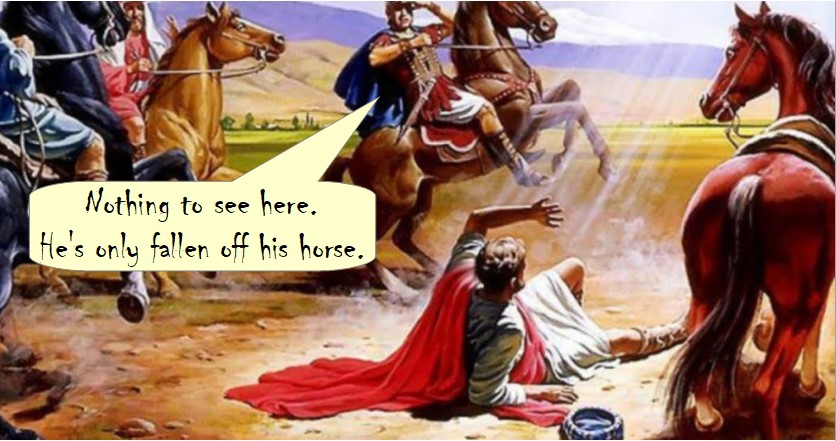
Exhibit 3. The author of Acts creates a story out of Paul’s first vision, the famous account of his conversion on the road to Damascus. It’s a fabrication of course, told differently each time it’s referred to Even so, Luke retains the visionary nature of the experience: Jesus is a bright light and a disembodied voice.

Exhibit 4. The other sightings of the risen Jesus in Acts are visions. When, for example, Stephen is about to be stoned (Acts 7:54-56) he sees in his mind’s eye the heavens open and Jesus sitting at the right hand of god. Other New Testament encounters of the resurrected Jesus, such as John’s Revelation, are explicitly said to be visions.

Exhibit 5. Many of the sightings of the risen Jesus in Matthew and Luke are not of a real, physical human being. Those who experience him see him materialising in locked rooms, vanishing at will and floating up into the clouds. None of these events actually happened; they are the gospel writers’ literary realisations of visions experienced decades earlier, and they retain the hallucinatory qualities of those experiences.

Exhibit 6. Remaining with the gospels’ accounts of the risen Jesus, there is the strange phenomenon of those experiencing him failing to recognise him. Mary in the garden thinks he’s the gardener; the disciples on the road to Emmaus don’t know its him until he breaks bread; the disciples mistake him for someone else on the shore until he tells them how to fish properly. Most damning of all, some of the inner circle of disciples doubt it’s Jesus they’re seeing in their collective visions (Matt 28:17-18). Again, these stories preserve the tradition that the earlier visions weren’t always recognised as Jesus. And why wasn’t he? Because he was an hallucination

Exhibit 7. The risen Jesus has to prove who he is. According to Acts 1:1-3, he ‘presents himself’ his followers, some of whom have wandered around aimlessly with him for three years, and has to convince them he is who he appears to be. And, the text suggests, it takes him forty days to do it. This makes no sense. A far better explanation of this story (and it is a story) is that having experienced their visions of something-they-took-to-be-the-resurrected-Jesus (bright lights? Disembodied voices?), his followers set about convincing themselves that what they experienced really was their former Master. This they did by scouring the scriptures to find ‘proof’ that the Messiah would die and rise again. We know this is how their thinking worked. The same process was used to create the gospels and is evident throughout the New Testament.

Exhibit 8. Dead people stay dead. They do not resurrect.. This is not an a priori assumption. No corpse has ever revived after 36 hours or indeed any other period of time. We know this experientially, statistically and scientifically. Only in stories and religious myth do the dead return. This is what we are dealing with here: stories and myth that flesh out the visions and hallucinations of a few religious zealots.

After the Gospels

None of the New Testament documents written prior to AD70 – those by Paul – contain any of the sayings, miracles or activities attributed to the Earthly Jesus in the later gospels. They don’t reflect anything of the oral tradition, first proposed in the 18th century. Those same gospels don’t reflect much of it either; the only ‘good news’ passed on by word of mouth was of a transcendent celestial Godman seen in visions. There is no evidence of any other. The later gospels incorporate the visions experienced by Cephas and others in their resurrection stories.

What then of the letters and books written after the appearance of the gospels? Do they reference, quote or base their teaching on the pre-crucifixion aspects of the Earthly Jesus of the gospels? Or do they, like Paul, concentrate solely on demonstrating the heavenly Jesus is the Messiah on the basis of what can be found in Jewish scriptures? You’d think that, with the gospels in circulation by then, that It’d be the former. But you’d be wrong.

Let’s make a quick survey of New Testament books post AD70. I’m taking their composition to be those listed here.

Hebrews (composed anywhere between 60 and 115 by unknown author[s])

Hebrews describes the Messiah as a heavenly high priest. Everything the writers ascribe to him is taken not from the gospels, nor an oral tradition on which the gospels are supposedly based, but from ancient Jewish writing; what we know as the Old Testament. Every single reference is from this source. Read the book for yourself and take note of the footnotes. Like gospel Jesus, Jesus the High Priest is constructed from snippets lifted from the Old Testament.

Revelation (composed anywhere between 70-110)

In Revelation, warrior Jesus has a lot to say, most of it quotations from the Old Testament. None of it is derived from the gospels nor the oral tradition on which the gospels are supposedly based. John’s ‘revelation’ is a fantasy constructed around ancient ‘prophecy’. Again, read the book for yourself and take note of the footnotes. Like gospel-Jesus, Jesus the Great Warrior is constructed from snippets lifted from the Old Testament.

1 Peter (70-100) and 2 Peter (125-150)

You’d think the letters purportedly written by the disciple Peter (or Cephas), the man who, according to the gospels spent three years with Jesus, would be full of his teaching, the mysteries he explained only to his closest followers, reports of his miracles or any of his other activities. But no. The best he can do across the two letters (written by two different people, decades apart, neither of them Peter the disciple) is this:

For we did not follow cleverly devised stories when we told you about the coming of our Lord Jesus Christ in power, but we were eyewitnesses of his majesty. He received honour and glory from God the Father when the voice came to him from the Majestic Glory, saying, “This is my Son, whom I love; with him I am well pleased.” We ourselves heard this voice that came from heaven when we were with him on the sacred mountain (2 Peter 1: 16).

Remarkably, this fake Peter recalls an event which never happened: when Jesus glowed like a lightbulb as two long-dead prophets beamed down from Heaven. It is, however, finally a reference to a gospel story. But then, doesn’t the author disparage ‘cleverly devised stories’ in this same passage? What else could he be referring to if not the gospels? We find a similar warning in 1 Timothy (and again in Titus 3: 9):

…command certain people not to teach false doctrines any longer or to devote themselves to myths and endless genealogies. Such things promote controversial speculations rather than advancing God’s work – which is by faith (1 Timothy 1: 4, written by a fraud pretending to be Paul).

These New Testament writers, even when they seem aware of gospel myths and their endless genealogies don’t approve of them. Perhaps that is why they prefer to ignore them, deriving proof of the Messiah from ancient Jewish scriptures instead. Every other reference to Jesus in the Peter epistles is from the Old Testament. How strange for someone pretending to know the man in the flesh.

We could go on to look at other books of the New Testament – for example, that written by ‘James’, supposedly Jesus’ brother – but this post is already too long. Rest assured if we did, we would see the same thing: none of the information about Jesus is derived from the gospels or the oral tradition on which the gospels are said by apologists to be based. There was no oral tradition, apart from stories of visions. The gospels are literary recreations – allegories – of those visions. They were not well received by the other writers of the New Testament who either ignore or disparage them. All that mattered to these early cultists were ‘revelations’ directly from the Lord and the Old Testament ‘prophecies’ that validated them.

No God and the Domino Effect

This a response to Don Camp’s comment on my post The Evil of Christianity, in which he tries to isolate ‘the crux’ of our disagreement about the Faith.

You start, Don, from the assumption that there is a God. I, on the other hand, have considered the evidence and concluded that in all probability there isn’t one. Certainly not the Christian God. There may be a god out there somewhere that has no interest in human beings and their affairs, though I doubt it. As far as we humans are concerned such a deity is as good as non-existent, being entirely hypothetical. If it is out there, it certainly won’t be offended at my saying so.

Once I realised some years ago that a personal God did not exist a number of other things followed (or rather, collapsed):

No God means no Son of God or God Incarnate, no Saviour or Christ.

No God means no resurrection (which Paul makes clear was a work of God).

No God means no Holy Spirit.

No Holy Spirit means no regeneration of individuals to become new creations in God (you only have to look at Christians today to see this is the case.)

No God means no grand Salvation plan.

No God means no Heaven, no Final Judgement, no Kingdom of Heaven of Earth, no Eternal Life.

No God means the universe can’t have been created by him.

No God means no manipulation of evolution, no intervention in human history and no prophecy of things to come.

No God means that the world would be just as we find it: messy, beautiful, dangerous, turbulent, indifferent.

No God means prophecy is man-made and comes to pass at no greater rate than chance allows (i.e. practically zero.)

No God means conversations with ‘him’, revelations from him and visions of him are all imagined, generated by and within the human brain, which works in mysterious ways.

No God means no God-given morality. Morality is, as you say, culturally determined and so may and does change over time. (You can see this in the Bible itself where morality supposedly handed down by God for all time evolves throughout the Old Testament and into the new.)

No God means there is neither Sin nor Righteousness. These are religious concepts. The whole spectrum of human behaviour, from destructive to altruistic, is demonstrated by believers and non-believers alike.

No God means assertions like ‘the issue turns on what I perceive as good for me versus what God declares is good for me’ are illusory. What is good for you is what you have worked out, even if you think God had a hand in it. A supernatural being who doesn’t exist cannot be responsible for your well-being, though your church and the bible undoubtedly contributed to your conditioning.

No God means individuals must work out their own meaning and purpose. Some do, some don’t, as you observe, Don. This is as true of believers as it is for non-believers. Many atheists have managed it, or not, without having it imposed by religion. And despite what you say, Christianity is a religion. It is the epitome of religion.

No God means none of the Abrahamic religions are true and therefore Christianity and its ‘holy’ book, being based on an invalid premise, must be false. Most of the posts on this here blog are about demonstrating this fact.

No God means all gods are man-made, not all gods except one.

The crux of the matter is you believe in God while I see how unlikely it is that there is one. I’d agree with you if I could, Don, but then we’d both be wrong.