Two Ways of Knowing

A Christian friend told me recently that there are two ways of knowing: science and faith. I don’t agree with him of course and, while I expressed my scepticism, I didn’t argue. It seemed unlikely he would change his mind.

Faith and science have different, incompatible concepts of reality. The first – and faith was first historically – is that there is an invisible realm beyond this one, populated by powerful beings who influence and manipulate the humans who live here below. This reality, though invisible and largely undetectable, is actually more real than the one we see around us. Glimpses have been had of it, however, by those finely attuned to it, in dreams, visions and messages delivered during heightened emotional states. These visionaries – prophets – then pass on to others what the beings of the hidden realm expect of them. Life is then to be lived according to the instructions so conveyed, which usually consist of attempts to appease these gods by doing their bidding. In return for this obsequience, you’re allowed to believe you will live on after death

The other epistemology – actually the only true epistemology in this instance – is empirical, knowledge-based science. A later arrival, historically speaking, than the gods of the invisible realm. The scientific method is the best tool we have for sifting knowledge from superstition and emotion. These, particularly the latter, often impede us in our pursuit of knowledge, which is why science strives to eliminate them from its investigations, taking an objective approach to evidence. Unfortunately, the findings of science are occasionally contradictory (can a man become a woman or not?) and very often misinterpreted by non-scientists. Politicians and the media frequently over-simplify science’s findings and interpret them in ways that suit their own agendas.

Then there are those who masquerade as scientists but are not. During the pandemic, the UK was locked down for almost two years on the basis of computer predictions of what might happen if certain conditions prevailed. These predictions were taken as a scientific conclusion when in fact they were hypotheses, which by their very nature, could not be tested. Needless to say, they turned out to be drastically wrong. Computer projections are not, in themselves, science.

Science, through its practical offspring, medicine and technology, has undoubtedly been a boon to humankind, in a way religion never has. It has also sometimes been a curse too, inflicting us with, amongst other things, an arsenal of ever deadlier weapons, the means of destroying the environment and Covid itself. Science is a tool and like any tool can be wielded both constructively and destructively.

So, perhaps the gods will save us from our own folly after all. If only they and their invisible realm existed. Alas (or thankfully) they don’t; there is zero evidence for them, and visions, dreams and wishful thinking as reliable means of knowing about them. We’re on our own. Science is the best hope we’ve got, our only sure-fire way of knowing. If only politicians and the media understood it more than they seem to.

There May Be Trouble Ahead…

Prophets, from left to right: Elijah, Julie Stephens,
Cindy Jacobs and er... Ed Miliband

Prophets don’t exist. A bunch of people intoxicated by religious fervour who think God has given them a special message that they must deliver to whoever will listen, are not prophets; they are a collection of extremists intoxicated with religious fervour.

We know this because no God exists. He can’t, as a result, drop messages, special or otherwise, into the heads of fanatics.

That’s it, really. No more to be said.

But so-called prophets exert quite an influence on our modern world. According to Abraham (I know, he’s a mythical figure but bear with me), God selected an ancient Jewish tribe to be his favourite buddies, so long as they did whatever he demanded of them, including hacking off their foreskins and that of their sons. What sort of prophet – what sort of God – comes up with this kind of lunatic fetishism?

Later the creators of a new prophet, whom they called Moses, came up with a story in which their hero encountered God in a bush (the symbolism is lost on us today.) This time he wanted his special buddies to invade their neighbour’s territory, slaughter them and take their land for themselves. This his favourite, de-foreskinned tribe did (modern genetic analysis of the peoples in the region suggests this isn’t what happened.)

After these fictional madmen came some potentially real fanatics who thought God had assigned them to lambast their fellow Jews for their shortcomings. These prophets promised the rubes rewards if they behaved as the prophets thought they should. These guys also came up with the idea that God would send a warrior Messiah to help his special little tribe take over the world. This is what happens when fanatics are allowed to get a hold of things.

A couple of centuries later, another self-proclaimed prophet turned up (or is invented) who seemed to think he’s the most special-est of all the prophets so far. This guy, called Yeshua (meaning ‘salvation’, so obviously not in any way symbolic) prophesied that the Messiah would be arriving real soon to sort the world out. He’d then hand it over to the Jewish people to manage. This guy’s script writers weren’t sure if Yeshua was talking about himself or some other supernatural character called the Son of Man. It doesn’t matter really. Nothing he prophesied happened when he confidently predicted it would: there was no Messiah who flies down from heaven, no final judgment, no great reset for the Earth. He was an absolute failure as a prophet; evidence, if more is needed, that those who claim to speak for God don’t know what they’re talking about. Don’t worry, though, this guy was recast as a resurrected Godman, just like the ones in pagan myths.

A few other prophets appeared around about the same time. In fact, the extremist who changed his name to Paul seemed to think that just about anyone could become one so long as they ‘edified’ the brethren. It was a few years though before the next really big so-called prophet came along.

In the 8th century, a guy called Muhammad said he was told by an angel who represented a different version of God that, amongst other things, Islam would spread worldwide and there would be an increase in senseless murders. These rather nebulous and self-fulfilling predictions are even now coming to pass. Muhammad’s future followers are indeed spreading Islam across the globe while senseless murders continue being committed, a good many of them by Muslims themselves.

While Muslims have made it clear that Muhammad is the final prophet, history has blessed us since with a few more. Joseph Smith in the 1880s was commanded by a different God (or maybe by the same one who’s changed his mind again) to start a new church and to obliterate anyone who stood in his way. He was successful in this enterprise, despite managing to get himself killed in the process.

You’d think, wouldn’t you, that given their abysmal success rate and the number of people who have suffered or perished as a result of their endeavours that we’d have had enough of prophets. While churches cannot agree on whether ‘genuine’ prophecy still exists, the prophets keep coming. Fanatics the world over, every bit as barmy as their predecessors, appoint themselves some deity’s spokesperson, and the ‘prophetic’ pronouncements begin: meaningless theobabble spattered across the Internet.

The End of Days

A friend of mine was recently given the book The Dragon’s Prophecy: Israel, the Dark Resurrection and the End of Days by Jonathan Cahn. My friend, already concerned about the state of the world, said how much the book had disturbed her. She had become convinced that the time we live in had been predicted in the Bible, in Revelation in particular. ‘It’s all there in the Bible,’ she said to me. ‘It’s all happening just as it says.’

I tried to reassure her that Revelation was written by someone who, 2000 years ago, believed that the situation then couldn’t get any worse, what with the Roman occupation, the destruction of Jerusalem and the persecution of Christians (as the writer saw it.) This, together with his belief that the Lord would soon be coming on the clouds (Revelation 1:7), convinced him he was living in the world’s last days. I told my friend that because of the mess the world is in today (and when is it not a mess?) the book of Revelation resonates with some people; a voice from the past echoing down the ages. In no way, however, was it written about today.

My friend was unconvinced so I took it upon myself to read The Dragon’s Prophecy. Coincidentally, I had just begun to read Bart D. Ehrman’s Armageddon: What the Bible Really Says About the End, dealing with the same concerns. The comparison between the two books couldn’t be more striking.

Ehrman’s is a measured analysis of Revelation and other ‘prophetic’ books of the Bible. He demonstrates from the outset that Revelation was written for believers of the late first/early second century and that its symbolism represents individuals and events of that time. John of Patmos, whoever he may have been (a cult leader, Ehrman suggests) expected, like most early Christians, that the End was going to materialise soon, in the first or early second century, emphatically not in the 21st.

Ehrman warns that ‘professional prophecy writers’ (he doesn’t name Cahn) think ‘the way to use the Bible is to assemble the pieces to reveal the big picture, which until now no one has seen before’ (p17). He’s right. This is precisely what they do. In his book, Cahn promises ‘to put together the pieces of the mystery’ (p11) and claims ‘We (sic) will now begin assembling the pieces of the puzzle’ (p36). He then proceeds to jump around the Bible like a grasshopper on steroids. He’s one of the ‘prophets’ who, as Ehrman puts it, sees the Bible as ‘a great jigsaw puzzle with one piece hidden in this place, one in another and yet a third somewhere else’ (p17).

Cahn opens his argument with a series of bald, unsupported assertions: ‘Behind the perceivable realm lies another, beyond our ability to measure or quantify’ and ‘Behind the history of this world lies another, unrecorded, unrecited (sic), unknown,’ his readers evidently not expected to ask how he knows any of this codswallop. He goes from there to build his argument, such as it is, with a bombardment of ridiculous questions and pseudo-profundities:

What is evil? And how did it come into existence? It is both a mystery and a problem. The mystery is the problem (p9).

Then there are the propositional statements of the ‘If… then we’d expect’ variety. There’s rarely any evidence for the ‘if’ and none at all for the proposed expectation. Here’s the two – rhetorical question and propositional statement – rolled into one: ‘If evil is uncreated, how did it come to exist?’ (p32). Naturally, Cahn is going to answer this question and all the others like it, with a series of unfounded assertions, non-sequiturs and a smattering of unrelated Bible verses.

A central premise of The Dragon’s Prophecy, the dragon being that of Revelation 12:9 and therefore the devil, is ‘the dark resurrection’ of its subtitle. This Cahn explains, pretending the idea comes from the Bible when it doesn’t, is the re-emergence of the Israelites’ old, (extinct) enemies, the Philistines. Like the Israeli nation they too have now been resurrected: as the Palestinians. Under the control of the dragon/devil, they re-enacted on October 7th last year one of the many ancient Philistine attacks recorded in the Bible, only this time with ‘guns and explosives’:

On that October morning, the ancient drama replayed. The resurrected Philistines had again invaded the land, and the resurrected Israelites had again gone into hiding, keeping silent and still in fear of their pursuers (pp99-100).

How do we know this is a replay of an ancient invasion? Because some of those under attack on 7th October went into hiding, just as the Israelites did in 1 Samuel 13:6. As if no other group of besieged civilians hasn’t tried to hide at any other point in history. That and the ‘fact’ there were, according to Cahn, exactly 3,000 invaders on each occasion. Yes, the book really is this bad.

And so, Cahn says, the stage is set for the final battle and the return of Christ who will knock a few heads together, torture and slaughter everyone who isn’t a Christian and set up his faithful followers in a new Jerusalem made of gold and fancy stuff. As Ehrman says, this is indeed what Revelation promises – for the world 2,000 years ago. Ehrman argues that the author of this revenge porn, (he doesn’t use the term: that’s my contribution – you’re welcome) creates a Christ so unlike those of the gospels that he can only be a fiction (aren’t they all?)

Revelation barely made it into the canon and we would all be better off if it hadn’t; certainly my friend would be, and as Ehrman shows, human society and the planet in general would be too. He warns us to read what the Bible actually says, instead of, as Cahn does, forcing it to say what we want it to (to sell books). Irritatingly, Ehrman consistently refers to the Christ’s prophesied appearance on the clouds as his ‘Second Coming’ when the Bible never uses the phrase. Read what it says Bart!

I don’t know whether I’ll finish Dragon’s Prophecy. Its cover blurb boasts that Cahn is a New York Times best seller so clearly there’s an audience for such poorly argued, alarmist nonsense – which is itself alarming. While Bart D. Ehrman has also made the NYT list in the past, Cahn easily outsells him. Nevertheless, I’ve bought my friend a copy of his Armageddon in the hopes it might serve as an antidote to the dire The Dragon’s Prophecy.

Religiophobia?

Is criticising Christianity and the way some people practise their religion a form of Christophobia? Strictly speaking a phobia is an irrational fear of whatever precedes it, as in homo-phobia, trans-phobia, Islamo-phobia and the like. In the accusations of whatever-phobia we hear today – and they invariably are accusations – ‘phobia’ seems to have come to mean ‘hatred of’; a hatred of Christianity and therefore of Christians; of homosexuality and therefore of gay people; of trans-people; of Muslims and so on.

Reasonable criticism of belief systems is not hatred. I don’t and am sure I never have had a hatred of Christianity or of any other religion. I certainly have views about Christianity as a seriously flawed, cock-eyed superstition (I hope I’m not giving my position away too early.) Reasonable criticism of it, mockery even, is perfectly legitimate, for reasons I’ve outlined before, just as criticism and mockery of any belief in the fantastic is legitimate. Ideologies based on belief in imaginary beings do not automatically merit respect nor do they have a de facto immunity from criticism. The same applies to those who subscribe to such fantasies, particularly when they attempt to force them on others. Calling out believers on their inconsistencies and hypocrisy is perfectly reasonable.

Is it fair then to express critical views of homosexuality and by extension of gay people? Of course. We are not immune from reasoned criticism, though much of it doesn’t qualify as ‘reasoned’; we have suffered much from emotional reactions to our existence and still do. (See Bruce’s recent post in which Republican North Carolina’s lieutenant governor, Mark Robinson rants about godless homos. When comment deteriorates into vitriol it becomes an incitement to hatred and, sometimes, violence. When this happens, the modern sense of phobia is justified.)

Islam is as irrational as Christianity and other religious belief systems. It is as legitimate to criticise and, when appropriate, to condemn Islam, just as it is Christianity. It is reasonable to question Muslim’s treatment of women, to insist it is inappropriate, particularly in a Western context. It is appropriate to oppose Muslims’ opposition to Western values rather to accede to their opposition to, for example, freedom of speech or the teaching of evolution and sex education in schools. It seems increasingly to me that in Britain we are conceding too much to Islam and to Muslims because we fear both the accusation of Islamophobia and, not entirely irrationally, a disproportionately aggressive response. Reasonable criticism of a belief system and those who subscribe to it is not hateful. We have a duty in a largely secular society to say so. To resist irrational belief in the supernatural when that belief, be it Christianity, Islam, Judaism or any other of the 4,200 religions human beings have dreamt up seeks to impose itself on others is neither hateful nor irrational. It is essential.

I‘d write more about Islam if I knew more about it. I’m disinclined to learn more, however, having already wasted much of my life in thrall to that other ‘great’ religion, the one I spend so much time deconstructing here. Who needs to know more about another? Saviours, Prophets, Gods, angels, signs and wonders – they’re all equally meaningless. Instead of claiming they’re victims of Christo/Islamophobia, religionists would do well to develop thicker skins as we ‘abominations’ and ‘perverts’ have had to do. They should ask themselves whether criticism of their practices and worldview is justified. They might just find it is.

Prophets At A Loss (again)

What a joy it is to witness the prophets of the Lord who a few weeks ago assured the world that Jesus had told them Donald Trump was going to win the US presidential election. Look at them floundering now to explain away their foolishness:

Pat Robertson on 20th October: ‘Without question, Trump is going to win the election.’

After the election: ‘Here is my take on the election. In my opinion I think Trump won it. That may shock you… There are cases being filed in many courts but I don’t give them much chance of winning.’

Paula White on 5th November: I hear a sound of victory. I hear a sound of abundance of rain. I hear a sound of victory. The Lord says it is done. The Lord says it is done. The Lord says it is done.

After the election: ‘God’s decision has been made… the church must enforce some things in the realm of the Earth. We must take authority over every demonic spirit, every high thing.’

Kat Kerr on 24th October: ‘Trump will win. He will be president of the United States. He will sit in that office for four more years and God will have his way in this country.’

After the election: ‘One of the things [God] had me say was that Trump would win by a landslide… But many times, as we know in the Word or even just from experience ourselves — especially as a prophet — that doesn’t ever mean what man thinks that means.’

Jeremiah Johnson on 30th September: ‘I had a dream… God showed me… President Trump will be re-elected.’

After the election: ‘There has been a chorus of mature and tested prophets in America with a proven track record that have predicted Donald J. Trump would be re-elected President of the United States. I am one of them… Either a lying spirit has filled the mouths of numerous trusted prophetic voices in America or Donald J. Trump really has won the Presidency and we are witnessing a diabolical and evil plan unfold to steal the Election. I believe with all my heart that the latter is true.’

Denise Goulet on 19th October, speaking to Trump in person: ‘The Lord showed me today that you are going to get a second wind…another in-filling of the Holy Spirit…because the Holy Spirit makes you able to finish, to take this to the end, Mr President.’

After the election: f*** all.

It’s demons! An evil plan! I meant something else! I still think I’m right! I hope everyone forgets what I said.

Friendly Atheist Hermant Mehta has a whole lot more. These people are either frauds or self-deluded idiots. It’s stating the obvious to say that God and Jesus do not communicate directly with them. They haven’t been singled out to receive divine messages. Yet that is what they believe, or claim to anyway. They know no more about the future or God’s intentions than a typical house fly does. Yet the gullible, those caught in the same pretence that is Christianity, believe them. Yes, there are smart arse discerning Christians out there who say they never fall for these charlatans. Yet they do.

In Jesus Eclipsed, David Chumney cites Eugene Boring who, he says, ‘catalogs dozens of sayings ascribed to Jesus in the Gospels that very likely originated with later Christian prophets’ (my emphasis). Yet the writers of the gospels pass off these ‘spiritual insights’ as though they were Jesus’ own. Those who first read the gospels believed they were. Christian’s today assume the same. They’re not. They’re the words of religious zealots making things up as they went along. Some, most perhaps, no doubt believed what they were channelling the words of the Lord. Others wouldn’t have been quite so sincere.

There is no such thing as a prophet. God doesn’t make his intentions known through cranks and fraudsters. There’s no God and no Eternal Jesus to do such a thing, as today’s holy con-artists so ably demonstrated with their predictions of a Trump victory.


God writes…

Blog398a

I see the insects are in trouble again. Seems they’ve infected themselves with some sort of virus. The joke is they think I’m going to do something about it. Imagine! Course, it could be said that I created this virus in the first place. But then I gifted it to bats, not them. How they managed to catch it, I don’t know (and care even less) but it’s certainly running rampant through them.

Some of them think they’re channeling their thoughts up to me and that with sufficient grovelling I’ll intervene. Fat chance! I know they think I have some interest in them – one of their number even reckoned I had nothing better to do but count the hairs on their heads. Well, I have nothing better to do, but I’m certainly not going to count hairs on their heads, or anywhere else. In fact, I’m not interested in them in any way. Why should I be? Incredibly, some of them think I want to have a relationship with them. A relationship! There’s as much chance of my having a relationship with them as they have with a colony of microbes.

And while we’re on the subject, I’ve have never ever written a book. I make galaxies and nebulae, I don’t write books. They do that and tell themselves it’s me. I ask you! Nor have I ever sent any messengers to their god-forsaken planet to tell them what I want from them. I don’t want anything from them. I don’t need anything from them. I. Am. Not. Interested. There are no special ways of attracting my attention whatever any of them say. And as for the idea I have an allergy to their behaviour – preposterous! I AM God Almighty. Their stupidity has no effect on me. They offer me nothing nor do they affect me in any way.

So, they’ll have to get on with their virus on their own, as they have with every other drawback of their miserable existence. I’ll be doing nothing, no matter how much they beg. Why should I?

Note:

No gods were harmed in the making of this blog. Any resemblance to any deity imagined or dead is purely coincidental. The existence of a god or gods is not presumed by this post. In point of fact, none does.

Coronavirus defeated

Blog395

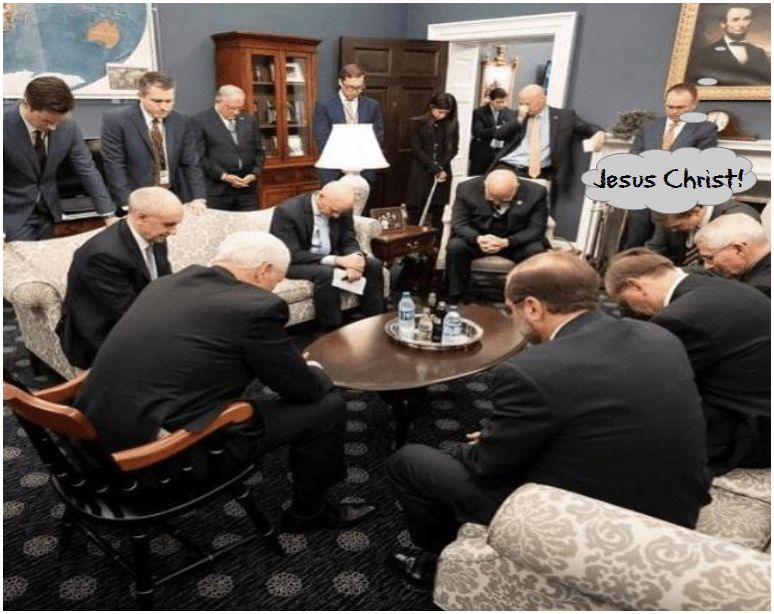
Thank God the Coronavirus pandemic is over. It was scary there for a minute or two. Over 3,000 people died from it. Fortunately, they were mainly Chinese and South Koreans. Vice-president Mike Pence and other anti-abortionists Christian leaders have now taken care of it. On Friday they prayed that it would go away and God has done as they asked. The picture above, courtesy of The Friendly Atheist, shows them doing it. Here’s some other nitwits righteous ones doing the same thing and here an article about the prophet whom God chose to announce to the world that the threat was over. You have to wonder, though, why he made the virus in the first place and why he allowed it to spread so indiscriminately. I mean, even Christians were infected.

Truly, the way to resolve a world wide health crisis is to enlist the help of an imaginary sky fairy who, as usual, does f**k all to help.

Next week: the coronavirus continues to spread. These same men of God then realise that the virus is actually God’s punishment for abortion… er, homosexuality… um, opposition to Trump… er, people shaking their fists in his face (he really doesn’t like that.) Then it all becomes clear why God made the virus in the first place. Difficult to explain why he started it off in China though, but the Lord will surely let his prophets know that too (I mean, those Chinese are commies.)

Life must be easy when all you have to do is make stuff up. It’s more than a little bit worrying that those who do it are listened to by multitudes who’ve switched off their critical faculties. More worrying still when some of these fantasists are in charge of entire countries. The only way coronavirus will be defeated is through science; the development of a vaccine, which is still many months away. Imaginary deities – and they’re all imaginary – prayers, pleading and blaming are all worse than useless.

Interlude: A word from God

Blog359

While nothing like Cyclone Idai that hit southern Africa recently, we had some terrible storms here in the north of England last weekend. The thunder woke me just after 2 a.m., each peal shaking the house, and with the flashes of lightning, it felt frighteningly apocalyptic.

And then it hit me: the Lord was sending a sign! He was angry about something we’d done! Maybe same-sex marriage, though as we’ve had that for a while now in the UK, I’d have thought he’d be used to that particular idea by now. So, maybe he was upset about abortion again. That could be it, though again, a bit late in the day. Still, with God a day is as a thousand years (and vice versa), so you never know. Maybe it’s Brexit. Perhaps the Lord’s angry we’re coming out of Europe. Or, perhaps he’s angry we aren’t coming out fast enough. Back in the 1970s, when Britain first joined the European Economic Community (as it was called then), he told his representatives here on Earth it was a Very Bad Thing, because it was like a recreation of the old Roman Empire and a sure sign of the End Times. He disapproved, but told only a few of his Chosen Ones how he felt and completely forgot to mention it to anyone else.

Christ! Don’t you just get fed up with religiously fixated nutjobs coming up with this sort of crap every time there’s a storm or a tsunami or an eclipse? Every natural disaster, every human catastrophe, every phenomenon in the night sky has to be interpreted as a message or warning from a deity who is otherwise as dumb as a rock. Only when weather does what weather is prone to do does he start communicating with us – incoherently and in code. Only a special few, those who’ve appointed themselves as his prophets and mouthpieces, are capable of telling us what he’s really saying. It’s a miracle if two or three of them ever agree about what that is.

If you need evidence there’s no God, then this is it. If he were real, we would have independent knowledge of him; knowledge that isn’t filtered through human messengers or delivered, garbled, by the weather or by a seriously flawed and obviously human book. He would be apparent; he wouldn’t need to be interpreted, explained and represented by people who give every impression of making stuff up as they go along.

What we have instead is a God who is very evidently human. It’s humans who interpret weather conditions, claim to know what God’s saying and declaim his messages and warnings. It is impossible to know anything, either about or from him, other than what humans – very often ones with very little brain and a penchant for self-promotion – tell us.

If there really were a God, I’d ask him to stop communicating with us through extreme weather, disasters and massacres, and instead to miraculously lift the curse of religion from the 7.7 billion of us here on Planet Earth. But there isn’t, so we’re stuck with it – with religion and those who have a vested interest in perpetuating its nonsense.