Like a Virgin. Or Not


To arrive at the nativity story most of us grew up with and which your kids and grandkids might well be performing this Christmas (mine are), the one with a stable, shepherds and wise-men, involves some cunning sleight of hand, not to mention a liberal dollop of invention.

The biblical ‘account’ of the story is spread across two gospels, Matthew and Luke. Mark hadn’t heard of it when he wrote his gospel so you won’t find it there. In fact, Mark’s Jesus doesn’t become God’s son until his baptism. Paul, writing earlier still, thinks God adopts Jesus only at his resurrection. Paul has no knowledge either of the nativity myth. John has no time for it: his Jesus is an eternal being who has existed with God from the beginning.

For Matthew, however, Jesus comes into existence when the Holy Spirit impregnates a virgin. Luke likes the idea and so copies it into his gospel. And now we have a problem: the idea that a virgin will bear the Messiah is lifted from the Septuagint, the Greek translation of the Jewish scripture, which renders Isaiah 7:14 as –

Therefore YHWH himself will give you a sign: the virgin (almah) will conceive and give birth to a son, and will call him Immanuel.

In the Septuagint, the Hebrew word almah, meaning ‘young woman’, is translated as virgin. However, the word for virgin in Hebrew is betulah, an entirely different word. Isaiah 7:14 is not a prophecy that a virgin will bear a son: only that a young woman will do so; in other words, a commonplace event. Matthew allowed himself to be misled: in his eagerness to find prophecies of Jesus in Jewish scriptures, he alighted on a mistranslation. He wrote his story accordingly, riffing freely on the error. Luke picked up on it a decade later, adding his own embellishments.

Neither does Isaiah 7:14 suggest the child being talked about will be the Messiah, nor that he will appear hundreds of years in the future. As subsequent verses make transparently clear, a short period of time is all that is suggested; no more than a few years:

He (the child) will be eating curds and honey when he knows enough to reject the wrong and choose the right, for before the boy knows enough to reject the wrong and choose the right, the land of the two kings you dread will be laid waste. YHWH will bring on you and on your people and on the house of your father a time unlike any since Ephraim broke away from Judah – he will bring the king of Assyria (Isaiah 7:15-17).

These are all events contemporaneous with the writing of this part of Isaiah. All that is being said is that a young woman will become pregnant and produce a child in the near future. Even before this child properly knows right from wrong, YHWH will bring Israel’s enemies down upon it. (Because he’s such a caring God.)

None of this has anything to do with a virgin becoming pregnant, nothing to do with a Messiah, nothing to do with Jesus. It is not a prophecy about him, even if Matthew persuaded himself it was. Shamefully, almost all modern ‘translations’ of Isaiah retain ‘virgin’, when they know perfectly well it is not the word used, and that the context neither supports it’s use nor makes it necessary. They do so to maintain the lie that Isaiah 7:14 is about Jesus and to give credibility to Matthew and Luke’s ridiculous fiction that he fulfilled ‘prophecy’ by being born of a virgin. It’s a deception that will be repeated in church services around the world over the next couple of weeks.

It’s the End!

AI shows how it’s done. Arrange your elements carefully, and – hey, presto! – Jesus appears!

I’ve reached the end! The end of Jonathan Cahn’s The Dragon Prophecy that is. He has me convinced: the end of the age and the world itself, is just around the corner. He looks around the world, particularly the Middle East, sees the state it’s in and dives into the scriptures to uncover the prophecies that presage present day events. He then reveals how, collectively, these scriptures accurately describe the state of the world today following Hamas’s invasion of Israel on 7th October 2023.

Had he collected these passages prior to 7th October, would they have accurately foretold the events of that day? They should’ve done if that’s what they are really about. So where was this expose before 7th October? Where were the books, by Cahn or anyone else, revealing how the Bible predicted in detail, events that still lay in the future? Predicatbly (pun intended), they don’t exist. Cahn’s The Serpent’s Prophecy could only be written with hindsight, after the events, 7th October 2023 in particular, that he’s decided fulfil biblical prophecy. The prescience of these ancient scriptures is only apparent, to Cahn if no-one else, in retrospect.

He gathers disparate verses together to demonstrate how they do indeed predict current events. He omits many that don’t, even though they too appear to prophesy the future. He does this because they don’t fit the picture he’s trying to create: his interpretation of events in Israel and the significance he wants ascribed to them.

Cahn disingenuously forces unrelated verses to work together, like pieces from different jigsaw puzzles, to create a picture that loosely and disjointedly conforms with and thereby confirms his own conclusions. 

The culmination of The Dragon’s Prophecy is that the time is right and the stage set for Christ’s ‘return’. Cahn advises his readers to surrender to him before he comes though the clouds to do unspeakable things to them. While none of the ‘prophecies’ he’s pressed into service have ever been fulfilled and are certainly not being now, this one must surely be the greatest of the Bible’s failed prophecies.

Does all of this sound familiar? It should. Starting with Paul and the gospel writers, numerous hacks have pulled together biblical prophecies to show how events of their times fulfil the conditions for Christ’s return.

More than this, the gospels were created in exactly the same way that Cahn creates his end-of-the-world scenario. Mark, Matthew and Luke, ruthlessly plundered ancient Jewish scripture to show how their suffering Messiah (whether real or not) was predicted there. Significantly, no-one prior to the early days of the Christian cult believed that these particular scriptures foresaw a suffering Messiah who would die for the sins of his people before coming back to life. The scriptures could only be made to do so in retrospect. After some claimed to have seen the risen Jesus, early cultists began to scour the scriptures for passages – how many they had to ignore or misinterpret! – that could be made to create a loose, disjointed picture of their super-hero. It’s how Paul attempted to persuade others that Jesus was the Messiah (1 Corinthians 15:3,4 etc).

So Cahn is doing nothing new, finding a ready audience for his particular sleight of hand.

A World When Revelation Was Possible

Greek and Roman cultures of the ancient world were obsessed with seers, oracles, prophets, muses and the fates. Politicians, priests and ordinary people were desperate to know how to keep on the right side of capricious gods and what the future held. Word from the supernatural realm, channelled through seers and prophets, was sought after and valued. Visions, dreams, portents and auspices that revealed secrets and mysteries were highly prized. It was a world saturated in superstition. Jewish culture, operating within this milieu, was no different.

Jews too revered prophets, dreams, visions and divination. This is apparent in both the Jewish scripture, the Old Testament, and also in the New, the writing of the early Christian cult birthed from Judaism in a Greco-Roman world. There are in the New Testament:

6 instances of god-induced dreams;

11 visions of heaven and heavenly beings;

578 new prophecies;

300 or so supposed fulfilments of earlier ‘prophecies’;

An abundance of revelations’ (Paul’s phrase) as well as those of Revelation itself (one long revelation or a series of shorter ones?);

113 visits from supernatural agents (Satan, demons, angels);

Assumptions that dead people can reappear (Jesus mistaken for Elijah and Jeremiah; Elijah and Moses manifesting themselves);

Multiple ‘resurrections’ both before and after Jesus’s.

People believed this kind of stuff! The supernatural, prophecy, ‘revelation’ and resurrection were regarded as entirely plausible, a given in the culture in which early Christians lived. The pagans around them may not have subscribed to the new cult’s reworking of these superstitions, nor accepted that Jesus was the Messiah, but they would not have found anything amiss with the idea and presence of the supernatural, with its attendant revelations, visions and prophecies. These were the currency of the day.

That such manifestations were mistaken or misinterpreted by the new cult would have been the point of disagreement for most people (though its important not to over-estimate how many actually knew of the Jesus cult in its early days), not that it manifested and incorporated them in the first place.

In the first century world, revelations, prophecies, visions and the like were considered to be gifts from the gods. Paul insisted that what he ‘received’ was from the supernatural realm, specifically from the heavenly Christ (Galatians 1:12). Accepting this was a prerequisite for believing what he went on to say about salvation, resurrection and Christ’s descent from the clouds. The supernatural world and its ability to communicate with ordinary mortals had to be accepted as real before anything Paul said could even be considered. Fortunately for him, the culture in which he operated embraced the idea that this was a reality.

If, however, there is no supernatural – and let’s be honest, we know there isn’t – there can’t ever have been revelation, prophecy or God-given visions. With no heavenly realm to transmit revelation, prophecy and visions into the brains of seers, prophets and visionaries, from where did – and do – their revelations, prophecies and visions originate? From brains conditioned in an environment infused with irrational, magical beliefs, whether that of the first-century or one of the many Christian, Bible-soaked bubbles that exist today. ‘Revelation’, ‘prophecy’ and visions emanate entirely from the human brain. It is this which originally created revelations and now sustains ideas like heavenly saviours and supernatural resurrections. These things have no independent existence outside of the human imagination.


The End of Days

A friend of mine was recently given the book The Dragon’s Prophecy: Israel, the Dark Resurrection and the End of Days by Jonathan Cahn. My friend, already concerned about the state of the world, said how much the book had disturbed her. She had become convinced that the time we live in had been predicted in the Bible, in Revelation in particular. ‘It’s all there in the Bible,’ she said to me. ‘It’s all happening just as it says.’

I tried to reassure her that Revelation was written by someone who, 2000 years ago, believed that the situation then couldn’t get any worse, what with the Roman occupation, the destruction of Jerusalem and the persecution of Christians (as the writer saw it.) This, together with his belief that the Lord would soon be coming on the clouds (Revelation 1:7), convinced him he was living in the world’s last days. I told my friend that because of the mess the world is in today (and when is it not a mess?) the book of Revelation resonates with some people; a voice from the past echoing down the ages. In no way, however, was it written about today.

My friend was unconvinced so I took it upon myself to read The Dragon’s Prophecy. Coincidentally, I had just begun to read Bart D. Ehrman’s Armageddon: What the Bible Really Says About the End, dealing with the same concerns. The comparison between the two books couldn’t be more striking.

Ehrman’s is a measured analysis of Revelation and other ‘prophetic’ books of the Bible. He demonstrates from the outset that Revelation was written for believers of the late first/early second century and that its symbolism represents individuals and events of that time. John of Patmos, whoever he may have been (a cult leader, Ehrman suggests) expected, like most early Christians, that the End was going to materialise soon, in the first or early second century, emphatically not in the 21st.

Ehrman warns that ‘professional prophecy writers’ (he doesn’t name Cahn) think ‘the way to use the Bible is to assemble the pieces to reveal the big picture, which until now no one has seen before’ (p17). He’s right. This is precisely what they do. In his book, Cahn promises ‘to put together the pieces of the mystery’ (p11) and claims ‘We (sic) will now begin assembling the pieces of the puzzle’ (p36). He then proceeds to jump around the Bible like a grasshopper on steroids. He’s one of the ‘prophets’ who, as Ehrman puts it, sees the Bible as ‘a great jigsaw puzzle with one piece hidden in this place, one in another and yet a third somewhere else’ (p17).

Cahn opens his argument with a series of bald, unsupported assertions: ‘Behind the perceivable realm lies another, beyond our ability to measure or quantify’ and ‘Behind the history of this world lies another, unrecorded, unrecited (sic), unknown,’ his readers evidently not expected to ask how he knows any of this codswallop. He goes from there to build his argument, such as it is, with a bombardment of ridiculous questions and pseudo-profundities:

What is evil? And how did it come into existence? It is both a mystery and a problem. The mystery is the problem (p9).

Then there are the propositional statements of the ‘If… then we’d expect’ variety. There’s rarely any evidence for the ‘if’ and none at all for the proposed expectation. Here’s the two – rhetorical question and propositional statement – rolled into one: ‘If evil is uncreated, how did it come to exist?’ (p32). Naturally, Cahn is going to answer this question and all the others like it, with a series of unfounded assertions, non-sequiturs and a smattering of unrelated Bible verses.

A central premise of The Dragon’s Prophecy, the dragon being that of Revelation 12:9 and therefore the devil, is ‘the dark resurrection’ of its subtitle. This Cahn explains, pretending the idea comes from the Bible when it doesn’t, is the re-emergence of the Israelites’ old, (extinct) enemies, the Philistines. Like the Israeli nation they too have now been resurrected: as the Palestinians. Under the control of the dragon/devil, they re-enacted on October 7th last year one of the many ancient Philistine attacks recorded in the Bible, only this time with ‘guns and explosives’:

On that October morning, the ancient drama replayed. The resurrected Philistines had again invaded the land, and the resurrected Israelites had again gone into hiding, keeping silent and still in fear of their pursuers (pp99-100).

How do we know this is a replay of an ancient invasion? Because some of those under attack on 7th October went into hiding, just as the Israelites did in 1 Samuel 13:6. As if no other group of besieged civilians hasn’t tried to hide at any other point in history. That and the ‘fact’ there were, according to Cahn, exactly 3,000 invaders on each occasion. Yes, the book really is this bad.

And so, Cahn says, the stage is set for the final battle and the return of Christ who will knock a few heads together, torture and slaughter everyone who isn’t a Christian and set up his faithful followers in a new Jerusalem made of gold and fancy stuff. As Ehrman says, this is indeed what Revelation promises – for the world 2,000 years ago. Ehrman argues that the author of this revenge porn, (he doesn’t use the term: that’s my contribution – you’re welcome) creates a Christ so unlike those of the gospels that he can only be a fiction (aren’t they all?)

Revelation barely made it into the canon and we would all be better off if it hadn’t; certainly my friend would be, and as Ehrman shows, human society and the planet in general would be too. He warns us to read what the Bible actually says, instead of, as Cahn does, forcing it to say what we want it to (to sell books). Irritatingly, Ehrman consistently refers to the Christ’s prophesied appearance on the clouds as his ‘Second Coming’ when the Bible never uses the phrase. Read what it says Bart!

I don’t know whether I’ll finish Dragon’s Prophecy. Its cover blurb boasts that Cahn is a New York Times best seller so clearly there’s an audience for such poorly argued, alarmist nonsense – which is itself alarming. While Bart D. Ehrman has also made the NYT list in the past, Cahn easily outsells him. Nevertheless, I’ve bought my friend a copy of his Armageddon in the hopes it might serve as an antidote to the dire The Dragon’s Prophecy.

Speaking in Tongues


I used to be so uncomfortable in prayer meetings that I attended back when I was a true believer when someone would start praying in tongues. It usually went something like alaluboolubamuba repeated over and over again, like a babbling brook. Babbling is what it was. In the churches I experienced it in, there was rarely any interpretation of the tongues as Paul instructed there should be. Even when someone was led by the Spirit to pipe up, what the speaker in tongues had said in gobbledegook was standard praise stuff: ‘Thank you Jesus for your wonderful mercies. Praise you for all you have done for us. Alleluia! Praise you’ etc, etc. And who were we, the others present, to say it wasn’t? Some would add their own Amens to the interpretation, adding credence to the meaningless phenomenon. The Spirit at work indeed.

Speaking in tongues, glossolalia, seems to have afflicted the cult in Corinth in particular. Paul addresses it in his first letter to the church there, and nowhere else. He doesn’t seem to know what to make of it. He feels unable to say that it’s merely a few people getting carried away (because that’s pretty much what all early Christian worship was) and can’t say it’s not the Spirit moving them to babble when that’s what the church was claiming. So he fudges it, claims he speaks in tongues more than anyone else (why do I hear Donald Trump in this boast?) and makes a few stipulations:

Only speak in tongues if there’s an interpreter present. (What happens if you get the urge the Spirit moves you when there’s no interpreter around?)

Glossolalia is ‘uttering mysteries’ in the Spirit that no-one can understand (so how can they be translated/interpreted by someone else?)

You shouldn’t speak in tongues all at the same time. It’s unseemly.

Use tongues only in private (according to the great know-it-all apostle, tongues are of the spirit and are merely a way of praising God. Tongues then are God praising God: what a narcissist he is! Other than this, Paul concludes they’re not much good.)

Interestingly, at no time does Paul suggest or acknowledge that some of the tongues manifesting themselves are other languages – real languages as opposed to unintelligible babbling. In fact he makes much of the fact that no-one understands what is said. It’s left to Luke to elevate linguistic nonsense to miracle status. In Acts 2:4-12, he has the disciples speak in real foreign languages after the Holy Spirit takes hold of them. Those around are ‘amazed’ (aren’t they always?) that they can suddenly hear the gospel message in their own tongue. Luke labours the point that, conveniently, there were men from ‘every nation under heaven’ present to verify the use of multiple languages by otherwise uneducated fishermen. Far more likely is that Luke, aware of the outbreak of babbling in at least one early church, shaped what he’d heard into what he thought was a more credible account. In other words he made up the story of the disciples spontaneously becoming fluently multi-lingual.

Later still, the unknown writer who invented the longer ending of Mark decided to mention the tongues phenomenon in the prophecies he invented for Jesus. In Mark 16:17 he has Jesus promise that those who believe in him would miraculously speak in ‘other languages’. How many times has this happened in the ensuing two millennia? I’d put money on there only ever having been sporadic outbreaks of meaningless babbling, such as that which I experienced. 

The church today continues to be confused about tongues. Some claim that ‘the gifts of the Spirit’, of which tongues are a part, no longer manifest themselves among believers. It’s a neat way to consign bizarre behaviour to the dumpster of history, but alas, it’s unscriptural. Nowhere does Paul suggest tongues and the other gifts of the Spirit would have a sell-by date before the Lord’s coming. Admittedly, he thought the Lord would be coming real soon. Only then, not before, would tongues and the other gifts of the Spirit ‘pass away’.

Other churches today are open to the possibility of tongues. Some even claim that the Spirit does indeed enable believers to launch fluently into languages, complete with correct syntax and vocabulary, that they don’t actually know. We can be sure there would be evidence of this online if it really occurred. There isn’t. 

Others are happy to go along with the unintelligible babbling, preferably with an interpreter who makes stuff up is also led by the Spirit to make sense of the mumbo jumbo.

Some abandon all restraint, with entire congregations babbling at the same time. Paul’s rules be damned!

And they wonder why we don’t take them seriously. As Paul himself warned:

If the whole church comes together and everyone speaks in tongues, and inquirers or unbelievers come in, will they not say that you are out of your mind? (1 Corinthians 14:23)

They surely will.

Have any of you encountered speaking in tongues? What did your church make of it?

Jesus and the Blind Man

This time we’ll take a closer look at Mark 8:22-26, a story about Jesus healing a blind man:

They came to Bethsaida, and some people brought a blind man and begged Jesus to touch him. He took the blind man by the hand and led him outside the village. When he had spit on the man’s eyes and put his hands on him, Jesus asked, “Do you see anything?”

He looked up and said, “I see people; they look like trees walking around.”

Once more Jesus put his hands on the man’s eyes. Then his eyes were opened, his sight was restored, and he saw everything clearly. Jesus sent him home, saying, “Don’t even go into the village.”

This parable is doing a lot of metaphorical heavy lifting.

First, it is located in Bethsaida, the home of some of the disciples as well as the place where Jesus does some of his most spectacular miracles, only later to curse the village for its lack of interest in him (Mark 11:21). It is symbolic of those who reject the cult’s message, or are too dim to see that their heavenly Jesus is the Messiah.

Second, the story is sandwiched (no pun intended) between the feeding of the four thousand, in which the hapless disciples fail to recognise Jesus’ miraculous status, and the account of Peter realising that Jesus is in fact the Messiah. The healing of the blind man, neatly placed between the two, is therefore an allegory within allegories about seeing (gettit?) Jesus for who he really is (i.e. what cultists believed him to be.)

Third, the story is a prophecy-fulfilled parable. Isaiah 35:5 says that when the Messiah comes ‘the eyes of the blind will be opened and the ears of the deaf unstopped.’ Jesus has to be made to do these things – he performs some ear unstopping too (Mark 7:31-35) – to show he is indeed the prophesied Messiah.

Fourth, physical blindness is a very obvious metaphor for spiritual blindness. The preceding story reminds those who can’t ‘see’ the cult’s truth for themselves: ‘Do you still not see or understand? Are your hearts hardened? Do you have eyes but fail to see, and ears but fail to hear?’ (Mark 8:18). This is itself a borrowing of Isaiah 6:9-10. Indeed, the entire story, together with that of the deaf man being cured, is a parable of Isaiah’s ‘prophecy’:

You shall indeed hear but never understand, and you shall indeed see but never perceive. For this people’s heart has grown dull, and their ears are heavy of hearing, and their eyes they have closed, lest they should perceive with their eyes, and hear with their ears, and understand with their heart, and turn for me to heal them.

Jesus’ healing of blindness then becomes a metaphor for seeing the light, as Peter does in the subsequent story when he finally recognises him, like the cult has done, as the Messiah.

Fifth, Jesus spits on or in the man’s eyes: a very clumsy metaphor for the streams of living water that emanate from God himself in Jeremiah 2:13. Perhaps too there’s a reference to the baptism ritual beloved of the early cult. (Christian bloggers themselves have trouble explaining this gross detail that Mark sees fit to include in his story.)

Sixth, in order to give sight to the blind man, Jesus (or rather the cult) first removes him – the initiate – from the village, from those who don’t even know they are blind. Next, Jesus/the cult shows him how those who are spiritually blind are no better than trees wandering around aimlessly (yes, Mark really does mix his metaphors). Jesus/the cult then opens the initiate’s eyes to the Truth so that finally he sees ‘everything clearly.’ He can now never return to his former state; his ‘home’ is with the cult, not with the spiritually blind outside it.

The story is evidently metaphorical. That Jesus spits in the man’s face is not, as some Christians claim, evidence that it really happened. It is weighed down by so much symbolism and clunky metaphor, and at the same time strategically placed between two other ‘seeing the light’ stories that its literary origins are apparent. Mark and his fellow cultists knew what they were doing when they dressed their beliefs up in stories like these. As they themselves insist, you need only open your eyes to see it.

Ramifications

I started writing this blog as a way of working out just what it was I’d believed prior to my realisation there was no God. While this ‘revelation’ caused the whole Christian edifice to collapse, I still had a lot of conditioning to deal with. I had been taught over the years that, like every other human being, I was worthless without God/Jesus. I needed first to regain some self-worth.

I had hang-ups too about how I spent my time and money. The cult had assured me that God was obsessively interested in how I used both. Did my use of my time and money further his kingdom? Was I using my time wisely? Tithing? Giving my money to alleviate suffering? I knew buying CDs and comic books didn’t really fit the bill, but I sinfully persisted in spending my hard-earned cash on them, when I had any to spare after taking care of my family and giving to the church and charity. Then the guilt! How could I be so thoughtless, so selfish? I had let God down badly (specially if I’d bought some of the devil’s music.)

The guilt was self-induced of course. I think I have a personality type that is prone to feeling guilty – it’s been the predominant emotion of my life – but the Christianity I encountered exacerbated it. I still struggle with guilt, not over any great ‘sin’ but in terms of how much I help others and whether my use of my money is self-indulgent and wasteful.

Despite now having no truck with the idea of sin (which is a worthless religious concept) I do sometimes catch myself worrying that I’ll be made to suffer in the next life (which doesn’t exist either) for who I am and my ‘lifestyle’ in this world. Completely irrational, I know, but the conditioning runs deep. It hasn’t been fully rooted out yet.

On the plus side, I can now see the Bible for what it is: a collection of stories, those in the so-called New Testament designed, as they declare quite openly, to promote the beliefs of the ancient Jesus-cult.

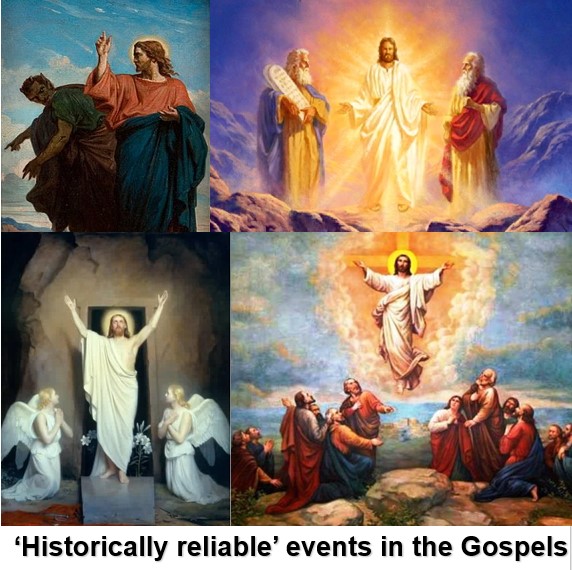
I realised that in an ocean of myth, legend and invention I had been taught to regard the gospels as an island of historical fact. Yet two of them are prefaced with patent fantasy – the incompatible nativity stories – and conclude with equally incompatible resurrection and ascension narratives. Yet I was expected to trust that everything in between these make-believe beginnings and endings – the miracles, the visions, the speeches, the fulfilled prophecy, the false promises and unlikely new prophecies – were all somehow factual and true.

No longer gullible, I came to see this as a preposterous expectation. Sandwiched between fantasy and illusion the gospels are all myth and legend. It’s pointless to argue, as apologists do – and quite a few sceptical scholars too – that we can discern the real Jesus among the invention:

that we can make something worth considering out of the discrepant resurrection appearances;

that because one or two historical figures are written into the story it must therefore be historical throughout;

that we can sift the factual wheat from the metaphorical chaff;

that there is a kernel to the tales that can be teased out from the fantastical accretions;

that contradictions can be explained (away) and by sleight of hand made compatible;

that somehow believing all of this fantasy material can ensure eternal life.

None of these things can be done, any more than they can with the legendary tales of Romulus, Buddha and King Arthur. Legends, are legends are legends. Stories are stories are stories.

Would I have been happier never to have been a Christian, never to have committed my life to Jesus? Almost certainly. But we are all where we are. Christianity and I have a history. It’s probably left me scarred, and perhaps you too. At least I escaped it to live my life as I needed to, even if I am still working my way through its legacy.

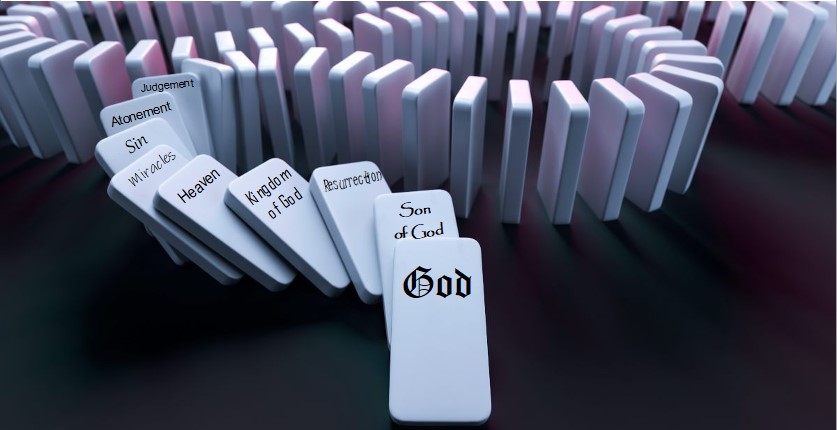
God and the Domino Effect

Once free of belief in God, everything that follows collapses.

No God means –

   No divinely inspired scripture, no sin, no salvation, no need of salvation, no repentance or divine forgiveness (and no need of these things either), no grace.

   No supernatural, no heaven or hell, no Satan, angels or demons, no Holy Spirit, no effective prayer, no miracles, no judgement, no eternal life.

  No Son of God, no God Incarnate, no prophecy, no atonement, and, most significantly, no resurrection. 

According to the Bible, God resurrected Jesus (Romans 6:4; Galatians 1:1; Acts 2:22 etc). Therefore, no God = no resurrection.

So, where did all these ideas that, once God ceases to exist, fall like dominoes? Answer: the only place ideas ever come from: the human mind. Everything ever associated with gods, and with YHWH (Old and New versions) is entirely human invention. This is the only logical, rational conclusion.

  Paul’s vision of what he took to be the Risen Christ and his consequent theology: the product of a tortured imagination.

  The resurrection appearances supposedly experienced by Cephas and others: within their own heads (grief-induced hallucinations, dreams, trances, emotional agitation). Or: an emotional response to some natural phenomenon such as bright lights.

  The stories of Jesus that these visions inspired: invented by creative writers imaginatively applying ‘prophecy’ imagined by earlier writers.

  If he existed, Jesus’ Messiah complex: worked up entirely within his own religion-soaked brain.

  His conclusion that the end of the age was nigh and that he would be king of the new order (assuming he really did think this): the result of wishful thinking, all in his imagination.

Subsequent additions to the Christian experience: the Trinity, guesswork about the Messiah’s delayed return, the panoply of saints, heresy, blasphemy, ‘God’s standards’, the inerrancy of scripture, apologetics and, coming full circle, conversion experiences. All creations of the human imagination and emotions.

With no actual God, this is the only viable explanation of the phenomenon that is religion. Human beings did it.


Announcement

The story so far…

While he used to argue vociferously that the gospels are history – remember they must be history because Pilate and Herod are in them? – our resident apologist has backed away from this position. He says now they’re not history as such but are only ‘like’ history, which means they’re ‘historical but not written as histories’, whatever this means. He derides the likes of Ehrman and Tabor for their inability to recognise this (newly invented) fact. These no-nothings make a category error when they confuse the gospels with history.

I suspect Don wants to reclassify the gospels because he recognises they make rather poor history. It’s safer to pretend they’re designed to be something else, something that doesn’t require external evidence to verify it: ‘announcement’, for example.

This, however, merely sidesteps the question of where the gospel writers got their information from. Don has previously argued that the gospels are based on eye-witness reports, Peter’s dictation to Mark and a reliable oral tradition. But conjecture like this is only necessary if the gospels are history. If they’re not, but are ‘announcement’ instead, then their sources need  be neither historically reliable nor demonstrable.

If the accounts are ‘announcement’ rather than history then where does their ahistorical, announced information come from? Fortunately, Mark gives us a clue:

To you has been given the secret of the kingdom of God, but for those outside everything is in parables, so that “‘they may indeed see but not perceive, and may indeed hear but not understand, lest they should turn and be forgiven’” (Mark 4:11-12, referencing and misquoting Isaiah 6:9)

In fact, the gospels’ ‘announcement’ is conveyed by a story constructed from supposed prophecies from Jewish scripture and the immediate concerns of the early cult communities, expressed in metaphors of the gospel writers’ making. All of the internal evidence supports this conclusion. In fact, the source of the gospels’ material is the same as Paul’s and that of other writers in the New Testament. Here’s how the great, self-appointed apostle puts it: 

My gospel and the preaching of Jesus Christ [is] according to the revelation of the mystery which was kept secret for long ages, but now is made visible through the prophetic scriptures and is made known to all nations, according to the command of the eternal God, for the obedience of faith. (Romans 16:25-26)

Christ died for our sins according to the Scriptures. (1 Cor 15:3-8)

Compare this with:

Today this scripture is fulfilled in your hearing. (Gospel Jesus in Luke 14:21)

He said to them, “How foolish you are, and how slow to believe all that the prophets have spoken! Did not the Messiah have to suffer these things and then enter his glory?” And beginning with Moses and all the Prophets, he explained to them what was said in all the Scriptures concerning himself. (Gospel Jesus in Luke 24:25-27)

He said to them, “How foolish you are, and how slow to believe all that the prophets have spoken! Did not the Messiah have to suffer these things and then enter his glory?” And beginning with Moses and all the Prophets, he explained to them what was said in all the Scriptures concerning himself. (Gospel Jesus in Luke 24: 25-27)

(Paul) reasoned with them from the Scriptures, explaining and proving that the Messiah had to suffer and rise from the dead. “This Jesus I am proclaiming to you is the Messiah,” he said. (Fictional Paul in Acts 17:2-3)

The revelation of the Messiah and the secrets and mysteries revealed to Paul and the other apostles are ‘explained and proved’ in their entirety by ancient scripture. But, these scriptures in and of themselves do not prophesy the kind of Messiah the early apostles envisaged. Rather, the scriptures are retrospectively pressed into service to match the revelations of the Messiah that Paul and the others experienced.

This is Don’s ‘announcement’: secrets and mysteries founded not on history but on revelation expressed through metaphor and the misapplication of scripture.

The Gospels and Other Fiction, part 2

The gospels were written as history. Their writers did not make things up.’

History, as koseighty has reminded us, is not littered with angels, devils, demons, spirits, apparitions, miracles, voices from the sky and resurrected corpses. Real history was being written at the same time as the gospels, by Josephus and Suetonius for example, who do not include the supernatural but do reference their sources, something the gospels never manage.

And of course the gospel writers did make things up. They invented numerous stories for Jesus to make it appear he is fulfilling prophecy (even when that ‘prophecy’ wasn’t prophecy to begin with.) This included making up ‘history’; Herod’s Massacre of the Innocents (a rewrite of a fiction about the infant Moses), the crucifixion eclipse, the rending of the temple curtain and more. These are all symbolic events. They didn’t really happen. Jesus’ own resurrection can safely be added to the list. It’s ironic that those who defend the gospel authors against the charge they made stuff up are the same who invent stories themselves: Mark and Luke knew each other? Mark proof-read Luke’s first draft? There were people who would fact check the gospels and point out any errors? But the original Christians wouldn’t do such a thing. Except they did.

There are no Inconsistencies, contradictions and inaccuracies in and between the gospels, but if there are, these are irrelevant. It’s the bigger picture that counts.’

Jesus is different in all four gospels. Despite Matthew and Luke’s plagiarising of Mark, they alter him to reflect the Jesus they believe in. John’s Jesus is so far removed from Mark’s that he’s a different character altogether. The inconsistencies do matter: did Jesus perform signs and wonders or not? Was he crucified on Thursday or Friday? Was it Peter, John or Mary who was first to see him resurrected? Did he hang around for one day or for 40? These conflicting details tell us that the creators of the Jesus story were more than happy to alter it when it suited their purposes. This is not how history is written. It is how propaganda is created. The ‘bigger picture’ is, in any case, made up of these smaller details. They work collectively and cumulatively to create the bigger picture. If we can’t rely on their being accurate how can we be sure the bigger picture is? When the gospel writers are unreliable in the smaller details, how can we be certain they’ve got the bigger picture right, given they’re all copying it from the same source, Mark, and giving it their own spin?

There is corroborating evidence of the gospels’ accounts’.

There is? Where? Just because there is some evidence that Nazareth existed doesn’t mean Jesus performed miracles, any more than Dunsinane castle’s existence proves Macbeth murdered King Duncan (he didn’t). Just because Pilate was a real historical figure doesn’t mean he crucified Jesus, any more than the existence of King’s Cross Station means Harry Potter catches his train there. And these, surely, are merely the small details. There is no corroboration at all for the bigger picture. Mention of the followers of Chrestus in Suetonius confirms at best that there were Christians in Rome at the time of Claudius, but no-one is disputing that. At worst, for the apologist, this curious reference has nothing whatever to do with Jesus. Later references to incidents from his story, by the much vaunted Church Fathers, are derived from the gospels and are therefore dependent on them. As such, they don’t constitute independent corroboration.

Everything Jesus prophesies or predicts in the gospels will come to pass, then sceptics will see that everything in the Jesus story is true.’

This one is from a commenter on Don’s blog. (I only went there by accident, honest.) The problem with this one is that everything Jesus is made to promise should already have come true, two thousand years ago. The Son of Man should have appeared in the sky with the heavenly host to usher in God’s Kingdom on Earth, while sending most of mankind to the fiery pit or outer darkness or some other damn place. Both he and Paul claimed that this would happen within their and their followers’ lifetimes. The trouble with Christianity is it is always winter and never Christmas. Its fulfilment God’s – God’s Kingdom on Earth, life after death, the final judgement – is always going to be at some indeterminate time in the future, a time and fulfilment that never quite arrives. It never will; part of ‘the big picture’ we can be confident we will never see.

More to come (unlike Jesus).