Who Decides?

DavisI’ve written before about how some parts of the Bible are more important than others; about how Christians relegate some of it – ironically much of what Jesus is purported to have said – while elevating other bits. These latter aspects trump the former, so that if there’s ever any dispute about how Christians should behave in a given context, they’ll happily cite the elevated parts while overlooking those that are less to their liking. This happened recently in the Kim Davis case,* which I talked about last time. In that context, the verses from Romans I quoted, in which Paul instructs believers to obey civil authorities, are explained away and dismissed in favour of other passages. Here are commenters doing just that on the crackpot Christian site, World Net Daily:

Have you not read Acts 4:19 and 5:29? There is a time when God’s authority trumps human authority. In this case, Kim Davis stood up for God’s authority. God’s word calls homosexuality an abomination. Ephesians 5:11 teaches that Christians must have nothing to do with the works of darkness, but instead expose them.

and

Sometimes…when you give to God…what is God’s…you will have to disobey the civil authorities that are over you. Kind of like Paul…refused to stop preaching and jailed…God took care of him, though, I do believe. Although never truly jailed, except at the end…didn’t Jesus disobey the “law”, Mosaic Law, when He preached?

It’s not as if Paul was writing about ‘authorities’ that conducted themselves in considered or considerate ways; this was the Romans, after all. They would eventually execute Paul – so much for God taking care of him! – just as they had Jesus himself. Nonetheless, Paul tells the brethren they must honour Roman authorities. But somehow, if Christians today are to be believed, he just didn’t understand what it’s like to obey civil (in both senses of the word) secular authorities in the 21st century. They consider his teaching in the early part of Romans 13 to be invalid, no longer applicable, irrelevant to the very situation it was designed to address. Other passages from the Bible are far more important and therefore trounce it easily.

But who decides this? Who decides, in what these same Christians deem to be the literal Word of God, which words are less literal than others; less applicable; less relevant? And, consequently, which are more important, more applicable, more ‘of God’?

The evidence would suggest it’s the individual Christian who does, led, no doubt, by the Holy Spirit, who inexplicably leads different believers to different conclusions about the same source material. There’s no ‘free-will’ involved in this process, however; individual interpretations of scripture are informed by the consensus of the church or the movement with which individual Christians align themselves. But who in these institutions determines the order of priority for the Bible’s many confused and often contradictory injunctions?

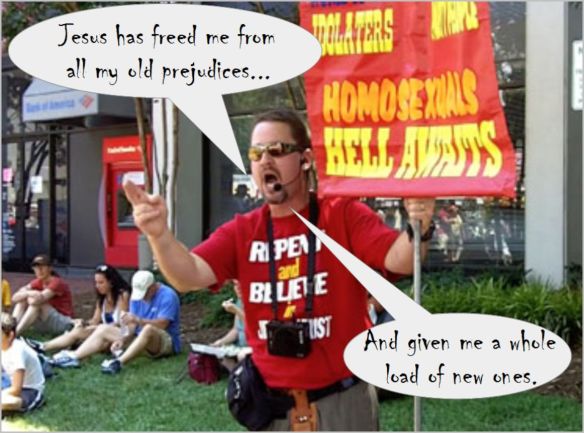
Determining what is important in the Bible, and what isn’t, is the result of a consensus of prejudices and biases. It’s easy to find ‘teaching’ in the Bible that supports one’s own views and opinions and equally easy to find that which doesn’t and is incompatible with the position one already holds. To reconcile the two, and to deal with the discomfort of any cognitive dissonance, Christians demote any teaching that doesn’t correspond with their pre-existent world-view – sorry, Paul, but this includes your silly suggestion that we should obey the authorities – while promoting those ideas that conform to and confirm that outlook (so hurray for those verses that say gay people are abominations and have no place in the Kingdom of God!) The very words of God are ranked according to the whims and prejudices of those reading them.

Again, I’ve written before about Christian priorities, about how those parts of the Bible they find unpalatable and challenging – such as those that say they should give away all they have and love their enemies – are explained away or ignored. But as for those passages that tell Christians how superior they are while excoriating others as ‘works of darkness’ – well, now you’re talking!  


*While Davis claims all her husband swapping took place before she met Jesus, she was a member of the Baptist church while she was busy trying them all on for size. At least three of her wedding ceremonies were conducted by Baptist ministers. All that happened in 2011 was that she joined the more extreme pentecostal movement, which empowered her to ignore the log in her eye and concentrate on the speck in others’.

Modern Day Martyr #94

A&ECherry picking had been a problem right from the start.

In case you missed it last time it happened, Christianity has been criminalised again. Yup, despite all the imprisonment of Jesus’ followers only a few short months ago (or was it weeks?) they’re all being rounded up again for no other reason than they’re Bible-believin’ Christians. True, they might have been incarcerated because they’re public officials who refuse to do their job because they believe God doesn’t want them to. True, they might have been divorced three times, married four and engaged in a little adultery along the way. But come on, be reasonable: ‘God’s standards’ don’t apply to Christians themselves; they’re for clobbering others with.

Naturally this isn’t how Christians themselves see it. Kim Davis, a county clerk in Kentucky charged with issuing marriage certificates, has been imprisoned – by a Christian judge at that – because she won’t issue them to same-sex couples. And that, according to Christo-fascist Matt Barber makes her a martyr. Plus, you know, the end of the world and what-not:

For the first time in American history a woman has been imprisoned by the government for merely exercising her Christian faith. War has been declared on Christ and His followers. And there’s no turning back.

Davis’s lawyer and fellow-believer, Matt Staver, goes even further. He equates her situation with the Nazis’ extermination of 6 million Jews:

Back in the 1930s, it began with the Jews, where they were evicted from public employment, then boycotted in their private employment, then stigmatized and that led to the gas chambers. This is the new persecution of Christians here in this country (the USA).

What melodrama! If only there was something in God’s Word™ that could’ve told Kimmy what to do before everything got out of hand.

Oh wait. What’s this in Romans 13?

Everyone must submit himself to the governing authorities, for there is no authority except that which God has established. The authorities that exist have been established by God. Consequently, he who rebels against the authority is rebelling against what God has instituted, and those who do so will bring judgement on themselves… it is necessary to submit to the authorities, not only because of possible punishment but also because of conscience (Romans 13.1-2 & 5).

Jeez, if only it were possible for Christians to ignore the bits of the Bible they don’t like.

Oh, I forgot… it is!

The imprisonment of a public servant who declines to serve the public and refuses to comply with the law does not mark the start of any war. It is not the fore-runner of a persecution such as we’ve never seen before. It is, rather, the predictable consequence of the same old Christian hypocrisy.

Rejecting Jesus – The Book

RJCoverIt’s a miracle! Rejecting Jesus is now in book form! And on Kindle too.

ScrollWell, not quite – sorry JC.

But you can now read Rejecting Jesus posts in the format the Son of God would surely have preferred if books had existed then the way they do now. The pictures are all present and correct too, in glorious B&W, for all first-century messiahs to enjoy.

Available here and here and also all over the world. Go, buy it, make disciples of all nations.


All is Vanity

DaleThe idea that human beings can live forever is a very old one, being part of a number of ancient religions. The Egyptians, for example, believed there was an afterlife and that where you spent it was determined by a post-mortem judgement. Christianity would later embrace similar notions of judgement and everlasting life.

The idea is, however, largely absent from Judaism. Ecclesiastes in the Christian Old Testament (‘Kohelet’ in Judaism) has this to say about death and its aftermath:

I said in my heart with regard to human beings that God is testing them to show that they are but animals. For the fate of humans and the fate of animals is the same; as one dies, so dies the other. They all have the same breath, and humans have no advantage over the animals; for all is vanity. All go to one place; all are from the dust, and all turn to dust again (Ecclesiastes 3.18-20).

This seems to me to be an entirely realistic, if somewhat pessimistic, view of life and death. (And humans as animals! Today’s believers still have trouble accepting this, even when their holy book spells it out for them.) Later writing – the book of Daniel, for example – begins to toy with the idea of eternal life, but it isn’t until we get to Jesus’ time that the idea really takes off.

As the writer of Ecclesiastes knew, and as I suggest here, there is no evidence we survive death. Death would hardly be death if we did. The dessicated bodies of those Egyptians, mummified so their ‘owners’ could reclaim and re-use them on the other side, are still with us. There’s no evidence either that a special part of us – a soul or spirit – makes the transition. In any case, this is a predominantly pagan idea and is not what the New Testament offers. Both Jesus and Paul are firm believers in bodily resurrection here on the Earth.

The desire to live beyond the brief few years that our physical bodies last is understandable. It’s hard to imagine that one day every single one of us will no longer exist, that our consciousness, personalities, thoughts, memories, emotions – everything that makes us who we are – will simply no longer be. That’s why, I suppose, people in the past rebelled against that inevitability and fantasised about a continued existence once this one came to an end. Eventually religions came to offer such compensatory life-after-death, provided of course suckers people believed the right things.

Such is Christianity.

When you think about it, what a truly absurd notion it is; that believing in a magic formula will defeat death and enable you to be resurrected on the Earth to live in God’s new Kingdom here, or (when that didn’t quite pan out) taken up to Heaven to live there. All you have to do is believe the right things and God will do this for you. Death will be defeated by the simple expedient of your belief. We’re so used to the idea after 2,000 years of Christianity that the absurdity ceases to register – but absurd it surely is.

to be continued


Idiotic Stuff Jesus Said 11: Build Your Lives on the Things I Say

WhoDoJesus demanded you base your life on his teaching. It’s the only way, he said, that you’re going to find meaning, as well as the principles you’ll need when the going gets tough:

Everyone then who hears these words of mine and acts on them will be like a wise man who built his house on rock. The rain fell, the floods came, and the winds blew and beat on that house, but it did not fall, because it had been founded on rock (Matthew 7.24-25).

And what exactly were those words of his? Here’s what he taught:

  • The Son of Man was coming to the Earth to establish God’s Kingdom within the lifetime of his original followers (Matthew 16:27-28; Matthew 24:27, 30-31, 34; Luke 21:27-28, 33-34);
  • His own people needed to be more ‘righteous’ in order to be part of this Kingdom (Matthew 5.20; Matthew 6.33; Matthew 13.49 etc);
  • Being righteous entailed some extreme behaviour; loving your enemies, giving away all you had, turning the other cheek, forgiving repeatedly, being perfect (Matthew 5.44; Matthew 5.42; Luke 6.29; Luke 6.37; Matthew 5.48; Matthew 19.21);
  • It was crucial to obey Jewish law, even if some of it could be reinterpreted (Matthew 5.17-18; Matthew 12.1-7);
  • Once the Kingdom arrived Jesus himself would be King of the world, aided and abetted by his pals (Matthew 19.28; Luke 22.30);
  • His followers would do even greater miracles than he did himself. Given he controlled the weather, healed the sick and raised the dead, that’s going some (John 14:12).

Anybody know anyone who believes all of this or lives this way? Anyone who operates on these exacting principles? I don’t know of anyone and never have. I didn’t even when I was Christian myself. Jesus demands are impossible. No-one can live according to them. ‘Of course not,’ say Christians. ‘You need supernatural help to live like this.’ So why don’t they, when they have God’s spirit living within them (John 14.16-17)? Why don’t we see Christians who perform spectacular miracles, who constantly go the extra mile, who give away everything they have, who are, as Jesus tells them they should be, perfect?

We don’t because no-one can live as Jesus insisted they should. Nor do we see Christians who believe his prophecies either, particularly the one about the Son of Man bringing God’s Kingdom to Earth two thousand years ago. Christians pretend he didn’t really say it, or if he did, that he meant something else entirely. They’ve changed his very words – the ones they should be building their lives on – to claim Jesus himself will be returning any time now (the synoptic gospels are confused about whether Jesus is this Son of Man, or someone else). When he does, they say, true believers will be going with him to Heaven. Never mind that Jesus teaches nothing of the kind and there’s absolutely no foundation for these beliefs in his words. As such, they’re the faith built on sand he tells them is worthless:

And everyone who hears these words of mine and does not act on them will be like a foolish man who built his house on sand. The rain fell, and the floods came, and the winds blew and beat against that house, and it fell—and great was its fall! (Matthew 7.26-27).

So, if Christians don’t do what Jesus tells them and don’t believe his promises or prophecies, then in what way can it be said they take his words as the foundation of their lives? Don’t they, rather, base them on Paul’s teaching, about a supernatural Christ who bears little resemblance to the zealous Jewish preacher they pretend is their ‘Lord’? Teaching that has nothing to do with that of the man who demands his pronouncements be the very basis of life? Paul doesn’t quote any of Jesus’ teaching.  The foundation Jesus speaks of is of no interest to him; so, naturally, this is whom Christians follow – not Jesus, but Paul and his mythical Christ.

Christians have no time for Jesus’ words – and who can blame them? All he offers is impossible morality, false promises and failed prophecies. Far better to go with what Paul offers, because that’s about what’s in it for them. But even Paul didn’t believe anyone was going to Heaven, so they ignore that bit in his teaching too.

Spontaneous Conversion

st-paul-conversionThe missionaries pressed on into the Amazonian jungle. They were now in uncharted territory. No-one had ever been this far in. And then, sounds from somewhere not too distant; human sounds, human voices – singing even. The missionary troupe emerged into the clearing to an amazing sight. Groups of Amazonian natives gathered together, a rudimentary cross in front of them, towards which they were undeniably directing their worship. These people, whose existence had hitherto been unknown, and who had never before encountered Westerners, were Christians!

Weeks later once basic communication had been established, the tribe’s chief priest and the head missionary communed together. The priest explained how, long ago in the past, his ancestors had recognised God’s presence in the incredible world around them and had opened their hearts to him. As a result – Miracle of Miracles! – God sent them a vision of Christ himself, much as he had to St Paul and the other disciples, and the whole tribe came to believe in Jesus. Ever since then, the tribe had worshipped the one true God and his only son, that same Jesus Christ.

“Amazing,” said the missionary, “so it looks like St Paul was absolutely right when he said God reveals himself in nature and speaks to our hearts to make himself known to us. It’s not as if we ever needed the Bible, or to go round telling people how to be saved. God is more than capable of doing it for himself. Praise the Lord and pass the communion wine!”

What a story! And it happened time and time again as the world was opened up by explorers and missionaries.

Or maybe not. Definitely not, in fact. But it should have happened if what Paul says in Romans 1.18-21 is right, as Ken Ham believes it to be:

For the wrath of God is revealed from heaven against all ungodliness and wickedness of those who by their wickedness suppress the truth. For what can be known about God is plain to them, because God has shown it to them. Ever since the creation of the world his eternal power and divine nature, invisible though they are, have been understood and seen through the things he has made. So they are without excuse; for though they knew God, they did not honour him as God or give thanks to him, but they became futile in their thinking, and their senseless minds were darkened.

If God is so obvious in the world that (supposedly) he created and if we humans can see and understand him through it, then why do Christians need to proselytise? Why doesn’t God make his personal presence felt just that tiny bit more clearly – with the odd ‘revelation’ like the one he provided Paul, say – so that people come to believe in him more fully? And by ‘him’, of course, I mean the proper God – the Jesus one. Why does he leave it so that folk seemingly pick up on the special vibes he’s placed in their hearts but then worship a ‘counterfeit’ god, like Allah or Jah or, back in Paul’s day, Zeus? Why doesn’t he provide revelations like he used to, to ensure everyone knows just who it is who’s standing at the door knocking?

If he did that, if God did indeed plant clues to his presence both around us and in us as Paul says he does, then the Bible wouldn’t be needed to convert people. But that’s not what we find, which is that the Bible is essential in perpetuating the God-myth. We wouldn’t even be aware of Paul’s ridiculous claims if they were not preserved in that ramshackle collection of writings.

The indoctrination of others is utterly reliant on two things and two things only. Not God-in-nature or inner prompting or visions, but on ‘the scriptures’ and those who are driven to spread the Jesus-meme. Now does that not strike you as odd? It strikes me as something entirely human, with nothing supernatural about it. If people have to be told, evangelised to and indoctrinated into Christianity, then it can hardly be the case that they see the one true God in nature or have an intuitive feel for him. If that were the case, then we would have discovered hitherto unknown groups of humans who already knew of him and the nonsensical clutter of beliefs that surround him. And we haven’t. Ever.

Christians’ Favourite Delusions 33: Atheists know in their hearts that God exists

DenyTwo tried cliches trotted out by evangelising (i.e. aggressive) Christians are that ‘atheism is a religion‘ and that in their ‘heart of hearts atheists know there really is a god’. Ken Ham of Answers In Genesis is fond of both assertions, as are other equally desperate promoters of unsupportable beliefs. We’ll come to the first in a later post, but here’s how Ham expresses the second:

They (atheists) know in their hearts that God exists, but they are actively suppressing this belief in unrighteousness (Romans 1:18). They fight so hard against a God that they claim doesn’t even exist because they know that He really does! We need to pray that, instead of fighting against God, these lost individuals will repent and put their faith and trust in Christ and in what He did for them.

Romans 1.18 that he cites says: For the wrath of God is revealed from heaven against all ungodliness and wickedness of those who by their wickedness suppress the truth.

Assuming Paul is saying here what Ham claims he is (it’s doubtful from this verse alone) both he and his hero are demonstrably wrong – as they are about so much. The evidence suggests that while young children look for meaning and assume agency, they do not necessarily attribute these to a god until they are taught to do so by others. The god they then come to acknowledge is the one already prevalent in their social environment. In a predominantly Christian context, they will come to be acquainted with – and may go on to develop a full-blown belief in – the interpretation of the Christian God common within their particular culture.

It is the same for conversion generally. You are more likely to be a Mormon in Salt Lake City, a Roman Catholic in East Timor. If raised in a Jewish environment, it’s more likely you’ll subscribe to YHWH; in an Islamic one, an interpretation of Allah; Buddha – not strictly speaking a god – in a Buddhist one. Statistically, those who adopt a religion and a belief in a god, almost always opt for that which is prevalent in the society into which they are born. This is not god ‘writing a knowledge of himself’ in their hearts, it is a cultural, human phenomenon.

Ham and others see this as evidence for their belief that we all have some sort of ‘god-shaped hole‘ in our psyche that we can just as easily fill with false gods as with the real one (theirs). But this is a shift in the argument; it’s not now that God makes himself known to everyone but that we all find a need for a god. This is not the same thing, nor is it true. Certainly humans have a history of creating gods to explain the strange, magnificent and sometimes hostile universe in which we find ourselves; but this does not mean these many gods exist, as Ham would be the first to admit (c’mon, there’s only one real God – his.) It means only that the human brain seeks pattern and meaning, and has often drawn the wrong conclusions in its quest for them. The gods – and God – are part of these wrong conclusions.

And what of Ham’s assertion that atheists deny their awareness of God because of ‘unrighteousness’ – because, he implies, we just want to live a life of rampant ‘sin’? Well, I admit, I like a bit of a sin as much as the next man, but that’s not why I’m an atheist. I’m an atheist because, like most others, I find no evidence for gods or God either in my ‘heart’, nor in the way the world works nor in collections of iron age stories. Morality doesn’t come into making this assessment. In any case, those who buy into a god don’t have a monopoly on ‘righteousness’, as their weak morals, judgemental attitudes and destructive behaviour regularly demonstrate. More than this, and as Ham admits, Christians are only concerned about others because the Bible says they should be: ‘The reason I care about poverty,’ he says, ‘is because God’s Word instructs me to care, and all humans are made in the image of God as God’s Word tells me.’ This is not righteousness, nor a morality that comes from any real concern for fellow human beings.

Finally, atheists don’t, as Ham claims, ‘fight so hard against’ a non-existent God that we secretly believe in. We oppose Christians and other purveyors of supernatural nonsense when they try to impose their irrational beliefs on others, when they condemn fellow human beings, seek to control them and try to limit their rights in the name of God and the cause of ‘righteousness’.

So, no, don’t condescend, Christians, to tell us we all know that there’s a God that we wilfully ignore. You’re wrong, and I’ll show you even more reasons why you are, next time.

A new creation? Or same old same old?

Preaches3Over at Answers In Genesis, John C. P. Smith (who?) argues that Christianity must be true because of ‘the testimony of countless Christians to the efficacy and potency of the gospel to radically change people’s lives for the better.’ Supposedly, this change is the result of a radical take-over of the individual by the Holy Spirit. As Paul explains in 2 Corinthians 5.17:

Therefore, if anyone is in Christ, he is a new creation. The old has passed away; behold, the new has come.

Even as we speak, Christian Voice’s Stephen Green is proposing, in one of his more spiteful and petty blog posts, that this is only way a young activist can be saved from a selfish, insensitive and deluded – talk about the pot impugning the kettle! – ‘gay lifestyle’, whatever that is. But do such changes really happen and are they ‘for the better’?

Speaking from personal experience and observation, I’d have to say they do. Sometimes they entail an apparent overhaul of the convert’s view of life, mindset and values. It’s as if the possibility of a spiritual aspect to life takes them by surprise and everything in their psychology shifts to accommodate new ideas. For others, the change is superficial and merely accentuates characteristics they already possess.

Having said that, many people have life-changing experiences without a religious catalyst; when they survive a bad accident or a potentially fatal illness, for example, or win lots of money; when they come to a full realisation of who they are or ‘come out’; when they first have sex or a baby; when they lose a loved one or experience an out-of-body experience or start a new job or move to a new area… and on and on.

None of these transformations involves Jesus, his Holy Spirit or ‘the gospel’. Humans are capable of the most drastic and radical of psychological change all on their own. How many times have you heard it said that someone isn’t themselves? Or that no-one knows what’s got into them? Or they’re acting out of character? Some even transform themselves without any external event playing a part. You may have done so yourself.

I would suggest that religious conversion is like that. The change can be real, but it has nothing to do with an external, supernatural agent. The human personality or psyche, whatever you want to call it, is much more fluid and pliable than we care to admit. Your self, values and thought patterns are in fact undergoing constant change, sometimes radically and rapidly so. The consistency you feel you maintain, the unchanging ‘you’, is an illusion. You are regularly updated, like the operating system on your computer. You’re not the same ‘you’ that you were last year and are certainly not the same as a decade ago or when you were a child. What you regard as ‘you’ is constructed from constant change.

The change that comes from religious conversion is no different. More, it doesn’t necessarily change you for the better; it can harden attitudes and make you less sympathetic towards others by transplanting values that are not conducive to empathy and generosity. You become one of ‘us’ and no longer one of ‘them’ as your chosen place of worship and the collective influence of fellow believers make a significant contribution to the process. This is why evangelists and those who are driven to convert others always insist you become part of a church (mosque or synagogue) afterwards – provided, of course, it’s one with the right sort of teaching (theirs). Your new attitudes and values are then reinforced by those who already have them, entrenching them further and convincing you that they, and now you, are ‘right’. This is how the ‘new creation’ you’re becoming is constructed and moulded.

As I’ve argued before, conversion can often reinforce behaviours that have already become habitual for individuals. Every church and Christian movement has adherents who are petty and spiteful, as well as those who are generous and considerate. But what becoming a new creation never entails, is making converts more intelligent, rational or stable. Why not? If it’s a miracle we’re talking about – and undoubtedly we are if God’s spirit suddenly or gradually takes up residence within a person – then surely it would result in a little cognitive rewiring so that the new Christian reaches their full intellectual potential. The fact it doesn’t bring about the ‘renewal of the mind’ (Romans 12.2) in anything like this sort of substantive way is the equivalent of the missing limb that no amount of prayer and laying on of hands can regenerate.

All of which suggests – no, more than suggests; demonstrates – that neither God nor his ‘Holy Spirit’ nor a dead Jewish preacher, nor ‘the gospel’, has anything to do with it. And perhaps that’s because an increase in intelligence, rationality or stability would run counter to the process which depends on blind faith and a submission to the very social forces that reshape the self.


Christians’ Favourite Delusions 32: Jesus Is God

Res2Test your Bible knowledge and see if you can work out when it was Jesus became God:

Was it:

a) After he died?
Paul thought this was when God decided to adopt Jesus. The Almighty noticed what a good man Jesus was and decided to resurrect him. In so doing, he made him his Son:

his Son… was descended from David according to the flesh and was declared to be Son of God with power according to the spirit of holiness by resurrection from the dead. (Romans 1. 3-4, my emphasis)

Paul doesn’t say Jesus was God. In fact, he strongly suggests he wasn’t, both in the phrase ‘descended from David’ and in his assertion that he became God’s Son – not God – only at the resurrection. So, Jesus wasn’t God when Paul wrote Romans, round about 57CE. If, as Bart Ehrman suggests in How Jesus Became God (p224), Paul is quoting an earlier creed, it’s not what the first Christians believed either.* Paul does edge closer to a divine Jesus in other letters – Philippians 2, for example – but that’s not what ‘God revealed’ to him originally.

b) When he was baptised?
In the earliest gospel, Mark says it was when he was baptised that Jesus became God’s son:

(Jesus) saw the heavens torn apart and the Spirit descending like a dove on him. And a voice came from heaven, ‘You are my Son, the Beloved; with you I am well pleased.’ (Mark 1.10-11)

So in Mark, God adopts Jesus earlier in his career than in Paul’s Romans scenario. All the same, while he gets to be God’s beloved son, this doesn’t make him divine; God has many sons in the Bible and a Son of God, with or without capitals, is not the same as ‘God the Son’. Jesus himself makes this clear in Mark 10.18, where he actually denies he’s God.

c) When he was born?
Well, this is more like it. According to Matthew, Jesus is the Messiah from the time he was born. We’ve got even further back now – from Paul’s post-mortem elevation of Jesus, to his baptism, to his birth. Of course all of these can’t right. If Jesus was divine from birth – or even before – there’d be no need for him to be promoted after his death. But Matthew doesn’t actually say he’s divine; he suggests that Jesus fulfils all the prophecies of the Messiah (of course he doesn’t, but that’s what Matthew wants us to believe.) However, the Messiah, according to the very ‘prophecies’ Matthew quotes, is not divine; he’s a human warrior king. Oops.

d) When he was conceived?
Luke is determined to push it back further still. For Luke, it’s when God magically makes Mary pregnant that Jesus becomes truly and literally God’s son (Luke 1.35). Except, of course, Mary appears to have no recollection of this event later in the gospel narratives when she can’t work out why her son behaves in bizarre ways. Could Luke have made up the entire conception story? You bet.

e) Back at the beginning of time?
John’s gospel appears to say so:

In the beginning was the Word, and the Word was with God, and the Word was God. He was in the beginning with God. All things came into being through him, and without him not one thing came into being. What has come into being in him was life, and the life was the light of all people. The light shines in the darkness, and the darkness did not overcome it. (John 1.1-5)

Or does it? John says the Word (Logos) has always existed and is part of God – but does this mean Jesus? This question vexed the church for the best part of it first four hundred years. Was the Logos the same as God and was Jesus the Logos? The council of Nicaea in 325 attempted to clear the matter up but not all bishops agreed with its conclusion – that the Son was ‘begotten not made’ (whatever that means) – and the controversy raged for another few decades.

f) When the church decided he was?
Yup, this is it. A different group of bishops decided, finally, that Jesus was God at the Council of Constantinople in 381. They re-jigged the statement made at Nicaea fifty-six years earlier, which then became the ‘Nicene creed’ that’s still said in some churches today.

So, Jesus didn’t become wholly and officially divine until 381, a mere 350 years after he lived and 300 after Paul and the gospel writers. How scriptural is that?

Jesus wasn’t divine, wasn’t God incarnate, wasn’t the Son of God with capital letters, wasn’t the Messiah, wasn’t and isn’t the saviour of the world. He was a first-century preacher and prophet whose prophecies were a disaster, whose mission to bring the Kingdom of God to Earth failed and who died and was buried. He was resurrected only in the ideas of other men, who tried and eventually succeeded in making him into something he wasn’t.


* I’ve not referred extensively to Ehrman’s writing in this post but undoubtedly his many books, especially How Jesus Became God, have influenced me, as has Barrie Wilson’s How Jesus Became Christian. Jonathan Hill’s Christianity: The First 400 Years, published by Christian company, Lion, was also useful.


Christians’ Favourite Delusions 30: The Resurrection means we’re going to Heaven.

Resurrection2According to the Bible, why did the resurrection happen?

To show us that we’re all going to go to Heaven when we die? No, nowhere does the Bible say that.

To demonstrate that Jesus was really God? No, it doesn’t say that either.

To let people know that God was about to resurrect everyone so that the righteous could live on a renewed Earth, while the rest would be sent off to eternal punishment?

Yup, that’s the one. That’s the way Mark, Matthew and Luke tell it and it’s also what Paul believed. He refers to Jesus as the ‘first fruits’, with lots more ‘saints’ being resurrected after him to populate God’s kingdom on Earth:

…in fact Christ has been raised from the dead, the first fruits of those who have died. For since death came through a human being, the resurrection of the dead has also come through a human being; for as all die in Adam, so all will be made alive in Christ. But each in his own order: Christ the first fruits, then at his coming those who belong to Christ. Then comes the end, when he hands over the kingdom to God the Father, after he has destroyed every ruler and every authority and power. For he must reign until he has put all his enemies under his feet (1 Corinthians 15. 20-25).

This is why Matthew has hordes of the dead rising from their tombs (Matthew 27.53) – he sees resurrection as the indisputable proof that the Kingdom has arrived. Matthew is so desperate to show that it’s already started, he has bodies emerging from their graves even before he has Jesus himself come back from the dead.

Of course, all of it’s a fairy story, Matthew’s zombies and Jesus’ resurrection included. As we saw last time, there’s no evidence at all that Jesus rose physically from the grave. Paul’s experience of the resurrected Christ was of a beam of light that appeared in his own head, and from this he concocted his entire theology (Galatians 1.12). When the gospel writers created their resurrection stories much later on, they turned such visions into ‘real’ encounters with a reinvigorated Jesus. They offer stories of his eventual return – after a quick visit to Heaven – as a conquering hero who will kick-start God’s Kingdom on Earth (Matthew 25.31).

So there you are. Jesus’ return from the dead, which didn’t happen anyway, was intended to be the first of many such resurrections, right here on Earth. According to Paul and the later synoptic gospels, it signified that God’s Kingdom was about to be established in this world, not the next. In the first century.

As we know, it all happened just as they said it would.