Heretic

Let me recommend a film to you: Heretic starring Hugh Grant, Sophie Thatcher and Chloe East (opens in the US today.) Ostensibly a horror film, it’s actually a dissection of religious faith: what we believe, why we believe it, its origins and how we might break free from it.

While there are a couple of grisly bits in it, it is actually a psychological thriller, with Grant’s character, Mr Reed, intent on breaking down the faith of two Mormon missionaries who have the misfortune to pay him a visit. Despite the hapless women being LatterDay Saints, his arguments apply to all religious belief. The film is a vehicle for this breakdown and demolition of faith. It veers into unpleasantness only in its final quarter, after taking a cynical swipe at the idea of resurrection.

I’m usually averse to horror films and only went to see this one because of the plaudits Hugh Grant’s alternately fatherly and menacing performance received from critics. He really is superb and Sophie Thatcher and Chloe East are excellent as the missionaries, sustaining a Mormon sensibility until it becomes, well, unsustainable. Scott Beck and Bryan Woods’ script is incisive and engaging (if you like your religion ruthlessly dissected and exposed.) Heretic is highly recommended.

The Boy On The Bus


The pleasant looking young man, his face scrubbed and shining, was already on the bus when we got on. He smiled as we took a seat in front of him. He struck up a conversation with the older woman on the seat across the aisle from him. Did she live nearby, he asked, his accent American. Had she been out shopping, what had she bought, which supermarket had she been to? He appeared interested in her answers, commenting and asking follow up questions. It was all harmless if a little intrusive. What possible interest could a young man in his early twenties have in the shopping habits of an elderly woman?

He told her he was from Ohio and his companion from Utah. The companion, whom we hadn’t noticed, was sitting further back in the bus He hadn’t spoken, perhaps having no interest in old ladies’ shopping trips.

The woman asked, probably out of politeness, what the two of them were doing in a town in the far north of England.

We’re on our way to a church meeting,’ the talkative one replied, ‘to prepare for missionary work.’

Oh,’ said the woman uncertainly, wishing perhaps she hadn’t asked.

Have you ever been to our church?’ asked the young man, the building in question being something of a local landmark, never looking, in our experience, as if it was ever open or attended.

Oh no,’ said the woman.

Why’s that?’

Because I… er, have my own religion.’

Which one is that?’ pounced her interlocutor.

Luckily, the bus happened to be passing a Roman Catholic church at this point. ‘Er, Catholic?’ stammered the unfortunate woman.

Catholic?’ he said. ‘Is that the same as Roman Catholic?’

No,’ she replied. ‘They’re quite different.’

The young man assured her, that Catholic or Roman Catholic, neither was a good church to be part of. They were, he told her, full of false teaching and idolatry. She should instead avail herself of the truth offered by his church.

The bus pulled up outside the local meeting house of the Church Of Latter Day Saints. ‘Here’s my stop,’ the missionary announced. ‘I hope you’ll think about my offer,’ he added as he stood up.

The two young men jumped down from the bus, the vociferous young man waving frantically to his mark as it set off again. His confederate had still not uttered a word.

Free Speech

The British government is considering making what it describes as Islamophobic remarks, on social media and elsewhere, a crime. It has so far been unable to define what Islamophobia is, but evidently it goes beyond the libel laws that already exist and which were used to jail the idiots who called for violence against immigrants (not exclusively Muslims) in the summer.

Critics say the government’s proposals are the means of introducing a blasphemy law through the back door. They fear it could lead to criminalising legitimate criticism of Islamic beliefs and practices. Should these be immune from criticism when some Muslim beliefs are as absurd as their Christian counterparts, others positively harmful and some antithetical to British democratic and social values? Should these aspects of Islam be immune from criticism or mockery? It would be a mistake if they were. Islam troubles me, and many others here in the UK, by virtue of the fact it is a religion. The imposition of a protected religion – any religion – is not something that would be beneficial for a largely secular society (or any other in my opinion).

And what of other religions? There has been mention that the new law would also protect Jews from anti-Semitism though there are, again, existing laws that do that. It’s difficult too to know what would be considered ‘anti-semitic’. Is criticism of the Israeli government’s actions? Hasidic Jews treatment of women? It’s hard to say, and it seems unlikely the British government will enlighten us any time soon.

You can be sure that if comment deemed Islamophobic or anti-Semitic becomes punishable by law, other religions will soon look to have their beliefs and practices granted the same ‘protections’. It would be perfectly reasonable for them to do so. After all, the criticism and mockery of Christianity and Christians themselves found here and elsewhere on the internet could be seen as being Christophobic, or whatever the Christian equivalent of Islamophobia is called. Of course Mormons and Jehovah’s Witnesses would be entitled to special protection too, as well as Buddhists, Hindus and all fringe religions. It might not be too long before criticism of politicians and politics is similarly curtailed.

Free speech would still exist for the practitioners of religions themselves of course. Our beloved local street preacher would still, presumably, be able shout about the evils of Pride and the sinfulness of homosexuality; his right to do so is, after all, enshrined in law. Muslim groups in Britain would still be able to deny women the same rights as men, while calling out the decadence and immorality of kafir Western cultures that have given them refuge. Terrorist acts carried out by Islamists would be protected from comment and censure. All religions would be able to assert the rightness of their ideologies over the mistaken beliefs of all the others.

Or will they? Will the proposed new law defining criticism of Islam as ‘Islamophobia’ escalate in the way I’m suggesting so that no-one can criticise or mock the beliefs of others? What of free speech then? How long before any such comment would be deemed hate speech, as negative remarks about transgenderism are now. How long before commenting on government policy is deemed to be ‘misinformation’? Questioning its ruinous pursuit of net zero, its immigration policy (or lack of one) and speaking out against whatever the current narrative happens to be might soon be anathema, in the same way questioning approaches to Covid were a few short years ago. How long before such ‘hate speech’ and ‘misinformation’ is punishable by law?

Of course I’m not saying calls to violence against any group of people whether religious, gay or transgender is something that should be tolerated. There are already laws to punish advocates of real hatred, as those who used social media to provoke riots in the UK discovered. Severely restricting free speech on the pretext of controlling hate speech and ‘misinformation’ still further will serve only to extinguish the legitimate criticism of religion, politics and other belief systems. It’s something totalitarian states do.

The only True Christians

Blog384

Pete Buttigieg, mayor of South Bend, Indiana and Democratic hopeful, isn’t a Christian. No, he isn’t, because, you see, despite saying he is, despite being committed to Jesus and regarding himself as saved in some way, he can’t be a Christian™. Why not? Because he’s gay. That precludes him from being a Christian of any sort. We all know how much God hates gays and their ‘lifestyle’, don’t we. It says so right here in this article from Charisma News, reposted on Bruce Gerencser’s blog.

Catholics are not Christians either. Nor are Mormons and Jehovah’s Witnesses. Yes, they say they are, but True Christians™ know better. Catholics, Mormons and Jehovah’s Witnesses are not True Christians because they’ve added to the simplicity of biblical faith: popes and saints and alternate holy books. Only those who believe exclusively in the original holy book are True Christians.

Except those who don’t interpret it properly. Charismatics, for example, are not true Christians. Yes, they profess Jesus with their hearts and voices, but the age of special spiritual gifts, like speaking in tongues and prophesying, has ceased. Christians with the wisdom to reject such things are clear about this. (I’ve no idea where this leaves Charisma News. Maybe it’s heretical too.)

Preachers like Beth Moore, Paula White and Joyce Meyer are not Christians. They’re not doctrinally sound. They’re false teachers, wolves in sheep’s clothing misleading the flock. I know this because respected Christian leaders say so (here and here and here.) In any case, they’re women, and women shouldn’t teach or be in a position of authority over men (1 Timothy 2:12.) That alone rules them out from being True Christians.

Moderates aren’t True Christians either. They’re too… well, moderate. They’re bland and compromising. Christ calls for Christians to be bold and zealous in spreading the gospel. Moderates though are neither hot nor cold, so he spews them out of his mouth (Revelation 3.16).

At the same time, extreme Christians aren’t True Christians. Westboro Baptist Church, for example, is just an embarrassment to real True Christians. So are Steven Anderson and other fanatical preachers. They might be getting their hatred and prejudices from the bible, and what they say may be what True Christians believe in their hearts, but, really, such people need to be kept at arm’s length. Even though they profess faith in Jesus, their fanaticism prevents them from being considered True Christians.

No, the only True Christians are the ones who agree with me. I know it sounds stark when put like that, but it’s the truth. Only those who have the same beliefs as me, who interpret the bible the same way I do and have arrived at the same doctrinal position as me are True Christians. There aren’t many of us, it’s true, but isn’t that what the bible says? That in the last days only a remnant will survive as the true church, being faithful to the Words of the Savior while others succumb to apostasy? Yes, it does, in Romans 11.2-5, and I and my church are that remnant.

Not that lot over there who say they are. They’re not true Christians at all, despite the fact they claim to believe in Jesus. They’re apostates who delude themselves and others.

Hasa Diga Eebowai*

Blog378

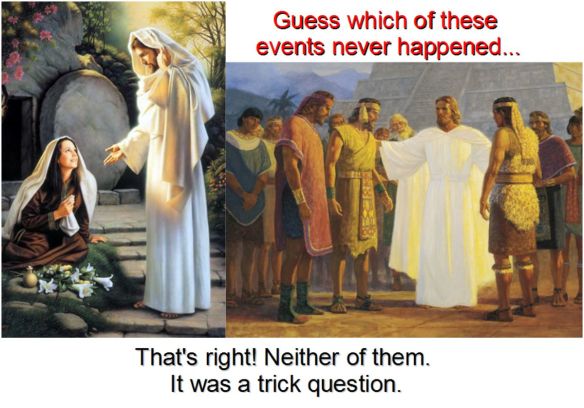
I went to see The Book of Mormon at the weekend. It’s offensive, blasphemous (if there is such a thing) and very funny. I recommend it. I’d say that, by and large, it represents the Mormon faith pretty accurately, mocking the Latter Day Saints’ belief that Jesus visited America about a year after his resurrection. Beaming into the proto-U.S.A, he converted the Nephite civilisation and turned them white, while the Lamanites, who were ‘so wicked’, God eventually curses ‘with (a) dark and benighted and loathsome condition’ (he made them black.) Sadly, all the archaeological evidence for these two civilisations has since been lost.

Three centuries later one of their number, a fictional character guy called Mormon, wrote down their adventures with Jesus on some gold plates that happened to be lying round. After Mormon died, his son Moroni buried these plates for safe keeping, as you would. 1500 years later still, Jesus prompted a chancer called Joseph Smith to dig them up again and, with the help of the returning Moroni and some magic stones, Smith translated them from the original Gibberish into stilted English. The plates and stones were never seen again, but every true Mormon knows that he/she will be resurrected after they die, provided, of course, they are wearing their special underwear. According to some, they’ll then be given their very own planet to rule.

Ludicrous, right? How could anyone invent such twaddle, let alone believe it and allow it to determine their lives? Yet, they do. But is it any more far-fetched than the fantasy on which it’s based? A guy called Yeshua goes round spouting platitudes and proclaims himself king of the New Age that’s coming soon. He gets killed and after 36 hours comes back to life, walks through walls and takes off into the sky. Not long after, a crank who never met him, decides this Yeshua must really have had super powers, and that all anyone has to in order to live forever is believe in a magic spell he, Paul, just made up! More than this, he’s convinced Yeshua will visit the Earth soon, when he’ll condemn most of its inhabitants to an eternity of hellish torture. Unbelievable! Literally unbelievable, and yet millions do believe it.

Joseph Smith’s hokum deserves all the mockery The Book of Mormon and others heap on it, but the original story is every bit as preposterous. Why can’t mainstream Christians see it?


*The phrase ‘Hasa Diga Eebowai’ appears in The Book of Mormon. It definitely doesn’t mean ‘no worries’.

Mormon news just in…

Mormon

God has told the 93 year old leader of the Mormons, Russell M. Nelson, that Mormons should no longer be called Mormons.

Henceforth, they will be known by a title that more accurately reflects their beliefs. They will, therefore, be dropping the second ‘m’ from their name.

It all comes down to feelings and subjective experience

Faith4

Argue with Christians (Hi there, Jim! Hi there, Don!) about the veracity of their faith and they will tell you it’s true for two reasons: the Bible and their own personal experience. ‘Christianity is true and Jesus is real because the Bible says so – and, whatsmore, I feel it.’

Or, as William Craig Lane likes to put it, the inner witness of the Holy Spirit testifies to the truth of Christianity. It’s a beautifully circular argument: ‘Christianity and its holy book are true; I know this because the Holy Spirit who lives in me tells me so; I know the Holy Spirit lives in me because the Bible says he does; therefore, I know Christianity and the Bible are true because the Holy Spirit tells me so’.

But equally, Mormons claim that they ‘know’ a completely different set of improbable beliefs are true because they experience a ‘burning in the bosom’ that tells them so. Roman Catholics say their faith is true because they experience Christ through the Eucharist, while Muslims know theirs is true because they have a real sense of Allah’s presence.

All of these spiritual convictions are not, as a liberal theologian like Karen Armstrong might claim, evidence that there is Something-Out-There that loves and communicates with us, but more obviously that human beings’ brains are adept at creating whatever ‘inner witness’ is required to support the beliefs and convictions they have arrived at. William Lane Craig concedes this when he acknowledges that

Anyone (or, at least any sort of theist) can claim to have a self-authenticating witness of God to the truth of his religion. But the reason you argue with them is because they really don’t: either they’ve just had some emotional experience or else they’ve misinterpreted their religious experience.

In other words, any experience of ‘self-authenticating witness’ enjoyed by believers in faiths outside Craig’s own brand of Christianity is at best mistaken, at worst fake. But then, how can anyone know, Craig included, that his own conviction isn’t just as much an emotional flush or mere subjective experience? Why is his conviction any more real than that of other kinds of believers? Ultimately, Craig can only say, “because it is”:

a person (possessed by the Holy Spirit) does not need supplementary arguments or evidence in order to know and to know with confidence that he is in fact experiencing the Spirit of God.

In other words, the true believer knows his experience of the Holy Spirit is real because his experience of the Holy Spirit tells him it is. And round the argument goes, though no amount of assertion makes a subjective experience an event in objective reality.

It is impossible for Craig, or any other Christian, to demonstrate that an entity he imagines inhabits his brain, no matter how convincing its presence may seem, has any existence anywhere other than in his brain. What the person who says ‘I believe’ is really saying is that they have no evidence at all for what they are claiming. If they had, they wouldn’t need to believe it; they would know it. They would, whatsmore, be able to point to independent, external evidence for it.

The Bible makes a virtue out of not knowing, of believing when there is no evidence.  It calls the resulting cognitive dissonance, ‘faith’.

Adapted from my book, Why Chrisitans Don’t Do What Jesus Tells Them To …And What They Believe Instead.