How the bible gets almost everything wrong: volume 2

bible-questions

The bible’s moral inconsistencies:

As we saw here and here, the bible’s morality is confused and frequently contradictory. Jesus himself adds to the confusion with pronouncements like:

You have heard it said (in Exodus 21.24), ‘Eye for eye, and tooth for tooth.’ But I tell you, do not resist an evil person. If anyone slaps you on the right cheek, turn to them the other cheek also. (Matthew 5:38-39)

and

You have heard it said, ‘You shall not commit adultery.’ But I tell you that anyone who looks at a woman lustfully has already committed adultery with her in his heart (Matthew 5.27-28).

God’s ‘standards’ change depending on who thinks they’re channelling him:

In Joel 3.8 he advocates slavery but in Exodus 21.16 he forbids it.

In Matthew 6.1 Jesus insists good deeds should be done secretly forgetting he’s already said, in Matthew 5.1, that they should be done openly to impress others.

In Matthew 7.1-3 Jesus says judging others is to be avoided while in 1 Corinthians 6.2-4, Paul gives it the go-ahead; judging others is fine.

In Matthew 19.10-12 Jesus disparages marriage but the writer of Hebrews approves of it (13.4)

God allows divorce in Deuteronomy 21.10-14 but in Matthew 5.32 Jesus doesn’t.

And on and on. Like everyone else’s, Christians’ morality is socially determined. Unlike everyone else’s, their morality reflects the bible’s own confusion and inconsistencies. To accommodate its contradictions, Christians cherry-pick from it to bolster their pre-existing prejudices and biases. The rest of us are then measured – judged – against the resulting pick’n’mix morality and, boy, are we found lacking. ‘Biblical morality’ is nothing if not projectile.


The bible’s weak understanding of psychology:

Many of those who wrote the bible had a particularly bleak view of human beings. To these men we are totally depraved and our every thought is ‘continually evil’ (Genesis 6.5) Our ‘hearts’ are supremely deceitful and desperately sick (Jeremiah 17.9) and we’re under the control of the devil (Ephesians 2.1-3). We are incapable of doing good (Romans 3.10-13) and as Jesus himself puts it:

That which proceeds from a person, defiles that person. For from within, out of the heart, proceed the evil thoughts, fornications, thefts, murders, adulteries, deeds of coveting and wickedness, as well as deceit, sensuality, envy, slander, pride and foolishness. All these evil things proceed from within and defile a person. (Mark 7.20-23).

I don’t recognise this as a description of myself and I’m sure you don’t of yourself. Of course human beings are capable of terrible acts (I’m writing this not long after a fanatical Muslim murdered 22 young, innocent people in a terrorist bombing in Manchester, here in the UK) and, on a more mundane level, we can behave in thoughtless or vindictive ways, entirely out of self-interest.

But we’re also capable of great kindness, compassion and concern. We are a complex mixture of these traits, the good and the bad. The biblical view that we are only ever hateful, devoid of any good, is jaundiced and unnecessarily negative. If parents were to spend their time telling a child he or she is only ever bad, wicked and evil, they would rapidly deprive the child of their self-worth, self-confidence and ability to relate in positive, loving ways to others. The description would become self-fulfilling. This is what the God of the bible does to his children.

Neither are we awash with sin. Sin is a religious idea, used to describe how humans fall short of the glory of God. It need not concern us here. There is no God to fall short of; sin therefore is a concept without any traction in the real world.


The bible’s fantasy perspective of the world:

Did you know this world is controlled by the devil and his demons? That powers and principalities of the air are at war with God and the powers of holiness all around us? In fact, the devil is always looking for ways to discredit the bible and is constantly trying to weaken Christians’ faith. He smuggles false doctrine into the church in order to mislead believers, and uses the hoax that is evolution to prevent unbelievers from accepting Christ as their saviour. He gives women ideas above their station, which God says is to be submissive, and has unleashed a wave of homosexual behaviour and gender confusion to blind people to God’s goodness and to kindle his wrath.

Did you know, though, that this fallen world and the ‘heavens’ above it are soon to be destroyed and replaced by a new earth and new heavens, where Jesus will reign over the select few God decides to raise from the dead? Despite Satan thinking he’s in control, it’s actually God who is. God only allows the devil to think he’s top-dog while he, God, is secretly pulling the strings.

If you do know these things, and if you believe them, then you have a ‘biblical worldview’. Or, to put it another way, you’ve bought into third-rate hokum that bears no relation to the world – the universe, even – as it is.


Sin

Sin

During the recent election in the UK, the leader of the Liberal Democrat party, Tim Farron, was asked if he thought gay sex was a sin. Farron is a born-again Christian and instead of answering the question, he hedged round it. Predictably, this meant that journalists returned to it, with the politician dodging it each time.

In all probability, Farron does regard gay sex as a sin. The bible teaches that all behaviour that offends God is sin, causing a rift between mortals and the deity. This, biblically speaking, is what defines sin. Tim Farron would have been better being honest, saying that his faith leads him to believe that sex between people of the same sex is sinful but that personally he is a supporter of equal rights for all. His voting record indicates this to be the case; he has consistently voted in favour of LGBT rights while, presumably, maintaining his faith. Perhaps if he had answered in this way, he might not have felt the need resign as Lib-Dem leader on the grounds that his role as party leader conflicted with his personal beliefs. Predictably, evangelical groups have claimed he was hounded out of office because of his beliefs, but it seems far more likely he was, as he said himself, finding it difficult to reconcile his faith-induced worldview with his public duty. It must be difficult defaming your colleagues when you’re supposed to be demonstrating Christ’s love.

Whatever the reason, those who believe that human behaviour is sinful are wrong. Nothing humans do is a sin. Nothing we do, gay sex included, offends God because there is no God to offend. Sin is an entirely religious concept that has outlived its usefulness, if it ever really had any. Which is not to say human behaviour cannot be immoral. It can, but immoral behaviour and sin are not the same thing. As a rule of thumb, morality is determined by the extent to which our behaviour adversely affects others. Deliberately harming them physically, materially or emotionally is (likely to be) immoral behaviour. Murder, theft and abuse are immoral – but they are not ‘sin’.

Morality is not always clear cut, however; arguably it would not be wrong to murder a terrorist or suicide bomber before he can embark on a killing spree. Aborting collections of cells in a woman’s uterus, if that is what she wants, is also not an immoral act. Similarly, victimless behaviours such as sex – both hetero and homosexual – between free, consenting adults is neither wrong nor immoral. Nor is masturbation, gender fluidity or transgenderism. And as for the betes noir of the church of my youth (and who knows, they may still be) – listening to rock music, having the odd drink and dancing – they’re not either.

On the other hand, some of the activities indulged in by religious people are immoral: attempting to impose their beliefs on others; misrepresenting and denigrating those different from themselves; pressurising gay people to deny their sexuality; advocating the death penalty for homosexuality; covering up fellow-believers’ criminal activity; teaching children that creation myths are true; dismissing science; persuading people that prayer works; convincing others they are sinners.

We all behave immorally, thoughtlessly and carelessly, from time to time. But we are not, as a consequence, destined for hell, nor are we in need of a saviour to magically wash away any wrong-doing; if that really worked, we would see no immoral Christians. No, when we have behaved immorally we need to make reparation to those we have harmed, not ‘repent’ by begging forgiveness of some irascible god. What we should never do, whatever the Righteous ones tell us, is regard ourselves as sinners. We are not: it is impossible to offend a deity that doesn’t exist.


How to argue like a Christian (part two)

Street-preachers

Five more ‘arguments’ offered by Christians in defence of their insupportable beliefs:

You’re not entitled to speak because you have no objective basis for your morality; morality comes only from God/the Bible.

Except it doesn’t, of course; moral codes existed long before the Bible or even the invention YHWH, who is, in any case, morally bankrupt. This ‘most unpleasant character in all fiction’ ‘wallows’, if I might borrow the term, in genocide (1 Samuel 15.2-3 etc) and slavery (Leviticus 25.44-46; Exodus 21.20-21 ); he relishes the death penalty for the most minor infringements of his petty rules (Leviticus 24.16; Deuteronomy 21.18-21, etc ad nauseam); fails to keep his promises (Genesis 17.7; Mark 11.24); does nothing to relieve human or animal suffering and lets millions of children die needlessly, year in, year out. It just doesn’t suit his mysterious ways, apparently, to behave like any halfway-decent human being would.

And even if he were the morally-upright paragon of virtue Christians delude themselves into thinking he is, they would ignore his moral guidance at every turn, just as they do now. Ministers, priests, evangelists as well as run-of-the-mill believers are convicted every day of the most despicable of crimes (Bruce Gerenscer keeps a tally on his blog-site) and that’s before we get to the more exacting moral demands Jesus makes. Going the extra mile (Matt 5.41), loving neighbour (Mark 12.31) and enemy alike (Luke 6.27), giving to all who ask (Luke 6.30) – these most Christians simply ignore. ‘We’re forgiven, not perfect,’ they whimper, even though ‘perfect’ is precisely what their unreasonable saviour tells them to be (Matt 5.48). But then I’m probably quoting out of context again… or something.

You’ve been hurt in the past.

This weak, ad hominem response is the converse of the charge that you’re immoral; good cop as opposed to bad cop. The Christian who says this is all-seeing and all-knowing and is able to evaluate your entire psychology and personal history from a single comment you’ve made. They can tell that you’re only disputing an aspect of Christianity because obviously at some point in your past a Christian – who wasn’t really a true Christian – hurt you. Or maybe it was a church you once belonged to that let you down. Well, you’ve every right to feel hurt! But that doesn’t mean there’s anything wrong with the True Faith™ or those who subscribe to it! And so your point is neatly invalidated; you’re only responding emotionally and you’ll get over it.

If there’s no God then life is meaningless.

Used extensively by some Christian blog-sites, this non-sequitur translates as, ‘I’m not going to address anything you say. My neediness demands there’s some point to life and I’ve decided that it comes from the fantasy I’ve bought into.’ Questions of whether that fantasy is actually true (which by definition it can’t be) and whether life is meaningless without it, are never considered. Believers’ need for the delusion to be true, their fear of working out meaning for themselves and their subsequent investment in Christianity’s empty promises, compel them to hide behind what is an essentially… er, meaningless solipsism.

Unbelievers have no right to criticise those who belong to Jesus.

Haven’t we? We put up with all the nonsense Christians spout, their attempts to influence everything from elections to what we can see on TV, from their opposition to gay rights, same-sex marriage, women’s rights, abortion and adoption issues to the restrooms people can or can’t use and their judging of the rest of us as hell-bound sinners. In return, we unbelievers are perfectly entitled to hold Christians accountable. At the risk of repeating myself, do they do what Jesus tells them to? Do they turn the other cheek (Matt 5.39)? Sell their possessions to give to the poor (Mark 10.21)? Give more than is demanded of them (Matt 5.40)? Avoid judging others so they’re not judged in return (Matt 7.1-3)?

What do you think?

You’re of the devil/an enemy of the cross/wilfully blind/apostate/a troll.

If all else fails (and it will) the faithful resort to an insult carefully selected from the extensive bank of Christian cliches. That way, there’s no need to engage the brain at all. God love ’em!


How not to love your neighbour

preachersImagine: a group of health-fascists set themselves up on a soap box in the city centre from where they lambaste everyone going past, with language that is abusive and demeaning, about the poor state of their health, their out-of-condition bodies and that many of them are  significantly over-weight. But, the speakers insist, a bottle of a magic potion they just happen to be selling will solve all their health problems overnight! All anyone has to do is commit to swallowing some every day for the rest of their lives.

Unsurprisingly, people are upset about this; they’ve come to town for all sorts of reasons, but not to be lectured about their health and size, which, for most of them are both perfectly fine. Some of these folk challenge the snake-oil salesmen, shouting back at them (not having the benefit of a tannoy system) and demanding to know what gives them the right to harass passers-by. In response, one of the salesmen pulls out a copy of last Tuesday’s Daily Mail; ‘it’s all in here,’ he declares, ‘all in black and white, and we believe it. The Daily Mail wouldn’t lie to us. Its Word is Truth. So get your magic potion now before it’s too late, ya depraved, ignorant slobs!’

Acceptable or not?

While you think about – if you even need to – the picture above was intended to accompany the previous post. It shows street preachers Michael Overd, Michael Stockwell and Adrian Clark before their trial for ‘public order offences’, which started last week and concluded on Tuesday this week. I felt it couldn’t be used while the trial was ongoing (contempt of court and all that) and so had it replaced with one of rabid American nutcase Franklin Graham.

Two of the three preachers, Overd and Stockwell, were found guilty and fined. Naturally, there’s an outcry from Christians and assorted fruitcakes everywhere about how the two have been denied their freedom of speech (though there is no protection of free speech under UK law) and how – oh calamity! – it’s no longer possible to ‘preach the gospel’ in the Britain. Absolute nonsense, of course, and while some more liberal commentators feel the case should never have reached the courts (let the nutjobs condemn themselves by spouting in the streets, suggests one) an example has been made of people who think the way to show love for your neighbour is setting out, in the judge’s words, to ‘insult, humiliate, demean (and) belittle’ them in public using a loud speaker in a shopping centre.

As Andrew Calibre pointed out in the previous post, haranguing and provoking people like this has nothing to do with love, nor is it ‘the gospel’. Shouting, as Overd did, about how your neighbour is ‘depraved and ignorant’ and how those who have sex outside marriage and gay people (of course) are ‘filthy, depraved and perverted’ is not, by any stretch of the imagination, ‘the good news’.

Perhaps the confusion is understandable when the Bible and God’s people™ are so muddled themselves about what ‘the good news’ actually is; God’s Kingdom arriving on Earth, as Jesus seems to have thought? Paul’s magical salvation formula? Or maybe it’s that there’s a free pass to heaven? One thing’s for sure, verbally abusing your neighbours and other strangers it isn’t. Even if street preachers justify their arrogance and rudeness by claiming they’re only conveying what (they think) the Bible says – so what? Their tawdry little book has no more authority than any other collection of ancient (or modern) fantasy, prejudice and supposition.

So, no, it’s not acceptable that hypothetical, self-appointed health experts verbally abuse strangers in the street. And as the court ruled this week, nor is it when religious zealots do the same. Passers-by and by-standers have every right to feel irritated, annoyed and offended, just as Christians would be if a group of Muslims propounded their beliefs with the same aggression, informing all and sundry how wicked they are and how they are destined to spend eternity in whatever hell Islam envisages. Nor would ‘we’re only preaching what the Qu’ran teaches’ be any justification.

But the issue isn’t only the irritation that people feel when religious extremists abuse them. It’s the one in a hundred, or whatever the percentage is, who takes them seriously, accepts the confederate’s tract, shows interest and is ultimately sucked into one of the many versions of the mind-numbing Jesus cult. Far worse than selling people magic potions, or insurance they don’t need, there is something obscene about cranks taking to the streets to recruit the gullible and unsuspecting to their (lost) cause. We wouldn’t tolerate it if it were anything other than religion, why should we accept it when it is? The prosecution of presumptuous con-artists does us all a service.


Faith by any other name (is still a waste of time)

celia3Faith; the brand name for ‘wishful thinking’. In what other area of life, other than the religious, do we have faith in faith? Christians like to say we do – we have faith, they say, in the pilot who’s controlling the aircraft we’re flying in, or we have it in the surgeon who’s operating on us. But this is not faith in the sense religious people usually use the term. ‘Faith’ in pilots, surgeons and even our own abilities is more like trust or confidence; trust that the pilot is qualified to fly the plane, confidence that the surgeon is trained and skilled or that we have the ability to complete the task we’ve set ourselves. This is not faith in the sense of ‘belief in things that can’t be seen and for which there’s no evidence’. It’s not faith in the sense of wishing and hoping there really is a God and that he cares enough about us to grant us eternal life, much in the manner of the magic fountains and wish-granting genies of folk tale.

Religious faith – Christian faith particularly – is of this latter kind. It’s not trust in a real person’s capabilities, be it our own or a specialist’s. It’s a blind belief in a God who evolved from being one tribal deity among many into the everlasting, omniscient creator of all things. A God who, if he did create everything, set us on the Earth together with viruses, microbes, infections, disease, sickness, cancer, AIDs and Alzheimer’s. A God who thought putting us in an environment so frequently hostile to our well-being on an insignificant planet in the corner of a vast and indifferent universe was just the right place for us.

This is a God who doesn’t seem to understand us but who is swift to punish us while he himself stands by as half of his favoured creation endures poverty, starvation and the cruelty of much of the other half. His ways are not our ways, believers say, making what they surely know is a flimsy excuse – the flimsiest – for his failure to interact with us in any meaningful way.

Faith is the wishful thinking that despite the evidence, this neglectful, capricious God really does care for us. He cares so much he has devised an illogical, incomprehensible plan (or two) that, with its blood sacrifice and magical overtones, we must believe if we want his forgiveness for the way he made us in the first place.

We need to have faith that this cosmic madman will bring us back to life us after we’ve died and take us to Heaven to live with him, but we must first have the right sort of belief, even if it’s difficult to work out what that is. Faith is necessary for all of this because there isn’t a scrap of evidence anyone has ever been returned to life after they’ve died, or that Heaven exists, or that anyone has ever gone there. That’s why it takes, not trust, but a great wallop of wishful thinking that this fantasy is not only real but more real than the reality in front of us.

As for me, I can’t believe any of it.

  – I can’t believe the claims of those who even today say they’ve seen or heard from God or Jesus or Mary, who reckon they’ve had visions the same way Paul or Peter, Joseph Smith or Mary Baker Eddy did.

  – I don’t believe those who say they almost died and went to Heaven, because what these visions of fantasy figures and make-believe places have in common is that they take place, so far as they occur at all, entirely within people’s heads.

  – I won’t believe that those who say all of this magic, hallucination and mumbo-jumbo is true because it’s in the Bible, when the creators of that book were men far more ignorant and superstitious than any reasonably educated person today.

  – I am unable to believe muddled nonsense that is designed to appeal to our vanity and fear of obliteration.

  – And I really don’t care that some say they get comfort, joy and morality from their belief; their morality no more derives from God as mine does from Superman and emotions don’t make any of it true.

So, faith – what good is it? If your answer is it enables you to believe the impossible, then isn’t it just another word for delusion?


Imagine… no religion

Jimenez2People say, like, you know, “Aren’t you sad that 50 superstitious nut-jobs died?” Here’s the problem with that. It’s like the equivalent of asking me, you know, what if you asked me, “Hey, are you sad that 50 Christians were killed today?” Um, no, I think that’s great! I think that helps society! You know, I think the world is a little safer tonight!…

The tragedy is that more of them didn’t die… because these people are predators! They are abusers! They take advantage of people! And look, as Rationalists, we need to take the stand that it is not our job to sit there and say, “Oh, this is a tragedy” or “Oh, this is something we mourn.” Look, everything tells us these are deluded, wicked people. These are evil people.

… People sometimes will say, “You guys are advocating violence!” We’re not advocating violence! We’re not saying we should go do this! But we’re just saying this: If we lived in a rational nation with a rational government, then the government should be taking them… I wish the government would round them all up, put them up against a firing wall, put a firing squad in front of them, and blow their brains out. If we lived under a truly secular government that loved rationality and loved children, and wanted to protect them, that’s what we’d do.

Hate speech? Certainly. But not mine. The original, which you can find here, is about the Orlando shootings a few weeks ago, and is directed at gay people. I’ve simply replaced gentle ‘Pastor’ Jimenez’s use of ‘sodomite’ and ‘paedophile’, which he disingenuously uses interchangeably, with ‘Christians’ and ‘religious nut-jobs’, and his use of ‘God’ and ‘righteous’ with ‘superstition’ and ‘rational’. Jimenez, emissary of a religion of love (Matthew 5.44 etc), would like to see his government exterminate LGBT people.

But, you know, maybe there’s also a case to be made for eliminating the superstitious and irrational from among us. Those of us who have adopted a rational basis for our lives would be happy to see the end of religion and superstition, the removal from the Earth of the religious and the superstitious (I use the terms interchangeably). After all, what do believers in mumbo-jumbo add to the world that is any way positive? What can those who are unable to engage with reality without the crutch of make-believe possibly have to give? On top of their general uselessness, they’re also dangerous and predatory.

Maybe there is a case to be made. But I’m not making it. Any philosophy, ideology or religion that preaches the extermination of other people is wrong, debased, corrupt (you’d think, wouldn’t you, that we’d have learnt that by now.) If you subscribe to such a view – be it from a Christian, Islamic or Jewish perspective – you are wrong. No-one, whatever magic books may say about them, merits death simply because those magic books say so (ratified, of course, by the dim-witted prejudices of those who subscribe to them). Rationality and a secular perspective, on the other hand, eschew hatred and are philosophically opposed to harming those who might not agree with them. Yes, even the religious.

In this way it is vastly superior to religion – your religion, whatever that happens to be.

Sweet and sour, nasty and nice

or, whatever happened to Luke 18.11-14?

prayer2Why is it when people are emotionally blackmailed into becoming followers of Jesus, does their conversion make them sweet and sour, nasty and nice at the same time? The sweet and nice parts are what their new experience does for them. They get a new start of sorts, are introduced to like-minded friends in the church and become compelled to share their new joy with everyone else, whether they want to hear it or not, about how much they’ve changed because of Jesus. It’s nice for them. Deluded too, but if it makes them happy then why not?

This is why not. What they don’t tell you, not at first anyway, is how sour and nasty they have also become; how they must now defend God’s standards, because, as everyone knows, the omnipotent God of all creation is incapable of defending them himself. Being born again and morphing into ‘a new creation’ involves, without exception, becoming judgemental of others, condemnatory, inflammatory, bigoted and spiteful.

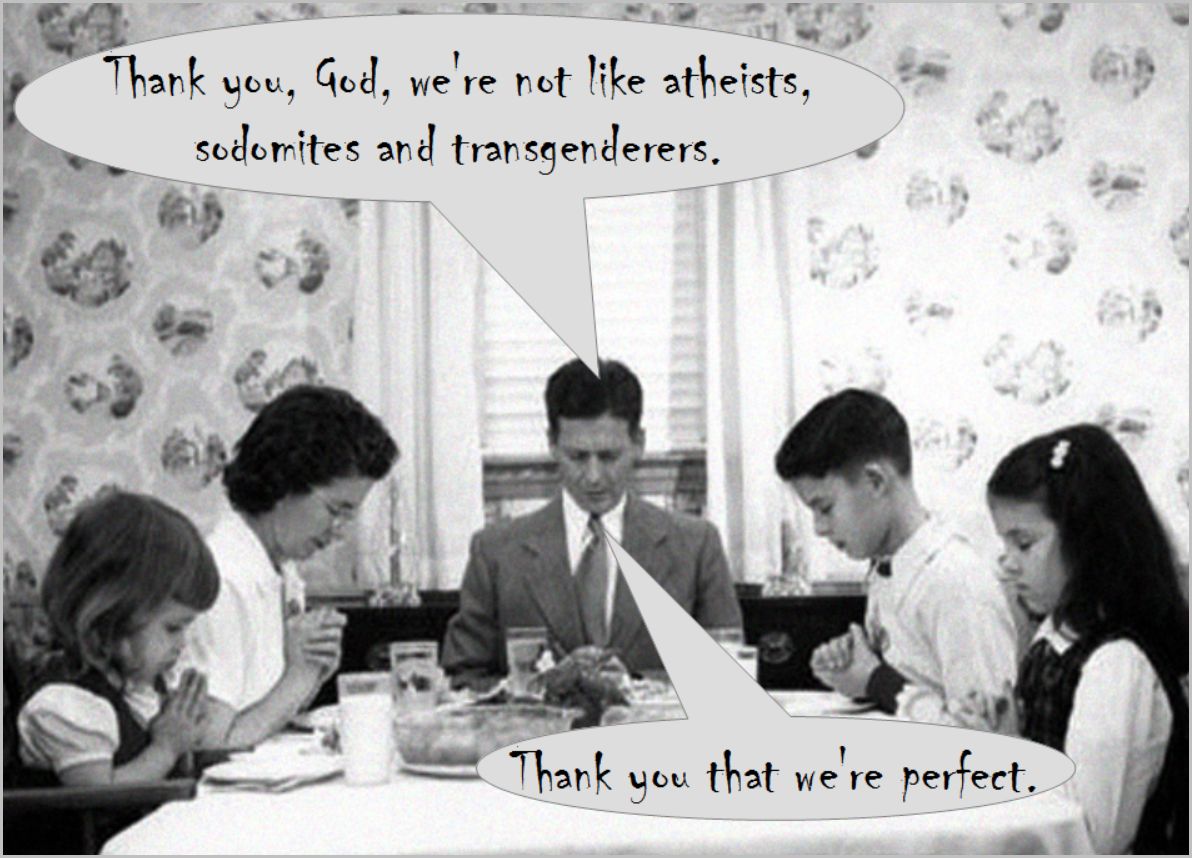
You think not? Then you haven’t heard what these same Christians think about abortion and women who have them. Homosexuality and those who are gay. Transgenderism and those born in the wrong body. Science and those who value evidence. Atheism and those of us who see through believers’ sad delusion.

Christians don’t, as some of them profess, hate the sin but love the sinner. They despise those who have philosophies different from them, those who live differently from them, those who are different from them.

A recent BBC poll asked if the world wouldn’t be more peaceful without religion. Here’s the results as of 14th July 2016:

Poll

I don’t know how many people this represents nor where they’re from – the site doesn’t say – but it would seem that most of us would think we would be better off without religion. It’s long past time we were able to be; religion has nothing to offer. It’s time we stopped giving it special treatment because some of it is sweet and nice. Its sour, nasty aspects are just as much a part of it, inseparable from whatever positives its adherents say it has. I’ll be looking soon at how we might push back against religion’s pervasive and poisonous influence in society.

Angels with anuses

Lot

Of the many tawdry stories in the Bible, the tale of Sodom and Gomorrah (Genesis 19.1-29) is one of the most sordid and ludicrous.

In case you don’t know it, two angels visit Lot in the first of these ‘two cities of the plain’ where the local men express a desire to rape the pair. Unbelievable, right? All the men (19.4) wanted to rape two other men? It would appear so, but only because the story, designed to explain the demise of the two cities, is a fabrication by a rabidly homophobic scribe, intent on expressing his own prejudices and sexual fantasies. There is little evidence the cities really existed.

Anyway, Lot offers them his daughters instead, telling the local rapist mob that the gals are virgins, though in fact they have husbands (19.12 & 14). Lot’s rampaging neighbours don’t seem to know this but all the same decline his generous offer. So, to cut a long story short, God destroys both Sodom and Gomorrah allowing only Lot and his family to survive. Then, for no plausible reason, his nameless wife dies as they flee and Lot has drunken sex with his not-so-virginal daughters (19.33-38). As a result of the incest, the two of them give birth to genetically compromised offspring.

So this Lot – I’m tempted to say ‘this Bad Lot’ – who lies, offers his daughters to hormonally charged thugs, fucks the gals himself and has children by them, is declared by God to be a ‘righteous’ man (Genesis 18 and 2 Peter 2.7-8). The bar was set very low in them good Old Testament days.

Over on National Catholic Register’s blog, Thomas L. McDonald tries to explain what this seedy little story really means. (Steve Wells responds to his desultory efforts here). Central to it, are the so-called angels. What sort of beings are these? The term means ‘messengers’ and this pair at least are very mundane; they are incapable of defending themselves against rape threats (Lot has to defend them) and while they claim they are about to destroy the two cities (19.13), it is in fact God who does so (19.24). Later angels are more like the X-Men; they have grown increasingly grotesque (Daniel 10.5-6) and have developed superpowers like flight (Isaiah 6.2) and invisibility (2 Kings 6.17). The Sodom pair though are mere prototypes. There is nothing supernatural about them because the concept of the angel as a supernatural emissary of the divine was in its infancy when this story was written. They are simply human messengers.

Which is how they are capable of being raped. If they were the ‘evolved’ angels of later fantasy it would be inconceivable that they could be overcome and abused in this way. That these two can be potentially is because they are human males with human male anatomy. The bottom line is, if you’ll forgive the pun, they have anuses, without which they could not be anally raped. The story blithely assumes this to be the case even though all subsequent exegesis consistently ignores it.

This ugly, homophobic, semi-pornographic story has led to untold damage to innumerable people throughout the ages. It has given us the disparaging terms ‘sodomy’ and ‘sodomite’, even though no ‘sodomy’ takes place in the story and isn’t, in any case, routinely practised by same-sex couples. It has served as the prototype for the blaming of LGBT people for (always unrelated) natural and man-made disasters, from earthquakes to tsunamis and 9/11. The moral usually taken from it – even though it lacks any morals at all – that being gay is evil, has led to, and provided ‘justification’ for, the persecution and destruction of gay people right up to the present day. Perhaps, given the same story is referenced in the Qur’an, its influence can even be seen in last week’s massacre in Orlando. 

That the prejudiced and ignorant today continue to be influenced by this unimaginative, tawdry little tale is the lasting legacy, the real tragedy, of Sodom and Gomorrah.


What does God think about the Orlando massacre?

Orlando

Let’s see what he’s saying through his spokesmen here on Earth:

According to a minister from the cathedral in my home town, who conveyed this message from the Lord at a vigil on Monday night,

God is just as confused as we are. All the same, he’s full of compassion for those who died and for their loved ones.

Makes you wonder though, if he’s so compassionate, why he didn’t do anything to prevent the murders in the first place. Still, he is sympathetic, which is something.

Oh wait! That isn’t how God feels at all, not according to Pastor Steven Anderson, who knows exactly what the Lord thinks:

…in Leviticus 20:13, God’s perfect law, he put the death penalty on murder, and he also put the death penalty on homosexuality. That’s what the Bible says, plain and simple. So, you know, the good news is that at least 50 of these pedophiles are not gonna be harming children anymore. The bad news is that a lot of the homos in the bar are still alive, so they’re gonna continue to molest children and recruit people into their filthy homosexual lifestyle.

Right. So now we know.

Hang on, though. Christian Today tells us something different again. According to this guy, what God really wants his followers to know is that,

true believers should pray for everyone involved in the terrible events of the weekend and ‘not miss a huge opportunity to build bridges and demonstrate our saviour’s love.’

Phew, glad that’s finally sorted.

Or maybe not, because God has changed his mind again: Pastor Roger Jimenez has this straight from the Lord himself:

The tragedy is that more of them didn’t die… the Bible paints the picture that these are wicked people. These are evil people. God gave them up to their vile affections… they’re not natural… they received a reward for their error… God almighty says, ‘there’s nothing I can do for (homosexuals).’

All these mixed messages, and all supposedly from the same Person! Compassion, punishment, love, abandonment; that truly is one confused, mixed-up deity you worship, Christians. You’d be confused too, I guess, if one nutjob after another put words into your mouth. Just who’s the ventriloquist here and who the dummy?

When, Christians, are you going to stop deluding yourselves that arses like Anderson and Jimenez know anything about what God thinks? When are you going to stop pretending that anyone knows what he thinks? When are you going to recognise that a God who ‘speaks’ so inconsistently through simple-minded ‘intermediaries’ is not God at all?  When are you going to stop deluding yourselves that there even is a God?

Religion poisons the well. Again.

dye

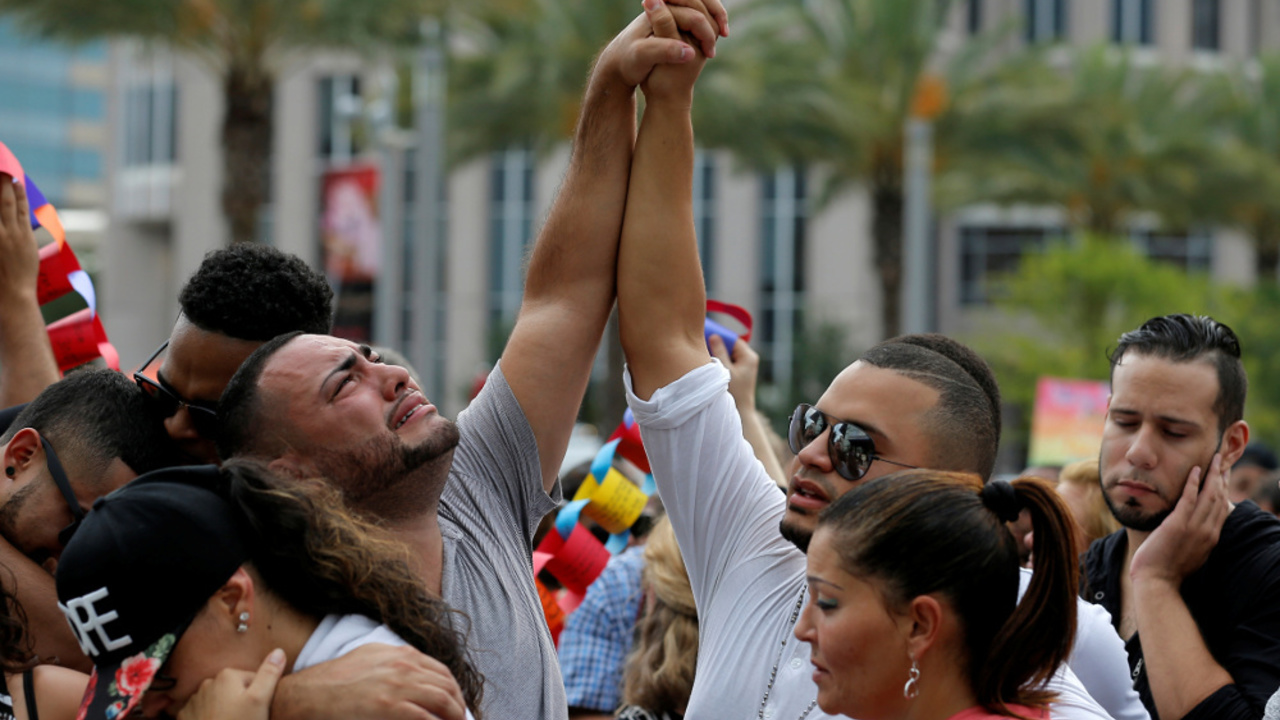
The shooting in Orlando of people in a gay night club (50 dead, 53 wounded) is yet another example of religion as the antithesis of human flourishing. Not Christianity this time, of course, but that other ‘great’ religion, Islam, the religion of peace. But Christians cannot distance themselves from atrocities like this, carried out in the name of God, when the influence of even moderate religion is a pervasive, unhealthy presence in our society.

It’s true that Christians don’t, as rule, rampage in the streets or fly planes into buildings but they do contribute to the medium in which more extreme forms of religion grow:

Westboro Baptist Church, for example, with its own peculiar brand of Bible-based homophobia – ‘God hates fags’ and all the rest – is, like it or not, an expression of Christianity;

Right-wing evangelicals who interfere in the churches and governments of Africa and South America, actively encouraging them to take a homophobic stance and to pass anti-LGBT laws, are equally culpable; Scott Lively, Pat Robertson, Sharon Slater, you too are people filled with hate;

Likewise, those Catholic bishops who use their influence to denounce gay and transgendered folk as ‘mentally disordered’;

Christian bloggers who trot out the old, ‘Woe to those who call evil good and good evil’ (Isaiah 5.20) and misapply it to homosexuality, together with those who quote Leviticus 18.22 (‘abominations!’) and Romans 1.26-27 (‘unnatural and indecent!’)…

All of these contribute to the animus directed towards fellow human beings whose ‘sin’ is merely to be different. Religions, or more specifically their adherents, contribute significantly to the levels of misery in the world today, though Christians will cry ‘foul’ here (or ‘persecution’ even, because how they love claiming they’re being persecuted when asked to demonstrate some empathy and a little love.) After all, it wasn’t a Christian who gunned down the people in the Pulse nightclub this weekend. No it wasn’t. But every time religious bigots –

tell others what despicable sinners they are,

misrepresent and denigrate minorities,

promote ‘gay cures’,

attack same-sex marriage,

add quotation marks around the words gay and gay marriage, as if they’re somehow not real,

assert homosexuality and transgenderism are synonymous with ‘moral decay’,

claim natural disasters are God’s response to gay people’s very existence,

boycott businesses that support equality,

‘take a stand’ against transgendered people using the appropriate restroom and

refuse to serve gay couples –

every time, in short, they say LGBT people are evil, sick or worthless, the self-righteous prepare the ground for individuals like Omar Mateen to do what he did in Florida on Sunday. Religious leaders condemning such atrocities after the event is too little, too late, when they’ve failed to take charge of their acolytes and  do nothing to stem the tide of hatred flowing from their churches, mosques and temples. 

To those of us on the outside, religions are all of a kind; harmful superstitions. If a ‘faith’ entails belief in supernatural beings and puts allegiance to such imaginary figures above fellow human beings, it is without merit. It is the evil among us.