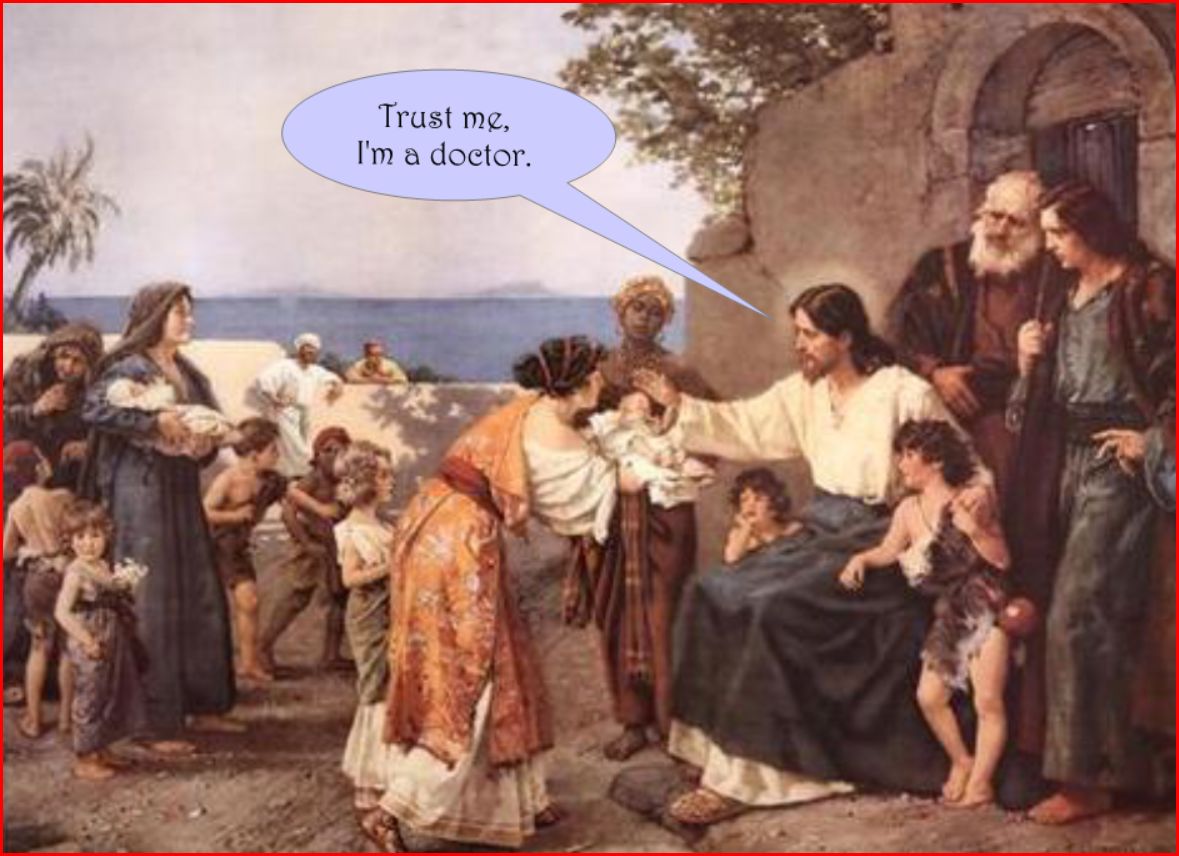
Idiotic stuff Jesus said 2: You need never have another bad hair day

ThePlanDon’tcha just love him?

Jesus says that whatever else happens, Christians will never, ever have a bad hair day. They may have limbs lopped from their bodies and they may be crucified just as he was, but – blessed assurance! – not a single hair on their heads will come to harm. Isn’t that fabulous?

Here’s how he puts it:

…they will arrest you and persecute you; they will hand you over to synagogues and prisons, and you will be brought before kings and governors because of my name… You will be betrayed even by parents and brothers, by relatives and friends; and they will put some of you to death. You will be hated by all because of my name. But not a hair of your head will perish. By your endurance you will gain your souls. (Luke 21.12, 16-18)

Of course, this particular part of Jesus’ script was written long after he died (wasn’t it all) when there was some mild persecution of Christians under the emperor Nero. Jesus’ promise was designed to be of comfort to those in trouble because of their faith. It turns out to be cold comfort, however, and a blatant lie. Jesus’ own brother and leader of the church in Jerusalem, James was tortured and executed round about 62CE, as were several of the disciples and the self-appointed apostle, Paul (circa 64CE). And we can be fairly certain that whatever hair they had on their heads ‘perished’ when they did.

Perhaps Jesus suffered from male pattern baldness, which might explain his fixation with hair, because as well as promising that not a single hair on believers’ heads would perish, he’s made to declare, equally improbably, in Matthew 10.30 that all the hairs on the disciples’ heads are numbered.

God really does have too much time on his hands. You’d have thought he could use it to prevent the deaths of the 25,000 African children who die each day because of malnutrition and the innumerable diseases he’s seen fit to create. But no. He counts hairs instead.

Consequently and predictably, Christians have tied themselves in tangled knots trying to explain Jesus’ bizarre claim that not a single, numbered hair would be lost. What he meant, some of them tell us, is that the souls of persecuted believers will be unharmed, safe in God’s care, whatever they endure. But hair, it has to be said, is an unlikely metaphor for the soul, and isn’t one that the gospel writers or other New Testament authors use anywhere else.

So maybe, Christians argue, because hair is a part of the physical body, Jesus means it to stand for the whole body, and yes, this might be put to death, but it will live again as a resurrected super-body. God will then reinstate even the hair of those who have died for Jesus’ sake. Which means there are going to be a lot of hirsute people in the Kingdom when all the hair they’ve ever possessed is returned, post-mortem, to their heads. This is what Jesus promises.

Paul, though, says in 1 Corinthians 11.14 that long hair degrades a man, while Augustine argues that, come the resurrection, any excess hair will be incorporated somewhere in the body (extra pubes maybe?). Perhaps, though, God doesn’t intend acting as divine hair-restorer at all, but plans to keep all the hair ever lost, alive and vibrant, in a special heavenly hair-museum.

Or maybe Jesus’ guarantee that even Christians’ hair will be saved is, like the rest of his promises, nothing more than total and utter BS.


What would the world look like if Jesus had been right?

NewEarth

If everything Jesus promised had come true, then:-

Jesus and his twelve mates – or maybe it’s eleven, what with one of them pissing on the parade – would have been running the world for 2,000 years by now (Matthew 24.34 & Matthew 19.28).

All the undesirables – that’s me and, in all probability, you – would’ve been consigned to Hell and the Righteous would’ve been living on the New Earth, working miracles all day long, not getting married, enjoying eternal life and definitely not having sex (Matthew 13.43, Luke 20.34-35, Matthew 25.46, Matthew 13.41-42).

But seeing how none of that has happened yet, what does the world-according-to-Jesus look like while we wait for the Kingdom to arrive?

Well, duh, look around you; this is how it is:

True Believers go around curing the sick, the blind and the lame, just by touching them or using magic saliva. There’s no need for hospitals, medicine, doctors or heath care. Jesus did this sort of thing and he said his followers would too, to an even greater extent. That’s why Christians can even help amputees grow back missing limbs (Mark 16.18 & John 14.12).

By the same principle, True Believers regularly raise the dead. Okay, so there’s not going to be any death in God’s Kingdom on Earth, but it’s a handy power to have all the same (Matthew 10.8).

Hunger is a thing of the past. When anyone feels a bit peckish – an entire continent, say – Christians feed them using whatever scraps they’ve got lying around, like left-over sardines and burnt toast with Jesus’ face on it (Matthew 14.13-21).

True Believers supply everyone with as much wine as they want, too. They simply pour out some water and change it into alcohol with their water-into-wine superpower. If their beneficiaries turn out to be tee-total, the Righteous change it into something else for them, like coffee or Kool-Aid or cyanide. Of course, cyanide is the beverage of choice for God’s Chosen. He makes sure no harm comes to those who imbibe it (John 2.1-11, Mark 16.18).

Christians are regularly to be seen playing with poisonous snakes, because, like Superman they’re practically invulnerable (Mark 16.18).

Transport is transformed in Jesus’ new world too. No need for ships or ferries; Believers travel overseas by walking over seas. Conditions a bit choppy? The Almighty calms things down for them; all they have to do is ask. (Matthew 14.22-33 & Mark 4.35-41).

Mountains getting in the way? They can just be lifted out of the way using the Power of Faith, and thrown into the sea. Or, if that’s likely to cause problems for those out for a stroll on the oceans, the mountains can be rearranged to make a passage through. Very neat and tidy (Mark 11.23-24).

Best of all, True Believers can ask God for anything at all and whatever they ask for he provides. No questions asked. He does it (Matthew 7.7 & 21.22, Mark 11.24 etc).

Thanks to Jesus’ followers, this is how it is in the world, while they wait for God’s Kingdom to arrive. And when it does, it’ll be even better. Hard to imagine it could be any better than it is, I know, but Jesus guarantees it. What a blessing it is to live, here and now, in such a transformed reality.

Except of course we don’t. None of these things happen. Not the miracles, the healings, the living forever. This is not the world we live in, even though Jesus said it would be. His Kingdom didn’t come; his followers don’t do miracles like his (and certainly don’t do better ones); no-one lives forever. They never have and never will.

Instead his Followers spend their time squabbling between themselves, judging others and living – and dying – pretty much the same way we all do.

Funny that.


Christians’ Favourite Delusions 23: Jesus shows us how to live

Doctor

Was JC a great moral teacher?

No, the best things he said – do unto others, love your neighbour – had already been said eons before he came along. Some of the other stuff he came out with was ridiculously impractical – give away all you have; live only for today; turn the other cheek – that his followers have been unable to do from day one.

Did what he said about God turn out to be right?

No. He said God would establish his Kingdom on Earth while the disciples were still alive.

Did he commit himself to long-term responsibility for others and their needs?

Another no.

Did he experience the infirmities and difficulties of old age?

Nope.

Did he suffer from any of the serious illnesses we mere mortals are prone to?

Apparently not.

Did he give over his entire life to raising children or taking care of elderly relatives?

Not that we know of.

Did he have to work each day to earn a living?

No. He sponged off gullible female fans (Luke 8.1-3).

Did he have any understanding of science and of how the world works?

Erm, no. He thought people became ill because of sin and demon possession and that Heaven was in the sky.

Was he interested in anything but his own futile ‘mission’?

Yet another no.

Apart from his last few days did he know suffering, the everyday frustrations of life or the daily struggle to make ends meet?

Not so’s you’d notice.

Did he, in short, know anything of the life as it was lived and is lived by ordinary people?

Emphatically not.

There was nothing marvellous about Jesus. He was out of touch with ordinary people and at loggerheads with those cleverer than he was. He was a failed prophet who was turned into a supernatural being by those who came along afterwards – mainly Paul, who’d never met him – and is worshipped today by those who ignore most of what he said.


Christians’ Favourite Delusions 21: Jesus Keeps His Promises

Promises

Jesus keeps his promises? Let’s see…

‘I’ll be back while my disciples are still alive’.

For the Son of Man is going to come in his Father’s glory with his angels… I tell you the truth, some who are standing here will not taste death before they see the Son of Man coming in his Kingdom. (Matthew 16:27-28)

Oops. He got that wrong. Two thousand years later and his followers are still waiting. Despite what today’s believers claim, he didn’t say he’d reappear over two thousand years into his future. Safe to assume he’s not going to make it at this late date

‘Anything you ask for will be yours… whatever you ask.’

Very truly, I tell you, if you ask anything of the Father in my name, he will give it to you. (John 16.23)

Truly I tell you, if you say to this mountain, “Be taken up and thrown into the sea”, and if you do not doubt in your heart, but believe that what you say will come to pass, it will be done for you. So I tell you, whatever you ask for in prayer, believe that you have received it, and it will be yours. (Mark 11.24; also Matthew 21.21-22)

Christians hedge round this one by saying God answers prayers in his own time and in his own way. His answer might be ‘no, you can’t have that’. But that’s not what Jesus says. He says ‘Whatever you ask… anything… will be yours.’ What is this if not a false promise?

‘My followers will do even greater miracles than I have.’

Very truly, I tell you, the one who believes in me will also do the works that I do and, in fact, will do greater works than these, because I am going to the Father. I will do whatever you ask in my name, so that the Father may be glorified in the Son. If in my name you ask me for anything, I will do it. (John 14.12-14)

Believers regularly walk on water, turn water into wine, and – slightly less frivolously – raise the dead. Except… no they don’t. It doesn’t happen. They should be doing even more startling things than this too – Jesus promises ‘greater works’ than his – but again, two thousand years on and they haven’t even mastered basic mountain throwing. What a let down. What hokum.

‘You’ll be able to do the impossible.’ 

These signs will accompany those who believe:…. they will pick up snakes in their hands, and if they drink any deadly thing, it will not hurt them; they will lay their hands on the sick, and they will recover. (Mark 16.17)

Which is why, I guess, we have no need of hospitals, because Christians can heal everyone; why members of those fanatical snake-handling churches in America, who take Jesus at his word… erm… regularly die from snake bites. And not even these true believers are crazy enough to drink poison. There’s a limit to how much faith even gullible Christians have in Jesus’ empty words.

‘Don’t bother working or earning a living. God will provide.’

Therefore do not worry, saying, “What will we eat?” or “What will we drink?” or “What will we wear?” For it is the Gentiles who strive for all these things; and indeed your heavenly Father knows that you need all these things. But strive first for the Kingdom of God and his righteousness, and all these things will be given to you as well. (Matthew 6.25-7.1)

Yeah, right. His followers recognise how useless this one is too; they do strive to make a living and provide for their families. None of them wait for God to provide because they’d be dead before he got round to it.

‘God will look after your hair (because you’re worth it).’

But even the hairs of your head are all counted… You will be hated by all because of my name. But not a hair of your head will perish. (Luke 12.7 &  21.12-19)

Oh, come on. Now he’s just being silly.

And that’s only a few of them… Jesus’ promises. All as worthless as the proverbial chocolate fire-guard. Christians, of course, know this well. They neither trust in his promises nor demonstrate them in their lives. As it is, how they live is indistinguishable from everyone else; completely devoid of miracles and lacking in any supernatural provision. They tell themselves (and us) that Jesus is special but then disregard most of what he said – and who can blame them from that? Anyone else who made the sort of ludicrous promises Jesus did would be dismissed as a fool and a charlatan. It’s way past time we recognised Jesus as just that.

Which Christians won’t be resurrected after they die?

Robertson

All of these well-known Christians are unworthy of the Kingdom of God and won’t live again after they’ve died. See if you can work out why:

Billy Graham, Justin Welby (Archbishop of Canterbury), Desmond Tutu, Pat Boone, Mel Gibson, John Sentamu (Archbishop of York), Stephen Green (Christian Voice), Bono, Her Majesty the Queen, Sarah Palin (politician), Pat Robertson (700 Club), Joyce Meyer (evangelist), Bryan Fischer (outspoken radio broadcaster), Rick Warren (pastor of US mega-church), Rob Bell (ditto), George W. Bush, Tony Blair, Cherie Blair (barrister), Graham Kendrick (songwriter), Tony Perkins (anti-gay preacher), Scott Lively (ditto), Matt Barber (ditto), Peter LaBarbera (ditto), Tom Wright (theologian), Fred Phelps (late of Westboro church), Joni Eareckson Tada (writer), Mike Ratcliff (minister and blogger), Kirk Cameron (actor)… and, in all probability, your local pastor  – and maybe even you yourself, Christian reader.

They’re not worthy of God’s Kingdom nor are they likely to be resurrected because they’re married. And who says this makes them unworthy? Not me… Jesus:

those who belong to this age marry and are given in marriage; but those who are considered worthy of a place in that age (of God’s Kingdom on Earth) and in the resurrection from the dead neither marry nor are given in marriage (Luke 20.34-35).

So next time one of these famous Christians or some other married believer tells you you’re not saved, tell them that they’re not either. Jesus says so.

They won’t care, of course, because they pick and choose the bits of the Bible they believe. They’re more than happy to pretend this tricky bit doesn’t exist or doesn’t apply to them. Obviously, or they wouldn’t be married. Naturally this doesn’t stop them going on about about God’s plan for marriage even though it’s one they’ve made up themselves that flies in the face of what Jesus says.

Which means these same believers also have to ignore Jesus when he says, ‘Why do you call me “Lord, Lord”, and do not do what I tell you?’, which is a very good question.

A Story From The Bible…

Luke 10.29-37 accurately translated from the original Greek

 Jerry&Sam

…And so Jesus told them a story to explain what he meant:

“There was,” he said, “a young man called Jerry Cohen who was making his way across the city late at night when he was set upon by some yobs. They kicked him to the ground, stole his wallet and phone and left him for dead. He lay in the doorway of a shop, blood seeping from the deep cut to the back of his head and pooling into the shadowed corner. With his teeth broken and ribs cracked, Jerry slipped into unconsciousness.

By chance, a group of people from a local church were out that night witnessing to the young people partying in the bars and pubs of the district and for whom, let’s be honest, this was an unwelcome intrusion. Some of these well-meaning church-folk noticed Jerry lying in the doorway as his life ebbed away, but as they couldn’t see all the blood they simply assumed he had passed out from an excess of alcohol. They decided to leave him where he was to sober up. ‘Let’s give him the Good News to read when he does,’ said one, tucking a tract called Salvation through the Redemptive Power of the Cross into his top pocket. 

Minutes later, an evangelist happened to pass Jerry, still curled foetally on the floor, and noticed that the premises next to where he was seemed to be one of dubious repute. Its lights blazed even at this late hour and there were over-sized, suggestive pictures of athletic-looking young men in the windows. He didn’t want to look too closely because he didn’t want the taint of sin to cling to him but it seemed obvious that if the shop was what he thought it was, then the boy next to it could only be a homosexualist, hell bent on foisting his perverted lifestyle on everyone and destroying traditional marriage in the process. And so he walked swiftly on, quietly quoting Romans 1.27 to himself: Men commit shameful acts with other men, and receive in themselves the due penalty for their error. ‘If ever there was a sign that the end times have arrived,’ he thought to himself, ‘it’s the likes of that degenerate individual over there.’ As he crossed the road, he failed to see another young man approaching in the opposite direction.

Sam Harrington wasn’t a homosexualist either – because really there’s no such thing – but he was a homosexual. He’d had been working late and was eager to get home so he too was taking a short cut through the centre of the town. He spotted Jerry in the doorway and before he could even think what he was doing, he had pulled his phone out of his pocket and had dialled the emergency number. While he waited for the ambulance to arrive, he cradled Jerry’s head in his lap, holding closed the gash to stop further blood loss and helping it start to heal. When the ambulance arrived, Sam went with Jerry to the hospital where he sat anxiously in Accident and Emergency for  two hours, waiting to hear how he was. When, finally, a nurse came to tell him that now the young man’s jaw had been wired together and his head stitched there was every chance he would pull through, Sam wept unashamedly.

With the last bus long gone, he began his long walk home. He didn’t have enough money for a cab and he didn’t like ringing his partner in the early hours of the morning to ask for a lift.”

“So tell me,” Jesus said finally, “which of the three, do you think, was a neighbour to the man who fell into the hands of the yobs? Who showed him real love?”

His followers looked around blankly at each other, for surely this was a question that was impossible to answer.    

Christians ignore Jesus

Optional

Christians are commanded to ‘take up their crosses’ to follow Jesus (Luke 9.23). That means, amongst other things, doing what he commands. Yet Christians don’t just fail to do as he tells them, they replace his agenda with their own and completely ignore him. Being a Christian, according to Jesus – and you’d think he’d know – is not about pointing out the failings of others, nor about defending God’s honour (as an omnipotent being he’s more than capable of doing that himself) and it isn’t about condemning those you don’t agree with. It’s about treating others as you’d like to be treated, loving your enemies… things like these, in fact –

Do not judge, so that you may not be judged. For with the judgement you make you will be judged, and the measure you give will be the measure you get (Matthew 7.1-2).

Yet Christians judge relentlessly and tell us they’re justified in doing so: ‘you’re a sinner’, ‘you’re going to hell’, ‘gay people are of the devil’, ‘you’ve got the wrong set of beliefs’. We can only suppose they’ve don’t have a problem with the judgement they themselves will face as a result (because they don’t really believe there’ll be any such judgement.)

But I say to you, love your enemies and pray for those who persecute you (Matthew 5.44).

What Jesus really meant to say here, surely, was ‘criticise those you don’t like, claim they’re infringing your rights, sue them if need be’. Yes, that’s it.

Give to everyone who begs from you, and do not refuse anyone who wants to borrow from you (Matthew 5.42).

Really? Let’s give it a go. Beg a Christian to pay off your mortgage or ask to borrow the cash for new car. See how far that gets you. The problem here, as with all of these commands, is that Jesus really has no idea. No wonder Christians ignore this one.

How can you say to your neighbour, ‘let me take out the speck in your eye,’ when you yourself do not see the log in your own eye? You hypocrite, first take the log out of your own eye, and then you will see clearly to take the speck out of your neighbour’s eye’ (Luke 6.42).

Another ‘don’t judge’ command, to which Christians respond, ‘What log? Your speck is more of an eyesore than my log. My log doesn’t impede my vision at all. It’s you who can’t see.’

If anyone strikes you on the cheek, offer the other also; and from anyone who takes away your coat do not withhold even your shirt (Luke 6.28).

Yeah, right.

Do to others as you would have them do to you (Luke 6.31).

From which we can only conclude that Christians really must want to be treated as shabbily as they treat others (see links above)  

So how about it Christians? Maybe if you were doing what Jesus commands instead of judging the rest of us, we might take you a little more seriously. And, assuming he’s up in Heaven watching you – though even you know he isn’t or else you’d be doing as he tells you – so would Jesus himself.

As he says in Luke 6.46: ‘Why do you call me “Lord, Lord,” and don’t do what I tell you?’

Why_Christians_Don't_Cover_for_Kindle

For more on this topic – Christians’ failure to take any notice of Jesus’ commands – see my book Why Christian Don’t Do What Jesus Tells Them To …And What They Believe Instead, available from Amazon.

Is your marriage a Bible-based marriage? Find out in this simple quiz.

Marry

1. If you’re male, have you got more than one wife? If female, has your husband got other wives as well as you?

If you answer ‘yes’, score 20 points: all the heroes of the Old Testament had multiple wives: Abraham, Esau, Jacob, Moses, Gideon, David, Solomon… Clearly, polygamy is acceptable in the sight of the Lord (Exodus 21.10). Even Jesus approves of it (Matthew 5.17-18 & 25.1-13). Well done if this is you! No points for a ‘no’ answer – you’ve a lot of catching up to do.

2. Are you married to your brother/sister?

20 for yes, nothing for no. God approves of this kind of marriage in Genesis 16.1-3 and as we know, the answer’s always in Genesis.

3. Ladies, were you a virgin on your wedding night?

Score 20 if you were. Otherwise, get your husband to have you stoned to death on your dad’s doorstep, like Deuteronomy 22.13-21 says he should.

4. Were you under-age when you married?

No problem. In fact, the minimum age for marriage in the Jesus’ time was 12 for girls, 13 for boys so award yourself 25 bonus points if you were still a child when you married. Nothing though if you were ancient… like say, 20.

 5. Have you taken a slave as a partner?

Another 30 points if you have. God’s quite happy with this arrangement. The slave might not be, but who cares? Not God, that’s for sure (Numbers 31.17-18).

6. Men, did you buy your bride off her father? Ladies were you bought?

To really qualify as a bible-based marriage, this how it should be. You gonna argue with Genesis 34.12 and Exodus 22.16-17? Score 50 if money changed hands. Nothing if it you did it all for love: that’s not biblical at all.

7. Have you married your brother’s newly widowed wife?

70 points if you did – it’s what God expects (Genesis 38.9 & Deuteronomy 25.5-10). Just don’t spill your semen on the ground on the wedding night because, as Onan discovered, sex-obsessed Yahweh will smite thee if thou doest.

 8. Do you frolic naked round a garden with your partner without bothering with a formal marriage service?

Score 50 if this Adam-and-Eve arrangement is for you – they didn’t bother with marriage either. You get nothing if you keep your clothes on while gardening.

9. Do you hate your spouse (and children and your father and mother)?

Jesus says you should, in Luke 14.26, so that you can follow him more zealously. If you really can’t stand the person you’ve married to, score 100 points. You get nothing if you’re soppy and still love your wife or husband.

10. Christians, have you shunned marriage altogether?

Your Saviour says you should (Luke 20.34-35) otherwise you’re not worthy of a place in his Kingdom (offer good only in the first century, admittedly). Award yourself 200 points if you’ve been obedient, nothing if you decided this instruction wasn’t for you and you went ahead and got married anyway!

11. Have you castrated yourself for Jesus’ sake?

He thinks you should, you know; see Matthew 19.12. Score 500 (though not much else) for taking this final step. You get nothing for deciding – again! – that this isn’t for you. What are you? A man or a wimp?

12. Have you divorced your partner and married another?

True, Jesus doesn’t approve of divorce, but more ‘bible-believing’ Christians divorce in the USA than non-believers (32% compared with 30%) and they can’t all be wrong. What does Jesus know anyway? Add an extra 100 points to your score for every additional wife or husband you’ve had.

So how did you do?

0. Forget it. You marriage is worthless in the eyes of the Lord.

5-100: What must God think? You’ve really let him down. He offers you all these attractive, biblical options – multiple wives, slaves, siblings  – and you’ve not gone for any of them. For shame.

100-199: Get serious! You think biblical marriage is negotiable?

200 and 499. Pretty good. You’ve avoided marriage, just like JC says you should.

Over 500: You’ve definitely got a bible-based marriage. Or rather, you haven’t, and no balls either.

Christmas Quiz Answers

Birth3

1. In what year was Jesus born?   a) 4 BCE (when Herod the Great was king)   b) the year 0     c) 6CE (when Quirinius was governor of Syria)

Matthew’s gospel claims Jesus was born when Herod the Great was king (Matthew 2.1) while Luke says it was when Quirinius was governor of Syria (Luke 2.2). But Herod died in 4BCE and Quirinius didn’t become governor of Syria until ten years later, in 6CE. So JC couldn’t have been born when both men were in their respective positions. Neither was he born in the year 0, because there wasn’t one (the Gregorian calendar goes from 1BCE to 1CE). Most scholars think Jesus was born around 4BCE, just before Herod’s death (as Matthew’s gospel suggests). Award yourself a splash of myrrh if you got this right.

2. When was Jesus born?  a) December 25th?   b) April 1st   c) in the summer

Not December 25th (see my post Jesus Is The Reason For The Season below) which was the date usurped from the pagan festival of Saturnalia; April 1st, maybe, as there’s something about this that takes us all for fools, but if the story is to be believed, it’s most likely he was born in the summer when shepherds would be out on the hillside with their sheep – if the story is to be believed. In short, we don’t actually know. If you said this, reward yourself with three hail Marys.

3. Who was Jesus’ father? a) God himself   b) Joseph, so that Jesus was descended from King David   c) one of Mary’s one night-stands

a) and b) rule each other out: see my post Jesus was born of a virgin… er, no was descended from David, er… below.  There were much later rumours that Mary was raped by a Roman soldier called Pantera, and certainly Jesus’ legitimacy is called into question by early critics of Christianity. This may be reflected in the gospels themselves where Jesus is referred to as his mother’s son, not his father’s as would have been customary (Mark 6.3). Treat yourself to Susan Boyle’s rendering of ‘Silent Night’ if you knew this.

4. How often did the Romans make people return to their ancestral home to be counted?  a) never   b) it was one-off   c) only when the gospel writer needed to get them to Bethlehem

Answer is c). While the Romans did carry out a census in 6CE, i) Jesus was born ten years earlier and ii) there is no record of the Romans forcing people to return to the home of their ancestors.

5. How did Mary get to Bethlehem?  a) on foot   b) on a donkey   c) by being a character in a contrived story

The answer is c). Luke’s nativity story, the only one to have them travel to Bethlehem, doesn’t say how she got there. Leave a carrot out for Santa’s reindeer if you answered correctly.

6. Where was Jesus born?  a) in a stable   b) in a cave   c) at home in Nazareth

Again, Luke’s Bethlehem account doesn’t say. Matthew implies Mary and Joseph lived in Bethlehem all along (Matthew 2.11 & 16) making the whole ‘no-room-at-the-inn’ scenario superfluous. Sprinkle yourself with frankincense for saying so.

7. According to Matthew’s gospel, how many wise-men visited the new-born babe?  a) none   b) three   c) they weren’t wise-men, they were astrologers

The answer is c) and the number isn’t specified.

8. What did the angels say to the wise-men when they told them of Jesus’ birth?  a) you will find him in a manger   b) nothing   c) follow that star

b) is correct. According to the story the angels spoke to the shepherds, not the wise-men. Deck the halls with boughs of holly if you fell for this one.

9. Where did the magic star shine?  a) over the stable where Jesus lay   b) over his house   c) since when do stars shine over specific objects here on Earth?

Looks like c) again, though Matthew, who is the only gospel writer to mention it, claims in Matthew 2.9-11 that it was b), over his house.

10. When did the wise-men visit the infant Jesus?  a) when he was a toddler   b) while he was still in the manger   c) after the Christmas rush

Matthew says Jesus was a child when the so-called wise-men visited him at home (Matthew 2.9-11 again). Given their encounter with Herod (Matthew 2.16), who thinks Jesus could be anything up to two years old, it’s likely JC was a toddler at this point in the fabricated story. Don ye now your gay apparel if you knew this.

11. When did Herod massacre all the little boys, hoping to kill the baby Jesus?  a) later that same week   b) a few years after the birth   c) there is no record of him having done any such thing

Yup, c) again.

12. How many shepherds visited the baby Jesus?  a) all of them  b) two old men and a young boy   c) none

The number isn’t specified, though Luke suggests all of them went (Luke 2.15-16). In fact it was ‘none’ because none of this actually happened.

13. What gifts did the shepherds bring?  a) a lamb   b) a lamb kebab   c) a pair of hand-knitted socks

It doesn’t say. You can have a new pair of hand-knitted socks yourself if you said so. Or a kebab.

14. Which animals were present at the birth?   a) a horse (c’mon, it was supposed to be in a stable)   b) an ox and ass   c) an ox, an ass, the wise-men’s camels and the shepherds’ sheep

No animals are mentioned.

15. After the birth, where did Mary, Joseph and the baby Jesus go?  a) to Egypt   b) home to Nazareth   c) nowhere

According to Matthew (2.13-18) the family went to Egypt following the visit of the wise-men and, after hiding there until Herod died, made their home in Nazareth (Matthew 2.19-23). According to Luke, however, they lived in Nazareth before the birth (Luke 1.26) and simply went back there once they’d had the baby circumcised (Luke 2.38); no mention of the holiday in Egypt nor of Herod, who’d been dead for ten years according to Luke’s chronology. It’s kinda neat the way the Bible tells such a consistent story, don’t you think?

16. Where will you find the Christmas story in the Bible?  a) in Genesis (because the answers are always in Genesis)   b) in all four gospels   c) in only two of the gospels, which have conflicting accounts

The answer is c); only in Matthew and Luke, each having a completely different take on things.

Feel entitled to sacrifice two turtle doves for making it this far.

Christians’ Favourite Delusions 13: Jesus was born of a virgin… er, no, was descended from David, er…

XmasMessage

That most fallible of books, the Bible, often wants it both ways. Never more so than when it’s trying to add spin to its central character. It wants us to believe that Jesus was born of a virgin, with no human male involved, and, at the same time, that he was physically descended from King David on his dad’s side.

He’s got to be born of David’s line, you see, because the prophecies say the Messiah will be just that. The writer of Acts (‘Luke’) knows this and tells his readers that God promised King David that through ‘the fruit of his loins, according to the flesh, he would raise up Christ to sit on his throne’. (Acts 2.30, KJV; my emphasis). The reference is to 2 Samuel 7:12, where Yahweh does indeed appear to tell David that he ‘will raise up your offspring after you, who shall come forth from your body, and I will establish his Kingdom’. This is to be a physical descendancy and is the reason for all those ‘begats’ at the start of some of the gospels; they are there to establish Jesus’ (supposed) royal descent on his father’s side. This is why, in his gospel, Luke contrives to get Mary and Joseph to Bethlehem for the birth: ‘Joseph also went from the town of Nazareth in Galilee to Judea, to the city of David called Bethlehem, because he was descended from the house and family of David‘ (Luke 2.4). That’s Joseph who was descended from David. Not Mary, not Jesus’ uncle Charlie and not the Almighty himself. Joseph.

Perversely, it is also Luke who insists that Jesus is the product of divine impregnation and a virgin birth (Luke 1.32-35). Why doesn’t he realise that if Jesus was virginally conceived, he cannot be the fruit of any human male’s loins? Luke includes the virgin conception and birth in his nativity story while insisting, in both his gospel and in Acts, that Jesus is the Messiah precisely because he is a physical descendant of David (see, for example, Luke 1.27, 1.32, 1.69, 2.4, 2.11, 3.31, 18.38, 20.41). But Jesus can’t be both a physical descendent of David through Joseph and the result of the God helping himself to a nice young girl. Could it be the two conflicting accounts were written by different fantasists?

So, is Jesus the ‘Son of God’ because he was created by the Almighty’s impregnation of Mary or is he the Messiah because he’s King David’s descendant ‘according to the flesh’? Either Jesus is physically descended from David or he is a being conceived through divine rape, like other mythical god-men of the ancient world.

He cannot be both – though he could, of course, be neither.