A Story From The Bible…

Luke 10.29-37 accurately translated from the original Greek

 Jerry&Sam

…And so Jesus told them a story to explain what he meant:

“There was,” he said, “a young man called Jerry Cohen who was making his way across the city late at night when he was set upon by some yobs. They kicked him to the ground, stole his wallet and phone and left him for dead. He lay in the doorway of a shop, blood seeping from the deep cut to the back of his head and pooling into the shadowed corner. With his teeth broken and ribs cracked, Jerry slipped into unconsciousness.

By chance, a group of people from a local church were out that night witnessing to the young people partying in the bars and pubs of the district and for whom, let’s be honest, this was an unwelcome intrusion. Some of these well-meaning church-folk noticed Jerry lying in the doorway as his life ebbed away, but as they couldn’t see all the blood they simply assumed he had passed out from an excess of alcohol. They decided to leave him where he was to sober up. ‘Let’s give him the Good News to read when he does,’ said one, tucking a tract called Salvation through the Redemptive Power of the Cross into his top pocket. 

Minutes later, an evangelist happened to pass Jerry, still curled foetally on the floor, and noticed that the premises next to where he was seemed to be one of dubious repute. Its lights blazed even at this late hour and there were over-sized, suggestive pictures of athletic-looking young men in the windows. He didn’t want to look too closely because he didn’t want the taint of sin to cling to him but it seemed obvious that if the shop was what he thought it was, then the boy next to it could only be a homosexualist, hell bent on foisting his perverted lifestyle on everyone and destroying traditional marriage in the process. And so he walked swiftly on, quietly quoting Romans 1.27 to himself: Men commit shameful acts with other men, and receive in themselves the due penalty for their error. ‘If ever there was a sign that the end times have arrived,’ he thought to himself, ‘it’s the likes of that degenerate individual over there.’ As he crossed the road, he failed to see another young man approaching in the opposite direction.

Sam Harrington wasn’t a homosexualist either – because really there’s no such thing – but he was a homosexual. He’d had been working late and was eager to get home so he too was taking a short cut through the centre of the town. He spotted Jerry in the doorway and before he could even think what he was doing, he had pulled his phone out of his pocket and had dialled the emergency number. While he waited for the ambulance to arrive, he cradled Jerry’s head in his lap, holding closed the gash to stop further blood loss and helping it start to heal. When the ambulance arrived, Sam went with Jerry to the hospital where he sat anxiously in Accident and Emergency for  two hours, waiting to hear how he was. When, finally, a nurse came to tell him that now the young man’s jaw had been wired together and his head stitched there was every chance he would pull through, Sam wept unashamedly.

With the last bus long gone, he began his long walk home. He didn’t have enough money for a cab and he didn’t like ringing his partner in the early hours of the morning to ask for a lift.”

“So tell me,” Jesus said finally, “which of the three, do you think, was a neighbour to the man who fell into the hands of the yobs? Who showed him real love?”

His followers looked around blankly at each other, for surely this was a question that was impossible to answer.    

Christians’ Favourite Delusions 19: We’re living in the End Times

Chicken licken

The belief that things are worse now than they’ve ever been before, is, ironically, a conviction that has been around for a very long time. Every generation, it seems, has held the view that it was all so much better back in some ill-defined time in the past and the likes of today’s wickedness and degeneration has never before been seen. With things as bad as they are, it can only mean one thing: God is going to intervene pretty soon to put things right.

This is how religions start. It’s what Jesus thought (Mark 8.38 and 13) and Paul (Roman 13) and most of the other New Testament writers (e.g. Ephesians 5; 2 Timothy 3). Many of today’s Christians believe it too:

There is no doubt whatsoever, that the signs of the end of the world in the Bible are pointing to our generation. Anyone can see the great moral degeneration that has happened over the past 50+ years. The moral depravation of this world has reached such a point that we are now like Sodom and Gomorrha just before God destroyed that city with fire … 2 Peter 2:6 …’And turning the cities of Sodom and Gomorrha into ashes, condemned them with an overthrow, making them an example unto those that after should live ungodly.’

But really, things today are no worse than they were back in the primitive past and in many ways they’re a great deal better. In general terms, we live longer, healthier lives and more of us are literate and educated. Many of us enjoy a very comfortable existence. There are fewer wars and violence is decreasing. Equality and opportunity exist in many parts of the world for all kinds of people; we are more welcoming of difference and by and large we treat each other better. Of course there are problems, but there always have been. Life in the first century, when Jesus lived and died, was short, brutish and insanitary. The culture he found himself in was paternalistic, maintained by slavery and ruled over by invaders who were cruel and violent. Who can blame him for thinking it couldn’t get any worse? It did, of course, mainly thanks to his legacy, but it also got better. Either way, God did not intervene.

What’s more, he won’t be doing any time soon, no matter the strength of conviction of those who feel he will or should.

He’s prevented from doing so chiefly by the fact he doesn’t exist (quite an impediment, I’d have thought) but also because for those in the affluent west – who are usually those who shout most about how dreadful things are – everything is pretty damn good.

As Jesus discovered (or was it Chicken Licken? I get confused) portents of doom do not bring about the end of the world. We might, one day, actually manage to destroy ourselves and this beautiful planet we live on, but if we do, it won’t be because our morals have changed for the better nor because we’re teaching evolution in schools (another sign of the end, apparently). And it certainly won’t have anything to do with a vengeful God.

If you stop thinking the world is going to hell in a hand-cart, you’ll very soon see that it isn’t.

Christians’ Favourite Delusions 18: We’re the ones being persecuted!

Persecution

You think Christians don’t say they’re persecuted? Take a look at a recent entry on Christian Voice, where the claim is made that Christianity itself is being ‘criminalised’ in the UK. Visit American Christian blogs where they insist they’re being persecuted. Listen to the former Archbishop of Canterbury, George Carey, complain ad nauseam that Jesus’ followers today are marginalised and mistreated.

And why do they feel this way? Usually because they don’t like being told they should stop persecuting gay people. It’s their religious right, they tell us, to ‘live according to conscience’ and to bash (if only verbally in this country at least) a maligned minority. And any attempt to stop them from doing so, they say, is an infringement of religious liberty. Hatred of homosexuality has become such an integral part of the Christian faith these days.

Suggest to Christians in the West that they’re not experiencing persecution at all, but only a fair and reasonable attempt to make them treat others as they themselves would be like to be treated (didn’t Jesus say that?) and they respond, as a Christian Voice supporter did the other day, by sending you a link to the site of the Christian Liberty Council. Here’s the proof that Christians are really the victims! Go to the link and what you get is, yes, a list of believers who’ve been cautioned for abusing LGBT people. It’s so unfair! And that’s it, that’s their evidence.

If Christians were prevented from gathering together for worship, imprisoned for their belief in Jesus, stopped from talking about their faith, denied the means of praying together and so on, then perhaps they could reasonably say they were being persecuted. As it is, they’re the ones doing the sniping – and whining when they’re chastised for it.

In fact, their saviour tells them in Matthew 24.9 what to expect when any real persecution or ‘criminalisation’ comes along. They should, he says, whinge about it at length, even if it’s only a very remote possibility.

Oh, no wait, that’s not it; see it as a gift, he tells them, and pray for those doing the persecuting (Mark 10.30 etc). Problem solved! As ever though, they choose to ignore him. They much prefer to hang on to their prejudices and see themselves as the real victims.

Picture shows, clockwise:

Pat Robertson, US TV evangelist, who says gay people want to destroy marriage and the church itself.

Yoweri Museveni, Ugandan president and evangelical Christian who this week approved a bill toughening penalties and punishments for gay people.

George Carey, former Archbishop of Canterbury, who complains about how dreadfully Christians are treated in Britain.

Scott Lively, American evangelist currently facing a lawsuit for ‘crimes against humanity’. Influenced the anti-gay laws recently introduced in parts of Africa and, possibly, in Russia.

Pope Francis, leader of the Roman Catholic Church, which officially condemns homosexuality, whatever conciliatory noises Frankie himself appears to make.

Stephen Green, operator of Christian Voice, which insists Christians in the UK are being criminalised for their intolerance.

Caption suggested by an article on the excellent Joe.My.God blog.

Christians’ Favourite Delusions 17: You get saved by being washed in the blood of the lamb (Romans 5.9 etc)

Sermon

Not according to Jesus you don’t. And you’d think he being the Son of God – not to mention ‘the lamb’ in question – he’d be in a position to know. So how does Jesus say you find salvation? No magic formula for him; no quick-fix like the one Paul invents after Jesus’ death.

So how does Jesus reckon you get right with God? For once, he couldn’t be clearer:

If you want to receive God’s forgiveness, first you have to give it:

For if you forgive men their trespasses your heavenly Father also will forgive you; but if you do not forgive neither will your Father forgive your trespasses. (Matthew 6.14)

If you want to avoid God’s judgement… then don’t judge others:

Judge not that you be not judged. For with the judgement you pronounce you will be judged, and the measure you give will be the measure you get. (Matthew 7.1-2)

If you want God to show you mercy, first show mercy yourself:

Blessed are the merciful, for they shall obtain mercy. (Matthew 5.7)

If you want to experience God’s riches and blessings, first you have to be generous yourself:

Give and it will be given to you; good measure, pressed down, shaken together, running over, put into your lap. For the measure you give will be the measure you get back. (Luke 6.38)

If you want God to show you compassion, first be compassionate yourself:

The King will say to those at his right hand… I was hungry and you gave me food, I was thirsty and you gave me drink, I was a stranger and you welcomed me… Then the righteous will answer him, ‘Lord when did we see the hungry and feed thee or thirsty and give thee drink? And when did we see thee a stranger and welcome thee?… And the King will answer them, Truly I say to you, as you did it to one of the least of these my brethren, you did it to me’.

Then he will say to those at his left hand, ‘Depart from me, you cursed, into the eternal fire prepared for the devil and his angels, for I was hungry and you gave me no food, I was thirsty and you gave me no drink, I was a stranger and you did not welcome me… Truly I say to you, as you did it not to one of the least of these my brethren, you did it not to me’. (Matthew 25.34-46)

That’s right, Jesus sees being saved as a ‘measure for measure’ arrangement and uses that exact term repeatedly in order to get the message across. According to the ‘Son of God’, you get what you give. And, what’s more, his death has nothing to do with it. He starts preaching his ‘gospel’ message long before he’s crucified (Mark 1.14) and it most definitely doesn’t include any mystical piggy-backing on a death that hasn’t happened yet in order to gain God’s favour. Even Matthew, Mark and Luke don’t add it to their stories of Jesus, even though they wrote them after he died and after Paul’s invention of his magic salvation formula.

Jesus’ ‘measure-for measure’ gospel is very different from Paul’s – the two are incompatible in fact, though Christians refuse to see this. Jesus’ gospel is practical and moral: the way to God’s heart, he says, is through treating others, even those who might despise us, with kindness and compassion.

This, though, is too hard for Christians. They find Paul’s spiritualised, self-centred version of salvation much more to their taste.

What’s this ‘Biblical morality’ we keep hearing about?

Is it feeding the hungry? Helping the poor? Visiting the sick and the imprisoned? Opposing injustice? Fighting against oppression? Giving away your possessions? Going the extra mile? Turning the other cheek? Respecting others? Loving your neighbour? Loving your enemies?

Or is just about sex? To read Christian web-sites and blogs, you’d think so. Jesus’ followers today are obsessed with it, which is why the God they make in their image is too. Sex that other people might be having, before marriage, during it; sex when it makes babies and when it doesn’t; sex with yourself; sex in the head, on the screen and in different positions; sex with too many partners, with the wrong partners and with partners of the same sex (the worst sin of all, apparently). They write about little else, because you see, what other people do in bed together is of great concern to God. It’s more important to him – or his self-appointed representatives on Earth, anyway – than hunger, oppression, slavery, injustice and genocide combined.

If only we all had sex like the Christian experts say we should (because it’s in the Bible) then we’d all be so much better off; civilisation wouldn’t be slipping into the abyss, God wouldn’t be so upset with us and we wouldn’t all be destined for hell.

End

But morality isn’t just about sex. In fact, it has little to do with who we sleep with and when. Rather, morality is about how we treat others, as Jesus said (Luke 6.31). Of course, how we treat others in a sexual context is important, but it’s no more important than how we treat them in other contexts. That’s because morality is, or should be, all embracing. It’s long past time Christians stopped banging on about it as if it was the only concern of morality. Instead they could start treating those who do sex differently from them as they themselves would like to be treated. That, if there really is such a thing, would be true Biblical morality.

Christians ignore Jesus

Optional

Christians are commanded to ‘take up their crosses’ to follow Jesus (Luke 9.23). That means, amongst other things, doing what he commands. Yet Christians don’t just fail to do as he tells them, they replace his agenda with their own and completely ignore him. Being a Christian, according to Jesus – and you’d think he’d know – is not about pointing out the failings of others, nor about defending God’s honour (as an omnipotent being he’s more than capable of doing that himself) and it isn’t about condemning those you don’t agree with. It’s about treating others as you’d like to be treated, loving your enemies… things like these, in fact –

Do not judge, so that you may not be judged. For with the judgement you make you will be judged, and the measure you give will be the measure you get (Matthew 7.1-2).

Yet Christians judge relentlessly and tell us they’re justified in doing so: ‘you’re a sinner’, ‘you’re going to hell’, ‘gay people are of the devil’, ‘you’ve got the wrong set of beliefs’. We can only suppose they’ve don’t have a problem with the judgement they themselves will face as a result (because they don’t really believe there’ll be any such judgement.)

But I say to you, love your enemies and pray for those who persecute you (Matthew 5.44).

What Jesus really meant to say here, surely, was ‘criticise those you don’t like, claim they’re infringing your rights, sue them if need be’. Yes, that’s it.

Give to everyone who begs from you, and do not refuse anyone who wants to borrow from you (Matthew 5.42).

Really? Let’s give it a go. Beg a Christian to pay off your mortgage or ask to borrow the cash for new car. See how far that gets you. The problem here, as with all of these commands, is that Jesus really has no idea. No wonder Christians ignore this one.

How can you say to your neighbour, ‘let me take out the speck in your eye,’ when you yourself do not see the log in your own eye? You hypocrite, first take the log out of your own eye, and then you will see clearly to take the speck out of your neighbour’s eye’ (Luke 6.42).

Another ‘don’t judge’ command, to which Christians respond, ‘What log? Your speck is more of an eyesore than my log. My log doesn’t impede my vision at all. It’s you who can’t see.’

If anyone strikes you on the cheek, offer the other also; and from anyone who takes away your coat do not withhold even your shirt (Luke 6.28).

Yeah, right.

Do to others as you would have them do to you (Luke 6.31).

From which we can only conclude that Christians really must want to be treated as shabbily as they treat others (see links above)  

So how about it Christians? Maybe if you were doing what Jesus commands instead of judging the rest of us, we might take you a little more seriously. And, assuming he’s up in Heaven watching you – though even you know he isn’t or else you’d be doing as he tells you – so would Jesus himself.

As he says in Luke 6.46: ‘Why do you call me “Lord, Lord,” and don’t do what I tell you?’

Why_Christians_Don't_Cover_for_Kindle

For more on this topic – Christians’ failure to take any notice of Jesus’ commands – see my book Why Christian Don’t Do What Jesus Tells Them To …And What They Believe Instead, available from Amazon.

Is your marriage a Bible-based marriage? Find out in this simple quiz.

Marry

1. If you’re male, have you got more than one wife? If female, has your husband got other wives as well as you?

If you answer ‘yes’, score 20 points: all the heroes of the Old Testament had multiple wives: Abraham, Esau, Jacob, Moses, Gideon, David, Solomon… Clearly, polygamy is acceptable in the sight of the Lord (Exodus 21.10). Even Jesus approves of it (Matthew 5.17-18 & 25.1-13). Well done if this is you! No points for a ‘no’ answer – you’ve a lot of catching up to do.

2. Are you married to your brother/sister?

20 for yes, nothing for no. God approves of this kind of marriage in Genesis 16.1-3 and as we know, the answer’s always in Genesis.

3. Ladies, were you a virgin on your wedding night?

Score 20 if you were. Otherwise, get your husband to have you stoned to death on your dad’s doorstep, like Deuteronomy 22.13-21 says he should.

4. Were you under-age when you married?

No problem. In fact, the minimum age for marriage in the Jesus’ time was 12 for girls, 13 for boys so award yourself 25 bonus points if you were still a child when you married. Nothing though if you were ancient… like say, 20.

 5. Have you taken a slave as a partner?

Another 30 points if you have. God’s quite happy with this arrangement. The slave might not be, but who cares? Not God, that’s for sure (Numbers 31.17-18).

6. Men, did you buy your bride off her father? Ladies were you bought?

To really qualify as a bible-based marriage, this how it should be. You gonna argue with Genesis 34.12 and Exodus 22.16-17? Score 50 if money changed hands. Nothing if it you did it all for love: that’s not biblical at all.

7. Have you married your brother’s newly widowed wife?

70 points if you did – it’s what God expects (Genesis 38.9 & Deuteronomy 25.5-10). Just don’t spill your semen on the ground on the wedding night because, as Onan discovered, sex-obsessed Yahweh will smite thee if thou doest.

 8. Do you frolic naked round a garden with your partner without bothering with a formal marriage service?

Score 50 if this Adam-and-Eve arrangement is for you – they didn’t bother with marriage either. You get nothing if you keep your clothes on while gardening.

9. Do you hate your spouse (and children and your father and mother)?

Jesus says you should, in Luke 14.26, so that you can follow him more zealously. If you really can’t stand the person you’ve married to, score 100 points. You get nothing if you’re soppy and still love your wife or husband.

10. Christians, have you shunned marriage altogether?

Your Saviour says you should (Luke 20.34-35) otherwise you’re not worthy of a place in his Kingdom (offer good only in the first century, admittedly). Award yourself 200 points if you’ve been obedient, nothing if you decided this instruction wasn’t for you and you went ahead and got married anyway!

11. Have you castrated yourself for Jesus’ sake?

He thinks you should, you know; see Matthew 19.12. Score 500 (though not much else) for taking this final step. You get nothing for deciding – again! – that this isn’t for you. What are you? A man or a wimp?

12. Have you divorced your partner and married another?

True, Jesus doesn’t approve of divorce, but more ‘bible-believing’ Christians divorce in the USA than non-believers (32% compared with 30%) and they can’t all be wrong. What does Jesus know anyway? Add an extra 100 points to your score for every additional wife or husband you’ve had.

So how did you do?

0. Forget it. You marriage is worthless in the eyes of the Lord.

5-100: What must God think? You’ve really let him down. He offers you all these attractive, biblical options – multiple wives, slaves, siblings  – and you’ve not gone for any of them. For shame.

100-199: Get serious! You think biblical marriage is negotiable?

200 and 499. Pretty good. You’ve avoided marriage, just like JC says you should.

Over 500: You’ve definitely got a bible-based marriage. Or rather, you haven’t, and no balls either.

Would you walk by on the other side?

GoodSamaritan

Earlier this week, Nigeria’s president, Goodluck Jonathan, signed into law draconian measures designed to combat homosexuality in the country. Two days ago, 12 men – 11 Muslims and 1 Christian – were arrested for being gay and could face up to 10 years imprisonment and maybe even the death penalty. The 11 Muslim men will be tried by an Islamic court and could be stoned to death if found guilty – which looks to be a forgone conclusion. Richard Branson and the secretary general of the UN have both protested.

Guess who hasn’t?

The Church of England has a significant presence in Nigeria, its largest ‘province’ outside the UK. It has protested neither the new law nor the arrest of the twelve men. Former Archbishop George Carey, who regularly complains that Christians are ‘marginalised’ and even persecuted in the UK (when they’ve been mildly slighted or offended) hasn’t said a word about the Nigerian situation. The two current Archbishops in the UK, John Sentamu of York and Justin Welby of Canterbury have remained similarly quiet, while the Anglican Church in Nigeria has itself been conspicuously silent.

It all brings to mind Jesus’ story of the Good Samaritan. You know, the one where church leaders see a man in need by the side of the road and pass by swiftly on the other side.

Why God is always a no-show

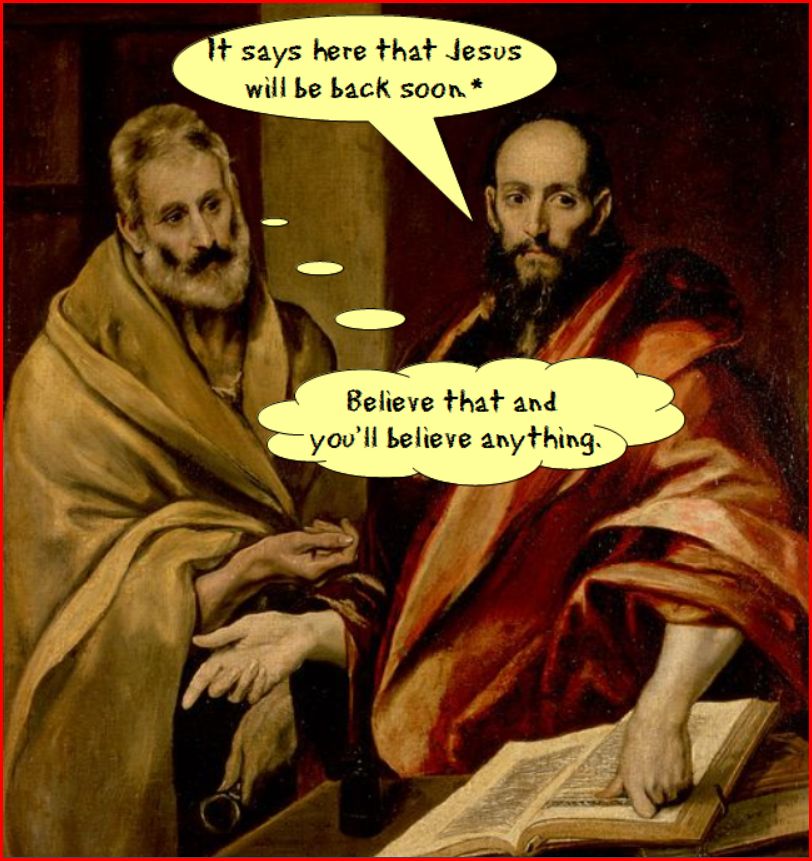
Peter&Paul

* And he should know; he wrote it in 1 Thessalonians 4:17, 5:23 and elsewhere.

When Jesus thought his world had got into such a bad way, he felt sure God would intervene and turn things around. But God didn’t and Jesus was executed instead.

When St Paul became convinced things couldn’t go on as they were, he told everyone that God was going to send Jesus back to Earth to sort it all out. But God didn’t and Paul was executed instead.

When people were accused of witchcraft in the middle ages, they waited for God to intervene and save them. But God was a no-show, again, and 100,000 were tortured or killed as a result.

When millions of Jews were taken to concentration camps in the second world war, they too prayed for God to save them. Once more, he failed to make an appearance and instead over six million men, women and children were exterminated by the Nazis.

When right-wing Christians today complain that the world has abandoned God (because, you know, gay marriage) they feel sure that God will intervene to judge us all and put things ‘right’. So far, he’s conspicuous by his absence.

God is always a no-show, despite the pleas of his followers, despite the earnest belief of his alleged son, despite the plight of his chosen people, despite those today who claim to know his will. Could this be because he has no existence outside the imaginations of human beings?

It surely could; a being that has failed to show himself throughout the history of mankind is a being that doesn’t exist.

Notes:

1) Jesus says God will intervene: Matthew 24:27, 30-31, 34, Luke 21:27-28 etc.

2) Witchcraft figures from An Atheist’s History of Belief:Understanding Our Most Extraordinary Invention by Matthew Kneale, p198

3) While I’ve linked one site that reflects modern Christian belief, there are thousands more of the same sort. Google ‘God will judge America’ for an unhealthy sample.

Christians’ Favourite Delusions 15: The Bible is the ultimate standard for morality

Plucking

Jesus claimed that his morality came from the only scriptures he knew, those Christians now refer to as the Old Testament. Here’s how he puts it in Matthew 5.18 & 19: 

Do not think that I have come to abolish the law or the prophets; I have come not to abolish but to fulfil. Whoever breaks one of the least of these commandments, and teaches others to do the same, will be called least in the Kingdom of heaven; but whoever does them and teaches them will be called great in the Kingdom of heaven’.

Today’s believers like to pretend that they too derive their morality from the Bible. One Christian web-site tells us that ‘the Bible becomes our source of morality because the Bible is the very Word of God in written form.’ Overlooking the fact, for now, that the Bible is not, for a whole host of reasons, ‘the Word of God’, what sort of moral guidance does it provide us with? Here’s a small sample:

Stone to death anyone who works on the Sabbath. (Exodus 35.2 and Numbers 15.32-36)

A slave is his master’s property; if you beat him so severely that he takes a day or two to die, you won’t be punished. (Exodus 21. 20-21)

Kill publicly children who dishonour their father or mother. (Leviticus 20.9);

Stone to death anyone who blasphemes the name of the Lord. (Leviticus 24.16);

Execute a married couple who have sexual intercourse during the woman’s period. (Leviticus 18.19);

Put to death those involved in adultery. (Leviticus 20.10);

Execute any man who lies with another man, as with a woman. (Leviticus 20.13)

Stone to death at her father’s door any woman who is not a virgin on her wedding night. (Deuteronomy 22.13-14 and 20-21).

Cut off ‘without pity’ a woman’s hand if, during a fight, she seeks to rescue her husband by grabbing his opponent’s testicles. (Deuteronomy 25.11-12)

Isn’t this just the kind of ‘morality’ promoted by the Taliban? Well, the good news is Jesus approves! And he’s got some corkers of his own. How about these for great moral teaching?

Wherefore if thy hand or thy foot offend thee, cut them off, and cast them from thee: it is better for thee to enter into life halt or maimed, rather than having two hands or two feet to be cast into everlasting fire. And if thine eye offend thee, pluck it out, and cast it from thee: it is better for thee to enter into life with one eye, rather than having two eyes to be cast into hell fire. (Matthew 18.8 & 9 AV).

So, no, very few Christians today get their morality from the Bible. Their moral sense has evolved, like that of the rest of us, without the Bible’s assistance and without any reference to god. Thank goodness for that, even if there are some who would like to see a return to the kind of moral barbarism the Bible, and Jesus, promote.