I Don’t Believe It

Fabric‘When you think about it’, the taller of the two men said, ‘there is no evidence whatsoever that God, nor indeed any supernatural being.

‘I suppose you’re right’, said the other.

‘With that realisation, my faith began to dissipate. I mean if there’s no God, no angels, demons or Christs, no Holy Spirit, devils, fairies or Santa Claus, then it must mean they’re just figments of the imagination. Take that human element out of the equation and what you’re left with is… well, the natural world and nothing else’.

‘I suppose not’, said the other.

‘From there one realises there is no point in praying – I mean, talking to a being who only exists in your own head. Or reading the Bible; one begins to see it as a very human book, which of course it is’.

‘I suppose so’, said the other.

‘It means too that Jesus can only have been a mortal man – of course he was – and that a good deal of his teaching – if we can believe it really was his and not simply invented by his followers – makes no sense whatever. It was only the eyes of misplaced faith that made it appear so’.

‘I suppose it doesn’t’, said the other.

‘I mean, “pray for whatever you need and God will supply it”. Who has ever believed that sort of thing anyway? No-one. Not really. We all know that doesn’t work; Jesus himself, one suspects. And as for the resurrection, well, if you read those accounts at face value all they saw – Mary Magdalene, Paul and the rest of them – all they saw were visions, not a real person. All in their minds, you see’.

‘I suppose I do’, said the other.

‘No, Christianity is nothing but false promises, failed prophecies – Jesus saying he’d return within his disciples’ lifetime – and impossible morality: “be perfect as your father in heaven is perfect”! Well, I’ve never met anyone who is, Christian or otherwise. Good people are good whether or not they’re Christians and the mean-spirited are mean-spirited whichever side of conversion they’re on.

‘I suppose so’, said the other, before seeing his chance to add, ‘well, that’s £1.80 for your Church Times, Archbishop. Will there be anything else?’

Rejecting Jesus – The Book

RJCoverIt’s a miracle! Rejecting Jesus is now in book form! And on Kindle too.

ScrollWell, not quite – sorry JC.

But you can now read Rejecting Jesus posts in the format the Son of God would surely have preferred if books had existed then the way they do now. The pictures are all present and correct too, in glorious B&W, for all first-century messiahs to enjoy.

Available here and here and also all over the world. Go, buy it, make disciples of all nations.


Christians’ Favourite Delusions 35: Jesus Christ is the same yesterday, today and forever.

LaughAccording to God’s Magic Book (in Hebrews 13.8), Jesus is ‘the same yesterday, today and forever’. Let’s see how that works out in reality:

Yesterday he said the way to ‘inherit eternal life’ was to follow the law and sell everything you had (Mark 17.17-22).
Today, according to his spin doctors, he says you’ve got to believe a magic formula – the one about him dying – if you want to live forever.

Yesterday he despised wealth and possessions (Luke 6.24-25).
Today he thinks they’re just fine.

Yesterday he said this world would end while his disciples were still alive (Matthew 16:27-28).
Today he says these are the end times:

… we’re now living in Romans 1. How do you know when the wrath of God is released? How do you know when the wrath of God is unleashed against a society? First, Romans 1:24, there is a sexual revolution. We’ve had that—in the 60s, the last century. Then there will be a homosexual revolution led by lesbians. The women are mentioned first in Romans 1:26. And then there will be the reprobate mind. And that’s when the thinking is really the product of the sexual, homosexual revolutions, and the thinking is so corrupt we can’t find our way back. That’s where we are. (John MacArthur, We Will Not Bow; all subsequent references to MacArthur are from this same poisoned well)

Yesterday Jesus’ Good News was about the coming Kingdom (Luke 4.43).
Today it’s about eternal damnation:

And the most compassionate thing you can do for those (LGBT) people is, in love, to warn them of eternal damnation—to warn them of eternal judgement. That’s compassionate. That’s compassionate. Preach the gospel; proclaim the gospel; proclaim grace and forgiveness such as we read in Isaiah and 1 Corinthians. But preach judgement. (MacArthur again)

Yesterday Jesus invited people to join God’s Kingdom on Earth (Matthew 6.10; 13.43 etc).
Today he’s made to invite everyone to Heaven.

Yesterday his Good News was only for his own people: ‘I was sent only to the lost sheep of the house of Israel’ (Matthew 15:24).
Today he says anybody can go to Heaven so long as they believe the magic formula. Oh, and aren’t gay.

Yesterday his own people were the Jews (Luke 2.22-32; Matthew 4.23 etc).
Today he’s really only interested in America (to listen to MacArthur and others).

Yesterday he was recruiting slaves for his Kingdom (Matthew 20.27).
Today he wants to be your buddy.

Yesterday he’d nothing good to say about marriage (Luke 20.34-35).
Today he’s all for it (unless it’s same-sex marriage).

Yesterday he had nothing good to say about the family (Luke 14.26).
Today he’s all for it (unless the parents are gay).

Yesterday he had nothing to say about abortion, homosexuality or people changing sex.
Today it’s all he’s interested in (MacArthur and just about every other Christian preacher).

Yesterday he was an itinerant Jewish preacher and failed messiah.
Today he’s a Starman waiting in the sky to zap unbelievers to hell (yup, MacArthur again, quoting 2 Thessalonians 1.7-8).

Like a ventriloquist’s dummy, Jesus just says whatever his self-appointed spokespersons want him to say. Pliable and malleable, he can be made to match the needs of anyone who recruits him to their spiritual, moral or social crusade. He is all things to all people and what he’s like today is nothing like what he was yesterday. Which doesn’t say much about ‘forever’.

And the World Turns

SerpentOver at the wackily named ‘Cripplegate‘ blog, pastor Mike Riccardi has an urgent message. Mike, in case you’re wondering, is the Pastor of Local Outreach Ministries at Grace Community Church in Los Angeles. He also teaches Evangelism at The Master’s Seminary. His urgent message is that God is not happy and must be appeased.

As we already know, the most powerful, creative and omniscient being in the whole of the universe and beyond is so very easily upset. And as usual what’s upsetting him is the Gay. But that’s not all this time! Turns out he doesn’t like people changing sex and abortion too. The only way we can put things right with this petulant monster, pastor Mike tells us, is to preach and pray all the bad away, so that he will bless us – well, America anyway, which is all Mike is really concerned about – instead of punishing us.

God likes more than anything else to mete out punishment for the slightest infringement of his rules, even though he neglected to tell us what he thought of transgenderism and abortion when inspiring his Magic Word™. You will search in vain for mention of either in the Bible, or anything like them, so it’s a good job we’ve got pastor Mike to tell us what God really thinks. He ‘processes’ it thus:

these checkpoints of moral degradation – transgrenderism (sic), homosexualism and the destruction of marriage, and abortion – all stem from the same polluted fountain out of which even the first sin flowed: self-deification.

It’s because we want to be like God, Mike concludes, that we are morally polluted. Work that one out if you can.

Haven’t we been here before? We sure have. Go back 50 years and God’s emissaries on Earth warned that if we (i.e. the United States again) accepted inter-racial marriage, it would be the end of civilisation because – yes, you guessed – it was against God’s rules. His wrath should have rained down on everyone once inter-racial marriage passed into law, but for some reason it didn’t. Just as it didn’t when same-sex marriage became legal a little while back. Just as it didn’t because of feminism. Just as it didn’t over the devil’s music, rock and roll (still upsetting Christians and their God even today.) Just as it didn’t when Jesus told everyone that judgement was nigh two millennia ago. Just as it didn’t when the prophets of doom in the Old Testament insisted it would (for example in Jeremiah 23.10-12). Just as it didn’t when primitive humans sought to explain why the harvests had failed.

Always, it was that God or the gods were angry and would punish us if we didn’t mend our ways. “But,” you say (just like Pat Robertson), “disasters and calamities do follow our ‘disobedience’ and ‘degradation’”. Of course they do, and they precede them too, but that does not mean the one causes the other. There is no correlation between our supposed ‘moral pollution’ and natural disasters. The latter are random and indiscriminate events, not divine punishment.

It is a favourite occupation of human beings generally and those of a religious disposition specifically, to assume a higher power will punish us, in this life or the next, if we don’t adjust our behaviour and stop doing what it doesn’t like. This is usually – by pure coincidence – what the religious themselves don’t like. As a result, it’s not all of us the deity is keen to judge, only those who don’t believe the same things as the Saved.

God’s favour is always conditional; not only on whether we have faith or carry out rituals that are pleasing unto him or dress appropriately (or grow straggly beards) but also on how we behave – whether we’re ‘morally polluted’ or ‘degraded’ and whether we regard ourselves, consciously or otherwise, as God. And you thought it was only about believing in Jesus.

And so the Righteous Ones direct their prayers up into the void (saying what, I wonder?) with words that never leave the room, or, sometimes, even, their own heads. No-one is listening. There is no-one there to listen. This same not-there, not-listening human creation is not angry with us because some people are attracted to their own sex or have abortions or change gender. Just like it was not angry about all of those other things we were told it once was. Just like it is not upset about poverty, injustice and cruelty, even though these were the concerns of Jesus, if not his present day followers. Meanwhile, not much changes here on Earth, unless we change it ourselves.

We can expect the next Jeremiah along soon, to tell us how offensive we all are to his make-believe god.

Amazing Grace’s Problem Page

Woman2Dear Grace,

Please help. I don’t know if my husband loves me. He says he does. He say he loves more than anything else, but very often the way he treats me makes me wonder. I can’t do anything right. He delights in telling me off and sometimes he hits me. I feel very unloved.

He likes to call me terrible names, like ‘worthless worm’, and says he feels nothing but contempt for me. He says that if I don’t do exactly what he says he’ll make my life a misery. He makes me grovel for his forgiveness and tells me I deserve to be punished for the way my family upset him way back when. I wasn’t even there so this hardly seems logical, let alone loving.

He insists that unless his interests come first in our marriage and in absolutely everything we do, he’ll put me through hell. He doesn’t want me to have life of my own and tells me unless I change to become more like him, he’ll abandon me.

I can’t bear the thought of his not approving of me and am frightened he’ll leave me if I don’t do what he says. So, Grace, can you tell me; does he care for me? Is this really love?

Yours,

Bridie

Grace replies: Of course he loves you, you silly bitch. Do you think I don’t recognise who you’re talking about here? Talk about ingratitude! You owe your husband everything. So what if he treats you like shit? He does everything for you and all he asks in return is you show him a little undying devotion. Quit your whingeing, get down on your knees and give him the adoration he so obviously craves.

When it’s Gone, it’s Gone

JudgementAs you’ll see in comments to previous posts, Christians like to encourage gambling. Recycling Pascal’s wager, they say things like ‘if I am wrong then I have based my life on a false premise and have ceased to exist. I won’t even have the opportunity to express regrets. However, if you are wrong, having rejected Christ, you, sadly, will have quite a while to weep, wail and gnash your teeth.’

The old faith-as-insurance-policy argument. Rather like the Chance card in Monopoly that lets you avoid jail, it offers you the chance to escape hell, where all this gnashing is supposed to occur, by the simple expedient of holding a particular set of beliefs in your head.

Surely this hedging of bets doesn’t impress God, the supposed creator of the universe, Father of mankind and judge of all the Earth. He won’t really be taken in, will he, on that great and dreadful Judgement Day when we admit, ‘actually, I only believed in you so you wouldn’t send me to hell’? Maybe he will, being a God without discernment or insight. It’s certainly all that evangelical Christianity has to offer – just ask my preacher friends – a Get Out Of Hell Free card. Which is a long way from what Jesus taught about the coming Kingdom and how to be part of it; not, in his case, by believing the right things but by doing them (Matthew 25.31-36).

What if I am wrong, though, as Christians think? Then I could be in trouble. But so might they; they could find they’ve gambled on entirely the wrong God (curse you Pascal for not thinking of that!) and find themselves up before Allah or Vishnu once they’ve miraculously survived death. ‘Wrong God, mate,’ Allah will have to tell them: الله خطأ، تتزاوج . What then?

And given that they think eternal life awaits them, why are so many Christians fearful of leaving this life? Could it be because they’re not convinced that the gamble is going to pay off? They know intuitively that this life is the only life they’ll be getting – and that when it’s gone it’s gone, as it says in Poundland. That will be why they mourn their brothers and sisters in Christ who ‘pass away’; “sorry to hear about your loss,” they say, when according to their magic betting slip it’s no loss at all but an immortal gain.

So I’m confident I’m not wrong. The odds are in my favour; the evidence is on my side. Consider, if you will, Christians:

  • Every single human who has ever lived has died, or will die, and has ceased to be in their entirety;
  • No human has ever lived again after death (not even Jesus who wasn’t, according to you, properly human anyway and so doesn’t qualify.)
  • No human has ever lived forever;
  • There’s nothing on the other side – no judgement, no Heaven, no Hell, no eternal life – because there is no ‘other side’.

If any of you would like to demonstrate that these assertions are wrong, please do. All I ask is that you bear in mind that insisting they’ll happen at some point in the future because the Bible says so, is not evidence; it’s wishful thinking. Which is pretty much where we came in.

All is vanity.

All is Vanity

DaleThe idea that human beings can live forever is a very old one, being part of a number of ancient religions. The Egyptians, for example, believed there was an afterlife and that where you spent it was determined by a post-mortem judgement. Christianity would later embrace similar notions of judgement and everlasting life.

The idea is, however, largely absent from Judaism. Ecclesiastes in the Christian Old Testament (‘Kohelet’ in Judaism) has this to say about death and its aftermath:

I said in my heart with regard to human beings that God is testing them to show that they are but animals. For the fate of humans and the fate of animals is the same; as one dies, so dies the other. They all have the same breath, and humans have no advantage over the animals; for all is vanity. All go to one place; all are from the dust, and all turn to dust again (Ecclesiastes 3.18-20).

This seems to me to be an entirely realistic, if somewhat pessimistic, view of life and death. (And humans as animals! Today’s believers still have trouble accepting this, even when their holy book spells it out for them.) Later writing – the book of Daniel, for example – begins to toy with the idea of eternal life, but it isn’t until we get to Jesus’ time that the idea really takes off.

As the writer of Ecclesiastes knew, and as I suggest here, there is no evidence we survive death. Death would hardly be death if we did. The dessicated bodies of those Egyptians, mummified so their ‘owners’ could reclaim and re-use them on the other side, are still with us. There’s no evidence either that a special part of us – a soul or spirit – makes the transition. In any case, this is a predominantly pagan idea and is not what the New Testament offers. Both Jesus and Paul are firm believers in bodily resurrection here on the Earth.

The desire to live beyond the brief few years that our physical bodies last is understandable. It’s hard to imagine that one day every single one of us will no longer exist, that our consciousness, personalities, thoughts, memories, emotions – everything that makes us who we are – will simply no longer be. That’s why, I suppose, people in the past rebelled against that inevitability and fantasised about a continued existence once this one came to an end. Eventually religions came to offer such compensatory life-after-death, provided of course suckers people believed the right things.

Such is Christianity.

When you think about it, what a truly absurd notion it is; that believing in a magic formula will defeat death and enable you to be resurrected on the Earth to live in God’s new Kingdom here, or (when that didn’t quite pan out) taken up to Heaven to live there. All you have to do is believe the right things and God will do this for you. Death will be defeated by the simple expedient of your belief. We’re so used to the idea after 2,000 years of Christianity that the absurdity ceases to register – but absurd it surely is.

to be continued


Invasion of the Body Snatchers

PissImagine the outcry there would be from Christians if having decided to hold an open-air service, a group of atheists turned up and started shouting through tannoys at them as they attempted to enjoy their celebration. Imagine those atheists shouting ‘Hypocrites!’ and ‘Losers. You need to come to your senses!’ Imagine if they said they were only doing this out of love to break the spell the Christians were under, the spell of religion. Imagine they held up signs the entire time with text inspired by Richard Dawkins and Christopher Hitchens, like ‘Free yourself from your God Delusion’ and ‘ Religion Poisons Everything’.

Yes, imagine the outcry; the Christians would see themselves as persecuted by ‘militant atheists’ out to spoil their day. And, who knows, perhaps they’d be right, though perhaps persecution is overstating it, though we all know Christians like their martyrdom. So long as it doesn’t entail any actual… erm… martyrdom.

This didn’t happen at the weekend in my home town – I doubt it happens anywhere – but pretty much the opposite did. A bunch of Christians, complete with loud speakers and placards with scripture verses on them, turned up at the Gay Pride celebration in the centre of town and proceeded to tell those out to enjoy their day that they were sinners in need of Christ and his salvation. They kept this up, because, they said, they loved the people whose afternoon they were trying to disrupt, for at least two hours. These were not members of a local church; according to the young man I spoke to they had come from various parts of the UK and from the States specifically to interfere with the event, or ‘preach the gospel’ as he put it.

The LGBT people at the Pride were having none of it, of course, and drowned out the tired old rhetoric with whistles and good natured chanting until the Righteous Ones accepted the futility of their mission and packed up to go home… but not before they transplanted themselves near the stage to show off their signs again.

Now, how is this different from the scenario we started with?

Christians would object if others gate-crashed their events and attempted to disrupt their celebrations; yet they think they have the right to do just that to others, with their message of hell and damnation. They’d cry ‘persecution’ and see the same kind of actions as militant (when they have no idea what the word ‘militant’ actually means) and part of an ‘anti-Christian agenda’, if it was they on the receiving end.

It’s Christians themsleves who have the agenda – to judge, impose on and convert those with different beliefs and philosophies. They think they have special knowledge of The Truth that no-one else has and which has never been heard before when all they really have is a superstition, a belief in a sky god and magical incantation, much like any other superstition. Even if this weren’t the case, even if their beliefs were what the Christians think they are, that does not give them the right to exercise their arrogant, shouty agenda by rudely imposing themselves on others’ special days.


Update: Evangelist Dale Mcalpine says it wasn’t his merry little brand of preachers that invaded Pride. Oh no. According to Dale, a bunch of irresponsible LGBT people tried to spoil a bona fide Christian event that just happened to be going on nearby at the same time.

These people’s self-delusion knows no bounds.


Idiotic Stuff Jesus Said 12: My words will never pass away

AndersonThe premise of my first ‘Jesus’ book* is that while Christians profess to believe in Jesus, they choose to ignore most of what he taught while he was alive. While they claim a vapid super-hero Christ as personal saviour, they replace what the human Jesus had to say with words of their own choosing. In reality, they have about as much time for Jesus’ ‘eternal words’ as the average non-believer or atheist. You don’t have to look very far to see how much his words have already ‘passed away’:

Jesus said, ‘Don’t judge so that you won’t be judged’ (Matthew 7.1). Our representative Christian says, ‘LGBT people are filthy and wrong.’

Jesus said ‘Love your enemies, pray for those who persecute you’ (Matthew 5.44). Our representative Christian says, ‘I’m gonna pray a transgender person dies and goes to Hell.’

Jesus said, ‘Love your neighbour as yourself’ (Mark 12.31). The Christian says, ‘The way to show love is to tell other people they’re going to Hell.’

Jesus said, ‘sell all you have and give to the poor’ (Mark 10.21). The Christian is concerned about where to buy jewellery: ‘…somewhere other than Tiffany’s, because Tiffany’s is gay friendly.’

Jesus said, ‘Forgive those who sin against you so you can be forgiven yourself’ (Matthew 6.14). Our believer rants, ‘LGBT people should be executed.’

Jesus said, ‘Don’t commit adultery and don’t get divorced’ (Matthew 5.27-28 and 19.9). Significant numbers of Christians , including our own Stephen Green, say, ‘that doesn’t apply to me.’

See what I mean? Christians regard the words of their saviour, not as having everlasting value, but as if they’re nothing more than worthless bits of fluff. Even if God were real, every word of the Bible true, every aspect of the Great Salvation Plan genuine, it wouldn’t change the fact that believers treat as optional almost everything Jesus commanded and live as if he never had.


* Why Christians Don’t Do What Jesus Tells Them To …And What They Believe Instead is available from Amazon worldwide (UK here, US here) but not, alas, from Tiffany’s.

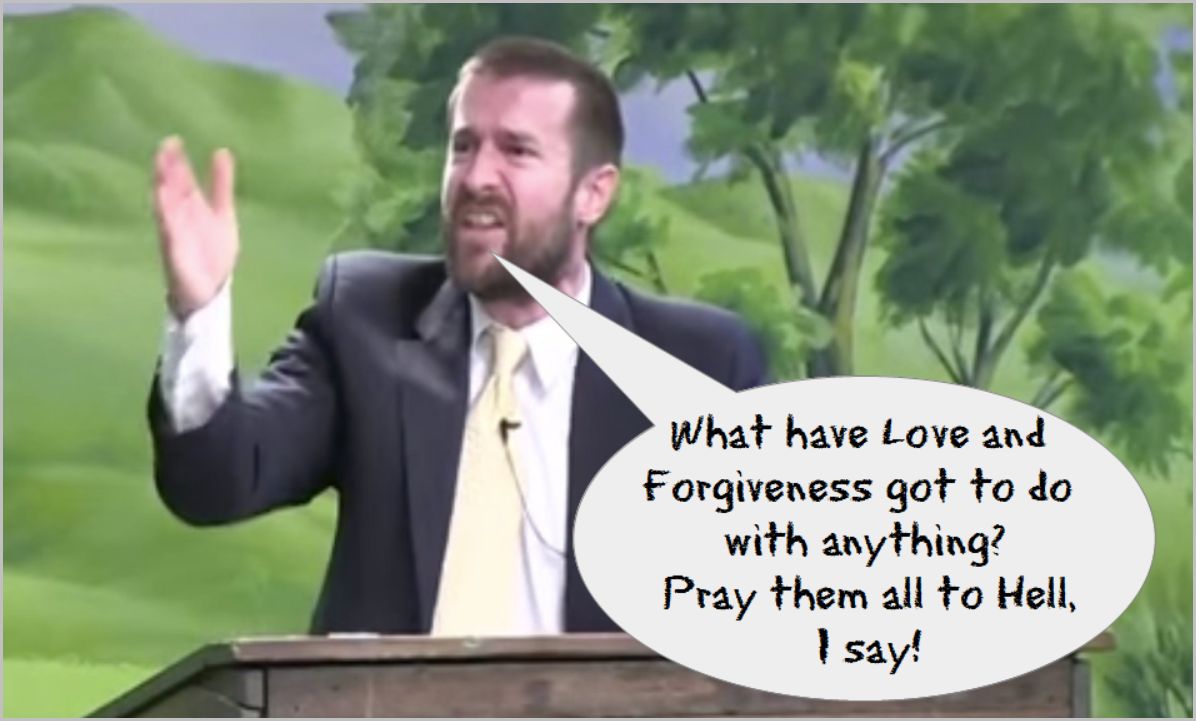
The picture shows the deplorable Pastor Steven Anderson (linked above). He knows better than Jesus ever did.


Idiotic Stuff Jesus Said 11: Build Your Lives on the Things I Say

WhoDoJesus demanded you base your life on his teaching. It’s the only way, he said, that you’re going to find meaning, as well as the principles you’ll need when the going gets tough:

Everyone then who hears these words of mine and acts on them will be like a wise man who built his house on rock. The rain fell, the floods came, and the winds blew and beat on that house, but it did not fall, because it had been founded on rock (Matthew 7.24-25).

And what exactly were those words of his? Here’s what he taught:

  • The Son of Man was coming to the Earth to establish God’s Kingdom within the lifetime of his original followers (Matthew 16:27-28; Matthew 24:27, 30-31, 34; Luke 21:27-28, 33-34);
  • His own people needed to be more ‘righteous’ in order to be part of this Kingdom (Matthew 5.20; Matthew 6.33; Matthew 13.49 etc);
  • Being righteous entailed some extreme behaviour; loving your enemies, giving away all you had, turning the other cheek, forgiving repeatedly, being perfect (Matthew 5.44; Matthew 5.42; Luke 6.29; Luke 6.37; Matthew 5.48; Matthew 19.21);
  • It was crucial to obey Jewish law, even if some of it could be reinterpreted (Matthew 5.17-18; Matthew 12.1-7);
  • Once the Kingdom arrived Jesus himself would be King of the world, aided and abetted by his pals (Matthew 19.28; Luke 22.30);
  • His followers would do even greater miracles than he did himself. Given he controlled the weather, healed the sick and raised the dead, that’s going some (John 14:12).

Anybody know anyone who believes all of this or lives this way? Anyone who operates on these exacting principles? I don’t know of anyone and never have. I didn’t even when I was Christian myself. Jesus demands are impossible. No-one can live according to them. ‘Of course not,’ say Christians. ‘You need supernatural help to live like this.’ So why don’t they, when they have God’s spirit living within them (John 14.16-17)? Why don’t we see Christians who perform spectacular miracles, who constantly go the extra mile, who give away everything they have, who are, as Jesus tells them they should be, perfect?

We don’t because no-one can live as Jesus insisted they should. Nor do we see Christians who believe his prophecies either, particularly the one about the Son of Man bringing God’s Kingdom to Earth two thousand years ago. Christians pretend he didn’t really say it, or if he did, that he meant something else entirely. They’ve changed his very words – the ones they should be building their lives on – to claim Jesus himself will be returning any time now (the synoptic gospels are confused about whether Jesus is this Son of Man, or someone else). When he does, they say, true believers will be going with him to Heaven. Never mind that Jesus teaches nothing of the kind and there’s absolutely no foundation for these beliefs in his words. As such, they’re the faith built on sand he tells them is worthless:

And everyone who hears these words of mine and does not act on them will be like a foolish man who built his house on sand. The rain fell, and the floods came, and the winds blew and beat against that house, and it fell—and great was its fall! (Matthew 7.26-27).

So, if Christians don’t do what Jesus tells them and don’t believe his promises or prophecies, then in what way can it be said they take his words as the foundation of their lives? Don’t they, rather, base them on Paul’s teaching, about a supernatural Christ who bears little resemblance to the zealous Jewish preacher they pretend is their ‘Lord’? Teaching that has nothing to do with that of the man who demands his pronouncements be the very basis of life? Paul doesn’t quote any of Jesus’ teaching.  The foundation Jesus speaks of is of no interest to him; so, naturally, this is whom Christians follow – not Jesus, but Paul and his mythical Christ.

Christians have no time for Jesus’ words – and who can blame them? All he offers is impossible morality, false promises and failed prophecies. Far better to go with what Paul offers, because that’s about what’s in it for them. But even Paul didn’t believe anyone was going to Heaven, so they ignore that bit in his teaching too.