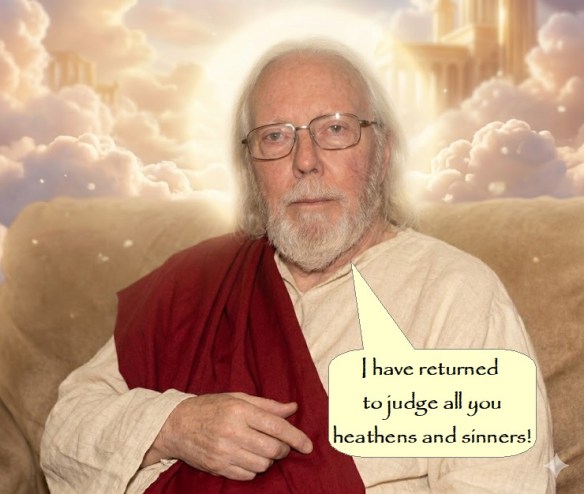
The Anunciation: A Ghost Story for Advent

The Nativity in Matthew and Luke begins long before Jesus’ birth. Matthew introduces Mary and Joseph once the former has been impregnated with The Holy Sperm. He doesn’t go into any detail about how this happened, he just drops in, in Matt 1:18, that the deed is done. Mary has had sex with a ghost.

This isn’t good enough for Luke though, who after reading Matthew’s tall tale, decides it needs some expansion. A lot of expansion, in fact. He takes the story back to before Mary’s non-consensual encounter with the Holy Spirit and picks on Elizabeth and Zechariah, an elderly couple well past the age of having kids. All the same, they do enjoy a tumble in the sack every now and then, and the Lord – ever the voyeur – decides he’ll bless one such union with fruitfulness. (There is much wrong with the details of this unbelievable yarn, some of which I consider here; I won’t reiterate them now for fear of awakening any amateur theologians who might be lurking here in the wings.)

Suffice to say, Luke – for it is he, lest we forget, who is making this stuff up – decides that Elizabeth is a long lost cousin of Mary’s, like in one of those soaps where long lost relatives pop up all the time, usually to no good end. In this particular episode, however, all goes well and Mary visits Elizabeth, whose baby is, in a strange twist of fate, destined to be John the Baptist from the earlier two gospels. In this story his embryonic self jumps for joy inside his mother once he realises his uterine Saviour has come to visit.

But were getting ahead of ourselves. First Mary has to go through the rigmarole of getting pregnant. Obviously as a good Catholic girl she can’t have sex with her betrothed prior to their wedding and just when she’s considering when that might be, an angel appears unto her. It’s Gabriel who has quite a bit to do in the Nativity story as a whole. As angels do, he annunciates to Mary all about the pregnancy part of the plot and she acquiesces to the Lord getting her with child by magically transferring his seed into her womb. I’m guessing it was by magic. It’s possible some sort of actual rumpy-pumpy occurred but Luke delicately passes over the intimate parts. As apparently the Holy Spirit does too.

Mary is so overjoyed to be pregnant before her 13th birthday that she bursts into song on the spot and spontaneously produces a hymn based on the Psalms and the future teaching of the baby she has only just conceived. It’s hard to believe that no actual time travel was involved. It is instead, a miracle, as her impromptu ditty flourishes into the literary masterpiece now known as The Magnificat, which is not, it turns out, a feline super-hero. Fortunately, she can remember it all, word for word, decades later when Luke decides he needs to invent record it. Honestly, the whole thing puts Cole Porter to shame.

You’d think then Mary would dash off to tell her betrothed, Joseph, the wonderful news that she is pregnant without his or any other man’s assistance, but Luke makes no mention of it. Luckily, it’s covered by Matthew, where an angel drops in on Joseph, a person of great gullibility faith. On hearing what the angel has to say, he swallows the story hook, line and stinker.

Then it’s back to where we came in. Mary’s sets off down the road to see the cousin, the wonderful bearer of John. She pitches up there for three whole months, perhaps to avoid Joseph, who, it turns out, was not as gullible as she thought.

**********************************************

Honestly, this is really what happened. Would I lie to you? No, but someone would, and did. We’ll see what else he has in store in his over-worked imagination, next time.

**********************************************

PS. Don, I know you like indulging in a bit of biblical exegesis. If you’d like to borrow this totally respectful effort for your blog, get in touch and we’ll work something out.

Do You See What I See?

Christianity with its visions of God, angels and resurrected god-men, is not distinctive. It emerged from a culture in which such epiphanies were commonplace and highly esteemed. Appearances of deities, other supernatural beings and dead people were valued as genuine encounters with a reality on the other side of this mortal life. Paul was a Hellenised Jew and a Roman citizen (if Acts 17 can be believed); it was perfectly natural for him and his contemporaries to see and hear things that weren’t there.

Not only was the fledging Christ-cult influenced by the superstitious culture around it, but was born too of Judaism, itself awash with visions, apparitions and revelations. How could the new religion fail to be when its originators existed in such a milieu. One or other of these ‘visionaries’ believed they’d seen a resurrected Jesus. Of course they did. This is how gods manifested themselves then; everyone knew it. There were even those who hadn’t really had any inner-visions but wanted to be regarded as mystics themselves so would pretend they too had had direct contact with the deities.

The human mind has always been susceptible to illusions, to the potency of dreams and to misinterpreting what is going on around it. It’s also prone to a spot of fantasising now and then. This propensity didn’t cease once Christianity established itself. Muhammed claimed to have been visited by angels who revealed new truths about the nature of God – not least a change in name.

In the 19th century, a young farmer, Joseph Smith, living during a widespread and particularly intense religious revival, imagined (or pretended) he’d been visited by God and Jesus. Later, he said he’d been visited by a hitherto unknown angel with the unlikely name of Moroni. The result of course was multiple wives for Smith and the foundation of the Church of Jesus Christ of Latter Day Saints. Sufficient numbers of people believed Smith’s cockamamie stories about his alleged visions to commit to Mormonism. Smith wasn’t alone; others had visions of deities, including but not restricted to the Big Two, Jesus and his Father God. Hundreds recently saw the Virgin Mary hovering above New York City. They couldn’t all be wrong could they? Of course not, but they were all be deluded. Just like Joshua Mhlakela whom Jesus appeared to and told him the date of the Rapture was 22nd September, or possibly the 23rd, then with ‘billion percent’ certainty 7th October. Or maybe 8th…

This is how religions are made, changed and adopted: on a bed of illusory sand. If we need any further evidence that such experiences are illusory, created by the mind itself, then consider this: each time God, his angels or his Son appear in the religion-soaked brains of mystics and fraudsters, they reveal a message at odds with that revealed to previous visionaries. Each revelation has to be different of course. There would be no reason for such ‘visits’ otherwise.

Hence Abraham (or his script writer) imagining YHWH promising an eternal covenant and a new land.

Moses (or his script-writer) claiming YHWH had issued new laws while at the time commanding the slaughter of tribal enemies.

Cephas thinking he’d seen a risen Jesus who may or may not have told him of the imminent the End of the Age.

Jesus himself reportedly talking with his ‘Father’ about the necessity of his execution.

Paul flying to heaven so that Jesus could explain in great detail a new covenant, negating the original ‘eternal’ covenant with Abraham.

John of Patmos envisaging Jesus coming to Earth to slaughter the enemies he purportedly instructed his followers to love. (And Christians claim the Bible presents a unified message!)

All of these are manifestations of, and within, the minds of fantasists. Such manifestations are a naturally occurring malfunction of the brain.

And so it continues. Beware anyone who claims to have seen or heard from a deity of any sort. They, like their biblical counterparts, are deluded and almost certainly ill.

The Day After The Rapture

Are you still there?

Either the rapture didn’t happen or there aren’t many True Christians round where I live. I watched all day for them jetting into the sky to meet Jesus but didn’t see a single one.

What went wrong? That South African preacher Joshua Mhlakela who saw Jesus surely can’t have been mistaken. Jesus told him clearly that yesterday, or maybe today, would be when he’d be back to collect his Chosen and judge the great multitude of sinners. I even turned on the TV last night to see if it had happened elsewhere. I thought the Final Judgement was underway with some dude ticking off the UN. Turned out just to be some big orange guy, not Jesus in disguise.

So what now? I think I can guess. Jesus’ message to Joshua Mhlakela will be reinterpreted: it wasn’t that the Rapture was going to happen yesterday, or today. It’s the events leading up to the rapture that he promised would kick off this week. That’ll be it. The Rapture itself is still some time off, as it always is.

Mhlakela’s vision of Jesus was no different from the ones the earliest Christian believers had: those character with fake names like Peter and Paul. Dismiss the good pastor’s vision of the Lord and what JC purportedly said and you have to dismiss the visions of those early fanatics who operated under aliases. Visions, dreams and hallucinations have no bearing on reality, as Mhlakela and the thousands who believed him have demonstrated yet again. Christianity and many other faiths are founded on such imaginings. As Luke puts it in Acts 2:17 during ‘the Last Days’ of 2,000 years ago:

And it shall come to pass in the last days, says God, that I will pour out of My Spirit on all flesh; your sons and your daughters shall prophesy, your young men shall see visions, your old men shall dream dreams (misquoting Joel 2: 28-29)

This is the basis of the Christian delusion, and every other.

I Wish We’d All Been Ready

Holy cow!

This is a special, urgent post!!! I just learnt to today, courtesy of Joe.My.God that tomorrow is the date set for the Rapture. In case you didn’t know, I need to warn you to give you time to repent and turn to Jesus. We know the rapture’s going to happen this time for sure because a pastor in South Africa was visited by Jesus a couple of nights ago who told him he was definitely returning tomorrow, 23rd September, at the time of the Jewish Feast of Trumpets (me neither). Charlie Kirk’s martyrdom has something to do with it too:

I’m sure these three signs together can’t be wrong, which means the Rapture is going to happen tomorrow as an absolute certainty.

Here’s how the UK’s always reliable Daily Mail reports it:

An ancient Biblical event in which Christians disappear from Earth and those who remain are left to face Doomsday is believed to be just days away.

Claims by social media users, as well as respected pastors and rabbis, have pushed the idea that the Rapture will begin on September 23, marking the Second Coming of Jesus and Judgment Day for non-believers.

This year, September 23 falls during the Jewish Feast of Trumpets, also known as Rosh Hashanah, but some Christians have tied the holiday to the prophecy that Jesus will return to Earth ‘with the voice of the archangel and with the trumpet call of God.’

The prophecy is mentioned in the Bible, 1 Thessalonians 4:16, which states that even the faithful who have died will rise from their graves and be taken to heaven by Jesus; however, a date for this event is not given.

In a YouTubevideo viewed nearly 500,000 times, Pastor Joshua Mhlakela, a South African preacher, claimed Jesus appeared to him in a divine vision and said he would return during the Feast of Trumpets.

‘The rapture is upon us, whether you are ready or not. I saw Jesus sitting on his throne, and I could hear him very loud and clear saying, I am coming soon,’Mhlakela said during the interview with CettwinzTV.

‘He said to me on the 23rd and 24th of September 2025, I will come back to the Earth,’ the pastor declared.

Even more clips predicting the imminent return of Jesus this month have been viewed hundreds of thousands of times in the last week alone.

If you can’t find it in yourselves to welcome Jesus into your hearts as Lord and Saviour then you’ll have to gird your loins for what happens next. Something dire I feel sure. Judgement and a millennium of despair or some such. It might not be too bad though, once the Righteous Ones are out of the picture.

Whichever, I’ll see those of you who are still around come Wednesday when we can discuss what we’re gonna do!!! This blog isn’t going to be of much use any more, that’s for sure. Those of you who’ve decided to head heaven-bound meanwhile, enjoy the trip and don’t forget to write.

Dear Christian…

I’m seriously considering converting but need some help figuring what I should believe. Can any Christians out there help me out?

1. As a Christian, what will happen when I die? Will I –

a) Go immediately to heaven like my pastor says;

b) Go into suspended animation until Christ’s coming and the final judgement, as it says in 1 Thessalonians 4:13-16;

c) Just cease to exist like my atheist friends tell me?

2. Can you clear up for me how long was Jesus in the grave?

a) Was it about 36 hours (Friday evening till early Sunday morning);

b) Three whole days like he predicts in Matthew 12:40;

c) Was he not really in the grave but down in hell like it says in the Apostles’ Creed?

3. Where can I find information in Paul’s letters about

a) Jesus’ miraculous birth;

b) Jesus’ parables, teaching and miracles;

c) The Empty Tomb?

4. How often did Paul refer to Jesus’ second coming?

a) In all of his letters

b) 2 or 3 times

c) Never

5. Can you tell me how often Jesus referred to his second coming? Was it –

a) Once or twice;

b) Frequently;

c) Never because it was someone called the Son of Man who was going to come?

6. Can you clear up my confusion about when Paul says the Messiah will be coming to the Earth? Is it –

a) While Paul was still alive;

b) Thousands of years later;

c) Any day now?

7. When did Jesus say this Son of Man would be coming to the Earth?

a) He didn’t

b) Thousands of years in the future

c) While those he was talking to were still alive

8. What is the Word of God? I’ve heard the term used for –

a) The Bible

b) The Church

c) Jesus

9. Help me out: which was written first?

a) Mark’s gospel

b) Acts of the Apostles

c) Paul’s letters

10. Can you clarify what it’s referring to when the Bible talks about ‘the Scriptures’?

a) Ancient Jewish writings;

b) The whole of the Bible as we now know it;

c) The New Testament.

11. How does the New Testament writers prove Jesus was the Messiah?

a) By claiming the scriptures predicted he would be;

b) By pointing to his miracles;

c) By quoting things he said

12. How would Jesus want me to spend my time?

a) By witnessing to atheists on the internet;

b) By worshipping him;

c) By feeding the hungry, healing the sick and helping the weak

(I know which I’d prefer.)

Flourishing

The solution to all our problems is to return to God.

How many times have we been told this recently? It seems here in the UK that hardly a week goes by without a new book, report or high-profile article appearing advocating a return to ‘Christian values’ or acknowledging Something Greater Than Ourselves (invariably the Christian God). This, it invariably assures us, is the only way to bring us back to our senses and solve all our problems. Even previously atheist/agnostic writers – Richard Dawkins, Douglas Murray, Tom Holland, Jordan Peterson, Aaran Hirsi Ali and Russell Brand (how’d he get in here?) – suggest that Christianity must be revived to prevent the vacuum created by its decline from being filled by the less humane Islam.

I’ve written about this fallacy before – here and here – so won’t go over the same ground again. Instead, I want to highlight a recent report, The Global Flourishing Study, carried out by Harvard University and funded primarily by the Templeton Foundation. Alarm bells! The Templeton Foundation is a religious organisation, so already the study’s conclusions are thrown into question. What were participants asked? What was their background? What bias did the questions convey?

Not surprisingly then, the study concluded that many people in the world are not flourishing and that those who are, are flourishing – surprise, surprise – largely as a result of religion:

Religious service attendance was one of the factors most consistently associated with present or subsequent wellbeing, across countries and across outcomes.

Religious groups have leapt on the conclusions as evidence that humans need God to live fulfilling lives. The key word here, however, is ‘attendance’. The study itself acknowledges that human community – being with other, like-minded people with a common interest or cause – is a significant aspect of the resulting flourishing. But we knew this already so maybe the $43.4 million spent on the study might have been better spent: feeding the hungry, perhaps? An earlier 2017 study also by Harvard was headlined:

Harvard study, almost 80 years old, has proved that embracing community helps us live longer, and be happier.

Numerous other recent studies have reached this same conclusion (see here, here, and here for more).

The god factor injected into Harvard’s more recent study to satisfy the Templeton Foundation and its affiliates is further complicated by the fact that there isn’t only one god involved in making us all feel jollier. There are currently thousands in use throughout the world (the internet is unable to provide an actual figure, however approximate). Thus, those who congregate in the mosque to praise Allah enjoy the same ‘flourishing’ as those who meet at the synagogue to worship Yahweh. Likewise, those who come together to worship Brahman experience the same benefits as those who gather to praise Jesus. Not because any one of the gods in question is the real one – they can’t all be – but because the participants are worshipping and serving together, collectively as a community. That is where the ‘blessing’ comes from. The innumerable gods involved are incidental. Indeed, each is dismissed, if not held in contempt, by the adherents of the others.

In the end then, what enables us to flourish and live longer healthier lives is company – human company. This doesn’t require a church, mosque, synagogue or temple. There are other, superstition-free ways: time spent with family; volunteering with others; joining a drama/bridge/walking/sports/writing/LGBT (worked for me) /whatever-you’re-interested-in group. The song from Funny Girl gets it right: ‘people who need people are the luckiest people in the world’. Of course other people can be frustrating (present company excepted) but unlike the gods they’re real and provide the companionship, fellowship and company we need to thrive. As ever, no God required.

Jesus outside the New Testament

So what about other 1st century writing? Doesn’t this provide extra-biblical evidence for an historical Jesus?

The Jewish historian Josephus wrote his Jewish Antiquities around 93/94CE. In the section known as the ‘Testimonium Flavianum’, he appears to talk about Jesus in glowing terms:

Now there was about this time Jesus, a wise man, if it be lawful to call him a man, for he was a doer of wonderful works, a teacher of such men as receive the truth with pleasure. He drew over to him both many of the Jews, and many of the Gentiles. He was the Christ; and when Pilate, at the suggestion of the principal men amongst us, had condemned him to the cross, those that loved him at the first did not forsake him, for he appeared to them alive again the third day, as the divine prophets had foretold these and ten thousand other wonderful things concerning him; and the tribe of Christians, so named from him, are not extinct to this day.

I’m not here going into great detail about why many scholars believe this to be an interpolation; suffice to say they do. A later Christian added the entire passage in the middle of an account Josephus is relating about Pontius Pilate that has nothing to do with Jesus. It employs language and a style alien to anything else Josephus wrote and appears to be a rewrite of the appearances of the resurrected Jesus on the road to Emmaus in Luke 24:13-35. None of it is testimony to any Earthly Jesus.

Josephus’ apparent second reference to Jesus is in a later section of Jewish Antiquities. There he relates a story about the execution of a certain James who happens to have a brother called Jesus. Unfortunately, despite the two names corresponding to gospel characters, the two are, as the context makes clear, two entirely different people. This James is a Jewish High Priest who, Josephus mentions incidentally, had a sibling called Jesus. They lived at a later time. Unfortunately, at some point, a scribe or someone else added the phrase, ‘called Christ’ after the second mention of this Jesus. This may have been accidental when a marginal note (who wrote it and why?) was transferred to the main text. This Jesus is not remotely ‘the Christ’.

Josephus, therefore, tells us nothing about Jesus, neither as a celestial super-being nor as a real person. 

Around the same time as Josephus’s Antiquities, the document now known now as 1 Clement appeared. Thought to have been written circa 95CE (though Carrier thinks it might be as early as 65), 1 Clement appears to quote gospel Jesus:

(Be) especially mindful of the words of the Lord Jesus which He spoke teaching us meekness and long-suffering. For thus He spoke: ‘Be merciful, that you may obtain mercy; forgive, that it may be forgiven to you; as you do, so shall it be done unto you; as you judge, so shall you be judged; as you are kind, so shall kindness be shown to you; with what measure you measure, with the same it shall be measured to you.’

Certainly this sounds like the things Jesus is reported as saying in the gospels, Matthew in particular. Nevertheless, it is not identical to anything Jesus does say there. These words sound suspiciously like an exposition of the behaviour the early cult expected of its members (though didn’t always experience, 1 Clement addressing this very issue). Similar words had already been put into the mouth of Jesus in Matthew’s gospel allegory. Of course if Carrier is right with his dating, Matthew might easily have appropriated them from 1 Clement itself. Whichever it is, they could as easily have been ‘spoken’ by an imaginary saviour in heaven than from a man who had lived on Earth several decades earlier.

Outside of these ‘words of the Lord Jesus’, every other reference in 1 Clement is to the Jewish scriptures. Its author makes all of his points using the scriptures, even when a reference to Jesus’ teaching, miracles or parables would be far more apposite. Like almost all of the New Testament writers, Clement appears not to know any of these details. When he addresses suffering, he uses Peter and Paul’s deaths as his examples, not Jesus’ crucifixion, which gets no mention at all.

Clement’s ‘Lord Jesus’ is, like that of Paul and other New Testament writers, a supernatural superman, whose existence is exclusively proven by ‘prophecies’ in ancient scripture.

And that’s it. No first century writer outside the Bible tells us anything about an Earthly Jesus. Those who appear to mention him, do so only briefly and offer no information about his life. The majority of first-century writing about Jesus then, both inside and outside the Bible, speak only of a mythical Christ who had cultic followers.

We’ll take look at some early 2nd century documentation next time.

You can already guess what this offers though, can’t you.

James, brother of the Lord

Let’s take a look at some of the problems that need to be addressed in recognising that Jesus the Christ was always a mythical being.

The first is, that despite the vast majority of what Paul writes talking about Jesus only as a divine super-being seen in visions and worked out through ‘revelations’, there are a couple of instances where he appears to be alluding to a real person.

The first is Galatians 1:19, where, in this literal translation, Paul refers to ‘James, the brother of the Lord’:

Then after three years I went up to Jerusalem to make acquaintance with Cephas and I remained with him days fifteen. Other, however, of the apostles none I saw if not James the brother of the Lord (‘adelphon’). In what now I write to you, behold before God, I lie not!

In context, Paul is asserting that his knowledge of ‘the Lord’ comes directly from the Lord himself in visions and revelations and ‘not from any man’ (Galatians 1:12) He did not, he asserts here, meet with Cephas and James until 3 years after his conversion. (His insistence he is not lying is curious, wouldn’t you say?)

His mention of James, ‘the brother of the Lord’ is potentially a problem for those who see Jesus as primarily a mythical figure. Richard Carrier accepts that the reference is an indicator in favour of historicity. However he goes on to say that Paul, Cephas, James and all fledgling Christians,

were brothers because they were at baptism the adopted sons of God. Literally. Paul explicitly says that. And this made them all brothers of the Lord Jesus. Again, Paul explicitly says that.

He explicitly says these things in Galatians 4:3-7 and Romans 8:15-17 respectively. Undoubtedly the term ‘brother of the Lord’ could refer to the fact that all Christians are brothers of the Lord through adoption. But then why is Cephas not also referred to as a brother of the Lord? Carrier demonstrates that Paul distinguishes between Apostles, who by definition have, like himself, had the risen Christ revealed to them (in other words have imagined they’ve seen him in their own heads) and those who haven’t. These less fortunate individuals, however well placed in the cult hierarchy, are, like all Christians, brothers of the Lord. Paul uses the term in this sense frequently, for example in 1 Corinthians 1:26 & 16:20; Romans 10:1 and 1 Thessalonians 1:4. He also calls his fellow Jews ‘brethren’ in Romans 9:3. His strange construction that he saw Cephas and ‘none other of the apostles, if not James’, does not imply he saw James as an apostle.

Nor does Paul say James is ‘the Lord’s brother’, which implies a familial connection. The Greek quite clearly employs the phrase ‘the brother of’, which suggests a looser, cultic connection; James is one of the adopted brotherhood.

Furthermore, Paul does not say James is the brother of ‘Jesus’ as Bart D. Ehrman falsely assumes. Paul says James is ‘the brother of the Lord’, ‘the Lord’ being the term he uses when referring to the heavenly saviour who was been ‘revealed’ to him. There’s no reason to suppose that Paul means anything other than this when he calls James the brother of the Lord. Again, what he is actually saying is, ‘I saw James, he of the brotherhood of our Heavenly Saviour.’ The term ‘brother’ for a fellow (male) Christian persists, in this very same way, in the present day.

I am not of the view, therefore, that Paul’s use of the term for James undercuts the likelihood that Jesus was then, as he is now, a mythical heavenly being.

Conclusions

So what do we see when we arrange the books of the New Testament in chronological order?

  1. In all probability, Jesus was first experienced in visions experienced by a few Jewish zealots looking for the arrival of the Messiah. His name – Yeshua – is symbolic and means ‘The Lord is Salvation’.

  2. These visions led to ‘revelations’ that convinced these zealots that the Messiah would soon arrive on the Earth to set God’s plans in motion.

  3. A small number of Jews were convinced of the veracity of these claims and sought to spread the message that the Messiah/Jesus was soon to arrive on Earth.

  4. A few years later, a Hellenized Jew who called himself Paul, argued that the Messiah – ‘Christ’ in Greek – had died in the heavenly realm and been raised from the dead by God. His sacrifice, Paul insisted, was a propitiation for human sin, both Jew and Gentile.

  5. Also according to Paul, the Christ’s arrival would trigger the resurrection of the dead, prophesied in Daniel 12:1-3 and Isaiah 26:19-20, the final judgement (Daniel 7:22) and the establishment of God’s kingdom on Earth, governed by God’s Chosen (Daniel 7:27). Regrettably, he drew most of these conclusion from a book, Daniel, now known to be fake.

  6. Paul ‘proved’ that the Messiah-figure he’d seen in his visions really was the Messiah prophesied in Jewish scripture by quoting from them extensively.

  7. Soon after Paul died, the original group of visionaries, who had had their differences with Paul, were all but wiped out when the Romans destroyed Jerusalem.

  8. Around the same time, an unknown cultist took it upon himself to write an allegorical history of the Christ’s activities. He based this allegory on Paul’s teaching about the Christ as well as events from Jewish scripture. He set his story in Galilee some forty years earlier and has his fictional Christ, Jesus, prophesy the arrival on Earth of the real Messiah whom he calls the Son of Man, after Daniel 7:13-14.

  9. Two other cultists set about altering and improving this original history. One re-establishes the Christ’s Jewish credentials, and extending references to and allegorising aspects of Jewish scripture.

  10. A completely imaginary history of the early cult was created by one of these writers, smoothing over the differences between the beliefs of the earliest visionaries and Paul.

  11. Other writers, including some pretending to be the late Paul, continue to write of Jesus the Christ as a celestial saviour.

  12. A fourth history of the Christ was created, this time providing Jesus with a bodily resurrection (contrary to Paul) and discarding some of the cult’s earlier beliefs, the imminence of God’s kingdom on Earth included. The authors of this account imply that dead believers will awaken to new life in heaven (John 14:2)

  13. The idea that the Messiah will arrive imminently was, however, kept alive by other writers. One anticipated the Christ would soon purge the world of evil-doers and bring a holy, bejewelled Jerusalem down to Earth.

  14. Others soon abandoned the idea that any of this would happen soon. The arrival of the Christ was postponed indefinitely.

  15. The notion the Son of Man/Messiah/Jesus had yet to appear was also dropped as the church adopted the allegorical gospels as real history. It began to expel those who disputed the gospels’ veracity and denied that Jesus was the Christ incarnate.

  16. While the term is not used in the New Testament the Christ’s delayed arrival was, from the early second century, thought of as a second coming.

  17. The church, once well established went on to embellish doctrine, adding the Triune God; eternal life in Heaven; the elevation of Mary and the saints; the New Testament as the Word of God and the infallibility of the Bible as a whole. Some of these were, and are, in direct contradiction of the beliefs of the earliest Christians.

  18. Believers today, if they read the New Testament at all, take its traditional order at face value, which distorts the evolution of its ideas. They allow their preachers to smooth over what now appear to be random contradictions (hermeneutics).

  19. Today’s Christians believe primarily in the heavenly Christ, who forgives their sins and guides their lives from Heaven. They also hold on to the belief that he was manifested as a human, and vociferously oppose the idea he was and is only an imagined supernatural being.

  20. At the same time they prioritise Paul’s teaching about him over anything he is made to say in the gospels .

That how I see it anyway. The more time I spend looking at the New Testament books in their correct order, as well as what this reveals about the beliefs of early Christians, the more I’m driven to these conclusions. They’re the only ones that make sense of all that we find in their writings. I realise this is contentious. Mythicism is not widely accepted but it is the only position that explains the recorded facts as we have them. The original Jesus was seen (in the mind of the first visionaries and by many later) as a heavenly Messiah. While the gospels were generally accepted as historical many decades after they were written, they are anomalies in the expression of the early faith. They can only be seen as allegories of the living, dying and rising of a cosmic saviour, a sequence not uncommon in the mythologies of the ancient world.

I recognise too that there may well be other problems with this position, which I’ll get to soon.

The New New Testament: part 2

We’re up to Hebrews in our new, chronological New Testament. The authors of Hebrews contend that their salvation was first ‘announced by the Lord’ and confirmed by those who ‘heard him’. This is not necessarily evidence of an earthly Jesus. Their declaration could equally refer to a cosmic Christ who, as he did with others, provided internal ‘revelations’, just as there are those today who claim Christ speaks to them in their heads. Hebrews’ authors say as much when they claim their faith has been confirmed by spiritual experiences such as ‘signs, wonders and various miracles, and by gifts of the Holy Spirit distributed according to his will’ (Hebrews 2: 3-4). They go on to announce that the New Covenant initiated by the new Moses – Jesus – is in every way superior to the Old Covenant and that he is the new, sinless high priest. Bizarre doesn’t doesn’t begin to describe it.

Hebrews contains the only example in the New Testament of a prediction of Jesus’ second coming: ‘so Christ, having been offered once to bear the sins of many, will appear a second time, not to deal with sin but to save those who are eagerly waiting for him’ (9:28). Hebrews, however, regards the Christ only as a supernatural high priest, operating in the heavenly realms. This second appearance then can only refer to this character, who is not conceived as having had any existence here on Earth.

Around the same time as Hebrews appeared, a senior cultist was writing to a group of Jewish Christians to remind them that faith alone isn’t enough for salvation. It must, James says, translate into improved behaviour. This runs contrary to Paul’s teaching which is that faith alone is sufficient. The letter mentions Jesus only twice (James 1:1 and 2:1) as ‘Lord Jesus, the Christ’. When reminding its readers to love their neighbour as themselves it doesn’t, as we might expect, tell them that this is because Jesus said so. Rather, it quotes from Jewish ‘scripture’; Leviticus 18:19 to be precise. An incongruous thing to do if, as some insist, the James in question was Jesus’ half-brother. In fact, the author makes no claim to have known Jesus and tells us nothing about him. He doesn’t make any reference to the teaching, miracles or activities attributed to Jesus in the first three gospels. Instead, he refers to him 11 times as ‘the Lord’ and tells his readers to be patient because ‘the coming of the Lord is at hand’ (James 5:8). Note what this is saying: the coming of the Lord is not a second coming or a return. And his arrival is ‘at hand’ (εγγύς, ‘engus’), meaning real soon, first century time.

Then, when you thought we’d never get to it, along comes a fourth gospel. Its authors revise the Jesus character and everything about him in this late entry. This Jesus speaks differently about different things. He’s fixated on himself, fully aware he’s a celestial being, completely in control of events, directing the entire story. The gospel introduces a new sidekick too, Jesus’ gay lover ‘the disciple whom Jesus loved’. This is possibly Lazarus, first introduced as a character in a parable in Luke 16:19-31 ‘John’, not Jesus, brings this symbolic character to life in the fourth gospel referring to him as the one the Lord loves (John 1:3). The previous three gospels know nothing of him as a real person.

John goes on to change the day of the crucifixion, to Thursday, because it fits his forced symbolism, and goes overboard in portraying the resurrection as a physical one, Jesus displaying his wounds and inviting the disciples to poke about in them. Preposterous grotesquery that, together with John’s unique resurrection accounts, the other gospel authors somehow missed. Were they not part of the much vaunted oral tradition when they wrote? Did they not know of it from Q? As commanding as John’s Jesus is, he is a very much a literary creation, of the ‘what if our celestial Christ had lived on Earth?’ type. But then again, aren’t they all?