This Must Be Heaven

In the last week or so my Facebook feed has been bombarded with posts and memes of a religious nature. Every other one is of this sort. Most are Evangelical though some are evidently Roman Catholic, what with Jesus and his mom with their hearts pinned to their blouses. All of them inform me in the schmaltziest of terms how wonderful Jesus/God/Heaven is. Just about every one is followed by comments consisting single word: Amen! Some have a ‘Praise Jesus’ and occasionally there’s profound philosophical insight (kidding).

Last time my FB was invaded, about six months ago, I had to go into each post separately to blocked them. For a while FB complied. Now that my period of grace (pun intended) is over, they’re back with a righteous vengeance. Before I block them all over again, I’d like to share one with you. Its picture is at the top of this post. Some bright-spark has given it the title First Moments in Heaven, which is patently not what it’s called; not even the nuttiest fantasist would include gravestones in heaven. None of the undiscerning commenters seemed to have spotted their inclusion. Having had this pile of old cobblers dumped on my FB page, I felt obliged to point out the problem. As if a single drooling commenter cared. Here’s a sample of what they went on to say:

I despair that this saccharine banality is the best many Christians have to offer. It really can’t be argued with; people who enthuse over such slush are immune to reflection, reason and critical thinking. A staggering 13,000 of them reposted the damn thing.

The picture evidently depicts the general resurrection here on Earth and, as I thought when I first saw it, is a Jehovah’s Witness creation, originating in a Watchtower magazine. Not a single one of the thousands of born-again geniuses who orgasmed over the picture noticed it was the product of a sect they detest. Again, I felt compelled to alert them to the fact.

Now to block the lot of them. Amen! Praise Jesus!


Free Speech

The British government is considering making what it describes as Islamophobic remarks, on social media and elsewhere, a crime. It has so far been unable to define what Islamophobia is, but evidently it goes beyond the libel laws that already exist and which were used to jail the idiots who called for violence against immigrants (not exclusively Muslims) in the summer.

Critics say the government’s proposals are the means of introducing a blasphemy law through the back door. They fear it could lead to criminalising legitimate criticism of Islamic beliefs and practices. Should these be immune from criticism when some Muslim beliefs are as absurd as their Christian counterparts, others positively harmful and some antithetical to British democratic and social values? Should these aspects of Islam be immune from criticism or mockery? It would be a mistake if they were. Islam troubles me, and many others here in the UK, by virtue of the fact it is a religion. The imposition of a protected religion – any religion – is not something that would be beneficial for a largely secular society (or any other in my opinion).

And what of other religions? There has been mention that the new law would also protect Jews from anti-Semitism though there are, again, existing laws that do that. It’s difficult too to know what would be considered ‘anti-semitic’. Is criticism of the Israeli government’s actions? Hasidic Jews treatment of women? It’s hard to say, and it seems unlikely the British government will enlighten us any time soon.

You can be sure that if comment deemed Islamophobic or anti-Semitic becomes punishable by law, other religions will soon look to have their beliefs and practices granted the same ‘protections’. It would be perfectly reasonable for them to do so. After all, the criticism and mockery of Christianity and Christians themselves found here and elsewhere on the internet could be seen as being Christophobic, or whatever the Christian equivalent of Islamophobia is called. Of course Mormons and Jehovah’s Witnesses would be entitled to special protection too, as well as Buddhists, Hindus and all fringe religions. It might not be too long before criticism of politicians and politics is similarly curtailed.

Free speech would still exist for the practitioners of religions themselves of course. Our beloved local street preacher would still, presumably, be able shout about the evils of Pride and the sinfulness of homosexuality; his right to do so is, after all, enshrined in law. Muslim groups in Britain would still be able to deny women the same rights as men, while calling out the decadence and immorality of kafir Western cultures that have given them refuge. Terrorist acts carried out by Islamists would be protected from comment and censure. All religions would be able to assert the rightness of their ideologies over the mistaken beliefs of all the others.

Or will they? Will the proposed new law defining criticism of Islam as ‘Islamophobia’ escalate in the way I’m suggesting so that no-one can criticise or mock the beliefs of others? What of free speech then? How long before any such comment would be deemed hate speech, as negative remarks about transgenderism are now. How long before commenting on government policy is deemed to be ‘misinformation’? Questioning its ruinous pursuit of net zero, its immigration policy (or lack of one) and speaking out against whatever the current narrative happens to be might soon be anathema, in the same way questioning approaches to Covid were a few short years ago. How long before such ‘hate speech’ and ‘misinformation’ is punishable by law?

Of course I’m not saying calls to violence against any group of people whether religious, gay or transgender is something that should be tolerated. There are already laws to punish advocates of real hatred, as those who used social media to provoke riots in the UK discovered. Severely restricting free speech on the pretext of controlling hate speech and ‘misinformation’ still further will serve only to extinguish the legitimate criticism of religion, politics and other belief systems. It’s something totalitarian states do.

Beyond The Grave

A few years ago, a friend of mine was working in his front garden when he spotted what he was sure were a couple of Jehovah’s Witnesses further down the street. He aimed to back inside before they reached his house, from where he could safely ignore them. But he timed it badly and before he knew it, the JWs were upon him.

My friend was under some stress at the time so when they asked him, ‘Wouldn’t you like to live forever?‘ he responded with, ‘Good God, no. This life’s bad enough. Why would I want it to go on forever?’ This took the wind out of their sail though didn’t divert them from their sales pitch for very long.

I’ve been in the same state of mind myself, and maybe you have, when life was so difficult I spent far too much time contemplating whether being dead might not be a better option. Thankfully, I couldn’t really contemplate doing anything about it, and was aware of the effect it would have on my loved ones if I did, but nonetheless I spent too much time considering – desiring even – my own non-existence.

I was pretty sure this was what awaited after death. I hadn’t, by this stage of my life, the conviction of the Jehovah’s Witnesses and mainstream Christians that a better life, one that would last forever, lay beyond this one. Instead, I made radical changes to my life in the here and now, to lift myself out of the slough of despond in which I found myself.

I love life now. It isn’t without its difficulties, not least the physical problems that come with older age, but I enjoy it to the full (apart from supermarket shopping). Having found my pearl of great price, I hope life will last for many years yet. I can’t guarantee it will, of course, so I make the most of every moment, surrounded by people I love and who love me.

Would I like my life to go on forever? Certainly, but I know it won’t. There is simply no evidence life continues after death. Assurances that it does in religious texts is no evidence at all. Even if it were, the type of eternal life suggested by the Bible, worshipping a needy, despotic God for evermore, is not the way I’d like to spend eternity.

Ask Christians how they know they will and the best that can come up with is that the Bible tells them so or that Jesus promises they will (which amounts to the same thing.) Ask them where this everlasting life will be lived and you’ll get one of two answers: in heaven or here on a restored Earth, once Jesus ‘returns’. The earliest writings in the New Testament support the here-on-Earth scenario. The later ones – perhaps because their authors had begun to realise Jesus wasn’t coming back any time soon – start, like John 14:2, to hint at a celestial existence.

No Christian – no non-believer either – has survived death to face eternal bliss or eternal damnation. Some will tell you that rising from the dead happens in an ethereal way immediately following death. The soul (or whatever) is resurrected either to be reunited with God outside of time and space or thrown to the demons in hell. The biblically savvy, like the JWs, will tell you the resurrection will not occur until Jesus’ return at some point in the future. Significantly, both expectations occur off-stage: the first in a undemonstrable plane of existence, the second in a future that never arrives. Both are wishful thinking, scenarios dreamt up by those frightened of their own non-existence.

The offer of everlasting life is one of the New Testament’s most pernicious lies. The idea is not to be found in the Jewish scriptures that make up the Christian Old Testament. It is a later development, dreamt up by extremists who convinced themselves, on the basis of a few visions, that God would ensure their continued survival, just as he had Jesus’s.

If this isn’t how the promise of living forever came about, then what is the evidence there is an existence beyond death? Empty assurances by first and second century cultists are not it.

  • Show me someone other than Jesus – whose ‘resurrection’ is metaphorical at best – who has risen from the dead.
  • Show me evidence that ordinary human Christians have already gone on to eternal life.
  • Show me, if you don’t subscribe to this view of immortality, the souls who rest with God awaiting a future resurrection (1 Thessalonians 4:13-18; Revelation 6:9-11).
  • Show me just one human, Christian or otherwise, who has gone on beyond death.
  • Prove that the promise of eternal life is real.

The Guilt Legacy

A couple of nights ago I watched a programme called Jehovah’s Witnesses and Me fronted by Rebekah Vardy. I know nothing about Rebekah apart from the fact she’s a footballer’s wife who was recently involved in a social media scandal, but her reflections on being brought up in a Jehovah’s Witness household were honest and sincere. She said one of the legacies of her mother being ‘disfellowshipped’ when she, Rebekah, was 8 was that she felt, and still feels, guilty about much in life. The teaching of the organisation was, as it is in many evangelical churches, that the individual is a hopeless sinner who cannot please Jehovah, though must nevertheless endeavour to work out their own salvation. For JWs this involved (and still does, as you may know from personal encounters with them) going door to door and standing for hours on end in public spaces with a trolley-full of Watchtower publications.

I could relate to Rebekah’s feelings of guilt. While not a Jehovah’s Witness (I was never that gullible) my years as a Christian left me with a legacy of guilt. For many years it was the dominant emotion of my life. While a Christian I constantly felt I was letting God down: not as good a Christian as those around me, not witnessing enough, listening to pop music instead of worship songs – practically anything could trigger my not-good-enough feelings. I also felt responsible for anything that went wrong, even when I couldn’t possibly be, and guilt about my secret sexual feelings and, most especially that I wasn’t been a good enough father. To this day, I feel awful if I’m unable to help with my grown-up children’s problems. I am moving away from such fruitless thinking, and recognise that possibly I am naturally inclined to blame myself for events both within and outside my control. Christianity nonetheless exacerbated the problem, with its emphasis on the sinful worthlessness of the individual who is nothing without Jesus. I have, I’m pleased to say, got a lot better since abandoning its negative anti-human philosophy.

What scars has religion left those of you who are escapees from religion with? I’d be more then pleased to hear it’s none, but most of the ex-Christians I know have not come away unscathed. Feel free to share in the comments.

All Along The Watchtower III

Jim has shaken the dust from his sandals. As he says, and as I knew, he wasn’t really looking for a discussion. He was looking to draw me, and the others who received his letter, into his cult. When it was obvious I wasn’t going to be, he lost interest. Plus, I mentioned Jesus’s non-return. I don’t think he liked that.

Hi Neil, 

Thanks again for your response. I think we’ll have to agree to disagree. We aren’t here to debate over things but we do respect your beliefs and thank you for taking the time to talk to us. 

We find what we read in the Bible answers many of life’s big questions and there is much archaeological evidence today to back up Bible accounts which adds to the accuracy of the Bible. So we want to share the truths and hope we have found with others, but we do respect everyone’s beliefs. 

Take care, 

Jim and Sandra 

All Along The Watchtower II

I’ve had a reply from my friendly neighbourhood Jehovah’s Witness, Jim and Sandra. Well, from Jim. Sandra seems to have left him to it. Naturally, politeness compelled me to reply to Jim’s reply.  

Jim first:

Hello Neil 

We wanted to say thanks very much for your email. We appreciate hearing what you had to say. We hope that you and your family are well, and continuing to stay safe. We want you to know that we fully respect your beliefs so thank you for sharing them with us. But please consider what we have to say in response with an open mind. 

Firstly, you may be familiar with the ‘Cambrian Explosion’ which marked the time when most of the major groups of animals first appear in the fossil record. The reason they call this an ‘Explosion’ is because of how short the period of time with which almost all animal life suddenly appears. As you mentioned with Occam’s Razor, we have found that the Bible provides one explanation as to how life got here, whereas science points to an accumulation of many different theories that even scientists themselves don’t agree on… such as Sir Isaac Newton and William of Ockham as well as many other scientists who do believe in an intelligent designer – God.

You also raised excellent points about God’s existence too, you mentioned that according to our reasoning things that are complex must have a creator. While we completely agree God is definitely complex, the Bible answers that question by saying that “From eternity [God has] existed” and “From everlasting to everlasting, you are God”. So we can see here that while God is the creator, he is not a creation. So as hard it is for us as humans to comprehend (as everything we know has a designer) God wasn’t created as he has always existed. 

You also mentioned that if God created everything, this would mean that he also created viruses etc. However if we think of Benjamin Franklin, for example, he created electricity… but we would not say he was the cause of people dying due to the electric chair would we? The Bible does clearly state that God “created all things, and because of [his] will they came into existence and were created”. So while we would not dispute God did create everything, things we experience today are present as a byproduct of a situation God never intended to happen.  However this then raises the questions… What was God’s initial purpose for humans? And why does God allow suffering and diseases?

If you would like the answers to those questions, just let us know in your reply and we would be happy to discuss that with you too.  In the mean time, we found this video that we thought you would find really interesting. You can watch it for free and by all means please let us know your thoughts on it.  https://www.jw.org/en/library/videos/viewpoints-origin-of-life/irene-hof-laurenceau-orthopedic-surgeon/

Kind regards, 

Jim

And my reply. I wanted to turn the discussion round to that JW weakness – one of many – their preoccupation with Jesus’ return (or lack of it):

Hi Jim,

Thank you for your response. I hope too you are both well. I have to say I was unconvinced by your assertion that Ben Franklin created electricity – he certainly didn’t. Electricity is a natural phenomenon that humans have been interested in for thousands of years. Consequently, your analogy between Franklin and God doesn’t stand up. If God created viruses, germs and parasites (as he must’ve done if he created ‘everything’) only to let them run amok amongst the rest of his creation, then he is responsible for the outcome. You say this is not what he intended but as an omniscient being he must have known what was going to happen, just as he must’ve known in advance that Adam and Eve would ‘sin’. Yet he still went ahead and created viruses and the like, knowing the havoc they would cause. How could a loving God do that?

I have to tell you, I’m not going to be persuaded of God’s existence by the argument from design, nor by the argument – though it’s really no more than an assertion – from incredulity. It’s the one in the video clip you sent that says essentially, ‘this natural phenomenon is just so amazing I can’t understand how it came about. Therefore it must have been God.’ Similarly, for you to quote the bible’s claim that God has always existed isn’t convincing either; that some ancient tribesman and their scribes thought so does not constitute proof. 

What might convince me? Possibly if the things Jesus said he was going to do had actually happened. Take, as one example, his promise that God’s Kingdom would be established on the Earth while those he was speaking to were still alive (Matthew 16:27-28, Matthew 24:27, 30-31, 34 and Luke 21:27-28, 33-34 amongst other places.) If this had happened, I’d be able to look around and see God’s plan for humankind in action and say to myself, ‘how mighty fine it is to live in the wonderful kingdom God has blessed us with these past 2000 years. He truly is real.’ But of course he didn’t, and Jehovah’s Witnesses and other branches of Christianity have been making excuses for him ever since. 

I keep a blog you might like to read. A while back I did some posts on the non-arrival of the Son of Man, the final judgement and God’s Kingdom on Earth. While you might find them irreverent, you can see them here: https://rejectingjesus.com/2018/01/28/jesus-demonstrates-that-god-doesnt-exist/ https://rejectingjesus.com/2017/06/23/making-excuses-for-jesus-4/

I do hope you’ll read them. Feel free to explore other of my posts too.

Neil  

All Along The Watchtower

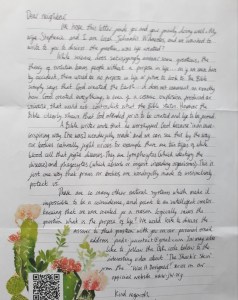
One post in and already a diversion from my planned ’12 Rules’ series. This is because I was fortunate enough to receive a letter in the post recently from my ‘neighbours’, Jim and Sandra. You can see it above. I’ve no idea who Jim and Sandra are – I’ve changed their names here to protect the guilty – but they tell me they’re Jehovah’s Witnesses. They want to convince me of their God, first by pointing out that we are, everyone of us, created by him. They then proceed to demonstrate their God’s existence with rather weak versions of the weak ‘argument from design’, with a spot of the so-called ‘argument from incredulity’ thrown in. Having ‘proved’ God, they conclude with a lovely non-sequitur, that God = purpose.

As they had gone to a lot of trouble to do this, I felt Jim and Sandra deserved a reply, specially as they were kind enough to include their email address. So here it is.  

Hi Jim and Sandra,

I was interested to get your letter recently. I notice you ask the question, ‘was life created?’ Of course it was! You’ll get no argument from me there. Nature and the processes of natural selection and evolution created life as we know it today. You of course want to draw God into these processes, but actually he’s not needed to explain them. 

Your ‘argument from design’ doesn’t work at all, because if God created all the wonderful, intricate things you talk about, he also created viruses, including covid-19, cancer and parasites. You can’t say he created everything and then discount all the nasty things as the product of natural processes or man’s sin or whatever. Either everything was made by God or everything is the result of natural processes – you don’t get to pick and choose. 

You say that only (your) God could make all the complexities of life, as complexity necessitates a creator. But that creator must, by definition, be more complex than his creation – yet you don’t think he had a creator, do you. But he must have done – because according to you, complexity has to have a creator. This principle doesn’t grind to a halt with God just because you or your church or holy book says it does. 

The intricacies and complexity of life that we see are the result of organisms, including ourselves and all other life & non-life, like viruses, adapting to their environments over billions of years. That’s it – no need to add another layer of complication, like a god, to this explanation (you may have heard of Occam’s razor, which is what I’m applying here). If something complex has existed for eons it is far more likely that it is something we know for sure exists – nature – rather than something we don’t. 

Life has in fact many purposes; one doesn’t need a God who doesn’t exist to discover them. I’d be happy to share some of these with you, though I imagine you are already quite set in your beliefs. That’s a shame.

Best wishes,

Neil 

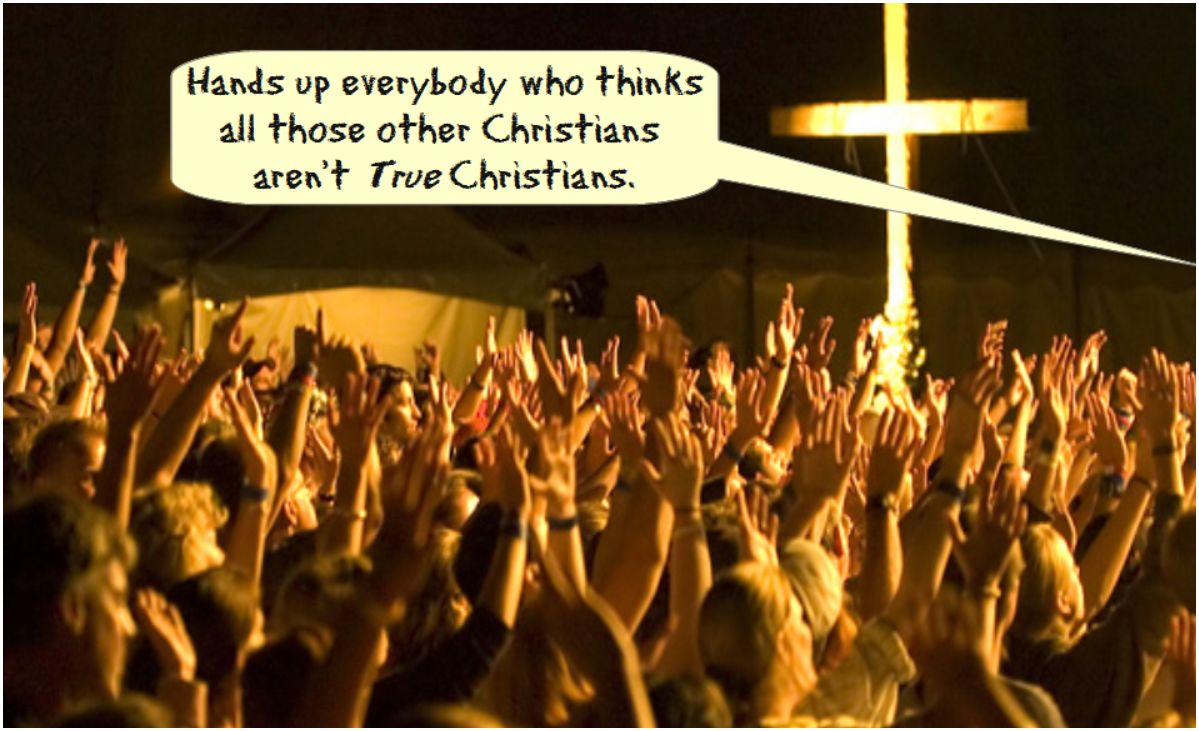
The only True Christians

Blog384

Pete Buttigieg, mayor of South Bend, Indiana and Democratic hopeful, isn’t a Christian. No, he isn’t, because, you see, despite saying he is, despite being committed to Jesus and regarding himself as saved in some way, he can’t be a Christian™. Why not? Because he’s gay. That precludes him from being a Christian of any sort. We all know how much God hates gays and their ‘lifestyle’, don’t we. It says so right here in this article from Charisma News, reposted on Bruce Gerencser’s blog.

Catholics are not Christians either. Nor are Mormons and Jehovah’s Witnesses. Yes, they say they are, but True Christians™ know better. Catholics, Mormons and Jehovah’s Witnesses are not True Christians because they’ve added to the simplicity of biblical faith: popes and saints and alternate holy books. Only those who believe exclusively in the original holy book are True Christians.

Except those who don’t interpret it properly. Charismatics, for example, are not true Christians. Yes, they profess Jesus with their hearts and voices, but the age of special spiritual gifts, like speaking in tongues and prophesying, has ceased. Christians with the wisdom to reject such things are clear about this. (I’ve no idea where this leaves Charisma News. Maybe it’s heretical too.)

Preachers like Beth Moore, Paula White and Joyce Meyer are not Christians. They’re not doctrinally sound. They’re false teachers, wolves in sheep’s clothing misleading the flock. I know this because respected Christian leaders say so (here and here and here.) In any case, they’re women, and women shouldn’t teach or be in a position of authority over men (1 Timothy 2:12.) That alone rules them out from being True Christians.

Moderates aren’t True Christians either. They’re too… well, moderate. They’re bland and compromising. Christ calls for Christians to be bold and zealous in spreading the gospel. Moderates though are neither hot nor cold, so he spews them out of his mouth (Revelation 3.16).

At the same time, extreme Christians aren’t True Christians. Westboro Baptist Church, for example, is just an embarrassment to real True Christians. So are Steven Anderson and other fanatical preachers. They might be getting their hatred and prejudices from the bible, and what they say may be what True Christians believe in their hearts, but, really, such people need to be kept at arm’s length. Even though they profess faith in Jesus, their fanaticism prevents them from being considered True Christians.

No, the only True Christians are the ones who agree with me. I know it sounds stark when put like that, but it’s the truth. Only those who have the same beliefs as me, who interpret the bible the same way I do and have arrived at the same doctrinal position as me are True Christians. There aren’t many of us, it’s true, but isn’t that what the bible says? That in the last days only a remnant will survive as the true church, being faithful to the Words of the Savior while others succumb to apostasy? Yes, it does, in Romans 11.2-5, and I and my church are that remnant.

Not that lot over there who say they are. They’re not true Christians at all, despite the fact they claim to believe in Jesus. They’re apostates who delude themselves and others.

Whatever happened to the Golden Rule?

Blog375a

So in everything, do to others what you would have them do to you, for this sums up the Law and the Prophets. (Matthew 7.12: New International Version)

In everything, treat others as you would want them to treat you, for this fulfils the law and the prophets. (Matthew 7.12: NET Bible)

I went to see a performance at the Edinburgh Fringe on Saturday. Actor David Benson presented a one-man show about the Cato Street Plot, which was an 1820 plan to assassinate the British Prime Minister and government (or possibly not. It was probably a set-up.)

During the show, Benson riffed on some of Jesus’ sayings, including the one above, about how we should treat one another in a country that claims to be Christian (as Britain did in 1820). ‘Do unto others’ has become known as The Golden Rule and like most rules it is largely ignored, even (or especially) by many who profess to be disciples of the man said to have formulated it. The principle is of course much older than the gospels.

When I returned home I caught up with some of my favourite blogs and read about:

A military organisation that promotes the separation of church and state in the U.S. on the receiving end of Christian hate mail.

A preacher who thinks the comedian Sarah Silverman should have her teeth smashed before dying prematurely and being sent to Hell.

The same preacher promising that the Jews, who he says are not God’s Chosen People, will be made to bow down before male Christians, who are.

A different pastor who recited Bible verses while allegedly assaulting an under-aged girl.

The cover-up of the sexual abuse of minors by the Jehovah’s Witness cult.

A Baptist Preacher charged with sexual assault.

Thousands of hateful messages, many from Christians, sent to Montreal Pride organisers.

They just don’t get it, do they? Being a Christian means doing what Jesus says (doesn’t it?) and he says that in everything we should to treat others as we ourselves like to be treated. Note how all encompassing that is: in everything, meaning ‘in every circumstance, with no exception’.

My guess is that the majority of Christians like to be treated fairly, with kindness and respect. I know they do because they whine endlessly when they think they’re not being. Yet so many of them won’t extend the same fairness, kindness and respect – in every circumstance – to other people.

I recently saw a slogan that said ‘Why be racist, sexist, homophobic or transphobic when you could just be quiet’; too many Christians can’t even manage that. They feel compelled to hurl vitriolic insults and threats in defence of the most powerful being ever imagined (and he is imagined). Others think that people more vulnerable than themselves, children included, exist only for their own sexual gratification. These Christians have no interest in ‘In everything, treat others as you like to be treated’. It just doesn’t apply to them.

Strike up another failure for their Lord and Saviour, Jesus Christ.

Making Excuses for Jesus

jesus-jw

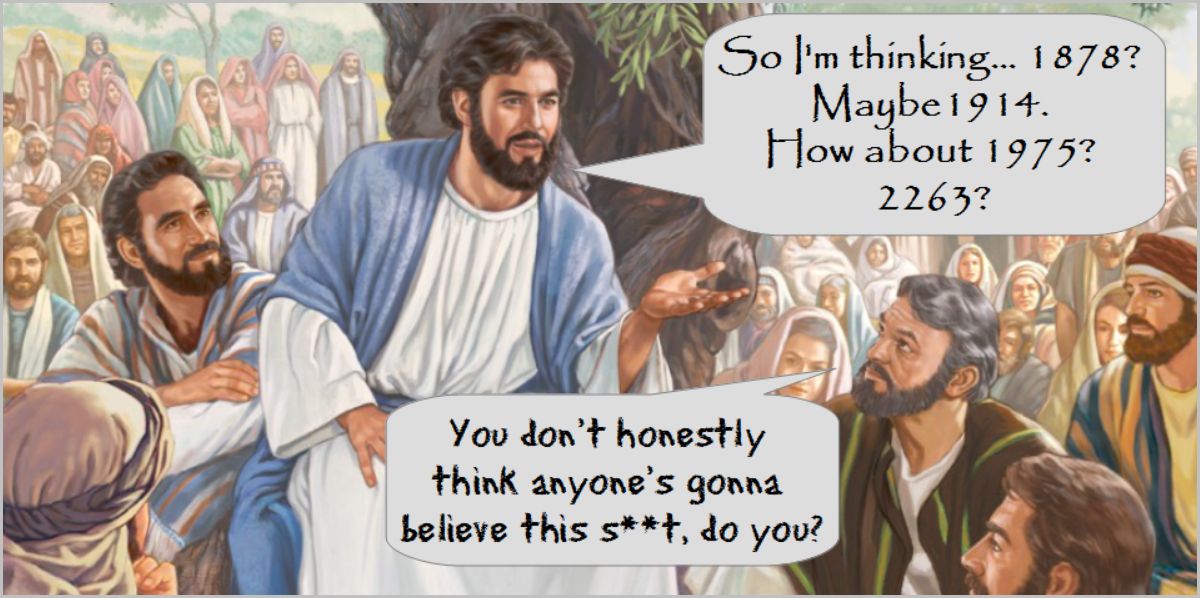
Excuse 5. When Jesus said the ‘Kingdom of God is coming soon’, what he meant to add was ‘but only in heaven and then in 1874. Or 1878. 1914? Er… 1975. After 2017?’

So say the Jehovah’s Witnesses. In 1897 they claimed that Jesus had started on his comeback tour in 1874:

Our Lord, the appointed King, is now present since October 1874, A.D., according to the testimony of the prophets, to those who have ears to hear it: and the formal inauguration of his kingly office dates from Apr 1878, A.D. Studies in Scriptures Series IV (p.621)

and

The year A.D. 1878 … clearly marks the time for the actual assuming of power as King of kings, by our present, spiritual, invisible Lord… The Time is At Hand (1911 ed) p.239

When there was no sign this had happened – and goodness knows what sort of sign there could possibly be – the JWs changed their minds again and said the real date for the start of the ‘full’ kingdom was to be 1914:

In view of this strong Bible evidence concerning the Times of the Gentiles, we consider it an established truth that the final end of the kingdoms of this world, and the full establishment of the Kingdom of God, will be accomplished near the end of A.D.1914. Studies in the Scriptures Series 2: The Time is at Hand (1889 ed) p.99

and

October, 1914, will witness the full end of Babylon, “as a great millstone cast into the sea,” utterly destroyed as a system. Watch Tower (Jun 15 1911) p.190

Alas, over a century later there’s no sign of the Kingdom’s ‘full establishment’, while the old, corrupt system (Babylon) carries on as normal. So, after another change of heart, and a quick, futile stab at 1975 as the right date, Jehovah’s Witnesses came up with a revised plan. Here’s how it looks:

Jesus will return while the generation alive in 1914 is still around, when he will finally get the Kingdom underway. This is the ‘generation’ to which he refers in his prophecies in the bible; his return and the Kingdom coming to the earth will definitely happen while the 1914 generation  is still alive.

But hang on! A person born in 1914 – and there are some still around – is now 103, while those who were already adults in 1914 are long dead. In other words, the 1914 generation has almost gone and there’s still no sign of Jesus or his Kingdom. Either he’s going to return real soon, before the last of the 1914 generation depart, or he’s going to miss the deadline yet again (Guess which it’s going to be).

But worry not, Jehovah’s Witnesses have this one covered too! When Jesus referred to ‘this generation’ he didn’t just mean one generation, but to the generation that ‘overlaps’ with that generation. There’s nothing biblical about ‘overlapping generations’, of course. Jesus didn’t say, ‘the Kingdom will come while this generation and those that overlap with it are still alive,’ but like mainstream Christians, Jehovah’s Witnesses need to give Jesus and themselves an excuse if they’re to avoid admitting that he and they have got it wrong.

So, an overlapping generation would be one like my own, whose grandparents were children in 1914. But we can extend this – and we can be sure JWs will once Jesus fails to return on time – because, using the same ‘reasoning’, my grandchildren’s generation ‘overlaps’ with my grandparents’ through me. My grandchildren’s grandchildren too will be connected with all previous generations, including that from 1914, because of those who have preceded them… and on and on, ad infinitum. In fact, Jesus could come back at any time in the future so long as someone is alive who can trace their ancestry back to 1914.

But he’s not going to. He wasn’t talking about a ‘generation’ almost 2000 years after he lived. He was certain the Kingdom of God was coming to his time and his people. All of these convoluted and ultimately unconvincing explanations of what he ‘really’ meant when he preached an imminent heavenly Kingdom on earth simply won’t do. While mainstream Christians mock Jehovah’s Witnesses for their silly conjecturing about Jesus’ return, they share the belief Jesus is coming back. Most won’t venture a date (though there have been plenty who have) because, they will tell you, Jesus also said ‘no-one knows the precise day or hour’ when the Son of Man and the Kingdom will appear (Mark 13.32). Nevertheless, they remain certain that Jesus will return: this year, next year, sometime… any time other than that which he actually predicted.

While evangelical Christians and others insist that the bible, where all Jesus’ failed prophecies appear, is the literal and infallible word of God, they refuse to take literally his pronouncements about the coming of the Kingdom. While he might have said he didn’t know exactly when it would arrive, he was certain it would be while his own generation lived. As he is made to say in Matthew 16.28, ‘some who are standing here will not taste death before they see the Son of Man coming in his kingdom’.

All of which is a problem for Christians: if these predictions are not to be ignored, then they must be interpreted, explained and, eventually, explained away. The last thing believers want to do is accept them for what they are; the demonstration of Jesus’ failure. The Kingdom didn’t arrive when he said it would and, given how far it is past its sell-by date, it’s certainly won’t be now.