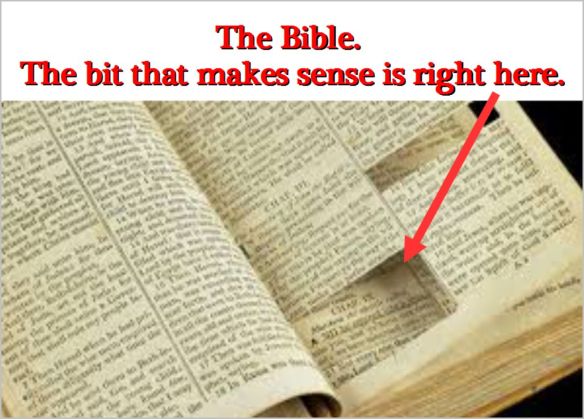
Ken Ham’s ‘Five Evidences that the Bible is True’

cut

Yes, that’s what he says: ‘evidences.’ Good use of English there, Kenny. Actually, the article is anonymous, but as it’s on Kenny’s site, and as it features inside his Noah’s Ark vanity-project, we can safely assume he authorised and approved it. That being the case, he can take responsibility for it.

Anyway, here are those ‘evidences’. Be prepared to be underwhelmed:

1. The Bible Is God’s Word

The ‘reasoning’ here is that God inspired the writers so, ipso facto, the Bible must be God’s words.

How do we know God inspired the Bible? Because the Bible appears to say so. But how do we know we can trust what the Bible claims about this and everything else? Duh… because God inspired it. Circular reasoning that gets us nowhere.

But wait, more ‘evidence’ from Kenny: ‘the Bible is authoritative in every subject it addresses’. I guess that’s so long as you exclude all the areas where it isn’t, like those that are scientifically, historically and geographically inaccurate, including the early chapters of Genesis that Kenny loves so much. Then there are those parts that are evidently myth, legend or fantasy.

Yes, apart from all those bits, the Bible is accurate and authoritative.

Isn’t it?

2. The Bible is Unique and Unified

Two claims in one. The Bible is far from unique; there are many religious texts in the world – the Qur’an, the Vedas, the Pali Canon, the Book of Mormon… many with evidence of several authors at work in them. Neither is the Bible unique because it is ‘unified.’ It is not unified. It is contradictory and inconsistent: the so-called ‘new covenant’ cuts across the ‘everlasting’ agreement God allegedly made with the Jews and YHWH himself evolves, even having a personality transplant somewhere between the Old and New Testaments. Most significantly, for what is supposedly its central message, the Bible offers several, frequently mutually exclusive, ways to salvation.

3. The Bible Has Been Faithfully Passed Down.

This is empirically, demonstrably false. Many books of the Bible were written decades, even centuries, after the events they purportedly describe; the oral tradition is an unreliable means of transmission; texts were altered both by accident and on purpose; some books are patent forgeries; ninety percent of surviving manuscripts were created 800 years or more after the originals, and none of these ‘autographs’ survive for anyone to determine how ‘faithful’ later copies might be.

4. The Bible Contains Fulfilled Prophecy

It does? Where? Is it in the gospels where Jesus prophesies that the Son of Man will, in the lifetime of his listeners, return through the clouds to judge the tribes of the Earth and establish God’s Kingdom? Is it in the contrived symbolic events imposed on Jesus’ life to make it look like he fulfilled prophecy, even when the earlier ‘prophecies’ were not prophecies at all? Is it in Paul’s letters where he promises the rapture will be coming while those in his churches still live? Is it in the many prophecies that were written after the events they were supposedly predicting? Is it in the innumerable prophecies that didn’t come to pass?

That’s right; not one of these bits of malarkey constitutes ‘fulfilled prophecy’.

5. The Bible Holds the Key To Eternal Life

No, it doesn’t because there’s no such thing. This is the great swindle at the heart of Christianity; a fantasy dreamed up by fanatics, fantasists and psychotics, and preserved in the Bible. Christians are singularly unable to provide any evidence that anyone has ever gone on to have a life after death, nor that they ever will. We know now, as we may always have suspected, that when the body dies ‘we’ die with it. End of.

So, every one of Ham’s ‘evidences’ is false; a sham like his beliefs and the book from which they spring. You’ll struggle to tell him so, however, because like so many Christian web-sites, there’s no posting of comments; Kenny broaches no dissent. That’s how confident he is of his case. Best not to entertain any views other than your own weak, unfounded assertions.


Faith by any other name (is still a waste of time)

celia3Faith; the brand name for ‘wishful thinking’. In what other area of life, other than the religious, do we have faith in faith? Christians like to say we do – we have faith, they say, in the pilot who’s controlling the aircraft we’re flying in, or we have it in the surgeon who’s operating on us. But this is not faith in the sense religious people usually use the term. ‘Faith’ in pilots, surgeons and even our own abilities is more like trust or confidence; trust that the pilot is qualified to fly the plane, confidence that the surgeon is trained and skilled or that we have the ability to complete the task we’ve set ourselves. This is not faith in the sense of ‘belief in things that can’t be seen and for which there’s no evidence’. It’s not faith in the sense of wishing and hoping there really is a God and that he cares enough about us to grant us eternal life, much in the manner of the magic fountains and wish-granting genies of folk tale.

Religious faith – Christian faith particularly – is of this latter kind. It’s not trust in a real person’s capabilities, be it our own or a specialist’s. It’s a blind belief in a God who evolved from being one tribal deity among many into the everlasting, omniscient creator of all things. A God who, if he did create everything, set us on the Earth together with viruses, microbes, infections, disease, sickness, cancer, AIDs and Alzheimer’s. A God who thought putting us in an environment so frequently hostile to our well-being on an insignificant planet in the corner of a vast and indifferent universe was just the right place for us.

This is a God who doesn’t seem to understand us but who is swift to punish us while he himself stands by as half of his favoured creation endures poverty, starvation and the cruelty of much of the other half. His ways are not our ways, believers say, making what they surely know is a flimsy excuse – the flimsiest – for his failure to interact with us in any meaningful way.

Faith is the wishful thinking that despite the evidence, this neglectful, capricious God really does care for us. He cares so much he has devised an illogical, incomprehensible plan (or two) that, with its blood sacrifice and magical overtones, we must believe if we want his forgiveness for the way he made us in the first place.

We need to have faith that this cosmic madman will bring us back to life us after we’ve died and take us to Heaven to live with him, but we must first have the right sort of belief, even if it’s difficult to work out what that is. Faith is necessary for all of this because there isn’t a scrap of evidence anyone has ever been returned to life after they’ve died, or that Heaven exists, or that anyone has ever gone there. That’s why it takes, not trust, but a great wallop of wishful thinking that this fantasy is not only real but more real than the reality in front of us.

As for me, I can’t believe any of it.

  – I can’t believe the claims of those who even today say they’ve seen or heard from God or Jesus or Mary, who reckon they’ve had visions the same way Paul or Peter, Joseph Smith or Mary Baker Eddy did.

  – I don’t believe those who say they almost died and went to Heaven, because what these visions of fantasy figures and make-believe places have in common is that they take place, so far as they occur at all, entirely within people’s heads.

  – I won’t believe that those who say all of this magic, hallucination and mumbo-jumbo is true because it’s in the Bible, when the creators of that book were men far more ignorant and superstitious than any reasonably educated person today.

  – I am unable to believe muddled nonsense that is designed to appeal to our vanity and fear of obliteration.

  – And I really don’t care that some say they get comfort, joy and morality from their belief; their morality no more derives from God as mine does from Superman and emotions don’t make any of it true.

So, faith – what good is it? If your answer is it enables you to believe the impossible, then isn’t it just another word for delusion?


It’s Only Make Believe

godsatan

All you have to do to become a Christian/be saved from sin/gain eternal life is to accept Jesus as your Lord and Saviour.

Except, it isn’t.

You’ve also to put your faith in the Bible, acknowledging it’s God’s word in some form or other. It would be impossible to be a Christian without it; you’re required  to read it, let the Holy Spirit or one of God’s chosen instruments here on Earth interpret it for you and you’ve to live by it.

And this, in turn, entails believing in the menagerie of supernatural creatures and invisible realms the Bible assumes exist. Angels and demons we considered last time, and then there’s –

The Risen Christ who sits at the hand of the Father. He sits? He’s like a real body, but at the same time not a real body? A spiritual body, then, who metaphorically ‘sits’ next to –

God the Father, whom no human has ever seen (confirmed by John 1.18 but contradicted by Genesis 32.20) who abides in –

Heaven, a place no-one has ever seen. No, really, no-one. Not even those people who have hallucinated about being there. Hallucinations, dreams, visions, even so-called out of body experiences, are not evidence Heaven exists. They’re evidence that people sometimes hallucinate, dream and have visions and out of body experiences. The same is true of ‘sightings’ of God himself and of –

The Holy Spirit. That’s the part of God Christians dupe themselves into thinking has moved in inside them to guide them through their Christian life. That’s the same Holy Spirit who’s guided God’s Chosen to create 34,000 different distinct interpretations of the Truth. Even now, the Spirit is leading church after church down the road of apostasy, according to those he also leads to condemn them. Confused yet? It all makes sense if you recognise that it’s all imaginary, created by human beings who didn’t and don’t know any better. Like –

Satan is. He’s the character who evolves during the course of Bible until he’s a cross between Lex Luthor and the Joker; God’s arch-enemy. He only ‘exists’ to get God off the hook. All the bad in the word can’t be God’s fault now, can it? Somebody’s got to carry the can and it sure isn’t YHWH. So Satan, the devil, gets to be the embodiment of evil. Which isn’t to say evil doesn’t exist because it does, but it’s not caused by this third-rate Dick Dastardly. Nor is –

The Anti-Christ. This is the guy Christians believe will appear at the end of the age, some time around AD 100 according to Revelation 14.9-10. Never mind his creator there calls him something else entirely (‘the Beast’ as it happens); unless he’s finally arrived in the shape of Donald J. Trump, he’s no more real than –

Those who’ve died (‘the saints’ according to Catholics) and have been given new, magic bodies in Heaven or –

Those who’ve died and have gone to Hell to be tortured forever. That’s because –

Hell doesn’t exist either.

Nor do seraphim (Isaiah 6.2), cherubim (Hebrews 9.5), dragons (Psalm 148.7), satyrs (Isaiah 13.21) or unicorns (Numbers 23.22 etc) .

How do we know these beings, places and states don’t exist? Well, they’re all invisible, intangible, undetectable, unverifiable, supernatural (literally, ‘outside nature’), and, ultimately, unconvincing. They’re rejects from far more interesting mythologies that abounded in the ancient world. Today’s mythologies – of Middle Earth, Game of Thrones and the innumerable virtual worlds of computer games – are far more plausible (and even then, not very).

The supernatural doesn’t exist; everything we know is part of a physical universe. There is no evidence anything exists outside, alongside or in addition to that universe. (Though if you think there is evidence for the supernatural – and I mean evidence, not ‘feelings’, personal experiences or ancient texts – then please make it known in the comments).

There is an abundance of evidence, however, that –

Human beings are rather good at inventing stories and mythologies;

Their psychology inclines them to inner imaginings;

They are largely irrational and with a tendency to attribute agency to inanimate objects, phenomena and the chimera of their own imagining;

They have a fear of death and their own personal extinction.

How could religion, with all of its make-believe, not fail to materialise under such conditions? And how can anyone in this day and age take it seriously, knowing what we do now?

I know I can’t.

God’s Election

church4

As we saw in the previous post, the Bible tells us that God chose his ‘Elect’* before the creation of the world (Ephesians 1.4-6). Which begs the questions –

1: On what basis did God select the favoured few untold aeons before they were born? Did he decide by looking at their dress sense, as Jesus’ parable in Matthew 22.1-14 suggests? I guess it must be, given the Bible is the ‘literal’ word of God.

Or did God assess ahead of time just how righteous his Chosen would turn out to be? In Matthew 25.31-46 Jesus says righteousness is the yard stick (though naturally Christians don’t believe him because Paul says something different).

Or did God decide in advance – Paul says he ‘foreknew’ – who would repent and turn to Jesus, free-will be damned? Maybe, but then Jesus suggests that not everyone who does even this will make it into God’s Kingdom (Matthew 22.1-14).

What a bummer! Looks like God’s decision is/was purely arbitrary. You make it, or not, on the whim of a capricious monster.

2: What’s the point of evangelism? If God chose who was going to have eternal life/enter the Kingdom/live in Heaven before the creation of the world, then there can be absolutely no need for anyone to tell anyone else about Jesus, sin and salvation. Why? Because it makes no difference; God’s Chosen will remain his Chosen, as they were long before they were born, and he’ll be sure to rescue them once they die. Those who haven’t been pre-selected will stay lost and will go to Hell whether or not they’ve heard or responded to the gospel.

‘But how will the unsaved Chosen hear the message if we don’t tell them?’ ask our zealous evangelical friends, still not getting the point. Jesus, lads! The Chosen don’t need to hear the gospel: God – has – already – chosen – them. They will go to Heaven, live in the Kingdom or whatever, regardless of your efforts. You and your evangelism are superfluous.

3: How can you be sure, if you’re a Christian, that you’re of the ‘Elect’ and so destined for Eternal Life? Yes, you’ve chosen Jesus – but has he chosen you? How can you know? Your own sense of righteousness, your faith, self-sacrifice and adherence to sound doctrine (whatever that is) are no guide to whether or not you’ve made the grade. Only God knows that, and he’s not telling.

Not yet, anyway, so you’d best make sure you’re buried in your very best clothes, just in case.

* Jesus is made to call the chosen few ‘the Elect’ in Matt 24.22, 24 & 31; Mark 13.20, 22 & 27 and Luke 18.7.

Recent Encounters of the Religious Kind

2. Maria and the Evil One

devil

Maria comes to the door again. She’s very personable but wasting away her life as a Jehovah’s Witness. She wonders if I’ve read the leaflet she left last time. I have, and have filled in the answers to its questions, including, ‘does the Bible have the answers to life’s big questions?’ Maria doesn’t seem very happy about my answer.

She insists on showing me a video on her iPad. It is slick and includes some clever CGI. She tells me afterwards that the ‘Evil One’ is in control of this world which is why it is in such a mess. I tell her that any mess is our own doing, we humans. She asks if I know the Bible; I say I do. She tells me that Jehovah’s Witnesses are the only ones who interpret it correctly. It doesn’t, she says, tell us that believers will go to heaven when they die (she’s right about this; it doesn’t). It promises rather that Jesus will be coming back to set up God’s Kingdom on Earth (right again). Except, I remind her, it has him promise that he will return within the lifetime of those listening to him, the Kingdom scheduled to appear within his own generation (Matthew 16:27-28; Matthew 24:27, 30-31, 34; Luke 21:27-28, 33-34). Maria concedes the point and then tries to say a generation is longer than we think. Maybe so, I say, but not 2,000 years.

Maria says she learnt something about this problem in a class recently. She appeals to her confederate for help, but he can’t remember what the elders said either. She decides now retreat is the better part of proselytising but promises to return once she has the answer.

But there is no answer; at least not one that sees Jesus’ megalomanic fantasies realised two millennia in his future.

I feel certain that, unlike Jesus, Maria will be back soon.


Christianity: always winter but never Christmas

Spot the difference:Shore

Christians are hot on evidence.

There isn’t enough for evolution, they say, even though there’s an abundance.     

None, they claim, that the Earth is billions of years old, but only 6 thousand.

Not enough that climate change is man-made, when there’s considerable evidence it is.

None that there’s a genetic component to homosexuality when science reveals that there is.

But, as far as the resurrection of the body, judgement and eternal life in either Heaven or Hell are concerned, these they believe in, no evidence required.

I recently challenged Christians on Charisma magazine’s blog-site to provide or point me to evidence that any one of the 107 billion people who has ever lived who after they had died had gone on to enjoy either eternal life in Heaven or eternal punishment in Hell. Unfulfilled promises from magic books weren’t admissible, because a promise of something happening is not the same as it actually doing so. Jesus didn’t count either, as there are no eye-witness accounts of his bodily resurrection, only stories written decades after the supposed event. In any case he was half Vulcan or something, not an ordinary mortal.

Alas, my challenge went unanswered. You won’t find it on the Charisma site now because it has been removed by the moderator there. Expecting evidence from Christians for what they believe is patently unreasonable. After all, who needs evidence when you can exercise your licence to believe whatever you’re told?

Of course, there is no evidence of any resurrection nor of anyone who has gone on, post-mortem, to enjoy everlasting life. Have you noticed how everything about Christianity is either invisible – God, the Holy Spirit, Heaven, angels, demons – or lies permanently in the future; the Second Coming, the resurrection of the body, the Kingdom of God, judgement and eternal life? All of them always just that little bit further on. This year, next year, sometime, never. Just not now.

Yet Jesus, Paul, Revelation’s John and most other New Testament luminaries believed God’s Kingdom, the resurrection and judgement were coming within their own lifetimes.* Not one of them entertained the thought that 2000 years down the line none of these miraculous events would have materialised.

Small wonder then, that at the start of the second century, believers began to lose hope in the Second Coming, the Kingdom’s arrival and an earthly resurrection of the dead. Maybe, some of them began to think, eternal life would be not be here on Earth, as Jesus and Paul had promised, but in Heaven with God, which they most definitely hadn’t. This way, everything that hadn’t happened here on Earth would happen instead after death (we can see this transition taking place in the very late gospel of John). All of which was fortunate, because it dispensed with the need for confirmation and evidence; no-one could prove – apart from the fact nobody has ever survived their own extinction – that believers didn’t go to Heaven when they died. Equally, no-one could provide evidence they did.** How neat and convenient.

So if any Christians reading this would like to like to show us some evidence for the resurrection of the dead, post-mortem judgement, Heaven, Hell, God’s Kingdom on Earth – any of it – I’m sure we would all like to see it. Until then, I will go on regarding all of these assurances as empty promises – pie in the sky – that believers cling to desperately, while calling their desperation ‘faith’.

* See Matthew 16.27-28 & 24.27, 30-31, 34; Luke 21.27-28, 33-34; 1 Corinthians 15.51-52; 1 Thessalonians 4.15-17; 1 John 2:17-181; Peter 4.7; Revelation 1.1 & 21.2-4

** Psychics claim to commune with the dead of course, or at least with their spirits; more hokum from the minds of the deluded. Even if it weren’t, this isn’t the kind of resurrection Christians envisage for themselves. They dismiss psychics’ ‘evidence’ of life-after-death as so much demonic deception.

The Stuff Christians Say… (part three)

DoorToDoorAtheists are aggressive/militant/unreasonable: The Christians might’ve got us on this one. After all, it is incredibly irritating when we atheists start preaching in the town centre or invade others’ events to tell them what to believe or dish out loony pamphlets or turn up at people’s doors when they’re just about to have their tea. And what about all those meeting places we have, on just about every corner of the city, with smart-arse posters about Adam and Steve on the board outside? And let’s not forget our readiness to blow up ourselves and others in the name of our great cause. Now that’s ‘militant’! Yes, we atheists really do have too much freedom to push our views on others. No wonder we’re so insufferable. (Note to self: check you’ve got this right.)

It takes more faith to be an atheist than a Christian: It takes no faith to recognise there are no supernatural beings. It takes no more faith not to believe in God – or to acknowledge that there is no God to believe in – than it does not to believe in Santa Claus, Poseidon or Ra. Christians themselves require no great abundance of faith to dismiss these characters. Is it so difficult to understand that atheists disregard the Christian pantheon of fantasy figures in exactly the same way? Or are believers practising their dishonesty-for-Jesus again? There is no faith involved in being an atheist. On the other hand, believing in an omnipotent but suspiciously inactive God, a super-hero Saviour, a magic Spirit, angels, cherubim, seraphim, demons, Satan, resurrected saints, Heaven, Hell and all manner of powers and principalities – this requires faith in delusional quantities. No atheist could possibly compete. Nor would they want to.

Faith: An Exercise In Futility

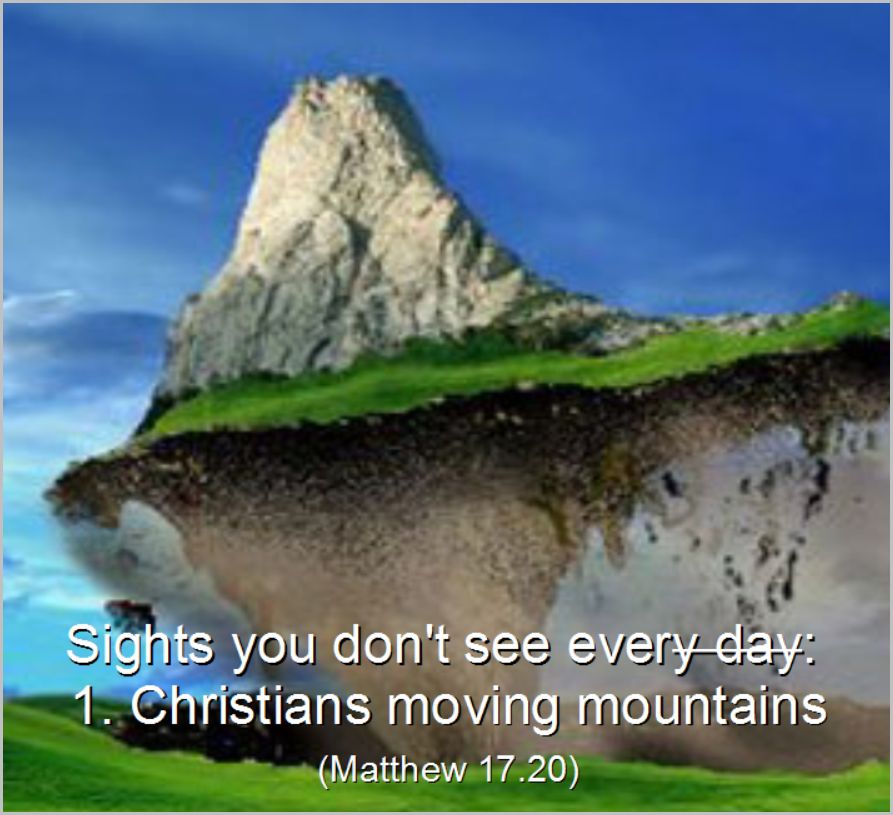
MountainsWhat is faith?

The anonymous author of the book of Hebrews says it’s ‘the substance of things hoped for, the evidence of things not seen.’ (11.1)

Hoping for ‘things’ like perfection, resurrection, eternal life, heaven (not to mention the ability to move mountains), the likes of which no-one has ever achieved, is nothing but wishful thinking. Despite what the Hebrews author says, wishful thinking isn’t evidence of anything – except a capacity for wishful thinking.

By it’s very nature, then, faith is not evidence, but the very opposite. It is the effort to believe in things for which there is no evidence and the delusional insistence that the imagined is more real than that which is.

Peace Off

angels

Glory to God in the highest, and on earth peace, good will toward men. Luke 2.14 as rendered by the King James Bible.

Whatever happened to that peace? There hasn’t been peace on earth ever since the angels were made to herald Christ’s birth with these words. Some of that absence of peace – the conflicts and wars – has been the result of religion, including that of Jesus himself. Then again, he did contradict the angels when he said he hadn’t come to bring peace but a sword and for once, he was right (Matthew 10.34). So what can the angels have meant? More to the point, what can those who created these words to put in the mouths of non-existent beings have been thinking? Is their declaration a promise? A prophecy? Something to look good on Christmas cards?

Other translations of Luke 2.14 avoid the whole peace on earth shtick by watering down the statement: ‘Glory to God in the highest heaven, and on earth peace to those on whom his favour rests’ reads the NIV. Now only those whom God ‘favours’ are granted peace, which presumably means only Christians, and it’s now a vague sense of well-being (complacency? smugness?) that isn’t of much use to the world at large. Certainly other New Testament writers, the creators of John’s gospel and the letter to the Ephesians for example, interpret ‘peace’ in this very limited way.

And yet, in Isaiah, in verses applied to Jesus (especially at this time of year; they were read out in the carol service I attended last night) we find him descibed like this:

For to us a child is born, to us a son is given, and the government will be on his shoulders. And he will be called Wonderful Counselor, Mighty God, Everlasting Father, Prince of Peace. (Isaiah 9.6)

Apart from the fact this is a specifically Jewish prophecy that has nothing to do with Jesus – which is why most of the titles don’t really apply to him (nobody has ever called him ‘Wonderful Counselor’ or ‘Everlasting Father’) – there again is the idea that he’s somehow connected with capital-letter Peace. He’s a Prince of it, no less.

But wait – there’s more:

Of the increase of his government and peace there will be no end. He will reign on David’s throne and over his kingdom, establishing and upholding it with justice and righteousness from that time on and forever. The zeal of the Lord Almighty will accomplish this. (9.7)

Of course; it’s all end time stuff! We should’ve guessed. Long term peace on the Earth, predicted by the angels and, ostensibly, by Isaiah is going to be in the future, after Jesus returns to establish God’s Kingdom on earth.

Have you noticed how it’s always in the future? Everything Christianity offers is going to happen later: heaven, eternal life, the second coming, the rapture, resurrection, God’s Kingdom, the lion lying down with the lamb, the end of war, everlasting peace. Not in Jesus’ own time as he thought; not in Paul’s, not in the gospel writers’, not any time since, but always just around the corner, any time now, soon. Never in the here and now. Peace on Earth, like all those other promises, is always just out of reach, like the pot of gold at the end of the rainbow – the closer you think you might be to it, the further it moves away.

A friend added one of those clever posters to Facebook recently. It said, amongst other things, that it wasn’t okay to ‘shame’ religion. I couldn’t disagree more. Scams must be debunked and the sham of religion’s empty promises held up to the light of reality. None of the things that the Bible says will happen is going to; not now, nor in an ever-elusive future.

A happy and peaceful Christmas to both my readers.

It’s Baby Jesus time again

Nativity2It’s that time of year again, when we’re expected to worship the baby Jesus and thank God for sending him. I do usually go to a church carol service with friends and sing along for nostalgic reasons, while marvelling at folk’s willingness to believe the fairy story. Plus, there’s always a drink or two afterwards to look forward to.

What would Jesus have made of it? The stories of his miraculous birth have been tacked on to the beginning of two of the gospels but even in Matthew and Luke there is no indication that he was aware of them. Neither he nor his mother mention them when it looks like aspersions are being cast on his legitimacy (eg: Mark 6.3; John 8.41). You’d think one or other would have done so as sure-fire proof that he was an emissary from God. In fact, apart from the two conflicting accounts in Matthew and Luke there are no other mentions of his spectacular nativity in the Bible; Paul, writing closest to Jesus’ lifetime, doesn’t refer to it even when he’s arguing in 1 Corinthians 15.42-52 that Jesus came from Heaven.

How do we account for this? The obvious answer is that the nativity narratives are much later inventions. We know they were not included in Matthew and Luke’s shared source material because the two are significantly different (as I discuss here). However, by the time these gospels were being compiled, in the 80s and 90s, such stories had begun to circulate – then as now, people liked origin stories for their super-heroes – and two such tales were incorporated into their accounts. The birth stories are invention, heavy with symbolism and designed to show that Jesus was not illegitimate but spawned by God in a supposed fulfilment of prophecy.

While the adult Jesus was a egotist who thought he was going to the end the system in which he lived (Matthew 24.34-35) and then rule the world with his mates (Matthew 19.28), he didn’t require that his followers worship him. It’s true that, like any other cult leader, he accepted others’ adulation when it was offered, especially when it was offered by women; one anoints him with expensive perfume in John 12.13, while another Mary – they were evidently short of female names back then – fawns over him in Luke 10.41-42. However, he doesn’t make it part of his mission to demand the worship of others. When early Christians started to think of Jesus as a supernatural-being worthy of adulation, they devised statements about how marvellous he was (Colossians 1.15-20 may be one such) but worshipping him through song does not appear to have been part of their agenda.

Modern Christians’ use of hymns and songs to tell Jesus how much they love him is, then, alien to the faith as it was originally practised, and to Jesus himself. The carols that’ll be sung this Christmas have no equivalent in Jesus’ life nor in that of his earliest followers. Even if he were hanging around in Heaven somewhere, which of course he isn’t, the last thing he’d want to be subjected to would be some badly sung Victorian carols telling him what a great guy he is. He was in no doubt about that when he was alive.