Christians’ Favourite Delusions 30: The Resurrection means we’re going to Heaven.

Resurrection2According to the Bible, why did the resurrection happen?

To show us that we’re all going to go to Heaven when we die? No, nowhere does the Bible say that.

To demonstrate that Jesus was really God? No, it doesn’t say that either.

To let people know that God was about to resurrect everyone so that the righteous could live on a renewed Earth, while the rest would be sent off to eternal punishment?

Yup, that’s the one. That’s the way Mark, Matthew and Luke tell it and it’s also what Paul believed. He refers to Jesus as the ‘first fruits’, with lots more ‘saints’ being resurrected after him to populate God’s kingdom on Earth:

…in fact Christ has been raised from the dead, the first fruits of those who have died. For since death came through a human being, the resurrection of the dead has also come through a human being; for as all die in Adam, so all will be made alive in Christ. But each in his own order: Christ the first fruits, then at his coming those who belong to Christ. Then comes the end, when he hands over the kingdom to God the Father, after he has destroyed every ruler and every authority and power. For he must reign until he has put all his enemies under his feet (1 Corinthians 15. 20-25).

This is why Matthew has hordes of the dead rising from their tombs (Matthew 27.53) – he sees resurrection as the indisputable proof that the Kingdom has arrived. Matthew is so desperate to show that it’s already started, he has bodies emerging from their graves even before he has Jesus himself come back from the dead.

Of course, all of it’s a fairy story, Matthew’s zombies and Jesus’ resurrection included. As we saw last time, there’s no evidence at all that Jesus rose physically from the grave. Paul’s experience of the resurrected Christ was of a beam of light that appeared in his own head, and from this he concocted his entire theology (Galatians 1.12). When the gospel writers created their resurrection stories much later on, they turned such visions into ‘real’ encounters with a reinvigorated Jesus. They offer stories of his eventual return – after a quick visit to Heaven – as a conquering hero who will kick-start God’s Kingdom on Earth (Matthew 25.31).

So there you are. Jesus’ return from the dead, which didn’t happen anyway, was intended to be the first of many such resurrections, right here on Earth. According to Paul and the later synoptic gospels, it signified that God’s Kingdom was about to be established in this world, not the next. In the first century.

As we know, it all happened just as they said it would.


Gentle Jesus – meek and mild?

StonedWhen it comes to derogatory and hateful remarks about minorities, Jesus is frequently given a pass. His ‘meek and mild’ persona – not one he actually had, but one he’s acquired over time – is brought into play to absolve him of all unpleasantness.

For example, and as liberal bloggers are fond of saying, here’s what he had to say about gay marriage:

                                                                                                                                            ”


Yup, that’s right; he said absolutely nothing about it – not directly anyway. But what Jesus did say, if ‘Matthew’ is to believed, was that he upheld the Jewish Law in its minutest detail:

Do not think that I have come to abolish the law or the prophets; I have come not to abolish but to fulfil. For truly I tell you, until heaven and earth pass away, not one letter, not one stroke of a letter, will pass from the law until all is accomplished. Therefore, whoever breaks one of the least of these commandments, and teaches others to do the same, will be called least in the kingdom of heaven; but whoever does them and teaches them will be called great in the kingdom of heaven. (Matthew 5.17-19)

That’s the Law that prescribes death for even the smallest infraction that he’s endorsing there. Here’s a brief sample of that Law and the penalty for breaking its petty rules:

Stone to death anyone who works on the Sabbath. (Exodus 35.2 and Numbers 15.32-36)

Kill publicly children who dishonour their father or mother. (Leviticus 20.9)

Stone to death anyone who blasphemes the name of the Lord. (Leviticus 24.16)

Execute a married couple who have sexual intercourse during the woman’s period. (Leviticus 18.19)

Put to death those involved in adultery. (Leviticus 20.10)

Execute any man who lies with another man, as with a woman. (Leviticus 20.13)

Stone to death at her father’s door any woman who is not a virgin on her wedding night. (Deuteronomy 22.13-14 and 20-21).

Sound familiar? With its oppressive brutality and liberal use of the death penalty, this sort of behaviour is like IS practices today. They’re both desert ‘moralities’, after all. And this is the law that Jesus advocates and insists remains in place until ‘heaven and earth pass away’. As that hasn’t happened yet, the Law, according to Jesus anyway, remains in effect. Never mind that Paul says it doesn’t – God himself, in the shape of Jesus Christ says it does. How’s that for meek and mild?

(Cue Christians referencing the story of the woman caught in adultery. That, however, is a late addition to the Bible and, in any case, Jesus only saves the woman because his beloved Law hasn’t been properly complied with.)

Thankfully, civilised human beings – and civilised Christians too – ignore Jesus and don’t seek to apply such old barbaric laws (though there are some believers who want to when it comes to LGBT people; see my previous post.) But if you want to know Jesus’ position on moral issues that he doesn’t pontificate on explicitly, just remember he fully supports the death penalty for adultery, homosexuality, working on the Sabbath, not being a virgin on your wedding night, having sex at the wrong time of month, dancing, listening to the radio, tweeting and texting… oh wait… now I have got him confused with Islamic extremists. It’s so easy to do.
Next time: Jesus says that the only way to gain eternal life is to follow this vicious Law with all its unreasonable demands.

Idiotic Stuff Jesus Said 9: God knows what you need before you ask him

PrayJesus said: ‘Do not be like non-Jews, for your Father knows what you need before you ask him.’ Matthew 6.8

Prayer has been in the news quite a bit lately. Not, of course because it’s suddenly started working, but because prominent Christians have been pretending, yet again, that it does:

Archbishop of Canterbury, Justin Welby, has been telling us just how important prayer is. He prays for others while he does the ironing.

The pope has been praying for victims of Islamic State.

Churches in Glasgow have been praying for the victims and families involved in last Monday’s terrible accident there.

Bishops in Australia prayed for victims of the Sydney seige.

Christians inherit this futile behaviour and empty posturing from Jesus himself. He believed that talking ‘in secret’ to his god-in-the-sky could actually change things down here on Earth. This God, according to Jesus, knew what his children wanted even before they asked.

His children were not, however, Christians; they were Jews. The phrase I’ve interpreted above as ‘non-Jews’ is ‘Gentiles’, which means exactly that – outsiders who weren’t Jews. These outsiders, Jesus implies, just don’t get prayer. Only the chosen people, the Jews, do. Only they know how to talk to the big Sky Daddy properly and it’s only their needs that he knows about beforehand. He isn’t interested in others, their needs or their prayers.

But if he knows the needs of his chosen before they even ask him, why doesn’t he simply meet those needs? Why does he have to be asked? What sort of perverse and twisted version of a loving father is this, who insists on being asked before he will consider acting? I’m only a fallible and flawed human being but when I know my children’s needs, I don’t wait to be asked to meet them.

Maybe God isn’t really as magic as Jesus seems to think. Maybe he needs time to let things happen by chance so that he can then take the credit. Because there’s absolutely no evidence prayer works. The opposite is the case; there’s plenty of evidence to suggest that the supposed results of prayer are no more likely than if they happened by chance.

As if this weren’t ludicrous enough, many of the examples of prayer we’ve heard about recently are prayers after the event; appeals for the victims and survivors of disasters once the disaster has struck. So did God not know those involved ‘needed’ not to be killed or tortured or bereaved? If he didn’t already know this, then Jesus’ claim is, like so many others he made, utterly worthless. And if God did know, why did he not do anything to prevent the loss of life, the hardship, the devastation? Because he wasn’t asked

It’s likely though that he was asked, by those believers who were caught up in appalling circumstances. So then, why didn’t he act? Why didn’t he meet those needs he knew so much about beforehand?

Perhaps he just doesn’t care or he’s not able. Or, more likely, maybe he doesn’t exist.

And if he doesn’t exist, then Jesus was wrong in everything he said about him. He was wrong to think God was there in Heaven, taking an interest; wrong to think he cared. It also means Jesus certainly wasn’t the son of any such god. Nor was he the human manifestation of a make-believe Sky Daddy on Earth.

Answers to this year’s all-new Christmas Quiz

saving-christmas-posterGod save us all from this, this Christmas time.

1. Where does the word ‘Christmas’ come from?
The answer is b, the name comes from the Catholic Mass held on the supposed date of Jesus’ birth. So all you anti-Catholic Christians need to find a new name for it fast.

2. When was Christ born?
a) is the answer here: Christ wasn’t born. Maybe Jesus was, but ‘the Christ’ is an invention of later Christians (Paul, for example, in Romans 8.3 and John’s gospel, written up to a century after Jesus lived.) The Christ is a mythic, supernatural being who’s always existed. He bears little relation to the itinerant Jewish preacher Yeshua who wasn’t born on 25th December or in the year 0.

3. Which gospel writers didn’t think the nativity story worth including in their accounts?
Mark and John (b & c) don’t bother including it. Did they not know it? The two gospels that do have bits of the story – Luke and Matthew – contradict each other.

4. How well attested are the events surrounding the birth in historical documents of the time?
a) Not at all. You’d have thought the Romans, who were pretty good at keeping records (lots of which have survived) would have noted Herod’s massacre of little boys or the appearance of a new, magic star in the sky – they were, after all, a superstitious lot. Not even Josephus, who, in the late first century, acknowledges the existence of Christians, sees fit to mention any of it.

5. Following the miraculous events of Jesus’ birth, what did Mary do?
According to Luke 2.19, she treasured them in her heart. However, the answer is c) because only a few verses further on, she hasn’t a clue about what her son is up to (Luke 2.48). Later still, she is part of the family’s efforts to ‘restrain him’ (Mark 3.21 & 31). Why, on these occasions, doesn’t she recall his miraculous beginning and think, ‘oh yes, I remember now. He behaves like a lunatic because he’s the son of the Most High.’ She certainly didn’t write down the details of his miraculous birth for later use in the gospels. No-one did. On account of them not really happening. Just sayin’.

6. How many times does Jesus refer to his miraculous birth?
a) Never. Strange that.

7. How many times does the rest of the New Testament refer to Jesus’ miraculous birth?
c) Never, even more strangely. Evidently the story hadn’t been invented when the rest of the New Testament was written.

8. When did Christians first start celebrating Christmas?
a) hundreds of years later.

9. Which of these Christmas traditions originate in the Bible?
None of them. Despite what Kirk Cameron might think, Christmas trees, kissing under the mistletoe and giving presents all have pagan origins. The giving of gifts did not come about because the wise men did it first. The tradition pre-dates Christianity.

10. Which of these groups has benefited the most from Jesus’ birth?
Yes, you’re right; none of them. Not women, not black people and not LGBT people. Christianity has a history of oppressing all three groups.

Speaking of which…
11. What does Pastor Steven Anderson want for Christmas?
c) he’d like to see the execution of all homosexuals so that AIDS – which, as far as the reverend understands it (I use the term loosely) only gay people get – might be wiped out. Peace and joy to you too, Stevie.

12. How will Christians celebrate Christmas this year?
The answer is a, b and c: by fighting the War On Christmas, putting the Christ back into Christmas and by telling us that Jesus is the Reason for the Season. Just like they do every year. As you can see, Kirk Cameron’s disaster of a movie, Saving Christmas, has two of these blessed clichés on its promotional poster alone.

So how did you do?
If you scored –
between 10-12: well done. Betcha don’t believe in Santa Claus either.
Between 7-10: your cynicism needs a little work. Order my book for Christmas – it’ll help.
Between 4-6: oh dear. You’re new around here, aren’t you. There’s hope for you though, so stick around. Oh yeah, and order my book for Christmas – it’ll definitely help.
Between 1-3: Like Christmas, you are in need of saving, my friend. May the scales fall from your eyes this holiday period. Amen.

Idiotic Stuff Jesus Said 8: Hate, hate and hate again

Preacher2If anyone comes to me and does not hate his father and mother, his wife and children, his brothers and sisters – yes, even his own life – he cannot be my disciple… In the same way, any of you who does not give up everything he has cannot be my disciple. (Luke 14. 26 & 33)

The words, not of an extremist Islamic preacher, but of Jesus.

The man was a megalomaniac. Almost everyone, with the exception of a few gullible fishermen, thought so (Mark 3.20-21). Even his own family was convinced he was mad. He claimed that all the spiritual leaders who’d come before him were thieves and robbers (John 10.8) and believed – demanded – that everyone should give their lives over to him. And, boy, did he turn unpleasant when they didn’t! (Matthew 11.20-22 etc) Imagine what we’d make today of a fanatic who went around making the same sort of claims. It puts Jesus’ delusions of grandeur in perspective, doesn’t it.

Christians will tell you, though, that Jesus had such a high opinion of himself because, of course, he was divine; he was, and is, God’s only son – God himself, in fact – so he was fully entitled to say the nutty things he said about himself.

But there are a couple of problems with this conclusion:

1. Little of what he promised came to be, from his predictions of his own return heralding the end of the world (Matthew 16.28) to his guarantees his followers would be able to do all manner of wondrous things (Mark 11.24 etc). In other words, there’s just no evidence to support Jesus’ ludicrous assertions about himself. The end of the world, marked by his return in power and glory, didn’t happen when he promised it would (or, indeed, at all); his followers didn’t and still don’t do the incredible things he said they would. In fact, the early church, despite the rosy story made up for it in Acts, spent its time judging and squabbling (Romans14, etc), much like the church today. Little wonder that Jesus’ friends and biographers had to invent the resurrection story, to replace all the stuff he said would happen that didn’t.

2. Christians aren’t prepared to be as radical as Jesus demands; by and large they don’t disown their parents and offspring; they don’t hate their own lives (only other people’s ‘lifestyles’) and they don’t give up their possessions when they become disciples. They’re right not to, of course, otherwise they’d be giving into the whims of a madman, but all the same they want their cake and eat it: to adopt this particular extremist as their saviour while ignoring everything he demands that they do. So they compromise; not prepared to despise their families, and certainly not wanting to give up everything, they claim him as their God while hanging on to all they hold dear. I don’t blame them, but Jesus certainly wouldn’t approve of the compromise. He says so in the passages quoted at the top of this post and in numerous other places in the Bible.

So, Christians, why do you call him ‘Lord, lord’, when you won’t do what he tells you? (Luke 6.46)

God’s Blunt Instruments

CultI get so tired of how Christians think they should show ‘love’ to others. They’ve got clear instructions in their holy book about how to do this but as with so many of their beliefs, they by-pass the commands of their saviour, to come up with their own, less costly ways of ‘loving’ their neighbour.

The righteous will (say), ‘Lord, when did we see you hungry and feed you, or thirsty and give you something to drink? When did we see you a stranger and invite you in, or needing clothes and clothe you? When did we see you sick or in prison and go to visit you?’

“The King will reply, ‘Truly I tell you, whatever you did for one of the least of these brothers and sisters of mine, you did for me.’ (Matthew 25.38-40)

Christians, however, have decided that the best way to show love is not to do what Jesus says but instead to call out others’ ‘sin’, to rant about how lost they are and how they’d be so much better if they adopted the same beliefs as Christians themselves.

I’ve experience of this in my own life. ‘While you’re a sinner of the worst kind,’ I’ve been told, ‘I love you enough to tell you about Jesus’ –

As if I’ve never heard about Jesus before;

As if there’s any credence to the entirely religious concept of ‘sin’;

As if this kind of emotional blackmail equates in any way with love.

In case you’ve been lucky enough to avoid it yourself, there’s plenty of this kind of stuff online too: try here or here or here or here for starters. As Matt Barber, who modestly describes himself as ‘an instrument of God’s truth’, puts it, ‘all we, all you, as faithful Christians can do is to speak truth in love and pray that those truths plant a seed that bears fruit in the hardened hearts of lost souls.’

Oh yes, it’s all done in the name of ‘love’ – and the cherry-picked bits of ‘God’s truth’ that appeal to the self-righteous.

Of course, gay people get more than their fair share of this brand of Christian love™. There’s no sign of the unconditional love of which Jesus speaks for the ‘sodomites’ regularly trashed by Christian Voice (Stephen Green’s choice of phrase, not mine) and those ‘mired’ in ‘the homosexual lifestyle’ (no, I don’t know what it is either) invented by the likes of Matt Barber and others who mistake their prejudices for truth and their bigotry for love.

Christians just don’t seem to get it that their ‘witness’ doesn’t consist of judging and condemning the rest of us for our ‘sin’, accosting us with ‘God’s truth’ and telling us how they love us really, even though they don’t show it.

It is – or should be – about action; doing and showing love unconditionally and sacrificially. How do we know this? Because their saviour says so. And until we see this, Christians, you’ll forgive us, won’t you, for not taking very seriously your claims to be instruments of God’s truth nor your empty rhetoric about ‘love’.


The words in the speech bubble above are Bill Muehlenberg’s, another of God’s self-appointed tools. Even Jesus, who was not averse to unpleasantness, didn’t spout the vitriol that some of today’s Men of God™ delight in. In any case, doesn’t Muehlenberg’s claim describe Christianity so much more accurately than it does ‘homosexualism’, whatever that is? Just try replacing the term with ‘Christianity’ and you’ll see. Bill doesn’t know a cult when he’s in one. (Well, he wouldn’t, would he.) And don’t you just love his mismatched pronouns?

Idiotic Stuff Jesus Said 6: The ‘I Am’ sayings

CampLet’s be clear from the outset here; Jesus never actually made any of the seven ‘I am’ claims put into his mouth in John’s gospel. You know the ones: ‘I am the Way, the Truth and the Life’, ‘I am the True Vine’, ‘the Good Shepherd’, ‘the Light of the World’ and so on. So it is a little unfair to lump them with all the idiotic things it’s more likely Jesus did say (see previous posts.)

How do we know he didn’t say them? Lots of reasons. Firstly, they’re not in the other three gospels all of which were written earlier than John’s, and are therefore closer to the time Jesus lived (though the earliest, Mark’s gospel, was probably put together thirty to forty years after Jesus lived.) If Jesus had really made all those grand ‘I am’ claims, wouldn’t the other gospel writers have recorded them too? Yet none of them mentions even one.

Secondly, in the synoptic gospels – Matthew, Mark and Luke – Jesus has a different message from the one given to him in John’s gospel. The earlier gospels have Jesus talk about himself only very rarely. Instead, he goes on at length about the coming of the Kingdom of God (or Heaven) and how y’all better get ready for it ’cause it’s a-coming soon. Was he wrong about that one! On the odd occasion he does refer to himself in the synoptic gospels, he often does it in a sort of coded way, calling himself ‘the son of man’. He hardly ever uses ‘I’, let alone makes grandiose claims about himself.

Thirdly, all three of the synoptic gospels rely on earlier sources, now lost to us, and none of those has Jesus make ‘I am’ statements either. How do we know? Because, again, they’re not there in any of the three accounts – Matthew, Mark or Luke – that are built up from them. Significantly, one of these sources is an early record of Jesus’ sayings; that’s a ‘sayings gospel’ that doesn’t relate any ‘I am’ sayings.

Fourthly, John’s gospel is late – at least sixty years after JC’s death and also after Paul’s supernatural Christianity had gained a foothold among the gullible. The Jesus of John’s gospel is a reworked version, more in-line with the ‘Christ’ that Paul preached and much less like the Jewish peasant who had lived and preached the Kingdom of God. Despite what Christians claim, John’s gospel is not another eye-witness report (none of the gospels is) that differs only in minor details from the other three accounts. It is total reworking of the story, with its central figure transformed into a sort of divine Superman, and the idea of the coming Kingdom relegated to a single mention. This change of agenda renders the fourth gospel utterly unreliable as an historical record of anything the earthly Jesus might have said.

Fifthly, Christians claim John’s gospel differs from the others because in it Jesus reveals special, secret truths about himself to ‘the disciple whom he loved’, traditionally the John whom the gospel is named after. But again, the problem with this explanation is that the synoptic gospels don’t mention Jesus favouring one particular disciple over the others (unless it’s Simon Peter). In these, John, a loud, brash fisherman, plays only a minor role. Why don’t the synoptics refer to the special, more intimate relationship that John’s gospel refers to? Largely because there wasn’t one – not until the fourth gospel came to be written and ‘John’, who led the community that produced it, wanted to bump up his part.

So, idiotic as it would have been for an itinerant Jewish preacher and ‘prophet’, whose mission ended in failure, to make these claims about himself, Jesus never did. He didn’t say he was ‘the Way, the Truth and the Life’. Or ‘the Vine’. Or ‘the Good Shepherd’. These are claims made for him long after he lived, by people who were persuaded by a snake-oil salesman that a God-man had mystically ‘saved’ them. They ‘re-imagined’ Jesus, sayings and all, to fit their idea of what he must have been like – and John’s gospel was born.

Its Jesus, if he was being honest, should really have said, ‘I Am… nothing but Pure Invention.’

Idiotic Stuff Jesus Said 5: Give to everyone who asks

Beggar

Give to everyone who asks you, and if anyone takes what belongs to you, do not demand it back. Do to others as you would have them do to you… Love your enemies, do good to them, and lend to them without expecting to get anything back. (Luke 6:30-35)

I’d really like to see this. I’d like to see Christians giving to anyone and everyone who asks them.

Asks them for what? Jesus implies in this ridiculous command that it’s ‘what belongs to you’. He’s talking about physical possessions – give your possessions to whoever asks, he says, and don’t try to get back any item that someone takes from you. There can be no making a metaphor out of this, or symbolising it away. Christians try to of course; see here and here for their lame attempts at explaining why Jesus doesn’t really mean they should give their stuff away. But he does mean it, and just in case Luke might’ve got it wrong, the writers of Mark’s and Matthew’s gospel record him saying much the same thing.

So how about it Christians? How about giving away all you’ve got? Even a little bit of it to everyone who asks of you? Should you own cars, property and businesses when there are charities asking you to give generously to the needy (‘give to all who ask’) and when there are people out there with nothing? Your Lord and saviour proposes you sell all you have and give the proceeds to the poor (Mark 10.21), so how about it? How about conceding (civil) same-sex marriage to gay couples, without making the shameful song and dance about it that you do? How about shouting less about the ‘rights’ you claim are being taken from you when your Lord specifically says not to? Why not try doing instead just what he commands?

Because you don’t really believe him. You prefer the super-hero Jesus, the ‘Christ’ that St Paul invented, who ‘saves’ you, guides you and doesn’t make demands like Jesus did when he was alive. That Jesus you don’t believe in. And who can blame you? He was a fanatic who believed the world was going to end very soon (Matthew 16.28). His idiotic demands, like this one, were for this soon-to-end system of things. You could give everything away when God was about to intervene and set up his own Kingdom in which you would be rewarded for your generosity. It’s this radical Jesus you reject; you don’t do what he says because he’s just too damned demanding.

Give to all who ask? Let others take things from you? Sell all you have?

Don’t be ridiculous.


Idiotic stuff Jesus said 2: You need never have another bad hair day

ThePlanDon’tcha just love him?

Jesus says that whatever else happens, Christians will never, ever have a bad hair day. They may have limbs lopped from their bodies and they may be crucified just as he was, but – blessed assurance! – not a single hair on their heads will come to harm. Isn’t that fabulous?

Here’s how he puts it:

…they will arrest you and persecute you; they will hand you over to synagogues and prisons, and you will be brought before kings and governors because of my name… You will be betrayed even by parents and brothers, by relatives and friends; and they will put some of you to death. You will be hated by all because of my name. But not a hair of your head will perish. By your endurance you will gain your souls. (Luke 21.12, 16-18)

Of course, this particular part of Jesus’ script was written long after he died (wasn’t it all) when there was some mild persecution of Christians under the emperor Nero. Jesus’ promise was designed to be of comfort to those in trouble because of their faith. It turns out to be cold comfort, however, and a blatant lie. Jesus’ own brother and leader of the church in Jerusalem, James was tortured and executed round about 62CE, as were several of the disciples and the self-appointed apostle, Paul (circa 64CE). And we can be fairly certain that whatever hair they had on their heads ‘perished’ when they did.

Perhaps Jesus suffered from male pattern baldness, which might explain his fixation with hair, because as well as promising that not a single hair on believers’ heads would perish, he’s made to declare, equally improbably, in Matthew 10.30 that all the hairs on the disciples’ heads are numbered.

God really does have too much time on his hands. You’d have thought he could use it to prevent the deaths of the 25,000 African children who die each day because of malnutrition and the innumerable diseases he’s seen fit to create. But no. He counts hairs instead.

Consequently and predictably, Christians have tied themselves in tangled knots trying to explain Jesus’ bizarre claim that not a single, numbered hair would be lost. What he meant, some of them tell us, is that the souls of persecuted believers will be unharmed, safe in God’s care, whatever they endure. But hair, it has to be said, is an unlikely metaphor for the soul, and isn’t one that the gospel writers or other New Testament authors use anywhere else.

So maybe, Christians argue, because hair is a part of the physical body, Jesus means it to stand for the whole body, and yes, this might be put to death, but it will live again as a resurrected super-body. God will then reinstate even the hair of those who have died for Jesus’ sake. Which means there are going to be a lot of hirsute people in the Kingdom when all the hair they’ve ever possessed is returned, post-mortem, to their heads. This is what Jesus promises.

Paul, though, says in 1 Corinthians 11.14 that long hair degrades a man, while Augustine argues that, come the resurrection, any excess hair will be incorporated somewhere in the body (extra pubes maybe?). Perhaps, though, God doesn’t intend acting as divine hair-restorer at all, but plans to keep all the hair ever lost, alive and vibrant, in a special heavenly hair-museum.

Or maybe Jesus’ guarantee that even Christians’ hair will be saved is, like the rest of his promises, nothing more than total and utter BS.


New series! Idiotic stuff Jesus said!

This one’s gonna run and run!

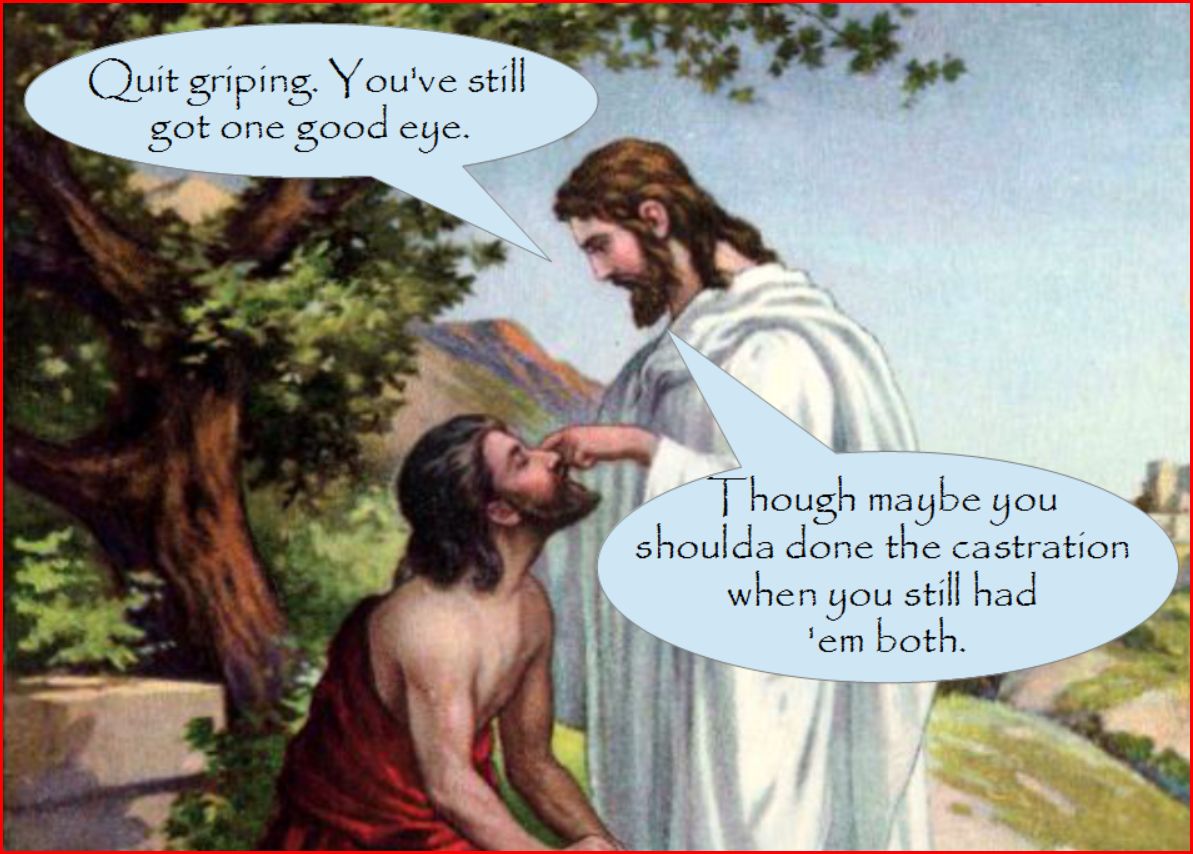
EyesYou hear the one about the blind Christian bloke with only one hand and no balls? And he did it all to himself! Cut off his hand, gouged out his eyes and castrated himself. When asked why he’d done it the man explained, ‘I’m a follower of Jesus and when he tells me to do something, I do it. My self-mutilation is my witness to what a great guy he is. He wouldn’t steer me wrong.’

Sure enough, the normal people who heard him were incredulous, until one of them looked in the Bible and found the very instructions to which the eyeless, testicle-free, one-handed believer referred.

In Matthew’s gospel chapter 5, Jesus is talking about lusting after a woman, which in his eyes (he still had both of his) is as bad as having sex with her. Course it isn’t, not by a long way, but he tells his followers, ‘If your right eye causes you to sin, tear it out and throw it away; it is better for you to lose one of your members than for your whole body to be thrown into hell’ (Matthew 5.29).

A bit drastic perhaps, but there it is; the Son of God is clear about how to avoid the sin of checking out a member of the opposite sex. That’s why you see so many one-eyed Christians around the place because they all take his admonition very seriously.

Except… you don’t. Either Christians ignore him entirely on this one or they never look at the opposite sex with an eye to sexual congress. We all know they’re like the rest of us in this respect – some, as Jimmy Carter once famously did, are honest enough to admit it – and some even act on it; the divorce rate among Christians is not the same as it is for everyone else just because they get tired of being married.

Perhaps though Jesus is being metaphorical when he proposes that gouging out one’s eyes is the best way to deal with lust. Not surprisingly, Christians prefer this possibility. In The Method and Message of Jesus’ Teachings, Robert Stein argues that:

what Jesus was seeking to convey to his listeners by this use of overstatement was the need to remove from their lives anything that might cause them to sin… Jesus is saying in effect, “Tear out anything in your life that is causing you to sin and keeping you from God”.

If that was his intention, Jesus might have actually used these words. If he wants to say ‘in effect’ that the believer should jettison anything from his life that causes him to sin then why doesn’t he?

But eyes are not enough. You gotta get rid of that wanking* hand too (the context of Jesus’ comments is specifically sexual and entirely male orientated throughout these verses): ‘And if your right hand causes you to sin, cut it off and throw it away; it is better for you to lose one of your members than for your whole body to go into hell’ (Matthew 5.30). This must be why we see so many one-handed Christians…

The difficulty with interpreting these and other verses metaphorically is that Christians want to claim that the Bible is the literal ‘word of God’ and then want select parts of it to be metaphorical – and guess who they think should do the selecting. But they can’t have it both ways. Even if they could, how would they know which parts to interpret literally and which symbolically? Perhaps the Holy Spirit tells them, or maybe, and more likely, it’s just their personal preferences. After all, who wants to lose eyes and hands just for being human?

If that’s not enough, Jesus encourages other mutilations for the sake of his Kingdom when he reveals in Matthew 19.12 that ‘there are eunuchs who have made themselves eunuchs for the sake of the Kingdom of heaven. Let anyone accept this who can’. No Christians today seem able to ‘accept’ this recommendation, either; what a truly feeble bunch they are, putting their testicles before the Kingdom!

It seems likely that, given he believed the end of the age was fast approaching, Jesus actually meant what he said, counting on the probability (as he saw it) that anyone who followed his ridiculous suggestions would not be eyeless or handless for long. They would, at the resurrection, be fully restored to live in the Kingdom where, according to Matthew 22.30, they would not be troubled by either impure thoughts or marriage itself (and so wouldn’t need those testicles anyway).

Whichever way you cut it (off) – literally or metaphorically – Jesus words in these verses are remarkably idiotic. Throughout history there have been some individuals, like the dude we started with, who have indeed made themselves eunuchs for the cause. But the vast majority of male Christians have always dismissed this advice or have decided JC was only speaking metaphorically (as he always is when they don’t like what he’s telling them to do).**

So next time True Believers start thundering on about the evils of same-sex marriage and gay sex, tell them to get their own house in order first. A little amputation is all that the Lord requires.


* ‘Jerking off’, for any Americans reading.

**Read more in my (five star reviewed!) book Why Christians Don’t Do What Jesus Tells Them To …And What They Believe Instead, available from Amazon.