Why We Can’t Return To Christian Values

There has been a spate of articles recently advocating for a return to Christian values in the UK. Some, like that by Madeline Grant, don’t specify which values they have in mind. Nonetheless, Ms Grant worries about these unspecified values being replaced by the ‘terrible new gods’ of wokeism, while Douglas Murray – an agnostic commentator I admire and enjoy a great deal – argues for the revival of Christian forgiveness. Elsewhere, Richard Dawkins repeats his call for the preservation of ‘cultural Christianity’ in the face of less ‘decent’ religions like Islam.

I’m sure there are good arguments to be made for exercising more forgiveness both in our personal and national lives, though the idea is not without its difficulties. Dawkins too is right to express concerns that the vacuum that may be left as Christianity declines might be filled with more unsavoury and less charitable values.

But what are the Christian values that these writers see less of in modern life? For Dawkins it’s the chiming of church bells and rousing hymns, which, as pleasant as these are (I would not like them to disappear either) do not have any bearing on our morals and values.

According to Total People, our values in the UK are Democracy, the Rule of Law, Respect & Tolerance and Personal Liberty. Certainly the UK has long regarded itself as a tolerant country – though those on the receiving end of intolerance in the past (early immigrants, gay people for example) might disagree – and we have always aspired to show respect without necessarily achieving it. Our morals on the other hand, especially with regard to sex (and Christians invariably mean sex when they talk about moral decline) have changed over the last 30 or so years, becoming more tolerant of, for example, same-sex relationships and less accepting of adulterous or abusive ones.

The question is, however, do we owe our values and morals to Christianity? I’ve argued before that we don’t. I’ve also tried to demonstrate that there is no time in the past we could pinpoint and say, ‘here’s where the country demonstrably and consistently upheld Biblical principles, showing us just how far we’ve fallen since.’ I applied this criterion to the USA when Don Camp suggested there was a now lost Christian golden age, taking random points in US history and demonstrating there never was a time when Christian values prevailed. Any such golden age is a myth, in the States, the UK and anywhere else. It always has been so; read Paul’s first letter to the church in Corinth to see how far even early cultists fell short of his ideals. Christians themselves don’t and never have demonstrated the high standards the bible demands.

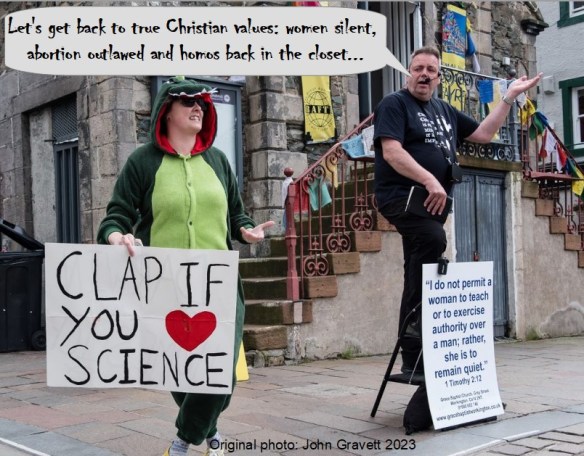
Why is this? Because Christian morals and values are impossible. Even those who think they live with the Holy Spirit in them fail, and frequently fail dramatically, to practise what they preach. They don’t love their enemies, a ridiculous expectation of Jesus’s that certainly can’t be extended to nations. Many of the righteous don’t demonstrate love for their neighbours (other than bombarding them with the gospel) and frequently showing an appalling lack of empathy for fellow-believers (take a look at the abuse that goes on in the church at large.) They don’t, in the main, sell all they have and give the proceeds to the poor; give to anyone and everyone who asks and give away their shirt as well as their jacket when it’s demanded of them. They do judge others but don’t – sorry, Douglas – forgive fellow-believers seventy times seven, let alone those of us they regard as the great unwashed. Perhaps it’s as well; what would a culture be like that repeatedly forgave its criminals, abusers and bullies?

The frequently ignored Golden Rule of ‘do onto others as you would have them do unto you’ predates Jesus by centuries, while the more realistic, secular version of it, tolerance and respect, likewise doesn’t derive from the Bible, Jesus or the church. This Holy Trinity of terrors demonstrate a marked absence of tolerance and respect for any positions other than their own and ‘personal liberty’ is not a concept known to them. Didn’t Jesus insist his followers become his slaves? His Father, meanwhile, is intolerant of everything human beings do and everything they are.

A Christian who commented on Grant’s article asked those who disputed her premise – that we need to return to Christian values – whether they would prefer to live in a country dominated by Christian, Islamic or Marxist values. I’ll leave his question with you – answers on a postcard please – and return to it next time.

.
Whatever happened to the Golden Rule?

Blog375a

So in everything, do to others what you would have them do to you, for this sums up the Law and the Prophets. (Matthew 7.12: New International Version)

In everything, treat others as you would want them to treat you, for this fulfils the law and the prophets. (Matthew 7.12: NET Bible)

I went to see a performance at the Edinburgh Fringe on Saturday. Actor David Benson presented a one-man show about the Cato Street Plot, which was an 1820 plan to assassinate the British Prime Minister and government (or possibly not. It was probably a set-up.)

During the show, Benson riffed on some of Jesus’ sayings, including the one above, about how we should treat one another in a country that claims to be Christian (as Britain did in 1820). ‘Do unto others’ has become known as The Golden Rule and like most rules it is largely ignored, even (or especially) by many who profess to be disciples of the man said to have formulated it. The principle is of course much older than the gospels.

When I returned home I caught up with some of my favourite blogs and read about:

A military organisation that promotes the separation of church and state in the U.S. on the receiving end of Christian hate mail.

A preacher who thinks the comedian Sarah Silverman should have her teeth smashed before dying prematurely and being sent to Hell.

The same preacher promising that the Jews, who he says are not God’s Chosen People, will be made to bow down before male Christians, who are.

A different pastor who recited Bible verses while allegedly assaulting an under-aged girl.

The cover-up of the sexual abuse of minors by the Jehovah’s Witness cult.

A Baptist Preacher charged with sexual assault.

Thousands of hateful messages, many from Christians, sent to Montreal Pride organisers.

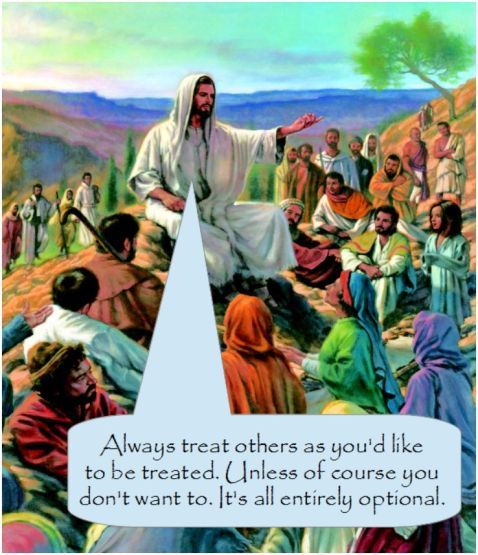
They just don’t get it, do they? Being a Christian means doing what Jesus says (doesn’t it?) and he says that in everything we should to treat others as we ourselves like to be treated. Note how all encompassing that is: in everything, meaning ‘in every circumstance, with no exception’.

My guess is that the majority of Christians like to be treated fairly, with kindness and respect. I know they do because they whine endlessly when they think they’re not being. Yet so many of them won’t extend the same fairness, kindness and respect – in every circumstance – to other people.

I recently saw a slogan that said ‘Why be racist, sexist, homophobic or transphobic when you could just be quiet’; too many Christians can’t even manage that. They feel compelled to hurl vitriolic insults and threats in defence of the most powerful being ever imagined (and he is imagined). Others think that people more vulnerable than themselves, children included, exist only for their own sexual gratification. These Christians have no interest in ‘In everything, treat others as you like to be treated’. It just doesn’t apply to them.

Strike up another failure for their Lord and Saviour, Jesus Christ.

Good For Nothing

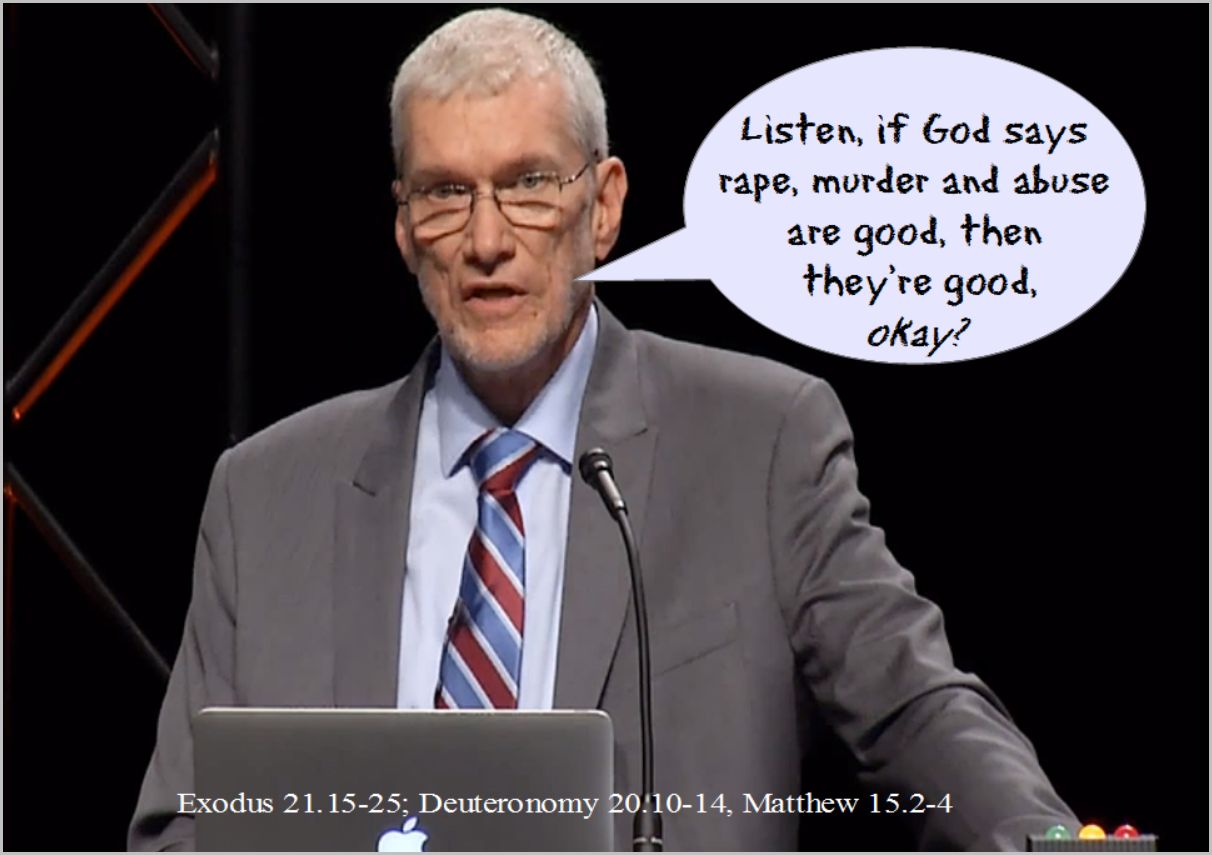
HamWhere does morality come from? Ken Ham of Answers In Genesis says it can only come from (his) God. Atheists have no grounds for morality, he claims, because, without a God to tell them, they’ve no way of knowing the difference between right and wrong .

As usual, Ham is being creative with the truth. Clearly atheists are as capable of being moral as anyone else. Equally and also evidently, Christians and other brands of believers are capable of deplorable immorality. Hardly a week goes by without more reports of Christians abusing, cheating, lying and killing in Jesus’ name.

Why do Christians act so despicably when, supposedly, they have God’s Spirit inside them – that’s the God from whom all morality flows, according to Ken Ham. Why doesn’t his indwelling Spirit guide Christians so that they always behave morally, or even just considerately?

I don’t have the answer. Perhaps Ken Ham or some other knowledgeable Christian can tell us.

No, morality doesn’t derive from any god. It has evolved, inevitably and like much of our behaviour, from our being social animals. Living in close proximity with other humans has meant we have developed ways of behaving that take these others into account, as well as the repercussions of our behaviour on ourselves.* The principle of treating others as we ourselves would like to be treated is very old – much older than Christianity.

Morality, though, is not absolute and is far from infallible. Non-believers, like the religious, make mistakes and don’t always treat others as they should. But the fact they behave well most of the time is evidence that behaving morally has nothing to do with a god, especially not the capricious, murderous psychopath of the Abrahamic religions.

Ken Ham’s position, and that of other religionists who tell us we have no grounds for morality without such a god, is as offensive as it is absurd.


* There are innumerable books that consider our moral evolution; you might like to try Frans De Waal’s Primates and Philosophers; How Morality Evolved or Christopher Boehms’s Moral Origins.


Who is the Pope to judge?

CoverSnip2I hope all you gay people out there are feeling mighty grateful to Pope Francis who this week had this to say about you:

“They say they exist. If someone is gay, who searches for the Lord and has goodwill, who am I to judge?” he added. “The Catechism of the Catholic Church explains this very well. It says they should not be marginalized because of this (orientation) but that they must be integrated into society.”

His words were widely reported as reflecting a new found tolerance of gay people by the Catholic church, the world’s largest cult. Nonsense; what his words reflect is the same old intolerance, this time with a smile on its face. The Pope’s words are disingenuous (“they say they exist”), condescending and conditional (‘happy to have you around  – but only so long as you’re interested in the same superstition as me’).

What the media generally failed to report was that Frankie also ‘reaffirmed the Catholic Church’s teaching that homosexual acts are a sin.’ Nor did most of it find it necessary to mention that ‘the official position of the Catholic Church on the issue is that while homosexual desires or attractions are not in themselves sinful, the physical acts are.’

This view, which is held by other Christians too, that gay people should forego all sexual fulfilment in their lives and deny themselves loving relationships, simply because these would, of necessity, be with a person of the same sex is not treating people as Christians themselves would like to be treated (Matthew 7.12). Would Christians be happy with an ‘acceptance’ that allowed them to believe whatever they wanted, provided they didn’t act upon it – church attendance, worship, hymn singing, prayer meetings and overt expressions of faith all disallowed?

I’m guessing not. And it is far more extreme to deny individuals something as integral to their identity as their sexuality, than it is to suppress the expression of a set of spurious beliefs.

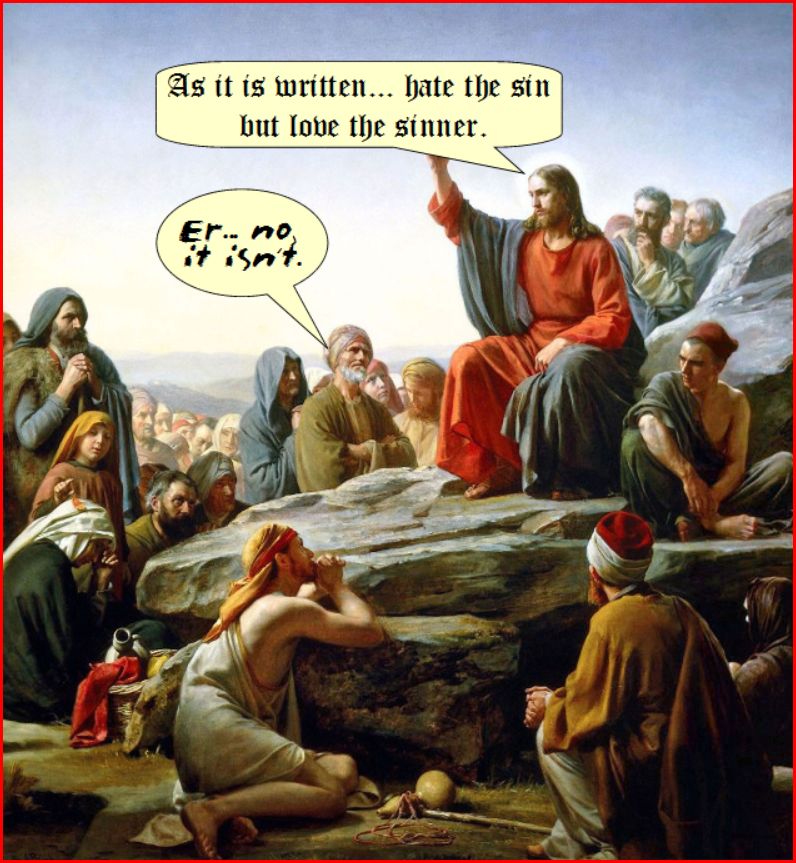
What the Pope was actually trotting out yesterday was the same old ‘hate the sin, love the sinner’ line. And there’s nothing remotely loving – or even biblical – about that. We are our behaviour, all of us, and are entitled to be loved (or not) for what we are, not in spite of it. If you can’t do that for another person, or group of people, then you’re not demonstrating love, whatever else you may be doing.

So, thanks Frankie, but no thanks. Until the Church you lead finds it in its heart to demonstrate real, unconditional love, your ‘tolerance’ is nothing more than an insulting irrelevance.

And another three things…

Following on from last time’s post, here, below the picture, are some more points I hold to be true.Image

Human behaviour, not sin.
There is no such thing as sin and we don’t need God’s forgiveness for it. Sin is a Christian construct with no purchase in the real world. There is only human behaviour – good, bad and indifferent. Most of it is indifferent (or neutral if you like) including what consenting adults may do with each other sexually. Some of it is good, in the sense that it benefits others significantly; some of it is bad – evil even – because of the harm it causes others. None of it is offensive to God, because there isn’t a God, and none of it is forgiven by him for the same reason. We are moral or not, without the assistance of a God. This seems to me to be self-evident: if there is no God and yet we are capable of behaving morally then any goodness cannot come from him. Similarly, immoral behaviour, of which the religious are as capable as the rest of us, is also entirely human.

We can draw two conclusions from this:

  1. No sin = nothing to be saved from = no redemption.

  2. The Christian claim that because atheists don’t acknowledge God they have no grounds for behaving morally is demonstrably false. The golden rule of ‘do unto others…’ is of value to us as social animals, which is why it pre-dates Jesus by millennia. Non-believers are as capable of behaving morally as believers, and sometimes a darn-sight better.

It is impossible to know the future.
No-one can know the future. The same Christians who castigate scientists for not being there when the Earth came into existence, have the temerity to claim they know what will happen at some indeterminate time in the future. There will be, they tell us, an anti-Christ, a rapture and Jesus will return from Heaven. They cannot know this of course, even if their holy book seems to predict it. It too was created by human beings with no more ability to read the future as anyone else. People have long wished they could tell what the future holds, which is why fortune tellers, astrologers, priests who read auspices, oracles and prophets have been with us throughout history. They’ve never been right, except by chance, for the simple expedient that humans are not gifted with accurate foresight. Biblical prophecies are no exception and have already failed, as we’ll see in future postings.

(Scientists do of course predict what the consequences of certain actions might be, but scientific predictions are subject to amendment as more information becomes available and are always open to refutation. They are not in the same category as prophecies purportedly from a deity who doesn’t actually exist.)

We are all humanists.
We are all utterly reliant on other human beings, not God, to help us fulfil our needs. Believers do not turn to God when they are hungry, because if they did they would starve (in spite of what Jesus says in Matthew 6.25). They don’t turn to him when they are ill, but look to medical science to help them (yes, there are a small minority of extremists who, because of faith in God and the likes of Mark 16.18, let their children die. But most believers don’t; they have faith in other humans, in science and technology). Christians and believers of all stripes demonstrate their faith, not in God but in human endeavours every time they get dressed, put on spectacles, catch a bus, board a plane, buy a house, switch on a computer, television or oven, use a phone, listen to music, admire art and marvel at architecture. None of this is God-given, it is all human, and believers, whatever else they may claim, are all humanists at heart, having far more faith in the human than the divine.