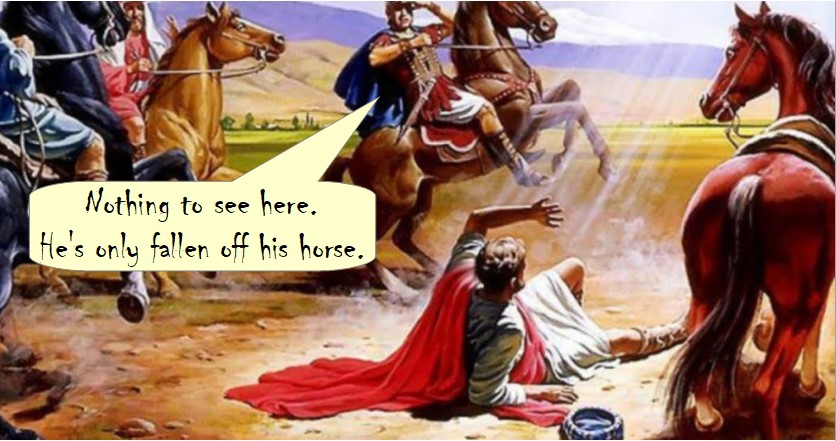
No God and the Domino Effect

This a response to Don Camp’s comment on my post The Evil of Christianity, in which he tries to isolate ‘the crux’ of our disagreement about the Faith.

You start, Don, from the assumption that there is a God. I, on the other hand, have considered the evidence and concluded that in all probability there isn’t one. Certainly not the Christian God. There may be a god out there somewhere that has no interest in human beings and their affairs, though I doubt it. As far as we humans are concerned such a deity is as good as non-existent, being entirely hypothetical. If it is out there, it certainly won’t be offended at my saying so.

Once I realised some years ago that a personal God did not exist a number of other things followed (or rather, collapsed):

No God means no Son of God or God Incarnate, no Saviour or Christ.

No God means no resurrection (which Paul makes clear was a work of God).

No God means no Holy Spirit.

No Holy Spirit means no regeneration of individuals to become new creations in God (you only have to look at Christians today to see this is the case.)

No God means no grand Salvation plan.

No God means no Heaven, no Final Judgement, no Kingdom of Heaven of Earth, no Eternal Life.

No God means the universe can’t have been created by him.

No God means no manipulation of evolution, no intervention in human history and no prophecy of things to come.

No God means that the world would be just as we find it: messy, beautiful, dangerous, turbulent, indifferent.

No God means prophecy is man-made and comes to pass at no greater rate than chance allows (i.e. practically zero.)

No God means conversations with ‘him’, revelations from him and visions of him are all imagined, generated by and within the human brain, which works in mysterious ways.

No God means no God-given morality. Morality is, as you say, culturally determined and so may and does change over time. (You can see this in the Bible itself where morality supposedly handed down by God for all time evolves throughout the Old Testament and into the new.)

No God means there is neither Sin nor Righteousness. These are religious concepts. The whole spectrum of human behaviour, from destructive to altruistic, is demonstrated by believers and non-believers alike.

No God means assertions like ‘the issue turns on what I perceive as good for me versus what God declares is good for me’ are illusory. What is good for you is what you have worked out, even if you think God had a hand in it. A supernatural being who doesn’t exist cannot be responsible for your well-being, though your church and the bible undoubtedly contributed to your conditioning.

No God means individuals must work out their own meaning and purpose. Some do, some don’t, as you observe, Don. This is as true of believers as it is for non-believers. Many atheists have managed it, or not, without having it imposed by religion. And despite what you say, Christianity is a religion. It is the epitome of religion.

No God means none of the Abrahamic religions are true and therefore Christianity and its ‘holy’ book, being based on an invalid premise, must be false. Most of the posts on this here blog are about demonstrating this fact.

No God means all gods are man-made, not all gods except one.

The crux of the matter is you believe in God while I see how unlikely it is that there is one. I’d agree with you if I could, Don, but then we’d both be wrong.

The Bible as Metaphor (again)

A few days ago, Dennis and I visited Penrith, a small market town a short distance from the city where we live. What a delight it was to discover that the street preacher who plagues our city – the humourless Dale McAlpine – also inflicts himself on this smaller place. We so enjoyed hearing him bellow out, as we manoeuvered past his confederates handing out poorly written tracts, that we were all sinners – ye, everyone of us – bound for hell.

As we stopped at an ATM we heard Dale announce how Jesus healed lepers and cured leprosy, which patently he did not. He said Jesus’ healing of lepers was a metaphor for what he could do for us all, by removing our sin and making us whole again. His metaphor schtick – an sophisticated one for a simple street preacher – put me in mind of our very own Camp commenter. As Sunday school teacher Don frequently reminds us, the Bible is a) literature and b) largely metaphorical.

In case he’s forgotten and is arguing this week that we should view the bible’s stories as historical accounts (his other favourite tack), here’s what he actually said:

Much of scripture is the kind of literature in which metaphor and other kinds of figurative language is common… you are out of touch with the literary character of ancient literature.

I hope you all feel thoroughly chastised by this. I know I do. Don was taking exception to my post in which I itemised the Bible’s mythical creatures, talking animals and impossible events. So, I’m going to take him, and Dale at their word and take a fresh look at the Bible’s use of ‘metaphor and other kinds of figurative language’

First though, let’s understand that metaphor and figurative language are distinctly literary techniques. In literature and sometimes in speech, metaphors make subtle comparisons and bring to mind a host of associations that the author does not then have to explain. Outside of fiction, they don’t have much of a function. We don’t, for example, attribute metaphorical meaning to human events and interactions in the real world. The present war in the middle east is not a metaphor for something else, like, for example, the warfare that Christians believe rages in the Spirit world. Sleepy Joe Biden’s activity, or lack of it, is not a metaphor for the present condition of the USA (let’s hope not anyway). Our personal relationships are not metaphors for something grander. There is no metaphor embedded in actual events or real world interactions.

No. Metaphor exists almost entirely in literature. While the occasional non-fiction author might add a metaphor for flourish, strictly speaking, metaphor exists in and for fiction and poetry. More than this, when, in fiction, ideas are expressed metaphorically, it signals that the surface meaning is of lesser significance. It is the underlying or hidden meaning that matters. The fiction is the vehicle by which the metaphorical truth is conveyed. Don admits as much in his comment.

Let’s try some illustrations. The underlying metaphor of The Great Gatsby, its truth, is the dark underside of the American dream. Its surface story isn’t real; it is fiction. The metaphor conveyed through Moby Dick – the fictional whale as well as the novel as a whole – is the destructive nature of obsession. Again, as powerful as this is, none of the story that conveys it actually happened. Frankenstein’s central metaphor is the danger that uncontrolled science represents to humankind. The story that carries this message is, however, pure invention. In All The Light We Cannot See, Light is the metaphor, as it frequently is. The characters’ insights into truth are what the author seeks to convey. The fiction is the vehicle of that truth. Choose your own example: fiction embodies metaphor, the ‘truth’ of the story. But the story itself is rarely an actual event. Even when it’s based on one, as the movies say, the narrative is extensively fictionalised.

So, let’s go back to Dale’s leprosy metaphor. In several gospel stories, the authors have Jesus cure lepers precisely to illustrate how he can heal people of their inner leprosy: their sinful nature. Jesus almost certainly did not heal any lepers; this is the fiction. The creators of the gospels designed the story to carry metaphorical meaning, which, in this case, is that Jesus can heal us from sin.

Likewise the stories in which he heals the blind; the blindness is metaphorical. The saviour opens people’s eyes to spiritual truth. He didn’t really cure blind people; that is the fictional vehicle for the metaphor.

He didn’t turn water into wine; the writers of the fourth gospel wanted to convey the spiritual ‘truth’ that the new cult’s beliefs were superseding old Jewish ones; a metaphor was a memorable way to do it.

Lazarus was not raised from the dead; the story is a metaphor to illustrate how God will raise believers at the last day.

The Romans did not execute Jesus; it was the spiritual rulers of the age who, according to Paul in 1 Corinthians 2:8, put the saviour to death. The Romans are the metaphor for the wickedness of these supernatural beings.

Jesus did not rise from the dead. This too is a metaphorical fiction.

How did I do, Don? I’ve interpreted isolated periscopes from the gospels metaphorically. I’ve borne in mind that metaphor and other figurative devices are purely literary, techniques in fiction. I’ve channelled the literary character of ancient literature as defined by you (except of course you never actually do define it.)

You are invited to respond. I offer to post your comment, if it is as lengthy as I expect it to be. You must, however, keep to the point and resist making personal jibes. Choose any of the miracles, healings or pericopes from the gospels and demonstrate that they are real historical events.

It matters to you and to other Christians that the events of Jesus’ life did happen. That they’re not just the invention of clever writers who, taking inspiration from Jewish scriptures, created metaphorical events to convey higher ‘truths’. So persuade us that at least one miracle, healing or episode is more than a literary device, a metaphor for some fanciful theological ‘truth’. Provide the evidence that it really happened. Claiming the disciples witnessed the miracles or healing won’t cut it, when the disciples are themselves characters in the stories, and metaphorical at that.

Evidence of God

As for evidence, you might be aware of Israel. That nation has been in the news much of late. So, without being flippant at all, I present Israel as evidence. Think about it. They are living the script written thousands of years ago. Not by chance.

Israel as evidence for the existence of God. I’m thinking about it as Don suggests.

Where did it all begin, this bizarre notion that one tribe in the Middle East was chosen by God to be his special people? According to the Genesis myth, it was when YHWH promised Abraham he’d be his best buddy forever and ever, so long as he mutilated his body and those of his sons in perpetuity. They would also have to keep every one of this bullying god’s 365 rules and regulations, including the petty and piffling ones. So far so good, apart from the fact it was all very one-sided, and the mutilation of course. You’d think this would’ve been a sign that things weren’t quite kosher, but no; Abraham and his descendants buy into it and almost straight away, YHWH begins to let them down.

God’s Chosen Ones soon find themselves slaves in Egypt. A second mythical character is needed – up pops Moses – to get them out of this scrape. Unfortunately, after Moses has finished chatting with YHWH, who identifies as a burning bush on the top of a mountain, the sulky deity feels slighted by something the Israelites are doing. As is his way, he has many of them slaughtered and the rest he forces to troop around the same small plot of land for 40 years. This is how best buddies treat each other!

Later, the Jews find themselves defeated by the Babylonians and are carted off into exile. This exile, which YHWH does nothing to prevent, lasts 70 years. Still, it leads to a pleasant song made famous by Boney M in 1978 so I suppose it was worth it.

For the next few hundred years, Israel falls under the rule of other nations more powerful than itself. Not to worry though, YHWH is still ‘looking after them’, particularly those who are slaughtered in the rebellions that ensue. As Robert Conner says in a recent comment on Debunking Christianity, ‘If Yahweh ever threatens to bless you and your children, just kill yourself and get it over with.’

Fast forward to the Roman occupation of Israel. YHWH, having undergone a makeover, reneges on his promise to take care of his Chosen Nation forever and ever and comes up with a different plan to save people from his own cussedness. Now, if they want to continue as his friend, they have to believe a supernatural being has returned from the dead.

Abandoned by God, as he now wants to be called, Jews who haven’t defected to the new faith see their sacred, eternal temple destroyed by the Romans in AD70. Thousands of them are massacred and the Jewish nation ceases to exist.

This sets the pattern for the next two millennia in which God’s new friends organise pogroms, massacres and vicious persecution of Jews. This culminates in the Final Solution of the Third Reich which seeks to eliminate the Jewish people entirely. While awaiting extermination in a concentration camp, Andrew Eames scrawls on the wall of his prison: ‘If there is a God, He will have to beg for my forgiveness.’ God allows six million of his Chosen People die at the hands at the Nazis.

Following the second world war, Israel takes possession of the area surrounding Jerusalem, then occupied by Palestinian Muslims who are themselves descended from earlier immigrants. Thousands on both sides are slaughtered in the conflict that follows. In 1948, after almost 2,000 years, Israel becomes a nation once again; not through any miracle of God but as a result of human endeavour and bloodshed.

Tension and further skirmishes followed, leading to the present day when Israel finds itself under attack by Hamas terrorists. Thousands of innocents – women, children and babies – have been slaughtered without mercy. Israel is, as I write, retaliating and intends to enact further vengeance. And where is God in all this? You guessed it: nowhere to be seen.

All of this, according to some – including the naive writer at the top of this post – serves as evidence of God’s existence. That Israel has persevered for so long, despite opposition, persecution and the holocaust is not, however, evidence of God, any more than the great cathedrals of the world are. It is instead testimony to the resilience, resolve and sheer bloody mindedness of the people themselves. Perhaps their belief in YHWH (they don’t of course recognise his Christian counterpart) has fuelled their persistence, as it has their territorial claims.

Jewish beliefs and history are not evidence that YHWH exists. If anything, his apparent abandonment* during their many trials and tribulations is evidence to the contrary.

*Of course a non-existent entity can’t actually abandon anything, any more than it can lend its support or favour one group of people over another.

The Power of Figments

Since his death, no-one has seen the itinerant preacher now known as Jesus. Some dispute he existed in the first place and certainly the character depicted in the gospels is a fictional creation. Assuming, however, that there was a real individual on whom this character was based, no-one has seen him in the flesh for 2000 years.

This includes all or most of those who wrote about him in the early years of the cult and whose writing now forms the New Testament. They either learnt about Jesus by word of mouth, as most converts throughout history have done, or they had a vision within their own heads of – what exactly? Those who write of such visions are either vague about what they claim they saw (Paul in Galatians 1: 15-16), are evidently making it up (John of Patmos in Revelation) or their visions are related by third parties many years down the line (Peter and Mary in the gospels, Stephen in Acts.)

Either way, the character believers claim to have seen or have heard about is a fantasy figure, not the rabbi who may or may not have existed. It’s this fantasy who lives in heaven snuggled up to his equally fictitious father, monitoring people’s behaviour, listening into their thoughts while simultaneously observing ‘the destruction the world is bringing on itself’ and doing not a thing to help.

All this from the heaven no Christian can locate: in another unspecified, invisible, undetectable dimension is the best they can offer. Nonetheless, if only more people would turn to him, Super-Jesus would help us solve the problems we face.

Because theocracies have always been so effective. They’ve led to a more just, fairer world as wise compassionate religionists have listened to their heavenly leaders – God, Allah, Jesus, Muhammed – and have applied the principles of their holy books to the running of their societies. Only obstinate sinners have had anything to fear from the arrangement: the degenerate, like those who have sex outside marriage and want access to contraceptives; gay people (especially); women who don’t know their place; women who seek abortions; the powerless; other, ‘inferior’ races; those of other religions, non-believers and atheists. None of these would have a place in Jesus’s new perfect world either, just as they don’t in societies controlled by Muhammed’s holy ones. Jesus’ agents will be happy to exterminate them, just as he instructs.

Magic Jesus as a figment of his followers’ imaginations can be made to say whatever they want, just as he was when he was being created by Paul and the gospel writers. He is a perpetual work in process, constantly changing to conform to what those who claim to know him want him to be. It’s easy to achieve this with a non-existent being from a non-existent place.

The Guilt Legacy

A couple of nights ago I watched a programme called Jehovah’s Witnesses and Me fronted by Rebekah Vardy. I know nothing about Rebekah apart from the fact she’s a footballer’s wife who was recently involved in a social media scandal, but her reflections on being brought up in a Jehovah’s Witness household were honest and sincere. She said one of the legacies of her mother being ‘disfellowshipped’ when she, Rebekah, was 8 was that she felt, and still feels, guilty about much in life. The teaching of the organisation was, as it is in many evangelical churches, that the individual is a hopeless sinner who cannot please Jehovah, though must nevertheless endeavour to work out their own salvation. For JWs this involved (and still does, as you may know from personal encounters with them) going door to door and standing for hours on end in public spaces with a trolley-full of Watchtower publications.

I could relate to Rebekah’s feelings of guilt. While not a Jehovah’s Witness (I was never that gullible) my years as a Christian left me with a legacy of guilt. For many years it was the dominant emotion of my life. While a Christian I constantly felt I was letting God down: not as good a Christian as those around me, not witnessing enough, listening to pop music instead of worship songs – practically anything could trigger my not-good-enough feelings. I also felt responsible for anything that went wrong, even when I couldn’t possibly be, and guilt about my secret sexual feelings and, most especially that I wasn’t been a good enough father. To this day, I feel awful if I’m unable to help with my grown-up children’s problems. I am moving away from such fruitless thinking, and recognise that possibly I am naturally inclined to blame myself for events both within and outside my control. Christianity nonetheless exacerbated the problem, with its emphasis on the sinful worthlessness of the individual who is nothing without Jesus. I have, I’m pleased to say, got a lot better since abandoning its negative anti-human philosophy.

What scars has religion left those of you who are escapees from religion with? I’d be more then pleased to hear it’s none, but most of the ex-Christians I know have not come away unscathed. Feel free to share in the comments.

The Evolution of Jesus I: from Itinerant Preacher to Death-Defying Vision

Image by Doppler, from YouTube video The Evolution of Jesus Christ.


Everything evolves. Not just Life, but the Mind, Personality, Morality and Culture. This is the thesis of Matt Ridley’s book, The Evolution of Everything: How Small Changes Transform Our World, in which he demonstrates that everything, from the Economy and Technology to Government and Education, were originally, and to some extent remain, bottom up phenomenon. Each emerged because of the developments that had preceded them; for this reason, they couldn’t arrive before they did, but their arrival, when it came, was inevitable. The time was right. Once each did arrive, it embarked on an inexorable process of change. It evolved.

‘Everything’, of course, includes Religion. As Ridley says (p259):

Further evidence for the man-made nature of gods comes from their evolutionary history. It is a little-known fact, but gods evolve. There is a steady and gradual transformation through human history not only from polytheism to monotheism, but from gods who are touchy, foolish, randy and greedy people, who just happen to be immortal, to disembodied and virtuous spirits living in an entirely different realm and concerned mainly with virtue. Contrast the vengeful and irritable Jehovah of the Old Testament with the loving Christian God of today.’

This is undoubtedly the case (Ridley presents his evidence); religion is an entirely human enterprise that developed from the bottom up. It too evolved. As Ridley shows, there is no other way.

While Ridley doesn’t discuss it, this evolutionary process applies to Jesus too. This seems to me apparent, rather than a little-known fact. He didn’t spring from nowhere; the time was right for him. By the start of what is now the first century, an apocalyptic brand of Judaism had emerged, inspired in part by the book of Daniel and other late Old Testament prophecy. It was whipped to fever pitch during the Roman occupation. People were anticipating that the Messiah would soon rescue them by force; the time was right for him to appear. And appear he did, in multiple forms, all of them eliminated by the Romans. Jesus was one of these.

He began either as an itinerant preacher with delusions of grandeur or he was an imaginary being whom a few people thought miraculously appeared to them. It doesn’t matter which; even if he existed, he very quickly evolved into a supernatural being. As an itinerant preacher he would have wandered around a small part of Palestine with a handful of followers, mouthing platitudes and predicting that God’s Kingdom would soon be arriving, and that he would be its king. Instead, he was executed for insurgency. Shortly afterwards, a couple of his followers swore they’d seen him alive again. With this claim Jesus made an evolutionary leap, from troublesome Jewish preacher to death-defying vision.

His evolution was underway.

To be continued…

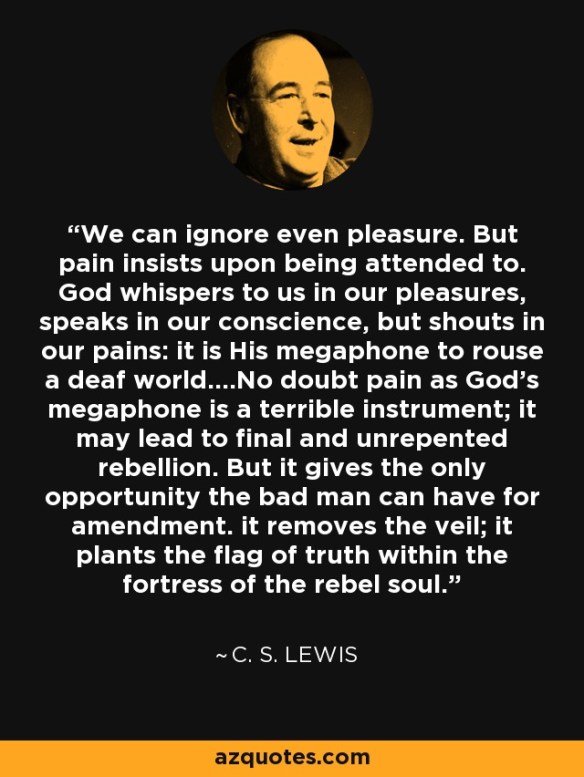
God’s Megaphone?

from his book, The Problem Of Pain

Does the Christian God use pain to draw people to himself? Assuming for a moment that such a God exists, does he use human suffering to make followers for himself?

There is no evidence in the Bible to suggest he does. To be sure, the Bible has a fair amount to say about pain. It claims that suffering is a means by which God either chastens Christians (Hebrews 12.7) or strengthens them (Romans 5.3-5), but this is exclusively for people who already believe. The Bible does not say non-believers are afflicted as a means of drawing them closer to God; the idea is unbiblical.

Let’s assume then that while this notion finds no support in the bible, Christians have learnt over the centuries, perhaps though extra-biblical revelation, that God does use pain in this way. What does this tell us about God? That he’s a being whose principal way of making human beings pay attention to him is by causing (or allowing) them to suffer frequently unbearable pain and anguish.

What sort of God is this? Not one who loves the world and cares for humans far more than he does mere sparrows (Matthew 6.26). He’s more an unpleasant, sadistic bully: the jock who backs you up against the wall, grips your balls and squeezes hard.

Maybe that’s how it is. The God who created the universe is just such a being; a moral monster, as commenter koseighty puts it. It’s easy to see how he might be: human beings suffer, yet there’s (supposedly) a God who loves them; therefore pain and suffering must at the very least be sanctioned by God, or, more likely, delivered by him. This, after all, is the story of the Old Testament. The God so arrived at though is a thoroughly human creation, a means of minimising cognitive dissonance by reconciling human suffering and a God who supposedly cares.

One more assumption is needed. Let’s assume this time that despite the odds, this character really exists. Does his strategy work? Does inflicting pain and anguish on people make them, as Lewis suggests, cry out to the One doing (or allowing) the inflicting and compel them to love him? It seems unlikely; I can’t find any evidence online of anyone claiming that pain or anguish brought them to God. From a personal perspective, I can honestly say that in times of distress or suffering I have never, post-deconversion, called out to God or any supernatural entity for help. I’ve never interpreted my suffering as his calling me closer and have never, since escaping Christianity, succumbed to his malicious charms. (What I did do occasionally, following my deconversion, was to convince myself that my suffering was a punishment from God – for leaving him behind, being gay or something I’d done. These feelings disappeared when I embraced fully the fact that the Christian God isn’t real.)

Where does this leave the Christian with, as Lewis puts it, ‘the problem of pain’? How do they reconcile a loving God who allows or even causes human beings to suffer? They can’t. Instead they spout empty platitudes that they think let their indifferent, imaginary God off the hook. Just look at the meaningless theo-babble religious leaders came up with in 2004 after a tsunami hit Indonesia, killing 227,898 people.

Leave God out of the equation, however, and there are far better explanations for why humans suffer. ‘Shit happens’ is far more convincing than anything the religious have to offer. Physical pain is the body’s reaction to damage. It is an imperfect system that frequently overreacts or fires up even after damage is repaired (I know this having fibromyalgia). That’s what it is to have, to be, a physical body. Anguish comes from random acts of nature, the violence and cruelty we inflict on each other and the death of loved ones, much of which is beyond human control. ‘Thoughts and prayers’ are useless in ameliorating this kind of suffering. Measures to restrict people’s access to weapons undoubtedly helps, as it has in countries with politicians with sufficient strength and intelligence to enact gun-control legislation. Without it, as in Ulvalde recently, more children will die, more parents will experience terrible anguish and another massacre is inevitable. God won’t stop it.

Suffering is not symbolic of something else; it is not ‘God’s megaphone’ or an opportunity for others to point those afflicted to Christ’s light (or any other bullshit that involves the supernatural.) Pain simply is. It is our lot as physical bodies to endure or alleviate it as best we can.

Christians’ Favourite Delusions 36: The Universe Is Fine-Tuned For Life.

  1. The return of an old favourite(?)! Christians’ Favourite Delusions. The other 35 posts in this series start here

The vast universe, almost infinite in size, was created, according to Christians, with the sole purpose of bringing us humans and the other creatures who share this planet with us into existence. This fine-tuning argument is used to ‘prove’ that the God of the Bible really exists.

According to Ken Ham, we’re the only life forms in the universe, while other Christians speculate that there may be other intelligent creatures out there somewhere. If there are, then, so says the late Larry Norman, ‘(Jesus) has been there once already and has died to save their souls.’*

The fine-tuning argument proposes that the universe exists so that this minute, insignificant blue dot we live on, and possibly a few other tiny specks, could produce life of some sort. But what of the rest of the universe: the other 99.9999% that doesn’t have life, because it is entirely hostile to it; the vast bulk of the universe that is made up of nebulae, gas clouds, lethal radiation, black holes, anti-matter and lifeless planets?

Taken as a whole, the universe is cold and dead; not finely-tuned for anything, let alone life. But don’t take my word for it. Here’s Richard Carrier debunking the whole fine-tuning argument:

‘[T]he only way we could exist without a God is by an extremely improbable chemical accident, and the only way an extremely improbable chemical accident is likely to occur is in a universe that’s vastly old and vastly large; so atheism predicts a vastly old and large universe; theism does not …

Likewise, if chance produced this universe, we should expect it to be only barely conducive to life, indeed almost entirely lethal to it (as in fact it is), since there are vastly more ways to get those universes by chance selection, than to get a universe perfectly suited to life throughout. … Design predicts exactly the opposite.’

And here, several more scientists, philosophers and other interested parties do the same thing:

https://www.skeptic.com/reading_room/non-fine-tuned-universe/

https://www.google.com/amp/s/www.technologyreview.com/2011/01/18/260556/evidence-emerges-that-laws-of-physics-are-not-fine-tuned-for-life/amp/

https://whyevolutionistrue.com/2015/12/31/sean-carroll-debunks-the-fine-tuning-argument-for-god/

https://m.youtube.com/watch?v=Z9O5wXsgqrc

https://www.goodreads.com/quotes/tag/fine-tuning-argument-debunked

https://www.answers-in-reason.com/religion/christianity/fine-tuning-debunked-holy-koolaid/

Life is remarkable, it is true (but then we would think that, wouldn’t we, when we are it) but it is no more remarkable than any other of the phenomena the universe has produced in its 13.7 billion years of its current existence. No God has been required for any of it. No fine-tuning = no fine-tuner

*In his 1972 song ‘UFO’.

Battle Of The Magic Books

Don Camp replies (in blue) to my previous post. My responses are in black.

There are multiple reason for rejecting Mormonism. The primary reason is similar to discerning between a fake $20 bill and the real thing. The fake just doesn’t feel like the real thing. Of course, that test requires that one knows what a $20 bill feels like. Anyone who does not know is easily fooled.

In fact, if you don’t know what the real thing is like, it is impossible to identify a fake. You might notice an ink smudge and a difference in paper, but who is to say one is fake and the other is not?

This presupposes that your version of Christianity is ‘the real thing’. For a Jew, Judaism is the real thing and Christianity the Johnny-come-lately fake. All you’re saying here is that you ‘feel’ your version of Christianity is the real thing and you ‘feel’ Mormonism isn’t. This isn’t persuasive. I know, for reasons other than intuition, that Christianity isn’t the real thing. To use your analogy, it is the twenty dollar bill received in change when in the UK a twenty pound note is the ‘real thing’.

But since you have a knowledge of literature, Neil, why not apply those standards? Nice concession there, Don. The Bible is indeed literature and as such deserves to have the same standards applied to it as any other work of fiction.

Is the Bible and the narrative in the Bible coherent?? No. Its central character is ridiculously inconsistent. Described as an unchanging God, he changes from book to book and most noticeably between the Old and New Testaments. As someone commented on Debunking Christianity recently, it’s as if he ate a Snickers bar between the two. (He does get hungry again towards the end of the NT, when he reverts to being an omnipotent Putin.)

As the protagonist undergoes his major rewrite, the plot also suddenly deviates, becoming a completely different story. It starts by being about this poorly conceived character’s ‘everlasting covenant’ with his chosen people, but then two thirds of the way through, this everlasting covenant is scrapped and replaced with a new, largely incoherent deal involving a human sacrifice that the unchanging God has previously said he finds abhorrent.

Does it stick together and develop a single theme across the whole? No, it doesn’t ‘stick together’, not unless you ignore the gaping inconsistencies in character and plotting, and its overall implausibility.

Do you know what the theme of the Bible is, Neil? Yes, thank you, Don. Condescending of you to ask. Any apparent consistency is because the writers of the second part of the story had access to the first part. They plundered it for their own purposes, drastically altering it so that it suited their new theme. That is why much of the Jesus story appears to be foreshadowed in the Old Testament. The Jesus story – and it is a story – is built on events and episodes they found there.

Remember that the Mormons tell us that the Book of Mormon is an extension of the Bible and that the people of the Americas were related to the Jews and held to the basic truths of the Jews. (Remember also the Mormons believe that Jesus appeared to these people in the New World shortly after his resurrection.) So if you put the Torah and the Book of Mormon together, is the narrative coherent? Does it develop a single theme? The Old testament and the New Testament are a coherent whole, but I do not think the Old Testament and the Book of Mormon are. As you can tell, I dispute that the Old and New Testament are a coherent whole. The Old Testament and the Book of Mormon aren’t either. That lack of coherency becomes even more obvious when we compare God in the Old Testament with God in the Book of Mormon. The person of Jesus is also inconsistent in the Book of Mormon with the Bible.

But they’re inconsistent within the Bible too, Don. Compare John’s Jesus with Mark’s. Compare Paul’s beatific Christ with Revelation’s grotesquely super-powered warlord.

Of course, the standard explanation by Latter Day Saints is that the Bible has not been adequately translated, though I know of no place where they can demonstrate that claim. There are significant translation problems with the Bible, which mainstream scholars consider at length. Mormon desperation to resolve these conflicts is the same as that demonstrated by Christian theologians.

Finally, there is a matter of provenance. We know in very good detail where the Bible came from.

We do? We know who Matthew, Mark, Luke and John actually were? No, we don’t nor do we know where they wrote or what their sources were. We don’t have the autographs (originals) of any of the New Testament documents but we do know some of them are forgeries and others have been tampered with.

There are many copies, especially for the New Testament, and there are many commentaries of both the OT and NT from very early in the their history. Proving what? Only that they were copied, frequently inaccurately. The copies are all much later than the probable time of composition. The commentaries are similarly far removed from them; there are commentaries on the Book of Mormon much closer to its composition.

What is the provenance of the Book of Mormon? It apparently appeared magically out of nowhere pretty recently. No mention in any other literature of its existence. It did appear magically! Oh ye of little faith! God sent an angel, like he does numerous times in the Bible, and told Joseph Smith to translate the golden tablets. The NT books were similarly created, with God breathing his word into cult followers as they wrote. God, angels, Holy Spirit, magic – all of a muchness, don’t you think?

No copy is available to examine. Nor of the original copies of anything in the Bible.

That is not to speak of the total lack of any archaeological evidence for the Mormon claims of Jews in the Americas. Mormons dispute this, of course. There are similar problems with some locations mentioned in the Bible. More fatally, most of what the Bible promises has proven false. For example: Jesus’ imminent return, his guarantee of miracles, believers becoming new creations. (Paul spends much of his time ticking off these ‘new creations’ who remain resolutely unreformed.)

So, I would say the Book of Mormon fails on all levels.

I would too. As does the Bible for the reasons I’ve outlined, and despite your special pleading. You don’t apply the same rigour in your consideration of the Bible that you do to Latter Day Saint fiction. Why is this, Don?

Religion Is Bad For You. Always.

There is no upside to religion. All of them, not just Christianity (though certainly including it.)

Religion makes its adherents judgmental. Those who don’t share their beliefs are ‘other’. Consider the terms that religion has spawned to describe non-believers: infidel, heathen, goy, kafir, lost, dissenter, apostate, scoffer, profaner, blasphemer, paynim, idolater, deviant. Needless to say, none of these is designed to flatter. If not being ostracised – ‘be not unequally yoked with unbelievers,’ says Paul with his usual magnanimity – then non-believers are viewed as sinners in need of redemption or enlightenment, as souls to be won, fodder for evangelism. Never as people to be respected or accepted for themselves.

Religion causes its adherents to abandon their critical faculties, accentuating their irrationality so that even those with some intellectual capacity sacrifice it to subscribe to a primitive, superstitious mind-set. They believe in miraculous resurrections, eternal life, covenants with the gods that necessitate the genital mutilation of children, prayer, ‘prophets’, demons, spirits, pantheons of supernatural beings and myths about the end of the world. There’s no evidence for any of this fantasy material, yet the believer trades in their good sense to embrace all of it to one degree or another.

Religion cultivates delusion. Otherwise intelligent believers are convinced their god talks to them in their heads while they, in turn, are capable of projecting their thoughts into the deity’s mind. They take part in rituals they believe appease him, assume  specific body positions and dress up in items of clothing they think, for some unfathomable reason, will help them gain favour in his sight. They believe they’re possessed by the spirit of the deity that enables them to do miraculous things, not least survive their own deaths.

Religion discourages thinking for oneself. Believers are told, either by a ‘holy’ book or by those who claim they know gods’ thoughts, what they should think about vaccinations, abortion, women, homosexuality, politics, guns, the significance of climate change, the state of the world and all those godawful infidels. Woe betide the believer who dissents from the views of their particular cult or sect.

Religion compels its adherents to deny reality. Believers are in a constant state of denial: about the world, evolution, education, the rights of others, the fact people can be moral without religion and death itself. They deny that the universe and nature are as they would be if there were no gods; that religion has contributed nothing to our understanding of the world, has discovered nothing, invented nothing. All of this is the equivalent of sticking one’s fingers in one’s ears and singing na-na na-na. Who needs facts when you’ve got third rate fantasy?

Religion causes hatred. There are those within every religion who seek to eliminate their enemies. They fly planes into buildings, shoot and stab innocent people in the street because they regard them as profaners or blasphemers, and call for the death penalty for those they regard as deviant.

Religion prevents people from being themselves. It convinces them they are worthless sinners in dire need of forgiveness and then imposes an inauthenticity on them. It makes them assume a role that reflects, or so they think, the nature of their saviour or prophet. It’s all an act, held in place by the collective pressure of fellow believers, in churches, synagogues, temples, mosques and kingdom halls. It is not life affirming but life denying. It is a lie.

Anyone care to defend religion? One particular version of it? What has your pet religion contributed to the world? What good does it serve?