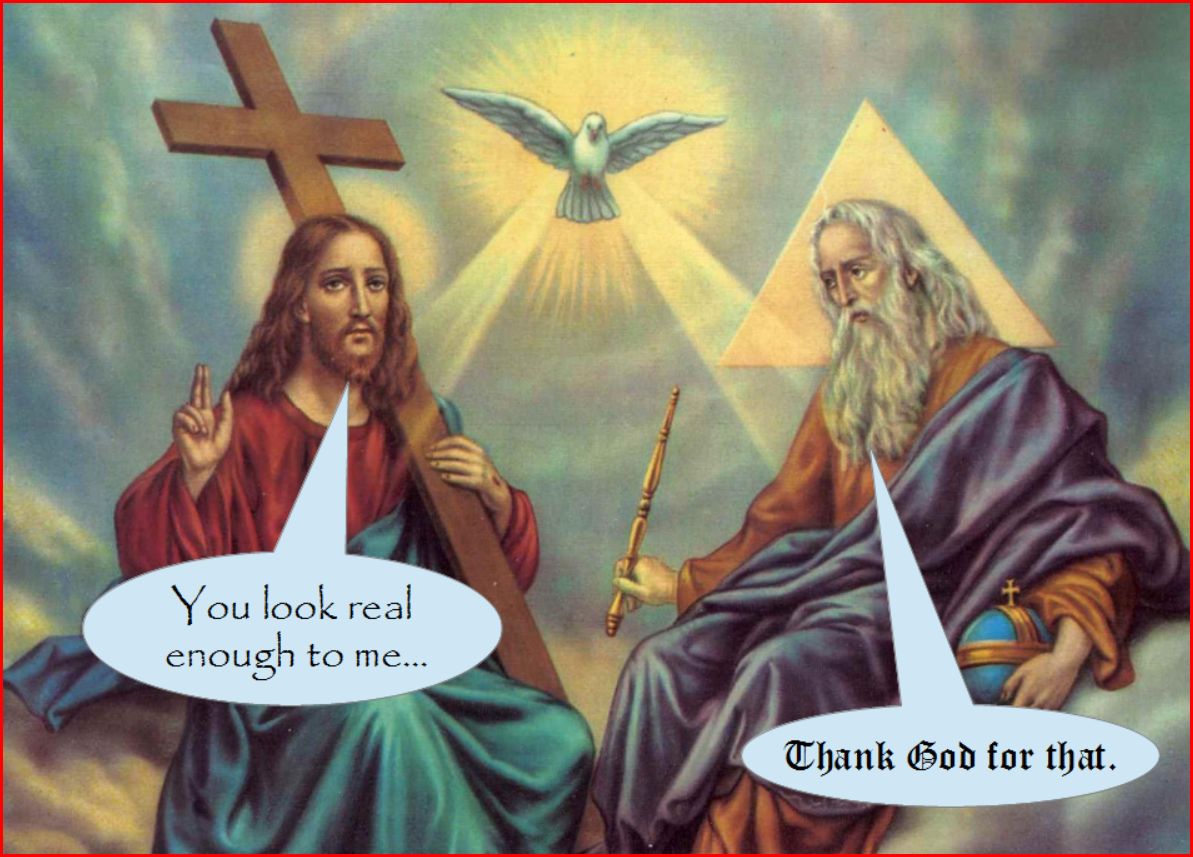
What would this world look like if there was no God?

TrinityIf God did not exist –

Human beings would frequently behave like territorial primates;

Nature would be the result of a mindless and heartless process;

Sex and death would be the drivers of its development;

Life would be a cruel struggle for most living creatures, including many humans;

Disease and illness would be pervasive, except where humans themselves had eliminated them;

The world would be largely indifferent to human aspiration;

The brain would find pattern and impose order where none existed;

Progress would be due entirely to human endeavour;

People would adopt the beliefs of their culture and be entirely convinced they alone were right.

Hang on a minute! Isn’t this the world we already have? It’s just like Julia Sweeney says: ‘The world behaves exactly as you expect it would if there were no Supreme Being, no Supreme Consciousness, and no supernatural’. A world without God is exactly the world we’ve got. And the world we’ve got is evidentially a world without a God.

Surely that’s no bad thing.

Unbelievable: Why, despite everything, Christianity makes absolutely no sense whatsoever.

Spufford2

There’s no real reason to believe in God.

 
Who says so? Francis Spufford in his book Unapologetic: Why, Despite Everything, Christianity Can Still Make Surprising Emotional Sense. Francis does believe though, because sometimes when he’s alone – specially after a tiff with his wife or while sitting quietly in church – he gets a funny feeling. And this feeling is so funny, as in weird, that it can only be God. Or so Frank says, slipping in as many four letter words as he can, just to show he’s not a namby-pamby sort of believer. (He’s especially proud of his new term for ‘sin’: ‘the Human Propensity to Fuck things Up’, or HPtFtU for short.)

 
What’s more, even though there are a hundred and one reasons to think there isn’t a God, at least not one who cares about us (think pain, suffering, death, evolution and his complete lack of interest in his creation, all of which Frank’s acknowledges) he nevertheless wants to say that he does believe because, you know… feelings.

 
That’s not all. This God Frank’s decided to believe in as result of feeling funny, is the Christian God. He could’ve turned out to be Allah or Zeus or Ra, but he isn’t, because Frank feels he’s the Christian God, for no other reason than he wants him to be. Then, in a final leap of faith, he decides that Yeshua, as he insists on calling Jesus, is the walking embodiment of this God, and he rewrites the gospel story so that it fits with the funny feeling that kick-started his delusion in the first place.

 
And so we have it from the horse’s mouth; a Christian who’s proud to admit there’s nothing remotely rational or empirical about believing in God. Faith, he confirms, is no more than some very human, very peculiar feelings that lead you merrily down whichever garden path you choose to take.

Christians’ Favourite Delusions 17: You get saved by being washed in the blood of the lamb (Romans 5.9 etc)

Sermon

Not according to Jesus you don’t. And you’d think he being the Son of God – not to mention ‘the lamb’ in question – he’d be in a position to know. So how does Jesus say you find salvation? No magic formula for him; no quick-fix like the one Paul invents after Jesus’ death.

So how does Jesus reckon you get right with God? For once, he couldn’t be clearer:

If you want to receive God’s forgiveness, first you have to give it:

For if you forgive men their trespasses your heavenly Father also will forgive you; but if you do not forgive neither will your Father forgive your trespasses. (Matthew 6.14)

If you want to avoid God’s judgement… then don’t judge others:

Judge not that you be not judged. For with the judgement you pronounce you will be judged, and the measure you give will be the measure you get. (Matthew 7.1-2)

If you want God to show you mercy, first show mercy yourself:

Blessed are the merciful, for they shall obtain mercy. (Matthew 5.7)

If you want to experience God’s riches and blessings, first you have to be generous yourself:

Give and it will be given to you; good measure, pressed down, shaken together, running over, put into your lap. For the measure you give will be the measure you get back. (Luke 6.38)

If you want God to show you compassion, first be compassionate yourself:

The King will say to those at his right hand… I was hungry and you gave me food, I was thirsty and you gave me drink, I was a stranger and you welcomed me… Then the righteous will answer him, ‘Lord when did we see the hungry and feed thee or thirsty and give thee drink? And when did we see thee a stranger and welcome thee?… And the King will answer them, Truly I say to you, as you did it to one of the least of these my brethren, you did it to me’.

Then he will say to those at his left hand, ‘Depart from me, you cursed, into the eternal fire prepared for the devil and his angels, for I was hungry and you gave me no food, I was thirsty and you gave me no drink, I was a stranger and you did not welcome me… Truly I say to you, as you did it not to one of the least of these my brethren, you did it not to me’. (Matthew 25.34-46)

That’s right, Jesus sees being saved as a ‘measure for measure’ arrangement and uses that exact term repeatedly in order to get the message across. According to the ‘Son of God’, you get what you give. And, what’s more, his death has nothing to do with it. He starts preaching his ‘gospel’ message long before he’s crucified (Mark 1.14) and it most definitely doesn’t include any mystical piggy-backing on a death that hasn’t happened yet in order to gain God’s favour. Even Matthew, Mark and Luke don’t add it to their stories of Jesus, even though they wrote them after he died and after Paul’s invention of his magic salvation formula.

Jesus’ ‘measure-for measure’ gospel is very different from Paul’s – the two are incompatible in fact, though Christians refuse to see this. Jesus’ gospel is practical and moral: the way to God’s heart, he says, is through treating others, even those who might despise us, with kindness and compassion.

This, though, is too hard for Christians. They find Paul’s spiritualised, self-centred version of salvation much more to their taste.

Is your marriage a Bible-based marriage? Find out in this simple quiz.

Marry

1. If you’re male, have you got more than one wife? If female, has your husband got other wives as well as you?

If you answer ‘yes’, score 20 points: all the heroes of the Old Testament had multiple wives: Abraham, Esau, Jacob, Moses, Gideon, David, Solomon… Clearly, polygamy is acceptable in the sight of the Lord (Exodus 21.10). Even Jesus approves of it (Matthew 5.17-18 & 25.1-13). Well done if this is you! No points for a ‘no’ answer – you’ve a lot of catching up to do.

2. Are you married to your brother/sister?

20 for yes, nothing for no. God approves of this kind of marriage in Genesis 16.1-3 and as we know, the answer’s always in Genesis.

3. Ladies, were you a virgin on your wedding night?

Score 20 if you were. Otherwise, get your husband to have you stoned to death on your dad’s doorstep, like Deuteronomy 22.13-21 says he should.

4. Were you under-age when you married?

No problem. In fact, the minimum age for marriage in the Jesus’ time was 12 for girls, 13 for boys so award yourself 25 bonus points if you were still a child when you married. Nothing though if you were ancient… like say, 20.

 5. Have you taken a slave as a partner?

Another 30 points if you have. God’s quite happy with this arrangement. The slave might not be, but who cares? Not God, that’s for sure (Numbers 31.17-18).

6. Men, did you buy your bride off her father? Ladies were you bought?

To really qualify as a bible-based marriage, this how it should be. You gonna argue with Genesis 34.12 and Exodus 22.16-17? Score 50 if money changed hands. Nothing if it you did it all for love: that’s not biblical at all.

7. Have you married your brother’s newly widowed wife?

70 points if you did – it’s what God expects (Genesis 38.9 & Deuteronomy 25.5-10). Just don’t spill your semen on the ground on the wedding night because, as Onan discovered, sex-obsessed Yahweh will smite thee if thou doest.

 8. Do you frolic naked round a garden with your partner without bothering with a formal marriage service?

Score 50 if this Adam-and-Eve arrangement is for you – they didn’t bother with marriage either. You get nothing if you keep your clothes on while gardening.

9. Do you hate your spouse (and children and your father and mother)?

Jesus says you should, in Luke 14.26, so that you can follow him more zealously. If you really can’t stand the person you’ve married to, score 100 points. You get nothing if you’re soppy and still love your wife or husband.

10. Christians, have you shunned marriage altogether?

Your Saviour says you should (Luke 20.34-35) otherwise you’re not worthy of a place in his Kingdom (offer good only in the first century, admittedly). Award yourself 200 points if you’ve been obedient, nothing if you decided this instruction wasn’t for you and you went ahead and got married anyway!

11. Have you castrated yourself for Jesus’ sake?

He thinks you should, you know; see Matthew 19.12. Score 500 (though not much else) for taking this final step. You get nothing for deciding – again! – that this isn’t for you. What are you? A man or a wimp?

12. Have you divorced your partner and married another?

True, Jesus doesn’t approve of divorce, but more ‘bible-believing’ Christians divorce in the USA than non-believers (32% compared with 30%) and they can’t all be wrong. What does Jesus know anyway? Add an extra 100 points to your score for every additional wife or husband you’ve had.

So how did you do?

0. Forget it. You marriage is worthless in the eyes of the Lord.

5-100: What must God think? You’ve really let him down. He offers you all these attractive, biblical options – multiple wives, slaves, siblings  – and you’ve not gone for any of them. For shame.

100-199: Get serious! You think biblical marriage is negotiable?

200 and 499. Pretty good. You’ve avoided marriage, just like JC says you should.

Over 500: You’ve definitely got a bible-based marriage. Or rather, you haven’t, and no balls either.

It’s time you all believed in my religion!

Reblog

Picture reblogged from GodlessEngineer via Friendly Atheist.

My God doesn’t like people who don’t worship Him in the right sort of way (the way I do).

My God thinks people – except people like me – don’t behave properly.

My God has sent a special book to me and my mates his chosen people. It’s a bit muddled but non-believers ignore it at their peril.

My God says followers of all other religions have got it wrong.

My God says Christians need to be cured of their unhealthy behaviour.

My God says Christians shouldn’t be allowed to ‘marry’ because they don’t do sex right (the way I do).

My God says it’s not hateful to say these things. The fact I’m telling you shows how loving I am, pointing out how everyone else has got the wrong beliefs, the wrong morals and doesn’t do sex right. If you’ve any sense, you’ll start to believe in my God and then you’ll be saved like me.

And when you do that, my God will like you too.

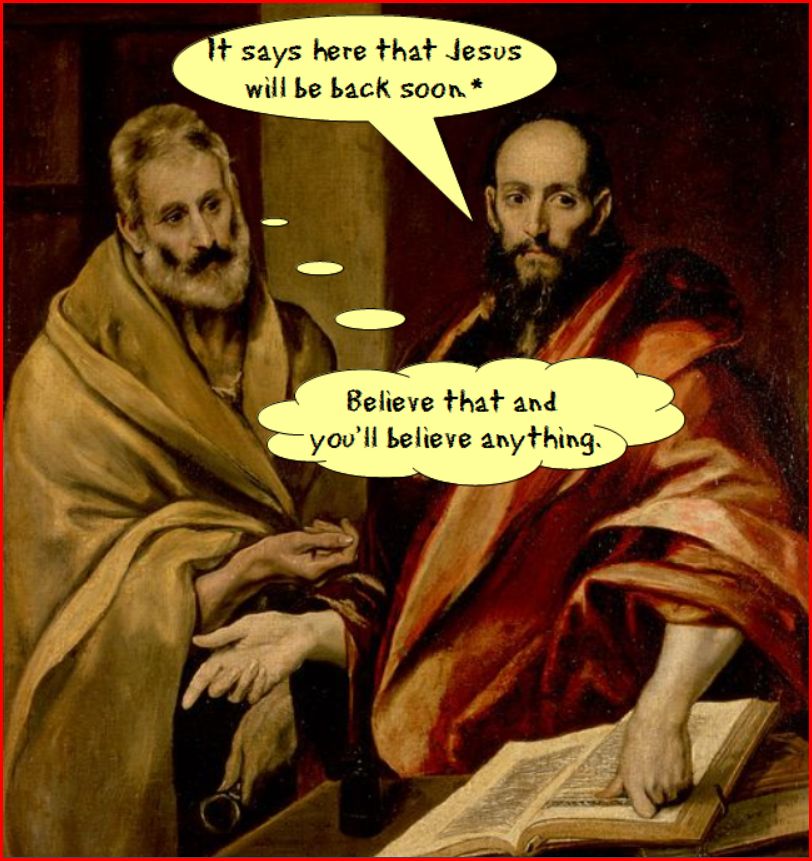
Why God is always a no-show

Peter&Paul

* And he should know; he wrote it in 1 Thessalonians 4:17, 5:23 and elsewhere.

When Jesus thought his world had got into such a bad way, he felt sure God would intervene and turn things around. But God didn’t and Jesus was executed instead.

When St Paul became convinced things couldn’t go on as they were, he told everyone that God was going to send Jesus back to Earth to sort it all out. But God didn’t and Paul was executed instead.

When people were accused of witchcraft in the middle ages, they waited for God to intervene and save them. But God was a no-show, again, and 100,000 were tortured or killed as a result.

When millions of Jews were taken to concentration camps in the second world war, they too prayed for God to save them. Once more, he failed to make an appearance and instead over six million men, women and children were exterminated by the Nazis.

When right-wing Christians today complain that the world has abandoned God (because, you know, gay marriage) they feel sure that God will intervene to judge us all and put things ‘right’. So far, he’s conspicuous by his absence.

God is always a no-show, despite the pleas of his followers, despite the earnest belief of his alleged son, despite the plight of his chosen people, despite those today who claim to know his will. Could this be because he has no existence outside the imaginations of human beings?

It surely could; a being that has failed to show himself throughout the history of mankind is a being that doesn’t exist.

Notes:

1) Jesus says God will intervene: Matthew 24:27, 30-31, 34, Luke 21:27-28 etc.

2) Witchcraft figures from An Atheist’s History of Belief:Understanding Our Most Extraordinary Invention by Matthew Kneale, p198

3) While I’ve linked one site that reflects modern Christian belief, there are thousands more of the same sort. Google ‘God will judge America’ for an unhealthy sample.

Christians’ Favourite Delusions 14: You can’t prove God doesn’t exist

Santa-JehovahThere’s a difference between ‘proving’ something – technically this can only be done in mathematics and, arguably, the law – and ‘demonstrating’ it. Atheists can’t ‘prove’ God doesn’t exist, any more than believers can prove he does. But it is relatively easy to demonstrate how unlikely it is that there’s a God. We can apply the scientific method. Science doesn’t ‘prove’ either – it demonstrates the likelihood of something being the case by looking at the evidence and determining from it whether a phenomenon is probable or improbable.

This is in fact what Christians (and Muslims and Hindus and Jews) do when they decide whether the tooth fairy, Santa Claus and Zeus exist; from the evidence they conclude, quite rightly, that it’s highly improbable.

What believers don’t do, though atheists do, is apply the same test to their own god. They say, ‘well of course these other supernatural beings don’t exist. There’s no evidence for them whatsoever. But as for my God, well, I’m not going to apply the same rigour. I know he exists because, erm, I believe in him, I have faith.’

But faith and belief are not evidence. Warm fuzzy feelings are not evidence of God. Books written by ancient tribesmen and other superstitious people aren’t either. Even the universe itself is not evidence, when its existence can be explained without recourse to him. Similarly the development of life on Earth and human beings themselves; all are better explained by other means, none of which require God.

It is fairly safe to conclude as a result that the reason they don’t require him is because he wasn’t involved. And he wasn’t involved because he doesn’t exist, in just the same way Santa Claus wasn’t involved when you received your Christmas presents this week. This may not be the ‘proof’ Christians and others would like, but it does demonstrate, more than adequately, the improbability of God’s existence.

Christians’ Favourite Delusions 13: Jesus was born of a virgin… er, no, was descended from David, er…

XmasMessage

That most fallible of books, the Bible, often wants it both ways. Never more so than when it’s trying to add spin to its central character. It wants us to believe that Jesus was born of a virgin, with no human male involved, and, at the same time, that he was physically descended from King David on his dad’s side.

He’s got to be born of David’s line, you see, because the prophecies say the Messiah will be just that. The writer of Acts (‘Luke’) knows this and tells his readers that God promised King David that through ‘the fruit of his loins, according to the flesh, he would raise up Christ to sit on his throne’. (Acts 2.30, KJV; my emphasis). The reference is to 2 Samuel 7:12, where Yahweh does indeed appear to tell David that he ‘will raise up your offspring after you, who shall come forth from your body, and I will establish his Kingdom’. This is to be a physical descendancy and is the reason for all those ‘begats’ at the start of some of the gospels; they are there to establish Jesus’ (supposed) royal descent on his father’s side. This is why, in his gospel, Luke contrives to get Mary and Joseph to Bethlehem for the birth: ‘Joseph also went from the town of Nazareth in Galilee to Judea, to the city of David called Bethlehem, because he was descended from the house and family of David‘ (Luke 2.4). That’s Joseph who was descended from David. Not Mary, not Jesus’ uncle Charlie and not the Almighty himself. Joseph.

Perversely, it is also Luke who insists that Jesus is the product of divine impregnation and a virgin birth (Luke 1.32-35). Why doesn’t he realise that if Jesus was virginally conceived, he cannot be the fruit of any human male’s loins? Luke includes the virgin conception and birth in his nativity story while insisting, in both his gospel and in Acts, that Jesus is the Messiah precisely because he is a physical descendant of David (see, for example, Luke 1.27, 1.32, 1.69, 2.4, 2.11, 3.31, 18.38, 20.41). But Jesus can’t be both a physical descendent of David through Joseph and the result of the God helping himself to a nice young girl. Could it be the two conflicting accounts were written by different fantasists?

So, is Jesus the ‘Son of God’ because he was created by the Almighty’s impregnation of Mary or is he the Messiah because he’s King David’s descendant ‘according to the flesh’? Either Jesus is physically descended from David or he is a being conceived through divine rape, like other mythical god-men of the ancient world.

He cannot be both – though he could, of course, be neither.

Christians – Jesus commands you be perfect. So why are you not?

Despot

‘Be perfect, therefore, as your heavenly Father is perfect’ is how he puts it. He even tells you in the verses that precede this one how to go about it: you have to turn the other cheek; give untiringly to anyone who asks (including to those who would sue you); constantly go the extra mile and show only love to your enemies (Matthew 5.38-48).

It is often claimed, even by those who don’t believe in him as their saviour, that Jesus offered great moral teaching. C. S. Lewis though cautions against seeing Jesus as simply ‘a great human teacher’ when, in Lewis’s eyes, he was far more besides. I would, however, invite Christians to consider whether the moral guidance Jesus provides here in Matthew’s gospel – how to be perfect – is in any sense ‘great’. If you think it is, because Jesus is Lord, a perfect being and possibly God himself, then you need to explain why it is never followed by Christians, and never has been. You need to explain why you yourself do not apply it in your life, because as sure as poached eggs is poached eggs, you do not. You do not give to all who ask; you do not invite insult after insult and violence on top of violence; you do not give away valuable and essential possessions when threatened with legal action – you are actually more likely to do the suing. And lest you think I am advocating a far more exacting morality for Christians than I would from anyone else, you will bear in mind, won’t you, that is not I who insists on it, but your Saviour. It’s not unreasonable under the circumstances to expect to see you obeying him.

As it is fairly safe to assume you don’t, I would further invite you to consider whether instead of being ‘great’, Jesus’ teaching is in fact unreasonable, unrealistic and impractical. If you are honest, you will acknowledge that it is all of these things, not great or timeless at all, and that is why you, and all other Christians worldwide, disregard it. Jesus’ moral teaching is no more than a series of reckless suggestions, a formula that applied can lead only to poverty and abuse, not perfection. You are probably wise to ignore it and to spend your time instead opposing gay marriage and judging the rest of us.

Revised from ‘Be Perfect’ in my book, Why Christians Don’t Do What Jesus Tells Them To …And What They Believe Instead, available from Amazon.

Notes: C. S. Lewis on Jesus as ‘great human teacher’: Mere Christianity (1952) William Collins & Sons, Glasgow, p52.

Christians’ Favourite Delusions 10: God cares

dead-sparrow

@deadsparrow had just made his final Tweet.

The Bible says God controls the weather and 53% of Americans believe it. A further 17% say they don’t know or don’t want to say whether he does; evidently, they aren’t prepared to rule out the possibility, otherwise they would be among the 29% who know that he doesn’t.

I wonder what those who were hit yesterday by the typhoon in the Philippines think of God’s control of the elements? Was the destruction he brought about by sending Haiyan a mark of his love for mankind? Presumably not – destroying lives, homes, possessions and livelihoods hardly speaks of love.

Was it a punishment then? Right-wing Christians like to tell us that natural disasters are God’s judgement on human sin and our ‘shaking a fist at God‘ by redefining marriage to include gay people.  Why then does he consistently punish those in parts of the world which are already prone to extreme weather conditions? Why does he punish those who are already poor? Why does he send devastating weather to the fifth largest Christian country in the world, which doesn’t recognise gay marriage? It’s all a bit indiscriminate, wouldn’t you say? What sort of Almighty are we dealing with here, who can’t even direct his punishments at the right target? It doesn’t speak much of ‘control’.

Jesus might claim, in Matthew 10:28-31, that God cares even for the sparrows but this is another of his bare-faced lies. The evidence tells us otherwise: ‘God’ doesn’t care how many humans perish in storms, typhoons, tornadoes, tsunamis, earthquakes and all manner of natural disasters. He doesn’t care how many lose their homes, loved ones and all they’ve worked for.

The weather, in fact, is random, largely unpredictable and indifferent to human and animal needs. If God exists, then he is as indiscriminate and uncaring as the weather he supposedly creates. But of course God is not needed to explain the weather; science tells us how it occurs in terms that don’t involve him. His very superfluousness – the same superfluousness we find in evolution and all the other ‘laws’ of the universe – is all the evidence we need that he doesn’t exist.