Is there anybody out there?

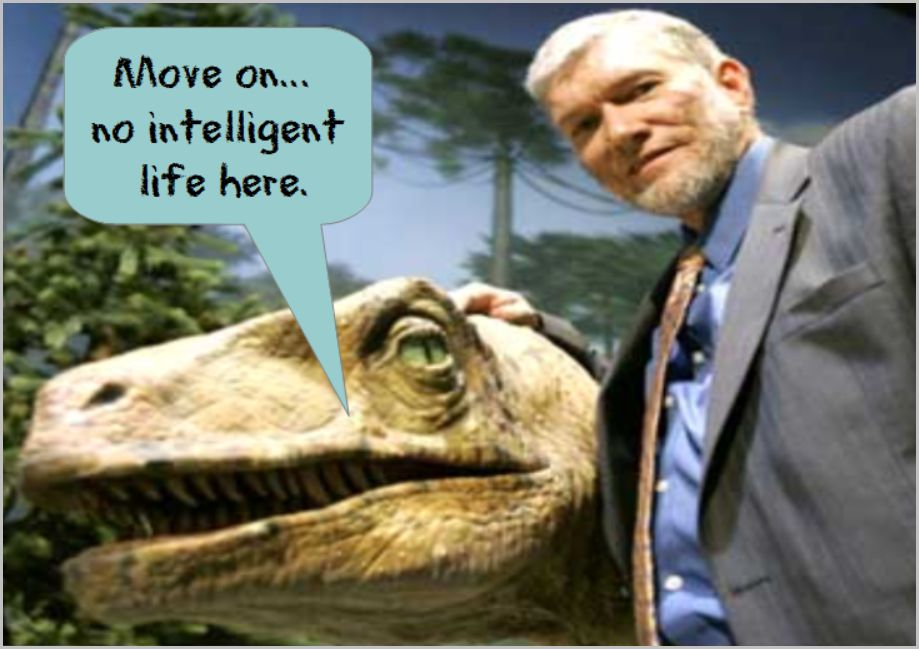
KenAnyone searching for extra-terrestrial life – NASA, SETI and so on – can stop now. We know definitively that there isn’t any out there. How do we know? Because Ken Ham says so. The Bible – Genesis specifically – doesn’t mention life on other planets so that means there isn’t:

(T)he notion of alien life does not square well with Scripture. The earth is unique. God designed the earth for life. The other planets have an entirely different purpose than does the earth, and thus, they are designed differently… where does the Bible discuss the creation of life on the “lights in the expanse of the heavens”? There is no such description because the lights in the expanse were not designed to accommodate life [this is utter gibberish; life within stars? Who has ever suggested that?] God gave care of the earth to man, but the heavens are the Lord’s. From a biblical perspective, extraterrestrial life does not seem reasonable.

But hang on a minute! The Bible doesn’t mention other planets, never mind whether there’s life on them. It doesn’t tell us anything about cultures outside of a small area in the Middle East, doesn’t mention the Americas or Australasia, doesn’t have anything to say about microbes, anti-biotics, computers or technology in general. It must follow, therefore – to use Ken’s logic – that none of these things exist either.

The reason the Bible doesn’t mention any of them, and a myriad of other things, is not because they don’t exist but because the primitive priests and ignorant scribes who wrote Genesis and the rest of Ken’s magic book didn’t know that they did. They had no concept that the Earth is a planet, let alone that there are others; they had no idea that the sun is a star, nor that other stars, which they thought were attached to the inner surface of a canopy surrounding the Earth, are suns. With such a limited cosmology, the possibility that there might be life on other planets was as alien to them as, well, aliens themselves.

Whether there is extra-terrestrial life, and whether any of it is intelligent, we may never know. But either way, Ham’s deity will have no bearing on it, nor it on the Christian God. The existence of aliens, like their absence, won’t breathe life into an already discredited idea.

The Late Great Planet Earth

burning_earth1The scene yesterday as the Earth finally came to an end.


Today is an illusion. You are not really here. Yesterday, the world ended, destroyed with the fire predicted in 2 Peter 3. The Lord finally had enough and set fire to the Earth and obliterated it.

So how was it for you?

And here we are today, the day after it all ended. Doesn’t it seem remarkably like it was before the terrible events of yesterday?

As ever, God mispoke to his trusted servants who took the time to tell us of our impending doom.

Never mind. Let’s set another date. Oh wait – we already have. Plenty to choose from here. You can’t have too many ends-of-the-world, can you?


Idiotic Stuff Jesus Said 13: We Don’t Need No Educashun

MegaBut you are not to be called rabbi (teacher), for you have one teacher, and you are all brothers. And call no man your father on earth, for you have one Father, who is in heaven. Neither be called instructors, for you have one instructor, the Christ. The greatest among you shall be your servant. Whoever exalts himself will be humbled, and whoever humbles himself will be exalted. Matthew 23:8-12

Evidently these words were put into Jesus’ mouth by the community that produced Matthew’s gospel and reflect the egalitarianism and communism that characterised it. The phrase that gives away their origins is ‘you have one instructor; the Christ’. ‘The Christ’, as we know, was a creation of the early church and it is highly unlikely Jesus would have referred to himself in such a way. In the synoptic gospels he is reticent even about claiming the Jewish title of Messiah for himself. In any case, the reference is patently to a third party, and is by an author or interpolator who subscribes to the later, supernatural Christ.

In the unlikely event, then, that these words emanated from Jesus himself, all they achieve is to demonstrate his lack of understanding of human psychology. Even as ‘Matthew’ set about recording them, the newly founded church was already ignoring them, which is perhaps why he felt the need to have Jesus say them. Here’s Ephesians 4.11, written by someone pretending to be Paul round about 80-100CE, contradicting them:

Christ gave (us) the apostles, the prophets, the evangelists, the shepherds and teachers…

The imposter who wrote 1 Timothy (5:17) up to a hundred years after Jesus’ death goes further, endorsing the exaltation of those who teach and rule others:

Let the elders who rule well be considered worthy of double honour, especially those who labour in preaching and teaching.

Why? Because human beings like hierarchies. Almost all human societies are hierarchical in nature and groups invariably arrange themselves hierarchically. There will always be people who see themselves as leaders and teachers and still others who look to those who’ve set themselves up as authorities to tell them what to do.

Despite what Jesus or ‘Matthew’ might have preferred – everyone being equal while those who ‘exalt’ themselves are humbled – it just doesn’t happen in human culture. It certainly wasn’t happening in the movement that emerged following Jesus’ death, in the church that existed by the time Matthew was making Jesus say that the only authority Christians should recognise was God’s and his own. The institution that was appearing in place of the end of the age – an institution that Jesus neither anticipated nor instigated – could not function effectively as the simple band of ‘brothers’ he is made to suggest. It was in need of structure, and a hierarchy was it.

And so it was that, before long, the first popes emerged – ‘pope’ deriving from the Latin for ‘papa’. Each of these exalted figures would come to be referred to as ‘Holy Father’, a title still in use today. With complete disregard for Jesus’ instructions, other priests (meaning ‘elders’) in the Catholic church also assumed the title ‘father’. Evangelical churches, lest they think the Catholic church is the only guilty party, have their ‘pastors’, meaning ‘shepherds’, who, by definition, lead others. A common or garden ‘clergyman’ is a ‘learned man’, while a bishop is one who ‘looks down from above’. An archbishop is chief look-downer and exalted indeed. Elsewhere, showmen preachers in mega-churches ‘teach’ with a mixture of anecdote, wild conjecture and stuff they make up as they go along; tune into TV’s God channels for a taste of this particular brand of humility. The church in all its manifestations has, from the beginning, been hierarchical from top to bottom.

Jesus, however, didn’t want there to be a top or bottom; if Matthew 23.8-12 is to be believed, he commanded there shouldn’t be. He envisaged his followers living in harmony with everyone equal under his and God’s authority. No-one was to set themselves up as teacher or leader; no-one was to exalt themselves above others. If any did, they would need to be humbled. But this isn’t how human beings organise themselves, and never how the church has conducted itself. Shouldn’t he have known that?

Modern Day Martyr #94

A&ECherry picking had been a problem right from the start.

In case you missed it last time it happened, Christianity has been criminalised again. Yup, despite all the imprisonment of Jesus’ followers only a few short months ago (or was it weeks?) they’re all being rounded up again for no other reason than they’re Bible-believin’ Christians. True, they might have been incarcerated because they’re public officials who refuse to do their job because they believe God doesn’t want them to. True, they might have been divorced three times, married four and engaged in a little adultery along the way. But come on, be reasonable: ‘God’s standards’ don’t apply to Christians themselves; they’re for clobbering others with.

Naturally this isn’t how Christians themselves see it. Kim Davis, a county clerk in Kentucky charged with issuing marriage certificates, has been imprisoned – by a Christian judge at that – because she won’t issue them to same-sex couples. And that, according to Christo-fascist Matt Barber makes her a martyr. Plus, you know, the end of the world and what-not:

For the first time in American history a woman has been imprisoned by the government for merely exercising her Christian faith. War has been declared on Christ and His followers. And there’s no turning back.

Davis’s lawyer and fellow-believer, Matt Staver, goes even further. He equates her situation with the Nazis’ extermination of 6 million Jews:

Back in the 1930s, it began with the Jews, where they were evicted from public employment, then boycotted in their private employment, then stigmatized and that led to the gas chambers. This is the new persecution of Christians here in this country (the USA).

What melodrama! If only there was something in God’s Word™ that could’ve told Kimmy what to do before everything got out of hand.

Oh wait. What’s this in Romans 13?

Everyone must submit himself to the governing authorities, for there is no authority except that which God has established. The authorities that exist have been established by God. Consequently, he who rebels against the authority is rebelling against what God has instituted, and those who do so will bring judgement on themselves… it is necessary to submit to the authorities, not only because of possible punishment but also because of conscience (Romans 13.1-2 & 5).

Jeez, if only it were possible for Christians to ignore the bits of the Bible they don’t like.

Oh, I forgot… it is!

The imprisonment of a public servant who declines to serve the public and refuses to comply with the law does not mark the start of any war. It is not the fore-runner of a persecution such as we’ve never seen before. It is, rather, the predictable consequence of the same old Christian hypocrisy.

I Don’t Believe It

Fabric‘When you think about it’, the taller of the two men said, ‘there is no evidence whatsoever that God, nor indeed any supernatural being.

‘I suppose you’re right’, said the other.

‘With that realisation, my faith began to dissipate. I mean if there’s no God, no angels, demons or Christs, no Holy Spirit, devils, fairies or Santa Claus, then it must mean they’re just figments of the imagination. Take that human element out of the equation and what you’re left with is… well, the natural world and nothing else’.

‘I suppose not’, said the other.

‘From there one realises there is no point in praying – I mean, talking to a being who only exists in your own head. Or reading the Bible; one begins to see it as a very human book, which of course it is’.

‘I suppose so’, said the other.

‘It means too that Jesus can only have been a mortal man – of course he was – and that a good deal of his teaching – if we can believe it really was his and not simply invented by his followers – makes no sense whatever. It was only the eyes of misplaced faith that made it appear so’.

‘I suppose it doesn’t’, said the other.

‘I mean, “pray for whatever you need and God will supply it”. Who has ever believed that sort of thing anyway? No-one. Not really. We all know that doesn’t work; Jesus himself, one suspects. And as for the resurrection, well, if you read those accounts at face value all they saw – Mary Magdalene, Paul and the rest of them – all they saw were visions, not a real person. All in their minds, you see’.

‘I suppose I do’, said the other.

‘No, Christianity is nothing but false promises, failed prophecies – Jesus saying he’d return within his disciples’ lifetime – and impossible morality: “be perfect as your father in heaven is perfect”! Well, I’ve never met anyone who is, Christian or otherwise. Good people are good whether or not they’re Christians and the mean-spirited are mean-spirited whichever side of conversion they’re on.

‘I suppose so’, said the other, before seeing his chance to add, ‘well, that’s £1.80 for your Church Times, Archbishop. Will there be anything else?’

Rejecting Jesus – The Book

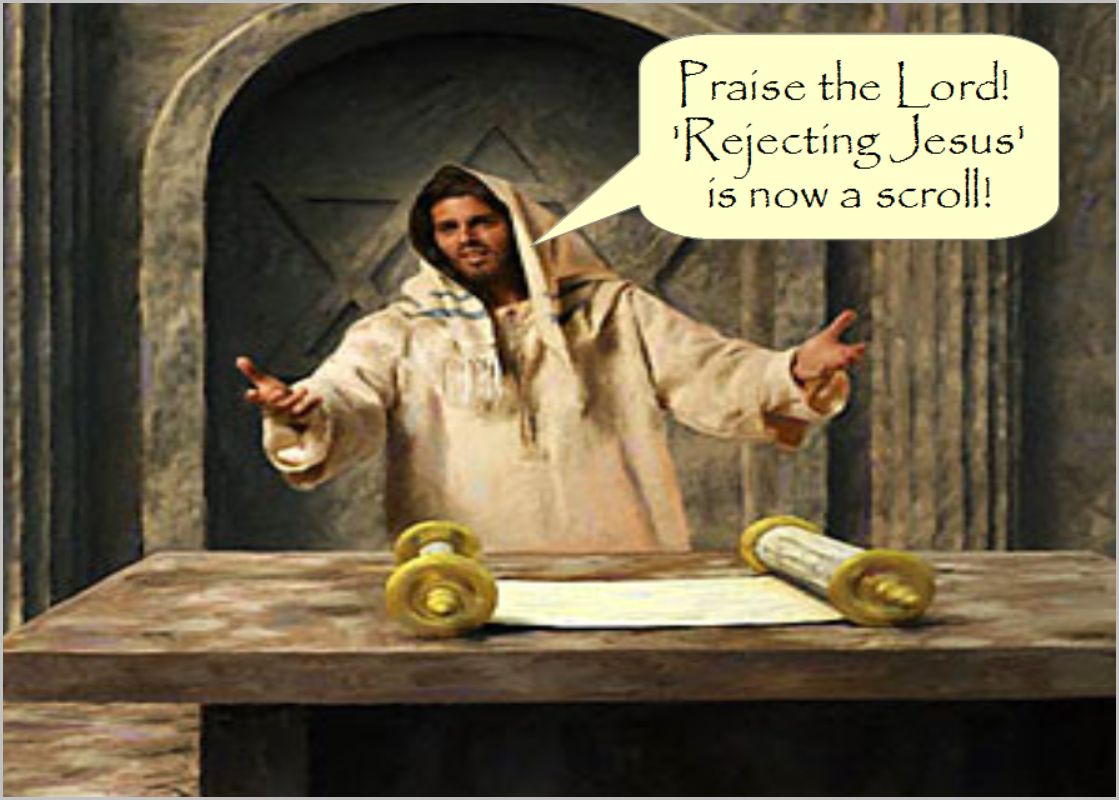
RJCoverIt’s a miracle! Rejecting Jesus is now in book form! And on Kindle too.

ScrollWell, not quite – sorry JC.

But you can now read Rejecting Jesus posts in the format the Son of God would surely have preferred if books had existed then the way they do now. The pictures are all present and correct too, in glorious B&W, for all first-century messiahs to enjoy.

Available here and here and also all over the world. Go, buy it, make disciples of all nations.


The Holy Spirit: transparently nonsense

CageIf anything is unsubstantiated fantasy, it’s the Holy Spirit. It – I know Christians prefer ‘he’, but the pronoun used in the Greek of the New Testament is more often neutralit began life as the comforting, fuzzy feeling the early believers got when they remembered their recently deceased leader. The same feeling that convinced them he was alive again in a sort of not-really-alive but as-good-as kind of way:

“He’s, like, alive-in-our-hearts and, hoo boy, what a buzz there is when a few of us get together and share that vibe at the same time. Far out, man. Hey, let’s put it in the story that this is exactly what he said it would be like when he was still alive!” (Matthew 18.20, sort of)

High on this feeling some believers started imagining they were actually in the dead leader’s presence and – miracle of miracles – could see him and commune with him (1 Corinthians 15.5-8). Such an experience, they felt, could only be from God and must, in some inexplicable way, actually be a part of God (1 Corinthians 2.10). And so the Holy Spirit – the capital letter version – was born. Spiritual highs had taken on independent existence as an aspect of God.

Except, of course, they didn’t. They remained feelings, amplified in and by a communal setting. And that’s what they are today. Which is how, when a Christian tells you the Holy Spirit prompts him or her to say or do certain things, the result is always in line with the teaching of his or her particular church or sect. So, for example, the interpretation of the scriptures to which the Holy Spirit leads a group of believers is fully in keeping with that of their denomination, church and pastor. Dissent is actively discouraged and those with different views are apostate, deceived by the devil and not led by the Spirit at all. Maybe, they’re told, they were never really Christians in the first place, which is remarkable, when the dissenters’ experience of the Spirit is every bit as real as the rest of the community’s. Experiencing one’s own thoughts and feelings usually is.

It never seems to occur to Christians how odd it is that this supposed aspect of God, the Spirit, leads different groups of believers down different, often contradictory, paths. How could it do that if it was truly of God? Why would it do that? It’s erratic, idiosyncratic methods are clear evidence of the human origin of its ‘working’. The Holy Spirit’s prompting is, as it was in the beginning, a communal feeling given ’embodiment’ by corporate consent. It even works effectively when believers are separated from each other, social pressure producing conformity.

Experiencing the Holy Spirit is not unlike the way those involved in a séance or in a ‘haunted’ house convince each other there is a presence in the room. These ‘ghosts’ are socially constructed too, from shared feelings and often not a little ‘guidance’ from those who claim to know better. The Holy Spirit is ‘realised’ in the same way, most clearly among a ‘worshipful’ group of Christians whipped up into a state of euphoria attributed to the work of the Spirit.

But the Holy Spirit is without independent existence in both origin and manifestation. It is human make-believe through and through. Any Christians who think otherwise are invited to provide evidence of the Spirit’s independent existence, separate from human emotions and imagination.

And the World Turns

SerpentOver at the wackily named ‘Cripplegate‘ blog, pastor Mike Riccardi has an urgent message. Mike, in case you’re wondering, is the Pastor of Local Outreach Ministries at Grace Community Church in Los Angeles. He also teaches Evangelism at The Master’s Seminary. His urgent message is that God is not happy and must be appeased.

As we already know, the most powerful, creative and omniscient being in the whole of the universe and beyond is so very easily upset. And as usual what’s upsetting him is the Gay. But that’s not all this time! Turns out he doesn’t like people changing sex and abortion too. The only way we can put things right with this petulant monster, pastor Mike tells us, is to preach and pray all the bad away, so that he will bless us – well, America anyway, which is all Mike is really concerned about – instead of punishing us.

God likes more than anything else to mete out punishment for the slightest infringement of his rules, even though he neglected to tell us what he thought of transgenderism and abortion when inspiring his Magic Word™. You will search in vain for mention of either in the Bible, or anything like them, so it’s a good job we’ve got pastor Mike to tell us what God really thinks. He ‘processes’ it thus:

these checkpoints of moral degradation – transgrenderism (sic), homosexualism and the destruction of marriage, and abortion – all stem from the same polluted fountain out of which even the first sin flowed: self-deification.

It’s because we want to be like God, Mike concludes, that we are morally polluted. Work that one out if you can.

Haven’t we been here before? We sure have. Go back 50 years and God’s emissaries on Earth warned that if we (i.e. the United States again) accepted inter-racial marriage, it would be the end of civilisation because – yes, you guessed – it was against God’s rules. His wrath should have rained down on everyone once inter-racial marriage passed into law, but for some reason it didn’t. Just as it didn’t when same-sex marriage became legal a little while back. Just as it didn’t because of feminism. Just as it didn’t over the devil’s music, rock and roll (still upsetting Christians and their God even today.) Just as it didn’t when Jesus told everyone that judgement was nigh two millennia ago. Just as it didn’t when the prophets of doom in the Old Testament insisted it would (for example in Jeremiah 23.10-12). Just as it didn’t when primitive humans sought to explain why the harvests had failed.

Always, it was that God or the gods were angry and would punish us if we didn’t mend our ways. “But,” you say (just like Pat Robertson), “disasters and calamities do follow our ‘disobedience’ and ‘degradation’”. Of course they do, and they precede them too, but that does not mean the one causes the other. There is no correlation between our supposed ‘moral pollution’ and natural disasters. The latter are random and indiscriminate events, not divine punishment.

It is a favourite occupation of human beings generally and those of a religious disposition specifically, to assume a higher power will punish us, in this life or the next, if we don’t adjust our behaviour and stop doing what it doesn’t like. This is usually – by pure coincidence – what the religious themselves don’t like. As a result, it’s not all of us the deity is keen to judge, only those who don’t believe the same things as the Saved.

God’s favour is always conditional; not only on whether we have faith or carry out rituals that are pleasing unto him or dress appropriately (or grow straggly beards) but also on how we behave – whether we’re ‘morally polluted’ or ‘degraded’ and whether we regard ourselves, consciously or otherwise, as God. And you thought it was only about believing in Jesus.

And so the Righteous Ones direct their prayers up into the void (saying what, I wonder?) with words that never leave the room, or, sometimes, even, their own heads. No-one is listening. There is no-one there to listen. This same not-there, not-listening human creation is not angry with us because some people are attracted to their own sex or have abortions or change gender. Just like it was not angry about all of those other things we were told it once was. Just like it is not upset about poverty, injustice and cruelty, even though these were the concerns of Jesus, if not his present day followers. Meanwhile, not much changes here on Earth, unless we change it ourselves.

We can expect the next Jeremiah along soon, to tell us how offensive we all are to his make-believe god.

Amazing Grace’s Problem Page

Woman2Dear Grace,

Please help. I don’t know if my husband loves me. He says he does. He say he loves more than anything else, but very often the way he treats me makes me wonder. I can’t do anything right. He delights in telling me off and sometimes he hits me. I feel very unloved.

He likes to call me terrible names, like ‘worthless worm’, and says he feels nothing but contempt for me. He says that if I don’t do exactly what he says he’ll make my life a misery. He makes me grovel for his forgiveness and tells me I deserve to be punished for the way my family upset him way back when. I wasn’t even there so this hardly seems logical, let alone loving.

He insists that unless his interests come first in our marriage and in absolutely everything we do, he’ll put me through hell. He doesn’t want me to have life of my own and tells me unless I change to become more like him, he’ll abandon me.

I can’t bear the thought of his not approving of me and am frightened he’ll leave me if I don’t do what he says. So, Grace, can you tell me; does he care for me? Is this really love?

Yours,

Bridie

Grace replies: Of course he loves you, you silly bitch. Do you think I don’t recognise who you’re talking about here? Talk about ingratitude! You owe your husband everything. So what if he treats you like shit? He does everything for you and all he asks in return is you show him a little undying devotion. Quit your whingeing, get down on your knees and give him the adoration he so obviously craves.

On Being An Agnostic Atheist

GodSo, no evidence offered by Christians – and I know quite a few read this blog – that human beings can, as their religion promises, live forever. No surprise there. Dave did comment, on Facebook, that he knows, because of faith, that he’s promised eternal life, but as I said last time, faith is not evidence.

Moving on. Over at his Northier Than Thou blog, Daniel Walldammit notes how often he comes across apologist sites that say, ‘I don’t believe in atheists.’ I’ve noticed similar statements online and in the hands of street preachers: ‘atheism is a temporary condition’ (quite clever that one, if somewhat overused), ‘atheists are just in rebellion against God‘ and ‘there’s no such thing as an atheist‘.

atheism-1Given that atheism exists whether Christians condescend to believe in it or not, I want to explain how you can be both an atheist and agnostic.

Theism is the belief in a personal god, one that was involved in the creation of the world, has taken an interest in its development and who relates to his principal creation, humankind. This theist god has a personality of his own (they are almost all ‘male’), is hands-on, intimately concerned with people and their behaviour. I see no evidence for this type of god, for reasons I’ve explored here and here. As a result, I am an a-theist, one who denies the existence of such an imaginary being.

‘But,’ say some critics of this argument, ‘absence of evidence is not evidence of absence.’ Not so, as Irving Copi demonstrated long ago:

in some circumstances it can be safely assumed that if a certain event had occurred, evidence of it could be discovered by qualified investigators. In such circumstances it is perfectly reasonable to take the absence of proof of its occurrence as positive proof of its non-occurrence.

Without evidence there is no existence either for my pet dragon nor for the multitude of gods that humans have imagined for themselves throughout history. To claim that ‘absence of evidence is not evidence of absence’ is an appeal to faith and wishful thinking (they’re the same thing). It says in effect that just because I can’t prove my God (or Santa Claus or my dragon) exists, doesn’t mean he doesn’t. But evidence is all: an entity which cannot be demonstrated evidentially does not exist independently from the human imagination that conceives it.

For my part, I’m also an anti-theist, which does not mean, as Christians like to claim it does, that I’m in rebellion against God – just as Christians themselves are not ‘in rebellion’ against Allah, Vishnu or Santa Claus. It isn’t possible to rebel against fictional characters. It is possible, however, to oppose the mumbo-jumbo that has accumulated around them and the irrational belief and unreasonable behaviour which that engenders. This is what it means to be anti-theist.

Deism is the belief in an impersonal god. It is a hypothetical entity that may or may not exist and is entirely unknowable, which is why I use ‘it’ to describe it because it would be impossible to know, if it does exist, whether it is male, female or something else entirely. While there is an absence of evidence for this type of god too, it is more difficult, because of its hypothetical nature, to demonstrate in the same way as for a personal god, that it doesn’t exist. It easier to refute the supposedly known features of a theist god, than it is the unknown qualities of the unknowable. So, I concede this impersonal deity may exist somewhere. I’m almost entirely certain it doesn’t, because absence of evidence is, after all, evidence of absence, but it could and I have to acknowledge that remote possibility. In this minimalist sense I am agnostic. I don’t, I stress, believe in this only remotely possible god; it is so hypothetical and inconsequential it might as well not exist, if it in fact it does. The concession I make that it may have a presence in some distant part of the universe, or possibly out of it, makes no difference to my life, beliefs or behaviour.

So, it is possible to be an agnostic atheist; to deny the existence of personal gods like Yahweh and Allah on the grounds that there is no evidence for them, while admitting to not knowing whether an unknowable god exists.

Even though it doesn’t.