
Mystic Revelations

What do the three ‘great’ Abrahamic religions have in common?

They all started with visions, hallucinations, dreams and mystic revelations. They’re not only based on these but owe their very existence to encounters with the supernatural that took place entirely within people’s heads. This of course is if they happened at all; many of these encounters with angels and God’s revelations take place in stories that have all the characteristics of myth or legend. Even so, they reveal much about the primitive state of mind (still around today) that believed God frequently revealed himself to, and in the minds of, chosen individuals.

First, the grand-daddy of the Abrahamic religions, Judaism: 

When Abram was 99 years old, YHWH appeared to him. He said to Abram, “I am El Shadday. Live in my presence with integrity. I will give you my promise, and I will give you very many descendants.” Immediately, Abram bowed with his face touching the ground, and again Elohim spoke to him, My promise is still with you. You will become the father of many nations. So your name will no longer be Abram [Exalted Father] but Abraham [Father of Many] because I have made you a father of many nations. I will give you many descendants. Many nations and kings will come from you. I will make my promise to you and your descendants for generations to come as an everlasting promise. I will be your Elohim and the God of your descendants. (Genesis 17)

Then Moses:

The Angel of YHWH appeared to (Moses) in a flame of fire from the midst of a bush. So he looked, and behold, the bush was burning with fire, but the bush was not consumed.

Then Moses said, “I will now turn aside and see this great sight, why the bush does not burn.”

So when YHWH saw that he turned aside to look, Elohim called to him from the midst of the bush and said, “Moses, Moses!” And he said, “Here I am.” (Exodus 3)

Notice how the inner voice goes from being that of ‘the angel of YHWH’ to YHWH himself (or one of his aliases). The entire scenario is preposterous of course, as is the Abraham episode before it. I’ve omitted the other occasions YHWH is said to appear to Abraham, including the infamous Genesis 22, where YHWH instructs Abraham to sacrifice his son. These stories are legends written, created from whole cloth, centuries after Abraham purportedly lived. He, like the later Moses, is almost certainly mythical, a character created to represent the beginnings of the Jewish faith. Even his names are symbolic. In truth, no one knows how Judaism began.

Onto Christianity:

The angel said to (Mary), “Don’t be afraid, Mary; God has shown you his grace. Listen! You will become pregnant and give birth to a son, and you will name him Jesus. He will be great and will be called the Son of the Most High. The Lord God will give him the throne of King David, his ancestor. He will rule over the people of Jacob forever, and his kingdom will never end.” (Luke 1)

Did this happen? If you believe angels exist then possibly, but we know they do not. We also know that this is myth. However, Luke wanted his readers to know that Jesus’ birth was miraculous so invented a story in which Mary encounters a heavenly being. The gospel writer anchors the divinity of Jesus to an implausible event which at best can only be a young woman’s vision (though it most certainly isn’t.)

The same is true of the resurrection appearances. Here’s Matthew 28:1-8:

Now after the Sabbath, as it began to dawn toward the first day of the week, Mary Magdalene and the other Mary came to look at the grave. And behold, a severe earthquake had occurred, for an angel of the Lord descended from heaven and came and rolled away the stone and sat upon it. And his appearance was like lightning, and his clothing as white as snow. The guards shook for fear of him and became like dead men. The angel said to the women, “Do not be afraid; for I know that you are looking for Jesus who has been crucified. He is not here, for He has risen, just as He said.”

More angels (they multiply in later gospels); again at best, though still highly improbable, the angel(s), if seen at all, can only be a vision or an hallucination (or mistaken identity.)

Onto the only first hand account of an encounter with the divine that the bible includes, Paul’s:

God was pleased to reveal His Son in me so that I might preach Him among the Gentiles… I want you to know, brothers and sisters, that the gospel I preached is not of human origin. I did not receive it from any man, nor was I taught it; rather, I received it by revelation from Jesus Christ. (Galatians 1)

I know a man in Christ who fourteen years ago—whether in the body I do not know, or out of the body I do not know, God knows—such a man was caught up to the third heaven. And I know how such a man—whether in the body or apart from the body I do not know, God knows— was caught up into Paradise and heard inexpressible words, which a man is not permitted to speak. (2 Corinthians)

This is all there is. This is the extent Paul talks about his heavenly encounters. In Galatians he admits that God revealing whatever it was he revealed was ‘in’ him, that is, in his own head. The bizarre tale he relates in 2 Corinthians reads like an hallucination (Paul says he doesn’t know whether it was in the body or out of it) which is all it could’ve been; there is no paradise or ‘third heaven’.

And finally, there’s Mohammed:

while I was sleeping last night, the keys of the treasures of the earth were brought to me till they were put in my hand.”… 

The angel came to him and asked him to read. The Prophet replied, “I do not know how to read. The Prophet added, “The angel caught me (forcefully) and pressed me so hard that I could not bear it any more. (Sahih Bukhari 6998)

Encounters with heavenly beings in dreams, ‘revelations’, visions, hallucinations and invented stories: these are central to Judaism, Christianity and Islam. The religions would not exist without them. Written as myth long after they supposedly occurred or referred to obliquely by those who claim to have experienced them, they are the products of fevered pre-scientific minds.

Post-script: I’ve searched in vain for Darwin’s admission that an angel revealed the process of evolution to him. I can only find his collection of evidence, his scientific observations and his careful analysis of his findings. Likewise Mendeleev who calculated the existence of elements that were at the time unknown. Likewise Crick, Watson and Franklin who discovered the structure of DNA. Strangely, none of these people relied on visions, dreams or divine revelations in uncovering truths about reality.

Redemption Songs

I was listening to some Bob Marley the other day and was struck by a line in his song ‘Get Up Stand Up’: ‘Almighty God is a living man’. He was not of course referring to Jesus but to Haile Selassie, the Emperor of Ethiopia who was still alive when ‘Get Up Stand Up’ was recorded in 1973. Rastafarians like Marley believed the Emperor would redeem African-descended Jamaicans and restore them to Africa from where their ancestors had been taken.

Rastafarians saw and still see themselves as modern day Israelites, like those in the Bible stories of Egyptian slavery and Babylonian captivity. Their perspective is reflected in songs like ‘Exodus’, by Marley, ‘The Israelites’ (Desmond Dekker) and ‘Rivers Of Babylon’ (The Melodians). Selassie himself denied being divine (‘why do you call me good, when only God is good?’) but that didn’t stop those who believed in him from making a saviour god of him. When, inevitably, he died (in 1975), some Rastas left the movement while others reinterpreted his role:

Some Rastas believed that Selassie did not really die and that claims to the contrary were Western misinformation… Another perspective within Rastafari acknowledged that Haile Selassie’s body had perished, but claimed that his inner essence survived as a spiritual force. A third response within the Rastafari community was that Selassie’s death was inconsequential as he had only been a “personification” of Jah rather than Jah himself.

It all sounds rather familiar doesn’t it? The saviour didn’t really die/his inner essence survived/his death was inconsequential. Where have we heard all that before?

This put me in mind of a cult that for a long time rivalled that of Christianity. Indeed, in the early days of Jesus belief, it boasted more members, all of them men. Unlike Christianity and Rastafari, this cult believed in a saviour whom adherents knew had never existed as a human on Earth. Mithras was a celestial being whose salvific work, which involved the symbolic slaughter of a bull, was carried out in the heavenly realm:

Mithras is the guide of souls which he leads from the earthly life into which they had fallen back up to the light from which they issued… It was not only from the religions and the wisdom of Orientals and Egyptians, even less from Christianity, that the notion that life on earth was merely a transition to a higher life was derived by the Romans. Their own anguish and the awareness of senescence made it plain enough that earthly existence was all hardship and bitterness. Mithras-worship became one, and perhaps the most significant, of the religions of redemption in declining paganism. (Jacob Burckhkart)

Eventually, in the fourth century, Christians suppressed Mithraism to the extent that its adherents, along with its ritualistic texts, were wiped from history. Only its deserted, underground temples remained.

What both examples tell us – and there are hundreds more – is that people have always been willing and eager to make gods of revered figures, both real and imagined. They are ready to believe them capable of impossible feats and to trust in them for whatever form of redemption they feel in need of. There can be no doubt Jesus belief sprang from this same sort of wishful thinking; Jesus being cast as a divine figure with the power to lead believers into the light and/or the promised land of eternal life. It hardly matters whether he existed or not. Like Mithras, an imaginary/imagined figure could just as easily fulfil the role as a real person, like Selassie, who had others’ unrealistic expectations thrust upon him.


Prophecy: The Bible’s Track Record

In earlier posts we saw how the authors of Mark and Matthew’s gospels rooted around in the scriptures for anything that might be passed off as a prophecy. They then turned what they found into stories about Jesus.

What though about passages in scripture that actually declare themselves to be prophecy? How do these fair in the fulfilment stakes? As you might guess, not well. There are many failed prophecies in both Testaments; here I’ll take a select few, just to give you a flavour of how hopeless they are:

In Exodus 23:27, YHWH declares that all of Israel’s enemies will run from them:

I will send my terror ahead of you and throw into confusion every nation you encounter. I will make all your enemies turn their backs and run.

Oops! The scriptures themselves are replete with examples of the Israelites’ defeat at the hands of their enemies.

In Ezekiel 29:8-12, the Lord proclaims his intentions towards the hated Egyptians:

The Nile is mine; I made it, therefore I am against you and against your streams, and I will make the land of Egypt a ruin and a desolate waste from Migdol to Aswan, as far as the border of Cush. The foot of neither man nor beast will pass through it; no one will live there for forty years. I will make the land of Egypt desolate among devastated lands, and her cities will lie desolate forty years among ruined cities. And I will disperse the Egyptians among the nations and scatter them through the countries.

None of this ever happened.

Isaiah has it in for Egypt too. In 19:1-8 the Lord promises:

The waters of the river will dry up, and the riverbed will be parched and dry. The canals will stink; the streams of Egypt will dwindle and dry up. The reeds and rushes will wither, also the plants along the Nile, at the mouth of the river. Every sown field along the Nile will become parched, will blow away and be no more. The fishermen will groan and lament, all who cast hooks into the Nile; those who throw nets on the water will pine away.

The Nile has never dried up.

In 2 Samuel 7:13-16, the Lord promises that the descendants of David will rule forever:

(David) is the one who will build a house for my Name, and I will establish the throne of his kingdom forever… Your house and your kingdom will endure forever before me; your throne will be established forever.

The Davidic line ended with King Zedekiah in about 586BC. Much is made in the New Testament of Jesus’ descent from David on his father’s side (while also insisting he didn’t have a human father!) and this prophecy is altered in Acts 2:29-31 to make it fit Jesus’ supposed kingship. This is neither what it says nor means in its original context.

The deranged Zephaniah, writing in the 7th century BC, prophesies that the end of the world is imminent:

The great day of the Lord is near – near and coming quickly. The cry on the day of the Lord is bitter; the Mighty Warrior shouts his battle cry. That day will be a day of wrath – a day of distress and anguish, a day of trouble and ruin, a day of darkness and gloom, a day of clouds and blackness – a day of trumpet and battle cry against the fortified cities and against the corner towers.

Another failure, unless you’re prepared to consider 2600+ years and counting as being ‘near and coming quickly’.

The earliest prediction we have of the Christ’s appearance on Earth is from Paul, in 1 Thessalonians 1-8. You’ll note how he says how everything he describes will happen soon to the people he is writing to:

Now, brothers and sisters, about times and dates we do not need to write to you, for you know very well that the day of the Lord will come like a thief in the night. While people are saying, “Peace and safety,” destruction will come on them suddenly, as labour pains on a pregnant woman, and they will not escape. But you, brothers and sisters, are not in darkness so that this day should surprise you like a thief. You are all children of the light and children of the day. We do not belong to the night or to the darkness. So then, let us not be like others, who are asleep, but let us be awake and sober… For God did not appoint us to suffer wrath but to receive salvation through our Lord Jesus Christ. He died for us so that, whether we are awake or asleep, we may live together with him.

Notch that up as another non-event.

How about the prediction in 2 Thessalonians 2:1-4, thought to have been written circa AD50, that the Christ will not appear from heaven until ‘the man of lawlessness’ takes up residence in the Temple?

Concerning the coming of our Lord Jesus Christ and our being gathered to him, we ask you, brothers and sisters, not to become easily unsettled or alarmed by the teaching allegedly from us – whether by a prophecy or by word of mouth or by letter – asserting that the day of the Lord has already come. Don’t let anyone deceive you in any way, for that day will not come until the rebellion occurs and the man of lawlessness is revealed, the man doomed to destruction. He will oppose and will exalt himself over everything that is called God or is worshiped, so that he sets himself up in God’s temple, proclaiming himself to be God.

The Temple was destroyed by the Romans in AD70 before the man of lawlessness could make his appearance. Unsurprisingly, not a single prophet foresaw the catastrophe. (No, not even Jesus. It is generally agreed that Mark’s gospel was written around AD70 and that Jesus’ ‘prophecy’ about the temple’s destruction was composed after it had happened.)

And then, finally, prophecies about the end times, whether from the scriptures or from Paul, are inserted into the synoptic gospels so, miraculously, they become the words of Jesus:

‘the sun will be darkened, and the moon will not give its light; the stars will fall from the sky, and the heavenly bodies will be shaken.’ (a quote from Isaiah 13:10; 34:4.) At that time people will see the Son of Man coming in clouds with great power and glory. And he will send his angels and gather his elect from the four winds, from the ends of the earth to the ends of the heavens. Now learn this lesson from the fig tree: As soon as its twigs get tender and its leaves come out, you know that summer is near. Even so, when you see these things happening, you know that it is near, right at the door. Truly I tell you, this generation will certainly not pass away until all these things have happened. Heaven and earth will pass away, but my words will never pass away (Mark 13.34).

And thus, Jesus is likewise made into a false prophet.

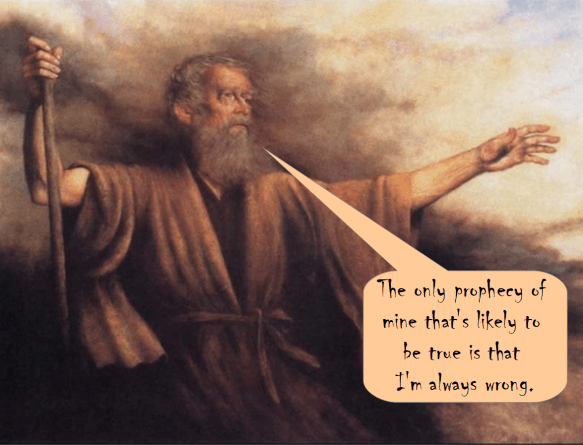
Then again, what other sort is there? Prophets are zealots who believe they’ve been granted special access to the Lord’s plans. There are still fantasists today who believe the Lord speaks to them with portents of future disaster. It would be generous to say that all of them – those in the Bible and their modern descendants – are wrong far more often than they are right. In fact, they are always wrong; it is impossible to know the future. Meanwhile, so-called interpreters of prophecy, like Matthew, Mark, Luke and their equivalents today, alter ‘prophecy’ and unrelated statements to suit their needs, shaping their stories to create the illusion they have been miraculously ‘fulfilled’.  

God approves of slavery

slavery

Over on his blog site, Biblical Musing, Don Camp is trying to justify why God appears to condone slavery. It’s not the first time Don has tried to defend the indefensible; he’s recently been arguing much the same thing on Debunking Christianity.

The fact the Old Testament appears to endorse the keeping of other human beings as slaves is a problem for Christians. It’s a problem compounded by the fact that Jesus in Luke 12.47-48 and the imposter-Paul, in Ephesians 6.5, both support the practice. How can it be that God approves, or at least raises no objection to it? Wouldn’t an omniscient, all-loving God have outlawed slavery, as he outlaws so much else, in one of his innumerable laws and commandments?

Instead, he provides instructions about how to keep and look after slaves; what to do, for example, when you flog one to within an inch of his life so that he later dies (Exodus 21.20-21) or when you deliberately blind your slave – she’s your property after all – or rape her (Exodus 21.26; Numbers 31.17-18).

Don’s answer is that, despite God involving himself in the minutiae of slave treatment, he knew it would be a waste of time telling his people slavery was wrong. Why? Because he took the trouble to tell them lying and stealing were wrong and yet they ignored him. So, hey, why should he bother telling them about slavery? They’d just ignore that too.

But the point is – disregarding the fact that not everyone steals and lies – ‘God’ did issue laws prohibiting stealing and lying (and eating shellfish, and wearing garments of mixed fabric). It seems it was important to him to tell his pet-tribe that these were wrong, even though he must have known many of their number, and many more subsequently, would ignore him.

What can we conclude from this? Only this: that God didn’t feel the same way about slavery as he did about lying and stealing, which is why he didn’t bother making even the same token effort to prohibit slavery.

Or, and much more likely: the tribes who wrote the laws didn’t think slavery was wrong. In fact, they thought it quite useful to have slaves. Given this utility, they were unlikely to have devised laws preventing their ownership. The enslaved themselves no doubt thought differently, but then they didn’t get to write the rules.

We don’t find a commandment prohibiting slavery in the bible because those who wrote it liked having slaves. For this reason too, we find all those inhumane instructions about keeping slaves and what should happen if you maim or kill them.

Of course God didn’t write these laws. People did. And they wrote them according to their understanding of what was moral, fair and legitimate within their own primitive milieu. Thus it was that slavery got a free pass.

How the Bible gets almost everything wrong: volume 1

Jesus7

Scripture is under attack! Yes, really. Answers in Genesis says so, so it must be true. The Enemy with a capital letter is out to undermine its authority. That Satan and his school-boy pranks! What will he think of next?

It doesn’t, though, need an all-powerful personification of evil to undermine the bible. It does it all by itself. In any aspect we might care to mention; scientific, medical, historical, moral, psychological – even how the universe operates- the bible is mistaken, confused and just plain wrong. The truth is not in it.

Let’s take look at some examples:

The bible’s scientific blunders

According to the bible:

the Earth was created before the sun (Genesis 1:9-16)

Stars are points of light in the canopy – ‘the firmament’ – that surrounds the Earth (Genesis 1:16-17)

Beyond this canopy is water (water comes for the sky doesn’t it? I guess the canopy leaks. God opens its ‘windows’ during Noah’s flood) (Genesis 1:6-7)

The sun moves, though it can be made to stop in its tracks with the right magic (Joshua 10:12-13)

Genetic characteristics can be changed by whatever animals look at while they’re copulating (Genesis 30:37-39)

Hares and coneys chew the cud (Leviticus 11:5-6) and flying insects sometimes have four legs (Leviticus 11:20-23)

The value of Pi is 3 (1 Kings 7:23-26)

More here if you can bear it: http://skepticsannotatedbible.com/science/long.html

The bible’s historical inaccuracies

The ‘history’ of the Old Testament is largely fabricated. Much of it is myth and legend, created centuries after the events it purports to describe. There is no evidence, for example, that the Israelites were slaves in Egypt, wandered the wilderness for forty years and then invaded the land of Canaan. Historians are now fairly sure that the people who would later fashion themselves as the Israelites were rabble-rousers within Canaan and that they set about eliminating, by one means or another, other populations that lived there. The ‘great kings’ of Judaism – David, Solomon – were no more than tribal leaders; think ‘Taliban commanders’ and you’ll have a pretty accurate picture of what they were really like.

There’s no evidence either for Noah’s ark and a global flood, the events of the tower of Babel, Joshua’s destruction of the walls of Jericho, Daniel’s adventures in the palace of Nebuchadnezzar… you name it. Each and everyone of these stories was created to make theological points, to aggrandise the people who created them.

There are similar problems when it comes to the historicity of Jesus’ life.

The bible’s medical ignorance

According to Jesus – God Incarnate, no less – many disabilities and diseases are caused by demons:

A man in the crowd answered, “Teacher, I brought you my son, who is possessed by a spirit that has robbed him of speech… Jesus rebuked the unclean spirit, saying to it, “You deaf and dumb spirit, I command you, come out of him and do not enter him again.” (Mark 9:17 & 25)

The way to cure illness therefore is to ‘drive out the unclean spirits’ that cause it. Jesus does so many times (Matthew 12.22 etc) and sends his chums out to have a go as well (Matt 10.1). Now, is this because God knows that sickness and disease really are caused by supernatural baddies, or is it because Jesus’ understanding of illness was as limited as that of any other first-century peasant? You got it – Jesus (and his later script-writers) merely reflect first-century ignorance about the causes of illness. However, if, as today’s Christians believe, Jesus was somehow God himself, then why don’t they opt for exorcism every time they’re ill? There are some nut-jobs who do, of course, but why don’t all of them trust their lord and saviour on the matter?

There’s equally ludicrous medical advice elsewhere in the New Testament: James 5.14-15 tells us that the cure for any ailment is prayer:

Is anyone among you sick? Let him call for the elders of the church, and let them pray over him, anointing him with oil in the name of the Lord. And the prayer of faith will save the one who is sick, and the Lord will raise him up.

Sure enough, some believers have taken this ridiculous advice seriously. Instead of medical treatment, they’ve done as the bible commands and prayed for their sick children, frequently with fatal consequences.

More next time…