It’s a Miracle!

MaryDo you believe in miracles? Do they happen? Author Eric Metaxas thinks so. He says so in his new e-book, Miracles: What they are, why they happen and how they can change your life.

He also says that anyone who doesn’t believe in miracles is closed-minded and intolerant, which is his Christian persecution complex speaking. Metaxas and other believers who accept unusual events as miracles are, apparently, ‘open-minded’, while the sceptic who looks for a rational or scientific explanation isn’t.

But isn’t the reality the opposite of this? Isn’t the seeking of rational explanation and analysing the evidence, the open-minded, imaginative act? And isn’t blindly accepting on faith that a particular event is the Christian God (naturally) messing about with ‘the laws of physics’, the closed-minded, unimaginative response? By definition, closing down all other possible explanations is the closed-minded response. It takes no imagination, no being open to possibilities, to refuse to look for an explanation beyond ‘God did it.’

As I’ve said before, most miracles are, in any case, very mundane, trivial affairs. They’re never the regrowing of severed limbs, the eradication of Ebola or the holding back of a tsunami. Why not? Why are ‘miracles’ always so unimpressive, like the ‘inner healings’, visions and coincidences Metaxas writes about? Why do they have far better scientific or rational explanations than supernatural ones? And when it comes to it, why do we more often hear about miracles than see them for ourselves? Why are most miracles nothing more than hearsay, rather like ghost sightings? It’s uncanny how miracles always happen to someone else, who swears they really happened just as they describe them (this is where the exercise of imagination comes into play.) The miracles in Metaxas’s book seem to be just this; second hand accounts of largely unspectacular coincidences and hallucinations, none of which happened to the author himself nor were witnessed directly by him. Why should any thinking person accept such spurious testimony? Why indeed should we be ‘tolerant’ of such woolly wishful-thinking?

If, for you, second-hand reports of unremarkable events qualify as miracles, then so be it. Like Eric Metaxas, you should just close your mind and accept. But don’t tell those of us who are considerably more sceptical that we’re the ones who aren’t open-minded or tolerant.


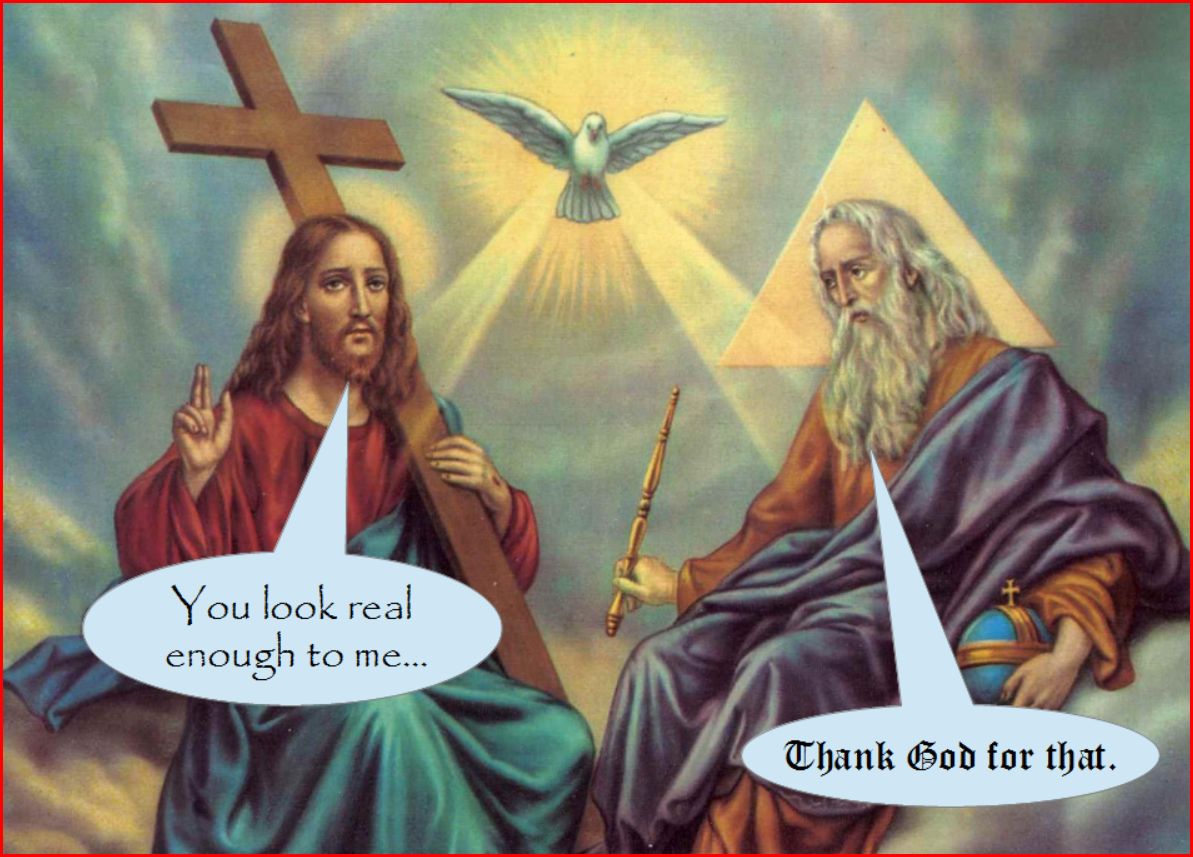
The picture above was originally used as a billboard by St. Matthews-in-the-City Church in Auckland, New Zealand. The captions were added later, though I don’t know by whom.
 

Who Ya Gonna Call?

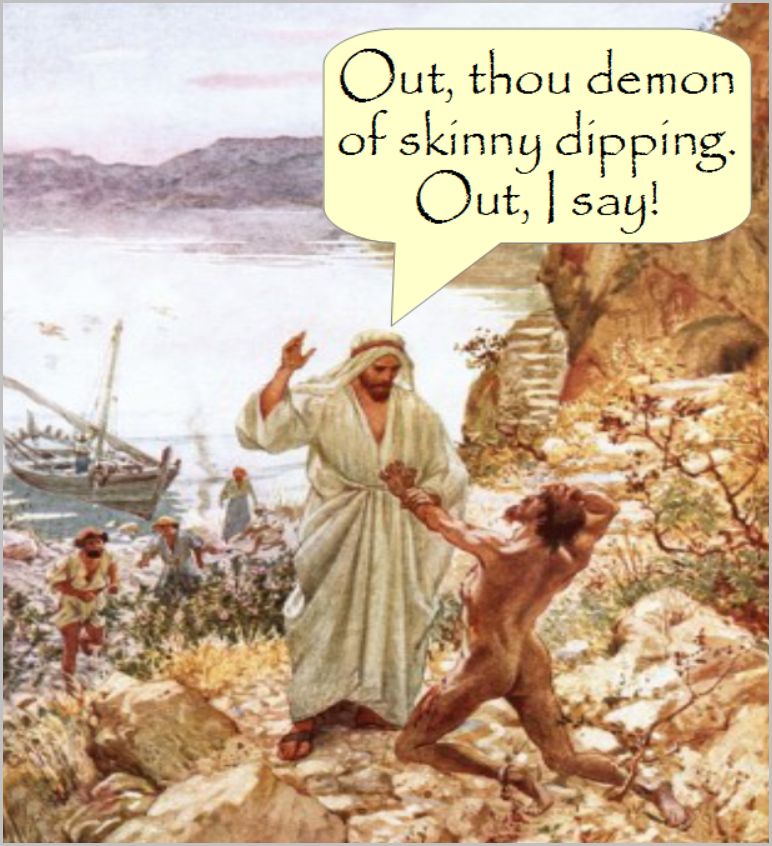
DemonAnd when they came to the crowd, a man came up to him and, kneeling before him, said, “Lord, have mercy on my son, for he is an epileptic and he suffers terribly. For often he falls into the fire, and often into the water. And I brought him to your disciples, and they could not heal him.” And Jesus answered, “O faithless and twisted generation, how long am I to be with you? How long am I to bear with you? Bring him here to me.” And Jesus rebuked the demon, and it came out of him, and the boy was healed instantly. (Matthew 17.14-20)

Do you believe in spirits and demons? When you’re ill, do you visit the nearest exorcist or do you take yourself off to the doctor or hospital? Of course, most Christians (but by no means all) have more faith in the medical profession than they do in the wingnuts who’d tell them their ailment was the result of demonic activity and command the demon to leave in the name of Jesus.

Why? Because, even Christians know, in spite of what they might tell you, what causes disease and illness. They know what cures them too; and it has nothing to do with Jesus. ‘The Son of God’ is among the wingnuts when it comes to believing unclean spirits are at the root of human ailments and behaviour (Mark 5.1-8; Matthew 8.28-34; Matthew 12.43-45; Luke 4.33-36; Luke 8.29 etc.)

In spite of the fact there’s absolutely no evidence that demons exist, Jesus thought that invisible supernatural creatures were responsible for conditions like epilepsy. Like everyone at the time he thought that if these unclean spirits could be driven out, then the condition would be ‘cured’. Some follow in his misguided footsteps today; the Catholic church has an entire coven of exorcists, and charlatans like the Reverend Bob Larson make a living driving out the demons of pride, lust, homosexuality and greed from stooges and the gullible (except of course they don’t.)

If you’re a Christian, you should believe in demons and unholy spirits; you believe everything Jesus uttered was true, don’t you?

Of course, Jesus was a product of the pre-scientific era in which he lived; his ignorance might be excusable if it wasn’t offered up as God’s Truth. All that Jesus’ belief in devils and unclean spirits demonstrates is that he was very much a man of his time – evidence, if more were needed, that he wasn’t remotely divine. Unless, of course, the God he also believed in was as ignorant of the causes of illness and human behaviour as he was.

But next time you’re unwell, Christian, or you’re feeling a mite greedy or lustful, don’t go to the doctor’s. Don’t even ask the Lord for forgiveness. Have a little faith and, in the name of Jesus, command that hell-spawned demon within you to leave. See how that works out for you.


Update: New this week in ‘It Can All Be Blamed On Demons’:

Right-wing American broadcaster, Bryan Fischer, claims unarmed black teenager killed by cop was in fact possessed by a ‘homicidal demon’.

Tele-evangelist Pat Robertson asserts playing Dungeons and Dragons leads to demon possession.

Thank you, Lord, for your endorsement of fantasist rubbish like this.


Christians’ Favourite Delusions 28: Evolution says we are no more than animals

AngryHere we go again. Christians claiming that evolution reduces human beings to being ‘just’ or ‘no more than’ animals.

Does it? Where? The ‘just’ and ‘no more than’ are unnecessary and invalid value judgements. They’re not there in Darwin, who goes out of his way to avoid making any such statement, while Richard Dawkins explicitly rejects the idea that we are ‘just’ gene carriers.

Evolutionary theory recognises that humans are indeed animals – with no ‘just’ or ‘no more than’ to qualify the fact. How can we not be animals? We do everything they do; like them, we have – indeed are – physical bodies that breath, eat, sleep, excrete, bond, mate, experience pain and pleasure and fight; we are, like most other animals, territorial and also like them, we put a great deal of effort into ensuring our own survival and that of our offspring. Even Christians who deny the body and its demands engage in these kinds of animal behaviour.

Of course, we also do things other animals don’t, or don’t to the same extent; we have remarkably complex social arrangements, which have resulted in our developing systems of morality and sophisticated ways of dealing with each other (though our morality is remarkably flawed); we have achieved much in the fields of culture, technology and in our understanding of the world and the universe beyond our tiny planet. We have also made a mess of our environment.

Our intelligence, our self-awareness, is the evolutionary equivalent of adaptations developed in other species. Our characteristics may seem to us to be somehow superior to those of other animals, but really they’re not. They have enabled our continued survival and allowed us to achieve all that we have, both good and bad. But in evolutionary terms, they are no different from the refinements that have enabled other animals to do the equivalent in their environments. This doesn’t mean, however, we are ‘just’ or ‘no more than’ animals. No creature is ‘just’ an animal and human achievements are all the more remarkable because we’re animals.

What Christians usually mean by their ‘just’ and ‘no more than’ is that as animals we are not extra-special to God, not ‘made in his image’. And of course, we’re not; there’s no God to be extra special to or made in the likeness of. Even if there were, he doesn’t seem to be particularly pre-disposed towards us; we exist as physical bodies that are as susceptible to the same hunger, disease, illness, injury, weakness, infirmity and death as any other animal. We are not immaterial, spiritual beings – though presumably the Christian God could have made us that way if he’d wanted to. To say, as some Christians do, that we are spiritual beings temporarily trapped in material bodies, or that we must deny the body and its demands to become spiritually perfect, is the grand perversion that is the Christian faith. It denies the reality of this physical, material world and our own natures. Any spirituality we might claim for ourselves is a projection of our intelligence and self-awareness; any morality the result of those complex social arrangements.

So, we are not ‘just’ animals, nor are we ‘no more than’ animals in any way that makes sense biologically. We are animals, remarkable perhaps in rising above our biology from time to time, but animals nonetheless, whether Christians want to believe it or not. ‘Just’ and ‘no more than’ don’t come into it.

Idiotic Stuff Jesus Said 8: Hate, hate and hate again

Preacher2If anyone comes to me and does not hate his father and mother, his wife and children, his brothers and sisters – yes, even his own life – he cannot be my disciple… In the same way, any of you who does not give up everything he has cannot be my disciple. (Luke 14. 26 & 33)

The words, not of an extremist Islamic preacher, but of Jesus.

The man was a megalomaniac. Almost everyone, with the exception of a few gullible fishermen, thought so (Mark 3.20-21). Even his own family was convinced he was mad. He claimed that all the spiritual leaders who’d come before him were thieves and robbers (John 10.8) and believed – demanded – that everyone should give their lives over to him. And, boy, did he turn unpleasant when they didn’t! (Matthew 11.20-22 etc) Imagine what we’d make today of a fanatic who went around making the same sort of claims. It puts Jesus’ delusions of grandeur in perspective, doesn’t it.

Christians will tell you, though, that Jesus had such a high opinion of himself because, of course, he was divine; he was, and is, God’s only son – God himself, in fact – so he was fully entitled to say the nutty things he said about himself.

But there are a couple of problems with this conclusion:

1. Little of what he promised came to be, from his predictions of his own return heralding the end of the world (Matthew 16.28) to his guarantees his followers would be able to do all manner of wondrous things (Mark 11.24 etc). In other words, there’s just no evidence to support Jesus’ ludicrous assertions about himself. The end of the world, marked by his return in power and glory, didn’t happen when he promised it would (or, indeed, at all); his followers didn’t and still don’t do the incredible things he said they would. In fact, the early church, despite the rosy story made up for it in Acts, spent its time judging and squabbling (Romans14, etc), much like the church today. Little wonder that Jesus’ friends and biographers had to invent the resurrection story, to replace all the stuff he said would happen that didn’t.

2. Christians aren’t prepared to be as radical as Jesus demands; by and large they don’t disown their parents and offspring; they don’t hate their own lives (only other people’s ‘lifestyles’) and they don’t give up their possessions when they become disciples. They’re right not to, of course, otherwise they’d be giving into the whims of a madman, but all the same they want their cake and eat it: to adopt this particular extremist as their saviour while ignoring everything he demands that they do. So they compromise; not prepared to despise their families, and certainly not wanting to give up everything, they claim him as their God while hanging on to all they hold dear. I don’t blame them, but Jesus certainly wouldn’t approve of the compromise. He says so in the passages quoted at the top of this post and in numerous other places in the Bible.

So, Christians, why do you call him ‘Lord, lord’, when you won’t do what he tells you? (Luke 6.46)

Idiotic Stuff Jesus Said 6: The ‘I Am’ sayings

CampLet’s be clear from the outset here; Jesus never actually made any of the seven ‘I am’ claims put into his mouth in John’s gospel. You know the ones: ‘I am the Way, the Truth and the Life’, ‘I am the True Vine’, ‘the Good Shepherd’, ‘the Light of the World’ and so on. So it is a little unfair to lump them with all the idiotic things it’s more likely Jesus did say (see previous posts.)

How do we know he didn’t say them? Lots of reasons. Firstly, they’re not in the other three gospels all of which were written earlier than John’s, and are therefore closer to the time Jesus lived (though the earliest, Mark’s gospel, was probably put together thirty to forty years after Jesus lived.) If Jesus had really made all those grand ‘I am’ claims, wouldn’t the other gospel writers have recorded them too? Yet none of them mentions even one.

Secondly, in the synoptic gospels – Matthew, Mark and Luke – Jesus has a different message from the one given to him in John’s gospel. The earlier gospels have Jesus talk about himself only very rarely. Instead, he goes on at length about the coming of the Kingdom of God (or Heaven) and how y’all better get ready for it ’cause it’s a-coming soon. Was he wrong about that one! On the odd occasion he does refer to himself in the synoptic gospels, he often does it in a sort of coded way, calling himself ‘the son of man’. He hardly ever uses ‘I’, let alone makes grandiose claims about himself.

Thirdly, all three of the synoptic gospels rely on earlier sources, now lost to us, and none of those has Jesus make ‘I am’ statements either. How do we know? Because, again, they’re not there in any of the three accounts – Matthew, Mark or Luke – that are built up from them. Significantly, one of these sources is an early record of Jesus’ sayings; that’s a ‘sayings gospel’ that doesn’t relate any ‘I am’ sayings.

Fourthly, John’s gospel is late – at least sixty years after JC’s death and also after Paul’s supernatural Christianity had gained a foothold among the gullible. The Jesus of John’s gospel is a reworked version, more in-line with the ‘Christ’ that Paul preached and much less like the Jewish peasant who had lived and preached the Kingdom of God. Despite what Christians claim, John’s gospel is not another eye-witness report (none of the gospels is) that differs only in minor details from the other three accounts. It is total reworking of the story, with its central figure transformed into a sort of divine Superman, and the idea of the coming Kingdom relegated to a single mention. This change of agenda renders the fourth gospel utterly unreliable as an historical record of anything the earthly Jesus might have said.

Fifthly, Christians claim John’s gospel differs from the others because in it Jesus reveals special, secret truths about himself to ‘the disciple whom he loved’, traditionally the John whom the gospel is named after. But again, the problem with this explanation is that the synoptic gospels don’t mention Jesus favouring one particular disciple over the others (unless it’s Simon Peter). In these, John, a loud, brash fisherman, plays only a minor role. Why don’t the synoptics refer to the special, more intimate relationship that John’s gospel refers to? Largely because there wasn’t one – not until the fourth gospel came to be written and ‘John’, who led the community that produced it, wanted to bump up his part.

So, idiotic as it would have been for an itinerant Jewish preacher and ‘prophet’, whose mission ended in failure, to make these claims about himself, Jesus never did. He didn’t say he was ‘the Way, the Truth and the Life’. Or ‘the Vine’. Or ‘the Good Shepherd’. These are claims made for him long after he lived, by people who were persuaded by a snake-oil salesman that a God-man had mystically ‘saved’ them. They ‘re-imagined’ Jesus, sayings and all, to fit their idea of what he must have been like – and John’s gospel was born.

Its Jesus, if he was being honest, should really have said, ‘I Am… nothing but Pure Invention.’

John Sentamu To End All War

SentamuNever one to shy away from self-promotion, the Archbishop of York, ‘the most reverend and right honourable’ John Sentamu, has begun a week-long fast and prayer vigil for world peace. The Archbishop reckons this will show ‘solidarity with the suffering people of our world, particularly in the Middle East.’

How, I hear you ask, will it do this? How will John’s fasting and praying – ‘on the hour, every hour’ – be any more effective than, say, his cutting up his dog collar in 2007 in protest at Mugabe’s presidency of Zimbabwe (seven years later and Mugabe is still there.) What will all the prayers and the fasting accomplish, other than thrusting the Archbishop briefly into the limelight once again?

Does God need Sentamu’s prayers to alert him to what is going on in the world? Doesn’t God know already? Will his pleading prick God’s conscience so that he intervenes and brings to an end the bloodshed in Syria, Iraq, Afghanistan and Palestine? Why doesn’t God do something anyway?

And isn’t all of this rather arrogant, this assumption that God will only act if problems are pointed out to him by fallible human beings? (Even Jesus thinks this is how it works in Luke 11.5-8.) What sort of God is this, who is unaware of how things are here on Earth and is unable or unwilling to do anything about them until important show-offs men like the Honourable Rev. let him know?

Maybe though, the Archbishop is less ambitious. Perhaps he just wants to demonstrate to those caught up in the world’s conflicts that he stands with them – though only metaphorically. But if that’s it, what exactly is he saying in all those prayers, on the hour, every hour?

Whatever it is, there will be no divine intervention. There is no God to take action, as evidence throughout history has shown us time and time again. Religion is part of the problem not its solution.

What would this world look like if there was no God?

TrinityIf God did not exist –

Human beings would frequently behave like territorial primates;

Nature would be the result of a mindless and heartless process;

Sex and death would be the drivers of its development;

Life would be a cruel struggle for most living creatures, including many humans;

Disease and illness would be pervasive, except where humans themselves had eliminated them;

The world would be largely indifferent to human aspiration;

The brain would find pattern and impose order where none existed;

Progress would be due entirely to human endeavour;

People would adopt the beliefs of their culture and be entirely convinced they alone were right.

Hang on a minute! Isn’t this the world we already have? It’s just like Julia Sweeney says: ‘The world behaves exactly as you expect it would if there were no Supreme Being, no Supreme Consciousness, and no supernatural’. A world without God is exactly the world we’ve got. And the world we’ve got is evidentially a world without a God.

Surely that’s no bad thing.

Unbelievable: Why, despite everything, Christianity makes absolutely no sense whatsoever.

Spufford2

There’s no real reason to believe in God.

 
Who says so? Francis Spufford in his book Unapologetic: Why, Despite Everything, Christianity Can Still Make Surprising Emotional Sense. Francis does believe though, because sometimes when he’s alone – specially after a tiff with his wife or while sitting quietly in church – he gets a funny feeling. And this feeling is so funny, as in weird, that it can only be God. Or so Frank says, slipping in as many four letter words as he can, just to show he’s not a namby-pamby sort of believer. (He’s especially proud of his new term for ‘sin’: ‘the Human Propensity to Fuck things Up’, or HPtFtU for short.)

 
What’s more, even though there are a hundred and one reasons to think there isn’t a God, at least not one who cares about us (think pain, suffering, death, evolution and his complete lack of interest in his creation, all of which Frank’s acknowledges) he nevertheless wants to say that he does believe because, you know… feelings.

 
That’s not all. This God Frank’s decided to believe in as result of feeling funny, is the Christian God. He could’ve turned out to be Allah or Zeus or Ra, but he isn’t, because Frank feels he’s the Christian God, for no other reason than he wants him to be. Then, in a final leap of faith, he decides that Yeshua, as he insists on calling Jesus, is the walking embodiment of this God, and he rewrites the gospel story so that it fits with the funny feeling that kick-started his delusion in the first place.

 
And so we have it from the horse’s mouth; a Christian who’s proud to admit there’s nothing remotely rational or empirical about believing in God. Faith, he confirms, is no more than some very human, very peculiar feelings that lead you merrily down whichever garden path you choose to take.

Christians’ Favourite Delusions 10: God cares

dead-sparrow

@deadsparrow had just made his final Tweet.

The Bible says God controls the weather and 53% of Americans believe it. A further 17% say they don’t know or don’t want to say whether he does; evidently, they aren’t prepared to rule out the possibility, otherwise they would be among the 29% who know that he doesn’t.

I wonder what those who were hit yesterday by the typhoon in the Philippines think of God’s control of the elements? Was the destruction he brought about by sending Haiyan a mark of his love for mankind? Presumably not – destroying lives, homes, possessions and livelihoods hardly speaks of love.

Was it a punishment then? Right-wing Christians like to tell us that natural disasters are God’s judgement on human sin and our ‘shaking a fist at God‘ by redefining marriage to include gay people.  Why then does he consistently punish those in parts of the world which are already prone to extreme weather conditions? Why does he punish those who are already poor? Why does he send devastating weather to the fifth largest Christian country in the world, which doesn’t recognise gay marriage? It’s all a bit indiscriminate, wouldn’t you say? What sort of Almighty are we dealing with here, who can’t even direct his punishments at the right target? It doesn’t speak much of ‘control’.

Jesus might claim, in Matthew 10:28-31, that God cares even for the sparrows but this is another of his bare-faced lies. The evidence tells us otherwise: ‘God’ doesn’t care how many humans perish in storms, typhoons, tornadoes, tsunamis, earthquakes and all manner of natural disasters. He doesn’t care how many lose their homes, loved ones and all they’ve worked for.

The weather, in fact, is random, largely unpredictable and indifferent to human and animal needs. If God exists, then he is as indiscriminate and uncaring as the weather he supposedly creates. But of course God is not needed to explain the weather; science tells us how it occurs in terms that don’t involve him. His very superfluousness – the same superfluousness we find in evolution and all the other ‘laws’ of the universe – is all the evidence we need that he doesn’t exist.

Why I could never be a Christian

RidiculousIn Through The Looking Glass, And What Alice Found There, Lewis Carroll has the White Queen boast that in her youth she could believe ‘six impossible things before breakfast’. Pfa! Only six? Today’s Christian can beat that with ease, and not only before breakfast!

To be a Christian you must accept through faith, and contrary to the evidence, that:

  • there is a reality above and beyond nature wherein exist angels, archangels, devils, demons, principalities (whatever they are), spirits (holy and otherwise) and God himself;

  • virgins can conceive and give birth;

  • a man who died 2,000 years ago is still alive;

  • this man could, when he lived, defy gravity; control the weather; sweat blood; reanimate corpses (his own included); pass through solid objects and project himself into space;

  • an intangible part of everyone survives death;

  • believing in a magic formula (‘Christ died for me’ or similar) leads to eternal life;

  • after death, believers will live again in an improved copy of the body they had when alive;

  • God reversed the laws on which the universe operates to make all of this possible, because he wanted to sacrifice a part of himself to himself;

  • he can do this because he is God;

  • he prompted men to explain his plan in a special book;

  • all you have to do to live forever is believe this book is true.

In addition to ‘essential’ beliefs like these, there are still more that Christians choose to accept on faith, add-ons that Christians are invited to see as the underpinning of ‘important’ doctrines. While not absolutely crucial, they are recommended as a means of adhering to (uncorroborated) biblical truth. Consequently, we find Christians who believe that:

  • God created the universe 6,000 years ago (because this is the time-scale that can be calculated from the Bible’s genealogies);

  • dinosaurs and humans co-existed (because this must be the case if the creation stories in Genesis are literally true);

  • evolution didn’t happen; God created the Earth and everything on it in just six days.

  • reality can be changed by the simple expedient of asking God to change it (prayer);

  • God directly controls the weather (omnipotence/divine irritability);

  • Jesus is coming back – with a selection of scenarios available to true believers about what this will be like (the second coming);

  • all unbelievers will be consigned to hell / oblivion / annihilation: again, take your pick (judgement).

There is not one scrap of evidence outside the special book that any of these items of faith are true. None is verifiable, and consequently none has ever been verified (accounts written inter-dependently fifty years after the alleged miracle-man lived don’t count).

There is, on the other hand, overwhelming evidence that virgins don’t conceive; that there is no agency behind the weather and natural disasters; that nothing of an individual’s self survives death and that dead bodies stay dead. This has always been the case and always will be. It was how nature operated two thousand years ago when all of the ‘essential’ items of faith, invented by the kinds of mind that believed earthquakes and floods were deliberate acts of God, were gaining currency.

Though I once did, I can’t subscribe to any of these ridiculously ‘impossible things’ in the vain hope that I might live forever.

Can you?