Christians’ Favourite Delusions 34: Atheism is a Religion

NoGodChristians like to claim atheism is a religion. It’s their way of saying, ‘look – atheists are as daft as we are. They believe in bullshit just like we do, except, of course, they’re wrong and we’re right.’ You can see them saying just this here and here and here.

But atheism isn’t a religion, any more than not collecting stamps is a hobby, as Penn Jillette puts it. It isn’t a religion because it is the absence of belief – primarily in a god, but also in any other kind of supernatural being. The atheist knows there are no saviours, angels, devils, demons, ethereal saints or eternal prophets, and no heaven and hell to house them either. Atheism is devoid of any sort of worship of imagined supernatural beings; nor does it address them, commune with them or otherwise revere them. It does not recognise the authority of ‘holy’ books nor that of self-appointed spiritual authorities, including popes, pastors, preachers, imams, mullahs and rabbis. It doesn’t regard anything as sacred, including its own experts; neither Darwin nor the so-called New Atheists are above criticism. (Try that with those who think they represent God’s Truth™!)

Where religionists build their belief systems on the insubstantial foundation of faith, atheists accept nothing on trust. Instead, they look for evidence to support their knowledge and value reason, not dogma – things that are anathema to religion.

Given, then, that atheism is the antithesis of religion and that atheists don’t do what religion demands, it is intellectual dishonesty to insist that atheism is a religion. Those who do so are false witnesses; mistaken at best, liars for sure.

Spontaneous Conversion

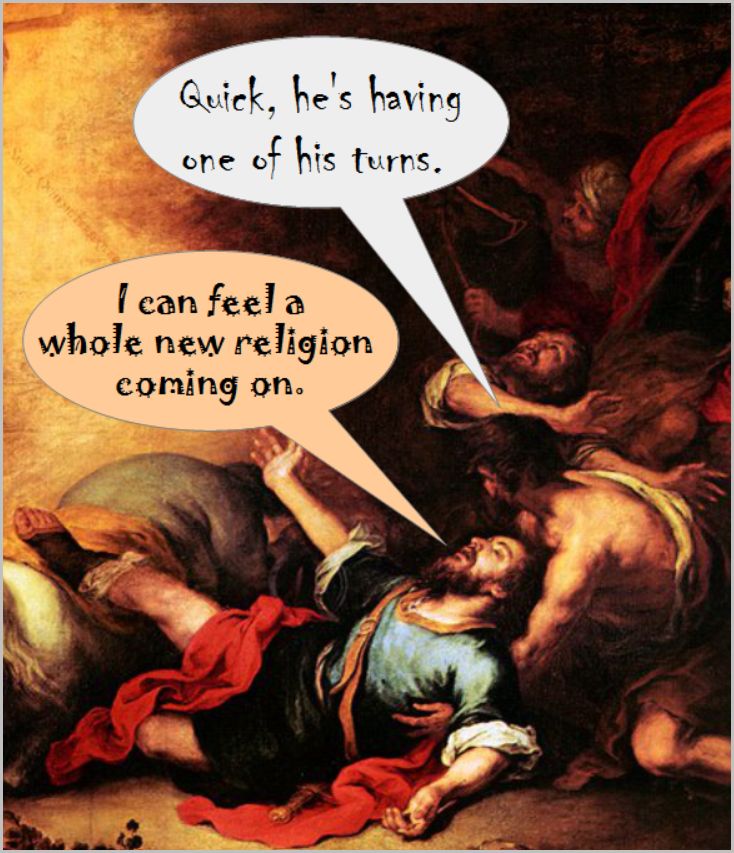
st-paul-conversionThe missionaries pressed on into the Amazonian jungle. They were now in uncharted territory. No-one had ever been this far in. And then, sounds from somewhere not too distant; human sounds, human voices – singing even. The missionary troupe emerged into the clearing to an amazing sight. Groups of Amazonian natives gathered together, a rudimentary cross in front of them, towards which they were undeniably directing their worship. These people, whose existence had hitherto been unknown, and who had never before encountered Westerners, were Christians!

Weeks later once basic communication had been established, the tribe’s chief priest and the head missionary communed together. The priest explained how, long ago in the past, his ancestors had recognised God’s presence in the incredible world around them and had opened their hearts to him. As a result – Miracle of Miracles! – God sent them a vision of Christ himself, much as he had to St Paul and the other disciples, and the whole tribe came to believe in Jesus. Ever since then, the tribe had worshipped the one true God and his only son, that same Jesus Christ.

“Amazing,” said the missionary, “so it looks like St Paul was absolutely right when he said God reveals himself in nature and speaks to our hearts to make himself known to us. It’s not as if we ever needed the Bible, or to go round telling people how to be saved. God is more than capable of doing it for himself. Praise the Lord and pass the communion wine!”

What a story! And it happened time and time again as the world was opened up by explorers and missionaries.

Or maybe not. Definitely not, in fact. But it should have happened if what Paul says in Romans 1.18-21 is right, as Ken Ham believes it to be:

For the wrath of God is revealed from heaven against all ungodliness and wickedness of those who by their wickedness suppress the truth. For what can be known about God is plain to them, because God has shown it to them. Ever since the creation of the world his eternal power and divine nature, invisible though they are, have been understood and seen through the things he has made. So they are without excuse; for though they knew God, they did not honour him as God or give thanks to him, but they became futile in their thinking, and their senseless minds were darkened.

If God is so obvious in the world that (supposedly) he created and if we humans can see and understand him through it, then why do Christians need to proselytise? Why doesn’t God make his personal presence felt just that tiny bit more clearly – with the odd ‘revelation’ like the one he provided Paul, say – so that people come to believe in him more fully? And by ‘him’, of course, I mean the proper God – the Jesus one. Why does he leave it so that folk seemingly pick up on the special vibes he’s placed in their hearts but then worship a ‘counterfeit’ god, like Allah or Jah or, back in Paul’s day, Zeus? Why doesn’t he provide revelations like he used to, to ensure everyone knows just who it is who’s standing at the door knocking?

If he did that, if God did indeed plant clues to his presence both around us and in us as Paul says he does, then the Bible wouldn’t be needed to convert people. But that’s not what we find, which is that the Bible is essential in perpetuating the God-myth. We wouldn’t even be aware of Paul’s ridiculous claims if they were not preserved in that ramshackle collection of writings.

The indoctrination of others is utterly reliant on two things and two things only. Not God-in-nature or inner prompting or visions, but on ‘the scriptures’ and those who are driven to spread the Jesus-meme. Now does that not strike you as odd? It strikes me as something entirely human, with nothing supernatural about it. If people have to be told, evangelised to and indoctrinated into Christianity, then it can hardly be the case that they see the one true God in nature or have an intuitive feel for him. If that were the case, then we would have discovered hitherto unknown groups of humans who already knew of him and the nonsensical clutter of beliefs that surround him. And we haven’t. Ever.

Christians’ Favourite Delusions 33: Atheists know in their hearts that God exists

DenyTwo tried cliches trotted out by evangelising (i.e. aggressive) Christians are that ‘atheism is a religion‘ and that in their ‘heart of hearts atheists know there really is a god’. Ken Ham of Answers In Genesis is fond of both assertions, as are other equally desperate promoters of unsupportable beliefs. We’ll come to the first in a later post, but here’s how Ham expresses the second:

They (atheists) know in their hearts that God exists, but they are actively suppressing this belief in unrighteousness (Romans 1:18). They fight so hard against a God that they claim doesn’t even exist because they know that He really does! We need to pray that, instead of fighting against God, these lost individuals will repent and put their faith and trust in Christ and in what He did for them.

Romans 1.18 that he cites says: For the wrath of God is revealed from heaven against all ungodliness and wickedness of those who by their wickedness suppress the truth.

Assuming Paul is saying here what Ham claims he is (it’s doubtful from this verse alone) both he and his hero are demonstrably wrong – as they are about so much. The evidence suggests that while young children look for meaning and assume agency, they do not necessarily attribute these to a god until they are taught to do so by others. The god they then come to acknowledge is the one already prevalent in their social environment. In a predominantly Christian context, they will come to be acquainted with – and may go on to develop a full-blown belief in – the interpretation of the Christian God common within their particular culture.

It is the same for conversion generally. You are more likely to be a Mormon in Salt Lake City, a Roman Catholic in East Timor. If raised in a Jewish environment, it’s more likely you’ll subscribe to YHWH; in an Islamic one, an interpretation of Allah; Buddha – not strictly speaking a god – in a Buddhist one. Statistically, those who adopt a religion and a belief in a god, almost always opt for that which is prevalent in the society into which they are born. This is not god ‘writing a knowledge of himself’ in their hearts, it is a cultural, human phenomenon.

Ham and others see this as evidence for their belief that we all have some sort of ‘god-shaped hole‘ in our psyche that we can just as easily fill with false gods as with the real one (theirs). But this is a shift in the argument; it’s not now that God makes himself known to everyone but that we all find a need for a god. This is not the same thing, nor is it true. Certainly humans have a history of creating gods to explain the strange, magnificent and sometimes hostile universe in which we find ourselves; but this does not mean these many gods exist, as Ham would be the first to admit (c’mon, there’s only one real God – his.) It means only that the human brain seeks pattern and meaning, and has often drawn the wrong conclusions in its quest for them. The gods – and God – are part of these wrong conclusions.

And what of Ham’s assertion that atheists deny their awareness of God because of ‘unrighteousness’ – because, he implies, we just want to live a life of rampant ‘sin’? Well, I admit, I like a bit of a sin as much as the next man, but that’s not why I’m an atheist. I’m an atheist because, like most others, I find no evidence for gods or God either in my ‘heart’, nor in the way the world works nor in collections of iron age stories. Morality doesn’t come into making this assessment. In any case, those who buy into a god don’t have a monopoly on ‘righteousness’, as their weak morals, judgemental attitudes and destructive behaviour regularly demonstrate. More than this, and as Ham admits, Christians are only concerned about others because the Bible says they should be: ‘The reason I care about poverty,’ he says, ‘is because God’s Word instructs me to care, and all humans are made in the image of God as God’s Word tells me.’ This is not righteousness, nor a morality that comes from any real concern for fellow human beings.

Finally, atheists don’t, as Ham claims, ‘fight so hard against’ a non-existent God that we secretly believe in. We oppose Christians and other purveyors of supernatural nonsense when they try to impose their irrational beliefs on others, when they condemn fellow human beings, seek to control them and try to limit their rights in the name of God and the cause of ‘righteousness’.

So, no, don’t condescend, Christians, to tell us we all know that there’s a God that we wilfully ignore. You’re wrong, and I’ll show you even more reasons why you are, next time.

Christians’ Favourite Delusions 32: Jesus Is God

Res2Test your Bible knowledge and see if you can work out when it was Jesus became God:

Was it:

a) After he died?
Paul thought this was when God decided to adopt Jesus. The Almighty noticed what a good man Jesus was and decided to resurrect him. In so doing, he made him his Son:

his Son… was descended from David according to the flesh and was declared to be Son of God with power according to the spirit of holiness by resurrection from the dead. (Romans 1. 3-4, my emphasis)

Paul doesn’t say Jesus was God. In fact, he strongly suggests he wasn’t, both in the phrase ‘descended from David’ and in his assertion that he became God’s Son – not God – only at the resurrection. So, Jesus wasn’t God when Paul wrote Romans, round about 57CE. If, as Bart Ehrman suggests in How Jesus Became God (p224), Paul is quoting an earlier creed, it’s not what the first Christians believed either.* Paul does edge closer to a divine Jesus in other letters – Philippians 2, for example – but that’s not what ‘God revealed’ to him originally.

b) When he was baptised?
In the earliest gospel, Mark says it was when he was baptised that Jesus became God’s son:

(Jesus) saw the heavens torn apart and the Spirit descending like a dove on him. And a voice came from heaven, ‘You are my Son, the Beloved; with you I am well pleased.’ (Mark 1.10-11)

So in Mark, God adopts Jesus earlier in his career than in Paul’s Romans scenario. All the same, while he gets to be God’s beloved son, this doesn’t make him divine; God has many sons in the Bible and a Son of God, with or without capitals, is not the same as ‘God the Son’. Jesus himself makes this clear in Mark 10.18, where he actually denies he’s God.

c) When he was born?
Well, this is more like it. According to Matthew, Jesus is the Messiah from the time he was born. We’ve got even further back now – from Paul’s post-mortem elevation of Jesus, to his baptism, to his birth. Of course all of these can’t right. If Jesus was divine from birth – or even before – there’d be no need for him to be promoted after his death. But Matthew doesn’t actually say he’s divine; he suggests that Jesus fulfils all the prophecies of the Messiah (of course he doesn’t, but that’s what Matthew wants us to believe.) However, the Messiah, according to the very ‘prophecies’ Matthew quotes, is not divine; he’s a human warrior king. Oops.

d) When he was conceived?
Luke is determined to push it back further still. For Luke, it’s when God magically makes Mary pregnant that Jesus becomes truly and literally God’s son (Luke 1.35). Except, of course, Mary appears to have no recollection of this event later in the gospel narratives when she can’t work out why her son behaves in bizarre ways. Could Luke have made up the entire conception story? You bet.

e) Back at the beginning of time?
John’s gospel appears to say so:

In the beginning was the Word, and the Word was with God, and the Word was God. He was in the beginning with God. All things came into being through him, and without him not one thing came into being. What has come into being in him was life, and the life was the light of all people. The light shines in the darkness, and the darkness did not overcome it. (John 1.1-5)

Or does it? John says the Word (Logos) has always existed and is part of God – but does this mean Jesus? This question vexed the church for the best part of it first four hundred years. Was the Logos the same as God and was Jesus the Logos? The council of Nicaea in 325 attempted to clear the matter up but not all bishops agreed with its conclusion – that the Son was ‘begotten not made’ (whatever that means) – and the controversy raged for another few decades.

f) When the church decided he was?
Yup, this is it. A different group of bishops decided, finally, that Jesus was God at the Council of Constantinople in 381. They re-jigged the statement made at Nicaea fifty-six years earlier, which then became the ‘Nicene creed’ that’s still said in some churches today.

So, Jesus didn’t become wholly and officially divine until 381, a mere 350 years after he lived and 300 after Paul and the gospel writers. How scriptural is that?

Jesus wasn’t divine, wasn’t God incarnate, wasn’t the Son of God with capital letters, wasn’t the Messiah, wasn’t and isn’t the saviour of the world. He was a first-century preacher and prophet whose prophecies were a disaster, whose mission to bring the Kingdom of God to Earth failed and who died and was buried. He was resurrected only in the ideas of other men, who tried and eventually succeeded in making him into something he wasn’t.


* I’ve not referred extensively to Ehrman’s writing in this post but undoubtedly his many books, especially How Jesus Became God, have influenced me, as has Barrie Wilson’s How Jesus Became Christian. Jonathan Hill’s Christianity: The First 400 Years, published by Christian company, Lion, was also useful.

 

Christians’ Favourite Delusions 31: The first Christians wouldn’t have been prepared to die for a lie.

VisionOkay, so if Jesus didn’t rise from the dead, what caused Christianity to spread the way it did? Or, as Christians like to put it, why would early Christians be prepared to die for something that didn’t happen? For the same reason they were ready to die for things that did happen; they were religious fanatics and people have died for a lot less. In any case, we have little evidence the earliest Christians did die prematurely for their faith, but they had plenty of reasons, other than a resurrection that didn’t happen, to give their lives to the cause:

1. Many of them seemed to think that, after his death, they’d had a vision of their leader. This was persuasive enough for the Pharisee Paul to become a follower ‘unto death’ – so why not for others? Still today, believers claim they’ve seen Jesus – it’s often how new cults get started – and those who lived in the first century were even more fanatical and superstitious. According to the gospels they –

  • believed in reincarnation (Jesus and John the Baptist are taken to be reincarnated versions of long dead prophets in Mark 6.14-15 and Matthew 16.14);
  • thought that the dead could return to life (Mark 6.16; Matthew 27.52) and
  • accepted that angels walked the Earth performing miracles (John 5.4).

It’s not much of step for them to have believed that the visions they were having or hearing about were of a resurrected Jesus. It doesn’t matter they weren’t; it was enough that early converts believed they were.

2. Jesus promised his original disciples and hangers-on that the Kingdom of God on earth was not far off. It would happen, he promised, in their lifetime; the ‘Son of Man’ would come down from heaven through the clouds with a battalion of angels and would take charge of the Earth on God’s behalf (Matthew 16:27-28; Matthew 24:27, 30-31, 34; Luke 21:27-28, 33-34). It’s not clear whether Jesus regarded himself as this mythical figure from the book of Daniel but nonetheless Jesus’ first followers were convinced the end was nigh – God was soon to intervene in history to transform the Earth, remodelling it in their favour (Matthew 5.5-12). They were privileged to have this information direct from Jesus himself – this was his Good News, his gospel – and they set about making it known. Even Paul, who changed the Jesus he’d never met into a cosmic super-hero, believed this (1 Corinthians 15:23-26). A brave new world was a cause worth living for and, if necessary, dying for.

3. The very first Jesus-followers, the disciples, believed that when all of this happened – when God’s Kingdom was on the Earth as it was in Heaven – they would rule it with him. Hadn’t Jesus himself told them that they would? He surely had – it’s recorded in Luke 22:28-30. So not only was God going to renew the Earth and its political systems, he was going to put them in charge! Who wouldn’t want to hang on to a promise like that? It was, surely, one worth living and dying for. We know, because Paul tells us in Galatians 2 and elsewhere that the disciples holed themselves up in Jerusalem to await God’s intervention; for them this meant the return of their Master who would carve up the transformed world and put them in charge of it.

So there we are, three good reasons why Christianity caught on:

  • Visions of Jesus, which meant that, even if his body had died, he had miraculously gone beyond death and would be returning soon;
  • The promise of God’s Kingdom on Earth, when the underdogs would become top dogs;
  • The susceptibility and gullibility of those at whom the message was aimed.

This is why the new movement spread rapidly, particularly among the susceptible, gullible under-class. No resurrection was necessary. Over time those visions, like Jesus’ message, would morph into something quite different, giving us the myth of a physical resurrection, a church he never intended founding and, eventually, the ‘promise’ of heaven. These were never part of the original ‘Good News’.

Happy Easter, y’all.

Christians’ Favourite Delusions 29: The Resurrection Can’t Be Disproved

Or can it?Burial

The resurrection can’t be disproved, or so says a Christian on Bob Seidensticker’s Cross Examined blog. If it could be, the commenter tells us, he would abandon his Christian faith. Of course it isn’t up to sceptics to disprove the resurrection, or any other of religion’s fantastic claims. It’s up to those making them to demonstrate their veracity, just as it would be for me to prove I keep an invisible pink unicorn in my garage. There would be no obligation on anyone else to disprove it.

That being said, the resurrection is rather easy to refute. First, let’s qualify what we mean by the term, or rather what Christians usually mean by it: that Jesus rose from the dead in or as the same body that had, a couple of days earlier, died on the cross. There are, it’s true, some liberal Christians who find this such a preposterous idea that they concede the resurrection happened only in some sort of metaphorical fashion. They’re probably right, so our truck is not with these particular believers, even if their evangelical brethren take them to task for their apostasy. No, we are refuting the idea that Jesus rose physically from the grave, fully alive again, after spending slightly under two days completely and entirely dead.

Here’s how we can know this didn’t happen:
1. There’s only one eye-witness account of the resurrected Jesus, and that’s Paul’s (in Galatians 1.11-12 and 1 Corinthians 9.1 & 15.45; I’ve covered this more fully here.) And what does he ‘see’? Not a resurrected body, just a beam of light and a voice, both in his own head as the text makes clear (the Greek states baldly his experience was ‘within’ him). His resurrected Jesus is therefore a vision or an hallucination or an epileptic event. It is most emphatically not an encounter with an actual man returned from the dead.

So much for our only eye-witness. What about the others?

There are no others:

2. All the other resurrection accounts were written, third, fourth, fifth hand, some 40-70 years after the supposed event, so they’re not exactly reliable. They are, in fact, positively unreliable. In these accounts, Jesus is unrecognisable to those who knew him; he walks through walls; disappears at will and beams up into the sky.

I’m sure it won’t escape your attention that these are not something a flesh-and-blood body can do. They are not, as a result, descriptions of real experiences and belong, like Paul’s inner experience, to the realm of fantasy/visions/hallucination. Paul himself was of the view that others’ experiences of the ‘risen Christ’ were exactly the same as his own (1 Corinthians 15.6-8).

Not only this, the gospel accounts of these visions were embellished between the time they occurred (if they did) and their being recorded many years later by different groups of interested parties. They were also significantly tampered with. For example, Mark’s gospel originally had no resurrection appearances; these were added later – possibly 40 years later – 80 after the events they supposedly describe.

And so we come to the most conclusive of the arguments against the resurrection:

3. The dead stay dead. Always, with no exceptions. Once the brain is dead it cannot be revived – certainly not 40 hours after it is extinguished. “Ah, but wait!” say Christians, “Jesus was (the Son of) God so the normal laws of nature don’t apply. He is the one true exception.” But this is special pleading based on circular reasoning: Jesus rose from the dead because he was (the Son of) God. How do we know he was (the Son of) God? Because he rose from the dead. As such, it’s no proof at all – even if, in Romans 1.14, Paul seems to think it is. The man Jesus died and then… he stayed dead.

There are other reasons that lend support to the fact that the resurrection did not happen (for example, all the noise about an empty tomb, which is nothing more than a distracting sleight of hand. So what? What does an empty tomb prove? Certainly not a resurrection.) These three, however, are sufficient evidence that Jesus didn’t physically rise from the dead – and without the resurrection, as Paul says in 1 Corinthians 15:13-19, Christianity falls apart:

If there is no resurrection of the dead, then not even Christ has been raised. And if Christ has not been raised, our preaching is useless and so is your faith. More than that, we are then found to be false witnesses about God, for we have testified about God that he raised Christ from the dead. But he did not raise him if in fact the dead are not raised. For if the dead are not raised, then Christ has not been raised either. And if Christ has not been raised, your faith is futile…

How right he was.

Now if you’ll excuse me, I have to take my invisible pink unicorn for a walk.

There Is No God. And Here’s Why

adamSometimes I wonder why I continue writing this blog. There seems to be little that can shake believers from their delusions; what I write here doesn’t appear to be it. When they do respond it’s to tell me that I’m in for a shock when, after my death, I stand in front of the the throne of God and have to give an account of myself. I’ll not be smiling then, they tell me. They’re right, I won’t be. Not because of any ‘judgement’, but because dead people don’t smile. Not of their own volition anyway.

Christians can’t seem to see the ludicrousness of their post-mortem proposals. Religion, all religion, is wrong about most things at most levels; it denies death, which does exist, and replaces it with fantasies about supernatural beings, eternal life and judgements, none of which does. Christianity offers false promises, failed prophecies and an impossible morality, which Christians themselves can’t even manage. By and large they don’t even try to (see previous posts on all of this) yet they stick uncritically, unthinkingly, blindly to the fantasy elements of their ‘faith’ because they’re frightened of their own extinction and want to live forever. Christianity deceitfully promises them that they will – the ultimate false promise.

So let’s cut to the chase. There is no God. This is an indisputable fact, though believers will dispute it anyway. Even now, any Christians who are reading this will be muttering something about the fool saying in his heart there is no God; another tired, cliched response, which I’ve already considered here. But there is no God, not because of any foolishness on my part but because of the evidence. Or rather the absence of it. There is no evidence there is anything other than the physical universe or that life came about as the result of anything other than physical processes (it is not the case that scientists do not know how life emerged from non-life; they do and it did) or that humans evolved by any means other than blind, mindless natural selection. God is not required to explain any of this; not necessary to explain anything at all to do with life, the universe and ‘why there is something rather than nothing’. That being the case, we can know for certainty that he wasn’t in any way involved.

Let’s take a more down-to-Earth parallel to illustrate the point: we do not need to resort to stories of the tooth fairy to explain dentistry. I’m guessing that even Christians would agree with this; the tooth fairy has no part in matters of dental hygiene, orthodontist training or even the payment sometimes made by indulgent parents when their child’s tooth falls out. Trying to force the tooth fairy into any of these scenarios is not only entirely unnecessary, it’s erroneous and unhelpful. Dentistry is far better explained without reference to a mythical sprite. The tooth fairy not being needed, we can safely conclude that she doesn’t actually exist; she is a figment invented for children intended to take the away the pain of tooth loss, nothing more.

So it is with God in explanations into which he too is shoe-horned. He’s not needed, he’s superfluous to requirements. That being so, we can similarly conclude that he isn’t real either. A being that isn’t needed to explain anything is one that doesn’t exist.

This is not, note, a rejection of a figure who, even now, is sitting up in the sky somewhere feeling sad or angry because we’re ‘shaking our fist’ at him. If that’s what you’re seeing, you’re still believing in God, even if it is one you might be in the process of rejecting. It’s worse than that, Jim (or better): there is no super-being in the sky, or anywhere else. The universe is devoid of gods and of God; it always has been and always will be. There are none to be found because there are none there; not your pet god, nor those of other faiths, ancient or modern. None. There is only the physical universe itself and for the brief time we are here in it, we are lucky to be here in it. Which is more than any god has ever managed.

All gods must pass

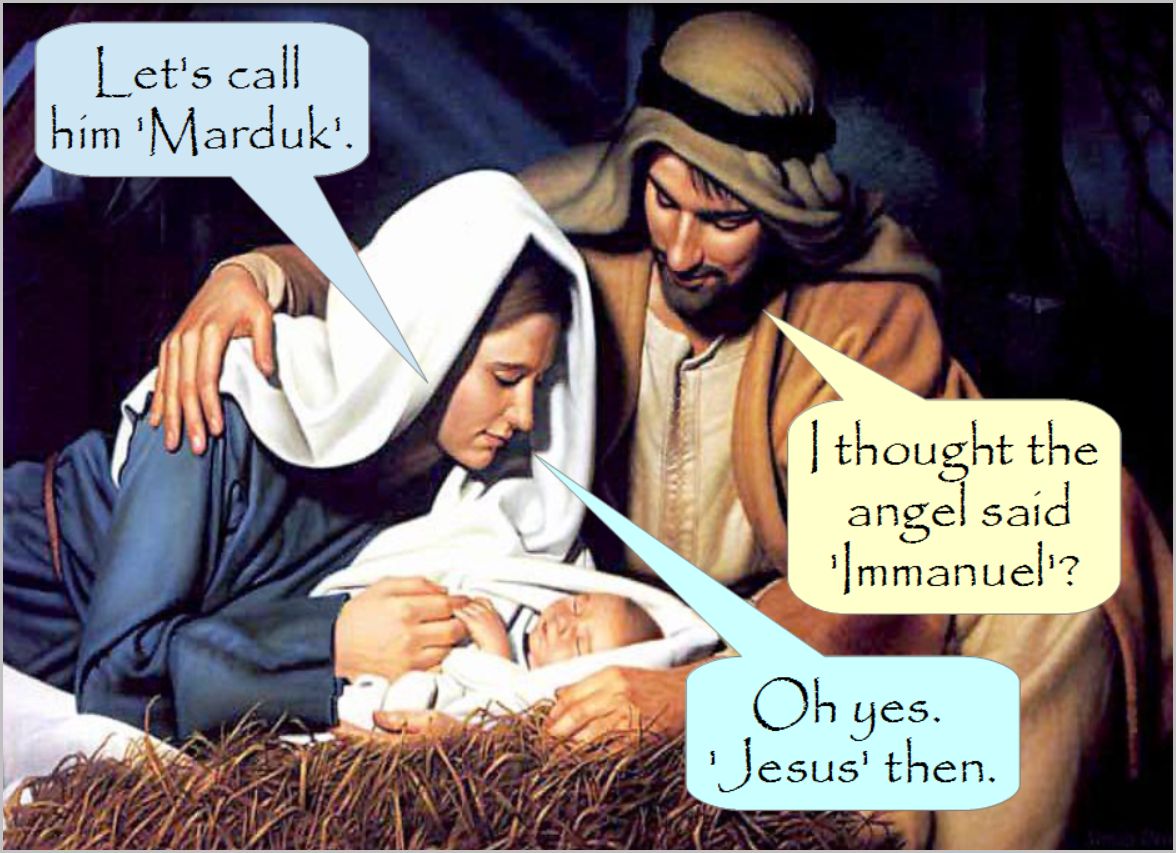
MardukIf human beings were suddenly wiped from the earth through, say, an Ebola pandemic, what would be left of us? What would become of all the things we’ve invented and created? What would happen to language, mathematics, science, literature, medicine, art, agriculture, architecture, democracy, industry, capitalism, civilisation, education, marriage, religion?

They’d all cease, most of them immediately. Remnants of others would survive for a little while before being reclaimed by nature. The surviving flora and fauna, the weather, climates, oceans, land masses would carry on just as before. Indeed, without humans around to abuse it both carelessly and deliberately, the rest of nature would flourish. Reproduction, evolution and the great cycles of life would continue unimpeded.

Which tells us what? That all of our accomplishments and preoccupations, from language and mathematics to marriage and religion are entirely human-made. When we go, they go. And nothing left behind will care. Our religions, all 4,200 of them, will disappear over night and with them their gods; Yahweh, Allah, Vishna will no longer exist, just as Marduk, Anu and Enlil no longer exist.

You’ve never heard of Marduk, Anu and Enlil? Of course not; this particular holy trinity were among the gods of ancient Babylon, a civilisation that existed two thousand years before the Christian God was even thought of. Their worshippers believed in them as enthusiastically as some people now believe in Jesus. For Babylonians, Anu, Enlil and Lord Marduk, the King of the Gods, were just as real, powerful and caring as Christ and Allah are for believers today.

But Enlil, Anu and Marduk have gone. From our vantage point we know they didn’t exist in the first place. They were nothing more than the product of ancient people’s imaginations. That didn’t stop those same people from having real faith in the three of them, praying to them and knowing in their hearts that they were being watched over by them. But as their civilisation fell, the Babylonians discovered that Marduk and company weren’t there to defend and preserve them. When, in 539 BCE, Babylon finally ceased to exist, so too did its mighty gods.

And so will the mighty gods of our own era. Either when a pandemic destroys us or when we destroy ourselves, or even when – as unlikely as it might seem – we come to our senses and abandon belief in made-up things.

However it happens, there will be no repercussions. Yahweh, Christ, Allah and Vishnu will not smite the Earth in their wrath at our abandonment of them. They will, instead, pass silently from history just as Marduk, Anu, Osiris, Zeus and Woden did before them.

If you still cling to human-made deities – and they’re all human-made – why wait? Why not be ahead of the game and let go of them now? Allow your pet god to go gently into that good night. You’ll not miss him, and he certainly won’t miss you. How can he? He’s not real, after all.

 
This post was prompted by Sapiens: A Brief History Of Humankind by Yuval Noah Harari.


Respect?

HebdoI could so easily take offence at this. (The caption reads ‘But who wants the English in Europe?’)

How far should we respect religious beliefs? I would suggest, not at all. The multitude of religions that exist in the world, not least the big five – Christianity, Islam, Buddhism, Hinduism and Judaism – are all built on mythologies that require belief in supernatural beings, highly improbable events and meaningless rituals. There is no evidence these beings exist or have ever existed, no evidence the improbable events ever occurred and none that the rituals lead to results of any sort.

Most religions have their revered teacher, prophet or saviour who died centuries or millennia ago, and about whom stories are told that cannot possibly be true. How can any thinking person respect the idea that one of these figures rose from the dead? Or that another flew to heaven on a winged horse? Or another grew a jewel tree from a toothpick? These stories deserve as much respect as other ancient tales – like the one about the man who killed a one-eyed giant or the dude who returned to life after being hacked to death and eaten. The preposterous stories told by today’s religions are of the same order.

For this reason, as well as many others – not least how religion causes some of its adherents to act and relate to others – religion is not above criticism. Indeed, there is a moral imperative to criticise world views based on far-fetched stories, especially when they cause some who subscribe to them to discriminate against others, advocate murder and  take it upon themselves to carry out executions like the ones we’ve seen in Paris this week. I’ve written before about how, while most religious believers are not themselves extremists, it is moderate believers who sustain the culture responsible for those who are. Fanatics, extremists and terrorists do not spontaneously create themselves; they emerge from mosques, churches, synagogues and temples. As Bill Maher said about Islam this week, ‘when there’s this many bad apples, there’s something wrong with the orchard.’

While some have argued that the magazine Charlie Hebdo provoked Muslim extremists to attack it with its satirical drawings of Muhammed (among many other religious ‘leaders’) it is absurd to suggest that publishing provocative pictures automatically leads to murder, as if the perpetrators have no choice in the matter. Of course they do. Caricatures of the pope have also appeared on the magazine’s cover and, as bizarre as the Catholic church is, it has not responded to these depictions with violence.

There is, in any case, a good argument to be made that offence can’t be given, only taken. While no doubt there are Muslims who don’t find rather poorly drawn, largely unfunny cartoons of Muhammed offensive, there are those who choose to. (Just like I could choose to take offence at the cover above.) But provocation, whatever the context, is no defence and no excuse for the slaughter, violence or incarceration of those with whom we’re offended.

The religious need to grow up and put away childish things; to stop taking offence so readily, insisting they’re being persecuted when they’re not and constantly assuming they and they alone have the right to mete out punishment. Is the god each religion claims for itself so weak and feeble he cannot look after himself, his standards and his reputation?

Well of course he can’t, because he doesn’t exist. Every god there has ever been, from Osiris to Christ, from Zeus to Allah has been a human invention. And if no god exists, then neither do his standards and reputation, nor his prophets and teachers, his Sons and emissaries; they’re all largely made up too. No-one should be punished for failing to respect the figments of primitive people’s imagination. It is beholden on all of us who have indeed put away such childish things, to disregard the sensibilities of those who subscribe to and peddle puerile nonsense and point out as often as we can that not only does the Emperor have no clothes but there’s not even an Emperor. Only then can the world work towards being free from the tyranny of religion.

Simplistic maybe, but the alternative is to continue tolerating the intolerable. And look where that’s getting us.

Idiotic Stuff Jesus Said 9: God knows what you need before you ask him

PrayJesus said: ‘Do not be like non-Jews, for your Father knows what you need before you ask him.’ Matthew 6.8

Prayer has been in the news quite a bit lately. Not, of course because it’s suddenly started working, but because prominent Christians have been pretending, yet again, that it does:

Archbishop of Canterbury, Justin Welby, has been telling us just how important prayer is. He prays for others while he does the ironing.

The pope has been praying for victims of Islamic State.

Churches in Glasgow have been praying for the victims and families involved in last Monday’s terrible accident there.

Bishops in Australia prayed for victims of the Sydney seige.

Christians inherit this futile behaviour and empty posturing from Jesus himself. He believed that talking ‘in secret’ to his god-in-the-sky could actually change things down here on Earth. This God, according to Jesus, knew what his children wanted even before they asked.

His children were not, however, Christians; they were Jews. The phrase I’ve interpreted above as ‘non-Jews’ is ‘Gentiles’, which means exactly that – outsiders who weren’t Jews. These outsiders, Jesus implies, just don’t get prayer. Only the chosen people, the Jews, do. Only they know how to talk to the big Sky Daddy properly and it’s only their needs that he knows about beforehand. He isn’t interested in others, their needs or their prayers.

But if he knows the needs of his chosen before they even ask him, why doesn’t he simply meet those needs? Why does he have to be asked? What sort of perverse and twisted version of a loving father is this, who insists on being asked before he will consider acting? I’m only a fallible and flawed human being but when I know my children’s needs, I don’t wait to be asked to meet them.

Maybe God isn’t really as magic as Jesus seems to think. Maybe he needs time to let things happen by chance so that he can then take the credit. Because there’s absolutely no evidence prayer works. The opposite is the case; there’s plenty of evidence to suggest that the supposed results of prayer are no more likely than if they happened by chance.

As if this weren’t ludicrous enough, many of the examples of prayer we’ve heard about recently are prayers after the event; appeals for the victims and survivors of disasters once the disaster has struck. So did God not know those involved ‘needed’ not to be killed or tortured or bereaved? If he didn’t already know this, then Jesus’ claim is, like so many others he made, utterly worthless. And if God did know, why did he not do anything to prevent the loss of life, the hardship, the devastation? Because he wasn’t asked

It’s likely though that he was asked, by those believers who were caught up in appalling circumstances. So then, why didn’t he act? Why didn’t he meet those needs he knew so much about beforehand?

Perhaps he just doesn’t care or he’s not able. Or, more likely, maybe he doesn’t exist.

And if he doesn’t exist, then Jesus was wrong in everything he said about him. He was wrong to think God was there in Heaven, taking an interest; wrong to think he cared. It also means Jesus certainly wasn’t the son of any such god. Nor was he the human manifestation of a make-believe Sky Daddy on Earth.