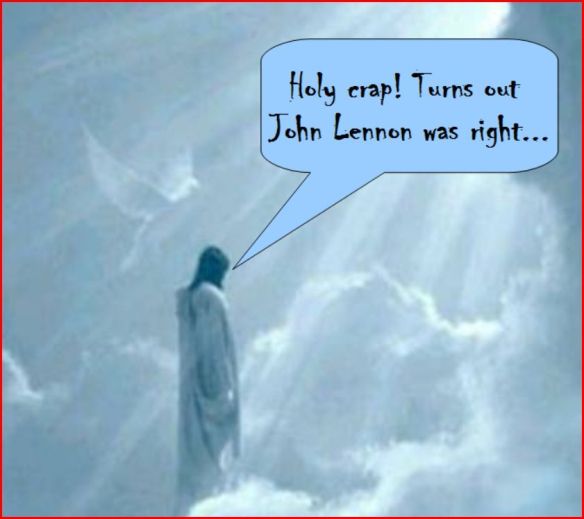
You don’t have to imagine: there is no Heaven

From an Anonymous commenter:

How do you know there is no Heaven or an afterlife? I have no proof Heaven or an afterlife exists either, but where is your proof that they don’t? I don’t think I will ever understand how atheists can be so certain of something that they can’t prove any more than I can understand fundamentalist Christians who say if you don’t accept Jesus Christ as savior you’re doomed to hell. You’ve got something in common. 

And my response:

Thanks for the comment, Anonymous. I’ve copied it here from the old post you added it to.

First, it isn’t up to those of us who question the existence of things like Heaven to ‘prove’ they don’t exist. It’s up to those who claim they do exist to demonstrate that this is the case. A negative proposition such as ‘there is no Heaven’ or ‘there’s no such thing as unicorns’, can’t be ‘proven’ as such, simply because its impossible to present evidence for a no-thing. A positive assertion, however, such as ‘there is a Heaven’, is theoretically demonstrable. But this particular claim never has been. No one has demonstrated where Heaven is (it has to exist somewhere, right?) No-one has ever returned from Heaven with empirical evidence of its existence. No-one has ever survived death to experience Heaven. No evangelical seems to understand that Heaven is exclusively God’s abode and no human will be resurrected into eternal life until the Final Judgement. That’s the Final Judgement Paul and Jesus said was just round the corner but which has never arrived.   

The problem is worse than this, however. There is so little evidence that a god exists, and even less the Christian God (see my previous post, as well as here and here). If there’s no God – and it is highly likely there isn’t – then all contingent beliefs are wiped out: there’s no Heaven, Saviour, Resurrection, Final Judgement, Hell or Eternal Life.

So this is how I know there is no Heaven: it all comes down to probability. The probability there is a Heaven is so infinitesimally small – its highly improbable in fact – that it’s to safe to assume there isn’t one.

Despite first impressions suggesting this view has a lot in common with evangelical belief, I think you’ll find it is actually the opposite. While evangelicals accept on faith that Heaven must exist – because the Bible says so – the fact that its existence is both highly improbable and indemonstrable allows for the 99% certainty that it does not.

Finally, Anonymous, no-one other than mathematicians and lawyers deal in proof. Scientists most certainly don’t: they are concerned with evidence and demonstrating something is or is not the case. You’d do best to drop ‘proof’ from your arguments. Unless you can prove something mathematically, you’re not going to provide or find proof, certainly not when contending with religions. Second, how about giving yourself an online name? Commenting as ‘Anonymous’ suggests you don’t have the courage of your convictions and also adds you to the numerous other Anonymous commenters who pop up on blogs. There’s no way of distinguishing between you.  


Conclusions

So what do we see when we arrange the books of the New Testament in chronological order?

  1. In all probability, Jesus was first experienced in visions experienced by a few Jewish zealots looking for the arrival of the Messiah. His name – Yeshua – is symbolic and means ‘The Lord is Salvation’.

  2. These visions led to ‘revelations’ that convinced these zealots that the Messiah would soon arrive on the Earth to set God’s plans in motion.

  3. A small number of Jews were convinced of the veracity of these claims and sought to spread the message that the Messiah/Jesus was soon to arrive on Earth.

  4. A few years later, a Hellenized Jew who called himself Paul, argued that the Messiah – ‘Christ’ in Greek – had died in the heavenly realm and been raised from the dead by God. His sacrifice, Paul insisted, was a propitiation for human sin, both Jew and Gentile.

  5. Also according to Paul, the Christ’s arrival would trigger the resurrection of the dead, prophesied in Daniel 12:1-3 and Isaiah 26:19-20, the final judgement (Daniel 7:22) and the establishment of God’s kingdom on Earth, governed by God’s Chosen (Daniel 7:27). Regrettably, he drew most of these conclusion from a book, Daniel, now known to be fake.

  6. Paul ‘proved’ that the Messiah-figure he’d seen in his visions really was the Messiah prophesied in Jewish scripture by quoting from them extensively.

  7. Soon after Paul died, the original group of visionaries, who had had their differences with Paul, were all but wiped out when the Romans destroyed Jerusalem.

  8. Around the same time, an unknown cultist took it upon himself to write an allegorical history of the Christ’s activities. He based this allegory on Paul’s teaching about the Christ as well as events from Jewish scripture. He set his story in Galilee some forty years earlier and has his fictional Christ, Jesus, prophesy the arrival on Earth of the real Messiah whom he calls the Son of Man, after Daniel 7:13-14.

  9. Two other cultists set about altering and improving this original history. One re-establishes the Christ’s Jewish credentials, and extending references to and allegorising aspects of Jewish scripture.

  10. A completely imaginary history of the early cult was created by one of these writers, smoothing over the differences between the beliefs of the earliest visionaries and Paul.

  11. Other writers, including some pretending to be the late Paul, continue to write of Jesus the Christ as a celestial saviour.

  12. A fourth history of the Christ was created, this time providing Jesus with a bodily resurrection (contrary to Paul) and discarding some of the cult’s earlier beliefs, the imminence of God’s kingdom on Earth included. The authors of this account imply that dead believers will awaken to new life in heaven (John 14:2)

  13. The idea that the Messiah will arrive imminently was, however, kept alive by other writers. One anticipated the Christ would soon purge the world of evil-doers and bring a holy, bejewelled Jerusalem down to Earth.

  14. Others soon abandoned the idea that any of this would happen soon. The arrival of the Christ was postponed indefinitely.

  15. The notion the Son of Man/Messiah/Jesus had yet to appear was also dropped as the church adopted the allegorical gospels as real history. It began to expel those who disputed the gospels’ veracity and denied that Jesus was the Christ incarnate.

  16. While the term is not used in the New Testament the Christ’s delayed arrival was, from the early second century, thought of as a second coming.

  17. The church, once well established went on to embellish doctrine, adding the Triune God; eternal life in Heaven; the elevation of Mary and the saints; the New Testament as the Word of God and the infallibility of the Bible as a whole. Some of these were, and are, in direct contradiction of the beliefs of the earliest Christians.

  18. Believers today, if they read the New Testament at all, take its traditional order at face value, which distorts the evolution of its ideas. They allow their preachers to smooth over what now appear to be random contradictions (hermeneutics).

  19. Today’s Christians believe primarily in the heavenly Christ, who forgives their sins and guides their lives from Heaven. They also hold on to the belief that he was manifested as a human, and vociferously oppose the idea he was and is only an imagined supernatural being.

  20. At the same time they prioritise Paul’s teaching about him over anything he is made to say in the gospels .

That how I see it anyway. The more time I spend looking at the New Testament books in their correct order, as well as what this reveals about the beliefs of early Christians, the more I’m driven to these conclusions. They’re the only ones that make sense of all that we find in their writings. I realise this is contentious. Mythicism is not widely accepted but it is the only position that explains the recorded facts as we have them. The original Jesus was seen (in the mind of the first visionaries and by many later) as a heavenly Messiah. While the gospels were generally accepted as historical many decades after they were written, they are anomalies in the expression of the early faith. They can only be seen as allegories of the living, dying and rising of a cosmic saviour, a sequence not uncommon in the mythologies of the ancient world.

I recognise too that there may well be other problems with this position, which I’ll get to soon.

The Great Eternal Life Scam

Heathens like me, and you dear reader, are gambling how we’ll spend eternity by rejecting Jesus. We’re turning down everlasting life to live in the mire of our own sin. Or so we’re told by evangelicals and other religious zealots.

So convinced am I that the claims of Christianity are wrong in every respect that I know I’m not gambling anything. Like everyone else who has ever lived, I will not survive my death. This is the nature of death – extinction, obliteration, oblivion. It is absurd to believe it is anything other when we know it is not.

I would not be averse to existence, particularly my own, continuing after death. I’d definitely go for it if that were available; I like being around, all sentient and self-aware and such. This is the sentiment to which Christianity appeals; most people do not want to think their existence is finite and that this often challenging life is really all there is. But life patently does not continue post mortem, except in works of fiction: fantasy, science fiction, the gospels.

Everlasting life is not the only promise Christianity makes, of course. There’s the whole ‘getting right with God’ shtick, forgiveness of sins and Life in all its fullness. Eternal life is the big one though, Christianity’s most miraculous, death-defying special offer.

Those doing the gambling are not atheists or sceptics. It’s Christians themselves doing that, succumbing to the false, utterly worthless promise of life after death. Those fully committed to Christianity spend their lives enslaved to its cultish demands, desperately trying to convince others they should surrender to its preposterous claims.

I value this life too much to squander any more of it on such nonsense. Yes, I did once, but I saw the light and stepped into it. Life is what you make it and needs to be lived before you die. There is zero chance you’ll be able to once it’s over.

Burst the bubble, those of you trapped within it. Your one and only life awaits you here on Earth. The clock is ticking.

Ramifications

I started writing this blog as a way of working out just what it was I’d believed prior to my realisation there was no God. While this ‘revelation’ caused the whole Christian edifice to collapse, I still had a lot of conditioning to deal with. I had been taught over the years that, like every other human being, I was worthless without God/Jesus. I needed first to regain some self-worth.

I had hang-ups too about how I spent my time and money. The cult had assured me that God was obsessively interested in how I used both. Did my use of my time and money further his kingdom? Was I using my time wisely? Tithing? Giving my money to alleviate suffering? I knew buying CDs and comic books didn’t really fit the bill, but I sinfully persisted in spending my hard-earned cash on them, when I had any to spare after taking care of my family and giving to the church and charity. Then the guilt! How could I be so thoughtless, so selfish? I had let God down badly (specially if I’d bought some of the devil’s music.)

The guilt was self-induced of course. I think I have a personality type that is prone to feeling guilty – it’s been the predominant emotion of my life – but the Christianity I encountered exacerbated it. I still struggle with guilt, not over any great ‘sin’ but in terms of how much I help others and whether my use of my money is self-indulgent and wasteful.

Despite now having no truck with the idea of sin (which is a worthless religious concept) I do sometimes catch myself worrying that I’ll be made to suffer in the next life (which doesn’t exist either) for who I am and my ‘lifestyle’ in this world. Completely irrational, I know, but the conditioning runs deep. It hasn’t been fully rooted out yet.

On the plus side, I can now see the Bible for what it is: a collection of stories, those in the so-called New Testament designed, as they declare quite openly, to promote the beliefs of the ancient Jesus-cult.

I realised that in an ocean of myth, legend and invention I had been taught to regard the gospels as an island of historical fact. Yet two of them are prefaced with patent fantasy – the incompatible nativity stories – and conclude with equally incompatible resurrection and ascension narratives. Yet I was expected to trust that everything in between these make-believe beginnings and endings – the miracles, the visions, the speeches, the fulfilled prophecy, the false promises and unlikely new prophecies – were all somehow factual and true.

No longer gullible, I came to see this as a preposterous expectation. Sandwiched between fantasy and illusion the gospels are all myth and legend. It’s pointless to argue, as apologists do – and quite a few sceptical scholars too – that we can discern the real Jesus among the invention:

that we can make something worth considering out of the discrepant resurrection appearances;

that because one or two historical figures are written into the story it must therefore be historical throughout;

that we can sift the factual wheat from the metaphorical chaff;

that there is a kernel to the tales that can be teased out from the fantastical accretions;

that contradictions can be explained (away) and by sleight of hand made compatible;

that somehow believing all of this fantasy material can ensure eternal life.

None of these things can be done, any more than they can with the legendary tales of Romulus, Buddha and King Arthur. Legends, are legends are legends. Stories are stories are stories.

Would I have been happier never to have been a Christian, never to have committed my life to Jesus? Almost certainly. But we are all where we are. Christianity and I have a history. It’s probably left me scarred, and perhaps you too. At least I escaped it to live my life as I needed to, even if I am still working my way through its legacy.

Just suppose…

Let’s imagine that the gospels were all written by eye-witnesses or the associates of eye-witnesses. Let’s suppose that prior to their composition there was a vibrant oral tradition that accurately preserved the Jesus story and his teaching in particular. Let’s suppose that Paul learnt what he knew of Christianity initially from the early believers he persecuted and then, following his miraculous conversion, from his meetings with the disciples. Let’s suppose that the later books of New Testament were written by people who knew Jesus personally or were really by Paul. Let’s suppose that everything in the bible was inspired by God and is truly his word. Let’s imagine that as result of all this, everything predicted and prophesied in the gospels, in Paul’s letters and the later ones by apostles, came to pass.

Because we’d have to imagine this. Even if everything we’ve supposed was true, none of the prophesies, predictions or promises have materialised in reality. Not one. No Son of Man beaming down from heaven while the disciples and Pilate were still alive, (as he promises in Mark 9:1 and Mark 14:62 respectively), no visit from the Messiah while Paul and his acolytes were living (1 Thessalonians 4:17), no final judgement, no Kingdom of heaven on Earth, no Christians performing miracles greater than those attributed to Jesus. Not even any ‘new creations’ imbued with the Holy Spirit (‘by their fruits shall ye know them.’)

Apologists put a lot of effort into explaining away these failures, some even arguing the Kingdom is actually with us now (how incredibly disappointing it is if this is the case!) Most disappointing of all is that no Christian has ever resurrected from the dead. Not Paul, not Peter, Mary Magdalene nor any other early follower, and no-one since: not Martin Luther, Charles Wesley, C. S. Lewis, Billy Graham nor any bishop, minister or evangelist who has ever lived. All have remained resolutely dead, just like everyone else who has ever ‘fallen asleep’ and everyone who will in the future.

However much Christians want to insist the Bible is true, accurate and God-breathed, in the end it simply doesn’t deliver.

No God and the Domino Effect

This a response to Don Camp’s comment on my post The Evil of Christianity, in which he tries to isolate ‘the crux’ of our disagreement about the Faith.

You start, Don, from the assumption that there is a God. I, on the other hand, have considered the evidence and concluded that in all probability there isn’t one. Certainly not the Christian God. There may be a god out there somewhere that has no interest in human beings and their affairs, though I doubt it. As far as we humans are concerned such a deity is as good as non-existent, being entirely hypothetical. If it is out there, it certainly won’t be offended at my saying so.

Once I realised some years ago that a personal God did not exist a number of other things followed (or rather, collapsed):

No God means no Son of God or God Incarnate, no Saviour or Christ.

No God means no resurrection (which Paul makes clear was a work of God).

No God means no Holy Spirit.

No Holy Spirit means no regeneration of individuals to become new creations in God (you only have to look at Christians today to see this is the case.)

No God means no grand Salvation plan.

No God means no Heaven, no Final Judgement, no Kingdom of Heaven of Earth, no Eternal Life.

No God means the universe can’t have been created by him.

No God means no manipulation of evolution, no intervention in human history and no prophecy of things to come.

No God means that the world would be just as we find it: messy, beautiful, dangerous, turbulent, indifferent.

No God means prophecy is man-made and comes to pass at no greater rate than chance allows (i.e. practically zero.)

No God means conversations with ‘him’, revelations from him and visions of him are all imagined, generated by and within the human brain, which works in mysterious ways.

No God means no God-given morality. Morality is, as you say, culturally determined and so may and does change over time. (You can see this in the Bible itself where morality supposedly handed down by God for all time evolves throughout the Old Testament and into the new.)

No God means there is neither Sin nor Righteousness. These are religious concepts. The whole spectrum of human behaviour, from destructive to altruistic, is demonstrated by believers and non-believers alike.

No God means assertions like ‘the issue turns on what I perceive as good for me versus what God declares is good for me’ are illusory. What is good for you is what you have worked out, even if you think God had a hand in it. A supernatural being who doesn’t exist cannot be responsible for your well-being, though your church and the bible undoubtedly contributed to your conditioning.

No God means individuals must work out their own meaning and purpose. Some do, some don’t, as you observe, Don. This is as true of believers as it is for non-believers. Many atheists have managed it, or not, without having it imposed by religion. And despite what you say, Christianity is a religion. It is the epitome of religion.

No God means none of the Abrahamic religions are true and therefore Christianity and its ‘holy’ book, being based on an invalid premise, must be false. Most of the posts on this here blog are about demonstrating this fact.

No God means all gods are man-made, not all gods except one.

The crux of the matter is you believe in God while I see how unlikely it is that there is one. I’d agree with you if I could, Don, but then we’d both be wrong.

Beyond The Grave

A few years ago, a friend of mine was working in his front garden when he spotted what he was sure were a couple of Jehovah’s Witnesses further down the street. He aimed to back inside before they reached his house, from where he could safely ignore them. But he timed it badly and before he knew it, the JWs were upon him.

My friend was under some stress at the time so when they asked him, ‘Wouldn’t you like to live forever?‘ he responded with, ‘Good God, no. This life’s bad enough. Why would I want it to go on forever?’ This took the wind out of their sail though didn’t divert them from their sales pitch for very long.

I’ve been in the same state of mind myself, and maybe you have, when life was so difficult I spent far too much time contemplating whether being dead might not be a better option. Thankfully, I couldn’t really contemplate doing anything about it, and was aware of the effect it would have on my loved ones if I did, but nonetheless I spent too much time considering – desiring even – my own non-existence.

I was pretty sure this was what awaited after death. I hadn’t, by this stage of my life, the conviction of the Jehovah’s Witnesses and mainstream Christians that a better life, one that would last forever, lay beyond this one. Instead, I made radical changes to my life in the here and now, to lift myself out of the slough of despond in which I found myself.

I love life now. It isn’t without its difficulties, not least the physical problems that come with older age, but I enjoy it to the full (apart from supermarket shopping). Having found my pearl of great price, I hope life will last for many years yet. I can’t guarantee it will, of course, so I make the most of every moment, surrounded by people I love and who love me.

Would I like my life to go on forever? Certainly, but I know it won’t. There is simply no evidence life continues after death. Assurances that it does in religious texts is no evidence at all. Even if it were, the type of eternal life suggested by the Bible, worshipping a needy, despotic God for evermore, is not the way I’d like to spend eternity.

Ask Christians how they know they will and the best that can come up with is that the Bible tells them so or that Jesus promises they will (which amounts to the same thing.) Ask them where this everlasting life will be lived and you’ll get one of two answers: in heaven or here on a restored Earth, once Jesus ‘returns’. The earliest writings in the New Testament support the here-on-Earth scenario. The later ones – perhaps because their authors had begun to realise Jesus wasn’t coming back any time soon – start, like John 14:2, to hint at a celestial existence.

No Christian – no non-believer either – has survived death to face eternal bliss or eternal damnation. Some will tell you that rising from the dead happens in an ethereal way immediately following death. The soul (or whatever) is resurrected either to be reunited with God outside of time and space or thrown to the demons in hell. The biblically savvy, like the JWs, will tell you the resurrection will not occur until Jesus’ return at some point in the future. Significantly, both expectations occur off-stage: the first in a undemonstrable plane of existence, the second in a future that never arrives. Both are wishful thinking, scenarios dreamt up by those frightened of their own non-existence.

The offer of everlasting life is one of the New Testament’s most pernicious lies. The idea is not to be found in the Jewish scriptures that make up the Christian Old Testament. It is a later development, dreamt up by extremists who convinced themselves, on the basis of a few visions, that God would ensure their continued survival, just as he had Jesus’s.

If this isn’t how the promise of living forever came about, then what is the evidence there is an existence beyond death? Empty assurances by first and second century cultists are not it.

  • Show me someone other than Jesus – whose ‘resurrection’ is metaphorical at best – who has risen from the dead.
  • Show me evidence that ordinary human Christians have already gone on to eternal life.
  • Show me, if you don’t subscribe to this view of immortality, the souls who rest with God awaiting a future resurrection (1 Thessalonians 4:13-18; Revelation 6:9-11).
  • Show me just one human, Christian or otherwise, who has gone on beyond death.
  • Prove that the promise of eternal life is real.

Real Christianity v Catholicism

I visited a Catholic cathedral in Santa Cruz, Tenerife, while on my latest adventure. Not, I hasten to add, as a worshipper but as a tourist. One of the Canary Islands, Tenerife is a Spanish territory with a long association with Catholicism. Its name means Holy Cross, reflecting its history and the pervasiveness of the church. The cathedral’s altar can be seen in the picture above, highly ornate and completely over the top, with a statue of Mary, the Holy Mother, as its centrepiece. .Her son, you’ll note, plays only a bit part in the picture above her.

Real Christians™ of course don’t regard Catholics as true Christians. They point to their reliance on the Pope, when Jesus himself says his followers should call no-one Father apart from God; the army of dead saints that intercedes in heaven when all people really need is Jesus; the need to confess sins to a priest and the worship of Mary as the immaculately conceived ‘Mother of God’, who works miracles on their behalf.

People – Catholics – who believe these things can never be part of the club. ‘Their ideas are as ridiculous as they are unbiblical. No-one in their right mind,’ Real Christians™ say, ‘should believe such fanciful stuff. Stick resolutely to what we know to be true: the resurrection of a dead man; the Virgin birth and the promise of eternal life. These things are biblical and as such we can know and trust them. Not rubbish about saints in… erm, heaven living forever, having to ask for our sins to be forgiven and thinking Mary was conceived free from the scourge of sin.’

It seems to me that it’s only a short hop from believing one lot of far-fetched rubbish to believing still more. Maybe the Catholic stuff isn’t strictly biblical (though at a stretch it could be said to have been drawn from the make-believe found there) but then there’s nothing particularly special, plausible or reasonable about that which has found its way into God’s Word. Just because something is in there doesn’t make it true. Those who invented Jesus’ Virgin birth, his resurrection and the promise of everlasting life were making it all up, just as those who, further down the line, created the phantasmagoria that is Catholicism.

Santa Cruz is nice though.


What Happens Before We Die (according to me)


Did you ever go to a party when you were a child and your parent told you it was time to leave before you were ready? That’s how I feel about death. I’m enjoying the party too much to want to leave. Although my ‘parent’ hasn’t told me it’s time to go just yet, I know they will before I want to. I can’t see me ever being ready really, though perhaps whatever cruelty nature visits upon my body and mind in years to come will change my mind about that. But as things stand, despite my fibromyalgia (a constant painful companion) and the levels of anxiety I allow myself to feel over trivial matters, I really have too much to live for. My partner Dennis and the adventures we have together; my family with my lovely grandchildren; my friends with whom I spend many good times; the many, many simple pleasures of life; everything I still want to do and try.

So, as the days, months and years roll by at an alarming rate – there’s definitely more of life behind me than there is front of me – it’s these things that matter in my life. 

All of this might suggest I’m afraid of dying. While I doubt the process of dying will be much fun, having so much to live for – enjoying the now – dispels, perversely, the fear of death itself. I’ll face it when I get to it, raging, I hope, against the dying of light, throwing a shameful tantrum because the party will go on without me. I’ll die, though, in the knowledge I actually got to it when so many didn’t. I’ll have enjoyed it too, for the most part, with a only a few bad times, fewer regrets and many more memories.

As Christians often tell those of us who are delusion-free, I am without hope. Of course I have hope – in continued days and achievable happiness – but none that there’s existence beyond death. I am confident there isn’t. Consciousness is completely dependent on the brain; when my brain dies, so do I. That will be that. The fantasy promoted by the New Testament, that there’ll be eternal life in a new body, is nothing but hopeless wishful thinking, that in spite of overwhelming evidence we go on. There is instead serenity and purpose in accepting the reality of death. It’s part of the deal, after all.

So let’s all eat, drink and be merry, as Ecclesiastes says. Enjoy life and help others, where we can, to enjoy theirs.

____________________________________________________

Dennis and I will be on one of our adventures when next I’m due to post. While I’ll set WordPress to publish it, I can guarantee it won’t. If I can do it manually (depends on whether I have a signal) I will. Otherwise I will see you on my return.

A Funny Thing Happened On The Way To The Forum

So I’m saved now.

Saved? From what?

My sins.

Your sins. Right. How’d this happen then?

My friend Marcus told me about a new Saviour.

And how did Marcus know about a new Saviour?

Gaius told him.

And Gaius?

His neighbour Livia told him.

And where’d she hear it?

She said she was told it by a travelling preacher.

Well, travelling preachers are always reliable, so sure.

Paûlos I think she said he was called. Anyway, Livia heard him talking about the new Saviour in the forum and she told Gaius, Gaius told Marcus and he told me.

Right. So what did this Paûlos say?

That he’d had a vision or something and had seen this new Saviour in his vision. I think he said he was called Iesous. Something like that.

So a Jewish Saviour then. I take it this Paûlos was Jewish?

I don’t think Livia said.

So what’s a Jewish Saviour to you? Or Livia and Gaius and Marcus for that matter?

Well, that’s the great thing. Marcus said that Gaius said that Livia said that Paûlos said that this particular Jewish Saviour is for everyone, not just Jews.

And Paûlos worked this out from his vision, did he?

Yes. Iesous told him all about it.

In his vision.

Yeah. He told Paûlos that anyone who wanted to could ask him to save them from their sins. So Livia did, and then when she told Gaius, he did too, and then Marcus.

So, Paûlos. He ever meet this Iesous? In the flesh, I mean.

Oh, I don’t think so. Paûlos didn’t need to, you see. Iesous talked to him from Heaven. He didn’t need to meet him.

He say whether he’d met anyone who had actually met him?

No. He knew of some fellas who’d seen Iesous same as him, in marvellous visions, but he said he didn’t need to meet them either. Like I said, Iesous the Saviour spoke to Paûlos direct. You don’t need any more than that. I’m hoping he’ll speak direct to me before long.

So, how’d you know this Iesous existed if nobody knows anyone who’s seen him in the flesh?

I told you, Paûlos saw him right there in his head and Iesous told him all he needed to know. The Saviour said that when he comes down from the sky, which he will real soon, those of us he’s saved will live with him forever, right here on Earth.

Live forever, you say?

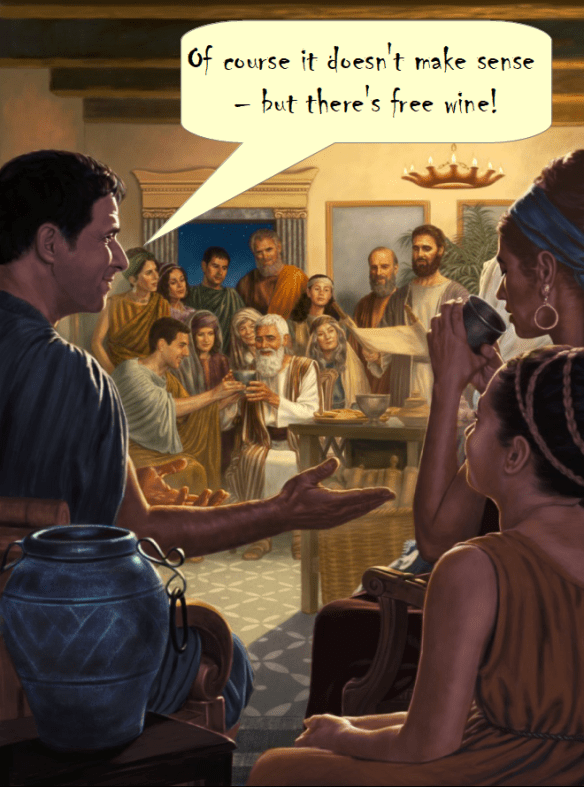
Sure. And there’s free wine while we wait.

Free wine? Why didn’t you say? Where do I sign up?